

Note: This article contains affiliate links. If you click on these links and make a purchase, I may earn a small commission at no extra cost to you. This helps support my research and content. Read my full affiliate disclosure here.
If ants are leaving mounds across your yard or tunneling through your turf, choosing the right lawn ant killer matters for both control and lawn health. The wrong treatment can damage grass, harm pollinators, or fail to reach the colony. This guide looks at a short list of seven top lawn ant killers suited to common yard situations, from small front lawns to large grassy areas. We evaluate products based on how well they eliminate colonies, how they affect turf and non-target organisms, and how easy they are to apply. Read on to compare the best options for fast knockdown, long-term colony suppression, and safe everyday use in home lawns.
Top Picks at a Glance
| Best Overall The best all-around choice for most situations | Spectracide Triazicide Insect Killer for Lawns & Landscapes, 32 oz |  |
| Best Quality Built to a higher standard if you want something more solid | Talstar One Insecticide Concentrate, 1 Gallon (Bifenthrin 7.9%) |  |
| Best Value The sweet spot between price and what you get | Ortho BugClear Lawn Insect Killer, 10 lb. granules |  |
| Best Budget The cheapest option that still gets the job done reliably | Amdro Ant Killer for Outdoor Home Perimeter, 12 oz |  |
| Highest Rated A top-rated pick with lots of positive feedback | Ortho Fire Ant Killer Mound Treatment, 3 lb |  |
| Most Popular A crowd favorite that many people choose with confidence | TERRO Ant Killer Plus Granules, 3 lb Shaker Bag |  |
| Best Seller A high-volume bestseller chosen again and again | Ortho Home Defense Insect Killer for Indoor & Perimeter, 1.33 gal with Comfort Wand |  |
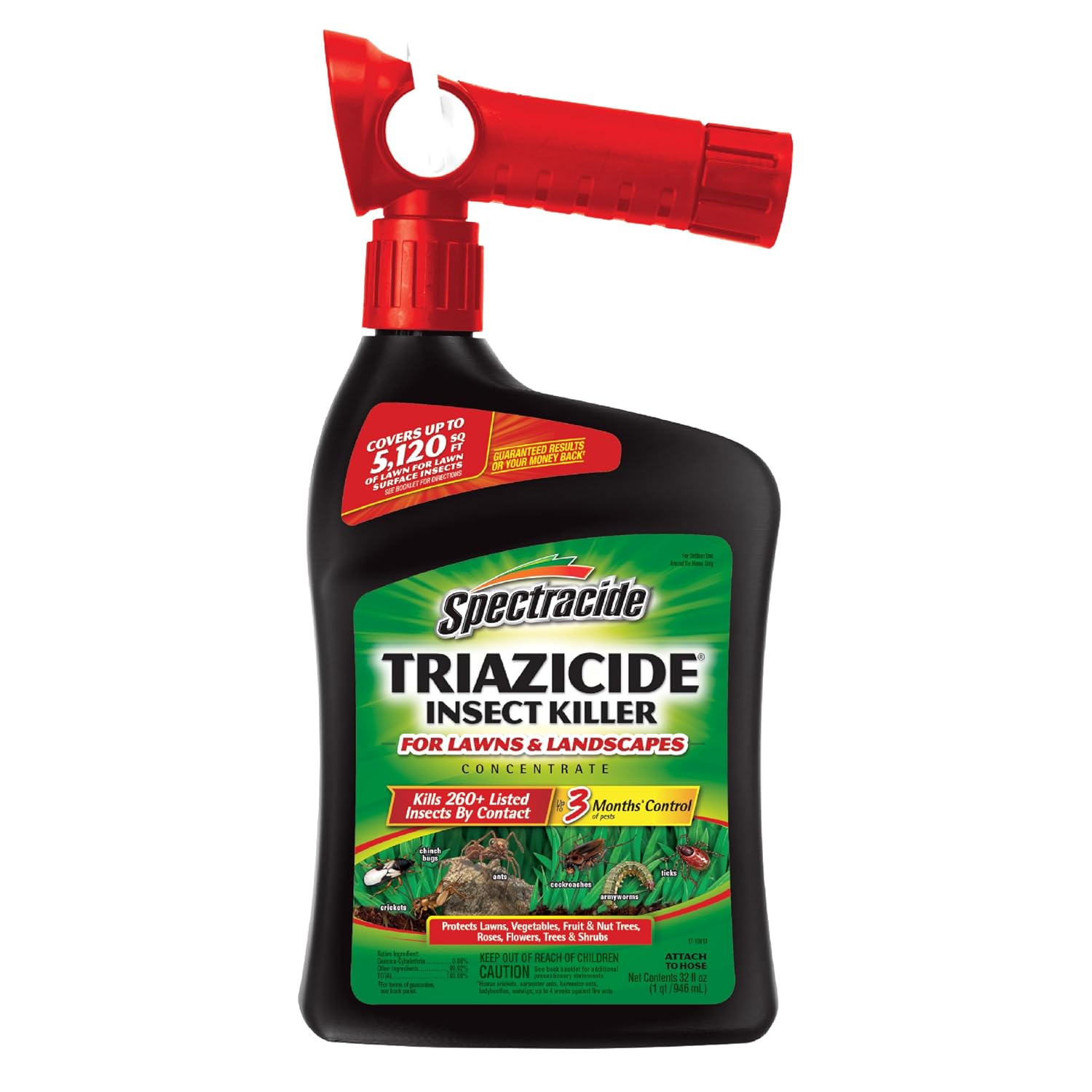
Spectracide Triazicide Insect Killer for Lawns & Landscapes, 32 oz
| Unit Count | 32 Ounce |
|---|---|
| Item Form | Spray concentrate |
| Target Species | Insects |
| Active Ingredients | Gamma-Cyhalothrin (0.08%) |
| Coverage claim | Manufacturer states up to 6,400 sq ft (mix rates vary) |
Spectracide Triazicide is a concentrate designed to be mixed with water and applied with a tank or hose-end sprayer to protect lawns, flower beds, trees and shrubs from more than 260 listed insects. Typical use is a preventive or early-treatment application for surface pests like ants, fleas and ticks and for soil pests such as grubs; it can also be used around vegetables and roses when label directions are followed. Notable features include a ready-to-mix concentrate that covers large areas, labeled directions for treating ant mounds and lawn pests, and a formula the manufacturer says is non-staining when used as directed. Practical benefits are broad-spectrum control and multi-month protection for treated areas, plus flexibility to treat beds, turf and individual mounds. Important limitations are safety and environmental cautions: the product is highly toxic to fish and bees and requires careful application to avoid runoff or drift, and it must be handled according to the label to protect people and pets. It is a powerful option for routine lawn pest control but demands cautious, label‑driven use.
Best for: Gardeners and homeowners who want a broad‑spectrum, professional-style insect control product for routine lawn and landscape pest management and who follow label safety directions.
Less Ideal for: People who need an organic or pollinator-safe solution or who cannot commit to the safety precautions required for concentrated pesticide use.
- Concentrate covers large areas when mixed, reducing number of refills
- Kills a very wide range of listed surface and soil insects including ants, fleas, ticks and Japanese beetles
- Includes specific directions for treating fire ant mounds and lawn-focused pests
- Can be applied with common garden sprayers or hose-end applicators
- Manufacturer notes non-staining when used as directed
- Highly toxic to aquatic life and bees so sensitive sites must be avoided
- Requires careful mixing and application per label to avoid harm to people, pets or non-target plants
Verdict: Choose this concentrate when you need broad, multi‑month control of ants and other lawn pests and are prepared to apply a conventional pesticide safely.
Talstar One Insecticide Concentrate, 1 Gallon (Bifenthrin 7.9%)

| Active ingredient | Bifenthrin 7.9% |
|---|---|
| Formulation | Concentrate, water-based |
| Primary uses | Perimeter, structural cracks, lawns, ornamentals |
| Coverage | Designed for large properties and multiple treatments |
Talstar One is a professional-strength bifenthrin concentrate designed for treating lawns, perimeters and structural cracks to suppress ants and many other nuisance pests. Mixable with water, the gallon concentrate is intended for perimeter barrier sprays around foundations, doors and eaves as well as spot treatments on lawns, shrubs and ornamentals when used according to the label. Notable features include a water-based, low-odor formula that dries clear and delivers residual control so treatments last longer between applications. For performance-minded users this product offers concentrated coverage that can treat large yards or multiple structures without frequent reapplication. Important limitations are that it is a synthetic pesticide requiring careful handling and strict adherence to label directions, and it targets a broad range of insects rather than being a species-specific bait solution for ants. It is best used by homeowners comfortable mixing concentrates or by professionals seeking a reliable perimeter and landscape treatment option.
Best for: Buyers who prioritize reliable, long-lasting pest control for lawns and perimeter protection and who are comfortable mixing and applying a professional-grade concentrate.
Less Ideal for: Casual users who want ready-to-use granular baits or non-chemical options, or those unwilling to follow pesticide safety instructions.
- Broad-spectrum control for 75+ listed pests including ants, spiders, fleas and mosquitoes
- Concentrated formula stretches a gallon into many treatments for large properties or repeat seasonal use
- Water-based, low-odor formula that dries clear and is suitable for visible outdoor living spaces
- Works for both perimeter/structural applications and spot treatments on lawns and ornamentals
- Contains bifenthrin and must be mixed and applied following label safety precautions
- Not a species-specific ant bait so it may not eliminate deeply nested colonies without integrated tactics
Verdict: Choose Talstar One when you want a concentrated, low-odor bifenthrin product that delivers professional-strength, long-lasting perimeter and lawn pest control.
Ortho BugClear Lawn Insect Killer, 10 lb. granules

| Unit Count | 160 Ounce |
|---|---|
| Item Form | Granules |
| Target Species | Insects |
| Coverage | Up to 16,500 sq ft |
Ortho BugClear Lawn Insect Killer is a granular treatment intended for broad lawn and landscape pest control. You apply it with a compatible broadcast spreader (for example a Scotts spreader), then water the lawn to activate the granules. The formula kills target pests on contact and is labeled to control ants, ticks, fleas, armyworms, grubs and other listed insects, with up to six months residual control for most ants and about three months for other pests. Its practical strengths are fast action and long-lasting coverage for mid-size to large yards—one 10 lb. bag covers up to 16,500 sq ft. The product is suitable for use on lawns, around home perimeters, in flower beds, on ornamental plants and on certain listed vegetables when used per label. Limitations to expect are the need for proper spreader calibration and immediate watering after application for activation, and exclusions for some ant species and fire ants which it does not rapidly control. Follow label directions for timing, re-entry, and application around edible plants.
Best for: Homeowners who prioritize efficient, long‑lasting pest control across medium to large lawns and want a granular product they can apply with a standard spreader.
Less Ideal for: People who need immediate control of fire ant mounds or those who prefer non-chemical or spot-only treatments for small turf areas.
- Targets a broad list of lawn pests including ants, ticks, fleas, armyworms and grubs.
- Provides long residual control up to 6 months for most ants and about 3 months for other listed pests.
- Covers a large area from a single 10 lb. bag (up to 16,500 sq ft).
- Easy to apply with a standard broadcast spreader and activates after watering.
- Does not provide fast control for fire ants and excludes certain ant species from its 6-month claim.
- Requires correct spreader settings and prompt watering to be effective.
Verdict: Choose this granular Ortho formula if you want one application to protect a medium to large lawn from a wide range of common pests with months-long residual control.
Amdro Ant Killer for Outdoor Home Perimeter, 12 oz

| Item Form | Granules |
|---|---|
| Target Species | Ant |
| Unit Count | 12 Ounce |
| Liquid Volume | 12 fluid ounces |
This granular bait is meant to be applied as a 1-foot band around the outside perimeter of a house to reduce ant pressure before ants enter your home. Foraging workers take the granules back to the colony where the bait is shared, which can eliminate mounds and reduce visible ants within a week. The formula claims to target around 25 common ant species and the product remains active for up to three months, making it a low-effort option for seasonal use. Application is simple — shake granules across lawns, landscaped beds, and foundation edges during cooler parts of the day and avoid wet conditions or upcoming rain. The practical benefits are easy setup, infrequent reapplication, and compatibility with ornamental garden areas. Important limitations are that it is an outdoor perimeter treatment only and effectiveness depends on correct placement and ant activity; wet turf, very cold temperatures, or immediate rain will reduce performance.
Best for: Homeowners who want an inexpensive, low-effort seasonal perimeter treatment to reduce ant pressure around lawns and landscaped beds before ants move indoors.
Less Ideal for: People needing immediate indoor ant elimination or year-round continuous control should consider indoor baits or integrated pest management programs instead.
- Targets a wide range of common outdoor ant species
- Lasts up to three months per application when applied correctly
- Easy shake-on application for foundation, lawn, and landscaped areas
- Worker ants carry bait back to the colony for colony-level control
- Only formulated for outdoor perimeter use and not for indoor infestations
- Performance is reduced on wet ground or when rain is expected within 24 hours
Verdict: Amdro provides an affordable, easy-to-apply outdoor perimeter bait that reduces ant colonies and protects lawns and foundations with minimal upkeep.
Ortho Fire Ant Killer Mound Treatment, 3 lb

| Item Form | Granules |
|---|---|
| Target Species | Insects |
| Item Type Name | Mound Treatment |
Ortho Fire Ant Killer Mound Treatment is a 3 lb granular product designed to kill active fire ant mounds and the queen with fast results. You apply about 2/3 cup over each mound and the surrounding 3-foot area, then drench with roughly 2 gallons of water to activate the granules. It is intended for outdoor use on residential lawns and around ornamentals and flower beds and works best when temperatures are between 65°F and 80°F or during cooler parts of the day. The label claims colonies begin to die within 15 minutes and the queen is eliminated within about 12 hours, which makes it useful when you want a quick, targeted response to visible mounds. Important limitations: do not use on vegetables, avoid applying in rain, and keep people and pets out of treated areas until dry. The product requires following specific dosing and watering steps for safe and effective results, so it suits homeowners who prefer a reliable, instruction-driven solution rather than a broadcast preventive program.
Best for: Homeowners who want a dependable, instruction-driven product to remove visible fire ant mounds quickly and restore usable lawn areas without hiring a pro.
Less Ideal for: Gardeners who need a broadcast long-term prevention program for whole-yard protection or those treating edible vegetable beds should consider other options.
- Fast acting with reported mound kill starting in about 15 minutes
- Formulated to kill the queen and collapse the entire colony
- Clear, simple application steps for spot treatment of visible mounds
- Suitable for use on lawns and around ornamentals when used as directed
- Must be watered in and kept dry until area dries, which restricts use in rainy conditions
- Not safe for use on vegetable beds
Verdict: A fast, reliable spot-treatment granule that kills fire ant mounds and the queen when used exactly as directed.
TERRO Ant Killer Plus Granules, 3 lb Shaker Bag

| Item Form | Granules |
|---|---|
| Target Species | Insects |
| Active Ingredients | Lambda-cyhalothri (0.04%) |
| Specification Met | Epa Standards |
TERRO Ant Killer Plus is an outdoor granular insecticide designed for perimeter, lawn and spot treatments to control ants, fire ants, roaches, fleas and several other listed pests. The product comes in a resealable shaker bag that makes hand-spreading simple without a spreader; you apply a 3 to 10 foot band along foundations, scatter on lawns, or sprinkle directly on ant hills and then water the granules in. Its active ingredient, lambda-cyhalothrin at 0.04%, is intended to deliver quick knockdown—claims state control within 24 hours—while leaving a short residual to reduce re-infestation. Practical benefits include straightforward application, clear mound-specific instructions for fire ants, and guidance to protect aquatic areas and pets by keeping treated zones dry until watered in. Limitations to consider are the need to follow distance and water restrictions near waterways, the requirement to water in for effectiveness which can be fiddly for spot treatments, and that it is for outdoor use only and not suitable for edible gardens or aquatic settings.
Best for: Homeowners who want a proven, easy-to-apply outdoor granule for quickly reducing lawn and perimeter ant activity and who prioritize product guidance and social proof when choosing a treatment.
Less Ideal for: People needing insect control for edible gardens, indoor infestations, or properties with ponds or streams within restricted setback distances should consider other options.
- Resealable shaker bag allows easy hand application without a spreader
- Fast-acting formula that claims control within 24 hours and provides residual control
- Clear, specific directions for perimeter treatments, ant hills, and fire ant mounds
- Instructions include safety guidance to reduce risk to children, pets, and aquatic life
- Contains a synthetic pyrethroid so users must avoid application near water and edible crops
- Requires watering in after application which can be inconvenient for some spot treatments
Verdict: A straightforward, resealable granule treatment that delivers fast perimeter and mound control for homeowners wanting a quick, proven solution for lawn ants.
Ortho Home Defense Insect Killer for Indoor & Perimeter, 1.33 gal with Comfort Wand

| Unit Count | 170.24 Fluid Ounces |
|---|---|
| Item Form | Spray |
| Target Species | Insects |
| Liquid Volume | 1.33 gallons |
| Active Ingredients | Bifenthrin 0.05%, Zeta-Cypermethrin 0.0125% |
Ortho Home Defense is a ready-to-use liquid spray formulated to kill a wide range of household and perimeter insects and to create a month-long barrier when applied correctly. It comes in a 1.33 gallon container with a battery-powered Comfort Wand that delivers continuous spray for easy, less-fatiguing application to foundation perimeters, patios, decks and indoor entry points. The formula lists bifenthrin and zeta-cypermethrin as active ingredients and is designed to dry clear with no fumes, making re-entry after drying straightforward. Typical use is a preventative sweep along the base of the house or targeted spot treatments where ants or roaches enter; indoors apply a narrow band on non-porous surfaces and outdoors a wider band to the foundation. Practical benefits include long-lasting residual control for ants, roaches and spiders and a convenient applicator that reduces bending and pumping. Important limitations are that it is for surfaces and perimeter use only, requires following safety directions around children and pets, and it is a chemical control that should be part of an integrated approach to persistent infestations.
Best for: Buyers who prioritize low-effort, reliable perimeter protection and want a ready-to-use spray they can apply themselves without specialized equipment.
Less Ideal for: People seeking organic or non-chemical ant control, those who need treatment for underground colony elimination, or users who prefer granular or bait-only solutions.
- Ready-to-use with battery-powered Comfort Wand for continuous spray and easier application
- Provides up to 12 months of barrier protection against ants, roaches and spiders on non-porous indoor surfaces
- Kills a broad list of common household and perimeter insects on contact
- Dries clear with low odor so treated areas can be re-entered once dry
- Contains synthetic pyrethroid active ingredients, so precautions around children, pets and beneficial insects are necessary
- Not intended for use on porous surfaces or as a soil drench for underground nests
Verdict: A convenient, ready-to-use spray with a comfort wand that delivers long-lasting perimeter protection against common ants and other household pests.
Choosing the Right Lawn Ant Killer: Key Factors to Consider
Mode of Action and Colony Targeting
How a product works determines whether it kills only foraging ants or reaches the queen and entire colony. Baits that carry a slow-acting active ingredient back to the nest can suppress colonies more permanently because worker ants distribute the material among nestmates. Contact sprays and drenches often knock down visible workers quickly but may not eliminate the queen unless the product penetrates the nest. Understanding mode of action helps match a product to your control goal, whether that is rapid reduction of surface activity or long-term colony suppression.
Turf Safety and Timing of Application
Some active ingredients can stress or scorch turf if applied in hot weather or at incorrect rates. Granular formulations and labeled liquid treatments are tested for lawn use, but even those can cause damage when applied over-seedings, newly sodded areas, or during drought. Timing applications for cooler parts of the day and following label guidance on watering and mowing reduces risk. Also consider whether the product requires irrigation to activate or to move the active ingredient into the nest, and how soon after treatment you should avoid foot traffic or mowing.
Environmental and Non-Target Risks
Protecting beneficial insects, pets, and nearby water features is a practical concern for most homeowners. Some treatments are formulated to minimize risk to pollinators when used properly on turf, while others carry higher toxicity or require strict buffer zones. Read label directions on reentry intervals, pet-safe dry times, and restrictions near ponds or storm drains. Choosing a product with lower non-target risk may mean sacrificing a bit of speed, so weigh immediate control versus broader environmental safety.
Application Method and Frequency
Different formats-granules, broadcast baits, mound-drenches, or liquid sprays-fit different yard sizes and user preferences. Granules and broadcast baits are convenient for large areas but may require repeat applications to catch new foragers. Mound treatments deliver concentrated control to visible nests and often need less product per mound. Consider how comfortable you are handling concentrated liquids versus easy-spread granules, and how often you are willing to retreat. Ease of application influences whether the product will be used correctly and consistently.
Residual Activity and Reinfestation Risk
Residual activity describes how long a product continues to affect ants after application. Longer residuals reduce the chance of rapid reinfestation but can increase non-target exposure if not applied carefully. Short-residual knockdown products can be useful for immediate relief before follow-up with a colony-targeting bait. Think about whether you need season-long suppression or targeted mound control, and choose a product whose residual profile matches that need.
Label Clarity and Safety Instructions
Clear label instructions ensure you apply the product effectively and safely. Look for guidance on application rates per square foot, how to treat multiple mounds, required PPE, watering or irrigation steps, and reentry times for pets and children. A product with detailed lawn-specific instructions reduces guesswork and the risk of misuse that can harm turf or non-target organisms. Labels that describe when not to apply are especially valuable for avoiding damage during heat or drought.
When to Treat Mounds Versus Use Area Treatments
Visible mounds are easy to spot but are not the whole story. Treating individual mounds with a directed mound drench or granular mound treatment works well when colonies are localized and you can find the nest entrance. For widespread surface activity across a large lawn, broadcast baits or perimeter applications will reach more foragers and help intercept workers returning to multiple nests.
- Use mound treatments for isolated colonies and small yards.
- Use broadcast baits for diffuse infestations across large lawns.
- Combine methods: a mound drench for big mounds plus a bait for background suppression.
Safety Steps for Pets and Children
Follow product reentry times and keep pets off treated areas until surfaces are dry or as the label specifies. When applying granular products, store unused product securely and avoid scattering near play areas. For liquids, wear recommended gloves and avoid contact with treated grass until it has dried or been irrigated per label directions.
- Read and follow reentry intervals closely.
- Keep pets and toys away from recently treated spots.
- Rinse hands and equipment after mixing or applying liquid concentrates.
Integrating Lawn Care Practices to Reduce Ant Pressure
Good turf management reduces conditions that favor ant activity. Aeration and proper irrigation limit bare patches ants use for nesting. Repairing thin areas with appropriate seed or sod removes easy nesting sites and reduces visible mounding. Maintaining a clean edge between beds and lawn can also discourage ants from moving between landscaped areas and turf.
- Fill lawn bare spots and repair damaged turf promptly.
- Avoid overwatering that creates soft soil favored by some ant species.
- Keep garden debris and woodpiles away from lawn edges.
Protecting Pollinators While Treating Turf
Most lawn applications are less attractive to pollinators than flowering beds, but bees can forage on clover or dandelions in the turf. Avoid treating lawns during peak bloom of flowering weeds and apply products when bees are least active, typically early morning or late evening. Use targeted mound treatments rather than broad broadcast sprays when pollinator exposure is a concern.
- Delay treatment if lawn has many flowering weeds present.
- Prefer targeted treatments to reduce off-target exposure.
- Follow label restrictions regarding flowering plants and pollinator safety.
Dealing With Tough or Recurring Infestations
Recurring ant problems often reflect multiple nests or species that forage widely. Rotate treatment approaches between baits and targeted mound controls to reach different parts of the colony lifecycle. Recheck treated areas weekly and retreat visible mounds according to label intervals until surface activity subsides for several weeks.
- Inspect lawns after rain and irrigation; activity can spike afterward.
- Alternate bait types if ants stop accepting a single bait.
- Record treatment dates and outcomes to inform future timing.
How We Chose the Best Lawn Ant Killer
We vetted options that are formulated specifically for use on lawns and grassy areas and excluded products intended only for indoor use, garden beds, or structural perimeter treatments. Our editorial filters favored treatments that address entire ant colonies rather than just surface workers, and that offer application methods compatible with typical lawn care routines. Key evaluation criteria included colony elimination effectiveness, turf safety and phytotoxicity risk, active ingredient mode of action and residual activity, application practicality for homeowners, and environmental impact including risk to pollinators, pets, and water. We also considered label clarity and instructions for treating mounds, broadcast applications, and reinfestation prevention. Excluded from consideration were generic home insect sprays, granular fertilizers with incidental activity, and products lacking clear lawn-use instructions. The final shortlist emphasizes options that balance rapid reduction of visible mounds with follow-up control that targets the nest, plus clear guidance to protect turf and non-target organisms.
FAQ
How long after applying a lawn ant killer will I see fewer ants?
Many contact treatments reduce visible ants within hours, but colony elimination can take days to weeks depending on whether the product reached the queen. Baits often show slower initial decline while foragers carry material back to the nest, then produce a steeper drop in activity.
Are granular products safer for lawns than liquid drenches?
Granules formulated for lawn use are generally designed to be turf-safe when applied at label rates, but improper application or heavy overlaps can still stress grass. Liquid drenches concentrated on mounds can be effective with minimal turf exposure when applied carefully. Always follow label guidance on rates and timing.
Can I apply lawn ant treatments during hot, dry weather?
Extreme heat and drought increase the risk of turf damage from some treatments. Labels often advise avoiding application during heat waves or watering restrictions. When in doubt, apply in cooler parts of the day or wait for milder conditions and follow any irrigation instructions on the product label.
Will treating ant mounds attract more ants from neighboring yards?
Treating visible mounds reduces local colony activity but may temporarily increase surface foragers as workers respond to disturbance. Long-term attraction from neighbors is usually related to untreated adjacent colonies rather than the treatment itself. Coordinated neighborhood efforts often work best for large shared turf areas.
How often should I retreat an area if ants come back?
Retreatment intervals depend on the product and label instructions. For baits, repeat applications may be needed when foraging declines or after heavy rain. For mound treatments, retreat only if activity returns at the same nest and follow label limits on frequency.
Final Verdict
Choose a lawn ant killer that matches the size of the infestation and your tolerance for environmental risk. For isolated mounds, targeted mound treatments deliver concentrated control with minimal turf exposure. For broad, low-density activity across large lawns, broadcast baits provide wider coverage and colony reach. Prioritize products with clear lawn-use instructions, low phytotoxicity risk, and modes of action that target the colony when long-term control is the goal. Balance speed against non-target safety and plan follow-up monitoring to confirm colonies are suppressed before ending treatments.
