

Note: This article contains affiliate links. If you click on these links and make a purchase, I may earn a small commission at no extra cost to you. This helps support my research and content. Read my full affiliate disclosure here.
If you care for acres or a large suburban lawn, a tow lawn aerator can cut hours of manual work and improve soil health quickly. The right tow aerator reduces compaction, helps water and fertilizer reach roots, and makes overseeding more effective. This guide covers seven top tow lawn aerators shortlisted for common towing setups and lawn sizes, and it explains the features that matter in real yard conditions. We evaluate key factors such as tine system, frame durability, and ease of hookup so you can pick the right tool for your tractor or ATV.
Top Picks at a Glance
| Best Overall The best all-around choice for most situations | Brinly 40" Tow-Behind Plug Aerator with Universal Hitch |  |
| Best Quality Built to a higher standard if you want something more solid | Brinly 48" Tow-Behind Plug Aerator with Universal Hitch |  |
| Best Value The sweet spot between price and what you get | Brinly SAT2-40BH-P 40" Tow-Behind Spike Aerator |  |
| Best Budget The cheapest option that still gets the job done reliably | VEVOR 32 in Tow-Behind Lawn Spike Aerator with Weight Tray |  |
| Highest Rated A top-rated pick with lots of positive feedback | Brinly PA-42BH-A 42" Tow-Behind Plug Aerator with Folding Tow Bar |  |
| Most Popular A crowd favorite that many people choose with confidence | Agri-Fab 48 in Tow-Behind Plug Aerator with 32 Galvanized Knives |  |
| Best Seller A high-volume bestseller chosen again and again | Agri-Fab 40 in Tow-Behind Plug Aerator with 24 Galvanized Coring Knives |  |
Brinly 40" Tow-Behind Plug Aerator with Universal Hitch

| Plugging spoons | 24 heat-treated, 16-gauge steel |
|---|---|
| Weight tray capacity | Holds up to 150 pounds |
| Working width | 40" |
| Transport wheels | 10" semi-pneumatic rubber tread tires |
| Hitch type | Universal single-pin hitch |
The Brinly 40" tow-behind plug aerator is built to relieve compacted lawns by extracting soil plugs so water, seed, and fertilizer can reach grass roots. It hooks to a lawn tractor or most ATVs with a universal single-pin hitch and uses 24 heat-treated, 16-gauge steel plugging spoons with sharpened ends to penetrate more easily than blunt spikes. A fully enclosed weight tray accepts up to 150 pounds of added ballast to increase penetration depth when you need it, and three independently rotating tine sections help maintain consistent contact across uneven ground and during turns. Transport is straightforward thanks to a lever that lifts the tines onto 10" semi-pneumatic tires for crossing drives or sidewalks. Practical strengths are durable all-steel construction and replaceable mechanical simplicity that make this suited to seasonal home maintenance. Limitations to consider are the need for a tow vehicle and physical handling when adding weights; it is not a handheld or walk-behind unit and requires storage space and occasional maintenance of tines and tires.
Best for: Homeowners with a lawn tractor or ATV who want a durable, low-complexity aerator to treat compacted or clay-rich turf as part of seasonal lawn care.
Less Ideal for: People with very small lawns, those without a tow vehicle, or gardeners who prefer lightweight hand or walk-behind aerators.
- Extracts real soil plugs rather than spiking, improving air and nutrient access to roots
- Heat-treated 16-gauge steel tines for strength and sharper penetration
- Enclosed weight tray accepts up to 150 lb to increase penetration depth
- Universal single-pin hitch fits most lawn tractors and many ATVs for easy towing
- Transport lever and semi-pneumatic tires make crossing paths and drives simple
- Requires a tractor or ATV to operate so not usable for small hand-tool tasks
- Adding and removing heavy ballast is manual and may be awkward for one person
- Tines and moving parts need occasional maintenance and storage space when not in use
Verdict: If you have a lawn tractor and want professional-style plug aeration with durable steel tines and adjustable weight for deeper penetration, this Brinly tow aerator is a practical, long-lasting choice.
Brinly 48" Tow-Behind Plug Aerator with Universal Hitch
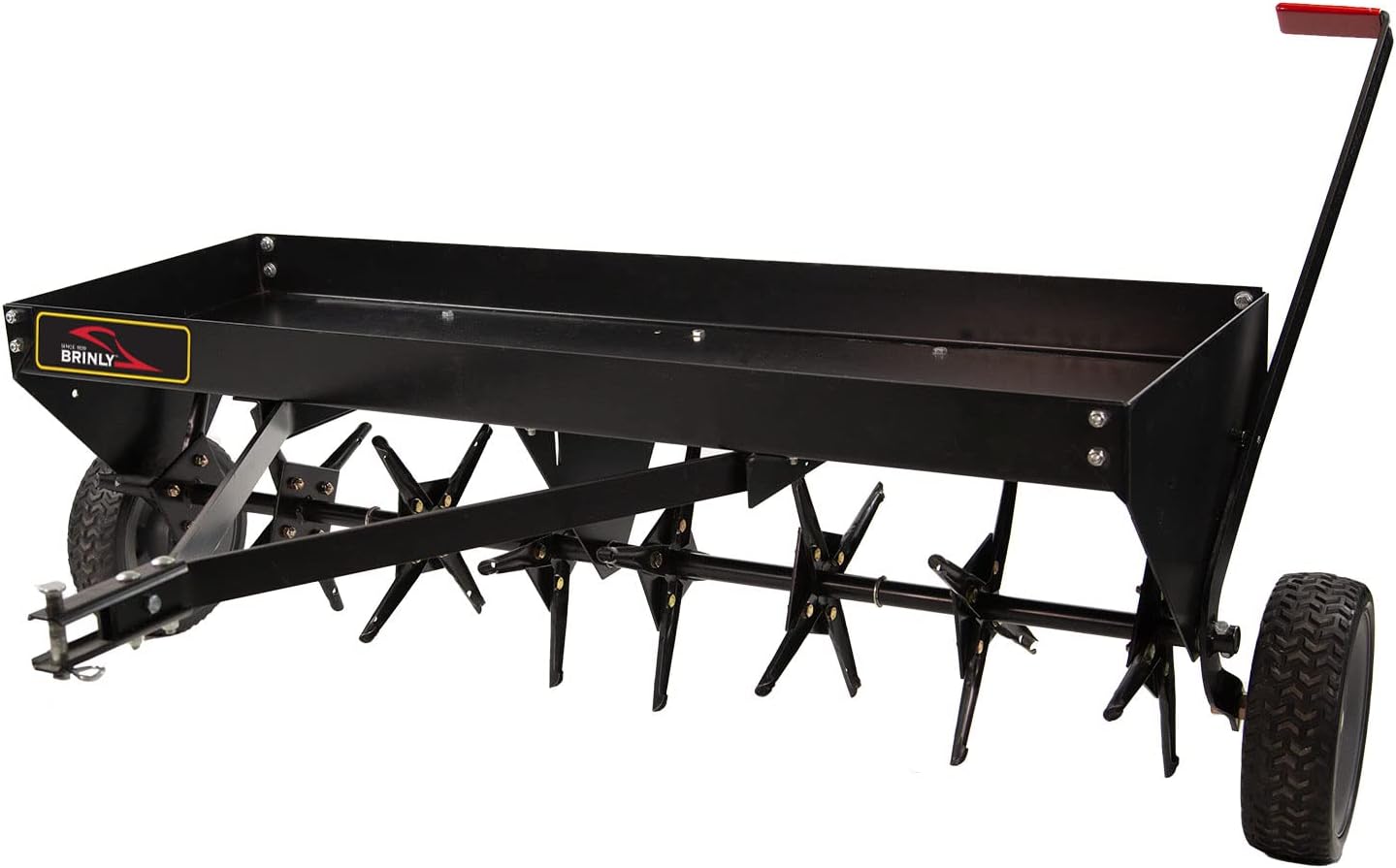
| Plug count | 32 |
|---|---|
| Plug depth | 3 inches |
| Tine material | 16-gauge heat-treated steel |
| Weight tray capacity | Up to 200 lb |
| Hitch type | Universal |
The Brinly 48" tow‑behind plug aerator is built for tackling compacted turf on medium to large lawns by removing cores rather than simply poking holes. It mounts to a lawn tractor or ZTR with a universal hitch and uses 32 heat-treated, 16‑gauge steel plug spoons arranged in three independently rotating sections to pull roughly 3" plugs and reduce compaction. A fully enclosed weight tray accepts up to 200 lb of ballast for deeper penetration when needed, and a single transport lever plus large treaded wheels make crossing driveways and walkways straightforward. The rotating tine sections help maintain consistent penetration on uneven ground and reduce turf scuffing during turns. Practical limitations are its size and weight, which assume you have a tractor or tow vehicle and storage space, and it is designed for plug aeration only so it will not replace powered core aerators for very large commercial properties. For homeowners focused on strong, measurable improvement in lawn health, this unit delivers durable construction and effective core removal.
Best for: Buyers who want a durable tow‑behind core aerator to improve lawn health on medium to large residential lawns and who already own or plan to use a lawn tractor or similar tow vehicle.
Less Ideal for: People with very small yards, those who only have a walk‑behind mower, or users needing a compact electric or handheld aerator for tight spaces.
- 32 heat-treated 16‑gauge steel plug spoons pull up 3" cores for effective decompaction
- Universal hitch and two-piece drawbar fit most lawn tractors and many ZTRs
- Fully enclosed weight tray accepts up to 200 lb for deeper aeration
- Independent rotating tine sections reduce turf damage on turns and uneven ground
- Designed to be towed by a tractor or ATV so not suitable for walk-behind use
- Large footprint requires storage space and may be cumbersome on very small yards
Verdict: If you own a lawn tractor and want a rugged tow‑behind aerator that pulls true soil cores for measurable turf improvement, this Brinly 48" unit is a strong performance choice.
Brinly SAT2-40BH-P 40" Tow-Behind Spike Aerator

| Power Source | manual |
|---|---|
| Material Type | Galvanized Steel |
| Item Type Name | Spike Aerator |
| Manufacturer Warranty Description | 2 years |
The Brinly SAT2-40BH-P is a tow-behind spike aerator built to aerate medium to large lawns by perforating compacted soil up to 2 inches deep. It attaches to riders, tractors, ZTRs, or ATVs via a universal hitch and uses 11 independently rotating 8-inch galvanized steel stars with patented 3-D tines to resist bending in tough soil. A 150 lb capacity steel weight tray lets you add mass for deeper penetration, and a single-lever transport mode raises the tines onto turf-tread wheels for crossing driveways and moving the unit without damaging surfaces. Construction is heavy-duty with a solid steel axle, nylon spacers, and a double tow bar intended for seasons of use. Practical benefits include more consistent coverage from rotating stars, easier vehicle hookup, and simple switching between transport and aeration modes. Important limitations are that it is manually towed—so you need a compatible towing vehicle—and spike aerators produce plugs rather than removing cores, which may be less effective on extremely compacted or clay-heavy soils compared with hollow-tine machines.
Best for: Buyers who want a durable, tow‑behind aerator to speed lawn maintenance on medium to large properties and prioritize reliable construction and straightforward operation.
Less Ideal for: Homeowners without a ride-on mower, tractor, or ATV or those who need hollow‑tine core removal for heavily compacted clay soils should consider other options.
- 11 independently rotating 8" galvanized steel stars for consistent coverage
- Patented 3-D tines resist bending and reduce rust in compacted soil
- 150 lb steel weight tray for increased penetration when needed
- Single-lever transport mode with turf-tread wheels for easy crossing of hard surfaces
- Spike-style aeration does not remove soil cores and can be less effective in very dense clay soils
- Requires a towing vehicle with a compatible hitch to operate
Verdict: A rugged, tow‑behind spike aerator that delivers consistent, deep penetration and easy transport for owners with a compatible towing vehicle.
VEVOR 32 in Tow-Behind Lawn Spike Aerator with Weight Tray

| Working width | 32 in |
|---|---|
| Maximum ballast weight | 100 lb |
| Tine depth | 2 in |
| Construction | Welded steel frame |
This VEVOR tow-behind spike aerator is a simple, budget-friendly way to aerate medium to large lawns without manual labor. It hooks to most lawn tractors or riding mowers and covers a 32-inch swath per pass, letting you finish quicker than with walk-behind models. The steel frame is fully welded and finished with a rust-resistant coating, and the weight tray accepts up to 100 pounds of ballast to help the 2-inch tines penetrate firmer soil. Wheels and an adjustable working height make it easier to control depth across different soil types. Assembly is straightforward and basic tools are included. Expect reliable performance on lawns, vegetable plots, and small farm areas, but this is a spike aerator rather than a core/plug aerator so it fractures soil rather than removing plugs. Also it relies on added weight and tractor towing for depth, so very heavy clay or severely compacted ground may need multiple passes or pre-wetting to get the best results.
Best for: Homeowners with a lawn tractor or riding mower who want an economical, towable aerator to speed up seasonal aeration on medium to large lawns.
Less Ideal for: Gardeners who need true plug/core aeration or those without a tow vehicle should consider walk-behind or plug aerators instead.
- Wide 32-inch working width covers more lawn per pass for faster work
- Weight tray supports up to 100 lb to improve tine penetration and stability
- Durable welded steel frame with rust-resistant coating for outdoor use
- Adjustable working height and 10.6-inch wheels aid control on varied terrain
- Spike-style tines penetrate but do not extract soil cores, which some users prefer for core aeration
- Performance depends on added ballast and towing power so it may struggle on very heavy clay without prep
Verdict: If you have a lawn tractor and want an affordable, wide tow-behind aerator to cover large areas quickly, this VEVOR spike aerator delivers solid, no-frills performance.
Brinly PA-42BH-A 42" Tow-Behind Plug Aerator with Folding Tow Bar

| Working width | 42" |
|---|---|
| Plug depth | 3" |
| Weight tray capacity | 175 lbs. |
| Tine construction | 16-gauge heat-treated steel |
The Brinly PA-42BH-A is a tow-behind plug aerator built for routine lawn maintenance and tougher, compacted soils. It pulls 3-inch plugs with heat-treated 16-gauge steel plugging spoons arranged in three independently rotating tine sections to maintain consistent penetration on uneven ground and reduce turf scuffing on turns. A fully enclosed steel weight tray accepts up to 175 pounds of additional ballast when you need extra downforce for clay or heavily compacted areas. Semi-pneumatic 10-inch tires and a single transport lever make it easy to raise the tines for crossing drives or moving between beds, and the folding tow bar saves storage space. Individual spoons are replaceable, which simplifies repairs after wear or damage. The unit is relatively heavy and intended to be towed behind an ATV or small tractor, so it is less convenient for very small lawns or users without a tow vehicle, and heavier weight plus deeper aeration can require more pulling power.
Best for: Homeowners or groundskeepers who need a reliable, heavy-duty tow aerator to cover mid-to-large lawns and want a tool that can be weighted for deeper penetration and long service life.
Less Ideal for: People with very small yards, or those who lack a tow vehicle and prefer a lightweight walk-behind aerator.
- 42-inch working width covers ground quickly for larger lawns
- 16-gauge heat-treated steel plugging spoons that remove 3-inch plugs for effective aeration
- Enclosed weight tray accepts up to 175 pounds to increase penetration on compacted soil
- Folding tow bar and transport lever simplify storage and moving between work and transport modes
- Designed to be towed so it requires an ATV, lawn tractor, or similar vehicle
- Heavier overall assembly can be harder to maneuver manually without a tow vehicle
Verdict: Choose this tow-behind aerator when you want a robust, serviceable machine that quickly aerates larger lawns and can be weighted for stubborn compacted soil.
Agri-Fab 48 in Tow-Behind Plug Aerator with 32 Galvanized Knives

| Knives | 32 galvanized self-sharpening |
|---|---|
| Plug depth | Up to 3 inches |
| Hitch | Universal hitch |
| Weight tray capacity | Holds up to 140 lbs |
| Tires | Flat-free transport tires |
The Agri-Fab 48 in Tow-Behind Plug Aerator is built for performance-minded homeowners who want deep, mechanical aeration without hiring a service. It mounts to a lawn tractor via a universal hitch and pulls 3-inch plugs with 32 galvanized, self-sharpening coring knives; a cantilever transport handle lets you raise and lower the drum from the tractor seat. The unit includes flat-free tires for low-maintenance towing and a weight tray to add ballast for better penetration. In practice this machine covers wide swaths quickly and produces consistent cores that improve air, water, and nutrient movement into compacted soils. Expect straightforward assembly and durable steel construction, but note it requires a tractor or tow vehicle to operate and is large to store. Also the aerator is primarily for turf that needs core aeration rather than lighter spike-style maintenance, so it may be overkill for very small yards.
Best for: Gardeners who prioritize effective, professional-level aeration on medium to large lawns and already own or plan to use a lawn tractor to tow the unit.
Less Ideal for: Urban gardeners with small yards, renters, or anyone without a tractor should consider smaller walk-behind or rental options instead.
- Pulls up to 3-inch plugs for deep core aeration across larger areas
- 32 galvanized self-sharpening knives for consistent penetration and reduced maintenance
- Universal hitch and tractor-seat transport handle for easy hookup and on-the-go control
- Flat-free tires reduce transport maintenance and roll smoothly over turf
- Weight tray allows added ballast for improved soil penetration
- Requires a lawn tractor or compatible tow vehicle to use
- Large footprint makes storage and maneuvering in tight spaces more difficult
Verdict: If you have a lawn tractor and want deep, consistent core aeration across medium to large lawns, this robust tow-behind aerator delivers professional-level results.
Agri-Fab 40 in Tow-Behind Plug Aerator with 24 Galvanized Coring Knives

| Working width | 40 in |
|---|---|
| Coring knives | 24 galvanized sharpened knives |
| Tires | 10 in x 3 in pneumatic |
The Agri-Fab 40 in tow-behind plug aerator is a straightforward machine for homeowners who want to reduce soil compaction across medium to large lawns. It removes small soil plugs with 24 galvanized, sharpened coring knives to improve water, air, and nutrient penetration, and the 40-inch working width covers more ground per pass so you spend less time aerating. Large 10 x 3 inch pneumatic tires make towing smoother over uneven turf, and a single-lever transport handle raises and lowers the unit for use and storage. The universal hitch fits most lawn and garden tractors, so setup is simple for common mower models. Because the coring knives are galvanized, they resist rust and hold up to repeated seasonal use, but this is a tow-behind tool that requires a compatible tractor and some storage space. For buyers who prefer low-maintenance, proven designs, this aerator delivers consistent results without fancy electronics or complex assembly.
Best for: Homeowners with a lawn tractor who want a reliable, low-tech way to aerate medium to large lawns and prioritize straightforward, durable equipment.
Less Ideal for: People with very small yards, renters without tractor access, or those looking for a lightweight manual or electric aerator option.
- Wide 40-inch working width covers large lawns quickly
- 24 galvanized coring knives for effective, corrosion-resistant plug removal
- Pneumatic 10 x 3 inch tires provide smoother towing over uneven terrain
- Single-lever transport handle for easy raising, lowering, and compact storage
- Universal hitch compatible with most lawn and garden tractors
- Requires a tow vehicle such as a lawn tractor so not usable as a standalone tool
- Relatively heavy and needs adequate off-season storage space
Verdict: A dependable tow-behind aerator that quickly covers large lawns with durable galvanized coring knives and simple, tractor-friendly operation.
Choosing the Right Tow Lawn Aerator: Key Factors to Consider
Tine Type and Spacing
Tine construction determines whether the aerator pulls cores or simply perforates the soil. Hollow coring tines remove plugs and are best for compacted soils and heavy clay because they relieve compaction and leave channels for air and water. Solid spike tines are simpler and lighter but can compact soil around the holes if used excessively.
Spacing between tines affects coverage and how many passes you need. Wider spacing covers more ground per pass but may require multiple passes to reach the same level of decompaction. For large lawns, balance spacing with tine durability to minimize towing time while ensuring adequate aeration.
Frame Strength and Build Materials
A sturdy frame resists bending and keeps tines aligned over uneven ground. Look for welded steel construction with reinforcements at stress points where the hitch and axle attach. Thinner metal or poorly braced frames can warp under repeated loads, leading to uneven aeration and increased maintenance.
Corrosion resistance matters because soil and moisture accelerate rust. Protective coatings, galvanizing, or powder-coating extend service life. Consider whether components exposed to wet soil are easily accessible for cleaning and whether replacement parts are available.
Towing Compatibility and Hitching
Tow aerators attach to a range of vehicles from small ATVs to garden tractors. Hitch height, tongue length, and coupling type must match your towing vehicle. A mismatched hitch can create poor weight distribution or unsafe towing geometry.
Also consider the turning radius and whether the aerator allows tight maneuvering around landscape features. For operators who switch vehicles, adjustable or universal hitching solutions provide flexibility without compromising performance.
Working Width and Transport Convenience
Working width determines how quickly you can cover a lawn. Wider aerators reduce passes but add weight and require more storage space. Consider how the width affects transport on narrow driveways and whether the unit folds or detaches easily for storage.
Transport features like locking pins for transport mode, removable tongues, or folding frames make it practical to stow the implement when not in use. Balance working width with the realities of getting the unit from storage to the lawn.
Depth Adjustment and Ground Following
Effective aeration depends on consistent tine penetration depth across varying terrain. Look for straightforward depth-adjustment mechanisms-such as crank-adjusted wheels or pin-stop settings-that allow repeatable settings without tools. Some designs use sprung or floating frames that follow ground contours to maintain even penetration over bumps.
If depth control is awkward or limited, you risk inconsistent aeration, missed compaction zones, or tines striking hard obstacles. Good ground following increases effectiveness while reducing stress on the tines and frame.
Maintenance, Serviceability, and Parts
Frequent tasks include removing soil from tines, greasing pivot points, and replacing worn tines or fasteners. Access to common wear parts matters for long-term ownership. Simple designs with modular tine mounts and standard fasteners are easier to repair in the field.
Consider whether bearings are sealed, the ease of accessing grease points, and how replacements are attached. Aerators that allow quick tine swaps and that use readily available hardware reduce downtime and make seasonal maintenance manageable.
Matching an Aerator to Your Towing Vehicle
Not all tow aerators are equal when it comes to towing loads. Assess your towing vehicle's drawbar rating and hitch height before choosing an implement. Lightweight ATVs can handle smaller, narrower aerators, while larger garden tractors can manage heavier, wider units with coring tines.
Check tongue length and turning clearance so the aerator does not overhang obstacles or impede steering. If you plan to use different vehicles, look for adjustable hitches or quick-change couplers to avoid repeated modifications.
- Verify hitch pin size and tongue style matches your vehicle
- Match aerator weight to vehicle towing capacity
- Consider folding or removable tongues for transport
When to Choose Core Aeration Versus Spike Aeration
Core aeration removes plugs and is generally more effective on compacted soils and older lawns. If your turf shows poor drainage, thin growth, or thatch build-up, machines that extract cores will provide measurable improvement in aeration and overseeding success.
Spike aeration is lighter and can be useful for maintenance or sandy soils where compaction is less severe. For large properties, spike-style tow units can speed coverage, but they may not address deep compaction the way coring tines do.
- Core aeration for heavy clay and compacted lawns
- Spike aeration for lighter maintenance and sandy soils
- Consider doing core aeration one season and spike maintenance the next
Operating Tips for Better Results
Plan aeration for moist but not saturated soil. If the ground is too dry, tines will not penetrate cleanly; if too wet, cores can smear and damage turf. A day or two after a light irrigation or rainfall is often ideal.
Overlap passes slightly to avoid missed strips and vary your driving pattern each season to reduce repeated ruts. Follow up with overseeding or topdressing where cores have left open channels to improve recovery and encourage denser turf.
- Aim for soil that crumbles with moderate pressure for best penetration
- Make two passes at right angles for even coverage on compacted turf
- Clean and inspect tines after use to prevent corrosion and wear
Storage and Seasonal Care
After use, remove soil from tines and let components dry before storing to slow corrosion. If the aerator has moving bearings or grease points, follow a seasonal lubrication schedule to prevent seizure during winter storage.
Store the unit in a dry, covered area away from direct ground contact to protect paint and metal. If long-term storage is required, consider light protective coatings on exposed metal and keeping spare tines on hand.
- Wash soil off tines and frame, then dry before storing
- Lubricate pivot points and inspect for loose fasteners
- Store on blocks or a pallet to keep metal off damp floors
Safety Considerations While Towing
Ensure proper weight distribution and secure hitch connections before moving at speed. Aerators add roll and yaw forces when turning; reduce speed on slopes and tight turns to maintain control.
Be aware of underground utilities or irrigation lines when using coring tines, and mark sprinkler heads and shallow cables before aerating. Personal protective equipment such as gloves and eye protection is recommended when handling tines and during maintenance.
- Check for buried lines and mark sprinkler heads
- Drive slowly over rough terrain and avoid sudden turns
- Disconnect or secure hitch when performing maintenance
How We Chose the Best Tow Lawn Aerator
We focused on features that matter in everyday lawn and turf care for gardeners who tow implements behind an ATV, lawn tractor, or small utility vehicle. Primary evaluation criteria included tine type and spacing, frame construction and corrosion resistance, compatibility with common towing hitches and vehicle classes, and capacity for working width and soil penetration. We also considered ease of maintenance, availability of replaceable parts, and how straightforward adjustments are for depth and transport. Practical reliability in different soil types and turf conditions was prioritized over niche specialty designs. We excluded lightweight aerators meant only for hand-pushing and any implements requiring commercial tractor three-point hitches. The final list reflects implements that balance effective core or spike aeration, durability, and real-world towing usability.
FAQ
How often should I aerate a large lawn with a tow aerator?
Often once a year is sufficient for most cool-season lawns, typically in fall. Lawns with high traffic or heavy clay soils may benefit from aeration every spring and fall. Frequency depends on soil type, use, and turf health.
Can I use a tow aerator behind any garden tractor or ATV?
It depends. Check your vehicle's towing capacity, hitch type, and drawbar height. Many tow aerators are designed for common lawn tractors and utility ATVs, but very small ATVs or consumer garden carts may not handle heavier coring units.
Will coring aeration damage my lawn?
Coring temporarily disrupts the surface but promotes healthier root growth and better water infiltration. Grass usually recovers within a few weeks, especially if you overseed and keep the soil slightly moist after aeration.
What tine depth should I set for effective aeration?
Aim for penetration that reaches the compacted layer, often 2 to 4 inches for typical lawns. Depth settings depend on soil hardness and tine design; adjust gradually and inspect cores to confirm adequate depth.
Are there maintenance tasks I should do after each use?
Yes. Remove soil and debris from tines and frame, inspect for bent or broken tines, and check fasteners. Lubricate moving parts as recommended and replace worn tines to keep performance consistent.
Final Verdict
For larger properties a tow lawn aerator that balances durable construction with the right tine system will deliver the most noticeable turf improvements. Prioritize tine type and spacing for the soil in your lawn, match the unit to your towing vehicle, and look for straightforward depth control and serviceability. Those tradeoffs-coverage speed versus weight and coring effectiveness versus simplicity-will guide the best choice for your yard.
