

Note: This article contains affiliate links. If you click on these links and make a purchase, I may earn a small commission at no extra cost to you. This helps support my research and content. Read my full affiliate disclosure here.
A healthy Zoysia lawn needs a fertilizer plan that encourages thick, even growth without forcing excessive top growth or disease. The right Zoysia fertilizer supports spring green-up, durable summer turf, and carbohydrate storage that helps the grass tolerate heat and drought. This guide gathers seven top options that suit different feeding strategies and maintenance schedules. We shortlisted products that match real gardener needs: steady nutrition, resistance to scorch, ease of application, and predictable release characteristics. Below you will find practical notes on how each option performs and the evaluation criteria we used to choose them.
Top Picks at a Glance
| Best Overall The best all-around choice for most situations | The Andersons Professional PGF Complete 16-4-8 Granular Fertilizer with Humic DG, 5,000 sq ft |  |
| Best Quality Built to a higher standard if you want something more solid | The Andersons PGF Balanced 10-10-10 Granular Fertilizer with Micronutrients and 2% Iron (5,000 sq ft) |  |
| Best Value The sweet spot between price and what you get | PETRAMAX Neighbor’s Envy Liquid Lawn Fertilizer Concentrate (1 gal) |  |
| Best Budget The cheapest option that still gets the job done reliably | Southern Ag All Purpose Granular Fertilizer 10-10-10 (5 lb) |  |
| Highest Rated A top-rated pick with lots of positive feedback | Ferti-lome Slow Release Nitrogen Lawn Fertilizer 15-0-15, 2 × 16 lb Bags |  |
| Most Popular A crowd favorite that many people choose with confidence | Scotts Turf Builder Weed & Feed5 Granular Weed Killer + Fertilizer, 33.95 lb. |  |
| Best Seller A high-volume bestseller chosen again and again | Scotts Turf Builder Lawn Food, 12.5 lb |  |
The Andersons Professional PGF Complete 16-4-8 Granular Fertilizer with Humic DG, 5,000 sq ft

| Item Form | Granules |
|---|---|
| Specific Uses For Product | Soil Conditioning |
| Target Species | lawn grasses |
| Mixing Ratio | 4-1-2 ratio |
This granular 16-4-8 fertilizer is formulated to feed lawns immediately and for up to eight weeks by combining fast-acting and slow-release nitrogen sources plus iron, micronutrients, and humic DG to improve nutrient uptake. It is applied with a broadcast spreader to dry foliage, walked at a steady pace with slight overlap, then lightly watered to activate the humic delivery. The super-fine particles give even distribution and a higher particle count per square foot, which helps avoid streaking and improves coverage for a uniform green-up. Practical benefits include sustained feeding, added micronutrients that support color and turf health, and humic acids that aid soil conditioning. Limitations are that it is a granular product that requires a compatible spreader and careful calibration, it must be watered in after application, and it is not intended for sale in California. Follow safety guidance and wear protection when handling to avoid irritation.
Best for: Homeowners seeking an all-around, maintenance-friendly fertilizer that promotes steady growth and improved color on warm-season lawns and who want both immediate and extended feeding in a single application.
Less Ideal for: People without a broadcast spreader or who need a liquid or foliar fertilizer for spot treatments should consider other formats.
- Balanced 16-4-8 N-P-K ratio offers both quick and extended nitrogen feeding for steady growth
- Includes iron and multiple micronutrients to improve turf color and vitality
- Humic DG particles help move nutrients into the soil when watered in
- Super-fine granules provide even distribution and reduce streaking
- Requires a spreader and proper calibration for even application
- Must be watered in after application to activate DG technology
Verdict: Choose this product for a balanced, professional-grade granular fertilizer that delivers both immediate green-up and up to eight weeks of sustained feeding while improving soil nutrient uptake.
The Andersons PGF Balanced 10-10-10 Granular Fertilizer with Micronutrients and 2% Iron (5,000 sq ft)

| Form | Granules |
|---|---|
| Coverage | 5000 square feet |
| Application method | spreader |
| Mixing ratio | 10-10-10 |
| Target species | Lawns and Gardens |
The Andersons PGF Balanced 10-10-10 is a fine-particle granular fertilizer designed to give more uniform coverage than typical pebble-sized granules, which helps ensure more even feeding across a lawn or garden. It is applied with a broadcast or drop spreader and is suitable for spring or fall use, for establishing new turf, overseeding, or routine maintenance. The formula is all quick-release nutrients, so it supplies an immediate boost to growth and color, and the added micronutrients and 2% iron promote deeper greening. One 18 lb bag covers about 5,000 sq ft and can also be worked into planting beds or used at the base of trees and shrubs. Limitations to note are the quick-release-only nitrogen, which means benefits come fast but do not provide long slow feeding, and the iron can stain paved surfaces if not swept off. For performance-focused turf care this product delivers predictable, rapid results, especially when watered in after application.
Best for: Buyers who want rapid, visible improvement in turf color and vigor and who manage their lawn with planned spreader applications and regular watering.
Less Ideal for: Homeowners seeking a slow-release or low-maintenance fertilizing program or those who prefer organic options should consider other products.
- Very fine particle size for more uniform coverage and even feeding
- Balanced 10-10-10 quick-release formula delivers an immediate nutrient boost
- Includes micronutrients and 2% iron for improved color and deep greening
- Covers up to 5,000 square feet per 18 lb bag, suitable for whole-yard applications
- All quick-release nutrients provide short-term feeding rather than extended release
- Iron content can stain sidewalks and driveways if product is not removed from paved areas
Verdict: Choose this product when you need fast, even greening and reliable short-term nutrient boost for performance-focused turf care.
PETRAMAX Neighbor’s Envy Liquid Lawn Fertilizer Concentrate (1 gal)

| Item Form | Liquid |
|---|---|
| Application Method | Spray |
| Coverage | 16000 |
| Target Species | Lawn Grass |
| Liquid Volume | 128 fluid ounces |
Neighbor’s Envy is a concentrated liquid fertilizer designed to deliver rapid greening and improved turf vigor when applied with a sprayer or hose-end applicator. It combines a high nitrogen content with iron, humic and fulvic acids, potassium, sulfur and sea kelp so you can feed for color, root strength and stress resistance in a single application. Use it on Zoysia and other warm- and cool-season turfs; dilution and spray application let you treat large areas without spreading granular product. Practical benefits include visible color improvement within days, soil-conditioning ingredients that support longer-term health, and pet-safe labeling for everyday yards. Limitations are that performance depends on correct mixing and even spray coverage, and a liquid concentrate requires a sprayer and careful measurement to avoid overapplication. For gardeners focused on efficient, repeatable lawn maintenance, this product simplifies multiple inputs into one bottle but still requires basic application skill to get consistent results.
Best for: Homeowners who want a time-saving, all-in-one liquid treatment to improve Zoysia color and vigor across medium to large lawns while minimizing separate products.
Less Ideal for: People who prefer granular slow-release programs or those unwilling to handle dilution and spray application should consider alternative formats.
- High nitrogen plus iron formula for quick, deep greening of turf
- Includes humic/fulvic acids and sea kelp to support soil health and stress tolerance
- Liquid concentrate covers up to 16,000 sq ft for efficient large-lawn applications
- Designed for spray application so it distributes evenly when applied correctly
- Requires accurate dilution and a sprayer to avoid uneven coverage or overfeeding
- No specific N-P-K breakdown beyond listed ingredients for precise nutrient planning
Verdict: A single, spray-applied concentrate that combines nitrogen, iron and soil conditioners to quickly green and strengthen Zoysia with one convenient product.
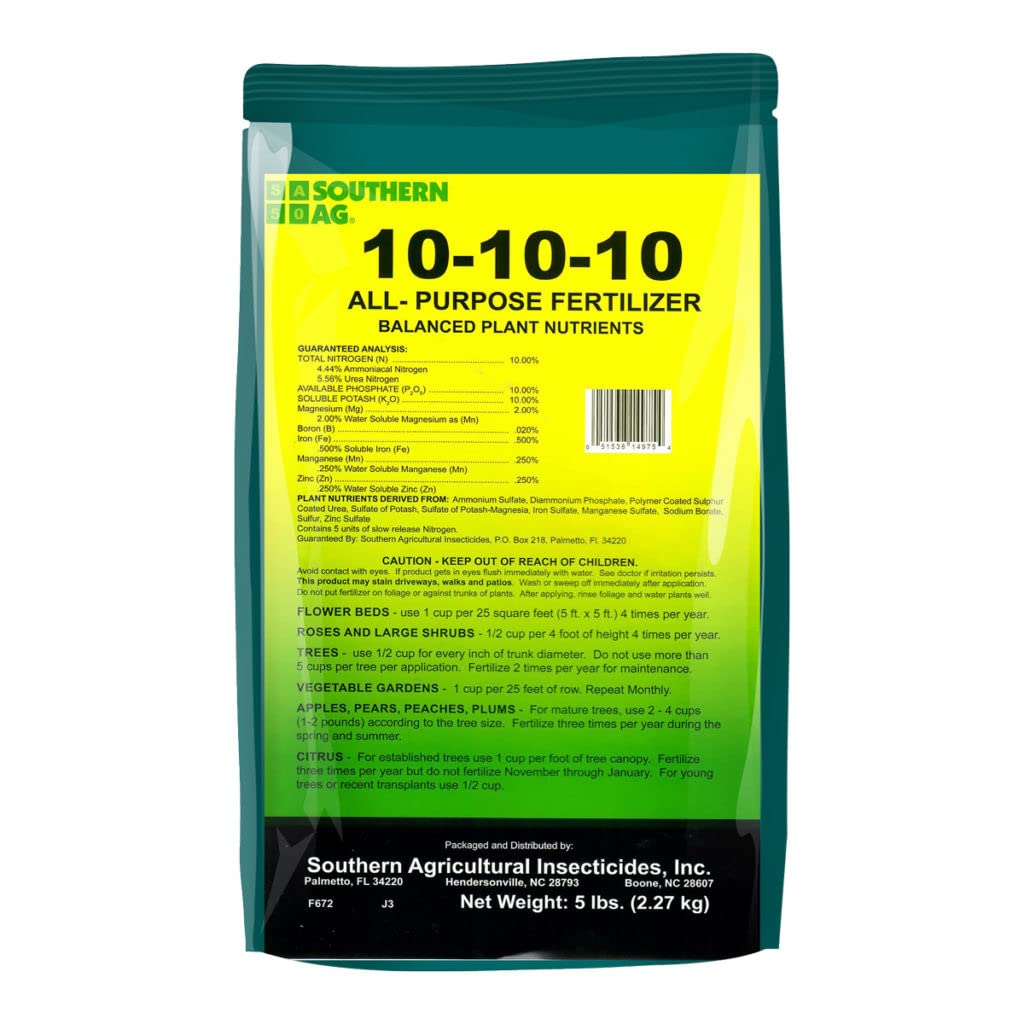
Southern Ag All Purpose Granular Fertilizer 10-10-10 (5 lb)
| Item Form | Granules |
|---|---|
| Specific Uses For Product | Citrus and Fruit Trees, Flowerbeds, Roses, Large Shrubs, Vegetable Gardens |
| Application Method | Broadcast evenly over area and water in. |
| Mixing Ratio | 10:10:10 |
This 5 lb bag of Southern Ag all purpose granular fertilizer delivers a straightforward 10-10-10 N-P-K formula with added minor elements such as magnesium, iron, manganese, zinc, and boron. It is applied by broadcasting evenly and watering in, with clear coverage and dosing guidance for flowerbeds, vegetables, shrubs, roses, and fruit trees. For routine lawn care it provides even nutrition that supports root and shoot growth without specialty slow-release chemistry. The product is simple to use for monthly vegetable feeding or seasonal shrub and tree maintenance, and the granular form is easy to measure and store. Important limitations are that it is a general-purpose fertilizer rather than a turf-specific or slow-release zoysia formula, so it may require more frequent applications and careful timing to avoid overstimulating growth in warm-season grasses. Also follow safety directions to avoid contact with hard surfaces and water bodies.
Best for: Practical gardeners seeking an affordable, no-frills granular fertilizer for mixed beds, fruit trees, and general feeding who prioritize value and ease of use.
Less Ideal for: Homeowners looking for a fertilizer formulated specifically for zoysia or slow-release long‑season turf feeding should consider a turf‑targeted product instead.
- Balanced 10-10-10 N-P-K provides even, all-purpose nutrition
- Granular form is easy to measure, broadcast, and store
- Includes several micronutrients (Mg, Fe, Mn, Zn, B) for broader plant support
- Clear application rates for vegetables, shrubs, roses, and trees
- Not a turf-specific or slow-release formulation optimized for zoysia lawn maintenance
Verdict: A budget-friendly, easy-to-use 10-10-10 granular fertilizer that provides reliable, general nutrition for mixed garden plantings.
Ferti-lome Slow Release Nitrogen Lawn Fertilizer 15-0-15, 2 × 16 lb Bags

| Formulation | 15-0-15 |
|---|---|
| Item Form | Granules |
| Unit Count | 2 Count |
| Target Species | Lawn Grass |
This two-pack of Ferti-lome 15-0-15 slow-release lawn fertilizer is built for straightforward, low-maintenance feeding of warm- and cool-season lawns. Each 16 lb bag covers up to 4,000 sq ft and the slow-release nitrogen delivers nutrients over time, which reduces the need for frequent reapplications and helps avoid growth spikes that require extra mowing. The formula includes iron and micronutrients to help improve color and overall turf vigor, and the manufacturer lists compatibility with common grasses including Zoysia, Bermuda, St. Augustine, and fescues. Typical use is a spring and fall application at the recommended rate (16 lb per 4,000 sq ft) with a broadcast spreader for even coverage. The product is simple to store and handle as granules and the multi-pack is convenient for larger yards or repeat seasonal passes. Limitations are that the N-P-K is fixed at 15-0-15 so it is not suitable when phosphorus or higher potassium is specifically required, and exact release timing depends on temperature and soil conditions rather than a stated release window.
Best for: Homeowners who prioritize a dependable, low-maintenance feeding program for their Zoysia or mixed warm-season lawns and prefer predictable seasonal applications.
Less Ideal for: Users needing a custom nutrient balance, high-phosphorus treatments, or an immediate quick-greenup product should consider alternative formulations.
- Slow-release nitrogen reduces frequency of applications and helps steady growth.
- Includes iron and micronutrients to improve lawn color and vigor.
- Two-bag pack covers multiple applications or larger yards without repurchasing quickly.
- Granular form works with standard broadcast spreaders for even coverage.
- Fixed 15-0-15 N-P-K ratio does not address phosphorus deficiencies or specialized nutrient plans.
- Release rate is temperature-dependent so feeding duration varies with climate and soil.
Verdict: Choose this two-pack if you want a reliable, slow-release nitrogen fertilizer that keeps Zoysia lawns fed with fewer applications.
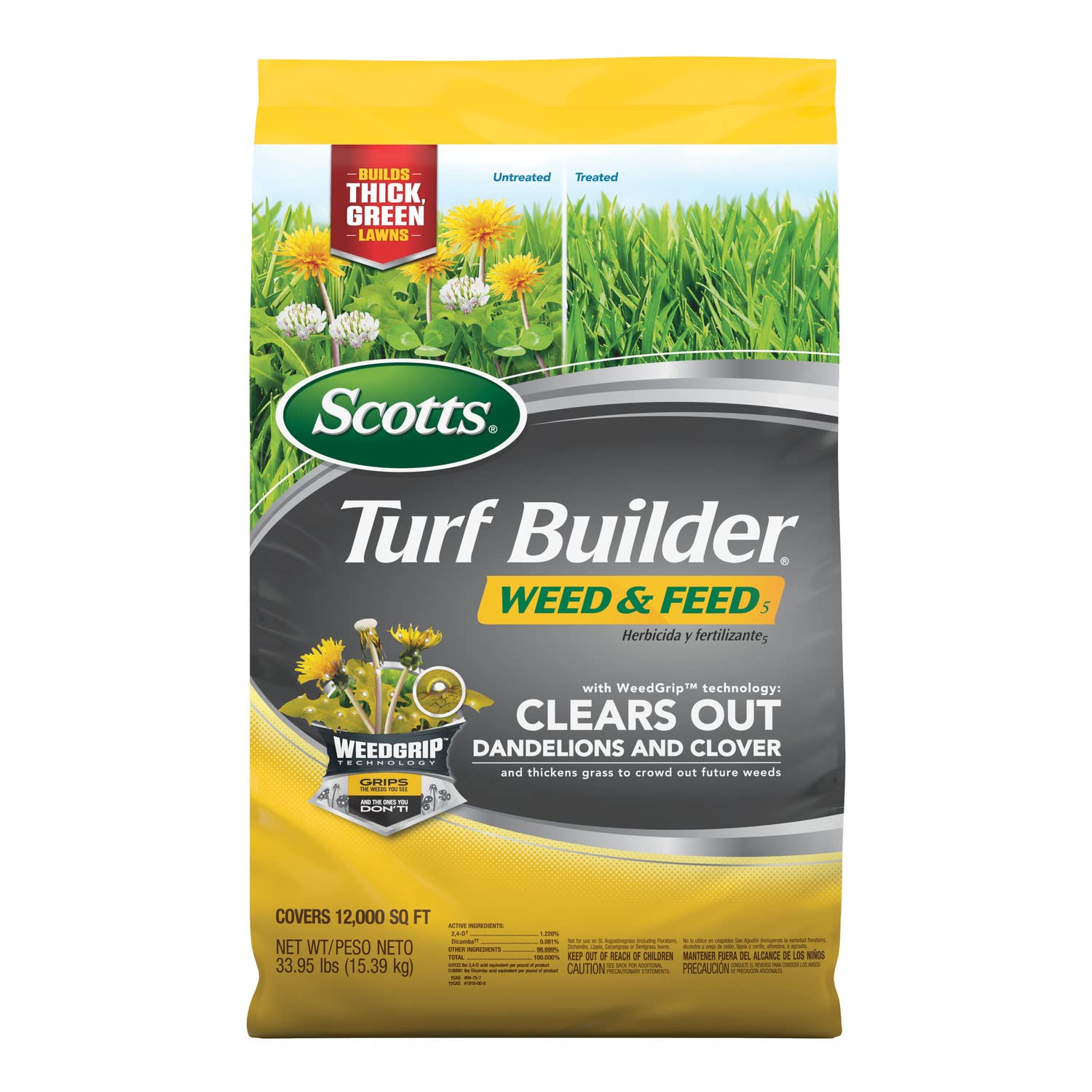
Scotts Turf Builder Weed & Feed5 Granular Weed Killer + Fertilizer, 33.95 lb.
| Item Form | Granule |
|---|---|
| Coverage | 12000 square feet |
| Active Ingredients | 2,4-D and Dicamba |
Scotts Turf Builder Weed & Feed5 combines a broadleaf weedkiller with a fertilizer formula intended to thicken lawns while removing common weeds such as dandelion and clover. It is applied with a broadcast or drop spreader to a wet lawn when daytime temperatures are between 60°F and 90°F and should not be watered for 24 hours after application so granules stick to weed leaves. The product lists active ingredients 2,4-D and dicamba and claims control of more than 50 listed weeds while delivering nitrogen, potassium, and sulfur to promote green-up. Practical benefits include wide coverage from a single 33.95 lb. bag and compatibility with standard Scotts spreader settings for even application. Important limitations: it is not safe for several grass types including St. Augustine, bentgrass, carpetgrass, dichondra, or lippia, so it is unsuitable for those lawns, and it should only be applied when weeds are actively growing and weather is appropriate. As with any herbicide, follow label safety directions and keep people and pets off treated areas until dust settles.
Best for: Homeowners seeking a combined weed-control and feeding step to reduce visible broadleaf weeds while improving turf density on compatible grass types. Ideal for people who want a large-coverage, easy broadcast application as part of seasonal lawn care.
Less Ideal for: Owners of St. Augustinegrass, creeping bentgrass, carpetgrass, dichondra or lippia lawns or anyone preferring organic or non-chemical weed control methods.
- Kills a wide range of common broadleaf lawn weeds and controls over 50 listed species
- Includes fertilizer nutrients to thicken grass and promote green-up while treating weeds
- Large coverage per bag covers up to 12,000 sq. ft., reducing how often you need to buy product
- Formulated for use with Scotts spreaders and provides recommended spreader settings for even application
- Contains synthetic herbicides (2,4-D and dicamba) that require careful timing, safety precautions, and exclusion of certain grass types
Verdict: Use this large-coverage weed-and-feed when you want one product to both remove broadleaf weeds and feed compatible warm- or cool-season lawns for thicker turf.
Scotts Turf Builder Lawn Food, 12.5 lb

| Item Form | Powder |
|---|---|
| Specific Uses For Product | Lawn |
| Coverage | 5,000 sq. ft. |
| Target Species | grass |
| Mixing Ratio | 32:0:4 |
Scotts Turf Builder Lawn Food is a granular fertilizer intended to thicken and green lawns while building stronger roots. It is applied with a broadcast or drop spreader to a wet or dry lawn and can be used in spring, summer, or fall. The product supplies nutrients that help grass absorb water and nutrients better than unfed turf, and the package includes application settings for Scotts spreaders to simplify dosing. For best results apply as part of a routine feeding plan and water lightly if quicker greening is desired, though watering is not required. The fertilizer is labeled for use on all grass types, which makes it convenient for mixed lawns or standard turf grasses like zoysia, but it is a broad-spectrum lawn food rather than a zoysia-specific formula. Users should follow safety directions to avoid runoff and keep the product away from open water and children. One 12.5 lb bag covers about 5,000 sq. ft., so homeowners with larger yards will need multiple bags or a larger size to complete a full-season program.
Best for: Homeowners who want a reliable, easy-to-apply lawn food to thicken and green turf while reducing risk from overcomplicated regimens; good for people who prefer simple, repeatable seasonal feeding.
Less Ideal for: Specialists seeking a zoysia-targeted fertilizer program or those managing very large lawns who prefer bulk commercial-size bags.
- Works on all grass types so it can be used on zoysia and mixed lawns
- Includes recommended spreader settings to simplify accurate application
- Builds stronger, deeper roots to improve water and nutrient uptake
- Can be applied to wet or dry lawns and used in multiple seasons
- Not a zoysia-specific NPK blend so it is a general lawn food rather than tailored nutrition
- 12.5 lb bag only covers about 5,000 sq. ft., requiring multiple bags for larger lawns
Verdict: A straightforward, dependable lawn food that makes seasonal feeding easy for homeowners who want a low-risk way to strengthen and green zoysia and other common turf types.
Choosing the Right Zoysia Fertilizer: Key Factors to Consider
Nutrient Ratio and Formulation
Zoysia responds differently to fertilization than cool-season grasses. A balanced nutrient ratio with an emphasis on moderate nitrogen helps build density without promoting excessive blade length that can weaken crowns. Look for products that list exact N-P-K percentages and secondary nutrients. Slow-release nitrogen sources reduce the risk of rapid top growth that demands more mowing and can encourage disease.
Formulations that include micronutrients such as iron can improve color without increasing growth. Liquid and granular versions deliver nutrients differently; granular slow-release options typically give steadier feeding while liquids offer rapid correction when color or growth lag needs addressing.
Release Type and Feeding Schedule
How fertilizer releases nitrogen matters for both performance and maintenance. Quick-release or soluble fertilizers produce fast green-up but can lead to surges in growth and higher watering or mowing needs. Coated or polymer-based slow-release products provide steady nutrition over weeks to months, which suits Zoysia's slower growth habit and reduces application frequency.
Consider how often you want to apply fertilizer. If you prefer a once-per-season or two-per-season program, choose a longer-lasting formulation. If you need to correct a deficiency quickly, a tank-mixable liquid or soluble product can be used in spring as a spot treatment.
Turf Safety and Heat Stress
Zoysia is typically grown in warm climates where heat stress and drought are common. Fertilizers with high soluble nitrogen can increase leaf burn risk during hot, dry periods. Products labeled for turf safety and containing slow-release nitrogen reduce burn risk and help the grass conserve moisture. Timing applications to avoid peaks of summer heat is as important as selecting the right formula.
Also consider whether a product advises on irrigation after application. Light watering to move nutrients into the root zone often reduces surface concentration that can cause scorch, but overwatering defeats the purpose of Zoysia's drought tolerance.
Application Method and Equipment
Ease of application affects accuracy and outcomes. Granular fertilizers require a broadcast or drop spreader and spreading patterns that avoid stripes and overlap. Check that the product's particle size and flow characteristics match common spreader settings. Liquid fertilizers need appropriate sprayer equipment and more frequent calibration but can be applied to areas where granular spreaders struggle, such as slopes or tight corners.
Consider storage and mixing too. Some concentrates require dilution and agitation, while many granular products store well. Choose a format that fits the tools you already own and your willingness to calibrate spreaders or sprayers.
Longevity and Cost of Maintenance
Longevity affects both calendar planning and total seasonal cost of care. A long-lasting slow-release fertilizer may cost more up front but reduce the number of applications needed across the growing season. That reduces time spent on spreading and the chance of misapplication. Conversely, short-lived formulas require more frequent maintenance but let you adjust feeding rates based on observed turf response.
Factor in how often you mow, irrigate, and perform other maintenance. A lawn that receives regular attention can take advantage of shorter-acting products, while lower-maintenance yards benefit from products that maintain steady nutrient delivery with minimal intervention.
Environmental Impact and Runoff Risk
Fertilizer runoff can harm waterways and public resources, so choose products and schedules that minimize loss. Slow-release nitrogen and proper timing reduce the window when nutrients are vulnerable to washing away. Avoid applying before heavy rain forecasts and use best practices like sweeping granules off hard surfaces.
Also look for clear label guidance on application rates for different soil types and slopes. Products that provide specific instructions for controlling runoff help you protect local waterways while supporting healthy turf growth.
Timing Fertilizer Applications for Zoysia
Zoysia has a distinct growing season and responds best when fertilized during active growth. In most warm climates, that means feeding in late spring after green-up and again in mid to late summer if needed. Avoid heavy applications in the hottest weeks of mid-summer when the grass is under peak heat stress.
For maintenance feeding, space applications to match the release profile of your chosen product. A slow-release granular applied once or twice per season can supply nutrients for months, while liquid feeds are better for spot correction or short-term color boost.
- Apply after the lawn has fully greened in spring.
- Avoid heavy feeding before predicted heat waves or drought.
- Use short, light irrigations after application if label recommends it.
Soil Testing and Adjusting Formulas
A soil test is the most reliable way to tailor fertilizer choices for Zoysia. Tests reveal pH and nutrient levels, letting you address phosphorus or potassium needs directly rather than guessing. Adjusting pH with lime or sulfur can improve nutrient uptake and reduce the need for corrective fertilizers.
If soil tests show low iron or micronutrients, consider a supplemental product rather than increasing nitrogen. That helps maintain color without unnecessarily stimulating top growth.
- Test every two to three years for stable lawns.
- Match fertilizer N-P-K to soil test recommendations.
Feeding Strategies for Low-Maintenance Lawns
Low-maintenance Zoysia lawns benefit from a conservative feeding schedule and longer-lasting formulations. A single spring application of a well-balanced slow-release granular can keep a low-input lawn healthy through the season with minimal fuss. Combine this with proper mowing height and infrequent irrigation to preserve density.
Spot-treat high-traffic areas or thin patches rather than feeding the whole yard more frequently. Overfeeding low-maintenance lawns often increases mowing and water needs without significant quality gains.
- Use slow-release products to reduce application frequency.
- Target thin areas with supplemental treatments instead of blanket feeding.
Combining Fertilizer with Other Cultural Practices
Fertilizer is one tool within a broader lawn care program. Proper mowing height for Zoysia, core aeration in compacted areas, and overseeding to repair thin patches all amplify the benefits of a good feeding program. Aeration improves nutrient penetration and root development, making fertilization more effective.
Irrigation timing also matters. Deep, infrequent watering encourages roots to grow deeper and makes nutrient uptake more efficient. Coordinate feeding with your irrigation schedule to avoid nutrient loss and promote steady growth.
- Aerate compacted soil before applying a heavy feed.
- Mow at recommended heights to maintain density and reduce stress.
Interpreting Label Information
Labels contain the critical information gardeners need to apply fertilizer safely. Focus on N-P-K values, the percentage of slow-release nitrogen, and instructions on spreader settings or dilution rates. If a label provides application rates by square footage, use that rather than estimating.
Also read cautions about burning, recommended irrigation after application, and any special instructions for warm-season grasses. Following label directions reduces the chance of damaging turf and helps you meet environmental best practices.
- Use the exact label rate for your lawn size.
- Follow reentry and watering instructions to avoid turf injury.
How We Chose the Best Zoysia Fertilizer
We focused on attributes that matter to gardeners managing Zoysia turf in home lawns and small properties. Key evaluation dimensions included nutrient ratio and formulation to see whether the product supplies the right balance of nitrogen, phosphorus, and potassium for Zoysia growth patterns. Release type and longevity were assessed to determine how well a product supports steady green-up versus quick flushes of growth. Application ease and spreader compatibility were reviewed so gardeners can apply products accurately without excessive passes. Turf safety and heat tolerance considered risk of burn and how fertilization affects drought resilience. Environmental impact and runoff risk were noted for slow-release and coated formulations. Products were excluded if they lacked clear nutrient analysis, had unclear release claims, or were intended only for other grass types without Zoysia-specific guidance. We prioritized options with transparent labels and practical instructions because predictable results in the yard depend on recipe clarity and proper timing.
FAQ
How often should I fertilize Zoysia turf?
Frequency depends on the product type and lawn goals. Slow-release granular fertilizers often need one to three applications per season, while soluble liquids may be applied more frequently. Match timing to active growth and avoid heavy feeding during peak summer heat.
Can I use a high-nitrogen fertilizer for faster green-up?
High-nitrogen formulas can produce rapid green-up but also spur excessive top growth and higher mowing needs. For Zoysia, a moderate nitrogen rate or a slow-release source usually gives better balance between color and turf health.
Should I water after applying granular Zoysia fertilizer?
Light irrigation after applying granular fertilizer often helps move nutrients into the root zone and reduces burn risk. Follow label guidance; some products require immediate watering while others advise waiting for rainfall within a specified window.
Does soil type change my fertilizer choice?
Yes. Sandy soils tend to leach nutrients faster and may benefit from more frequent, lower-rate applications or slow-release formulas. Clay soils hold nutrients longer, so you may opt for less frequent feeding. A soil test clarifies specific needs.
Can I fertilize Zoysia in late fall?
Fertilizing in late fall is generally not recommended for Zoysia because it is entering dormancy. Late-season nitrogen can reduce cold hardiness and deplete carbohydrate reserves. Focus on early fall cultural practices like aeration if maintenance is needed.
Are iron supplements necessary for darker green Zoysia?
Iron can darken leaf color without stimulating significant growth and is often used as a supplement when soils are iron-deficient. Use iron as a targeted treatment based on tissue or soil tests rather than as a routine substitute for balanced fertilization.
Final Verdict
Choose a Zoysia fertilizer that fits your maintenance style and local climate. Prioritize nutrient balance and a release profile that matches how often you want to apply product and how much mowing and irrigation you are willing to do. Consider turf safety in heat and the environmental impact of runoff when scheduling applications. For low-effort lawns, favor slow-release granular formulas and conservative nitrogen rates. If you need rapid correction of color or deficiencies, use targeted liquid supplements sparingly. Align feeding with soil test results and core cultural practices to get the most consistent, durable results from your Zoysia lawn.
