

Note: This article contains affiliate links. If you click on these links and make a purchase, I may earn a small commission at no extra cost to you. This helps support my research and content. Read my full affiliate disclosure here.
If you need reliable knockdown of flying and hiding pests across a yard, greenhouse, or around structures, choosing the right thermal fogger insecticide matters. The wrong unit wastes product, creates uneven coverage, or becomes a handling hazard in tight spaces. This guide looks at six carefully shortlisted fogger insecticides and the thermal fogger platforms they work with to help you match reach, fuel type, and droplet size to your situation. We evaluate coverage, application control, fuel and chemical compatibility, and user safety so you can pick an option that performs in real garden and small-structure use. Read on for practical advice about how fogger droplet size, run time, and mixing affect effectiveness and cleanup before the product summaries.
Top Picks at a Glance
| Best Overall The best all-around choice for most situations | Vectorfog H100SF Mid-Size Thermal Fogger |  |
| Best Quality Built to a higher standard if you want something more solid | Vectorfog H200SF-SS 110V Thermal Fogger Machine, 6.5L Stainless Steel Tank |  |
| Best Value The sweet spot between price and what you get | VEVOR 4-Gallon 63cc Gas Backpack Fogger Sprayer |  |
| Best Budget The cheapest option that still gets the job done reliably | Bonide Propane Insect Fogger |  |
| Highest Rated A top-rated pick with lots of positive feedback | Burgess 1443 Propane Insect Fogger |  |
| Most Popular A crowd favorite that many people choose with confidence | Black Flag 190095 Propane Insect Fogger |  |
Vectorfog H100SF Mid-Size Thermal Fogger

| Manufacturer | Vectorfog |
|---|---|
| Item model number | H100 SF |
| Batteries | 1 Product Specific batteries required (included) |
The Vectorfog H100SF is a mid-size thermal fogger built for jobs that need more reach than a handheld unit but more mobility than vehicle-mounted equipment. It produces a dense, consistent fog using a fuel-injection thermal system, making it suitable for applying oil-based insecticides and odor neutralizers across greenhouses, warehouses, poultry houses, and parks. Its mid-size frame and ergonomic design help operators move through large spaces for extended periods, and the high-velocity output reduces time spent treating wide areas compared with cold foggers or manual sprayers. The unit is intended for professional or serious maintenance use and will perform best with compatible oil-based solutions. Limitations include its 25.3 pound weight and physical size, which mean it is not as convenient as small handheld foggers for tight indoor work, and it requires careful handling and appropriate protective equipment during use.
Best for: Buyers who need a robust, mobile thermal fogger for medium-scale pest control and odor treatment across farms, greenhouses, or industrial spaces and prioritize coverage efficiency and professional performance.
Less Ideal for: Homeowners with small yards, casual users, or anyone needing a lightweight, indoors-only sprayer should consider smaller handheld or cold fogger options instead.
- Delivers dense, uniform fog for effective coverage of large areas.
- Mid-size design balances power and portability for medium-scale jobs.
- Engineered for oil-based solutions including insecticides and odor neutralizers.
- High-velocity output cuts treatment time versus manual spraying methods.
- Heavier and larger than handheld foggers, making tight-space maneuvering more awkward.
- Designed specifically for oil-based formulations so it is not suitable for all solution types.
Verdict: Choose the H100SF when you need a professional mid-size thermal fogger that delivers fast, dense coverage across medium to large treatment areas.
Vectorfog H200SF-SS 110V Thermal Fogger Machine, 6.5L Stainless Steel Tank

| Power Source | Battery Powered |
|---|---|
| Material Type | Stainless Steel |
This Vectorfog H200SF-SS is a purpose-built thermal fogger for wide-area outdoor pest control and agricultural use. It produces a dense thermal fog plume from oil- or water-based solutions using automatic ignition and a high-output nozzle, making it suitable for perimeter treatments, barns, fields, and service routes. The 6.5 liter stainless steel tank and dual inlet design let you switch between oil and water formulations, while the advertised flow rates (up to 50 L/h oil, 30 L/h water) mean faster coverage on large properties. Portability and durable stainless construction make it field-ready and easier to transport than fragile units. Important limitations are that it is intended for outdoor or well-ventilated commercial spaces only and requires appropriate chemical handling and PPE; it is not suited to indoor household use. Also the unit runs on 110V power and appears optimized for pro users who need high throughput rather than casual garden spot treatments.
Best for: Professional applicators and serious property owners who need fast, large-area thermal fogging for outdoor pest control, agriculture, or perimeter treatments and prioritize throughput and durability.
Less Ideal for: Casual gardeners or homeowners seeking a small, indoor-safe fogger for spot treatments should consider lighter, user-friendly alternatives.
- High-output fogging with up to 50 L/h for oil-based solutions for rapid large-area coverage
- Dual inlet design accepts both water- and oil-based formulations for flexible use
- 6.5L stainless steel tank and stainless construction for durability in field conditions
- Automatic ignition and professional nozzle design for controlled directional fogging
- Designed for outdoor or well-ventilated commercial use only and not safe for indoor household treatments
- Requires 110V power source which may limit remote cordless operation
Verdict: Choose this fogger when you need a durable, high-output thermal machine to quickly cover large outdoor areas for professional pest control.
VEVOR 4-Gallon 63cc Gas Backpack Fogger Sprayer

| Tank Volume | 4 gallons |
|---|---|
| Item Highlight | 3HP Engine Weed Sprayer with Powder and Liquid Mister Duster System for Fleas Ticks Critters Control, Gardening & Farming |
| Material Type | Metal, Plastic |
| Hose Length | 59.06 inches |
| Power Source | Hand Powered |
The VEVOR 4-gallon backpack fogger is a gas-powered sprayer designed for broad outdoor pest control and crop applications. It pairs a 63cc, 3HP engine with a one-piece metal L-shaped spray tube to deliver a long-reaching mist that the listing says can cover large areas with minimal refills. The unit supports both liquid fogging and powder dusting, so you can switch between insecticide sprays and granular/powder treatments without a different machine. Padded shoulder straps and a ventilated back cushion aim to reduce operator fatigue during extended jobs, and included accessories such as hoses, nozzle assembly, and a spray shield help get the unit running out of the box. Expect louder operation, engine maintenance and fuel handling typical of gas equipment, and the pack is heavier than battery models when full. For someone who needs a robust, engine-driven fogger for big yards, orchards, or agricultural plots, this is a practical option that balances coverage and versatility, but it is less convenient for short, infrequent treatments or noise-sensitive areas.
Best for: Buyers who need a workhorse fogger for regular, large-area pest control and prefer an engine-driven unit that maximizes run time and spray reach.
Less Ideal for: Not a good fit for users needing a quiet, lightweight sprayer for occasional small-yard treatments or those who prefer electric battery operation.
- Supports both liquid fogging and powder dusting for flexible pest treatments
- Large 4-gallon tank reduces refill frequency during extended jobs
- 63cc 3HP engine provides strong spray reach and coverage
- Padded straps and ventilated back cushion improve comfort for longer use
- Gas engine requires fuel, routine maintenance, and produces noise
- Relatively heavy when filled compared with battery-powered alternatives
Verdict: Choose this gas backpack fogger when you need a durable, engine-powered machine that delivers long reach and handles both liquid and powder treatments for large outdoor areas.
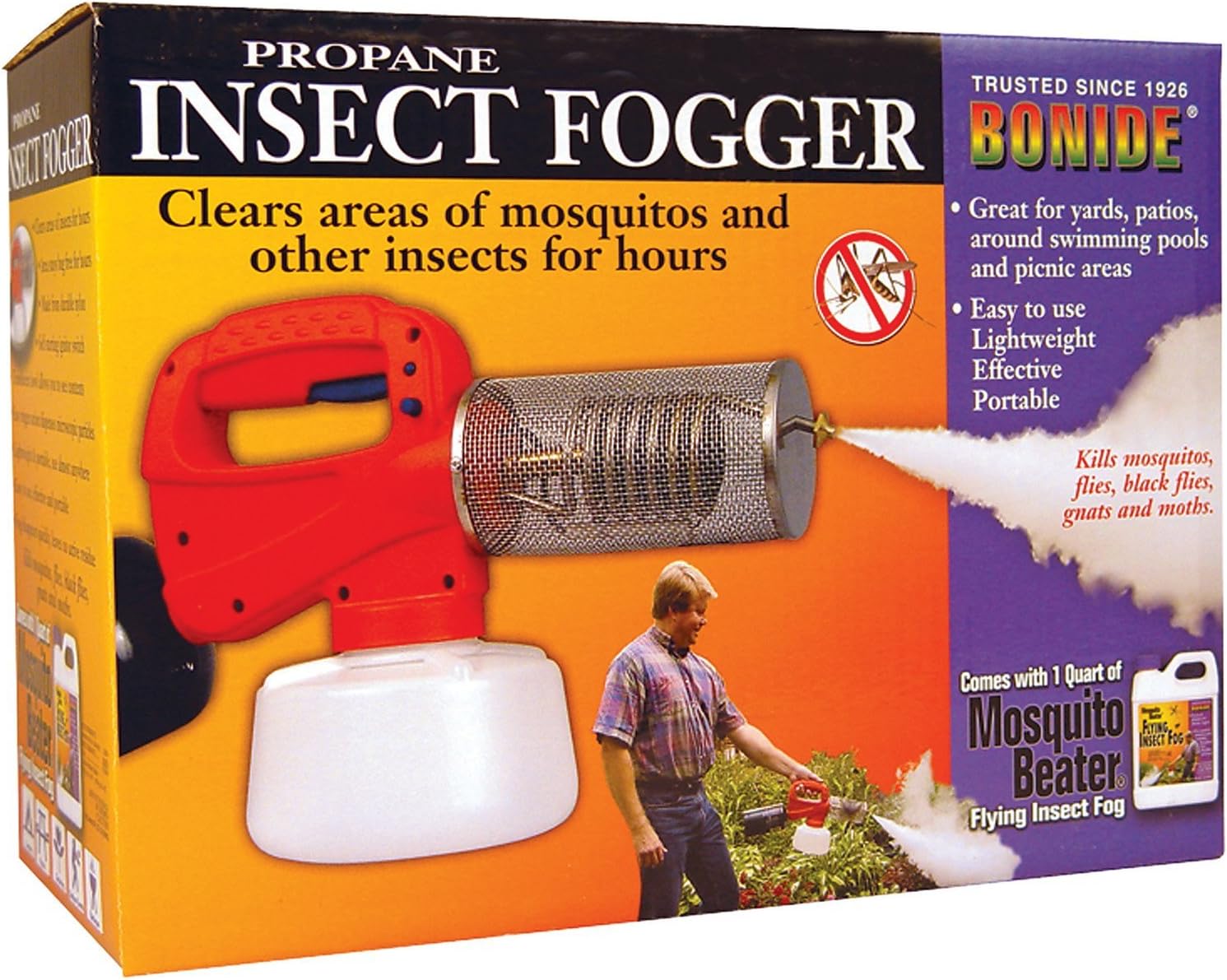
Bonide Propane Insect Fogger
| Unit Count | 1 Count |
|---|---|
| Included Components | home-pest-control-foggers |
| Item Type Name | Propane Insect Fogger |
| Target Species | Insects |
The Bonide Propane Insect Fogger is a simple thermal fogging tool that uses propane to generate a dense insecticidal fog for outdoor pest control. It is typically used around shrubs, garden beds, and other outdoor areas where insects hide in foliage or crevices; you connect a fogging solution and a propane source, then sweep the fog through the treatment area to penetrate leaves and gaps. Notable features include a durable nylon construction with a translucent bowl that makes it easy to monitor fluid level and a design intended to create a thick, penetrating fog. In practice it can collapse localized insect populations quickly when used as directed and reaches places that sprays miss. Important limitations are that it requires a separate insecticidal formulation and a propane tank, is for outdoor use only, and users must follow safety directions closely because the fogger generates heat and a fine aerosol. This is a functional, no-frills option for spot or perimeter fogging when budget is the primary concern.
Best for: Buyers who need an inexpensive, practical thermal fogger for outdoor spot or perimeter insect control and prefer a straightforward tool they can operate themselves.
Less Ideal for: Users who want an all-in-one ready-to-use unit, an indoor-safe fogger, or a low-maintenance solution that does not require handling propane or mixing insecticide.
- Produces a dense fog that penetrates foliage and cracks
- Durable nylon construction with translucent bowl for fluid visibility
- Simple, straightforward design easy to operate for spot treatments
- Requires separate insecticide solution and propane tank to operate
- Intended for outdoor use only and must be handled with caution due to heat and aerosol
Verdict: A budget-friendly propane thermal fogger that delivers dense outdoor fogging coverage for buyers who want a no-frills tool to treat insect hiding spots.
Burgess 1443 Propane Insect Fogger

| Target Species | Fly, Mosquito |
|---|---|
| Power Source | Propane |
| Material Type | Plastic |
| Unit Count | 1 Count |
The Burgess 1443 is a propane-powered yard fogger engineered to produce a very fine, fast-dissipating insecticidal fog for outdoor mosquito control. It is designed for short treatments of larger lawns and landscaped areas, dispersing an odorless 10-foot cone of fog that can treat about 5,000 square feet in roughly 10 minutes. Typical use is simple: mount a tall 14.1 oz propane cylinder, fill the 40 oz reservoir with approved fogging insecticide, aim into vegetation, and activate the trigger; a lock prevents accidental dispensing. The unit’s fine particles penetrate foliage where mosquitoes hide and claim up to six hours of knockdown and repellent effect, with the visible fog gone in about five minutes so the area can be reoccupied. Practical benefits are portability, rapid coverage, and the professional-style fog quality. Limitations include the need to buy compatible branded fog insecticides, a separate propane cylinder, and that it is intended only for outdoor residential use rather than enclosed or sensitive environments.
Best for: Buyers who prioritize fast, professional-style mosquito control for backyard events or large yards and want a portable, high-coverage solution they can deploy on demand.
Less Ideal for: People looking for continuous, low-chemical prevention for small patios or enclosed spaces should consider other mosquito control methods.
- Produces very fine fog particles that penetrate foliage for effective mosquito knockdown
- Portable propane power lets you treat larger yards without cords
- Treats an average 5,000 sq ft in about 10 minutes for fast coverage
- Fog dissipates in roughly five minutes so spaces can be reused quickly
- Requires separate purchase of compatible branded fogging insecticide
- Needs a tall 14.1 oz propane cylinder which is not included
Verdict: Choose the Burgess 1443 when you need a portable, fast-acting fogger that delivers professional-style mosquito knockdown across a large yard.
Black Flag 190095 Propane Insect Fogger

| Target Species | Fly |
|---|---|
| Material Type | Metal |
| Unit Count | 1 Count |
The Black Flag 190095 is a propane thermal fogger built for quick, professional-style outdoor pest control. It creates a very fine fog that penetrates landscaped areas to kill mosquitoes and flies on contact and can provide protection for several hours after treatment. Typical use is straightforward: fill the tank with a compatible branded insecticide, attach a propane canister, push the auto-start button, preheat, then walk the perimeter of the area pumping the trigger every 3 to 4 seconds until treated. Notable features include propane portability so no electrical hookup is needed, an auto-start button for easier ignition, and a metal construction that feels durable. The fog dissipates in minutes so treated areas are usable quickly and an average backyard (several thousand square feet) can be handled in under 10 minutes. Important limitations are that it is for outdoor use only, requires use of specific insecticide brands, and produces a chemical fog so users must follow safety directions and avoid windy conditions that reduce effectiveness.
Best for: Buyers who want a fast, professional-style way to clear mosquitoes and flying pests from outdoor gatherings and yards and who prioritize effectiveness and ease of use backed by strong community feedback.
Less Ideal for: People seeking an indoor solution, those who prefer non-chemical methods, or users who cannot follow safety and local pesticide use guidelines.
- Propane powered for true portability without cords or outlets
- Produces very fine fog that penetrates dense foliage and covers large outdoor areas quickly
- Auto-start ignition and simple trigger operation make it easy to use
- Metal construction offers durability for repeated seasonal use
- Requires compatible branded insecticide and propane canisters to operate
- Intended for outdoor use only and is affected by wind and weather
Verdict: Choose this propane thermal fogger when you need a portable, professional-style way to clear mosquitoes and flies from outdoor events quickly.
Choosing the Right Thermal Fogger Insecticide: Key Factors to Consider
Spray Reach and Penetration
How far the fog travels and how well it penetrates dense foliage or structural voids directly affects whether insecticide droplets contact target pests. A unit with poor reach will leave untreated pockets where insects continue to survive and reproduce. Consider both horizontal throw distance and the ability of the fog to move into leaf axils, under eaves, or into crevices.
Wind, humidity, and ambient temperature all change how a thermal fog behaves in the garden. Still conditions allow the fog to settle into lower layers, while breezy days disperse droplets rapidly and reduce efficacy. Matching fogger output to typical treatment environments helps you choose a machine that gives consistent coverage in your conditions.
Droplet Size Control
Droplet diameter determines whether the spray behaves like a true fog that suspends briefly for penetrating coverage or larger droplets that fall quickly and provide residual contact. Smaller droplets travel farther and can contact hidden adults or nymphs, but they may also drift off-target or be more affected by wind.
Look for adjustable nozzles or settings that let you tune droplet size for different tasks. Use finer droplets for dense canopy penetration and coarser settings when you need more immediate surface contact and less drift.
Fuel Type and Efficiency
Thermal foggers rely on a heat source to vaporize carrier fluids, and fuel type affects run time, ease of refilling, and operating cost. Efficient combustion extends continuous run time and reduces interruptions while treating larger areas. Consider whether a unit supports fuel mixes that are easy to source and safe around garden plants.
Fuel efficiency also ties to maintenance: units that burn cleanly produce fewer carbon deposits and require less frequent nozzle or burner cleaning. For regular seasonal use, a slightly more fuel-efficient fogger reduces the cumulative effort needed to keep the machine functioning well.
Chemical Compatibility and Tank Design
Not all insecticide formulations are safe for every thermal fogger. Some carriers and active ingredients can corrode seals, clog orifices, or change combustion characteristics. Confirm the fogger's compatibility with common garden insecticide classes and follow label directions for dilution ratios.
Tank shape and material affect mixing, pouring, and cleaning. A well-designed tank minimizes spills when refilling and has accessible access for rinsing so residue does not build up between uses. Clear volume markings and a secure cap reduce the risk of overfilling or accidental leaks.
Run Time and Capacity
Tank capacity and continuous run time determine how much area you can treat before stopping to refuel or remix chemical. Larger tanks and longer runtimes are helpful for orchards, nurseries, or extensive landscape edges, while smaller, lighter units may suit spot treatment or patio use.
Think about the treatment area you typically manage and whether frequent stops are an acceptable tradeoff for a lighter, easier-to-handle machine. Longer run time often means carrying more fuel weight and larger tanks, which affects maneuverability.
User Safety and Handling
Thermal foggers produce hot vapors and aerosolized insecticide, so operator safety features are essential. Look for reliable shutoff valves, robust insulation on the body and handles, and clear operating controls that can be manipulated while wearing gloves. Stable stands or balanced grips reduce the risk of spills during mixing or transit.
Also consider the ease of wearing and using personal protective equipment with the unit. Devices that require awkward positioning or constant hand strain increase the chance of user fatigue and mistakes, especially during longer treatment sessions.
Matching Fogger Output to Garden Size and Layout
Small patios, compact greenhouses, and dense ornamental beds have different airflow and penetration needs than large lawns or orchards. For tight spaces you want a shorter, controllable plume to avoid treating non-target areas, while open landscapes benefit from a unit that produces a stable fog that holds together over distance.
- Use lower output settings in confined spaces to limit drift and reduce exposure.
- In large or windy areas choose machines with directional nozzles and higher output to reach canopy edges.
Timing Treatments for Weather and Plant Safety
Early morning or late evening treatments reduce sunlight degradation of certain actives and lower thermal updrafts that disperse fog. Avoid spraying in high winds or immediately before expected rain. Also consider plant sensitivity; some ornamentals are more prone to foliage burn when exposed to strong aerosols or solvents.
- Check wind speeds and humidity before treating.
- Wait until dew has evaporated on foliage for better contact in some cases.
Mixing and Application Best Practices
Measure insecticide concentrates carefully and use only recommended carrier ratios for thermal application. Mix in a well-ventilated area away from plants and rinse measuring tools; leftover concentrate can damage desirable plants. During application move at a steady pace and maintain a consistent nozzle height relative to target foliage for uniform deposition.
- Label and store mixed chemicals per label instructions.
- Start in low-sensitivity areas to confirm droplet behavior before full treatment.
Routine Maintenance to Preserve Performance
Thermal foggers require periodic burner and nozzle cleaning to prevent carbon and residue build-up that changes droplet size and reduces output. After each use flush the system with appropriate cleaning solvent and inspect seals for wear. Replace worn gaskets and clogged nozzles before the next season to maintain predictable spray characteristics.
- Follow a seasonal maintenance checklist including burner inspection and fuel-line checks.
- Keep a small tool kit and spare seals on hand for field repairs.
Safety Gear and Exposure Minimization
Always use appropriate personal protective equipment such as respirators rated for aerosols, chemical-resistant gloves, and eye protection. Position yourself upwind whenever possible and avoid entering the treated zone until the fog has settled and label-specified re-entry intervals have passed. Keep bystanders, pets, and beneficial pollinators away from the treatment area and avoid fogging during active pollinator hours unless label guidance permits otherwise.
- Have a plan for accidental spills and know emergency rinse procedures.
- Record applications and conditions for future reference and compliance.
How We Chose the Best Thermal Fogger Insecticide
We prioritized selection criteria that matter to gardeners and small-property managers using thermal fogger insecticides. First, effective spray reach and droplet control were required because fog penetration into dense foliage and cracks determines whether a treatment actually contacts hiding insects. Second, fuel and chemical compatibility were assessed to ensure the unit can safely vaporize common insecticide formulations without degrading seals or producing unsafe byproducts. Third, run time and tank capacity were evaluated because realistic treatment windows and fewer refills reduce interruption during large-scale applications. Fourth, user handling and safety features were considered, including shutoff valves, nozzle adjustment, and material construction for secure grip while wearing PPE. We excluded handheld misters and cold-fogger-only devices that do not heat the carrier to produce thermal aerosol. We also filtered out units lacking basic safety controls or clear guidance on compatible chemical classes. Final selections balanced application effectiveness, fuel efficiency, and practical field usability rather than focusing solely on theoretical maximum reach.
FAQ
Can I use thermal fogger insecticide around edible plants?
Often you can, but it depends on the insecticide label. Many thermal fog formulations are not labeled for crops intended for consumption or require strict pre-harvest intervals. Always read and follow the product label before applying near edibles.
How does humidity affect thermal fog effectiveness?
Higher humidity can help aerosol droplets remain suspended longer and improve deposition onto foliage, while very dry conditions may increase drift. Wind has a larger negative effect than moderate changes in humidity.
Is a gasoline-fueled fogger better than one using a different fuel?
No single fuel type is universally better. Gasoline units often deliver longer run times but require careful handling and maintenance. Propane and other fuels can offer cleaner combustion and easier storage. Choose based on compatibility with your insecticide, expected run time, and maintenance preferences.
How often should I clean the nozzle and burner?
Inspect and clean the nozzle and burner after every few uses, and perform a thorough cleaning at the end of each treatment season. Residue builds up gradually and will change droplet output if not addressed.
Will thermal fogging harm beneficial insects and pollinators?
Thermal fogging can impact non-target insects if applied during their active periods. Minimize harm by timing applications for low pollinator activity, creating buffer zones, and using targeted treatments rather than broad blanket applications.
Final Verdict
Prioritize spray reach, droplet control, and compatibility with the insecticide chemistry when choosing a thermal fogger insecticide for garden or structural use. Balance tank capacity and fuel efficiency against maneuverability and the typical size of areas you treat. Good maintenance and attentive use of safety features will preserve performance and reduce drift or accidental exposure. Focus on the environmental conditions and treatment patterns you encounter most often, and pick the machine and formulation combination that provides consistent coverage, controllable droplet size, and clear safety guidance for repeatable results.
