

Note: This article contains affiliate links. If you click on these links and make a purchase, I may earn a small commission at no extra cost to you. This helps support my research and content. Read my full affiliate disclosure here.
Pests on indoor plants spread quickly in the close quarters of apartments, sunrooms, and greenhouses. Picking the right insecticide spray for houseplants matters because some formulations control bugs without harming delicate foliage or upsetting household air quality. This guide examines seven shortlisted sprays suited to indoor growing, focusing on both pest knockdown and plant safety so you can treat infestations without sacrificing healthy growth. Below we summarize practical pros and limits for each option and explain the criteria used to evaluate them, including application ease, residual control, and safety for common indoor species. After the product list, read the factors that should influence your choice and answers to common questions about treating houseplant pests.
Top Picks at a Glance
| Best Overall The best all-around choice for most situations | BioAdvanced 3-in-1 Insect, Disease & Mite Control Spray, 24 fl oz |  |
| Best Quality Built to a higher standard if you want something more solid | Trifecta Crop Control Ready-to-Use Natural Insecticide, Fungicide & Miticide (32 fl oz) |  |
| Best Value The sweet spot between price and what you get | Garden Safe Houseplant & Garden Insect Killer, Ready-to-Use, 32 oz |  |
| Best Budget The cheapest option that still gets the job done reliably | Bonide Captain Jack's Mite-X Houseplant Spray, 12 oz |  |
| Highest Rated A top-rated pick with lots of positive feedback | Athena IPM Ready-to-Use Insecticide & Fungicide Spray, 32 fl oz |  |
| Most Popular A crowd favorite that many people choose with confidence | Bonide Captain Jack's Ready-to-Use Neem Oil Spray, 32 oz |  |
| Best Seller A high-volume bestseller chosen again and again | BioAdvanced Houseplant Insect & Mite Control Spray, 24 fl oz |  |
BioAdvanced 3-in-1 Insect, Disease & Mite Control Spray, 24 fl oz

| Unit Count | 24 Fluid Ounces |
|---|---|
| Item Form | Spray |
| Liquid Volume | 24 fluid ounces |
| Active Ingredients | 0.012% Imidacloprid, 0.014% Tau-fluvalinate, 0.015% Tebuconazole |
| Specification Met | EPA |
This ready-to-use BioAdvanced 3-in-1 spray combines an insecticide, miticide, and fungicide for broad protection on ornamental plants, including orchids listed among similar use sites. It is applied with a trigger sprayer to foliage and blooms, killing aphids, caterpillars, Japanese beetles and controlling spider mites on contact while the systemic components provide rainproof protection for up to 30 days. The inclusion of a fungicide helps manage common diseases such as powdery mildew and black spot, which can benefit orchids prone to fungal problems in humid conditions. Practical benefits are ease of use, multi-target control in one bottle, and coverage for dozens of plants per container. Important limitations are that the formula contains systemic insecticides so it must be used according to label directions and is not allowed for sale in several states, and specific orchid suitability is not detailed on the label so spot-testing on a few plants is prudent before wide application. Expect good short-term control but follow safety and timing guidance for flowering plants.
Best for: Home gardeners who want a single, easy-to-use product to manage common insect pests, mites, and fungal issues on ornamental plants and potted specimens while minimizing application time.
Less Ideal for: Specialist growers who require orchid-specific products or organic/chemical-free controls should consider targeted or softer alternatives tailored to sensitive species.
- Combines insect, mite, and fungal control in one ready-to-use spray for simplified treatment.
- Trigger-spray applicator makes spot and foliar application easy for container and potted plants.
- Systemic, rainproof protection that can last up to 30 days reduces reapplication frequency.
- Covers many common pests on ornamentals including aphids, caterpillars, Japanese beetles, and spider mites.
- Label does not list detailed directions specific to orchids so compatibility with sensitive species is not guaranteed.
- Not available for sale in several states which limits access depending on location.
- Contains multiple active ingredients so users must follow safety precautions and withholding periods for bloom treatments.
Verdict: A convenient all-in-one ready-to-use spray for casual orchid and ornamental growers who want combined insect, mite, and disease control with minimal fuss.
Trifecta Crop Control Ready-to-Use Natural Insecticide, Fungicide & Miticide (32 fl oz)

| Unit Count | 32 Fluid Ounces |
|---|---|
| Item Form | Spray |
| Strength | Maximum Strength (20:1) |
Trifecta Crop Control is a ready-to-use, plant-derived spray that combines insecticidal soap, miticide and fungicide action for vegetables, ornamentals and houseplants. It is typically applied with a trigger sprayer, atomizer or misting system until foliage is thoroughly wet, including leaf undersides, and can be used every other day during active infestations until control is achieved. Notable features include a maximum-strength formulation aimed at tough pests, a fast-drying no-residue finish suitable for edible crops when used as directed, and guidance for application at dusk to reduce foliage burn. In practice it performs well against spider mites, aphids, whiteflies, fungus gnats and powdery mildew and is biodegradable and generally safe around beneficial insects when used properly. Important limitations: it requires frequent reapplication for heavy infestations, may need careful coverage to reach crevices where pests hide, and users should wear eye protection and gloves during handling because of irritation risk.
Best for: Vegetable growers and serious home gardeners who prioritize strong, natural control of pests and fungal issues and are willing to follow a regular spray schedule to protect crops.
Less Ideal for: Growers seeking a single systemic treatment or those unwilling to perform repeat applications and close foliage inspection should consider alternative control methods.
- Plant-based formula safe for use on edible crops when label directions are followed
- Ready-to-use trigger-spray format for immediate application
- Broad-spectrum activity against common vegetable pests and powdery mildew
- Fast-drying, low-residue finish that reduces risk to harvestable produce
- Requires thorough, repeat coverage to be effective against heavy or hidden infestations
- Not a one-time systemic solution so ongoing maintenance sprays may be necessary
Verdict: Choose Trifecta Crop Control if you want a powerful, plant-based ready-to-use spray that reliably knocks down common vegetable pests and powdery mildew while leaving no harmful residues.
Garden Safe Houseplant & Garden Insect Killer, Ready-to-Use, 32 oz

| Item Form | Spray |
|---|---|
| Target Species | Insects |
| Liquid Volume | 32 fluid ounces |
This ready-to-use Garden Safe spray is a contact insect killer formulated for use on houseplants, ornamentals and edible garden crops. You apply it by spraying the upper and lower leaf surfaces weekly or as needed; the label allows use up to the day of harvest, which makes it practical for vegetable and herb growers. It claims to kill more than 100 listed pests on contact, so it can quickly reduce visible populations of common houseplant pests including spider mites when sprayed thoroughly. Important features include a convenient trigger-spray bottle and instructions for repeated applications up to ten times per season. Be mindful that it is a pesticide with safety precautions: avoid applying in hot weather above 90 F, keep it away from water and bees, and follow first-aid guidance for accidental exposure. For someone who wants an effective, easy-to-use spray to manage outbreaks, this product is a straightforward option, but it requires careful application to protect beneficial insects and aquatic life.
Best for: For practical plant owners who want a simple, grab-and-spray solution to bring down visible pest outbreaks on houseplants and small garden plots without mixing concentrates.
Less Ideal for: Not a good fit for people wanting organically certified or strictly pollinator-safe solutions for flowering plants visited by bees.
- Ready-to-use spray bottle is convenient for spot treatments on houseplants
- Label lists use on edible crops up to day of harvest for flexible garden use
- Fast-acting contact formula that targets over 100 listed insect pests
- Directions support repeat applications (weekly, up to 10 times per season)
- Toxic to aquatic life and bees when directly applied to blooming plants
- Not recommended for use when temperatures exceed 90 degrees Fahrenheit
Verdict: A convenient, ready-to-use spray that quickly reduces common houseplant and garden insect pests and is practical for repeat spot treatments.
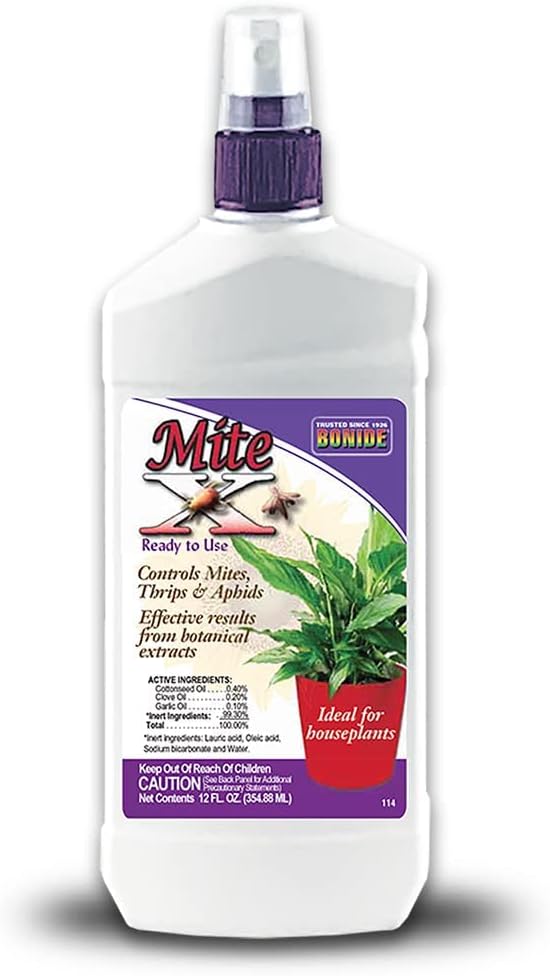
Bonide Captain Jack's Mite-X Houseplant Spray, 12 oz
| Unit Count | 12 Ounce |
|---|---|
| Item Form | Spray |
| Target Species | Insects |
| Liquid Volume | 12 fluid ounces |
| Specification Met | USDA |
Bonide Captain Jack's Mite-X is a ready-to-use contact spray formulated from botanical extracts to control mites, aphids and thrips on herbs, ornamentals and houseplants. You use it like any spray bottle product: target infested foliage and wet insects directly since it requires contact to kill pests. The product is convenient for spot treatments and can be applied up to the day before harvest, making it suitable for edible container herbs. Notable features include a trigger sprayer for easy application and a formula based on cottonseed, clove and garlic extracts rather than synthetic chemicals. For budget-minded gardeners this bottle provides a simple, low-effort way to suppress outbreaks without mixing concentrates. Limitations are that it is a contact spray so it will not control hidden or egg-stage pests and repeated applications are often necessary for full control; heavy infestations may need a more systemic or residual product. Follow safety guidance on the label when using around people and pets.
Best for: Gardeners who want a low-cost, easy-to-use spray to quickly knock down visible spider mites and other small insects on houseplants and container herbs.
Less Ideal for: Growers facing large-scale or chronic mite infestations who need systemic or long‑lasting control should consider stronger or professional options.
- Ready-to-use trigger spray requires no mixing
- Botanical active ingredients suitable for use up to day before harvest
- Effective on contact against mites, aphids and thrips
- Designed for both indoor and outdoor houseplants
- No residual or systemic activity so eggs and hidden pests may survive
Verdict: A convenient, budget-friendly botanical contact spray that quickly knocks down visible spider mites and other small pests on houseplants.
Athena IPM Ready-to-Use Insecticide & Fungicide Spray, 32 fl oz

| Brand | Athena |
|---|---|
| Unit Count | 32 Fluid Ounces |
| EPA Status | 25(b) minimum risk |
| Pest Targets | Spider mites, aphids, thrips |
| Use Type | Ready to use |
Athena IPM is a 32-ounce ready-to-use spray that combines botanical insecticidal and fungicidal action for routine plant protection. It is formulated to kill spider mites, aphids, thrips and contact-treat powdery mildew, so you use it by shaking the bottle and spraying affected leaves, stems, and surrounding foliage. Because it meets EPA 25(b) minimum risk criteria, it is positioned as an eco-friendlier option that can be used around people and pets when directions are followed. The product is versatile for outdoor beds, ornamental plants, vegetables, fruit trees and greenhouse use, and it requires no mixing or special equipment which simplifies regular preventive treatments. Practical limitations are that it is a contact-control product so it works best on visible infestations and vulnerable life stages rather than as a long-lasting residual solution, and repeated applications may be required for complete control of heavy infestations. Follow safety guidance for storage and keep away from children and pets while applying.
Best for: Gardeners and plant stewards who prioritize dependable, easy-to-use pest and mildew control and prefer lower-toxicity, ready-made solutions for routine outdoor plant care.
Less Ideal for: Anyone needing a long-lasting residual insecticide or rapid systemic control for severe, established infestations should consider professional or stronger systemic products.
- Ready-to-use formula requires no measuring or mixing
- Broad-spectrum action against common pests and powdery mildew on contact
- EPA 25(b) minimum risk ingredients for reduced chemical exposure when used as directed
- Suitable for a wide range of plant settings including gardens, greenhouses, and hydroponics
- Contact-only action provides limited residual control against re-infestation
- May require multiple applications for heavy or established pest problems
Verdict: A simple, lower-toxicity ready-to-use spray that reliably handles common outdoor plant pests and powdery mildew for gardeners who want straightforward, repeatable protection.
Bonide Captain Jack's Ready-to-Use Neem Oil Spray, 32 oz

| Item Form | Liquid |
|---|---|
| Target Species | Insects |
| Liquid Volume | 32 fluid ounces |
| Active Ingredients | Clarified Hydrophobic Extract of Neem Oil |
This ready-to-use neem oil spray is a multipurpose garden treatment that kills insects at all life stages while also serving as a miticide and preventative fungicide. Packaged in a 32-ounce trigger bottle, it is applied by shaking and thoroughly spraying plant surfaces, including leaf undersides, at the first sign of pests or disease and reapplying every 7 to 14 days as needed. The active ingredient is a clarified hydrophobic extract of neem oil, which is approved for organic gardening and labeled safe to use on vegetables up to the day of harvest. Practical benefits include broad pest coverage (aphids, whiteflies, spider mites and others), disease suppression such as powdery mildew, and convenience from a ready-to-use sprayer. Important limitations are that results are slower than synthetic contact insecticides and application timing matters to avoid leaf burn in full sun; repeated applications may be needed for heavy infestations. Follow label safety directions and keep the product away from children and pets.
Best for: Gardeners who want a single, organic-approved product to manage common vegetable garden pests and fungal problems and who prefer products with strong user feedback.
Less Ideal for: Growers needing rapid knockdown of severe infestations or commercial producers who require fast-acting, high-throughput treatments.
- Kills multiple pest stages including eggs, larvae and adults for more complete control.
- Also acts as a fungicide and miticide so one product covers pests and common fungal issues.
- Ready-to-use trigger bottle requires no mixing and is easy to apply to leaves and undersides.
- Approved for organic gardening and can be used on vegetables up to day of harvest.
- Slower-acting than many synthetic contact insecticides, so it may take several applications to see control.
- Must avoid spraying in peak sunlight to reduce risk of leaf burn.
Verdict: A convenient, organic-approved all-in-one neem spray that controls common vegetable garden pests and fungal issues with minimal fuss.
BioAdvanced Houseplant Insect & Mite Control Spray, 24 fl oz

| Unit Count | 24 Fluid Ounces |
|---|---|
| Item Form | Spray |
| Target Species | Insects |
| Active Ingredients | Sulfur 0.20%, Pyrethrins 0.01% |
This ready-to-use BioAdvanced spray combines an insecticide, miticide, and fungicide in one bottle for straightforward houseplant care. It is used by shaking the bottle and thoroughly spraying both upper and lower leaf surfaces, including new growth, to contact-kill listed pests like aphids, whiteflies, fungus gnats, and spider mites while also controlling fungal problems such as powdery mildew and leaf spot. The active ingredients include sulfur and pyrethrins, and the label allows application up to one day before harvest on herbs, making it practical for indoor edible plants as well as ornamentals. Its main benefits are convenience and breadth of coverage in one product, so you can treat multiple problems without mixing. Limitations are that effectiveness requires direct contact with pests and disease symptoms, and it is not a systemic treatment so it will not protect new growth after application for long periods. Users should follow safety instructions and avoid contact with children and pets during application.
Best for: Practical plant owners who want a single, easy spray to treat both pests and common fungal diseases on indoor ornamentals and herbs without mixing concentrates.
Less Ideal for: Growers seeking long-lasting systemic protection or targeted treatments for pest infestations that live inside soil or roots should consider specialized systemic products instead.
- Combines insect, mite, and fungal disease control in a single ready-to-use spray
- Works by contact to quickly kill listed pests including aphids, whiteflies, and fungus gnats
- Label permits use up to one day before harvest, so safe for herbs and edible plants when directions are followed
- Large 24 fluid ounce bottle provides multiple treatments for several houseplants
- Not systemic so it does not provide long-term internal protection for new growth
- Requires direct contact with pests or affected tissue to be effective
Verdict: A convenient all-in-one ready-to-use spray that quickly kills listed insects and treats common fungal diseases on houseplants and herbs.
Choosing the Right Insecticide Spray for Houseplants: Key Factors to Consider
Active Ingredient and Target Pests
Knowing the active ingredient tells you what pests the spray will control and how it works. Contact insecticides kill insects on contact but usually lack long-term residual protection, which is fine for a quick knockdown. Systemic active ingredients move through the plant vascular system and can protect new growth, but not all houseplants tolerate systemic uptake. Some ingredients are targeted for soft-bodied pests like aphids, mealybugs, and spider mites, while others have broader spectra that include scale and whiteflies.
Read label directions to confirm the insect spectrum and to check whether the active is appropriate for the species you grow. For recurring pests in high-humidity rooms, an ingredient with at least short residual action can reduce repeat treatments, but always balance that against phytotoxicity risk for sensitive foliage.
Plant Sensitivity and Phytotoxicity Risk
Houseplants include a wide range of leaf textures and thicknesses; thin-leaved tropicals and variegated varieties can scorch more easily than thick succulents. Phytotoxicity can appear as leaf spotting, yellowing, curling, or excessive drop after treatment. Labels sometimes list plant groups that are more susceptible, and manufacturer instructions will note whether to test on a single leaf before full-plant application.
Temperature, sunlight, and watering status at time of spraying affect risk. Avoid treating plants in direct bright sun or when heat is high. When a product suggests a dilution or a short contact time, follow that guidance and test first on an inconspicuous area to avoid damaging prized specimens.
Application Method and Indoor Practicality
Spray format determines how easy it is to treat potted plants without making a mess. Pump spray bottles give more control and lower drift than aerosols, which can be convenient but increase VOCs in closed rooms. Trigger sprayers let you target undersides of leaves and crevices where pests hide. Some concentrates require mixing and generate larger volumes for repeated treatments; others are ready-to-use for spot treatment.
Consider whether you need a fine mist for delicate foliage or a stronger stream for soil drench or trunk application. Also plan for containment: use trays, lay down newspaper, and ventilate the room to limit overspray and protect nearby textiles or electronics.
Residual Activity and Reapplication Schedule
Residual activity determines how long a product continues to protect after application. Short residual contact sprays may require multiple treatments spaced a few days apart to catch newly hatched pests. Longer residuals reduce application frequency but can leave residues on foliage and in potting mix, which may be undesirable for households with children or pets.
Balance the convenience of longer protection with the need for regular monitoring. For persistent infestations, integrate mechanical controls such as hand removal and isolation of affected plants alongside chemical treatments to reduce selection pressure and the number of sprays needed.
Indoor Air Quality, Scent, and Reentry Considerations
Because houseplants live inside occupied spaces, the scent and volatile organic compound profile of a spray matter. Strong solvents or aerosol propellants can produce lingering odors and irritate sensitive occupants. Products formulated for indoor or enclosed-space use often note shorter reentry times and lower odor.
Ventilation after application reduces exposure. If anyone in the home is pregnant, very young, elderly, or has respiratory issues, choose low-odor, low-VOC formulations and follow label reentry intervals. Keep treated plants separated from food preparation areas until any recommended waiting period has passed.
Residues in Soil and Effect on Beneficials
Some sprays are designed to be foliar-only, while others impact soil organisms when used as soil drenches or when residues wash into the potting mix. Beneficial predatory mites and pollinating insects brought indoors can be harmed by broad-spectrum insecticides. If you rely on biological controls or repot frequently, prefer sprays with minimal soil persistence or use targeted spot treatments.
Check label warnings about impact on beneficial insects and whether the product advises against soil soaking. For integrated pest management, combine cultural measures and selective sprays to preserve beneficial organisms.
Identifying the Culprit Before Spraying
Match treatment to the pest for best results. Inspect undersides of leaves, leaf axils, and the soil surface for signs such as webbing, sticky honeydew, cottony masses, or tiny moving dots. A hand lens helps with tiny mites and thrips.
If you cannot confidently identify the pest, start with gentle, contact-based options and perform spot tests on a single leaf. Correct identification reduces unnecessary exposure to stronger chemistries and improves success.
- Look for webbing for spider mites; sticky residue for aphids or whiteflies.
- Tap foliage over white paper to dislodge small insects for easier ID.
- Check new growth first; many pests congregate on tender shoots.
Application Tips for Indoor Use
Work in a well-ventilated room and protect nearby surfaces. Use trays or damp towels under pots to catch runoff and prevent residue on floors. Wear gloves and eye protection when recommended by the label.
Target hidden spots such as leaf joints and undersides where pests shelter. For systemic products that require root uptake, ensure the plant is watered lightly beforehand so roots can absorb the active ingredient.
- Avoid spraying in direct sunlight to reduce leaf scorch risk.
- Rotate spray angles and flip leaves to treat both surfaces.
- Isolate treated plants for the recommended reentry time.
When to Use Mechanical Controls Alongside Sprays
Physical removal is often the fastest way to reduce pest numbers before chemical treatment. Wiping leaves with a damp cloth, using a soft stream of water, or prying off mealybugs with a cotton swab can lower overall pesticide needs.
Combine mechanical methods with sprays to target remaining individuals and eggs. This integrated approach reduces repeat applications and lowers the chance of developing resistant pest populations.
- Prune heavily infested foliage to limit spread.
- Use sticky traps for flying pests to monitor infestation levels.
- Quarantine new plants for several weeks before adding them to your collection.
Safe Storage and Disposal of Leftover Spray
Store insecticide sprays in their original containers in a locked, cool, dry place away from food and reach of children or pets. Keep labels intact and avoid transferring contents to other bottles to prevent misuse.
Follow local regulations for disposal; do not pour concentrated leftover into drains. Rinse empty spray bottles only if the label permits and dispose according to municipal guidance.
- Mark the cabinet where you store garden chemicals so household members know to avoid it.
- Keep a small spill kit and absorbent material nearby when mixing concentrates.
Monitoring After Treatment
Check treated plants regularly for signs of recovery or continued activity. Look for dead insects, decline in new feeding damage, and any signs of phytotoxicity. Reapply according to label intervals only if pest activity persists.
Record treatments and outcomes to learn which approaches work best for each plant species and pest type. Consistent monitoring prevents small problems from becoming large infestations.
- Inspect plants twice weekly for two to three weeks after treatment.
- Keep a treatment log with dates, product used, and observed effects.
How We Chose the Best Insecticide Spray for Houseplants
We prioritized sprays designed to work on the pests most common indoors and to be safe for use on typical houseplants. Evaluation centered on four to six concrete dimensions gardeners can verify on labels or in product literature: active ingredient spectrum and contact action, phytotoxicity risk on tender foliage, ease of application indoors, residual activity against returning pests, and scent or VOC profile that affects indoor air. We also looked at coverage method options such as aerosols, pump sprays, and hose-end compatible concentrates when applicable. We excluded products formulated only for outdoor landscapes, for pets, or for food-crop field use that do not list houseplant-safe directions. Poorly documented mixes or unclear label instructions were also filtered out. The final shortlist contains sprays whose labels and typical use cases align with indoor houseplant care and that provide clear guidance for safe application and re-entry times.
FAQ
How soon can I bring a treated houseplant back indoors after spraying?
That depends on the product label and the spray type. Many low-odor, indoor-labeled sprays have short reentry intervals, but aerosols or solvent-heavy formulations may require longer ventilation before returning plants to occupied areas. Always follow the manufacturer's reentry guidance and ventilate the room well.
Are natural or botanical sprays safe for all houseplants?
Natural or botanical sprays are often gentler but are not universally safe. Essential oils and soaps can still cause leaf burn on sensitive varieties, especially under heat or bright light. Test any new spray on a single small area before treating the whole plant.
Can I use the same spray on succulents and tropicals?
You should be cautious. Succulents tolerate some formulations less well than tropical foliage because of differing leaf thickness and surface chemistry. Check label guidance for plant types and perform a spot test to confirm there is no adverse reaction.
How many treatments are usually needed to clear an infestation?
It often takes multiple treatments spaced according to the label to reach eggs that hatch after the first application. For contact sprays, plan on at least two to three applications a week apart. Integrating physical removal reduces the number of chemical treatments required.
Will insecticide spray harm beneficial insects in an indoor setting?
Broad-spectrum sprays can harm beneficial predatory mites and other organisms if they are present indoors. If you use biological controls, choose targeted products with minimal soil persistence and apply sprays selectively to affected plants rather than broadcasting treatments.
Is it safe to mist flowering houseplants with insecticide sprays?
Avoid spraying open flowers whenever possible because residues can land on nectar and pollen. If treating a flowering plant is necessary, use spot treatments on foliage and avoid direct contact with blooms.
Final Verdict
For houseplants, prioritize products that balance effective pest control with low phytotoxicity and minimal indoor air impact. Focus on the pest spectrum, application method, and residual profile that fit your indoor growing conditions and household sensitivities. Adopt an integrated approach: correctly identify the pest, use mechanical removal where possible, and follow label instructions for safe application and timing. That way you can regain healthy foliage while minimizing risks to people, pets, and the plants themselves.
