

Note: This article contains affiliate links. If you click on these links and make a purchase, I may earn a small commission at no extra cost to you. This helps support my research and content. Read my full affiliate disclosure here.
Pest pressure can quickly reduce yield and damage tender foliage in vegetable beds, so picking the right insecticide spray matters. You need a product that reduces chewing and sap-sucking insects without stressing transplants or contaminating harvest windows. This guide covers the top shortlisted insecticide sprays for vegetables selected for real garden use. We evaluated each option for on-plant effectiveness, crop safety, and ease of application so you can match a product to the pests and growing stage in your plot. Read on to find the best fit for your vegetable garden and move to application with confidence.
Top Picks at a Glance
| Best Overall The best all-around choice for most situations | Bonide Captain Jack's Deadbug Brew Concentrate, 32 oz |  |
| Best Quality Built to a higher standard if you want something more solid | BioAdvanced Vegetable & Garden Insect Spray Concentrate, 32 fl oz |  |
| Best Value The sweet spot between price and what you get | Garden Safe Insecticidal Soap Ready-to-Use Spray, 32 oz |  |
| Best Budget The cheapest option that still gets the job done reliably | BioAdvanced Organics Neem Oil Spray, Ready-to-Use, 24 fl oz |  |
| Highest Rated A top-rated pick with lots of positive feedback | Bonide Captain Jack's Bt Thuricide Ready-to-Use Spray, 32 oz |  |
| Most Popular A crowd favorite that many people choose with confidence | Bonide Captain Jack's Ready-to-Use Neem Oil Spray, 32 oz |  |
Bonide Captain Jack's Deadbug Brew Concentrate, 32 oz

| Unit Count | 32 Ounce |
|---|---|
| Item Form | Liquid |
| Target Species | Insects |
| Active Ingredients | Spinosad |
Bonide Captain Jack's Deadbug Brew is a concentrated spinosad-based insecticide designed for use on vegetables, fruits, flowers, and ornamentals in organic gardens. You mix the concentrate with water and apply it with a trigger, hand-held, backpack, or hose-end sprayer to target caterpillars, beetles, borers, leaf miners, thrips, spider mites and other listed pests. Because the active ingredient is spinosad, the product targets many chewing and some sucking insects while having limited impact on predatory beneficials when used as directed. The concentrate format keeps storage and transport compact and lets you treat multiple beds or trees from one bottle. Important limitations are following label directions closely for application rates and timing and taking normal safety precautions; like all insecticides it will not selectively remove a single pest species and repeated use can require integrated pest management strategies. For gardeners seeking a broadly effective, organic-eligible spray, this is a practical go-to option.
Best for: Gardeners who want a single, broadly effective insecticide approved for organic use to protect vegetables, fruits and ornamental beds and who prefer a concentrate that treats multiple areas.
Less Ideal for: People seeking an immediate-contact knockdown spray for household pests or those unwilling to follow dilution and safety instructions should consider other options.
- Contains spinosad, an organic-approved active ingredient effective against many caterpillars, beetles, borers and leaf-feeding pests
- Concentrate mixes easily with water and works with common sprayers including trigger, backpack and hose-end models
- Approved for use on a wide range of edible and ornamental plants, including vegetables, fruits and ornamentals
- Formulation is designed to have limited impact on predatory beneficial insects when used according to the label
- Requires careful dilution and adherence to label directions for safe and effective use
- Not selective to a single pest species and may require integration with other IPM practices
Verdict: Choose this concentrated spinosad spray if you want a versatile, organic-approved insecticide to protect a wide range of garden plants.
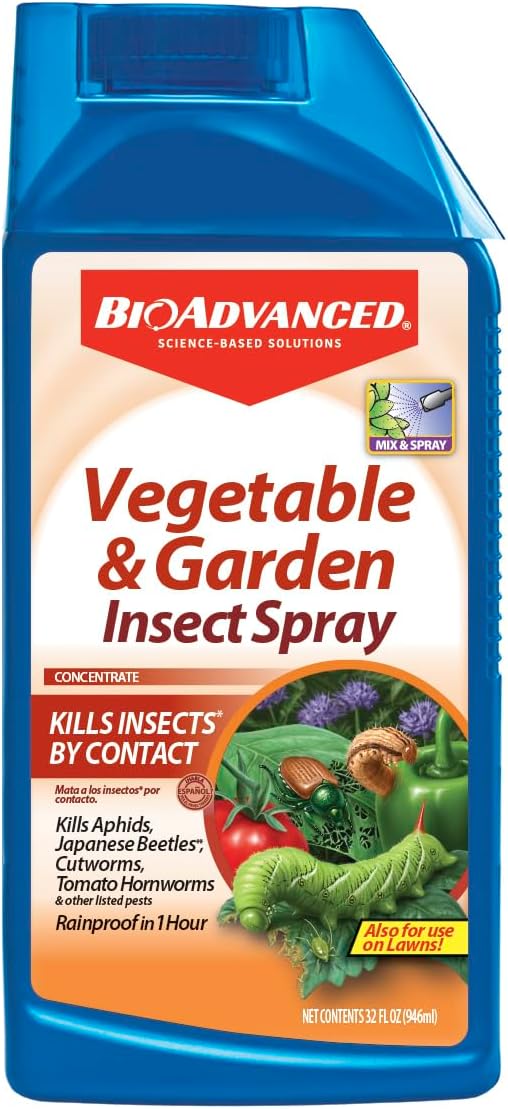
BioAdvanced Vegetable & Garden Insect Spray Concentrate, 32 fl oz
| Item Form | Spray |
|---|---|
| Target Species | Insects |
| Liquid Volume | 32 fluid ounces |
| Active Ingredients | Cyfluthrin |
This BioAdvanced concentrate is designed for gardeners who need a versatile, broad-spectrum insect control for outdoor plants. The bottle mixes into a ready spray that kills common pests on contact, including aphids, caterpillars, whiteflies, and tomato hornworms, and the formula becomes rainproof in about an hour so treatments hold up to light rain. Because it is a concentrate, one 32-ounce bottle makes up to 64 gallons of spray, which is convenient for treating larger beds or multiple plantings without frequent repurchasing. Typical use is diluting to label rates, filling a garden sprayer, and coating leaves until wet but not dripping. The main limitation is that it uses a synthetic pyrethroid active ingredient so it will also affect nontarget insects including beneficials if oversprayed, and label precautions must be followed for edible crops and pollinators. It is not a selective or organic option, but for balanced gardeners wanting an effective, easy-to-apply contact insecticide for outdoor plants, it provides strong, reliable control.
Best for: Gardeners who want a single, effective contact insecticide to protect vegetables, fruits, and ornamentals across a typical backyard garden and value ease of use and wide pest coverage.
Less Ideal for: Growers who prioritize organic methods, pollinator-safe selective controls, or those managing very small container plantings where concentrate dilution is inconvenient.
- Concentrate mixes to make up to 64 gallons, suitable for treating large areas
- Kills a wide range of listed garden pests on contact, including common vegetable pests
- Rainproof protection within one hour helps treatments withstand light rain
- Can be applied with most common garden sprayers for straightforward use
- Contains a synthetic pyrethroid (cyfluthrin) that can harm beneficial insects if not used carefully
- Not an organic or selective option for gardeners seeking softer pest control
Verdict: A productive, rainproof concentrate that delivers broad, contact insect control for gardeners who need reliable protection across vegetable and outdoor plantings.
Garden Safe Insecticidal Soap Ready-to-Use Spray, 32 oz

| Item Form | Spray |
|---|---|
| Target Species | Insects |
| Liquid Volume | 32 fluid ounces |
| Active Ingredients | Potassium Salts Of Fatty Acids |
Garden Safe Insecticidal Soap is a ready-to-use contact spray formulated with potassium salts of fatty acids to control aphids, mealybugs, mites, whiteflies and similar soft-bodied pests. You use it like a normal garden spray: thoroughly coat insects and all plant surfaces including undersides of leaves, ideally in calm weather and not in full sun. It is safe for use on vegetables, fruit trees, ornamentals, shrubs, flowers and in greenhouses and may be applied to edibles up to the day of harvest, which simplifies timing for vegetable growers. The spray works on direct contact so thorough coverage is essential and multiple applications may be needed for heavy infestations. The product is convenient because no mixing is required, but it can be washed off by rain and is hazardous to aquatic invertebrates so care is needed to avoid runoff into water. For routine control of common garden pests this soap is a practical, low-toxicity option when used as part of an integrated pest management approach.
Best for: Gardeners who prioritize practical, low-toxicity pest control and want a ready-made spray that can be used on edible crops without pre-harvest delays.
Less Ideal for: People needing a long-residual or systemic pesticide for heavy infestations or for pests hidden inside plant tissues should consider other control methods.
- Ready-to-use formula requires no mixing for quick spot treatments
- Labeled for use on vegetables and may be applied up to the day of harvest
- Controls a broad list of soft-bodied pests including aphids, mites and whiteflies
- Plant-safe when used as directed and usable indoors, outdoors and in greenhouses
- Only kills pests by direct contact so it has limited residual or systemic activity
- Can be washed off by rain and must be reapplied after watering or heavy rainfall
- Harmful to aquatic invertebrates so it requires careful application near water
Verdict: A convenient, low-toxicity ready-to-use soap spray that gives effective contact control of common soft-bodied garden pests and is safe to use up to harvest.
BioAdvanced Organics Neem Oil Spray, Ready-to-Use, 24 fl oz

| Unit Count | 24 Fluid Ounces |
|---|---|
| Item Form | Oil |
| Target Species | Spider |
| Specification Met | OMRI |
| Active Ingredients | Clarified Hydrophobic Extract of Neem Oil 0.9% |
This BioAdvanced Organics Neem Oil spray is a ready-to-use 3-in-1 treatment for home gardeners who need broad protection from both pests and common fungal diseases. The trigger bottle applies neem oil in a clarified hydrophobic extract formulation that kills eggs, larvae, and adults of listed insects such as aphids, whiteflies, and spider mites on contact while also helping prevent and control fungal problems like black spot, powdery mildew, and rust when used on a 7 to 14 day schedule. It is labeled for roses, flowers, vegetables, fruits and shrubs and can be used up to the day of harvest, making it suitable for edible gardens. Practical benefits include convenience of a pre-mixed spray, multi-target control in one treatment, and OMRI recognition for organic gardening. Limits to expect are that it is a contact-based product so full coverage is required for effectiveness and repeated applications are needed for prevention, and results can be slower than synthetic pesticides for heavy infestations. The bottle is best for small to medium gardens and spot treatments rather than large-scale applications.
Best for: Gardeners who want a single, organic-friendly spray to manage common insects and fungal issues on roses, ornamentals, and edible plants without mixing concentrates.
Less Ideal for: Those managing very large beds or commercial plantings who need high-volume coverage or fast knockdown from systemic synthetic products should consider concentrate or professional options.
- Ready-to-use trigger spray for easy application
- Combines insecticide, miticide, and fungicide action in one product
- Labeled for use on edible plants and permitted up to day of harvest
- OMRI listed formulation suitable for organic gardening
- Effectiveness depends on thorough coverage because it works primarily on contact
- Requires repeated applications on a regular schedule for disease prevention
Verdict: A convenient ready-to-use organic neem spray that gives home gardeners broad, multi-purpose protection against common insects and fungal diseases.
Bonide Captain Jack's Bt Thuricide Ready-to-Use Spray, 32 oz

| Unit Count | 32 Ounce |
|---|---|
| Item Form | Spray |
| Target Species | Insects |
| Active Ingredients | Bacillus Thuringiensi,Lapidapteran Active Toxins |
Bonide Captain Jack's Bt Thuricide is a ready-to-use biological spray that delivers Bacillus thuringiensis (Bt) to control caterpillars and worm-stage insects. You apply it with the trigger sprayer directly to the tops and undersides of leaves when you first see feeding damage; it is labeled for use on vegetables, fruit, shade trees and ornamentals and can be used up to the day of harvest on edibles. Because it kills by ingestion, treated pests stop feeding within a couple of days while birds, earthworms and many beneficial insects are largely unharmed. The product is convenient for small-to-medium infestations since it needs thorough coverage and repeat applications for new larvae. It is approved for organic gardening and comes in a 32-ounce bottle that is easier to use than concentrates for spot treatments, but using a ready-to-use bottle across a large property can become time consuming compared with hose-end or pressurized sprayers.
Best for: Gardeners who prioritize proven, low-risk biological control and want an easy spray for spot treating caterpillars on edible and ornamental plants; ideal for those who value safety around beneficials and pets.
Less Ideal for: People needing fast-contact knockdown for a large-scale outbreak or who must treat many acres quickly should consider concentrates or professional application methods instead.
- Targets caterpillars and worm-stage pests with a proven Bt active ingredient
- Safe for use on edible plants up to day of harvest when label directions are followed
- Ready-to-use trigger bottle requires no mixing for quick spot treatments
- Labeled for a wide range of plants including vegetables, ornamentals and shade trees
- Requires insects to ingest product so results are not immediate and depend on good spray coverage
- Ready-to-use bottle is less efficient for treating large areas compared with concentrates or hose-end applicators
Verdict: A convenient, organic-ready Bt spray that reliably controls caterpillars and worm pests while protecting beneficials, ideal for careful gardeners treating spot infestations.
Bonide Captain Jack's Ready-to-Use Neem Oil Spray, 32 oz

| Item Form | Liquid |
|---|---|
| Target Species | Insects |
| Liquid Volume | 32 fluid ounces |
| Active Ingredients | Clarified Hydrophobic Extract of Neem Oil |
This ready-to-use neem oil spray is a multipurpose garden treatment that kills insects at all life stages while also serving as a miticide and preventative fungicide. Packaged in a 32-ounce trigger bottle, it is applied by shaking and thoroughly spraying plant surfaces, including leaf undersides, at the first sign of pests or disease and reapplying every 7 to 14 days as needed. The active ingredient is a clarified hydrophobic extract of neem oil, which is approved for organic gardening and labeled safe to use on vegetables up to the day of harvest. Practical benefits include broad pest coverage (aphids, whiteflies, spider mites and others), disease suppression such as powdery mildew, and convenience from a ready-to-use sprayer. Important limitations are that results are slower than synthetic contact insecticides and application timing matters to avoid leaf burn in full sun; repeated applications may be needed for heavy infestations. Follow label safety directions and keep the product away from children and pets.
Best for: Gardeners who want a single, organic-approved product to manage common vegetable garden pests and fungal problems and who prefer products with strong user feedback.
Less Ideal for: Growers needing rapid knockdown of severe infestations or commercial producers who require fast-acting, high-throughput treatments.
- Kills multiple pest stages including eggs, larvae and adults for more complete control.
- Also acts as a fungicide and miticide so one product covers pests and common fungal issues.
- Ready-to-use trigger bottle requires no mixing and is easy to apply to leaves and undersides.
- Approved for organic gardening and can be used on vegetables up to day of harvest.
- Slower-acting than many synthetic contact insecticides, so it may take several applications to see control.
- Must avoid spraying in peak sunlight to reduce risk of leaf burn.
Verdict: A convenient, organic-approved all-in-one neem spray that controls common vegetable garden pests and fungal issues with minimal fuss.
Choosing the Right Insecticide Spray for Vegetables: Key Factors to Consider
Target Pest Spectrum
Know which pests are causing damage before selecting a spray. Some products are broad-spectrum and suppress chewing insects like caterpillars and beetles as well as sap-suckers such as aphids and whiteflies, while others target a narrower group. Matching the active ingredient to the pest reduces unnecessary exposure and improves control outcomes.
Accurate identification affects timing and application rate. For example, translaminar activity helps reach larvae feeding on undersides of leaves, whereas contact-only sprays require thorough coverage. Consider seasonal pest cycles so you apply a product that interrupts the pest population effectively.
Crop Safety and Timing
Vegetables vary in sensitivity to active ingredients and to spray droplets on flowers or young leaves. Check the crop safety profile and recommended application stages to avoid leaf burn or flower drop. Preharvest interval and re-entry restrictions determine when fruit can be harvested and when gardeners can safely return to beds.
Avoid sprays with a history of phytotoxicity on tender transplants or in hot, sunny conditions. When possible, choose products with short wait periods before harvest for short-season vegetables and pick those that are labeled safe for use on edible tissues.
Residue and Environmental Exposure
Residual activity influences how often you need to reapply and how long beneficial insects and pollinators may be affected. Longer-residual chemistries lower application frequency but can pose higher non-target risk. Shorter-residual or more selective options preserve beneficial predators and pollinators when used carefully.
Consider how spray drift, runoff, and persistence in soil might impact adjacent plantings, water features, and pollinator habitat. Use application practices that minimize off-target exposure and read label guidance about buffer zones and environmental precautions.
Mode of Action and Resistance Management
Active ingredient mode of action affects effectiveness and the risk of pests developing resistance. Rotating sprays with different modes of action reduces selection pressure on pest populations. Grouping products by chemistry helps plan a season-long program that alternates modes and limits repeated use of the same mechanism.
Integrated pest management adds non-chemical tactics alongside sprays to preserve effectiveness. Use monitoring and threshold-based applications rather than calendar sprays to reduce resistance risk.
Applicator Convenience and Coverage
How easy a product is to mix and apply matters when you are treating multiple beds or a small market plot. Look for clear dilution instructions, ready-to-use or concentrated formats that match your sprayer capacity, and spray patterns that wet both upper and lower leaf surfaces.
Consider nozzle compatibility, foaming tendency, and how often agitation is needed in the tank. Products that clog nozzles or require repeated mixing increase application time and reduce thoroughness, which can undermine control.
Safety Precautions and Protective Equipment
Spray safety is essential in edible gardens. Review required personal protective equipment for mixing and applying and consider formulations that reduce inhalation risk or dermal exposure. Some formulations recommend gloves and respirators, while others require minimal protection when used at label rates.
Plan for safe storage, label the sprayer after use, and follow wash and hygiene guidance to avoid residue transfer to harvested produce. Proper handling protects both the applicator and the integrity of the crop.
Common Vegetable Pests and Symptom-Based Diagnosis
Recognizing the signs of pest feeding helps you pick the right spray and apply it at the right time. Look for chewed leaves, ragged holes, skeletonized foliage, sticky honeydew from sap-feeders, distorted new growth, and small larvae or adult insects on the underside of leaves.
- Chewing damage often indicates caterpillars, beetles, or grasshoppers and usually responds to contact and ingested toxins.
- Sticky residue and curled leaves suggest aphids or whiteflies and may require systemic or translaminar coverage.
- Small holes and linear feeding can indicate flea beetles, which need products that contact small, active pests.
Application Timing and Technique for Best Results
Apply sprays during early morning or late evening when pollinators are less active and temperatures are moderate. Aim for complete coverage of both upper and lower leaf surfaces, new growth, and the undersides of leaves where many pests hide. Reapply at intervals recommended on the label based on rainfall and pest pressure.
- Avoid spraying open blossoms if possible to protect pollinators; treat at dusk or target foliage only when crops are flowering.
- Maintain proper droplet size for coverage without excessive drift; finer droplets improve coverage but increase drift risk.
- Agitate the tank as directed and replace nozzle tips that show wear to preserve spray pattern.
Integrating Sprays With Cultural and Biological Controls
Use sprays as one tool in an integrated program that includes crop rotation, sanitation, physical barriers, and encouragement of predatory insects. Removing crop residue, weeding, and scouting reduce pest habitat and population buildup. Beneficial insects such as lacewings and parasitic wasps help maintain pest levels but can be harmed by broad-spectrum sprays.
- Reserve targeted sprays for threshold-based outbreaks rather than routine calendar applications.
- Use selective or lower-residual options when beneficials are present or when cultural controls are in place.
- Combine row covers early in the season with targeted sprays later to reduce total chemical applications.
Sprayer Types and Nozzle Selection
Different sprayers suit different garden scales and application goals. Hand-pump and hose-end sprayers work for small beds and spot treatment, while backpack and compression sprayers provide more consistent coverage for larger plots. Nozzle choice affects droplet size and coverage and should match the product label recommendations.
- Use flat-fan nozzles for even coverage on broadleaf crops.
- Choose cone or hollow-cone nozzles for dense canopies requiring penetration.
- Check for sprayer compatibility with concentrated formulations to avoid corrosion or clogging.
Minimizing Impact on Pollinators and Beneficials
Protect pollinators by timing sprays outside peak foraging hours and avoiding bloom where possible. When treatment of flowering plants is unavoidable, select options with lower toxicity to bees and apply in late evening to let residues degrade before morning foraging begins. Spot-spray affected areas instead of blanket applications to preserve nearby beneficial insect habitat and reduce overall environmental load.
- Establish flowering margins away from vegetable beds to provide refuge for pollinators.
- Monitor beneficial populations and adjust spray choice to be more selective when beneficials are abundant.
How We Chose the Best Insecticide Spray for Vegetables
Our shortlist focuses on insecticide sprays that are appropriate for edible plantings and realistic backyard-to-small-farm vegetable production. We prioritized products formulated or labeled for common vegetable pests and considered how each option behaves when used on leaves, flowers, and fruiting structures. Selection criteria emphasized pest control spectrum, active ingredient profile, and documented compatibility with common vegetable crops. We also assessed crop safety factors such as preharvest interval, phytotoxicity risk on tender foliage, and suitability for use on transplants. Practical application aspects like spray pattern, dilution flexibility, and equipment compatibility were reviewed to reflect real garden handling. We excluded products labeled only for ornamental use, foggers, and systemic soil drenches not intended for foliar application. We also excluded granular insecticides and biological control agents delivered by release rather than spray. The filters ensured every included spray is positioned for targeted foliar pest control in vegetable production and scored against pest coverage, crop safety, ease of application, and environmental exposure.
FAQ
Can I spray vegetables while they are flowering?
Spraying while vegetables are flowering increases risk to pollinators and may cause flower injury depending on the product. If you must treat, apply in the evening after pollinators finish foraging and use a product labeled safe for blooming crops with minimal bee toxicity.
How soon after spraying can I harvest vegetables?
Harvest interval varies by active ingredient and formulation, so check the product label for the specific preharvest interval. Many foliar sprays have short wait periods measured in days, while some require longer intervals for certain crops.
Will repeated use of the same spray cause resistance?
Repeated use of the same mode of action can select for resistant pest populations. Rotate sprays with different modes of action, use threshold-based applications, and integrate non-chemical controls to slow resistance development.
Are there safe spray options for transplant stage seedlings?
Some formulations are labeled for use on transplants and young seedlings, but tender plants are more prone to phytotoxicity. Use lower labeled rates, avoid spraying in hot sun, and test a small area first if the label permits.
Can I mix different insecticide sprays in the same tank?
Tank mixing depends on compatibility and label instructions. Do not mix without checking the label for allowed tank mixes and performing a jar test when guidance is unclear. Some combinations can reduce effectiveness or increase phytotoxicity.
How do I choose between contact and systemic sprays?
Contact sprays work by contacting the pest and are good for fast knockdown, while systemic or translaminar products move into plant tissues and can protect new growth. Choose based on pest behavior, crop stage, and whether coverage of undersides and interior foliage is achievable.
Final Verdict
Choosing the right insecticide spray for vegetables means balancing effective pest control with crop safety and environmental responsibility. Prioritize products that match the target pest spectrum, have acceptable preharvest intervals for your crops, and fit your sprayer and application routine. Rotate modes of action and integrate cultural and biological controls to preserve efficacy over time. Use the decision criteria outlined in this guide to select a spray that meets your pest control needs while minimizing non-target impacts and harvest disruption. Thoughtful timing and precise application will deliver the best results for healthy, productive vegetable beds.
