

Note: This article contains affiliate links. If you click on these links and make a purchase, I may earn a small commission at no extra cost to you. This helps support my research and content. Read my full affiliate disclosure here.
If you grow plants indoors, the right grow light changes how well seedlings take off, how compact foliage stays, and how abundant blooms become. This guide focuses on the most useful grow lights for indoor gardening situations, from small seed trays and cloches to larger tent and shelf setups. We shortlisted seven top-rated grow lights and evaluated each against practical gardener priorities like spectrum output, usable light per watt, heat management, and fixture durability. Read on to match a solution to your space, plant types, and desired control over light cycles.
Top Picks at a Glance
| Best Overall The best all-around choice for most situations | VIVOSUN LumaLight 100W LED Full Spectrum Grow Light |  |
| Best Quality Built to a higher standard if you want something more solid | Spider Farmer G5000 LED Grow Light — App‑Controlled, 480W, 4×4 Coverage |  |
| Best Value The sweet spot between price and what you get | EWPJDK 84‑LED Clip Gooseneck Full Spectrum Grow Light with Timer |  |
| Best Budget The cheapest option that still gets the job done reliably | Briignite A19 Full Spectrum LED Grow Light Bulb (2-Pack) |  |
| Highest Rated A top-rated pick with lots of positive feedback | GLOWRIUM 48W Dual-Head Full Spectrum Tall LED Grow Light |  |
| Most Popular A crowd favorite that many people choose with confidence | GooingTop HY-021 Clip-On Full-Spectrum LED Grow Light |  |
| Best Seller A high-volume bestseller chosen again and again | Barrina T5 1ft LED Grow Lights, 5000K Full Spectrum (4-Pack) |  |
VIVOSUN LumaLight 100W LED Full Spectrum Grow Light

| Wattage | 100 watts |
|---|---|
| Light Source Type | LED |
| Number of Light Sources | 336 |
| Is Waterproof | True |
| Control Method | Remote |
The VIVOSUN LumaLight 100W is a compact full-spectrum LED grow light intended for indoor gardens and patios. It uses a mix of white, blue, red and far-red diodes to support all growth stages from seedlings through flowering, and the array is arranged to deliver uniform intensity across the canopy. Typical use is hanging above a small grow area with the included rope hangers and adjusting intensity via the four-level dimming knob or remote/mobile control when paired with VIVOSUN accessories. Notable features include IP65 water and dust resistance for high-humidity setups, a low-heat design for closer placement to plants, and Bluetooth/remote control compatibility for easier scheduling. Practical benefits are even coverage for several small plants, lower heat stress, and long expected LED life. Limitations are its 100W power level, which is best for small tents or a few plants rather than larger grow rooms, and some advanced scheduling requires the separate GrowHub controller for full smart automation.
Best for: A practical home grower who wants a reliable, compact full-spectrum light for seedlings through flowering and values even coverage and low heat in a small tent or patio setup.
Less Ideal for: Large-scale growers or those outfitting multi-shelf systems who need higher wattage fixtures or broader coverage should consider more powerful models.
- Full-spectrum diode mix (white, blue, red, far-red) suitable for all growth stages
- Dimmable four-level control plus Bluetooth/remote connectivity for convenient intensity adjustments
- IP65 waterproof and dustproof rating allows use in humid or misted environments
- Low-heat design with aluminum body for efficient thermal management and longer LED life
- At 100 watts it is intended for small tents or modest plant counts and not optimized for larger grows
- Advanced smart scheduling requires purchasing the GrowHub controller separately
Verdict: A dependable, compact full-spectrum LED grow light that delivers even coverage and low heat for small indoor grows.
Spider Farmer G5000 LED Grow Light — App‑Controlled, 480W, 4×4 Coverage

| Light Source Type | Light Emitting Diode |
|---|---|
| Power Source | Corded Electric |
| Voltage | 120 volts |
| Wattage | 480 watts |
| Mounting Type | Ceiling Mount |
The Spider Farmer G5000 is a high-output LED panel built to run a 4×4 grow tent or small grow room through a complete crop cycle. It delivers a full spectrum tuned for seedlings through flowering and uses a dense array of Bridgelux diodes to spread light evenly across the canopy while keeping heat low. Typical use is ceiling-mounted above a 4×4 area where the unit’s digital dimmer and app control let you set schedules, simulate sunrise/sunset, and drop output from 10 to 100 percent as plants move between growth stages. The daisy-chain dimming and APP support make it easy to control multiple fixtures from one controller. Practical benefits include strong, uniform coverage, energy-efficient PPE around the stated spec, and a five-year warranty for longer runs. Important limitations are the fixed 4×4 personal coverage expectation and the need to match hanging height and light schedule to your crop; growers wanting higher PPE or larger single-fixture coverage may prefer a different series or a higher-spec diode option.
Best for: Serious hobbyists and performance‑focused growers who need reliable, uniform light for a 4×4 tent and value precise scheduling and remote control to maximize yields.
Less Ideal for: Casual plant owners with single houseplants or growers who need single-fixture coverage for areas larger than 4×4 feet; those prioritizing the absolute highest PPE available should consider higher-tier models.
- High 480W output with dense Bridgelux diode array for uniform canopy penetration
- Full spectrum suitable for seedling to flowering stages
- App control plus digital dimmer and daisy-chain capability for multi-light scheduling
- Designed for low heat and energy-efficient operation relative to output
- Five-year warranty and recognized safety certifications (CE, ETL, FCC)
- Personal coverage optimized for 4×4 spaces so larger rooms require multiple units
- PPE stated in comparative materials but not a separately listed spec on the product page
Verdict: If you want a performance-focused 4×4 full-cycle grow light with app control, dimming, and dependable uniform coverage, the Spider Farmer G5000 is a strong choice.
EWPJDK 84‑LED Clip Gooseneck Full Spectrum Grow Light with Timer

| Number of Light Sources | 84 |
|---|---|
| Wattage | 10 watts |
| Voltage | 5 volts_of_direct_current |
| Connectivity Technology | USB |
| Controller Type | Push Button, Timer Function |
This compact EWPJDK clip grow light is aimed at boosting light for desktop and small indoor plants. It plugs into USB power, clamps to shelves or desks with a strong padded clip and uses a flexible gooseneck so you can aim the 84 LEDs over seedlings, succulents or potted herbs. The lamp offers three spectra—white, red, and combined—and ten dimming steps, so you can match intensity to seedling, vegetative or flowering stages. A built‑in cycle memory timer (3/9/12 hours) automates daily schedules, which is handy if you forget to switch lights. At about 10 watts the light is low power and runs cool, making it safe for close placement to foliage. Limits to expect are the small coverage area and modest power, so it will not replace larger fixtures for multiple plants or wide trays. Also it is not water resistant so it should be kept away from humid setups and wet benches. For single pots, propagation trays and desk gardening it is a practical, easy to position option.
Best for: Gardeners who want a low‑effort, energy‑efficient solution for single pots, seedlings or a small windowsill and who value an easy to position, set‑and‑forget light.
Less Ideal for: Growers planning to light multiple plants, large trays, or a grow tent should choose a higher‑output panel or multiple fixtures instead.
- Flexible gooseneck and strong padded clamp make it easy to position and secure on desks or shelves
- Three light modes and 10 dim levels let you tailor spectrum and intensity to growth stages
- Built‑in memory timer with 3/9/12 hour cycles automates daily light schedules
- Low 10 watt draw and USB power keep energy use and heat minimal for close placement
- Small footprint and limited output mean it only covers a few small pots or seedlings
- Not water resistant so it cannot be used in humid or wet greenhouse benches
Verdict: A compact, low‑power clip grow light with adjustable spectrum and a memory timer that makes automated care simple for single pots and small seedlings.
Briignite A19 Full Spectrum LED Grow Light Bulb (2-Pack)

| Light Type | LED |
|---|---|
| Additional Features | Full Spectrum |
| Bulb Base | E26 |
| Light Output Maximum | 1000 lumens |
| Light Source Operating Life | 30000 hours |
These Briignite A19 grow light bulbs are a straightforward, budget-friendly option for indoor gardeners who need plug-and-play lighting. Each 11–12 watt bulb delivers about 1000 lumens with a 3500–4000K full-spectrum output that appears warm white while including red and blue wavelengths useful for seedlings, leafy greens and fruiting vegetables. They use a standard E26 base so you can install them in existing lamps or fixtures without adapters. Practical benefits include low power draw compared with incandescent equivalents and an advertised LED lifetime around 25,000–30,000 hours, plus a metal and plastic housing for basic heat dissipation. Limitations are that these bulbs are not purpose-built high-output fixtures for large canopy areas so you will need multiple bulbs or closer placement for denser plantings and the product listing suggests app control but the core item functions as a simple push-button bulb. For small windowsill gardens, herbs and single-tier grow setups this delivers usable light at a low cost, but larger or multi-tier operations will want higher PPFD fixtures designed for heavier production.
Best for: Growers on a tight budget who want an easy, no-fuss way to add usable full-spectrum light to windowsills, hobby planters, or single-shelf indoor gardens.
Less Ideal for: Those running multi-shelf, larger canopy, or production-focused grows that need high PPFD and engineered light distribution should choose purpose-built grow fixtures instead.
- Full-spectrum output that mimics natural sunlight while appearing warm white indoors
- Low power consumption (about 11–12W) for energy-efficient continuous use
- Standard E26 base for easy installation in existing lamps and fixtures
- High claimed operating life (around 25,000–30,000 hours) for fewer replacements
- Not a high-output commercial fixture so coverage is limited for larger or dense plantings
- App/control features appear limited compared with dedicated smart grow systems
Verdict: A cheap, easy-to-install full-spectrum A19 bulb pack that gives small indoor gardens usable plant light without major setup or expense.
GLOWRIUM 48W Dual-Head Full Spectrum Tall LED Grow Light

| Wattage | 48 watts |
|---|---|
| Light Source Type | LED |
| Number of Light Sources | 268 |
| Power Source | Corded Electric |
| Additional Features | Adjustable Arm, Adjustable Height, Dimmable, Full Spectrum, Timer |
This GLOWRIUM floor-standing grow light is built for steady, long-term indoor plant support. It uses 268 LEDs across two adjustable heads to deliver full-spectrum modes for seedling, vegetative, and flowering stages, and the 48W output with tested PPFD up to about 280 μmol/m²/s at 6 inches is sufficient for most houseplants and many flowering specimens. The lamp is height adjustable and each head has a 360° flexible gooseneck for precise light placement, while an iron base and metal pole give the unit real stability for taller setups. Controls are simple: an inline push-button controller with presets, stepless dimming and a multi-hour timer makes scheduling easy without smartphone apps. The light is corded electric and rated for long life, so you can expect minimal maintenance. Limitations are its indoor-only, non-waterproof design and a fixed mounting type, so it is not suitable for humid outdoor areas or mounting to walls or ceilings.
Best for: Buyers who want a dependable, easy-to-use indoor grow light that runs reliably over time and provides consistent full-spectrum coverage for multiple growth stages.
Less Ideal for: People needing waterproof or outdoor lighting solutions or those who need a compact, mountable fixture for limited shelf or cabinet spaces.
- Full-spectrum modes for seedling, vegetative, and flowering stages
- Height-adjustable freestanding design with two 360° flexible gooseneck heads for targeted coverage
- High LED count (268) and 48W power provide strong, efficient light with long rated lifespan
- Built-in timer and stepless dimming plus preset levels for easy scheduling and intensity control
- Not water resistant so it cannot be used in humid outdoor or wet locations
- Freestanding only with no wall- or ceiling-mount option
Verdict: A sturdy, no-frills full-spectrum floor grow light designed for reliable, long-term indoor plant care.
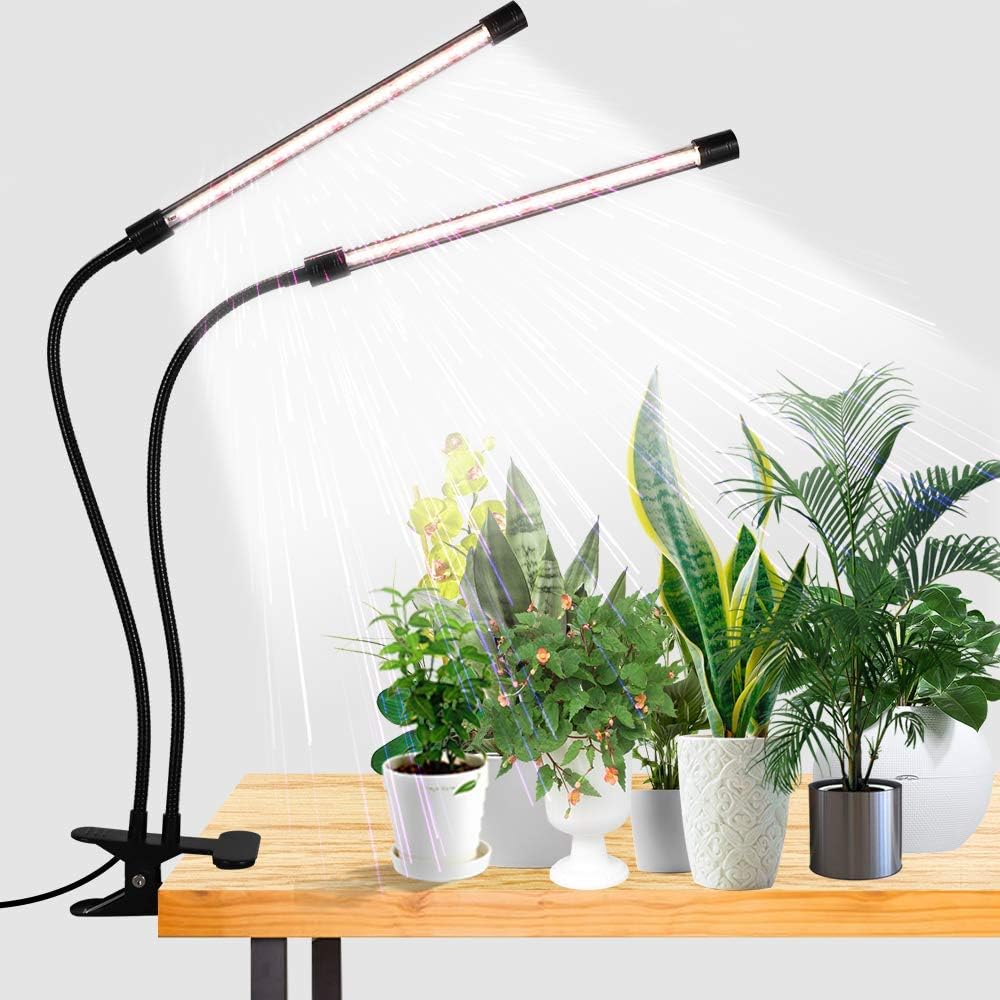
GooingTop HY-021 Clip-On Full-Spectrum LED Grow Light
| Power Source | Corded Electric |
|---|---|
| Color Temperature | 6000 Kelvin |
| Light Output Maximum | 2500 lumens |
| Number of Light Sources | 84 |
| Light Source Special Features | Dimmable |
The GooingTop HY-021 is a clip-on full-spectrum grow lamp intended for desktops, shelves, and small indoor growing setups. It uses 84 LEDs (white and red) to provide a 6000K daylight-balanced output with deep-red 660 nm diodes for flowering support. The dual gooseneck heads and strong clamp let you aim light precisely at seedlings or individual pots, while the inline remote offers two brightness levels and repeatable 4/8/12 hour timer cycles so you can automate daily light periods. Practical benefits include low power draw (about 10W draw per manufacturer details) and a compact footprint that works in tight spaces, plus useful extras like a clamp stand and remote already attached to the cord. Limitations to note are that the unit is built for small-area coverage (manufacturer lists about 1–2 square meters) and the clip design is not a replacement for full-spectrum fixtures over larger grow benches. Also the lamp relies on a corded power source and fixed gooseneck reach, so placement flexibility is bounded by available clamp points and cord length.
Best for: Buyers who want a compact, easy-to-use grow light to support seedlings, herbs, or a few houseplants and prefer simple automation and proven features over larger commercial fixtures.
Less Ideal for: Not a good fit for growers who need wide-area coverage, multishelf installations, or a hardwired, permanent lighting solution.
- Full-spectrum blend with dedicated 660 nm red LEDs to support both vegetative growth and flowering
- Dual flexible goosenecks and strong clamp make targeted positioning easy in small spaces
- Built-in timer and dimmable settings let you automate light cycles and adjust intensity without extra equipment
- Designed for small-area use so it will not evenly cover large shelving or multiple large plants
- Corded design and clamp mounting limit placement compared with freestanding fixtures
Verdict: A compact, clamp-mounted full-spectrum LED that automates daily light cycles and delivers focused light for seedlings and small indoor plant setups.
Barrina T5 1ft LED Grow Lights, 5000K Full Spectrum (4-Pack)

| Wattage | 5W per fixture |
|---|---|
| Color temperature | 5000K full spectrum |
| Linkable | Link up to 16 lights |
| Control | Separate on/off switch per fixture |
The Barrina T5 1ft grow light 4-pack is a straightforward, plug-and-play lighting solution for indoor seedlings, vegetative growth, and small flowering setups. Each slim fixture offers a 5000K full spectrum output and an individual on/off switch so you can control lights separately or together, and included cords and connectors let you link up to 16 lights in series. Installation is simple with clips, double-sided tape, and cable ties, making it easy to mount on shelves or in a small grow tent. The lights are energy efficient and designed to deliver a high PPFD for their size, which helps young plants take up light effectively. Practical limitations are the 1ft length and modest wattage, so you will need multiple fixtures to cover wider shelving or larger canopy areas, and the magnetic claim is contradicted in the description so mounting options are mostly adhesive or clip-based. For gardeners who want a low-effort, measurable upgrade from window light, these provide reliable, adjustable illumination without complicated setup.
Best for: Buyers who want a low-risk, easy-to-install grow light for shelves, small tents, or propagation stations and prefer a simple, controllable setup over fiddly electronics.
Less Ideal for: Large-scale growers or anyone needing single-fixture wide coverage should choose longer or higher-power fixtures instead.
- Full-spectrum 5000K output suitable for seedlings through flowering
- Individual on/off switches for each fixture allow flexible coverage and scheduling
- Linkable design supports up to 16 lights for expanding setups
- Includes basic mounting hardware and connecting cords for quick installation
- Short 1ft length means multiple units are required to cover larger areas
- Mounting relies on clips and tape since magnetic mounting is not supported
Verdict: An inexpensive, easy-to-install full-spectrum T5 kit that lets cautious growers add reliable supplemental light to small indoor setups with minimal fuss.
Choosing the Right Grow Light: Key Factors to Consider
Light Spectrum and Plant Stage Matching
Different plant stages respond to different portions of the light spectrum. Blue-rich output encourages compact, sturdy seedlings and vegetative growth while red-dominant output helps flowering and fruiting. A multi-spectrum or full-spectrum fixture lets you run the same light across stages or switch spectrums if the unit includes toggles. Knowing which wavelengths a fixture emits helps you plan light schedules and prevents stretch or poor bud set.
For mixed plantings or continuous production where seedlings and bloom-stage plants share space, select fixtures with broad, balanced spectra or separate fixtures with matching spectrums positioned appropriately. Avoid lights that advertise vague 'plant friendly' claims without published spectral data because those make it hard to predict plant responses.
Photosynthetic Photon Flux Density and Canopy Needs
PPFD measures the amount of usable light hitting the plant surface and is more meaningful than wattage. Different crops and stages require different PPFD ranges; for example, seedlings need much lower PPFD than flowering vegetables. Consider the target PPFD at the height your plants will be grown, and choose a fixture that can deliver that intensity across the canopy without forcing plants too close to the lamp.
When planning a layout, account for distance to canopy, hanging height flexibility, and whether you need spot coverage for single racks or wide even light for multiple trays. Fixtures that publish PPFD maps or have adjustable output make it easier to design a setup that meets crop requirements.
Energy Use and Operating Cost
Electric consumption matters for indoor growers running lights long hours. Look beyond bulb wattage to how much useful light the fixture produces per watt. LED technology usually provides higher lumen-to-watt or micromole-per-joule efficiency than older lamp types, which reduces running cost and heat output.
Factor in the expected daily photoperiod you will run, seasonal variations, and any supplemental ventilation or cooling. Higher upfront fixture efficiency often pays back quickly in lower monthly energy spend and reduced HVAC load in conditioned spaces.
Heat Output and Thermal Control
Heat from grow lights affects plant spacing, humidity, and room temperature. Fixtures with active cooling or well-designed passive heatsinks let you hang lights closer to the canopy for better light delivery without burning foliage. Excess heat often forces additional ventilation, which increases noise and electricity use.
Consider the room or tent size and whether you can provide airflow. In confined areas, prefer low-heat fixtures or those with integrated thermal management. Also check material durability and whether fans are serviceable since fan failure can degrade performance over time.
Coverage Pattern and Mounting Flexibility
How evenly a light spreads over trays or pots determines how many fixtures you need and how many plants receive equal light. Narrow beam lights can be excellent for single plants or deep racks, while wide-angle panels suit shallow, broad canopies. Overlap multiple fixtures if necessary to avoid hotspots and shaded zones.
Mounting options and hanging hardware affect ease of installation and future rearranging. Look for fixtures that include adjustable hangers, daisy-chain power, or rails for multi-fixture rigs to simplify scaling up from seed trays to a full bench.
Build Quality and Maintenance
Durability matters because grow lights are running many hours daily in humid or dusty environments. Water-resistant housings, corrosion-resistant fittings, and accessible drivers reduce failure risk. Also consider how easy it is to clean lenses and access fans or power supplies for maintenance.
Longer warranty terms and replaceable components indicate higher expected lifespan. While initial cost is important, a fixture that lasts longer with lower maintenance can be less expensive over multiple growing cycles.
Matching Fixtures to Different Indoor Spaces
Small seed-starting trays, stacked shelving, and full-size grow tents all impose different physical and light-distribution demands. For single tray tables, compact panels or bars with narrow height options give concentrated PPFD without wasting light sideways. For multi-shelf setups, low-profile LED strips or bars that can mount under shelves prevent shading between levels.
In tents and larger rooms, modular panels that can be arrayed to create uniform coverage work best. Plan your fixture layout before buying so you can minimize overlap while providing even PPFD across the canopy. Consider mobility too; if you will rearrange plants frequently, lighter fixtures with easy hanging hardware reduce setup time.
- Use bars or strips for stacked shelving and racks.
- Choose wide panels for shallow, wide canopies.
- Position fixtures to avoid shadows from plant supports or trellises.
Controlling Light Schedules and Dimming
Plants respond to both daily light duration and intensity. Look for fixtures with built-in dimming or compatibility with external timers and controllers to create realistic day/night cycles and ramp intensity across stages. Dimmers help you fine-tune PPFD without changing fixture height, which is useful for delicate seedlings.
If you plan automated schedules, confirm the fixture supports common controller types and that firmware or control interfaces are documented. Simple mechanical timers work for basic schedules, but digital controllers let you create sunrise and sunset ramps that reduce plant stress.
- Use timers for consistent photoperiods.
- Dimming prevents leaf burn when increasing intensity.
- Controllers can sequence spectrums for stage transitions.
Integrating Grow Lights with Ventilation and Climate Control
Lights affect air temperature and humidity, so factor them into your ventilation and dehumidification plans. Higher-heat fixtures require stronger exhaust or intake airflow to keep canopy temperature stable. Even efficient LEDs will add heat if multiple fixtures are used in a small room.
Place air inlets and outlets to circulate air across the top of the canopy and remove heat away from fixtures. Monitor ambient conditions when you first run a new lamp for several hours and adjust fan schedule, intake size, or spacing to maintain the ideal temperature and humidity for your crops.
- Measure canopy temperature, not just room temperature.
- Use oscillating fans to prevent microclimates around individual plants.
- Adjust ventilation when increasing fixture density.
Safety, Wiring, and Installation Best Practices
Install grow lights on secure hangers rated for the fixture weight and keep electrical connections away from water sources. Use properly rated power supplies and avoid overloading circuits when daisy-chaining multiple fixtures. Protect cords from wear and keep them off the floor where water might collect.
Consider plugging lights into GFCI-protected circuits in humid spaces. Check local electrical rules for permanent installations, and when in doubt consult a qualified electrician for multi-fixture builds or hardwired setups.
- Use rated hanging hardware and anchors.
- Avoid extension cords for long-term installations.
- Place timers or controllers in dry, ventilated enclosures.
Staging Plants Under Lights for Fast Results
Group plants by light needs and height to get consistent growth. Place seedlings under lower intensity or further from the light, and move them closer or increase intensity as they transition to vegetative growth. Taller bloom-stage plants may require different fixtures or repositioning to keep light distributed to lower foliage.
Rotate trays periodically to reduce edge effects where outer plants receive more light. If you are running multiple spectrums, stage plants so those needing more red light spend time under bloom-spectrum fixtures during flowering.
- Keep seedlings on separate trays from bloom-stage plants when possible.
- Use adjustable hangers to raise or lower fixtures between stages.
- Rotate trays to even out edge-to-center growth differences.
How We Chose the Best Grow Light
We prioritized products that address real indoor-gardening needs rather than lab specs alone. Selection began with fixtures designed for horticultural light spectra and consistent photon delivery across the active canopy. We favored units with clear spectrum specifications, measured photosynthetic photon flux density (PPFD) or useful equivalent data, and adjustable intensity so growers can use the same fixture through seedling, vegetative, and bloom stages. Durable construction and thermal design mattered because heat affects plant spacing and room conditions. Energy efficiency was judged by delivered usable light per watt rather than just electrical draw. Ease of installation, mounting options, and dimming or controller compatibility were included so setups work in tight closets, shelves, or tents. We also considered lensing or beam-angle options for even coverage and modular expandability for larger racks. We excluded consumer lamps with no horticultural spectrum data, products intended only for ambient room lighting, and fixtures lacking clear thermal or mounting specs. The final picks balance light quality, energy efficiency, and real-world usability for indoor gardeners.
FAQ
How close should I hang a grow light to seedlings?
Distance depends on fixture intensity and spectrum. Start with recommended manufacturer distances or lower-intensity settings and watch for stretch or leaf curl. Increase PPFD gradually by lowering the fixture or increasing output while monitoring canopy temperature.
Can I use a single fixture for both vegetative and flowering stages?
Often yes if the fixture provides a broad full spectrum and adjustable intensity. Fixtures with switchable spectrums or dimming let you run the same unit across stages, but very high-light crops may still need supplementary or additional fixtures at bloom time.
Are LEDs always better than other lamp types for indoor gardening?
LEDs are typically more energy efficient and produce less waste heat than older lamp types, but the best choice depends on crop needs and budget. Look at usable light delivery, not technology label alone, and consider beam pattern and spectrum.
How do I know if my light provides the right spectrum?
Check for published spectral output graphs or color temperature combined with PPFD data. Grow-specific fixtures usually publish spectrum charts and useful light measurements. If data is lacking, consider measuring light with a PAR meter for accurate assessment.
Will more wattage always mean better plant growth?
Not necessarily. Wattage tells electricity use but not how much usable light reaches the canopy. Efficiency and beam control determine how many micromoles of light your plants receive per watt. Aim for higher usable light per watt rather than raw electrical draw.
How do I manage heat if my space is small?
Use low-heat fixtures, improve ventilation, and maintain distance from the canopy. Active cooling with exhaust fans and oscillating circulation helps remove heat. Also monitor humidity because increased ventilation can dry out small spaces quickly.
Final Verdict
Choose a grow light by matching spectrum, usable light, and coverage to the plants and space you have. Prioritize fixtures that publish PPFD or spectral data, have good thermal design, and offer mounting flexibility so you can adjust height and intensity as plants grow. Expect tradeoffs between upfront cost, operating energy, and long-term durability. Focus on the criteria that directly affect plant health and room conditions to pick the best fit for your indoor gardening goals.
