

Note: This article contains affiliate links. If you click on these links and make a purchase, I may earn a small commission at no extra cost to you. This helps support my research and content. Read my full affiliate disclosure here.
Apricot trees respond strongly to thoughtful feeding. The right fertilizer and timing help set more blossoms, reduce fruit drop, and build tree vigor without encouraging weak, disease-prone growth. This guide covers seven carefully shortlisted fertilizing options and feeding approaches specifically for apricot trees, chosen for how they balance nutrients, application ease, and suitability for common garden situations. You will find clear information on nutrient ratios, timing, and methods so you can match a feeding plan to your soil, tree age, and climate. Read on for practical tips and a summary of the evaluation criteria used to pick these top options.
Top Picks at a Glance
| Best Overall The best all-around choice for most situations | Espoma Organic Citrus-Tone 5-2-6 Organic Fertilizer for Citrus, Fruit, Nut & Avocado Trees, 4 lb |  |
| Best Quality Built to a higher standard if you want something more solid | Espoma Organic Tree-Tone 6-3-2 Granular Tree Fertilizer, 18 lb Bag |  |
| Best Value The sweet spot between price and what you get | Jobe's Organics Granular Fruit & Citrus Fertilizer, 4 lb |  |
| Best Budget The cheapest option that still gets the job done reliably | Jobe's Organics Granular Fruit & Nut Fertilizer, 4 lb |  |
| Highest Rated A top-rated pick with lots of positive feedback | Gardenera Premium Liquid Silica Plant Supplement for Apricot Trees, 8 oz |  |
| Most Popular A crowd favorite that many people choose with confidence | Miracle-Gro Fruit & Citrus Plant Food Spikes (12-count) |  |
| Best Seller A high-volume bestseller chosen again and again | Farmer's Secret Fruit Tree Booster Liquid Fertilizer (8 oz) |  |
Espoma Organic Citrus-Tone 5-2-6 Organic Fertilizer for Citrus, Fruit, Nut & Avocado Trees, 4 lb

| Item Form | Granules |
|---|---|
| Specific Uses For Product | Agriculture,Gardening,Plant Growth |
| Application Method | Spread evenly over the entire tree or plant area |
| Target Species | Citrus, Fruit Trees, Nut Trees, Avocado |
Espoma Citrus-Tone is a ready-to-use granular organic fertilizer designed specifically for citrus and other fruit and nut trees, including avocados. You apply it by spreading the measured amount around the tree drip line and watering it in; the product requires no mixing. The 5-2-6 NPK formula with 5% calcium and the Bio-tone microbial blend supports steady vegetative growth, flowering and fruit set while feeding soil biology. As a granular, slow-release option it is convenient for seasonal feedings in late winter, after bloom and in fall. It is certified for organic production and contains no inert sludges or fillers, so it fits an organic care program. Limitations are the small 4 lb package size for larger trees or multiple specimens and the need to reapply seasonally rather than provide continuous feeding like some slow-release spikes or timed-release products. For home gardeners managing a few avocado trees this product gives targeted, organic nutrition in an easy-to-apply format.
Best for: Home gardeners who want an organic, easy-to-apply fertilizer to support flowering and fruiting on one or a few avocado trees and who prefer simple seasonal feedings.
Less Ideal for: Large-scale growers or anyone seeking a single-season, low-maintenance slow-release system for many large trees should consider higher-capacity or different delivery formats.
- Organic, certified input suitable for organic avocado production
- 5-2-6 NPK with 5% calcium supports fruit set and overall tree health
- Ready-to-use granules require no mixing and are simple to apply
- Includes Bio-tone microbial blend to support soil biology
- Small 4 lb bag may be insufficient for large mature trees or multi-tree yards
- Granular application requires seasonal reapplication rather than long-term timed release
Verdict: A compact, certified organic granular fertilizer that delivers targeted nutrition and soil biology support for home avocado trees in a simple seasonal application.
Espoma Organic Tree-Tone 6-3-2 Granular Tree Fertilizer, 18 lb Bag

| Item Form | Granules |
|---|---|
| Application Method | Ready to use |
| Coverage | Medium |
| Target Species | Shade trees, fruit trees, and ornamental trees |
| Mixing Ratio | 6:3:2 |
Espoma Tree-Tone is a granular, ready-to-use organic fertilizer intended for feeding shade, fruit and ornamental trees in spring and fall. Applied around the dripline, it supplies a balanced 6-3-2 NPK blend plus 5% calcium from natural ingredients and the company’s Bio-tone formula to support root health and steady growth. In practice this product is easy to use because it requires no mixing and spreads cleanly by hand or with a broadcast spreader; the medium coverage claim fits yards with several small to medium trees. Being approved for organic gardening makes it a good fit for growers who prefer natural inputs and want to avoid synthetic salts. Limitations are that it is a lower-analysis fertilizer so it delivers nutrients more gradually and you may need larger amounts or more frequent applications for trees showing acute deficiencies or heavy fruit loads. Also the granular form requires incorporation into the root zone by light watering or raking to get the best uptake.
Best for: Gardeners who prioritize steady, natural feeding for fruit and shade trees and prefer organic inputs that support root health and long-term vigor.
Less Ideal for: Growers needing fast correction of severe nutrient deficiencies or those who want a high-analysis synthetic fertilizer for aggressive, immediate growth.
- Organic formula approved for organic gardening and free of sludges or fillers
- Ready-to-use granular form that spreads easily without mixing
- Balanced 6-3-2 NPK plus 5% calcium to support general tree growth and fruit development
- Includes Bio-tone for improved root health and microbial activity
- Lower nutrient concentration means larger volumes may be needed for quickly correcting deficiencies
Verdict: Choose this organic, ready-to-use granular fertilizer when you want a reliable, low-salt feeding program to maintain healthy fruit and shade trees over the long term.
Jobe's Organics Granular Fruit & Citrus Fertilizer, 4 lb

| Item Form | Granules |
|---|---|
| Specific Uses For Product | Plant Growth, Root Development, Seed Development, Soil Conditioning |
| Application Method | Spread evenly around base |
| NPK | 3-5-5 |
| OMRI Listed | Yes |
This granular Jobe's Organics fertilizer is designed to feed fruit and citrus trees with a slow-release, root-targeted NPK of 3-5-5. It is typically applied by measuring and spreading the granules evenly around the base of the tree, then watering in; applications are recommended every 4 to 8 weeks during the growing season. Notable features include OMRI listing for organic gardening, a blend of feather meal, bone meal and processed poultry manure for organic nutrient sources, and a resealable bag for convenient storage. In practice the formula supports root development and fruit set without synthetic chemicals, and the slow-release nature reduces the need for very frequent feeding. Limitations are that the lower nitrogen level makes it better suited for fruiting and flowering stage nutrition rather than rapid leafy growth, and larger trees will require repeated applications or larger quantities. For gardeners aiming for an organic, low-fuss feed for citrus, this provides predictable, targeted nutrition, but it is not a quick-fix soluble feed for immediate green-up.
Best for: Gardeners who prefer organic, low-maintenance feeding for citrus and fruit trees and want a slow-release product that focuses on fruit and root health.
Less Ideal for: Growers needing fast, high-nitrogen correction or a soluble foliar feed; landscapers managing many mature trees who need bulk quantities more often.
- OMRI listed organic formula suitable for certified organic gardens
- Balanced 3-5-5 NPK aimed at improving flowering and fruit production
- Slow-release granules that feed roots over time and reduce application frequency
- Resealable packaging keeps product fresh between uses
- Lower nitrogen content means it will not rapidly promote leafy growth
- 4 lb bag may be insufficient for mature trees or larger plantings
Verdict: A reliable OMRI-listed granular fertilizer that delivers slow-release, fruit-focused nutrition for organic citrus gardeners.
Jobe's Organics Granular Fruit & Nut Fertilizer, 4 lb

| NPK | 3-5-5 |
|---|---|
| Target Species | Fruit and nut |
| Item Form | Granules |
| Unit Count | 64 Ounce |
| Specific Uses For Product | Plant Growth, Root Development, Seed Development, Soil Conditioning |
Jobe's Organics Granular Fruit & Nut Fertilizer is a small-bag, slow-release granular designed to feed the roots of fruit and nut trees, including pears. It supplies a balanced 3-5-5 NPK plus calcium, magnesium, and sulfur derived from organic sources such as feather meal and bone meal. Typical use is to broadcast or side-dress around the root zone every 4 to 8 weeks during the growing season; granules release nutrients gradually so you do not need frequent reapplication. Benefits include organic certification for use in organic gardens, straightforward measuring and application, and nutrients aimed at improving bloom and fruit set rather than quick leafy growth. Important limitations are the small 4 lb bag size, which means multiple bags will be needed for larger orchards, and the lower nitrogen ratio compared with general-purpose fertilizers if you want foliage-heavy growth. It is safe to use around people and pets when directions are followed, but users should avoid applying in windy conditions to prevent drift.
Best for: Home gardeners and small-plot fruit growers who prioritize organic inputs and want an easy-to-apply fertilizer to support fruit set and steady production in pear trees.
Less Ideal for: Commercial orchards or large properties that need bulk fertilizer or fast-acting high-nitrogen feed to drive rapid vegetative growth.
- OMRI listed organic formula suitable for certified organic gardens
- Balanced 3-5-5 NPK geared toward flowering and fruit production
- Slow-release granules that feed roots over weeks reducing application frequency
- Includes secondary nutrients like calcium and magnesium to support fruit quality
- 4 lb bag is small for multiple or mature trees
- Lower nitrogen percentage may be insufficient when rapid vegetative growth is desired
Verdict: A small, OMRI-listed granular fertilizer that reliably supports flowering and fruit production in pear trees for gardeners who prefer organic, slow-release nutrition.
Gardenera Premium Liquid Silica Plant Supplement for Apricot Trees, 8 oz

| Item Form | Liquid |
|---|---|
| Application Method | Watering Can, Hose End Sprayer, Foliar Spray |
| Coverage | Makes 45 Gallons |
| Target Species | Apricot |
| Mixing Ratio | 1-1.5:1 (grow), 1:1 (bloom) |
This liquid silica supplement is designed to be added to watering routines to strengthen apricot tree cell walls, reduce leaf browning, and improve stress resistance. It comes as an 8 ounce concentrate that makes up to 45 gallons of working solution and can be applied via watering can, hose-end sprayer, or as a foliar spray. The formula is described as bio-available silica suitable for soil, coco, peat and hydroponic systems, and the label provides clear mixing ratios for grow and bloom phases as well as foliar use. In practical use you would add small measured amounts to each watering for ongoing structural support, or use the hose-end instructions for larger areas and the foliar mix for faster uptake. The main benefits are stronger stems that resist breakage and healthier foliage under heat or drought stress. Expect to follow the specified mixing rates closely and reapply regularly since results depend on consistent use; the product is a targeted supplement rather than a complete fertilizer, so it should be used alongside a balanced nutrient program.
Best for: Gardeners who prioritize predictable, ongoing plant strength and want a targeted supplement to reduce stem breakage and leaf browning on apricot trees.
Less Ideal for: Growers looking for an all-in-one fertilizer or those managing large commercial orchards where bulk concentrated fertilizers would be more economical.
- Concentrated 8 oz bottle yields up to 45 gallons of solution for extended use
- Multiple application methods: watering can, hose-end sprayer, and foliar spray
- Bio-available silica formulation intended to remain available in soil and aid uptake
- Clear mixing ratios provided for grow, bloom, and foliar applications
- Not a complete fertilizer so needs to be used alongside regular nutrient feeding
- Small bottle size may require frequent repurchasing for larger orchards
Verdict: Use this concentrated liquid silica when you want a reliable, easy-to-apply supplement that strengthens apricot tree stems and improves leaf health.
Miracle-Gro Fruit & Citrus Plant Food Spikes (12-count)

| Item Form | Sticks |
|---|---|
| Specific Uses For Product | Fruit & Citrus Tree Care |
| Application Method | Insert spikes into the ground |
| Mixing Ratio | 10:15:15 |
| Number of Items | 12 |
These Miracle-Gro Fruit & Citrus Plant Food Spikes are pre-measured, slow-release sticks designed to feed in-ground fruit and citrus trees, including avocados, with a 10-15-15 NPK formula. Use is simple: water the soil to soften it, place spikes around the tree drip line according to the label chart, then drive them below the soil surface with a mallet or by stepping on them. The spikes deliver nutrients directly to the root zone, which reduces mess compared with granular feeding and eliminates monthly mixing. They are intended for a twice-yearly schedule, one application in early spring and another in mid-fall, so maintenance is low. Because the spikes are targeted and contain a balanced NPK higher in phosphorus and potassium, they can support flowering and fruit set for productive trees. Limitations to note are the infrequent feeding schedule and fixed nutrient ratio, so if your soil test shows different needs or you prefer monthly liquid feeding you may need supplemental products. Very compact root zones or heavy clay that stays hard when wet can make insertion difficult without extra effort or tools.
Best for: Home gardeners who want a low-effort, seasonal fertilizer for established avocado and other fruit trees and who prefer a simple apply-twice-a-year routine backed by broad user experience.
Less Ideal for: Growers who rely on frequent liquid feeding, need a customized nutrient program from soil tests, or work exclusively with container-grown trees.
- Direct root-zone delivery reduces surface runoff and mess compared with broadcast granules
- Pre-measured spikes make seasonal feeding fast and low-effort
- 10-15-15 NPK supports flowering and fruit development useful for fruiting trees
- Works on a range of trees listed for the product including avocado and palm
- Fixed NPK ratio and twice-yearly schedule may not match specific soil test recommendations
- May be hard to insert in very compacted or rocky soils without a mallet or tool
Verdict: A low-maintenance, targeted fertilizer solution that makes seasonal feeding of avocado and other fruit trees quick and reliable.
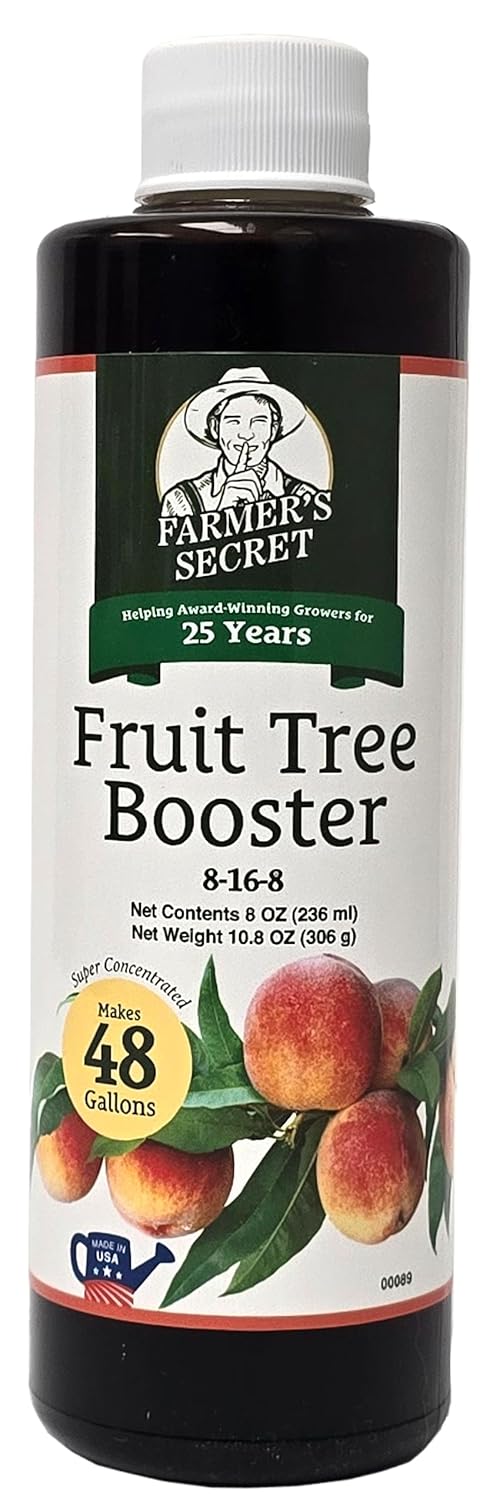
Farmer's Secret Fruit Tree Booster Liquid Fertilizer (8 oz)
| Item Form | Liquid |
|---|---|
| Specific Uses For Product | Plant Growth, Fruit Production |
| Coverage | Full |
| Target Species | Apple, Banana, Peach |
| Unit Count | 7.98 Fluid Ounces |
This concentrated liquid booster is designed for fruit trees and is used as a weekly soil drench or foliar feed to support root growth and fruit production. The formula emphasizes phosphorus to encourage strong roots and early-season fruit development while also supplying nitrogen, potassium and trace minerals like zinc and iron. It is highly concentrated so a teaspoon per gallon is the standard dilution, with higher recommended doses for young trees and mature trees, which makes a small bottle go a long way. Practical benefits include quick availability of nutrients compared with granules, compatibility with watering cans, sprayers and irrigation systems, and clear directions aimed at beginners. Important limitations are that you must follow dilution guidance to avoid overfeeding and the 8 ounce bottle is small, so multiple trees or long seasons may require repeat purchases or larger sizes. The product carries safety advice to keep it away from children and to avoid skin or eye contact.
Best for: Gardeners who want a beginner-friendly, agronomist-formulated liquid fertilizer to boost root strength and fruiting on apple trees and prefer a product with clear weekly dosing guidance.
Less Ideal for: Large-scale growers or those managing many mature trees who need bulk or measured NPK analyses for precise fertility programs should consider larger or lab-analyzed options.
- Highly concentrated formula stretches a small bottle across multiple feedings
- Phosphorus-forward blend supports root expansion and early fruit set
- Suitable for soil drench or foliar feeding and compatible with irrigation systems
- Includes both macronutrients and trace minerals for more complete nutrition
- Clear, simple dilution and feeding guidance for beginners
- Small 8 ounce bottle may not be economical for large orchards or many trees
- Requires careful dilution to avoid potential overapplication
- Ingredient list is general rather than listing exact nutrient percentages
Verdict: A concentrated, easy-to-use liquid booster that gives apple trees quick-access phosphorus and trace minerals to strengthen roots and encourage fruiting.
Choosing the Right Fertilizing Apricot Trees: Key Factors to Consider
Nutrient Balance and Ratios
Apricot trees need a balanced supply of nitrogen, phosphorus, and potassium, with attention to micronutrients like zinc and boron that affect fruit set and quality. Too much nitrogen in spring can push excessive leafy growth at the expense of flowers and fruit, while insufficient phosphorus can limit root development and bloom energy.
When evaluating fertilizers, look for products formulated for fruit trees or with labeled N-P-K ratios appropriate for your tree's age and goals. Younger trees need more nitrogen relative to potassium to encourage woody growth early on, whereas mature, fruiting trees benefit from formulas that support bloom and fruit development with slightly higher phosphorus and potassium levels.
Application Timing and Frequency
Timing feeding to the apricot tree's growth cycle has a big effect on outcomes. A light early-spring feeding supports leaf-out and initial shoot growth, while a pre-bloom or early-bloom application can encourage blossom energy and reduce fruitlet drop. Avoid heavy late-summer or fall nitrogen applications that delay hardening off before winter.
Frequency depends on fertilizer type. Slow-release granular fertilizers typically need one or two applications per year, while water-soluble and foliar feeds may be used more often in smaller doses. Consider local climate and frost dates when scheduling applications so that you do not stimulate vulnerable late-season growth.
Soil Type and Drainage
Soil texture and drainage affect how nutrients move and how often you should feed. Apricots prefer well-drained loam; in heavy clay soils nutrients can become immobilized and roots may suffer, increasing the risk of root damage from overfeeding. Sandy soils drain quickly and may require more frequent, lower-dose applications to keep nutrients available.
Before committing to a feeding regimen, test your soil to determine pH and existing nutrient levels. pH affects micronutrient availability, and adjusting soil conditions can be as important as adding fertilizer. Feeding plans should account for soil organic matter, which buffers nutrient availability and improves moisture retention.
Application Method and Coverage
How you apply fertilizer determines how effectively roots access nutrients. Granular fertilizers spread under the drip line feed the root zone slowly, while concentrated banding close to the trunk risks root and cambium harm. Water-soluble granules and liquid feeds applied with hose-end sprayers or fertigation systems deliver nutrients more quickly but require precise measurement to avoid burn.
Foliar feeds can correct micronutrient deficiencies faster than soil applications, but they are a supplement rather than a complete feeding strategy. Ensure even coverage when foliar feeding and avoid applying in hot sun to limit leaf scorch.
Salt Accumulation and Root Health
Some fertilizers, especially highly soluble ones, increase soil salt levels over time and can damage delicate feeder roots. Salt buildup shows up as reduced growth, leaf browning, and reduced water uptake. This is a particular concern in poorly drained soils or for plants irrigated with saline water.
To reduce risk, choose slow-release formulations or lower-salt organic amendments when appropriate. Periodic deep watering to leach salts below the root zone and monitoring electrical conductivity in problem areas helps prevent chronic damage.
Organic Credentials and Soil Biology
Organic fertilizers and amendments support long-term soil biology, which helps with nutrient cycling and improves soil structure. Compost, well-aged manure, and other organic sources release nutrients more slowly and are less likely to cause burn. They also increase microbial activity that benefits root health and nutrient uptake.
However, organic feeds can be lower in immediately available nutrients, so they may need to be combined with targeted mineral supplements when a rapid correction is required. Consider your management goals and whether you want to prioritize immediate fruit responses or long-term soil building.
When to Feed Apricot Trees Through the Seasons
Plan feedings around the tree's natural growth stages. Apply a light, balanced feed in early spring as buds swell to support leaf-out. A bloom-time application with phosphorus and potassium emphasis can help set fruit, while a mid-summer maintenance feed can sustain developing fruit without stimulating late shoot growth.
Avoid late-summer high-nitrogen applications that encourage soft new growth heading into dormancy. In regions with mild winters, reduce feedings in late fall to let trees harden off. Adjust timing to local climate and frost risk, and stagger small doses rather than one heavy application to reduce nutrient stress.
- Early-spring: support leaf and shoot development
- Pre-bloom/bloom: improve blossom energy and fruit set
- Mid-summer: maintain fruit development with moderate feeding
- Late summer/fall: avoid high nitrogen to promote dormancy
How to Read Fertilizer Labels for Fruit Trees
Fertilizer labels show N-P-K and sometimes micronutrients. For apricots, look for balanced formulas that do not overemphasize nitrogen for mature trees. Also check for directions specific to fruit trees and recommended rates per tree size.
If the label lists salt index or conductivity, use that information to compare burn risk. Organic product labels will list guaranteed analyses for major nutrients and may include biological content like compost percentage. Follow label instructions closely and convert rates to your tree's canopy size for even coverage.
- Match N-P-K to tree age and fruiting goals
- Follow recommended application rates per canopy spread
- Watch for micronutrient listings and salt information
Using Soil Tests to Tailor Feeding Plans
A recent soil test is the best starting point for any feeding plan. Tests show baseline levels for phosphorus, potassium, pH, and micronutrients so you do not apply what is already abundant. Adjust fertilizer choices and rates based on those results rather than defaulting to high-dose programs.
If a test reveals deficiencies like low boron or zinc, address them with targeted supplements or foliar sprays at the appropriate stage. Retest periodically to monitor how your feeding program affects soil chemistry over multiple seasons.
- Test before major fertilizer changes
- Correct specific micronutrient deficits with targeted treatments
- Retest every few years to evaluate long-term effects
Balancing Fertilizer With Cultural Practices
Fertilizer works best when paired with good watering, pruning, and pest management. Regular irrigation schedules prevent fertilizer salts from concentrating and improve nutrient uptake. Pruning shapes the tree and reduces excessive vigor that might otherwise require corrective feeding.
Mulching with organic material reduces surface evaporation, slowly adds nutrients, and moderates soil temperature for healthier roots. Take a holistic approach so feeding complements these cultural practices rather than compensating for neglect.
- Keep irrigation steady to aid nutrient uptake
- Use mulch to improve soil organic matter
- Prune to balance vegetative growth and fruiting demands
Common Mistakes and How to Avoid Them
Overfeeding, especially with high-nitrogen products, can cause lush vegetative growth and weak wood prone to disease and winter damage. Applying fertilizer too close to the trunk can burn roots and girdle the cambium. Another common error is relying on foliar sprays for major nutrient needs instead of using them as corrections.
Measure carefully and apply by canopy area rather than blanket rates for the whole yard. If you see signs of salt stress or nutrient imbalance, pause feeding and reassess soil tests and irrigation practices before continuing.
- Do not over-apply nitrogen late in the season
- Avoid placing granules against the trunk
- Use foliar feeds as supplements only
How We Chose the Best Fertilizing Apricot Trees
We focused on fertilizers and feeding methods that deliver measurable benefits to apricot trees in home orchards and garden settings. Selection prioritized nutrient formulas appropriate for fruit trees, timing flexibility for spring and summer applications, and product forms and methods that gardeners can apply accurately. We evaluated concentration and nutrient ratios for fruiting needs, ease of application for hobby growers, potential to alter soil pH or salinity, and compatibility with organic management where relevant. We excluded generic lawn feeds, high-nitrogen formulas intended for turf, and fertilizers aimed solely at container plants unless they offered tree-suitable nutrient delivery. We also filtered out feeding approaches that require specialized commercial equipment. Final picks favored options that help support flowering and fruit set while minimizing excessive vegetative growth and salt buildup. The criteria below guided our choices and match the scoring metrics used in the product cards.
FAQ
How often should I fertilize an established apricot tree?
Usually one to two targeted feedings per year are sufficient for established apricot trees when using slow-release or granular tree fertilizers. If using water-soluble feeds, smaller monthly doses through the active growing season are an alternative. Frequency depends on soil fertility, tree vigor, and product type.
Can I use general fruit tree fertilizer on apricots?
Yes, fruit-tree formulations are generally suitable, provided the N-P-K ratio matches your tree's stage. Avoid formulas high in nitrogen for mature, fruiting trees and check for micronutrients important to stone fruit. Tailor rates to canopy size and soil test results.
Is foliar feeding effective for correcting deficiencies?
Foliar feeding is effective for quickly correcting certain micronutrient shortages like zinc or boron and can improve blossom health when timed correctly. It should supplement soil feeding rather than replace a proper root-zone fertilizer program.
What signs show my apricot tree needs fertilizer?
Common signs include small or sparse fruit, poor leaf color, reduced shoot growth in the spring, or repeated fruit drop. However, these symptoms can also indicate water stress or disease, so confirm with a soil test before changing fertilizer routines.
Can overfertilizing cause fruit drop?
Yes. Excessive nitrogen at bloom or early fruit set can encourage vegetative growth and interfere with proper fruit development, sometimes leading to poor fruit retention. Balanced feeding timed to the tree's needs reduces that risk.
Final Verdict
Choose a feeding plan that reflects your tree's age, soil test results, and local climate. Prioritize balanced nutrient ratios and proper timing around bloom and fruit development, and prefer application methods that deliver nutrients to the root zone without creating salt stress. If you need quick correction for micronutrients, use targeted foliar sprays alongside a long-term soil-building approach. With thoughtful timing and monitoring you can boost yields while protecting tree health.
