

Note: This article contains affiliate links. If you click on these links and make a purchase, I may earn a small commission at no extra cost to you. This helps support my research and content. Read my full affiliate disclosure here.
A dependable soaker hose makes landscape irrigation low-effort and efficient, delivering slow, deep watering where roots need it most. Whether you maintain foundation plantings, mixed perennial beds, or long hedgerows, the right soaker hose reduces runoff, keeps foliage drier, and can cut water use compared with overhead sprinklers. This guide covers our top shortlisted options for landscaping use and explains the practical tradeoffs to consider. We evaluated hose consistency, material longevity, and installation flexibility so you can pick an option that fits your yard layout and seasonal routine. Read on for the criteria gardeners rely on and the key features that matter in real landscapes.
Top Picks at a Glance
| Best Overall The best all-around choice for most situations | MIXC Thickened Flat Soaker Hose — 200 ft with Brass/Copper Connectors |  |
| Best Quality Built to a higher standard if you want something more solid | Water Right 700 Series Polyurethane Soaker Hose, 25 ft (1/2" ID) |  |
| Best Value The sweet spot between price and what you get | ZGWDrip 150 ft 1/2" Water-Saving Soaker Hose with Solid Brass Connectors and Accessory Kit |  |
| Best Budget The cheapest option that still gets the job done reliably | YANEYAN 1/2-Inch 15 ft Soaker Hose |  |
| Highest Rated A top-rated pick with lots of positive feedback | A.M. Leonard 5/8in x 250ft Bulk Rubber Soaker Hose (hose only) |  |
| Most Popular A crowd favorite that many people choose with confidence | Gilmour 50' Flat Weeper Soaker Hose |  |
| Best Seller A high-volume bestseller chosen again and again | Gilmour 25 ft Flat Weeper Soaker Hose |  |
MIXC Thickened Flat Soaker Hose — 200 ft with Brass/Copper Connectors

| Item Length | 200 feet |
|---|---|
| Nominal Wall Thickness | 1 millimeters |
| Material Type | Brass, Polyvinyl Chloride (PVC) |
| Maximum Pressure | 50 psi |
This MIXC soaker hose is built for heavy garden use where durability and reliable seepage matter. It delivers slow, even irrigation through built-in pore holes while its 1 mm wall thickness and reinforced aluminum rings around the connector reduce punctures and connection leaks common to thinner hoses. Typical use is laying the flat hose along beds or under mulch and running water at moderated pressure so moisture seeps out evenly; the long swivel handle makes attaching and turning the hose easier without kinking. Practical benefits include resistance to sun damage and abrasion, sturdier metal joints that outlast plastic fittings, and compatibility with standard watering setups when pressure is kept within the recommended range. Limitations are that the manufacturer advises shorter runs for consistent flow so you may need multiple sections or a splitter for large areas, and performance depends on keeping pressure near the suggested 30–50 psi to avoid reduced flow at the far end or risk of burst under sustained high pressure. Installers should use the provided washers and consider a regulator for best results.
Best for: Gardeners who prioritize durable, maintenance‑free irrigation for vegetable beds and flower borders and want a soaker hose that stands up to rough use and sun exposure while providing steady seepage.
Less Ideal for: Those who need a single long uninterrupted run beyond 100–200 feet or have very high water pressure without a regulator should consider alternative drip systems or pressure-rated tubing.
- Thicker 1 mm wall resists punctures and UV degradation compared with thinner soaker hoses
- Metal (brass/copper) connector assemblies reduce leak-prone failures at joints
- Long swivel handle eases connection and prevents twisting or kinking during use
- Flat profile lays neatly along beds and under mulch for discreet, even watering
- Manufacturer recommends limiting continuous run length which may require extra hose or splitters for larger gardens
- Maximum recommended pressure (50 psi) means you should use a pressure regulator to avoid damage
Verdict: Choose this hose if you want a heavier‑duty soaker line with metal connectors that reduces leaks and holds up to sun and abrasion for reliable garden irrigation.
Water Right 700 Series Polyurethane Soaker Hose, 25 ft (1/2" ID)

| Material Type | Polyurethane |
|---|---|
| Unit Count | 25 Feet |
| Inner Diameter | 1/2" |
| Maximum Pressure | 150 psi |
| Included Components | End cap, fittings, strain reliefs |
The Water Right 700 Series soaker hose is built for steady, root-level irrigation in vegetable beds and compact garden plots. Install it along rows or weave it through raised beds and connect to a faucet or timer for long, low-pressure runs that soak soil rather than spray foliage. Its 1/2" inner diameter and porous wall produce a consistent weep from end to end, which reduces runoff and promotes deep root growth for vegetables. Polyurethane construction makes the hose light to handle, resistant to kinks and UV damage, and safe for edible gardens because it is free of lead, phthalates, and BPA. The hose comes with end fittings and an end cap so you can section beds and control flow, and the manufacturer recommends a filter if you have hard water to avoid mineral clogging. The main limitations are that a 25 ft length suits small to medium beds only and soaker hoses require careful placement and occasional unclogging compared with emitters or drip tubing for very long runs or precision single-plant feeding.
Best for: Gardeners who prioritize reliable, plant-safe irrigation and want a simple low-pressure solution for small to medium vegetable beds that promotes deep root watering.
Less Ideal for: Large-scale vegetable plots or gardeners who need precise per-plant emitters or very long continuous runs without connectors should consider alternative drip systems.
- Consistent end-to-end seep for even root-zone watering
- Made from drinking-water-safe polyurethane with no lead, phthalates, or BPA
- Resists kinking, cracking, and UV damage for season-to-season durability
- Includes end cap, fittings, and strain reliefs for straightforward installation
- 25-foot length may be too short for larger gardens without joining multiple sections
- Porous wall can clog with hard water minerals if an inline filter is not used
Verdict: Choose this hose if you want a durable, drinking-water-safe soaker hose that delivers consistent, root-focused watering for small to medium vegetable beds.
ZGWDrip 150 ft 1/2" Water-Saving Soaker Hose with Solid Brass Connectors and Accessory Kit

| Material Type | Rubber |
|---|---|
| Unit Count | 150 Feet |
| Maximum Pressure | 100 psi |
| Included Components | Hose Body |
This ZGWDrip 150 ft 1/2" soaker hose is built as a straightforward drip-irrigation solution for lawns, foundation planting beds, and larger landscapes. It delivers uniform seepage along the hose to target root zones and reduce evaporation compared with overhead sprinklers. The rubber construction is described as flexible and kink-resistant so it is easy to lay out around foundations and bed edges or to tuck slightly below the soil for hidden drip irrigation. Solid brass connectors and a maximum pressure rating of 100 psi give a sturdier, more leak-resistant connection than molded plastic fittings, and the included accessory kit and ground stakes simplify joining runs and holding the hose in place. Practical limitations to note are that installation still requires planning for flow and row layout to avoid over- or under-watering, and performance will depend on water pressure at your spigot. For foundation watering this length and the accessory set make it simple to cover long runs without needing many extra parts.
Best for: Buyers who want a balanced, reliable soaker hose to irrigate foundation plantings or long garden beds with minimal fuss and a complete set of connectors to get started.
Less Ideal for: People who need precise flow control for small container gardens or those who require permanent buried drip systems with emitters rated for extremely low flow per plant.
- Even, continuous seepage that targets root zones to reduce surface evaporation
- Solid brass connectors for more reliable, corrosion-resistant connections
- Long 150 ft length covers extensive foundation runs or large beds without many joins
- Included accessory kit and 20 stakes make layout and basic installation faster
- Requires planning for proper flow and spacing to avoid uneven watering
- Rubber hose and fittings may still need seasonal protection in freezing climates
Verdict: A long, ready-to-install soaker hose with brass fittings and a full accessory kit that makes covering foundation beds and long runs quick and dependable.
YANEYAN 1/2-Inch 15 ft Soaker Hose

| Material Type | Rubber |
|---|---|
| Item Length | 15 feet |
| Outside Diameter | 0.5 inches |
| Maximum Pressure | 60 psi |
This YANEYAN 1/2-inch, 15-foot soaker hose is a straightforward solution for slow, root-level watering of garden beds and landscaping. It connects to a standard garden hose or timer via a 3/4-inch threaded brass connector and can be linked end-to-end with other lengths to cover longer runs. The rubber construction is described as more elastic and resistant to breakage than basic tubing, and the hose delivers water by seepage to reduce surface runoff and evaporation. For budget-focused gardeners the product promises significant water savings and easy installation without tools. Important limitations are that it is intended for conventional low-pressure systems only (max 60 psi) and the 15-foot length means you may need multiple hoses for larger areas. Also the single color and simple design offer no protections like a buried dripline, so it will be exposed on the surface and may be subject to foot traffic or lawn mower damage if not routed carefully.
Best for: Gardeners on a tight budget who want a simple, low-tech way to water beds and borders efficiently and install it without tools or specialized parts.
Less Ideal for: Large properties or irrigation plans that require buried drip lines, precise emitters, or high-pressure systems; also not ideal for heavy-traffic turf areas where an exposed hose would be damaged.
- Brass threaded connectors reduce leakage and fit standard hoses and timers
- Rubber construction designed to be elastic and less prone to breakage than thin tubing
- Delivers slow seepage to roots for water savings compared with overhead watering
- Can be connected end-to-end to extend coverage for larger beds
- Limited to low-pressure systems (60 psi maximum)
- Short 15-foot length may require buying additional lengths for bigger landscapes
Verdict: A cost-conscious, easy-to-install soaker hose that delivers slow, root-focused watering for small to medium landscaped beds.
A.M. Leonard 5/8in x 250ft Bulk Rubber Soaker Hose (hose only)

| Material Type | Rubber |
|---|---|
| Unit Count | 250 Feet |
| Item Type Name | Soaker Hose |
This 5/8in x 250ft rubber soaker hose is built for long stretches of low‑pressure, root‑zone watering. Made from high‑grade rubber with thicker walls, it is intended for professional or demanding home use where durability matters. You lay the hose along planting rows or at the base of arborvitae, connect it to a water source and run low pressure so water seeps directly into the soil, reducing runoff and evaporation and allowing deep, even wetting over time. The 250ft bulk length is convenient for covering long hedgerows without frequent joins, and because fittings are not included you can cut and couple runs to fit your layout. Practical limitations are that you must supply appropriate fittings and a pressure regulator or timer for best performance, and the hose performs best on fairly level runs or gentle slopes per manufacturer guidance. For reliability‑minded gardeners this hose focuses on rugged construction and sustained, water‑efficient delivery rather than bundled accessories or short‑run convenience.
Best for: Gardeners who prioritize a durable, no‑frills irrigation solution for long runs of arborvitae or hedges and want consistent, deep watering rather than quick surface wetting.
Less Ideal for: People who need a ready‑to‑use kit with fittings or those irrigating steep, uneven terrain where pressure and flow control are difficult to maintain.
- Long continuous 250ft length minimizes joins for long hedgerows
- Heavy‑duty rubber construction with thicker walls for improved durability
- Low‑flow, low‑pressure delivery concentrates water at the root zone to cut evaporation and runoff
- Made in the USA from recycled materials, supporting sustainable irrigation choices
- Does not include fittings or connectors so additional purchases are required
- Best performance requires a pressure regulator or timer and relatively level installation
Verdict: Choose this heavy‑duty 250ft rubber soaker hose when you need a reliable, long‑run solution to deliver slow, deep irrigation to arborvitae rows.
Gilmour 50' Flat Weeper Soaker Hose
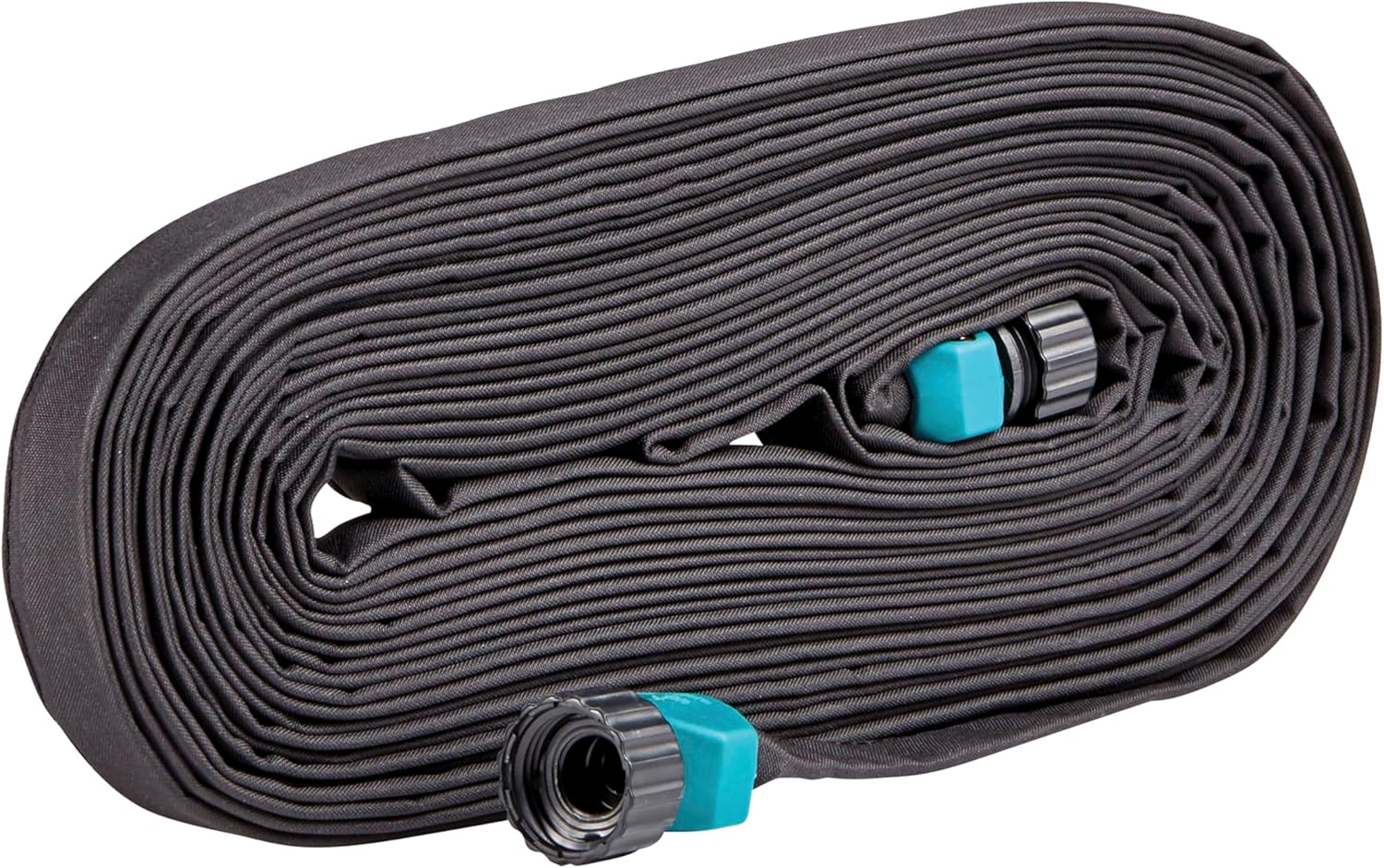
| Material Type | Vinyl |
|---|---|
| Item Length | 50 feet |
| Nominal Wall Thickness | 0.0625 inches |
| Outside Diameter | 0.63 inches |
The Gilmour 50' Flat Weeper Soaker Hose is a lightweight, vinyl soaker hose that waters plants by seeping moisture through a fabric jacket directly into the soil. It is typically laid along planting rows or buried shallowly under mulch so water reaches roots without wetting foliage or pathways. Notable features include a clog-resistant fabric cover and a flat profile that makes rolling and winter storage simple. Being made from 100% recycled vinyl and described as UV resistant, it is intended for repeated seasonal use and can be linked to additional hoses to create a longer DIY drip system. Practical benefits are water savings from targeted delivery and easier placement in narrow beds where sprinklers would waste water. Limitations to expect are the usual for vinyl soaker hoses: it is not intended for high-pressure use and can be punctured by sharp tools or heavy foot traffic, and performance depends on even water pressure along the length so very long runs may deliver uneven soaking without splitters or a faucet regulator.
Best for: Gardeners who prioritize reliable, water-efficient irrigation for beds and vegetable rows and who prefer a simple, low-tech solution that is easy to install and store.
Less Ideal for: People who need high-pressure irrigation, frequent heavy-duty use, or a permanent buried drip system should consider reinforced or commercial-grade drip tubing instead.
- Delivers water directly to roots through a fabric jacket for efficient, low-waste watering
- Clog-resistant fabric cover helps maintain consistent seepage over time
- Flat, flexible design rolls up for compact, easy seasonal storage
- Made from recycled vinyl and marketed as UV resistant for seasonal durability
- Not designed for high-pressure applications and can give uneven watering on very long runs
- Vinyl construction can be damaged by sharp objects or heavy foot traffic
Verdict: A straightforward, water-saving soaker hose that makes efficient root watering and seasonal storage easy for home garden beds.
Gilmour 25 ft Flat Weeper Soaker Hose

| Material Type | Vinyl |
|---|---|
| Item Length | 25 feet |
| Unit Count | 1 Count |
| Manufacturer | Lawn and Garden LLC |
The Gilmour 25 ft Flat Weeper Soaker Hose is a simple, budget-friendly soaker designed to deliver water at the root zone. Its fabric-covered vinyl body seeps water from all sides, making it useful for foundation watering, garden beds, and narrow planting strips where targeted, low-volume irrigation is needed. The flat profile makes it easy to lay along foundation lines or tuck under mulch and convenient to roll up and store when the season ends. Made from recycled vinyl with a clog-resistant jacket, it resists UV exposure and can be linked to other hoses to extend coverage for longer runs. Because it relies on system pressure and surface placement, expect slower soak rates than pressurized drip tubing and occasional pressure variability along long lengths. It is not a timed automatic system by itself, so pairing it with a simple timer or a pressure-regulating valve is recommended for consistent foundation watering. Overall this hose gives reliable, water-efficient root watering on a modest budget with straightforward setup and storage.
Best for: Buyers wanting an inexpensive, easy-to-use solution for watering foundation beds and narrow planting strips who prioritize straightforward installation and low water waste.
Less Ideal for: Those who need precise, pressurized drip irrigation for long runs or fully automated commercial-style systems should consider professional drip tubing or emitters instead.
- Delivers water directly to roots for efficient foundation and bed watering
- Flat, flexible design is easy to position and rolls up compactly for storage
- Clog-resistant fabric jacket provides more consistent seepage
- Can be linked with additional hoses to expand coverage
- Water output varies with house pressure and hose length, so long runs may water unevenly
- Requires manual setup or an external timer for automated schedules
Verdict: A no-frills, cost-conscious soaker hose that delivers targeted root watering along foundations and beds with simple setup and compact storage.
Choosing the Right Soaker Hose for Landscaping: Key Factors to Consider
Flow Consistency and Output Rate
How uniformly a soaker hose emits water along its length directly affects plant health in landscape beds. Uneven flow creates wet spots and dry areas that force you to reposition the hose, water longer, or supplement with spot watering. Consider both the per-foot output and whether the hose maintains similar seepage from end to end when pressurized at typical household water pressures.
Flow rate also influences run time. Hoses that deliver a steady low flow let you water longer without surface pooling, encouraging deeper root growth in shrubs and perennials. If you have long runs or elevation changes, verify how pressure loss affects output so you can plan looped runs or shorter sections to preserve consistency.
Material and UV Resistance
Landscape hoses sit on soil and in sun for months at a time, so the base material and UV resistance determine lifespan. Materials that resist cracking, brittleness, and abrasion will survive seasonal freeze-thaw cycles and foot traffic near paths or garden edges. Look for thicker walls and polymers formulated to withstand sunlight exposure without becoming brittle quickly.
Resistant materials also reduce the incidence of pinhole leaks and splits that cause uneven watering patterns. When a hose is rated for outdoor use and specifically mentions UV inhibitors or reinforced construction, it is more likely to last multiple seasons with routine care.
Installation Flexibility and Layout Options
Landscaping often requires routing hose around plantings, edging, and hardscape. A flexible soaker hose that bends easily without kinking makes it simpler to contour beds and deliver water where roots need it. Hose diameter and wall stiffness affect how tight a curve you can make and whether the hose stays put against the soil.
Consider whether the hose can be buried shallowly under mulch, attached to staples, or combined with connectors to create longer runs. Hoses that accept standard fittings and repair couplers let you adapt lengths and make field repairs without replacing entire runs.
Clog Resistance and Maintenance
Soaker hoses can trap sediment and mineral deposits over time, especially if you use hard water or leave them pressurized between uses. Clog-resistant designs with larger internal channels, integrated filtration screens at the connector, or materials that resist buildup simplify long-term maintenance. Easier-to-flush hoses save time during seasonal start-up and extend the functional life of the system.
Regular winterizing and occasional flushing will always help, but choosing a hose that tolerates debris and is straightforward to clear reduces headaches for gardeners with sandy or silty water supplies.
Repairability and Connector Compatibility
Even durable hoses will eventually need a patch or connector change. Hoses that accept common barbed fittings and repair couplers make it easy to splice in new sections or mend damage without specialized tools. Compatibility with standard garden spigots, timers, and pressure regulators also matters for integrating a soaker hose into an existing irrigation setup.
Assess whether the hose comes with or supports simple end caps, inline filters, and splitters. Being able to replace a short damaged length instead of an entire hose keeps costs and waste down, and makes the system more reliable season to season.
Sizing Runs and Managing Pressure
Measure beds and plan runs so that pressure loss does not reduce seepage at the far end. Longer single runs will experience lower output at the terminus, so splitting a long bed into two shorter runs or looping lines back to the source helps maintain uniform watering.
Consider installing a pressure regulator if your household water pressure is high. Higher pressure does not increase soak depth but can force excess flow that pools at the surface or stresses the hose seams.
- Map bed lengths and pick hose lengths that leave minimal excess coiling
- Use tees or splitters to create parallel runs for long borders
- Add a pressure regulator on high-pressure supplies to protect hose integrity
Placement Under Mulch and Soil Contact
Placing a soaker hose under a 1 to 2 inch layer of mulch reduces evaporation and hides the line from view while still allowing water to reach the root zone. Avoid burying the hose deeply; shallow coverage keeps evaporation low but preserves the seep pattern.
Ensure the hose lies flat against the soil and is pinned at gentle intervals to prevent movement from garden tools or animals. Avoid running the hose where heavy foot traffic or lawn equipment will repeatedly cross it.
- Lay hose directly on soil surface before covering with mulch
- Secure with landscape staples every few feet to maintain placement
- Keep hose at least a few inches away from tree trunks to avoid girdling roots
Winter Care and Seasonal Storage
Drain and store soaker hoses during freezing months to prevent cracking from trapped water. If the system will remain installed, fully drain lines and disconnect from the spigot, then cap or plug ends to block pests from entering.
Coiling hoses loosely and storing them in a sheltered location prolongs life. Avoid leaving hoses exposed to standing water or prolonged soil saturation during off-season storage.
- Flush and drain hoses before the first hard freeze
- Coil without tight bends and keep out of direct winter sun when possible
- Inspect and repair small leaks before reusing in spring
Integrating Timers and Water-Saving Practices
Combine soaker hoses with simple mechanical timers to run short, frequent cycles early in the morning. Timed low-flow watering reduces runoff and encourages roots to grow deeper rather than staying near the soil surface.
Group plants with similar water needs on the same runs to avoid overwatering or underwatering. Using a moisture meter or observing plant vigor after a set schedule helps dial in run lengths and frequency.
- Program timers for 30 to 60 minute cycles depending on soil type and plant needs
- Use splitters to serve different zones with tailored schedules
- Adjust frequency seasonally to match rainfall and plant growth stages
Common Installation Mistakes to Avoid
Do not run soaker hoses across areas subject to heavy foot traffic or lawn mower paths unless protected, as abrasion and repeated pressure cause premature failure. Avoid forcing hoses into extremely tight bends that kink the line and interrupt flow.
Do not leave hoses constantly pressurized between uses, which can force particulates into the material and increase the risk of leaks. Instead, attach only when in use or use a quick-connect system with a shutoff at the spigot.
- Avoid sharp bends and kinks that restrict flow
- Do not leave hoses under constant pressure when idle
- Check for clogs before burying or covering hose runs
How We Chose the Best Soaker Hose for Landscaping
We focused selection on criteria that matter to gardeners installing soaker systems in landscape beds and around shrubs. Flow consistency was prioritized first, since even output along the hose prevents dry patches and overwatered sections. Durability under common outdoor stresses such as UV, soil contact, and intermittent foot traffic was next, because material failures are the most common cause of replacement. Installation flexibility and ease of layout determined how practical a hose is for winding through beds, working around roots, and adapting to irregular shapes. Clog resistance and maintenance needs were considered to signal how often a hose will need flushing or replacement. Fitting compatibility with common garden spigots and simple repairability rounded out our assessment. We excluded hoses designed only for temporary or decorative use, micro-irrigation drip tapes not intended for higher-flow landscaping, and items that require specialty fittings incompatible with typical yard setups. The final list reflects products that balance steady seepage, long service life, and practical garden installation.
FAQ
How long should a typical soaker hose run be for consistent watering?
Typical effective runs are often under 50 to 75 feet to maintain even output at household pressure. For longer borders, split the run into parallel lines or use a supply tee to reduce pressure drop and keep seepage uniform.
Can I bury a soaker hose permanently under mulch?
You can bury soaker hoses under a shallow mulch layer to reduce evaporation and hide them, but avoid deep burial. Shallow coverage keeps seepage effective and allows easier inspection and maintenance when needed.
What maintenance keeps a soaker hose working season after season?
Flush hoses at seasonal start and end, clear debris from connectors, and store or drain before freezes. Periodically check for pinhole leaks and repair with simple couplers to extend service life.
Will high household water pressure damage a soaker hose?
High pressure can stress hose seams and force excessive flow. Using a pressure regulator between the spigot and the hose helps maintain appropriate seepage and reduces risk of leaks or bursts.
Are soaker hoses suitable for established trees and shrubs?
Soaker hoses are well suited to established shrubs and perennials because they deliver slow, deep watering that encourages root growth. For large trees, place runs in a radial pattern away from the trunk to target feeder roots rather than the trunk flare.
Final Verdict
When choosing a soaker hose for landscaping, prioritize steady flow consistency and durable construction that withstands sun and soil contact. Match hose length and layout to your beds to avoid pressure loss, and choose options that accept common fittings so you can repair or extend runs easily. Balance installation flexibility and clog resistance against the specific needs of your site. With the right hose and straightforward maintenance, you can achieve even watering, reduce runoff, and support deeper, healthier root systems across your landscape.
