

Note: This article contains affiliate links. If you click on these links and make a purchase, I may earn a small commission at no extra cost to you. This helps support my research and content. Read my full affiliate disclosure here.
If you need faster spring green-up or want to help new turf establish, choosing a lawn fertilizer with phosphorus changes how roots develop and how quickly turf responds. The right phosphorus-containing formula can speed seedling establishment, improve root mass in thin areas, and support recovery after stress. But not every product suits every situation – rates, release type, and soil phosphorus levels matter in practical use. This guide covers seven top picks for lawns with phosphorus, shortlisted for common garden situations from new seed beds to established turf needing recovery. We explain the evaluation criteria and what to watch for so you can pick a fertilizer that fits your soil test, timing, and maintenance plan.
Top Picks at a Glance
| Best Overall The best all-around choice for most situations | Jonathan Green Green-Up Lawn Food for Seeding & Sodding (12-18-8), 15 lb |  |
| Best Quality Built to a higher standard if you want something more solid | Espoma Triple Phosphate Fertilizer 0-45-0, 6.5 lb |  |
| Best Value The sweet spot between price and what you get | Lawn Synergy 15-20-10 Starter Fertilizer (25 lb) |  |
| Best Budget The cheapest option that still gets the job done reliably | OULLYY Triple Super Phosphate Fertilizer (Granules, 1.9 lb) |  |
| Highest Rated A top-rated pick with lots of positive feedback | Supply Solutions Triple Superphosphate 0-45-0 High-Phosphorus Granular Fertilizer (10 lb) |  |
| Most Popular A crowd favorite that many people choose with confidence | Easy Peasy Triple Super Phosphate Fertilizer 0-46-0 (Granules) |  |
| Best Seller A high-volume bestseller chosen again and again | Scotts Turf Builder Starter Food for New Grass, 15 lb |  |
Jonathan Green Green-Up Lawn Food for Seeding & Sodding (12-18-8), 15 lb

| Item Form | Granules |
|---|---|
| Specific Uses For Product | Lawn |
| Application Method | spreader |
| Mixing Ratio | 12-18-8 |
| Coverage | Full |
Jonathan Green Green-Up is a granular starter fertilizer designed specifically for seeding, overseeding, and laying sod. With a 12-18-8 analysis it supplies extra phosphorus to promote root formation while added iron helps deepen green color. Use it the same day you seed or install sod, applied with a rotary, drop, or hand-held spreader; a single 15 lb bag claims coverage up to 5,000 sq ft and feeds for roughly two months. Practical benefits include faster establishment of seedlings, stronger root systems for improved turf durability, and humates that can improve nutrient availability in the soil. Important limitations are that it contains phosphorus so local regulations may restrict use in some areas and it is formulated for establishing new grass rather than routine maintenance feeding. Also the coverage and longevity will vary with application rate, soil type, and weather, so follow label directions for best results.
Best for: Buyers planting new grass in fall who want a focused starter fertilizer to speed root establishment and get seedlings off to a strong start.
Less Ideal for: Homeowners seeking an all-season maintenance fertilizer or those in regions that forbid phosphorus lawn products should consider alternate formulations.
- High phosphorus formula (12-18-8) supports rapid root development for new seed and sod
- Granular form works with common spreaders for even application
- Contains humates to improve nutrient availability and iron for deeper greening
- Feeds for up to about two months, reducing the need for immediate repeat applications
- Contains phosphorus which may be restricted by local regulations and can pose runoff risk
- Designed for establishment rather than long-term lawn feeding
Verdict: Choose this as your fall starter fertilizer when you need a high-phosphorus, spreader-applied product to help new seed or sod establish strong roots quickly.
Espoma Triple Phosphate Fertilizer 0-45-0, 6.5 lb

| Item Form | Granules |
|---|---|
| Specific Uses For Product | Growth |
| Application Method | Sprinkle on the soil |
| Target Species | Fruiting and flowering plants |
| Mixing Ratio | 0:45:0 |
Espoma Triple Phosphate 0-45-0 is a straightforward, high-phosphorus granular fertilizer aimed at stimulating root growth and flower or fruit set. You apply it by sprinkling the granules on soil around flowering plants, vegetables, trees, and shrubs and then watering in according to label rates. Its 0-45-0 analysis means virtually all the nutrient content is phosphorus, so it provides a quick, targeted boost where phosphorus is the limiting factor. The product contains no fillers and is ready to use without mixing, which makes applications fast and predictable for seasonal feeding or corrective treatments. Important limitations are that it supplies no nitrogen or potassium, so it should be used alongside a balanced program if plants need overall nutrition, and local regulations may restrict phosphorus use on lawns because of runoff concerns. Handle with care to avoid skin or eye contact and follow label rates to prevent overapplication.
Best for: Gardeners and growers who need a focused phosphorus treatment to push root establishment or improve bloom and fruit set and who prioritize measurable, fast nutrient response.
Less Ideal for: Those looking for an all-in-one or slow-release lawn fertilizer or gardeners wanting a balanced NPK feed without adding a separate product.
- Very high phosphorus concentration (0-45-0) for rapid root development and improved blooming
- Granular, ready-to-use formula requires no mixing and is easy to apply
- Contains pure triple phosphate with no fillers for predictable nutrient delivery
- Suitable for a wide range of plants including flowers, vegetables, trees, and shrubs
- No nitrogen or potassium, so it cannot provide complete nutrition on its own
- Phosphorus runoff risk means some areas restrict use on lawns
Verdict: Use this concentrated phosphorus granule when you need a quick, no-fuss boost to roots and blooms rather than a balanced all-purpose feed.
Lawn Synergy 15-20-10 Starter Fertilizer (25 lb)

| N‑P‑K | 15-20-10 |
|---|---|
| Item Form | Granules |
| Application Method | broadcast spreader |
| Coverage | 6,500 sq.ft. |
This starter fertilizer is designed specifically for newly seeded lawns and fresh sod, delivering a high-phosphorus 15-20-10 formula to encourage root growth and stronger germination. It combines XCU polymer-sulfur coated slow-release nitrogen with ammonium sulfate for an initial color and growth boost, plus micronutrients to help young turf handle stress. Typical use is broadcasting the granules with a spreader at the recommended rate (about 5 lbs per 1,000 sq ft) before or immediately after seeding or when laying sod, then lightly watering to move nutrients into the root zone. Practical benefits include steady feeding for up to ten weeks from the XCU technology, effective early establishment from the higher phosphorus, and broad coverage for larger lawns. Limitations to note are that it is a granular product requiring a spreader for even application and that specific timing and watering are necessary to avoid runoff or uneven results; it is not a liquid option for foliar feeding. This is a solid, no-nonsense starter choice when you want predictable early establishment for new turf.
Best for: Buyers who prioritize reliable, predictable establishment for new lawns and want a fertilizer that combines steady long-term feeding with an early growth response.
Less Ideal for: Gardeners who need a liquid or foliar feed solution or who plan very small patch treatments where a granular spreader is impractical.
- High phosphorus N-P-K ratio tailored for root development in new seed and sod
- XCU slow-release nitrogen for steady feeding up to about 10 weeks
- Includes fast-release ammonium sulfate for quick early greening
- Contains micronutrients to support stress tolerance and even establishment
- Large 25 lb bag covers a substantial area per application
- Granular form requires a broadcast or rotary spreader for even application
- Not formulated for foliar or immediate soluble feeding needs
Verdict: Choose this 15-20-10 starter fertilizer when you want dependable, steady early root development and predictable establishment for new seed or sod.
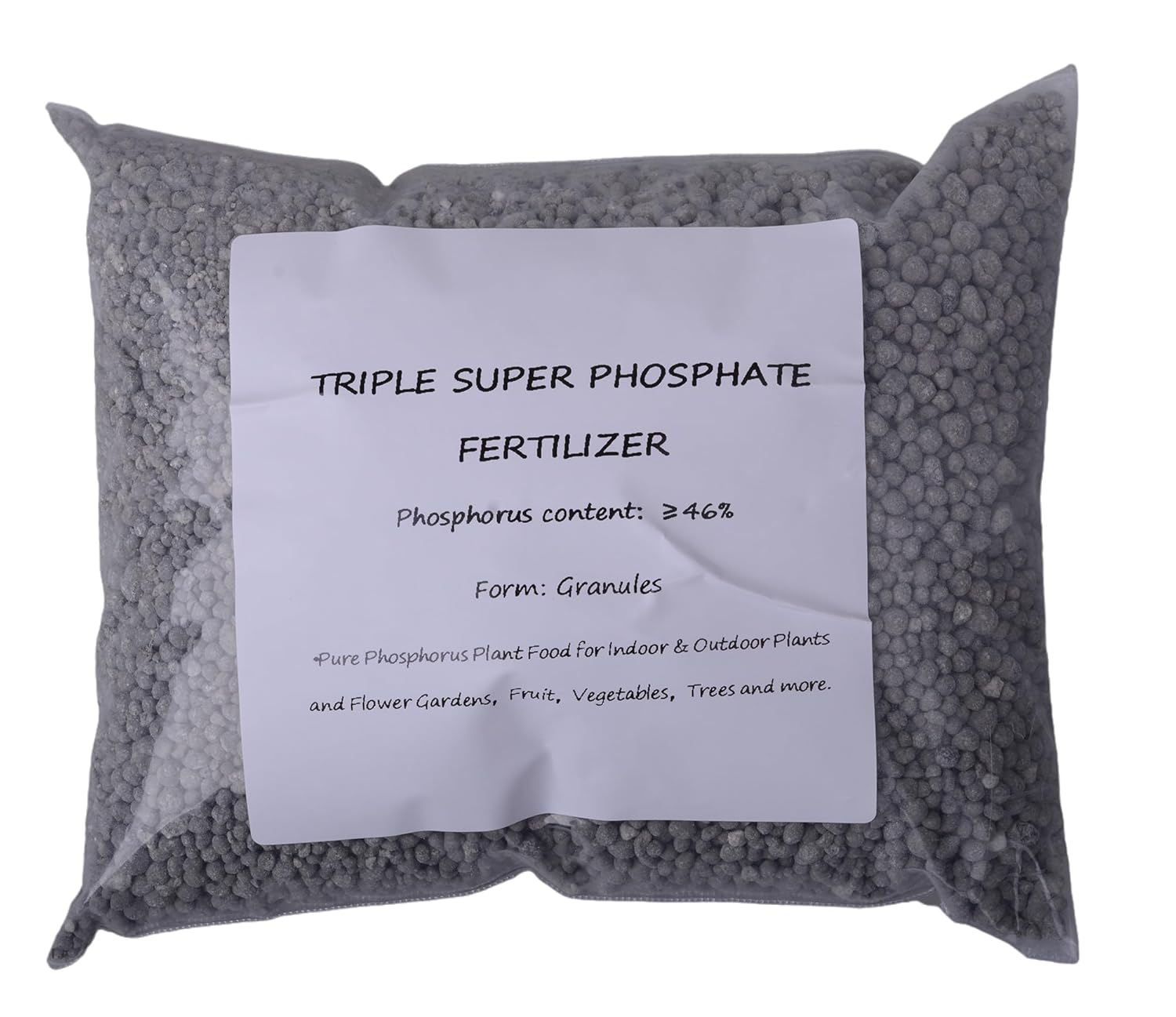
OULLYY Triple Super Phosphate Fertilizer (Granules, 1.9 lb)
| Item Form | Granules |
|---|---|
| Specific Uses For Product | Plant Growth |
| Coverage | ½ lb.100 sq. ft. |
| Target Species | Flowers, Vegetables |
| Mixing Ratio | 0.5 lb/100 sq. ft. |
This granular triple super phosphate product supplies a concentrated source of phosphorus to support root development, flowering, and fruit set in gardens and lawns. It is typically applied by broadcasting 0.5 pound per 100 square feet into the top inch of soil and watered in, with repeat applications every 5 to 6 weeks. Because it is nearly pure phosphate, it is useful when soil tests show a phosphorus deficiency or when you want to encourage blooms and heavier fruiting on flowers and vegetables. The granules are easy to measure and blend into soil; the product’s small bag size makes it practical for home garden beds and raised planters. Important limitations are that this is a single-nutrient fertilizer so it will not supply nitrogen or potassium, and it should not be overapplied because concentrated phosphorus can build up in soil or runoff into waterways. For routine balanced feeding you will still need a complete fertilizer or a tailored program based on soil test results.
Best for: Gardeners who want an affordable, focused phosphorus boost for flower beds, vegetable patches, or spot treatments and who plan to follow soil-test guidance or pair it with a balanced fertilizer.
Less Ideal for: People looking for an all-in-one or balanced fertilizer for routine feeding of a large lawn or for those who prefer slow-release complete formulas.
- High phosphorus concentration useful for promoting root growth, flowering, and fruit set
- Measured application rate (0.5 lb per 100 sq ft) makes dosing straightforward
- Granular form is easy to apply and incorporate into soil
- Suitable for flowers and vegetables where phosphorus is specifically needed
- Single-nutrient product that does not provide nitrogen or potassium
- Small unit size may require multiple purchases for larger lawns or gardens
Verdict: Buy this if you need an inexpensive, concentrated phosphorus boost to improve flowering and fruiting where soil tests show a deficiency.
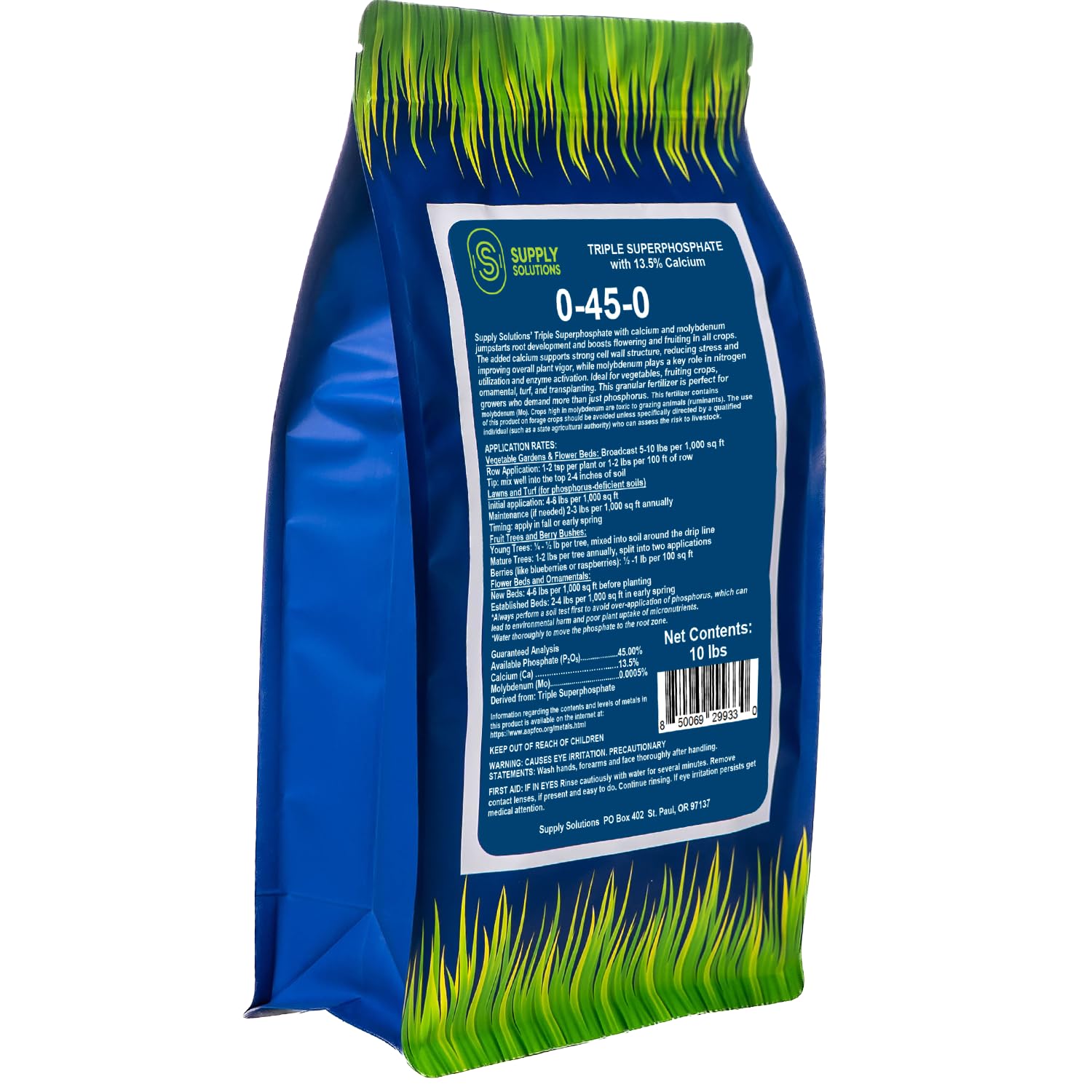
Supply Solutions Triple Superphosphate 0-45-0 High-Phosphorus Granular Fertilizer (10 lb)
| NPK | 0-45-0 |
|---|---|
| Form | Granules |
| Unit Count | 160 Ounce |
| Includes | Granules Fertilizer |
Supply Solutions 0-45-0 Triple Superphosphate is a straightforward, phosphorus-focused granular fertilizer intended to strengthen roots and promote bigger blooms and fruit. You apply it as a dilute solution for potted plants or broadcast granules for outdoor beds and lawns following the label directions; typical use is every 4 to 6 weeks during active growth. Its concentrated 0-45-0 NPK delivers a strong phosphorus dose with added calcium to support cell strength and soil conditioning, which is useful as a starter treatment for transplants, for orchids and flowering shrubs, or as a seasonal booster for fruit trees and lawns. The product is versatile across indoor pots and garden plots and is easy to measure and mix with water or spread with a garden spreader. Important limitations are that it supplies virtually no nitrogen or potassium, so it should be used alongside a balanced fertilizer program when plants need overall nutrition, and it is not a complete feed for continuous use without complementary products.
Best for: Gardeners who prioritize consistent, measurable phosphorus boosts for flowering and fruiting plants and who plan to pair this with other feeds as part of a reliable fertilizer routine.
Less Ideal for: Beginners who want an all-in-one fertilizer or growers seeking a single-product maintenance feed for overall vegetative growth.
- Very high phosphorus concentration (0-45-0) for strong bloom and root stimulation
- Granular form that can be mixed for liquid feeds or broadcast for soil application
- Contains calcium to support cell strength and improve soil structure
- Clear application rates for both indoor and outdoor use make feeding predictable
- No nitrogen or potassium included, so it is not a standalone complete fertilizer
- Not suited for plants that need regular balanced feeding without additional products
Verdict: Choose this product when you need a dependable, high-phosphorus booster to reliably drive stronger roots, blooms, and fruit as part of a planned feeding program.
Easy Peasy Triple Super Phosphate Fertilizer 0-46-0 (Granules)

| Item Form | Granules |
|---|---|
| Specific Uses For Product | Lawns,Plant Food |
| Application Method | Work into the top six inches of the soil |
| Target Species | Cactus |
This triple super phosphate product supplies a concentrated source of phosphorus in a granular form for gardeners who want to boost bloom size and root development. It is typically worked into the top of the soil and applied every 6 to 8 weeks during the growing season to support flowering plants such as wisteria, fruit trees, and ornamentals. Notable features include a 0-46-0 analysis that provides one of the highest phosphate concentrations available and a slow-release granular form that reduces the risk of burning plant roots compared with liquid high-strength alternatives. Practical benefits are clearer: stronger root establishment, more prolific flowering when phosphorus is the limiting nutrient, and easy soil incorporation around established shrubs and vines. Important limitations are that it supplies phosphorus only, so nitrogen and potassium must be provided separately, and it will not correct other soil issues like pH or micronutrient deficiencies. Also, because it is high in phosphate it should be used according to soil test results to avoid excess buildup.
Best for: Gardeners focused on maximizing blooms and root strength for flowering vines and shrubs who will apply targeted phosphorus treatments as part of a broader feeding plan.
Less Ideal for: People seeking an all-in-one balanced fertilizer or a product to correct pH or micronutrient deficiencies should consider a different option.
- Very high phosphate concentration (0-46-0) for strong bloom and root promotion
- Granular slow-release form lowers burn risk and is easy to work into soil
- Recommended application interval (every 6–8 weeks) aligns with growing season needs
- Suitable for a wide range of flowering shrubs and vines that benefit from extra phosphorus
- Provides only phosphorus so other nutrients must be added separately
- Can contribute to phosphate buildup if used without soil test guidance
Verdict: Use this concentrated phosphate granule to push bigger blooms and stronger roots on wisteria and other flowering shrubs when phosphorus is the primary limiting nutrient.
Scotts Turf Builder Starter Food for New Grass, 15 lb

| Item Form | Powder |
|---|---|
| Application Method | spreader |
| Specific Uses For Product | Starting |
| Coverage | 5000 square feet |
| Mixing Ratio | 24-25-4 |
Scotts Turf Builder Starter Food for New Grass is a powder starter fertilizer with a 24-25-4 NPK formulated specifically for new lawns. It is applied with a broadcast or drop spreader at planting and again 2 to 4 weeks later to encourage root development and faster, thicker turf. The high phosphate content is intended to fuel early root growth, which helps seedlings and newly laid sod establish more reliably than seed alone. Practical benefits include clear application guidance for Scotts spreaders, coverage of roughly 5,000 square feet per 15 lb bag, and compatibility with all grass types. Users should plan two timed applications and maintain consistent watering until seedlings are 2 inches tall, so it works best for owners willing to follow a short feeding schedule. Limitations are that it is a starter-only formula meant for initial establishment rather than ongoing maintenance and that proper spreader settings and watering are important for results, otherwise performance will be diminished.
Best for: Homeowners starting a lawn or reseeding patches who want a proven, easy-to-follow starter fertilizer to improve root establishment and germination success.
Less Ideal for: Gardeners looking for a year-round fertilizer or a combined weed-and-feed product should consider maintenance blends or targeted weed control options instead.
- High phosphate 24-25-4 formula designed to promote early root development
- Covers up to 5,000 sq. ft. per 15 lb bag, suitable for modest lawns
- Clear instructions for spreader settings and a recommended two-application schedule
- Safe for use on any grass type and applicable to seed, sod, plugs, or sprigs
- Starter-only formula so you must switch to a maintenance fertilizer after establishment
- Requires careful spreading and consistent watering to realize the claimed results
Verdict: Use this starter fertilizer if you want a straightforward, phosphate-rich feed to help new seed or sod establish stronger roots and fill in faster.
Choosing the Right Lawn Fertilizer with Phosphorus: Key Factors to Consider
Soil Test and Existing Phosphorus Levels
A soil test should be the first step because phosphorus does not move through soil quickly and can accumulate. Knowing your existing phosphorus level determines whether adding phosphorus is necessary, helps you choose an appropriate N-P-K ratio, and prevents unnecessary application that could harm water quality.
If soil phosphorus is already adequate, look for maintenance formulations with low or no added phosphorus. For new seedings or very low test values, select a fertilizer with a starter phosphorus concentration that supports root establishment while following recommended labeling rates to avoid overapplication.
Application Timing and Turf Stage
Timing matters for phosphorus effectiveness. Phosphorus is most useful during seed germination, early root development, or recovery after stress. Applying a phosphorus-containing fertilizer at the correct turf stage ensures nutrients are available when young roots can take them up.
Avoid routine phosphorus application on mature lawns without a soil test. For overseeding or new sod, plan an application at installation and monitor follow-up feedings based on growth and soil test results rather than a fixed schedule.
Phosphorus Source and Solubility
Phosphorus can come from several chemical sources with different solubilities. Water-soluble phosphorus acts quickly after application and is useful for immediate root stimulation, but it is also more susceptible to runoff if applied before heavy rain. Less soluble, slow-release phosphorus sources provide a more gradual supply and reduce short-term availability but may be safer for environmentally sensitive sites.
Consider the balance between quick root response and environmental risk. On slopes or near waterways, prefer formulations or practices that limit runoff. Match the source to your timing needs and site conditions.
Release Mechanism and Longevity
The release mechanism of the fertilizer controls how nutrients are delivered over time. Rapid-release formulations give an immediate nutrient boost but may require more frequent applications. Controlled-release or polymer-coated granules spread nutrient availability over weeks or months, reducing application frequency and peak nutrient loads.
Decide whether you need an immediate establishment boost or a longer, steadier feed. Release characteristics also influence mowing and irrigation scheduling after application to help move phosphorus into the root zone without promoting runoff.
Granule Size and Spreader Compatibility
Uniform granule size ensures even coverage when using spreaders. Irregular granules can cause streaking or uneven application, leading to patches of over- or under-fertilized turf. Check that the fertilizer you choose lists spreader settings or has a consistent granule profile for common broadcast or drop spreaders.
Consistent application reduces the need for repeat spot treatments. For smaller lawns or precision work, look for formulations recommended for walk-behind or handheld spreaders to make consistent application easier.
Label Instructions and Environmental Safeguards
Clear label instructions are essential for safe, effective use. The label should specify application rates per 1,000 square feet, re-entry intervals, turf types, and any restrictions related to timing or sensitive areas. It should also include guidance on cleanup and runoff prevention.
Good labels will advise against application before heavy rain and give steps to reduce phosphorus movement into stormwater. Prioritize formulations with precise, practical instructions so you can comply with local regulations and protect nearby water resources.
When to Use Phosphorus Versus When to Skip It
Phosphorus is most useful for seed establishment and root recovery. Use a phosphorus-containing fertilizer when installing new seed, laying sod, or dealing with turf that has shown signs of poor root development and a confirmed low soil test value.
Skip phosphorus for routine maintenance on established lawns if a soil test shows adequate levels. Routine use without need can lead to unnecessary buildup and increase the risk of runoff into waterways. Many local programs restrict phosphorus application unless a need is demonstrated.
- Use with overseeding or new sod for better root establishment
- Avoid routine phosphorus on established lawns unless soil test indicates deficiency
- Check local regulations; some areas limit phosphorus use to prevent water quality issues
Starter Fertilizers and Seeding Best Practices
Starter fertilizers formulated for seeding typically carry a higher phosphorus ratio to support young root systems. Apply starter products at the labeled rate at the time of seeding or sodding and water them in lightly to move phosphorus into the root zone.
Combine good cultural practices with starter fertilizer: prepare a clean seedbed, ensure adequate soil contact with seed, and keep moisture consistent during germination. Overapplication can harm seedlings, so follow label rates and avoid broadcast double applications that exceed recommended nitrogen and phosphorus limits.
- Apply starter at seeding or sodding, then follow up based on turf growth and soil test
- Light irrigation after application helps incorporate phosphorus without runoff
- Avoid heavy nitrogen at time of seeding unless specifically recommended
Minimizing Environmental Impact
Phosphorus runoff can contribute to algal blooms in sensitive waters. To reduce impact, do not apply before heavy rain, avoid spreading on impervious surfaces, and sweep stray granules off driveways and sidewalks back onto turf or collect them for proper disposal.
Use buffer strips of vegetation near waterways and select slow-release or less soluble phosphorus sources on vulnerable sites. Following label instructions and local guidelines helps balance lawn needs with watershed protection.
- Avoid application before forecasted heavy rainfall
- Keep fertilizer off paved surfaces and collect spills promptly
- Prefer slow-release sources near waterways or use targeted placement
Applying Fertilizer Accurately
Measure lawn area to calculate correct product quantity and set your spreader according to label recommendations. Calibrate your spreader if settings are not provided, using a catch-can test to ensure even distribution.
Apply in overlapping passes to avoid streaks and vary directions between passes. Water lightly after application when label guidance suggests to help move phosphorus into the root zone, but avoid heavy irrigation that could cause runoff.
- Measure lawn area and follow application rate per 1,000 square feet
- Calibrate spreader and apply in overlapping passes
- Use light irrigation when recommended to incorporate nutrients
Interpreting N-P-K on the Bag
N-P-K numbers indicate the percentage of nitrogen, phosphorus (as P2O5), and potassium. For phosphorus needs, focus on the middle number and convert recommendations to actual elemental phosphorus if necessary for soil test comparisons.
Remember that a higher middle number does not automatically mean better for every situation. Match the N-P-K profile to lawn stage and soil test results to avoid unnecessary phosphorus buildup.
- Compare the middle number to soil test recommendations
- Convert P2O5 to elemental phosphorus when needed for clarity
- Select an N-P-K balance appropriate to seeding, recovery, or maintenance
How We Chose the Best Lawn Fertilizer with Phosphorus
We prioritized products that deliver predictable phosphorus availability while fitting common lawn care workflows. Key evaluation criteria included nutrient analysis and balance to ensure appropriate N-P-K ratios for either establishment or maintenance; phosphorus source and solubility to distinguish quick-acting vs slow-release supply; release mechanism, comparing water-soluble, controlled-release, and starter formulations for timing and leaching risk; granule uniformity and spreading compatibility so application rates are consistent with walk-behind and broadcast spreaders; and label clarity for application rates, turf types, and safety precautions. We excluded any formulations lacking clear phosphorus content on the label or those intended solely for ornamental beds rather than turf. We also filtered out products with incomplete application instructions that could lead to overapplication. The picks emphasize balanced nutrient profiles and practical handling details gardeners need to apply fertilizer accurately and responsibly.
FAQ
Does every lawn need phosphorus?
No. Many established lawns already have sufficient phosphorus. A soil test is the best way to determine need. Phosphorus is most important for new lawns, seed establishment, or confirmed deficiencies.
When is the best time to apply a phosphorus-containing fertilizer?
Apply phosphorus at seeding, sodding, or during recovery when root growth is the priority. Avoid applying before heavy rain and follow label timing to maximize uptake and reduce runoff risk.
Can phosphorus leach out of my lawn?
Phosphorus binds more strongly to soil than nitrogen and does not leach as readily. However, it can be transported in runoff attached to soil particles, so preventing erosion and avoiding application before storms are important.
How much phosphorus is safe to apply?
Follow soil test recommendations and label rates. Overapplication can lead to accumulation and environmental harm. Use the amount indicated for your soil test category and avoid repeated excess applications.
Are slow-release phosphorus sources better for sensitive sites?
Often yes. Less soluble or controlled-release phosphorus decreases the immediate availability that can be washed away and reduces short-term peaks in soil phosphorus. Site conditions and timing still matter.
Will phosphorus make my lawn greener quickly?
Phosphorus primarily supports root development rather than quick topgrowth. If nitrogen is also present, you may see faster greening. For immediate color, ensure the fertilizer provides an appropriate nitrogen form alongside phosphorus.
Final Verdict
Prioritize soil testing and site conditions when deciding whether to use a lawn fertilizer with phosphorus. Use phosphorus-containing products for new seedings, sodding, or confirmed deficiencies, and choose a release type and application rate that match your timing and environmental sensitivity. By aligning N-P-K balance, release mechanism, and accurate application, you can promote strong root systems without needless buildup or runoff.
