

Note: This article contains affiliate links. If you click on these links and make a purchase, I may earn a small commission at no extra cost to you. This helps support my research and content. Read my full affiliate disclosure here.
If you are establishing new turf or repairing a bare spot, the right starter lawn fertilizer makes a visible difference in root development and early growth. You want a formula that encourages strong roots without pushing weak top growth, and that applies evenly over newly seeded or sodded areas. This guide shortlists seven top starter lawn fertilizers chosen for how they support root establishment, ease of use, and predictable nutrient delivery in real yard conditions. Below you will find concise explanations of what matters for new lawns, how we evaluated these products, and practical advice for applying starter fertilizer safely and effectively. Read on to find an option that suits your seeding method, soil type, and maintenance plan.
Top Picks at a Glance
| Best Overall The best all-around choice for most situations | Jonathan Green Green-Up Lawn Food for Seeding & Sodding (12-18-8), 15 lb |  |
| Best Quality Built to a higher standard if you want something more solid | Lawn Synergy Starter Fertilizer 15-20-10 (50 lb) |  |
| Best Value The sweet spot between price and what you get | GreenView Solutions Starter Fertilizer, 48 lb |  |
| Best Budget The cheapest option that still gets the job done reliably | Jonathan Green Veri-Green Starter Fertilizer for Seeding & Sodding, 1,500 Sq Ft |  |
| Highest Rated A top-rated pick with lots of positive feedback | Espoma Turf-Tone Lawn Starter Organic 4-6-3 Fertilizer, 30 lb |  |
| Most Popular A crowd favorite that many people choose with confidence | Scotts Turf Builder Starter Food for New Grass, 15 lb |  |
| Best Seller A high-volume bestseller chosen again and again | Scotts Turf Builder Starter Food for New Grass, 42 lb. |  |
Jonathan Green Green-Up Lawn Food for Seeding & Sodding (12-18-8), 15 lb

| Item Form | Granules |
|---|---|
| Specific Uses For Product | Lawn |
| Application Method | spreader |
| Mixing Ratio | 12-18-8 |
| Coverage | Full |
Jonathan Green Green-Up is a granular starter fertilizer designed specifically for seeding, overseeding, and laying sod. With a 12-18-8 analysis it supplies extra phosphorus to promote root formation while added iron helps deepen green color. Use it the same day you seed or install sod, applied with a rotary, drop, or hand-held spreader; a single 15 lb bag claims coverage up to 5,000 sq ft and feeds for roughly two months. Practical benefits include faster establishment of seedlings, stronger root systems for improved turf durability, and humates that can improve nutrient availability in the soil. Important limitations are that it contains phosphorus so local regulations may restrict use in some areas and it is formulated for establishing new grass rather than routine maintenance feeding. Also the coverage and longevity will vary with application rate, soil type, and weather, so follow label directions for best results.
Best for: Buyers planting new grass in fall who want a focused starter fertilizer to speed root establishment and get seedlings off to a strong start.
Less Ideal for: Homeowners seeking an all-season maintenance fertilizer or those in regions that forbid phosphorus lawn products should consider alternate formulations.
- High phosphorus formula (12-18-8) supports rapid root development for new seed and sod
- Granular form works with common spreaders for even application
- Contains humates to improve nutrient availability and iron for deeper greening
- Feeds for up to about two months, reducing the need for immediate repeat applications
- Contains phosphorus which may be restricted by local regulations and can pose runoff risk
- Designed for establishment rather than long-term lawn feeding
Verdict: Choose this as your fall starter fertilizer when you need a high-phosphorus, spreader-applied product to help new seed or sod establish strong roots quickly.
Lawn Synergy Starter Fertilizer 15-20-10 (50 lb)

| N-P-K | 15-20-10 |
|---|---|
| Item Form | Granules |
| Application Method | broadcast spreader |
| Coverage | 12,000 sq.ft. |
This 50 lb Lawn Synergy starter fertilizer is built specifically for new lawns, seeded areas, and fresh sod. The 15-20-10 formula emphasizes phosphorus to encourage strong early root growth while combining XCU slow-release nitrogen and ammonium sulfate for an initial green-up followed by steady feeding. It is applied with a broadcast or rotary spreader at the recommended 5 lbs per 1,000 sq ft to cover large areas efficiently. Notable features include polymer-sulfur coated XCU granules for up to about 10 weeks of nutrient release and added micronutrients to support stress tolerance in young turf. Practical benefits are predictable, extended nutrition that reduces the need for repeat applications and enough coverage for up to roughly 12,000 sq ft from one bag. Limitations are that it is a bulk 50 lb granular product that requires a spreader and handling space, and it is intended for establishment use rather than routine maintenance feeding.
Best for: Buyers who prioritize reliable, predictable establishment results for new seed or sod and want a single product that provides both immediate and extended nutrition during the first weeks of growth.
Less Ideal for: Gardeners who need a lightweight, small-quantity product for spot repairs or those looking for a regular maintenance fertilizer regimen rather than an establishment starter.
- High phosphorus ratio tailored for root development and stronger seed germination
- Dual-source nitrogen (XCU slow-release plus ammonium sulfate) for immediate color and sustained feeding
- Includes micronutrients to support young turf through establishment
- Covers a large area per bag when applied at the recommended rate
- Large 50 lb bag requires storage space and a spreader for even application
- Formulated for initial establishment rather than long-term maintenance feeding
Verdict: Choose this starter fertilizer when you want dependable, long-lasting nutrition to help new grass seed or sod establish quickly and evenly.
GreenView Solutions Starter Fertilizer, 48 lb

| NPK | 10-18-10 |
|---|---|
| Item Form | Granules |
| Specific Uses For Product | Root Development, Seed Development |
| Coverage Area | 15,000 sq. ft. |
GreenView Solutions Starter Fertilizer is a granular starter fertilizer designed for establishing new lawns and repairing bare spots. It delivers a 10-18-10 NPK formulation with a high phosphorus content to accelerate root development while slow-release nitrogen provides steady feeding for up to eight weeks. Typical use is: clear the seeding area, spread seed, apply this product, then water to activate nutrients. The product covers large areas and is aimed at homeowners seeding lawns or spot-repairing worn turf. Notable features include a formulation without microplastic coatings and an emphasis on steady, even growth rather than rapid surges that increase mowing. In practical terms that means stronger root systems, improved seedling vigor, and less frequent feeding during the initial establishment phase. Limitations are that it is a starter formula rather than an all-season maintenance fertilizer and the large 48 pound bag may be bulky for small properties or gardeners who prefer smaller, easier-to-handle packages.
Best for: Homeowners seeding a new lawn or repairing bare patches who want a focused starter fertilizer that supports root development and reduces repeat feedings during establishment.
Less Ideal for: Gardeners looking for a year-round maintenance fertilizer or those with very small lawns who prefer smaller, easier-to-handle packages.
- High phosphorus (18%) to promote rapid root establishment for new seed and bare spots
- Slow-release nitrogen feeds for up to eight weeks, reducing immediate reapplication needs
- No microplastic coatings, reducing plastic residues in the lawn
- Formulated specifically for lawn grass and seed establishment
- Designed as a starter product so it does not replace regular maintenance fertilizers
- Large 48 lb bag can be cumbersome for small-scale or container gardeners
Verdict: Pick this starter fertilizer when you need a seed-focused formula that builds strong roots and feeds new grass steadily through the critical establishment period.
Jonathan Green Veri-Green Starter Fertilizer for Seeding & Sodding, 1,500 Sq Ft

| N-P-K ratio | 12-18-8 |
|---|---|
| Application method | Spreader |
| Form | Granules |
| Coverage | 1,500 sq ft |
| Included components | Grass Seed, Plant Fertilizer |
Jonathan Green Veri-Green Starter Fertilizer is a granular lawn starter designed to be applied the same day as seeding or sodding to help new grass establish quickly. It delivers a 12-18-8 N-P-K blend that emphasizes phosphorus for root development and includes humates and micronutrients to improve nutrient availability. Use it with a rotary, drop, or handheld spreader over the area being seeded; a 5 lb bag covers up to 1,500 sq ft and feeds seedlings for roughly two months. Practically, this product speeds germination, encourages deeper roots, and helps new grass withstand early stressors like temperature swings and light drought. Its granule form is easy to apply and safe for kids and pets to re-enter the lawn after treatment. The main limitations are coverage and longevity for larger projects since a single 5 lb bag suits only small yards or spot repairs, and it is specifically a starter fertilizer so additional feeding with a general lawn fertilizer will be needed later in the season.
Best for: Homeowners who need an affordable, purpose-built starter fertilizer for seeding, overseeding, or laying sod on small lawns or repair patches and who prioritize quick germination and strong root development.
Less Ideal for: People caring for large properties or seeking a season-long all-purpose fertilizer should consider larger coverage or multi-application products instead.
- High-phosphorus 12-18-8 formula targeted to promote seed germination and root growth
- Granular form works with rotary, drop, or handheld spreaders for even application
- Includes humates and micronutrients to improve nutrient uptake and early vigor
- Feeds new grass for up to two months, supporting initial establishment
- 5 lb bag only covers about 1,500 sq ft so multiple bags are needed for larger lawns
- Designed as a starter fertilizer so it does not replace regular seasonal feedings
Verdict: A cost-effective, phosphorus-rich starter fertilizer that speeds germination and builds strong roots for new or repaired lawns up to 1,500 sq ft.
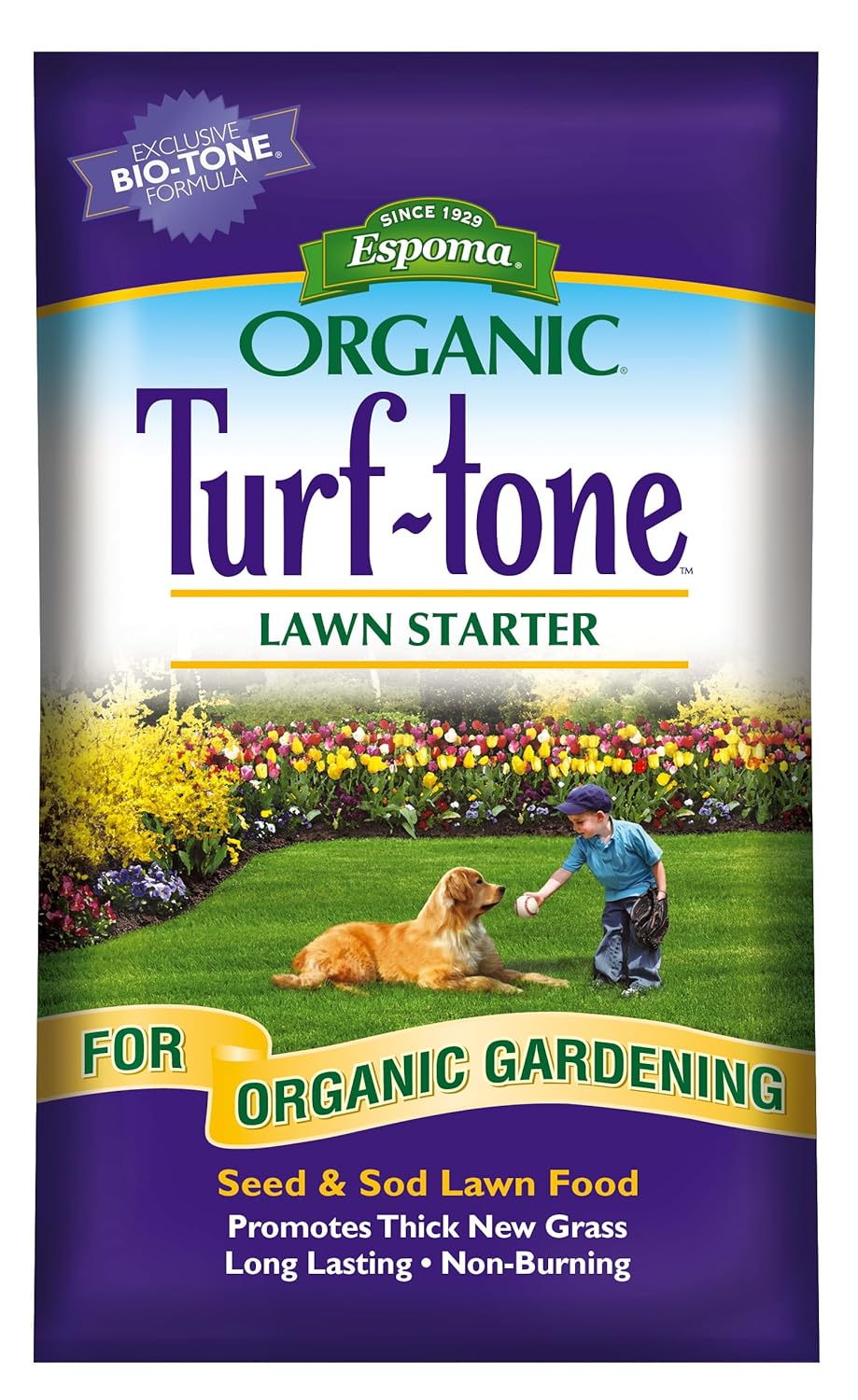
Espoma Turf-Tone Lawn Starter Organic 4-6-3 Fertilizer, 30 lb
| Item Form | Granules |
|---|---|
| Application Method | Apply with a drop or broadcast spreader. |
| Target Species | Lawn Grass |
| Mixing Ratio | 4:6:3 |
Espoma Turf-Tone Lawn Starter is an organic granular starter fertilizer designed for establishing new turf, overseeding, or laying sod. It is applied with a drop or broadcast spreader and supplies a 4-6-3 ratio that emphasizes phosphorus for root development while providing long-lasting nitrogen and Espoma's Bio-tone formula to support early growth. Practical benefits include organic nutrient sources such as feather meal and poultry manure, predictable coverage for moderate-sized yards, and simple application instructions tailored to new turf situations. For reliability-minded buyers this product reduces the risk of starter burn that can come from high-soluble synthetic starters and supports steady root establishment. Limitations are that it is a starter formula intended for new or recently seeded turf rather than routine maintenance feeding, and application timing and rates matter to avoid wasting product. Expect good early root development on warm-season grasses when used as directed, but plan a separate maintenance program for long-term fertility needs.
Best for: Homeowners installing new turf, overseeding thin areas, or laying sod who prioritize dependable, gentler organic nutrition that supports early root development.
Less Ideal for: People looking for an all-season maintenance fertilizer or quick greening treatments for established lawns should choose a regular maintenance formula instead.
- Organic ingredients (feather meal and poultry manure) that feed soil biology
- Starter-specific 4-6-3 analysis to promote root establishment and early growth
- Applied with standard drop or broadcast spreaders for even coverage
- Formulated to reduce risk of seedling burn compared with high-salt synthetic starters
- Designed for new lawns and overseeding rather than ongoing maintenance feeding
Verdict: A reliable organic starter fertilizer that helps new or overseeded lawns establish strong roots without the harshness of high-salt synthetic starters.
Scotts Turf Builder Starter Food for New Grass, 15 lb

| Item Form | Powder |
|---|---|
| Application Method | spreader |
| Specific Uses For Product | Starting |
| Coverage | 5000 square feet |
| Mixing Ratio | 24-25-4 |
Scotts Turf Builder Starter Food for New Grass is a powder starter fertilizer with a 24-25-4 NPK formulated specifically for new lawns. It is applied with a broadcast or drop spreader at planting and again 2 to 4 weeks later to encourage root development and faster, thicker turf. The high phosphate content is intended to fuel early root growth, which helps seedlings and newly laid sod establish more reliably than seed alone. Practical benefits include clear application guidance for Scotts spreaders, coverage of roughly 5,000 square feet per 15 lb bag, and compatibility with all grass types. Users should plan two timed applications and maintain consistent watering until seedlings are 2 inches tall, so it works best for owners willing to follow a short feeding schedule. Limitations are that it is a starter-only formula meant for initial establishment rather than ongoing maintenance and that proper spreader settings and watering are important for results, otherwise performance will be diminished.
Best for: Homeowners starting a lawn or reseeding patches who want a proven, easy-to-follow starter fertilizer to improve root establishment and germination success.
Less Ideal for: Gardeners looking for a year-round fertilizer or a combined weed-and-feed product should consider maintenance blends or targeted weed control options instead.
- High phosphate 24-25-4 formula designed to promote early root development
- Covers up to 5,000 sq. ft. per 15 lb bag, suitable for modest lawns
- Clear instructions for spreader settings and a recommended two-application schedule
- Safe for use on any grass type and applicable to seed, sod, plugs, or sprigs
- Starter-only formula so you must switch to a maintenance fertilizer after establishment
- Requires careful spreading and consistent watering to realize the claimed results
Verdict: Use this starter fertilizer if you want a straightforward, phosphate-rich feed to help new seed or sod establish stronger roots and fill in faster.
Scotts Turf Builder Starter Food for New Grass, 42 lb.

| Item Form | Granules |
|---|---|
| Coverage | 14000 |
| Target Species | new grass |
| Mixing Ratio | 24-25-4 (N-P-K) |
Scotts Turf Builder Starter Food for New Grass is a granular starter fertilizer designed for use when planting seed, laying sod, or installing plugs and sprigs. The 24-25-4 formula supplies a high phosphate boost to encourage root development and quicker blade emergence during the first 2 to 4 weeks after planting. It is applied with a spreader at planting and again 2 to 4 weeks later, then switched to regular lawn food for ongoing maintenance. In practice the product makes seeding and sod establishment simpler for typical yards: the particles are uniform for even spreader coverage and the instructions spell out recommended spreader settings. Practical benefits include wide coverage from a single 42 lb bag and compatibility with all grass types. Limitations are that it is a one-purpose starter rather than an all-season fertilizer and it requires daily watering of new seed until seedlings reach about 2 inches tall, which may be a chore in drier climates. Users should also follow label directions for application rates to avoid overfeeding.
Best for: Homeowners planting a new lawn or repairing large seeded or sodded areas who want a proven, easy-to-follow starter fertilizer to improve establishment success.
Less Ideal for: Gardeners who need an all-in-one year‑round fertilizer or those unable to provide the consistent watering new seed requires.
- High phosphate 24-25-4 formula to encourage strong root development in new lawns
- Granular particles formulated for even spreader distribution and predictable coverage
- Covers a large area from one 42 lb bag, reducing the need for multiple purchases
- Clear application guidance including spreader settings and a recommended two-application schedule
- Designed specifically as a starter product so it is not intended for ongoing all-season feeding
- Requires regular watering of seed after application to be effective
Verdict: Choose this product if you want a reliable, high‑phosphate starter fertilizer that simplifies getting new grass to establish faster.
Choosing the Right Starter Lawn Fertilizer: Key Factors to Consider
Nutrient Ratio and Formulation
The balance of nitrogen, phosphorus, and potassium in a starter fertilizer directly affects how a new lawn allocates resources. New seedlings and young sod benefit from a higher phosphorus level relative to mature lawn formulas because phosphorus supports root development. However, too much quick-release nitrogen can force top growth before roots are established and increase the risk of burning.
Look for formulas labeled for new seed or starter use that provide a tailored N-P-K ratio and clear guidance on seeding applications. The presence of secondary nutrients like magnesium or calcium can help in deficient soils, but primary attention should be on a root-focused macronutrient mix.
Release Profile and Burn Risk
How fast nutrients become available matters for young turf. Slow-release nitrogen supplies steady, gentle feeding that lowers burn risk and supports sustained growth, while water-soluble nitrogen produces quick green-up but raises the chance of scorching newly germinated seedlings. Consider the local climate and watering capacity when choosing between more soluble or more controlled-release chemistry.
Product labels should state release characteristics and safe rates for seeded or sodded lawns. When in doubt, err on the side of a milder release profile and follow lower label rates until the root system is established.
Application Method and Evenness
A starter fertilizer must be easy to apply evenly over newly prepared soil. Granular products require compatible spreader settings and consistent walking patterns to avoid streaks, while liquid concentrates need correct dilution and sprayer calibration. Uneven application creates patchy growth that complicates early maintenance and can stress seedlings.
Assess whether you will use a hand spreader, broadcast spreader, or sprayer and choose a product form and package that match your equipment. Clear label instructions and recommended spreader settings are important features for predictable results.
Compatibility with Seeding and Sodding Schedules
Timing starter fertilizer with seeding or sodding changes how the nutrients affect turf. Some starter formulations are intended to be applied at seeding, others after germination, and some work well with sod installation. Following the recommended timing reduces the chance of nutrient burn and maximizes root uptake when seedlings need it most.
Consider your seeding method and local germination timeframe. If you plan to overseed rather than establish a new lawn from bare soil, check that the product explicitly supports overseeding rates and timing.
Soil Type and Existing Nutrient Levels
Soil texture and fertility influence how starter fertilizer behaves. Sandy soils drain quickly and may require split applications or more frequent watering to keep nutrients available, while clay soils retain nutrients but can hold salts near the surface, increasing burn risk for new seedlings.
A basic soil test can show existing phosphorus and potassium levels and help you choose a product that complements your soil. If soil tests show high phosphorus, a low- or no-phosphorus starter may be appropriate. Matching product chemistry to soil conditions reduces unnecessary nutrient buildup and supports healthier root development.
Timing Starter Fertilizer for Seed and Sod
Apply starter fertilizer according to seeding or sodding practices rather than a generic calendar date. For seeded lawns, many experts recommend applying a starter at the time of seeding or within a week of germination depending on the product label. For sod, apply before or at installation as directed so roots find nutrients as they contact the planting medium.
Adjust timing for temperature and rainfall. Cooler soils slow nutrient uptake and seed germination, so gentler release profiles and careful timing can prevent nutrient stress in colder conditions.
- Follow label recommendations for seeded versus sodded lawns
- Avoid heavy nitrogen applications immediately after seeding unless label permits
- Delay any follow-up feeding until roots are established
Matching Application Equipment to Product Form
Choose a product form that matches your spreader or sprayer. Granules work well with broadcast or drop spreaders when settings are known, while liquids suit calibrated hose-end or pump sprayers. Spreaders and sprayers that are not properly calibrated create uneven coverage that is obvious on new turf.
Practice a small test pass with water or a handful of product to judge coverage before treating the whole yard. Many starter fertilizer packages include sample spreader settings which can be used as a starting point for calibration.
- Use even, overlapping passes with spreaders to avoid stripes
- Maintain the same walking speed across the yard for consistency
- Rinse sprayer equipment thoroughly after use to avoid residue buildup
Watering After Application
Watering ties nutrient availability to seed germination. Light, frequent watering after applying starter fertilizer helps dissolve granules or distribute liquid nutrients into the soil without washing them away. The goal is to keep the seedbed consistently moist, not saturated.
Avoid heavy irrigation that could leach nutrients from sandy soils or create runoff. Adjust watering schedules based on soil texture and weather to maintain moisture for germination while preventing nutrient loss.
- Apply light irrigation immediately after spreading when label recommends
- Switch to a germination watering pattern until seedlings establish
- Reduce watering frequency as roots grow deeper
Common Label Terms and What They Mean
Understanding label language helps you pick products that are safe for new lawns. Terms like water-soluble nitrogen, slow-release nitrogen, and available phosphate describe how quickly nutrients become accessible. Labels should also state safe rates for seeding and sod installation.
Look for clear guidance on application rate per 1,000 square feet and any temperature or soil moisture caveats. A transparent label reduces guesswork and improves early-season outcomes.
- Water-soluble nitrogen offers quick green-up but increases burn risk
- Slow-release nitrogen feeds gradually and reduces stress on seedlings
- Available phosphate indicates how much phosphorus is immediately usable
When to Retest Soil and Plan Follow-Up Feeding
Run a soil test before establishing a new lawn when possible and again after the first growing season. Results help refine follow-up feeding schedules and prevent nutrient buildup. Starter fertilizer is intended to help roots establish and should be followed by a maintenance plan tailored to soil needs and grass species.
Plan follow-up applications based on turf development rather than calendar dates alone. Young lawns often need a mild second feeding after roots have had time to develop, but the timing depends on initial product release characteristics and observed growth.
- Soil tests guide phosphorus and potassium decisions
- Delay heavier nitrogen programs until the second or third mowing cycle
- Match follow-up feeds to grass species and use patterns
How We Chose the Best Starter Lawn Fertilizer
We focused on attributes that matter specifically for new lawns and first-season establishment. Key evaluation criteria included nutrient ratio and formulation to ensure a starter blend that favors root development, nutrient release profile to avoid burning young turf, granule consistency or liquid concentration for uniform coverage, and application ease for homeowners and landscapers using spreaders or sprayers. We also considered soil compatibility and how well a product integrates with common seeding and sodding schedules. Products were excluded if their label recommended rates that risked seedling burn, if they were designed only for mature lawns, or if they lacked clear application guidance for new seed or sod. We prioritized transparent labels and predictable release characteristics over marketing claims. Other practical filters included availability in homeowner-friendly package sizes and compatibility with standard spreader or sprayer settings. These filters produced a list focused on safe root stimulation, consistent nutrient delivery, and straightforward application for new turf establishment.
FAQ
Can I use a regular lawn fertilizer as a starter for new seed?
Often it depends on the product. Regular lawn fertilizers sometimes have higher nitrogen designed for mature turf and can increase burn risk for seedlings. Use formulas labeled for new seed or follow reduced application rates specifically given for seeding to avoid stressing young grass.
How soon after applying starter fertilizer should I water?
Usually you should water lightly immediately after application if the label recommends it so nutrients move into the soil. After that, maintain a germination watering schedule with frequent light irrigations until seedlings establish.
Is phosphorus always necessary for a starter fertilizer?
Not always. Phosphorus supports root growth, but if a soil test shows adequate phosphorus levels, applying more is unnecessary and can create excess. Use a soil test to decide whether a phosphate-rich starter is needed.
Will starter fertilizer prevent weeds during lawn establishment?
Starter fertilizer itself does not prevent weeds and can sometimes help weed growth along with grass. For weed control, use products labeled for seed-safe preemergent or apply mechanical weed management appropriate for new turf, following any label restrictions.
How much starter fertilizer should I apply to a newly seeded lawn?
Application rates vary by product and release profile, so follow the label guidance for seeded lawns. When in doubt, choose the lower recommended rate to reduce burn risk and consider split applications if the product supports them.
Can I use starter fertilizer when overseeding an existing lawn?
Often you can, but it depends on the product label. Some starter fertilizers include overseeding rates; others advise caution. Use formulations and rates intended for overseeding to balance feeding both existing turf and new seedlings.
Final Verdict
Selecting a starter lawn fertilizer means prioritizing root development, predictable nutrient release, and safe application for fragile seedlings. Focus on products with starter-specific N-P-K ratios, clear seeding instructions, and release profiles that match your watering capacity and soil type. Tradeoffs are simple: faster-release products give quicker color but raise burn risk, while slow-release formulas are gentler and support steady root growth. Choose the approach that aligns with your climate, equipment, and patience for establishment so you can confidently support a durable new lawn.
