

Note: This article contains affiliate links. If you click on these links and make a purchase, I may earn a small commission at no extra cost to you. This helps support my research and content. Read my full affiliate disclosure here.
Feeding fruit trees correctly makes a noticeable difference in bloom, fruit size, and long-term tree health. Whether you grow a few espaliered apples on a small patio or maintain a backyard orchard, the right plant food schedule and formulation help trees recover from pruning, set more fruit, and store reserves for winter. This guide highlights the top plant food options for fruit trees and explains how each choice matches different soil types, tree ages, and application preferences. We shortlisted products that suit common gardener needs and evaluated them on nutrient profile, ease of use, and impact on tree vigor and yield. Read on to find a feeding approach that fits your orchard or single-tree setup and to see the practical criteria we used to compare each option.
Top Picks at a Glance
| Best Overall The best all-around choice for most situations | Miracle-Gro Fruit & Citrus Plant Food Spikes (12 spikes, 10-15-15) |  |
| Best Quality Built to a higher standard if you want something more solid | Miracle-Gro Shake 'N Feed Citrus, Avocado & Mango Plant Food (4.5 lb) |  |
| Best Value The sweet spot between price and what you get | Farmer's Secret Fruit & Bloom Booster Liquid Fertilizer (8 oz) |  |
| Best Budget The cheapest option that still gets the job done reliably | Jobe's Organics Granular Fruit & Citrus Fertilizer, 4 lb |  |
| Highest Rated A top-rated pick with lots of positive feedback | Jobe's Fruit and Citrus Tree Fertilizer Spikes, 15 Count |  |
| Most Popular A crowd favorite that many people choose with confidence | TPS Nutrients Lemon Tree Fertilizer Liquid, 8 fl oz |  |
| Best Seller A high-volume bestseller chosen again and again | Miracle-Gro Water Soluble All Purpose Plant Food, 3 lb |  |
Miracle-Gro Fruit & Citrus Plant Food Spikes (12 spikes, 10-15-15)

| Item Form | Sticks |
|---|---|
| Specific Uses For Product | Fruit & Citrus Tree Care |
| Application Method | Insert spikes into the ground |
| Mixing Ratio | 10:15:15 |
Miracle-Gro Fruit & Citrus Plant Food Spikes are pre-measured nutrient sticks designed to deliver fertilizer directly to the root zone of fruit and citrus trees. You place the spikes around the tree dripline, drive them into soft soil with a rubber mallet or your foot, and repeat once in early spring and again in mid-fall. The 10-15-15 NPK ratio targets fruit production and leafy vigor, and the targeted placement reduces surface runoff compared with broadcasting granular fertilizer. The package contains 12 spikes, which the label says is enough for trees with roughly a 4-foot dripline, and the spikes are low-maintenance for gardeners who prefer a set-and-forget seasonal feeding. Limitations are that spikes are seasonal only and are not intended for summer correction, and they require soft, workable soil to insert properly. For larger trees or specialty acid-loving species you may need different products or more frequent applications, but for most home fruit and citrus trees these spikes simplify routine feeding and concentrate nutrients where roots can access them.
Best for: Home gardeners who want a low-effort, seasonal feeding solution for in-ground fruit and citrus trees and prefer targeted nutrition over frequent feedings.
Less Ideal for: Growers needing continuous or rapid correction of nutrient deficiencies, container-grown fruit trees, or acid-loving species that require a different nutrient profile.
- Pre-measured spikes deliver nutrients directly to the root zone for targeted feeding
- Simple seasonal schedule of early spring and mid-fall requires minimal maintenance
- 10-15-15 NPK balance aimed at promoting fruit production and lush foliage
- Easy application with a rubber mallet or by stepping on spikes
- Only intended for two seasonal feedings and not for mid-season corrections
- Requires soft, moist soil to drive spikes in which can be difficult in dry or compacted ground
Verdict: Use these spikes if you want a simple, twice-a-year, targeted fertilizer to help backyard fruit and citrus trees produce more fruit with minimal fuss.
Miracle-Gro Shake 'N Feed Citrus, Avocado & Mango Plant Food (4.5 lb)
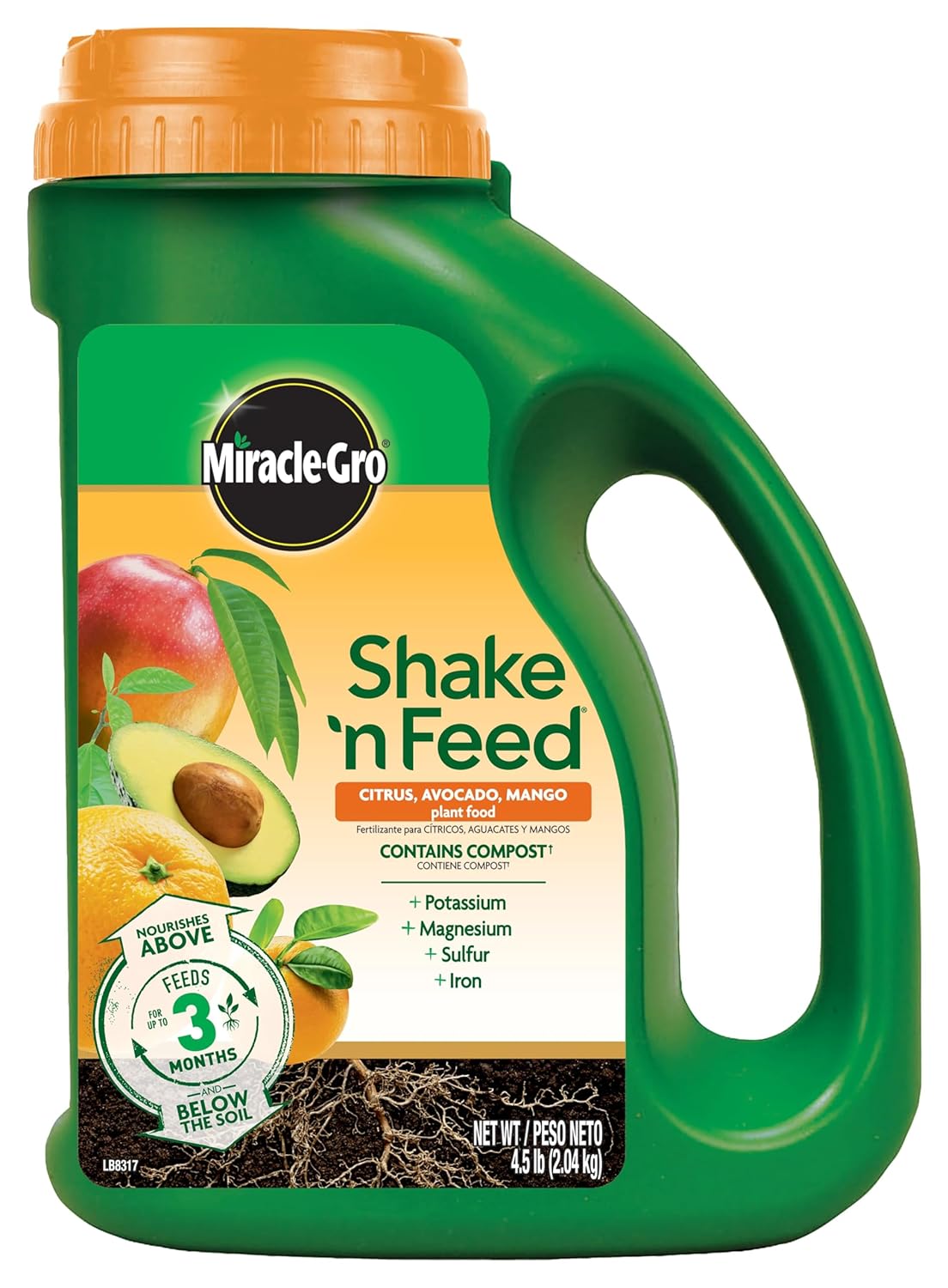
| Item Form | Granules |
|---|---|
| Application Method | Shake evenly onto soil |
| Target Species | citrus, avocado, mango |
| Mixing Ratio | 8-2-10 |
This Shake 'N Feed formula delivers an 8-2-10 NPK blend in granules designed for easy, no-mess application to citrus, avocado, and mango trees. You shake the granules onto the soil within the canopy, work them lightly into the top inch or three of soil, then water to activate the slow-release nutrients that feed roots and foliage for up to three months. The product lists added micronutrients and microbes intended to correct common deficiencies and improve root strength and water efficiency, which is useful for fruit trees that demand steady nutrition over the growing season. Typical use is quarterly applications during the active growing season for both container and in-ground specimens. Practical benefits include simple application, multi-month feeding so you do not need frequent reapplication, and coverage suited to small to medium trees or multiple potted specimens. Limitations are that the formula is tailored specifically to citrus, avocado, and mango so it is not an all-purpose fertilizer for every fruit species and the granular form requires surface working and watering to begin release rather than instant uptake.
Best for: Fruit-tree growers who prioritize steady, performance-oriented nutrition for citrus, avocado, or mango and want a low-effort quarterly feeding schedule for containers or small-to-medium in-ground trees.
Less Ideal for: Growers managing diverse orchard plantings with many fruit types or those who need a fast-acting liquid feed for immediate correction of deficiencies.
- Slow-release feed that nourishes plants up to three months per application
- Formulated specifically for citrus, avocado, and mango with added micronutrients
- Granular shake-and-feed application is quick and easy for in-ground and container trees
- Contains microbes to support root development and nutrient breakdown
- Not formulated for a wide range of other fruit species so may not suit all orchard needs
- Requires physical application and watering to activate rather than providing immediate foliar uptake
Verdict: A straightforward slow-release granular fertilizer that provides targeted, low-effort quarterly nutrition for citrus, avocado, and mango trees.
Farmer's Secret Fruit & Bloom Booster Liquid Fertilizer (8 oz)

| Item Form | Liquid |
|---|---|
| Application Method | dilute with water and pour or spray |
| Coverage | general garden use |
| Mixing Ratio | 1 teaspoon : 2 gallons |
Farmer's Secret Fruit & Bloom Booster is a concentrated liquid plant food designed to encourage blooms and higher fruit yields by supplying elevated phosphorus and potassium along with nitrogen and trace minerals. Typical use is simple: dilute 1 teaspoon per 2 gallons of water and apply as a soil drench or foliar spray every 1–2 weeks once plants begin to bud. The high phosphorus formulation supports root development and bloom set, while compatibility with watering cans, sprayers, or irrigation systems makes it easy to integrate into an existing routine. Because it is concentrated, a small bottle treats a lot of plants, which suits seasonal feeding through the mid and late growth stages. Limitations to note are that nutrient analysis is given only in broad terms rather than exact N-P-K percentages on the listing, and as with any concentrated fertilizer you must follow dilution instructions carefully to avoid overfeeding sensitive plants. Best results depend on consistent timing and appropriate use for fruiting and flowering species.
Best for: Home growers focused on increasing bloom set and fruit yield who want an easy-to-apply, concentrated booster they can add to a regular feeding schedule.
Less Ideal for: People seeking exact N-P-K ratios on label or those who prefer slow-release granular fertilizers for low-maintenance gardens.
- Highly concentrated so small amounts treat many plants
- Formulated to support blooms and fruit with elevated phosphorus and potassium
- Works as both soil drench and foliar spray and is compatible with irrigation systems
- Includes trace minerals in addition to NPK for broader nutrient support
- Listing does not provide an explicit N-P-K percentage breakdown
- Small 8 oz bottle may require careful dilution planning for very large plantings
Verdict: A compact, professional-strength liquid booster that makes it easy to increase blooms and fruit production when used as a regular dilute feed.
Jobe's Organics Granular Fruit & Citrus Fertilizer, 4 lb

| NPK | 3-5-5 |
|---|---|
| Item Form | Granules |
| Unit Count | 64 Ounce |
| Application Method | Spread evenly around base |
Jobe's Organics Granular Fruit & Citrus Fertilizer is a slow-release, OMRI-listed granular product designed to feed the roots of fruit and citrus trees and plants. It is used by measuring and spreading the granules evenly around the plant base and then watering in, with recommended reapplication every 4 to 8 weeks during the growing season. The 3-5-5 NPK formula combines feather meal, bone meal and processed poultry manure to encourage bloom and fruit development while supplying calcium, magnesium and sulfur for balanced nutrition. The resealable bag and granular form make it easy to store and apply without messy runoff, and the organic certification means it can be used in organic gardens. Limitations are its relatively low nitrogen content for heavy-feeding periods and the need for repeated applications through the season compared with longer-term spikes or very high analysis fertilizers, so you may need more frequent attention to maintain vigorous growth on large trees.
Best for: Gardeners on a budget who want an organic, easy-to-apply fertilizer for backyard fruit and citrus trees and who are willing to apply feedings periodically during the growing season.
Less Ideal for: Large orchards or growers seeking a single-season, low-maintenance feeding solution should consider long-release or higher-analysis fertilizers instead.
- OMRI listed and suitable for certified organic fruit and citrus production
- Balanced 3-5-5 NPK tailored to bloom and fruit development
- Granular slow-release formula feeds roots over time and reduces immediate runoff
- Resealable 4 lb bag is convenient to store and measure for repeated applications
- Lower nitrogen percentage may not meet needs of very heavy-feeding trees
- Requires reapplication every 4–8 weeks rather than a single long-term feeding
Verdict: A cost-effective organic granular fertilizer that delivers targeted, slow-release nutrition to boost blooms and fruit on backyard fruit and citrus plants.
Jobe's Fruit and Citrus Tree Fertilizer Spikes, 15 Count

| Count | 15 spikes |
|---|
These fertilizer spikes are pre-measured, easy-to-install plant food designed for fruit and citrus trees. You push a spike into the soil around the tree drip line and the spike slowly releases nutrients over time, so you do not need to mix or measure granular fertilizer. For backyard fruit trees this makes seasonal feeding straightforward and tidy, and the spikes reduce the chance of over-application compared with loose powders. Because they target the root zone, they are useful for established trees and help maintain steady nutrient delivery during the growing season. Limitations are that spikes supply a fixed nutrient dose and schedule, so they are less flexible for trees with specific soil test needs or for very young saplings that require gentler feeding intervals. If you prefer custom nutrient programs or need to correct a specific deficiency, a soluble or granular fertilizer you can adjust may be better.
Best for: Gardeners who want a low-effort, reliable way to keep established fruit or citrus trees fed on a regular schedule without measuring fertilizer.
Less Ideal for: Growers who need to correct specific nutrient deficiencies, run custom feeding programs, or are tending newly planted saplings that require gentle, frequent feedings.
- Pre-measured spikes for consistent, low-effort feeding
- Targets the tree root zone to reduce nutrient waste
- Reduces measuring and mixing so application is quick and tidy
- Good option for seasonal maintenance of established fruit and citrus trees
- Fixed nutrient amount and release schedule cannot be tailored to specific soil test results
- Not ideal for very young or newly planted trees that need milder introductions to fertilizer
Verdict: Use these pre-measured spikes when you want a simple, dependable maintenance feed for established fruit and citrus trees.
TPS Nutrients Lemon Tree Fertilizer Liquid, 8 fl oz

| Item Form | Liquid |
|---|---|
| Application Method | Watering can, hose end sprayer, or leaf misting |
| Target Species | Lemon Trees |
| Mixing Ratio | 1:200 |
| Unit Count | 8 Fluid Ounces |
This 8 fl oz liquid fertilizer is made for lemon and other citrus trees and is used by diluting at the suggested 1:200 ratio and applying via watering can, hose-end sprayer, or foliar misting. In practice it supplies a balanced, fast-absorbing feed that supports root strength, leafy vigor, and better fruit set on both in-ground and container trees. The small bottle is convenient for patio growers or gardeners with a few trees and the medium coverage fits regular maintenance rather than large orchards. Notable features include a citrus-targeted formulation and multiple application options so you can feed established trees or spray new growth. Because the product is concentrated, a little goes a long way, but the bottle size means you may need to repurchase sooner if you care for several trees. This is a straightforward option for growers who want a citrus-specific liquid feed with flexible application; expect consistent, incremental improvements rather than dramatic overnight results.
Best for: Buyers who want a tested, citrus-specific liquid feed for a few patio or backyard lemon trees and who value straightforward dosing and flexible application methods.
Less Ideal for: Not the best choice for orchard-scale growers or those needing a long-lasting bulk supply for many trees.
- Formulated specifically for lemon and citrus trees for targeted nutrition
- Liquid concentrate with 1:200 mixing ratio allows precise dosing
- Multiple application methods: watering can, hose-end sprayer, or foliar mist
- Suitable for both in-ground and container citrus trees
- Fast-absorbing formula for quicker uptake by roots and leaves
- Small 8 fl oz bottle may require frequent repurchase for multiple trees
- Coverage labeled as medium so not ideal for large orchards
Verdict: A concentrated liquid feed made for lemon and citrus trees that delivers targeted, fast-absorbing nutrition in a small, easy-to-apply bottle.
Miracle-Gro Water Soluble All Purpose Plant Food, 3 lb

| Item Form | Powder |
|---|---|
| Application Method | Mix with water in a watering can |
| Fertilizer Analysis | 24-8-16 |
| Unit Count | 48 Ounce |
Miracle-Gro Water Soluble All Purpose Plant Food is a powdered NPK fertilizer (24-8-16) designed to dissolve in water and feed a wide range of plants, from houseplants to garden vegetables and trees. You mix measured scoops into a watering can and apply every 7 to 14 days for outdoor plants or every 2 weeks for indoor plants. Its water-soluble formula means nutrients reach roots quickly, which is useful for correcting short-term deficiencies or giving fruit trees a growth boost during the growing season. The included scoop and clear directions make it straightforward for cautious gardeners to dose safely. Important limitations: it is a fast-release product rather than a slow-release feed, so it requires regular reapplication and careful following of mixing rates to avoid overfeeding. It also provides a higher nitrogen ratio, which favors leafy growth and may need to be balanced with other formulations if you want to prioritize fruit set and bloom over vegetative growth.
Best for: Gardeners who prefer a reliable, easy-to-use fertilizer to give fruit trees periodic, measurable nutrient boosts and who follow directions closely to avoid overfeeding.
Less Ideal for: Growers seeking a single-season slow-release program or those who want a fertilizer specifically balanced to maximize fruiting without encouraging extra leafy growth.
- Water-soluble formula delivers nutrients to roots quickly after application
- Clear mixing instructions and included scoop reduce dosing mistakes
- Broadly labeled safe for indoor and outdoor plants including trees and shrubs
- High nitrogen content supports rapid vegetative growth when needed
- Fast-release formula requires regular reapplication rather than long-term feeding
Verdict: Use this when you want a straightforward, fast-acting nutrient boost for fruit trees that is simple to measure and apply.
Choosing the Right Plant Food for Fruit Trees: Key Factors to Consider
Nutrient Ratio and Timing
The relative amounts of nitrogen, phosphorus, and potassium determine how a fruit tree allocates energy between leaf growth, flowering, and fruit development. A higher nitrogen fertilizer early in the season supports leafy growth and recovery from pruning, but excessive nitrogen during bloom can reduce fruit set. Look for feeding plans that lower nitrogen as bloom approaches and boost phosphorus and potassium when fruit is forming.
Timing matters as much as ratio. Slow-release feeds or timed granular applications can provide steady nutrition through the growing season, while foliar or soluble feeds give a quicker uptake when trees need a rapid nutrient boost. Match the feeding schedule to your local climate and the tree's growth stage to avoid late-season stimulation that could delay dormancy.
Formulation and Application Method
Plant food for fruit trees comes as granular, slow-release pellets, water-soluble powders, liquid concentrates, and organic options like composted manures or fish emulsion. Each behaves differently in the soil and around roots. Granular slow-release formulas feed over weeks or months with fewer applications, while soluble or liquid feeds are fast-acting and useful for rapid deficiencies.
Application method affects labor and precision. Granular feeds are often broadcast or placed in drill holes around the dripline, while liquids can be applied with hose-end injectors or by watering in. Consider how much effort you want to invest and whether you need targeted root-zone feeding, trunk drenches, or foliar sprays for micronutrient correction.
Soil Type and pH Interaction
Soil texture and pH control nutrient availability and mobility. Sandy soils drain quickly and may require more frequent, smaller feedings to avoid leaching. Clay soils can hold nutrients but may restrict root growth if compacted, affecting uptake. pH affects whether nutrients like iron, manganese, and phosphorus are accessible to roots, so you may need an amendment or specific formulation that compensates for local soil chemistry.
A simple soil test can steer you toward a product that supplies what is missing rather than repeating what's already abundant. Many plant foods pair well with soil conditioners that adjust pH slightly or improve structure, which leads to more efficient nutrient use by fruit trees.
Tree Age and Root Zone Considerations
Young fruit trees need a gentler feeding approach to encourage root and scaffold growth without forcing excessive top growth. Seedlings and newly planted trees benefit from lower nutrient concentrations and frequent light feedings to support root establishment. Mature trees with extensive root systems can draw from a wider soil volume and usually tolerate higher feeding rates when applied correctly.
Consider root zone depth and feeder root distribution when placing plant food. For established trees, spread applications near the dripline where feeder roots concentrate. For small or container-grown fruit trees, use diluted solutions and avoid placing undiluted fertilizers against the trunk.
Organic Vs Synthetic Options
Organic plant foods release nutrients more slowly and contribute to soil biology through added organic matter. They are often preferred for long-term soil health and for gardeners avoiding synthetic inputs. Synthetic fertilizers provide precise, predictable nutrient concentrations and are useful when a specific deficiency must be corrected quickly.
Decide whether ongoing soil-building is a priority or whether you need targeted correction. Organic options can improve structure and microbial activity, but they may require larger application rates to match the immediate nutrient availability of synthetic alternatives. Consider combining approaches for both short-term correction and long-term soil improvement.
Micronutrients and Special Formulations
Fruit trees occasionally show deficiency symptoms in micronutrients such as iron, zinc, magnesium, or boron. These trace elements influence flowering, fruit set, and overall tree vigor even though they are needed in small amounts. Some plant food formulations include a broad micronutrient package, while others focus on macronutrients only.
If your soil test indicates specific trace element shortages, choose a formulation that supplies those elements or plan for supplemental foliar sprays. Be cautious with metal micronutrients, as oversupply can be toxic. Clear labeling and recommended application rates help avoid accidental over-application.
Feeding Schedules by Tree Stage
Young trees, fruiting maturity, and post-harvest each require different feeding approaches. For newly planted trees, start with low-strength feeds and focus on root establishment during the first season. Young orchard trees benefit from moderate, regular feedings that encourage scaffold development without pushing excessive vegetative growth.
Mature, bearing trees often need targeted feeding timed to pre-bloom and early fruit set to support flower development and the energy demands of growing fruit. After harvest, a late-season, low-nitrogen application helps replenish reserves without encouraging late growth that might not harden off before cold weather.
- Pre-bloom: moderate phosphorus and potassium, controlled nitrogen
- Fruit set: maintain steady potassium for fruit quality
- Post-harvest: low nitrogen, focus on root and reserve replenishment
Matching Feed to Common Fruit Tree Types
Different fruit species can have slightly different nutrient preferences. Pome fruits such as apples and pears typically respond well to balanced feeding with attention to calcium for skin quality. Stone fruits like peaches and plums benefit from careful timing to avoid late-season growth that increases disease susceptibility.
Citrus and subtropical fruit trees often need regular micronutrient attention, particularly iron and zinc, and are commonly fed more frequently in containers or marginal soils. Adjust feeding frequency and formulation to the species and local climate to get the best flowering and fruiting response.
- Pome fruits: watch calcium and boron levels for fruit set and storage quality
- Stone fruits: avoid late nitrogen rushes that promote soft wood
- Citrus: regular micronutrient monitoring and frequent light feedings in containers
Correcting Common Nutrient Deficiencies
Yellowing leaves with green veins often indicate iron chlorosis, while overall pale foliage can signal nitrogen shortage. Small fruits or poor set sometimes show a lack of phosphorus or boron. Identifying the symptom is the first step, but confirming with a soil or tissue test produces the best long-term result.
Corrective feeding can be foliar or soil-applied depending on the nutrient and urgency. Foliar sprays bring rapid relief for micronutrients but do not replace soil conditioning. Use corrective feeds sparingly and follow label guidance to avoid excessive concentrations that can damage roots or foliage.
- Iron deficiency: foliar chelated iron or soil acidification if pH is high
- Nitrogen deficiency: light soil-applied feed early season
- Boron shortage: targeted supplements at blossom time for some crops
Integrating Organic Matter and Mulch
Adding compost and maintaining a mulch layer around fruit trees improves soil structure and moisture retention, which enhances nutrient uptake from any plant food you apply. Organic matter helps buffer nutrient release and supports beneficial microbes that make nutrients more available to roots.
Keep mulch a few inches away from the trunk to prevent rot and concentrate it over the root zone to protect feeder roots. Regularly top-dress with compost or well-rotted manure to supply low-level nutrients and to reduce dependence on high-rate synthetic feeds.
- Use 2 to 4 inches of organic mulch over the root zone, keeping it off the trunk
- Top-dress annually with compost to supply slow-release nutrients
- Mulch reduces water evaporation and stabilizes soil temperature for better root activity
Safety and Environmental Best Practices
Apply plant food carefully to avoid runoff into storm drains or water bodies. Over-application is a common cause of nutrient pollution and can harm nearby aquatic habitats. Use recommended rates based on tree size and soil tests rather than applying blanket amounts.
Store fertilizers in a dry, labeled container away from pets and children. Rinse application equipment and avoid spraying on windy days to reduce drift. When using concentrated liquids or soluble powders, mix them in a well-ventilated area and follow protective guidance on the label.
- Base rates on soil test results and tree size to minimize excess
- Avoid feeding before heavy rains to reduce leaching
- Use protective equipment when handling concentrated fertilizers
How We Chose the Best Plant Food for Fruit Trees
We started by identifying the outcomes gardeners expect from plant food for fruit trees: reliable bloom set, consistent fruit sizing, and sustainable tree vigor across seasons. From there we filtered candidates that provide balanced nitrogen, phosphorus, and potassium ratios appropriate for fruiting trees and include supporting micronutrients when relevant. We prioritized formulations that are safe for established trees and that can be matched to soil test results or common garden soil types. Practical application factors were part of our selection: ease of application to trunks, root zones, or through irrigation; clear dosing guidance for different tree sizes; and options for seasonal feeding schedules. We also looked at ingredient transparency and whether feeding programs avoid excessive nitrogen at bloom time, which can reduce fruiting. Exclusions included products lacking clear nutrient analysis, those intended only for seedlings or container-only use, and any fertilizer with restricted or unsafe ingredients for home gardens. The final shortlist balanced nutrient accuracy, application practicality, seasonality of use, and compatibility with typical orchard maintenance practices.
FAQ
How often should I feed established fruit trees?
Established trees typically benefit from two to three targeted feedings per season: early spring pre-bloom, at fruit set, and a light post-harvest application. Frequency depends on soil type and the formulation you choose, with sandy soils needing more frequent, smaller applications.
Can I use general garden fertilizer on fruit trees?
You can, but choose a formulation with an appropriate balance for fruiting rather than one designed solely for leafy growth. General garden fertilizers may be suitable if they have clear N-P-K ratios and you adjust timing to avoid too much nitrogen at bloom time.
Are foliar sprays better than soil-applied feeds for micronutrients?
Foliar sprays work quickly for correcting trace element deficiencies and are useful in acute cases. They do not replace the need for healthy soil and long-term nutrient availability, so use them as a supplement to soil-based feeding when diagnostics show a deficiency.
Do organic plant foods supply enough nutrients for heavy-bearing trees?
Organic feeds supply nutrients more slowly and improve soil health, but they may require larger application rates or complementary treatments to match the immediate availability provided by synthetic options. Combining organic matter with targeted supplements can support heavy yields over time.
When is the worst time to apply a high-nitrogen feed?
Applying high-nitrogen feed during bloom or late in the growing season is usually counterproductive. It can reduce fruit set during bloom and promote tender late-season growth that is vulnerable to frost or disease.
Final Verdict
Choosing plant food for fruit trees is about matching nutrient ratios, timing, and application method to the tree's age, soil conditions, and your management style. Prioritize nutrient balance and seasonal timing over blanket feeding, and use soil or tissue tests to guide targeted corrections. Focus on steady, appropriate feeding that supports bloom and fruit set without encouraging excessive vegetative growth. With attention to root-zone placement, mulch and organic matter, and careful timing, you can pick a feeding approach that increases yield while protecting long-term tree health.
