

Note: This article contains affiliate links. If you click on these links and make a purchase, I may earn a small commission at no extra cost to you. This helps support my research and content. Read my full affiliate disclosure here.
Anthuriums thrive when their roots sit in a medium that drains quickly yet holds enough moisture to feed steady growth. Choosing the right potting soil affects root oxygenation, disease risk, and how often you need to water. This guide covers seven shortlisted potting soils for Anthurium, each selected for characteristics that matter in a houseplant or shaded patio environment. We evaluate mixes for aeration, water-holding ability, and suitability for common Anthurium care routines. Read on to understand the differences and find a mix that fits your watering habits and container setup.
Top Picks at a Glance
| Best Overall The best all-around choice for most situations | Grow Queen Craft Houseplant Potting Mix, 2 Quart |  |
| Best Quality Built to a higher standard if you want something more solid | HydraGarden Forbidden Cereal Chunky Potting Mix for Houseplants & Aroids, 12 qt |  |
| Best Value The sweet spot between price and what you get | Top Tier Genetics Aroid Soil Blend for Monstera and Alocasia (4 qt) |  |
| Best Budget The cheapest option that still gets the job done reliably | Kapecute 2QT Anthurium Potting Soil |  |
| Highest Rated A top-rated pick with lots of positive feedback | Rosy Soil Aroid Potting Mix, Chunky Biochar Soil, 4 Quarts |  |
| Most Popular A crowd favorite that many people choose with confidence | Grow Queen Craft Aroid Potting Mix, Chunky Monstera & Tropical Plant Soil, 2 qt |  |
| Best Seller A high-volume bestseller chosen again and again | Soil Sunrise Anthurium Potting Soil Mix (4 Quarts) |  |
Grow Queen Craft Houseplant Potting Mix, 2 Quart

| Unit Count | 64 Ounce |
|---|---|
| Item Type Name | Potting Mix |
| Volume | 2 quarts |
| Ingredients | Douglas Fir Bark, Lava Rock, Pumice, Coco Coir, Organic Worm Castings, Charged Biochar |
This Grow Queen craft houseplant mix is a chunky, peat-free potting soil made for repotting and ongoing care of indoor plants like peace lily. The blend uses Douglas fir bark, lava rock and pumice to create permanent air pockets so the mix drains quickly and resists compaction, which helps prevent root rot while still allowing the soil to dry evenly between waterings. It arrives slightly moist and ready to use, which makes repotting new plants or rooting cuttings faster and less messy. Organic worm castings and charged biochar supply steady micronutrients and help retain water and nutrients at the root zone without synthetic fertilizer burn. The formula excludes peat and perlite and is designed to stay structured for multiple seasons, so you repot less often. Note that the bag is small at 2 quarts, so you will need larger sizes for bigger plants or multiple repots and should confirm quantity before starting a project.
Best for: Buyers who want a low-maintenance, sustainable indoor potting mix that prevents soggy roots and feeds plants gradually while minimizing repotting frequency.
Less Ideal for: People who need large volumes of soil for many plants or very large containers should choose bigger bag sizes or bulk potting mix alternatives.
- Chunky mix with bark, lava rock and pumice for lasting aeration and fast drainage
- Contains organic worm castings and charged biochar for slow-release nutrition and improved moisture retention at roots
- Peat-free and perlite-free formula reduces compaction and uses renewable ingredients
- Arrives pre-moistened and ready to use for immediate repotting or rooting cuttings
- Small 2 quart bag may not be enough for larger peace lilies or multiple plants
Verdict: A sustainable, chunky houseplant mix that keeps peace lilies healthy by combining fast drainage with bioactive nutrition.
HydraGarden Forbidden Cereal Chunky Potting Mix for Houseplants & Aroids, 12 qt

| Volume | 12 quarts |
|---|---|
| Unit Count | 384 Ounce |
| Style Name | Houseplants & Aroids |
Forbidden Cereal is a purpose-built chunky potting mix aimed at plants that suffer in dense, water-retentive soils. It combines heat-treated Douglas fir bark, coarse and fine perlite, triple-washed coco coir and chips, biochar, worm castings, LECA clay balls, and New Zealand sphagnum moss (shipped separately) to create an open, fast-draining medium that reduces the risk of overwatering and root rot. In practice you use it like a standard potting mix for repotting or freshening containers; the large particles keep channels open for air and water so roots get oxygen and excess water drains quickly. The separated sphagnum gives flexibility — use it as a top layer for humidity or mix a little in for added moisture retention during propagation. Benefits include improved root health, easier watering control, and organic nutrient content from worm castings. Limitations are that the chunky texture means it holds less water than traditional peat mixes so plants in very dry environments may need more frequent watering, and the mixed particle sizes require careful settling in pots to avoid uneven compaction.
Best for: Buyers who prioritize strong drainage and fast root oxygenation for aroids and pothos and who prefer a peat-free, performance-oriented mix to prevent overwatering issues.
Less Ideal for: People who want a moisture-holding, low-maintenance mix for very dry homes or for small shallow containers that require uniform fine texture.
- Very open, chunky structure greatly reduces risk of overwatering and root rot
- Peat-free, renewable components for better long-term aeration
- Includes organic worm castings and biochar for nutrient retention and soil health
- Sphagnum moss packaged separately so you can topdress, mix in, or use for propagation
- Lower overall water retention than peat-based mixes, requiring more frequent watering in dry conditions
- Chunky particles may settle unevenly in shallow pots and need extra attention when potting
Verdict: Choose this mix if you want a peat-free, chunky potting medium that keeps pothos roots airy and virtually eliminates overwatering-related problems.
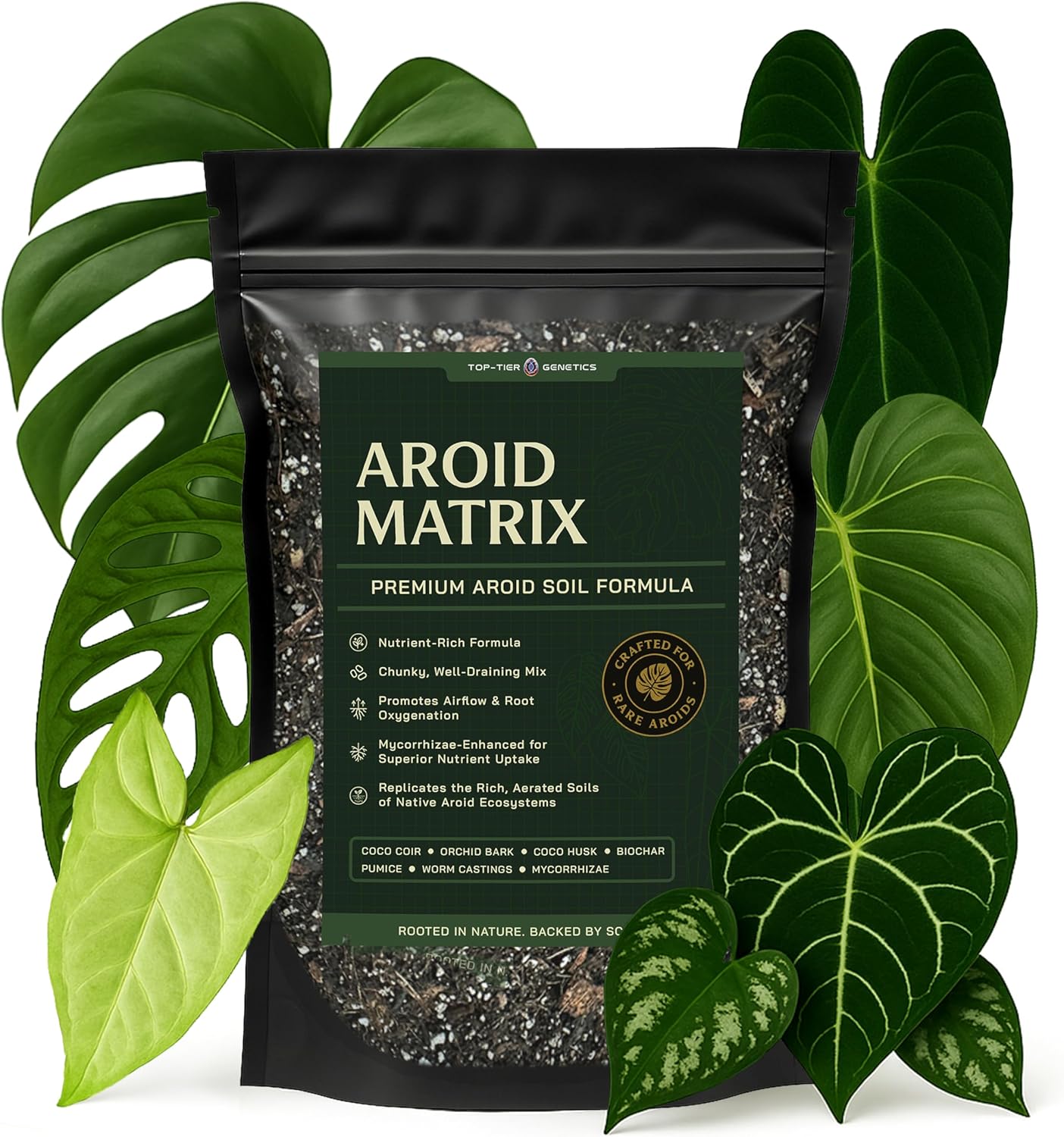
Top Tier Genetics Aroid Soil Blend for Monstera and Alocasia (4 qt)
| Volume | 4 quarts |
|---|---|
| Ingredients | Orchid bark; coco coir; pumice; coco husk; worm castings; biochar; mycorrhizae |
| Unit Count | 64 Ounce |
This ready‑to‑use aroid soil is designed for plants like Alocasia and Monstera and aims to give fast-draining, airy conditions without additional mixing. The mix combines orchid bark, coco coir and pumice for chunky structure that keeps media loose and prevents compaction, while coco husk and coir offer balanced moisture retention so roots stay hydrated but not waterlogged. Worm castings and mycorrhizae add nutrients and beneficial fungi to support early root establishment and leaf growth, and biochar helps hold nutrients and foster microbial life over time. Practical benefits include saving time—you can pot plants straight from the bag—and reducing common aroid problems such as slow drainage and root rot. Limitations are the small 4 quart volume, which means it is best for repotting small to medium plants or for top dressing rather than redoing large specimens, and gardeners who prefer precise DIY mixes may find ready blends less customizable.
Best for: Buyers who want a convenient, ready-made soil that minimizes repotting hassle and targets the drainage and biology needs of Alocasia and other aroids.
Less Ideal for: Growers repotting large specimens or those who prefer to custom-blend exact proportions of bark, coir and pumice should look for larger bags or individual components.
- Chunky, well-aerated mix reduces compaction and improves drainage for aroids
- Includes worm castings and mycorrhizae to support root development and nutrient uptake
- Biochar and organic matter help long-term soil biology and nutrient retention
- Ready to use out of the bag saves time compared with mixing components yourself
- Small 4 quart bag may be insufficient for repotting larger Alocasia plants
- Pre-blended formula limits ability to adjust ratios for individual plant preferences
Verdict: A convenient, biology‑forward chunky mix that gives Alocasia the fast drainage and microbial boost they need without any mixing.
Kapecute 2QT Anthurium Potting Soil

| Item Type Name | potting soil |
|---|---|
| Brand Name | Kapecute |
| Volume | 2 quarts |
| Contains | Sphagnum moss, perlite, NPK slow‑release fertilizer |
Kapecute 2QT Anthurium Potting Soil is a compact, ready‑to‑use mix aimed at growing anthurium. The product ships as a compressed sphagnum moss puck with individually wrapped perlite and slow‑release NPK granules; you rehydrate the moss, mix in the perlite and fertilizer, and pot the plant. Its formulation emphasizes persistent humidity for moisture-loving anthuriums while still allowing fast drainage to reduce the risk of waterlogged roots. For small collections or trialing a new potting medium it is convenient because no additional mixing is required and the included fertilizer offers a short-term nutrient boost. Important limitations are the small 2 quart/mini package size and light weight, which make it suitable only for a few plants or repotting small specimens rather than frequent use across many pots. Also follow the safety guidance and avoid inhaling dust or prolonged skin contact when handling the dry components.
Best for: Buyers who want an inexpensive, no‑mix solution to repot one or a few anthuriums and prefer a product tailored to their moisture needs without extra formulation work.
Less Ideal for: Growers with larger collections, frequent repotting needs, or who prefer to blend their own custom mixes should choose larger or bulk potting media instead.
- Formulated specifically for anthurium to balance moisture retention and drainage
- Includes slow‑release NPK fertilizer so plants get nutrients without separate feeding
- Comes as a ready‑to‑use compressed moss plus perlite system that simplifies potting
- Very small 2 quart package not suitable for multiple repots or larger plants
- Contains dry dust and granular components that can irritate skin or lungs during handling
Verdict: A convenient, budget-friendly single‑use potting mix made for anthuriums that simplifies repotting small plants.
Rosy Soil Aroid Potting Mix, Chunky Biochar Soil, 4 Quarts

| Unit Count | 128 Ounce |
|---|---|
| Volume | 4 quarts |
| Item Highlight | Peat-Free, Microbially Active, Superior Aeration & Drainage |
| Style Name | Aroid Soil |
Rosy Soil Aroid Potting Mix is designed specifically for Monsteras, philodendrons, anthuriums and other tropical aroids that need fast-draining, airy media. The mix combines pine bark fines, pumice and biochar to give a chunky structure that resists compaction and lets roots breathe while water moves through quickly. It is also enriched with worm castings, mycorrhizae and compost to create a microbially active medium that supports nutrient uptake and root vigor over time. Because it is peat-free and formulated to be carbon negative, it is a good choice for growers who want an environmentally friendlier alternative to peat-based mixes. In practical use the mix fills multiple small pots from a 4-quart bag, comes in a resealable bag to stay fresh, and is well-suited for repotting and top-ups where drainage and aeration are priorities. Limitations are the small package size for larger collections and the chunky texture may dry faster than peat blends, requiring more frequent watering for some indoor conditions.
Best for: Buyers who prioritize plant performance and root health for Monsteras and other tropical aroids and who want a fast-draining, microbially active soil that keeps roots airy.
Less Ideal for: Casual plant owners who prefer low-maintenance, moisture-retentive peat blends or who need large volumes for many pots should consider other options.
- Chunky mix with pine bark and pumice provides excellent drainage and prevents compaction
- Includes biochar and beneficial microbes to boost nutrient availability and root health
- Peat-free, designed to reduce carbon impact compared with traditional peat mixes
- Resealable bag and 4-quart volume convenient for repotting multiple small houseplants
- 4-quart bag is small for larger collections or multiple repots
- Chunky texture dries faster than peat-based mixes and may require more frequent watering
Verdict: Choose this mix if you want a high-performance, chunky potting medium that gives Monsteras and other aroids superior drainage, aeration, and microbial support.
Grow Queen Craft Aroid Potting Mix, Chunky Monstera & Tropical Plant Soil, 2 qt

| Brand | Grow Queen |
|---|---|
| Volume | 2 quarts |
| Ingredients | Tree fern fiber, earthworm castings, lava rock, biochar, coco coir, gypsum, alfalfa meal |
| Designed for | Monstera, Alocasia, Philodendron, Anthurium and tropical houseplants |
This Grow Queen Craft Aroid Mix is a ready-to-use, chunky potting soil built to replicate a rainforest floor for Monsteras, Alocasias and similar tropical houseplants. The blend combines large bark pieces, pumice and lava rock for fast drainage and aeration, while coco coir and charged biochar retain modest moisture so the mix does not go bone dry between waterings. It also includes earthworm castings, alfalfa meal and gypsum to support beneficial microbes and provide gentle nutrition out of the bag. The mix arrives pre‑moistened and is straightforward for repotting, especially when you want to reduce compaction and lower the risk of overwatering. Notable limitations are the small 2 quart bag size for larger repotting jobs and the absence of perlite if you prefer that specific amendment. This is a practical, botanist‑informed option for people who want a sustainable, peat‑free alternative tailored to aroids and other chunky‑soil‑loving houseplants.
Best for: Buyers who want a ready-made, sustainable potting mix that mimics tropical forest soil for Monsteras and other aroids and who value drainage with living amendments over DIY mixing.
Less Ideal for: Growers repotting many large plants at once or those who prefer to fully customize their own soil recipe with specific additives like perlite or added fertilizer concentrates.
- Chunky, well aerated formula with bark, pumice and lava rock to improve drainage and prevent compaction
- Includes charged biochar and earthworm castings to support microbes and provide starter nutrients
- Peat free and perlite free, using coco coir and natural porous aggregates for sustainability
- Pre‑moistened and ready to use straight from the bag for easy repotting
- Small 2 quart volume may be impractical for repotting multiple or large plants
- Does not contain perlite, which some growers prefer for a lighter texture
Verdict: Choose this mix if you want a peat‑free, botanist‑designed chunky soil that gives Monsteras and other aroids the fast drainage and living nutrition they need straight from the bag.
Soil Sunrise Anthurium Potting Soil Mix (4 Quarts)

| Volume | 4 quarts |
|---|---|
| Ingredients | Peat moss, pine bark, charcoal, perlite, sand, lime |
| Unit Count | 1 Count |
| Brand Name | Soil Sunrise |
This Soil Sunrise mix is formulated specifically for Anthuriums and is ready to use straight from the bag. It combines peat moss, pine bark, horticultural charcoal, perlite, sand, and lime to create a light, airy medium that drains quickly while still holding moisture and nutrients. In practice the mix makes repotting simple: pour into a pot, set the plant, and water without needing extra additives. Notable features are the perlite and sand for fast drainage to reduce root rot risk, peat to retain water between waterings, and charcoal and bark to keep the root zone breathable and help filter impurities. For growers focused on consistent bloom and glossy foliage, the formula supports healthy roots and longer-lasting flowers. Limitations are the small 4 quart bag size for larger plants or multiple repots and the peat content, which some gardeners avoid for sustainability reasons.
Best for: A practical indoor plant owner who wants a ready-made mix that simplifies repotting and supports consistent blooms without extra amendments.
Less Ideal for: Large-scale growers, nurseries, or anyone who avoids peat-based products should look for bulk soil or peat-free alternatives instead.
- Blended for Anthuriums with ingredients that support flowering and glossy foliage
- Fast-draining mix reduces risk of waterlogged roots
- Peat moss component holds nutrients and moisture between waterings
- Charcoal and bark improve aeration and help filter toxins
- Small 4 quart volume may not be enough for multiple plants or full repots
- Contains peat moss which some buyers prefer to avoid for environmental reasons
Verdict: Choose this premixed Anthurium soil when you want a convenient, plant-specific potting medium that balances drainage and moisture to encourage lasting blooms.
Choosing the Right Potting Soil for Anthurium: Key Factors to Consider
Texture and Particle Mix
Anthuriums need a chunky, open texture that keeps roots oxygenated. A mix with coarse bark, perlite, or coconut chips creates pore space for air and fast drainage between waterings. Fine textured or silt-rich soils compact over time and reduce oxygen flow, increasing the risk of root rot.
Look for visible, stable particles rather than only fine peat or compost. Chunky components also help maintain structure when the medium is slightly moist, which is crucial for potted Anthuriums grown in containers with limited depth.
Water Retention Vs Drainage Balance
A good Anthurium mix holds moisture without becoming soggy. Organic components such as coconut coir or aged compost help retain water near roots, while inorganic additives like perlite regulate drainage. The aim is a medium that wets through but dries partially between waterings so roots are not constantly saturated.
Your local climate and indoor humidity affect how thirsty the mix will behave. In dry homes choose mixes with slightly higher water retention; in humid spaces favor faster-draining blends to avoid long wet periods.
pH and Nutrient Profile
Anthuriums prefer a slightly acidic to neutral pH and steady, mild nutrient availability. A mix with balanced organic matter and a pH in the slightly acidic range supports iron and micronutrient uptake, which affects leaf color and flowering. Avoid soils that are extremely alkaline or heavily amended with slow-release fertilizers intended for heavy feeders.
For long-term potted culture, a medium that provides modest, steady nutrients is better than one that is dense with fresh, high-dose fertilizers that can burn fine roots or force rapid, weak growth.
Sterility and Disease Risk
Soil-borne pathogens and pest eggs can travel in poorly processed media. For Anthuriums, choosing a clean, well-processed potting mix reduces the likelihood of fungal rots and soil pests. Ingredients that resist compaction and waterlogging also lower disease risk because dry aerobic conditions hamper many pathogens.
When repotting, always inspect the media for mold, odors, or signs of contamination. Prefer mixes produced with sanitary practices and those that list components clearly to allow you to judge disease risk more accurately.
Longevity and Reworking Frequency
How long a mix holds structure affects how often you must repot or refresh the media. Organic pieces will break down over time, reducing aeration and requiring re-potting or amendment. A durable mix that keeps particle integrity for a couple of years reduces disturbance to roots and saves labor.
Consider whether you want a low-maintenance medium that lasts, which may include more stable inorganic components, or a faster-decomposing organic-rich mix if you prefer more frequent repotting and nutrient renewal.
Container Type and Drainage Setup
The pot you use interacts with the soil. Unglazed clay pots wick moisture and accelerate drying, which favors mixes with higher water retention. Plastic or glazed containers retain moisture longer, so pair them with faster-draining mixes. Also consider whether the pot has adequate drainage holes and if you use a liner or cachepot that can trap excess water.
Match your chosen media to your container and watering routine. The same mix behaves differently in a shallow versus deep container and in pots with or without drainage.
Why Anthuriums Need Airy, Fast-Draining Media
Anthuriums evolved as epiphytic or hemi-epiphytic tropical plants, so their roots expect a substrate that allows air and moisture to alternate. In containers, replicating that rhythm prevents oxygen starvation and supports the fine feeder roots that take up nutrients.
Using an airy mix reduces the chance of root rot and encourages stronger root branching. It also affects how often you water and how the plant responds to feeding, with airier media producing slower but steadier growth that is easier to manage indoors.
- Air pockets supply oxygen to roots and beneficial microbes
- Alternate wet-dry cycles keep roots healthy and active
- Chunky particles slow compaction compared with fine soils
Common Potting Ingredients and What They Do
Bark adds structure and mimics the coarse debris an epiphyte would encounter on tree branches. Perlite or pumice increases porosity and speeds drainage. Coconut coir holds water and resists compaction better than raw peat in long-term container culture.
Compost or well-rotted organic matter contributes nutrients but should be used sparingly to avoid overly rich, dense media. Recognizing each ingredient's role helps you choose or blend a mix tailored to your watering style and environment.
- Coarse bark: structural porosity and longevity
- Perlite/pumice: inorganic drainage without holding water
- Coconut coir: balanced water retention and aeration
- Aged compost: gentle nutrient source when used moderately
Adjusting Mixes for Your Home Climate
In dry, heated homes increase the proportion of water-retentive components like coir or small amounts of sphagnum to avoid daily watering. In humid or poorly ventilated rooms reduce retained moisture with more perlite, pumice, or bark to shorten drying time.
Observe how quickly the top inch and the root ball dry after watering and tweak the mix in small batches. Small adjustments to particle size and organic content can make a big difference in watering frequency and plant vigor.
- Dry indoor air: add coir or sphagnum for extra moisture
- Humid rooms: increase inorganic particles to speed drying
- Poor light: favor slightly higher drainage to limit rot risk
Repotting Timing and Technique for Anthuriums
Repot young Anthuriums every 12 to 18 months to refresh media before it compacts and to check root health. Mature plants may need repotting less often unless roots have filled the container or the medium has degraded.
When you repot, remove loose old media, trim only obviously dead roots, and place the plant so the root crown sits at the same depth as before. Backfill with the chosen mix, firm lightly, and water to settle the medium without packing it.
- Repot when media is compacted or roots show at drainage holes
- Avoid burying the crown deeper than its previous level
- Use a pot that permits adequate drainage and matches root volume
Simple DIY Mixes and How to Modify Them
You can tailor a potting medium by combining a quality peat- or coir-based potting soil with coarse bark and perlite or pumice. A typical starting blend for Anthuriums is roughly equal parts chunky bark, coir, and a standard potting base, then adjusted for your climate.
If you find the mix dries too quickly, increase the coir proportion. If it stays wet too long, add more perlite or bark. Keep records of proportions and note plant responses so you can refine the recipe over time.
- Starter ratio: 1 part potting base, 1 part bark, 1 part coir/perlite mix
- Increase coir for higher retention, perlite for more drainage
- Label tweaks to repeat successful blends later
How We Chose the Best Potting Soil for Anthurium
We focused on potting soils and mixes engineered for aroids and broad-leaf tropicals, prioritizing attributes that support Anthurium root health and foliage performance. Key evaluation criteria included drainage and aeration to prevent waterlogged roots, water-holding capacity to moderate watering frequency, pH and nutrient balance to support leaf color and bloom formation, particle stability to avoid compaction over time, and pest and pathogen resistance related to media composition. Editorial filters excluded heavy, all-purpose garden soils and mixes designed for cacti, succulents, or orchids that lack the moisture profile Anthuriums need. We also discounted proprietary blends that do not disclose ingredient composition because transparency matters for long-term plant care. The picks emphasize mixes with visible chunky components such as bark, perlite, or coconut chip that preserve porosity, plus organic matter for slow nutrient release. Each candidate was assessed on how well its stated composition aligns with Anthurium cultural needs rather than marketing claims alone.
FAQ
How often should I repot an Anthurium?
Usually every 12 to 24 months depending on growth rate and media breakdown. Repot sooner if the medium compacts or roots are circling the pot.
Is peat or coir better for Anthuriums?
Coir is often preferred because it holds water without compacting as quickly and is more sustainable in many regions. Peat retains moisture well but can compress and reduce aeration over time.
Can I use orchid bark alone for Anthuriums?
Orchid bark provides excellent aeration but usually lacks sufficient water retention and nutrients on its own. It is best used blended with coir or a potting base to balance moisture.
What potting mix pH should I aim for?
Aim for a slightly acidic to neutral pH, roughly 5.5 to 6.8. That range supports nutrient availability important for leaf color and flowering.
How can I tell if the soil is too wet for my Anthurium?
Signs include yellowing or limp leaves, a sour smell from the soil, and slow growth. Check the root ball; healthy roots are firm and light-colored, while rotten roots are brown and mushy.
Should I sterilize potting mix before use?
Sterilizing is usually not necessary for commercially produced, well-processed mixes. Home-blended fresh ingredients may benefit from light pasteurization if you suspect contamination, but proper ingredient selection and good watering practices are more important for disease prevention.
Final Verdict
Choosing potting soil for Anthurium is a balance between airy drainage and enough water-holding capacity to keep feeder roots active. Prioritize mixes with chunky components and moderate organic content so the medium resists compaction while still delivering moisture and nutrients. Match the mix to your container type and indoor climate, and be prepared to tweak proportions as you observe drying rates and plant response. Focus on drainage and particle stability first, then refine for water retention and pH to give your Anthurium the best chance of healthy growth and flowering.
