

Note: This article contains affiliate links. If you click on these links and make a purchase, I may earn a small commission at no extra cost to you. This helps support my research and content. Read my full affiliate disclosure here.
Choosing the right fertilizer spreader affects how evenly nutrients reach your lawn, beds, and entryway plantings. A good homeowner-friendly spreader saves time, reduces wasted product, and helps you avoid burn from overlapping passes. This guide covers seven top picks that are practical for typical yard sizes, easy to calibrate, and built to handle common garden fertilizers and seed mixes. We shortlisted options that balance spread accuracy, ease of use, and durability, then tested those traits on representative homeowner tasks. Read on to understand how these spreaders perform in everyday garden situations and which features matter most for your property.
Top Picks at a Glance
| Best Overall The best all-around choice for most situations | EarthWay 2030P-Plus 65 lb Walk-Behind Broadcast Spreader |  |
| Best Quality Built to a higher standard if you want something more solid | EarthWay 2150 Commercial 50 lb Broadcast Fertilizer Spreader |  |
| Best Value The sweet spot between price and what you get | SOLO 421-S 20 lb Portable Chest-Mount Spreader |  |
| Best Budget The cheapest option that still gets the job done reliably | CHAPIN 8740A 64-oz All-Season Hand Shaker Spreader |  |
| Highest Rated A top-rated pick with lots of positive feedback | SmarketBuy 90 lb Walk-Behind Broadcast Spreader with Pneumatic Wheels |  |
| Most Popular A crowd favorite that many people choose with confidence | Scotts Whirl Hand-Powered Spreader |  |
| Best Seller A high-volume bestseller chosen again and again | Scotts Turf Builder EdgeGuard Mini Broadcast Spreader |  |
EarthWay 2030P-Plus 65 lb Walk-Behind Broadcast Spreader

| Brand | EarthWay |
|---|---|
| Model Number | 2030P-Plus |
| Capacity | 65 LB (29 KG) |
| Tire Type | Pneumatic tires |
The EarthWay 2030P-Plus is a walk-behind broadcast spreader built for homeowners who want commercial-style performance. It carries a large 65 pound rustproof poly hopper so you can cover more lawn between refills, and the patented three-hole drop system with side-spread control produces an even, feathered pattern that reduces striping and protects beds and sidewalks. The variable flow rate control on the handle makes it easy to set and stop product delivery without bending down. Its 10-inch pneumatic tires and powder-coated steel frame handle rough turf and uneven ground more comfortably than smaller hobby models. Assembly is minimal since the unit ships mostly preassembled. Expect a sturdy, long-lasting tool for regular seasonal fertilizer, seed, or ice-melt use, but be aware it is a large, walking unit intended for push operation rather than one-handed or very small-lawn tasks. Some buyers may find it heavier to maneuver than compact spreaders, and precise calibration still requires checking settings against product recommendations.
Best for: Homeowners who want a dependable, professional-style spreader to handle medium to large lawns and who value even coverage and durability over compact size.
Less Ideal for: People with very small yards, limited storage, or those who need a lightweight, one-handed spreader for quick spot treatments.
- Large 65 lb rustproof poly hopper reduces refills for bigger yards
- Even-Spread three-hole drop system and side-spread control for accurate, feathered distribution
- Variable flow rate at the handle for easy on/off and rate adjustments
- 10-inch pneumatic tires and powder-coated steel frame improve durability and handling on rough turf
- Designed for push operation and larger lawns, so it is less convenient for very small yards or one-handed use
- Heavier and bulkier to maneuver than compact or handheld spreaders
Verdict: Choose the 2030P-Plus if you want a homeowner-friendly spreader with commercial durability and consistent, accurate coverage for medium to large lawns.
EarthWay 2150 Commercial 50 lb Broadcast Fertilizer Spreader

| Brand | EarthWay |
|---|---|
| Model Number | 2150 |
| Hopper Capacity | 50 lb |
| Tire Type | 13 inch pneumatic |
| Gearbox | Fully enclosed |
The EarthWay 2150 is a commercial-style broadcast spreader built for precise, repeatable coverage on residential lawns. It uses EarthWay's patented 3-hole drop system with side-spread control to deliver a near 50/50 spread pattern and feathered edges, and the drop rate is adjustable directly on the unit so you can match application rates without guesswork. The 50 lb rustproof poly hopper is sized for a full bag while remaining compact enough for garage storage, and the removable grate helps prevent clogs from oversized particles. Construction leans professional grade: powder-coated steel frame, a fully enclosed gearbox rated for damp use, solid stainless-steel linkages instead of cables, and 13-inch pneumatic tires that smooth rough turf. Practical benefits include even material placement, low maintenance from corrosion-resistant parts, and comfortable operation thanks to the multi-position handle. The main compromises are its professional weight and footprint, which are heavier and larger than consumer entry-level spreaders, and the higher initial investment required for the rugged components.
Best for: Homeowners who prioritize consistent, professional-quality spread patterns and durability for regular lawn care and seasonal fertilizing.
Less Ideal for: Casual users with very small yards or those who only fertilize once a year and prefer a lightweight, low-cost handheld spreader.
- Patented 3-hole drop system with side-spread control for accurate, even coverage
- Durable construction with powder-coated steel frame, stainless-steel linkages, and enclosed gearbox
- Large 50 lb rustproof poly hopper that resists corrosion and is easy to wash
- 13-inch pneumatic tires that roll smoothly over uneven turf and reduce operator effort
- Heavier, more industrial footprint than basic consumer spreaders
- Higher upfront cost compared with entry-level models
Verdict: Buy this if you want a rugged, professional-grade spreader that delivers accurate, repeatable coverage on home lawns.
SOLO 421-S 20 lb Portable Chest-Mount Spreader

| Capacity | 20 lbs |
|---|---|
| Hopper opening | 6-inch with screw-on cap |
| Drive | Enclosed lubricated gear drive |
| Applications | Seed, fertilizer, ice melt, sand |
The SOLO 421-S is a chest-mounted broadcast spreader built for precise, mobile application of seed, fertilizer, ice melt and similar granular products. It straps across the shoulders so weight sits on your chest for better maneuverability on beds, slopes and around obstacles where wheeled spreaders are awkward. Fingertip levers let you adjust flow, volume and direction while an agitator and enclosed gear drive promote smooth, consistent discharge and reduced clogging. The twist-on cap keeps material contained when filling and transporting. Because it holds up to 20 pounds, you can cover medium-sized lawns or multiple garden beds without frequent refills, yet it remains compact enough for spot treatments. Expect long service from the polyethylene hopper and stainless components, but wearing 20 pounds on your chest for long runs can be tiring compared with wheeled carts, and it is not designed for bulk commercial-acreage broadcast work. For homeowners who value control and efficient coverage in tight or uneven areas, this is a practical, durable choice.
Best for: Homeowners who prioritize precise, efficient application and need a maneuverable spreader for beds, small to medium lawns, or spot treatments around obstacles.
Less Ideal for: People who prefer low-effort, long continuous coverage for very large lawns or who need a wheeled unit for heavy, sustained spreading sessions.
- Chest-mount design improves maneuverability in tight or uneven areas
- Fingertip controls for adjustable flow, spread volume, and direction
- Agitator and enclosed gear drive reduce clogging and provide smooth, consistent application
- 20 lb hopper reduces refill frequency for medium-sized lawns
- Twist-on cap prevents spills during filling and transport
- Carrying full load on chest can become tiring during extended use
- Not intended for very large lawns or commercial-scale applications
Verdict: Choose the SOLO 421-S if you want a durable, chest-mounted spreader that delivers precise, clog-resistant application for homeowners managing beds and medium-sized lawns.
CHAPIN 8740A 64-oz All-Season Hand Shaker Spreader

| Capacity | 1.8 kg |
|---|---|
| Bottle Type | Shaker Bottle |
| Reusability | Reusable |
| Material Type | Plastic |
The Chapin 8740A is a basic handheld shaker spreader designed for spot applications around the yard and walkways. You fill the 64-ounce poly bottle through a wide screw-top opening, choose one of three twist-to-open lid settings for small, large or wide flows, then dispense material with one hand while walking short distances. Its large handle and glove-friendly design make it easy to scoop and use year-round for winter salt and ice melt as well as spring-to-fall seed and pelletized fertilizer. The plastic construction keeps the unit lightweight and corrosion-free so you can store it with product inside, but that same inexpensive material means it is not built for heavy commercial use and may wear faster than metal alternatives. The shaker is best for spot treatments and tight spaces where a broadcast spreader cannot reach, but it is slow for larger lawns and offers no calibrated spread pattern for precise application rates.
Best for: Homeowners who need an inexpensive, no-frills tool for spot-seeding, fertilizing small patches, or applying ice melt on steps and sidewalks.
Less Ideal for: People who need to cover medium to large lawns quickly or who require precise, calibrated application rates should choose a broadcast or push spreader instead.
- 64-ounce capacity reduces refills during small jobs
- Three twist-to-open lid positions for different particle sizes
- Wide screw-top and large handle make filling and scooping easy
- Plastic body resists corrosion and can be stored with product inside
- Plastic construction is less durable than metal for heavy or commercial use
- Not suitable for quickly covering large lawns due to manual dispensing
Verdict: A low-cost, easy-to-use hand shaker ideal for spot treatments and small areas where a larger spreader is impractical.
SmarketBuy 90 lb Walk-Behind Broadcast Spreader with Pneumatic Wheels

| Capacity | 90 lbs (23 L hopper) |
|---|---|
| Wheels | 12.5 x 4.5-inch pneumatic |
| Flow settings | 3-position control |
| Frame | Carbon steel, powder coated |
This SmarketBuy walk-behind broadcast spreader is built for routine lawn and property care where dependable, even coverage matters. It holds up to 90 pounds in a 23 L hopper and uses a three-position flow control with a lever for adjusting spread rate and pattern, so you can switch from light seeding to heavier fertilizing or salt spreading for winter. Large 12.5-inch pneumatic tires and a carbon-steel powder-coated frame make it easier to roll across uneven turf and resist corrosion over time, and the enclosed gearbox helps protect moving parts from the elements. Assembly requires some setup but the design includes a wide hopper opening and an ergonomic handle for easier filling and pushing. Limitations include the manual push operation, which can be tiring on very large properties, and the spreader lacks motorized drive or electronic rate control for ultra-precise commercial application. For typical homeowners who need a robust, year-round tool, it balances capacity and durability well.
Best for: Homeowners who prioritize a reliable, durable spreader for year-round tasks like seeding, fertilizing, and winter salt spreading and who value low-maintenance mechanical durability over automated features.
Less Ideal for: Large estates or commercial contractors who need motorized or GPS-calibrated spreading and users who want fully hands-off operation.
- Large 90 lb hopper reduces refills for medium to large lawns
- Three flow settings with a control lever for adjustable spreading rates
- 12.5-inch pneumatic wheels improve maneuverability on uneven terrain
- Carbon steel frame with powder coat and enclosed gearbox for durability
- Manual push design can be physically demanding on very large properties
- No powered drive or electronic calibration for precise commercial-grade application
Verdict: Buy this spreader if you want a sturdy, low-maintenance broadcast spreader that delivers reliable, year-round coverage for typical homeowner lawns.
Scotts Whirl Hand-Powered Spreader

| Capacity coverage | Up to 1,500 sq. ft. |
|---|---|
| Material type | Metal, Plastic |
| Handle material | Rubber |
| Additional features | Adjustable Arm Support, Smooth Even Coverage |
The Scotts Whirl is a lightweight, hand-powered spreader made for small yards and targeted tasks like patch seeding, spot fertilizing, or spreading ice melt on steps and paths. It arrives ready to use and features an adjustable arm support and a simple hopper that the manufacturer says covers up to 1,500 sq. ft. The mechanism is engineered to give smooth, even coverage with minimal setup, and the compact size makes it easy to maneuver around gardens, flower beds, and tight spaces where a push spreader would be overkill. Because it is hand-held and low-capacity, it is best for quick jobs rather than whole-lawn treatments on larger properties. Construction mixes metal and plastic with a rubber handle for grip, so it feels sturdy for seasonal chores but is not intended for heavy commercial use. If you want an easy tool for occasional fertilizing, reseeding patches, or winter de-icing on small areas, this delivers predictable, controlled application without complexity.
Best for: Homeowners with small lawns or those who need a compact tool for spot seeding, seasonal fertilizing, or treating walkways and steps who prioritize ease of use and predictable results.
Less Ideal for: Owners of medium to large lawns who need to treat entire properties regularly or users who prefer motorized or high-capacity spreaders for faster coverage.
- Compact and lightweight for easy maneuvering and storage
- Ready to use out of the box with simple operation
- Adjustable arm support improves comfort during use
- Engineered to provide smooth, even product coverage
- Suitable for multiple products: seed, fertilizer, salt, and ice melt
- Low capacity limits use to small yards and spot treatments
- Hand-powered design requires more effort for larger areas
Verdict: A simple, ready-to-use handheld spreader that gives controlled, even application for small lawns and spot treatments.
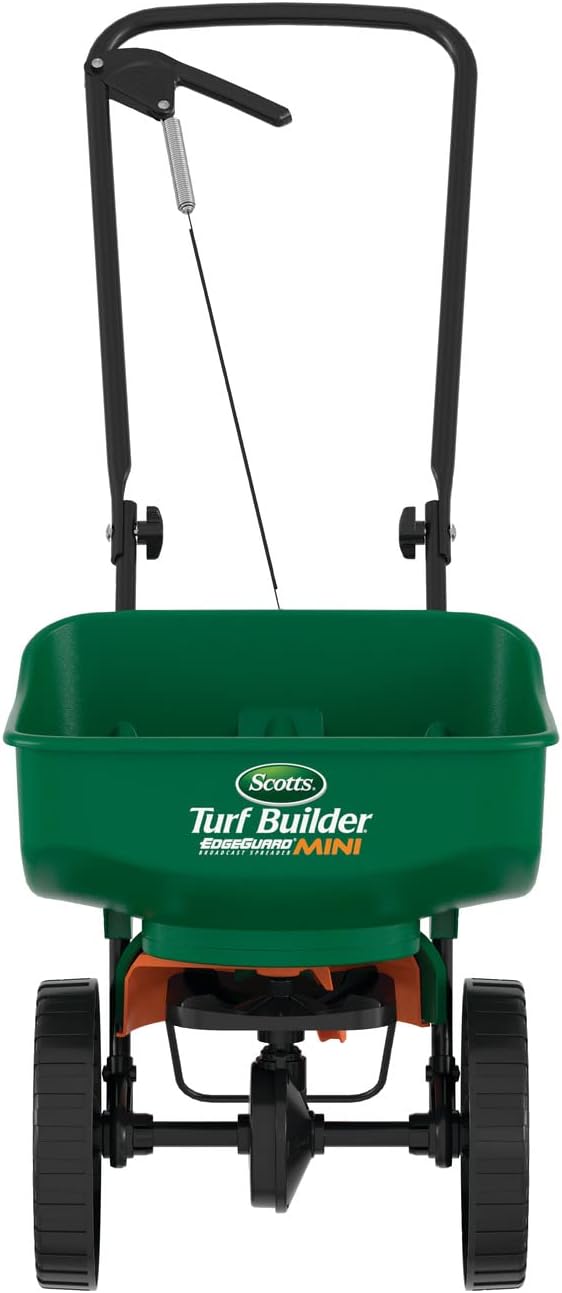
Scotts Turf Builder EdgeGuard Mini Broadcast Spreader
| Capacity coverage | Up to 5,000 sq. ft. |
|---|---|
| No assembly | Pre-calibrated, ready-to-use |
| Uses | Fertilizer, seed, granular weed control, salt, ice melt |
| Feature | EdgeGuard side shield |
The Scotts Turf Builder EdgeGuard Mini is a small broadcast spreader meant for homeowners treating up to about 5,000 sq. ft. of lawn with granular fertilizer, seed, ice melt, or salt. It arrives ready-to-use with a pre-calibrated dial, a redesigned curved hopper and dual-bladed agitator to keep product flowing smoothly, and a fold-down handle for compact storage. The signature EdgeGuard side shield blocks the right-side broadcast pattern so material is less likely to land on sidewalks or planting beds, which is helpful when you want neat, targeted application. Open-spoke durable wheels roll easily over typical yard terrain and the unit’s simplicity makes it easy for anyone to set the correct spread setting from product instructions and walk a lawn consistently. Limitations include its smaller capacity and design intended for modest lawns, so frequent refills are necessary on larger properties, and the lightweight plastic construction is not as heavy-duty as commercial models. For routine homeowner lawn care and occasional winter use for ice melt, it provides reliable, low-effort coverage.
Best for: Homeowners who want a straightforward, low-effort spreader for routine fertilizing, seeding, or winter ice melt on small to medium yards and prefer predictable, tidy application.
Less Ideal for: Those with large properties or professional landscapers who need higher capacity, heavier-duty construction, or more precise commercial-grade distribution across many acres.
- Pre-calibrated and simple to use with clear settings for Scotts products
- EdgeGuard side shield prevents product from drifting onto sidewalks and driveways
- Redesigned hopper and dual-blade agitator promote smooth, consistent flow
- Fold-down handle and compact size make storage easy
- Smaller hopper requires more frequent refills on larger lawns
- Plastic construction is less durable than heavier commercial spreaders
Verdict: A simple, homeowner-friendly broadcast spreader that delivers consistent coverage and keeps product off sidewalks and driveways for tidy, low-stress lawn care.
Choosing the Right Fertilizer Spreader for Homeowners: Key Factors to Consider
Spread Accuracy and Pattern
How evenly a spreader distributes granules determines whether you get consistent nutrient coverage or develop burned patches and streaks. Accuracy depends on the dispenser design, the broadcast plate or drop opening, and the ability to adjust spread width. For homeowners a predictable pattern means fewer overlapping passes and less wasted product, which is important when fertilizing near flower beds or driveways. Check that the spread width and calibration settings match the granule size of your fertilizer and seed mixes.
Small adjustments can drastically change distribution at lawn edges and around obstacles. Consider whether the spreader allows narrowing the pattern or closing off the flow when you pass close to non-target areas.
Hopper Capacity Relative to Yard Size
Hopper size affects how often you must refill during a job. A larger capacity reduces downtime for mid-size and larger yards, but adds weight to push or tow. For most homeowners, a medium-sized hopper balances fewer refills with manageable handling. Consider the weight of the fertilizer when full; heavier loads feel more when pushing on uneven terrain.
If you only manage a small lawn or containers, a compact hopper is easier to store and clean. For properties with mixed areas-lawn, beds, and pathways-a hopper with a graduated capacity or removable insert helps match load size to task without overfilling.
Ease of Calibration and Application Rate Control
Accurate application rates protect plants and reduce waste. A spreader with clear, numbered settings and an easy-to-read calibration chart saves time and avoids guesswork. Look for mechanisms that allow fine adjustments rather than broad on/off settings. Simple controls let homeowners change rates for different products, such as switching from a granular lawn fertilizer to seed or ice melt.
Calibration should be replicable across uses. Consider whether the spreader comes with guidance for common fertilizer granule sizes or if it provides an easy method to measure output in a short test run. The simpler the calibration, the more likely you will use the spreader correctly every season.
Durability and Corrosion Resistance
Fertilizers contain salts that can corrode metal and degrade plastics. For seasonal storage and intermittent use, materials and finishes matter. Look for powder-coated frames, stainless fasteners, and UV-stable plastics that resist cracking from sunlight exposure. Wheel bearings and axle designs should tolerate the occasional rinse without seizing.
A robust chassis and corrosion-resistant components lengthen service life and reduce the need for replacement parts. Even for light use, spending a little more on corrosion resistance protects your investment when you store the device in a garage or shed.
Maneuverability on Typical Home Terrain
How a spreader handles slopes, edges, and narrow passages affects how quickly you can finish a job. Larger wheels roll better over rough turf and thresholds, while a compact turning radius helps when navigating around landscape beds or garden ornaments. Balance the wheel size and axle height against your common working surfaces.
Consider whether you prefer a broadcast spreader that is pushed or a tow-style hopper that mounts to a garden cart or small ATV. For many homeowners, a lightweight push or pull spreader provides enough stability while staying easy to store.
Cleanup, Maintenance, and Storage
After use, leftover fertilizer will sit in the hopper and can corrode components or cake into hard-to-clean deposits. A spreader designed for easy rinsing, with removable parts and a smooth hopper interior, reduces maintenance time. Quick-release pins and detachable spread plates let you flush out residual material thoroughly.
Compact storage features such as foldable handles or a small footprint matter when shed space is limited. Consider how easy it will be to winterize the unit and whether basic replacement parts are accessible for simple repairs.
Matching Spreaders to Typical Home Landscapes
Different lawn shapes and landscape features call for different spreader styles. Small, rectangular lawns and container gardens often benefit from a handheld or compact push spreader that is easy to turn and store. Larger, irregular yards may be more efficient with a broadcast-style walk-behind that covers wider swaths per pass. For properties with lots of beds and edging, a spreader that narrows its pattern or has a drop-control option reduces waste and cleanup.
Think about the surfaces you treat most often. Gravel driveways require careful control to avoid scattering product onto paving. Sloped areas need larger wheels and stable frames to maintain a consistent flow rate without tipping.
- Compact push spreaders suit small lawns and container gardens
- Broadcast walk-behinds cover more ground on medium to large yards
- Drop-control or adjustable pattern options help protect beds and paths
Calibrating a Spreader Quickly
A simple calibration test will save fertilizer and protect plants. Start by setting the spreader to a middle setting, measure a short treated strip, and collect the output into a container for a fixed distance. Compare the mass or volume to the product label rate and adjust accordingly. Repeat until the output matches the recommended application rate for your product.
Keep a log of settings that worked for specific fertilizers and seed mixes so you can repeat the process next season without starting from scratch.
- Run a short test strip to measure output
- Adjust settings in small increments for fine control
- Record successful settings for future use
Storage and Winter Care
Rinse the hopper and spread plate after each use to remove corrosive residues. Allow parts to dry fully before storing to prevent rust and mold. If a spreader disassembles easily, remove the plate and axle to dry independently, and lubricate moving parts with a light, garden-friendly oil.
Store the spreader indoors or under cover and keep it off concrete floors if possible. Protect plastic hoppers from prolonged sunlight to avoid UV degradation. For long gaps between uses, perform a quick inspection of wheels, axles, and fasteners before the first spring application.
- Rinse and dry all parts after use
- Lubricate axles and bearings seasonally
- Store under cover and away from direct sunlight
Common Mistakes Homeowners Make
Applying fertilizer at the wrong rate is the most common issue and leads to plant stress or waste. Ignoring the product label and assuming a default spreader setting will be accurate often causes over-application. Always calibrate for the specific product you are using.
Another frequent error is poor overlap technique. Too much overlap creates stripes, while too little leaves gaps. Walk at a steady pace and maintain consistent spacing between passes. Also avoid applying right before heavy rain; that can wash product away and create runoff.
- Do not skip calibration for each product
- Maintain steady walking speed and even overlap
- Avoid applying before predicted heavy rain
Accessories That Make Work Easier
Simple accessories can improve efficiency. A spreader cart or dolly makes moving heavier loads across driveways easier. A replacement spread plate for different granule sizes can improve accuracy. Funnels and measuring scoops simplify refills and help avoid spills.
Look for covers to protect hoppers in storage and replacement seals for flow controls that wear with use. Having a small brush and hose nearby speeds cleanup and reduces the chance of residue damage.
- Dollies and carts for transporting filled hoppers
- Replacement plates for varying granule sizes
- Covers, seals, and basic cleaning tools
How We Chose the Best Fertilizer Spreader for Homeowners
We limited the shortlist to spreaders that are practical for homeowner workloads rather than commercial turf operations. Selection focused on real-world usability and measurable performance rather than marketing claims. Key evaluation criteria included spread accuracy across common granular fertilizer sizes, hopper capacity relative to typical yard sizes, and ease of calibration and flow control so homeowners can set rates without specialty tools. We also prioritized build durability for occasional seasonal use, inspecting frame materials, axle robustness, and resistance to corrosion from fertilizer salts. Maneuverability and handling were reviewed, including wheel size and stability on slopes and around obstacles. Finally, we assessed cleanup and storage features such as simple disassembly, rinseability, and compact footprint. Products were excluded if they were designed exclusively for commercial contractors, required specialized service tools, or lacked clear calibration guidance for common homeowner fertilizers. Models with persistent clogging issues or poor documentation were also removed from consideration.
FAQ
How often should I calibrate my spreader?
You should calibrate whenever you switch fertilizer products or if you have not used the spreader in a season. Even small changes in granule size or moisture can change flow rate, so a quick calibration test before each major application is recommended.
Can I use the same spreader for fertilizer and grass seed?
Often you can use the same spreader, but you may need to change settings or the spread plate to match seed size. Perform a short test run and adjust the rate to prevent over- or under-seeding.
Is a tow-behind spreader overkill for a typical suburban yard?
A tow-behind spreader can be useful if you have a large property or prefer faster coverage. For many suburban yards a push or compact walk-behind spreader offers sufficient capacity and better maneuverability around beds and obstacles.
How should I store the spreader between seasons?
Rinse out all fertilizer, let components dry completely, lubricate moving parts lightly, and store the spreader indoors or under a protective cover. Removing batteries or electronic components is recommended if the unit has any to prevent corrosion.
What wheel size works best for uneven lawns?
Larger diameter wheels roll more smoothly over bumps and thresholds and improve stability on slopes. If your yard is uneven, prioritize models with larger, treaded wheels and robust axles to maintain consistent flow.
Final Verdict
For homeowners, the best fertilizer spreader balances predictable distribution, manageable hopper size, and simple calibration. Prioritize spread accuracy and corrosion resistance if you treat mixed landscapes or store equipment in a shared shed. If your lawn is small, opt for compact models that are easy to handle and store. For larger yards, choose wider coverage and larger wheels to reduce work time. Focus on the tradeoffs among capacity, maneuverability, and maintenance demands, and pick the spreader that matches how often and where you apply fertilizers.
