

Note: This article contains affiliate links. If you click on these links and make a purchase, I may earn a small commission at no extra cost to you. This helps support my research and content. Read my full affiliate disclosure here.
Gravel beds look clean and low-maintenance until spring weeds push through the stones. Using a pre-emergent herbicide for gravel can block weed seeds from germinating and cut down on constant hand-pulling. Choosing the right formulation matters because gravel surfaces behave differently than soil beds: contact with stone, limited mulch cover, and runoff onto surrounding areas change how products act. This guide shortlists the top options tested for gravel use and explains the evaluation criteria gardeners care about, including residual weed control and environmental considerations. Read on to find which pre-emergent traits matter most for your gravel areas and how we assessed the candidates.
Top Picks at a Glance
| Best Overall The best all-around choice for most situations | Roundup Dual Action Weed & Grass Killer Plus 4 Month Preventer Refill (1.25 gal) |  |
| Best Quality Built to a higher standard if you want something more solid | The Andersons Barricade Granular Pre-Emergent Weed Control (18 lb, covers 5,800 sq ft) |  |
| Highest Rated A top-rated pick with lots of positive feedback | RM43 Concentrated Extended Control Weed Killer (1 gallon) |  |
| Most Popular A crowd favorite that many people choose with confidence | Roundup Dual Action 365 Weed & Grass Killer Plus 12 Month Preventer with Pump 'N Go 2 Sprayer |  |
| Best Seller A high-volume bestseller chosen again and again | Roundup Weed & Grass Killer4 with Pump 'N Go 2 Sprayer, 1.33 gal |  |
Roundup Dual Action Weed & Grass Killer Plus 4 Month Preventer Refill (1.25 gal)

| Form | Liquid |
|---|---|
| Coverage | 375 square feet |
| Volume | 1.25 gallons |
This Roundup Dual Action refill is designed to clear established weeds and help stop new growth in areas like gravel, driveways, patios, and along fences. The concentrate is mixed or used with compatible Roundup applicators to cover roughly 375 square feet per refill. It starts working quickly—visible wilting within hours and full control in one to two weeks—and becomes rainproof in about 30 minutes, which is useful for outdoor applications. The product creates an invisible barrier in the soil that prevents weed germination for up to four months, making it a practical choice for seasonal maintenance of gravel beds and hardscaped gaps. Important practical points: you must spray the entire target area (not just individual weeds) to get prevention, avoid treating lawns or desirable plants, and wait four months before planting ornamentals or installing seed in treated spots. Use when temperatures are above 60°F for best results and keep people and pets out until the spray dries.
Best for: Gardeners and homeowners who maintain gravel beds, patios, or driveways and want a fast-acting product that also provides multi-month pre-emergent control for low-maintenance hardscape areas.
Less Ideal for: People needing a spot-treatment solution for individual weeds in lawns or those who plan to replant immediately in treated soil; not suitable for organic or chemical-free gardening approaches.
- Kills weeds and grasses down to the root for thorough removal
- Forms a preventive soil barrier that lasts up to four months
- Becomes rainproof in about 30 minutes so applications are less weather-sensitive
- Covers approximately 375 sq. ft. per 1.25 gallon refill for typical gravel/ hardscape areas
- Must treat the entire area to achieve prevention rather than spot-treating visible weeds
- Not safe for lawns or desirable plants and requires a four-month waiting period before replanting
Verdict: Choose this refill when you need fast weed knockdown plus up to four months of prevention for gravel and hardscape areas.
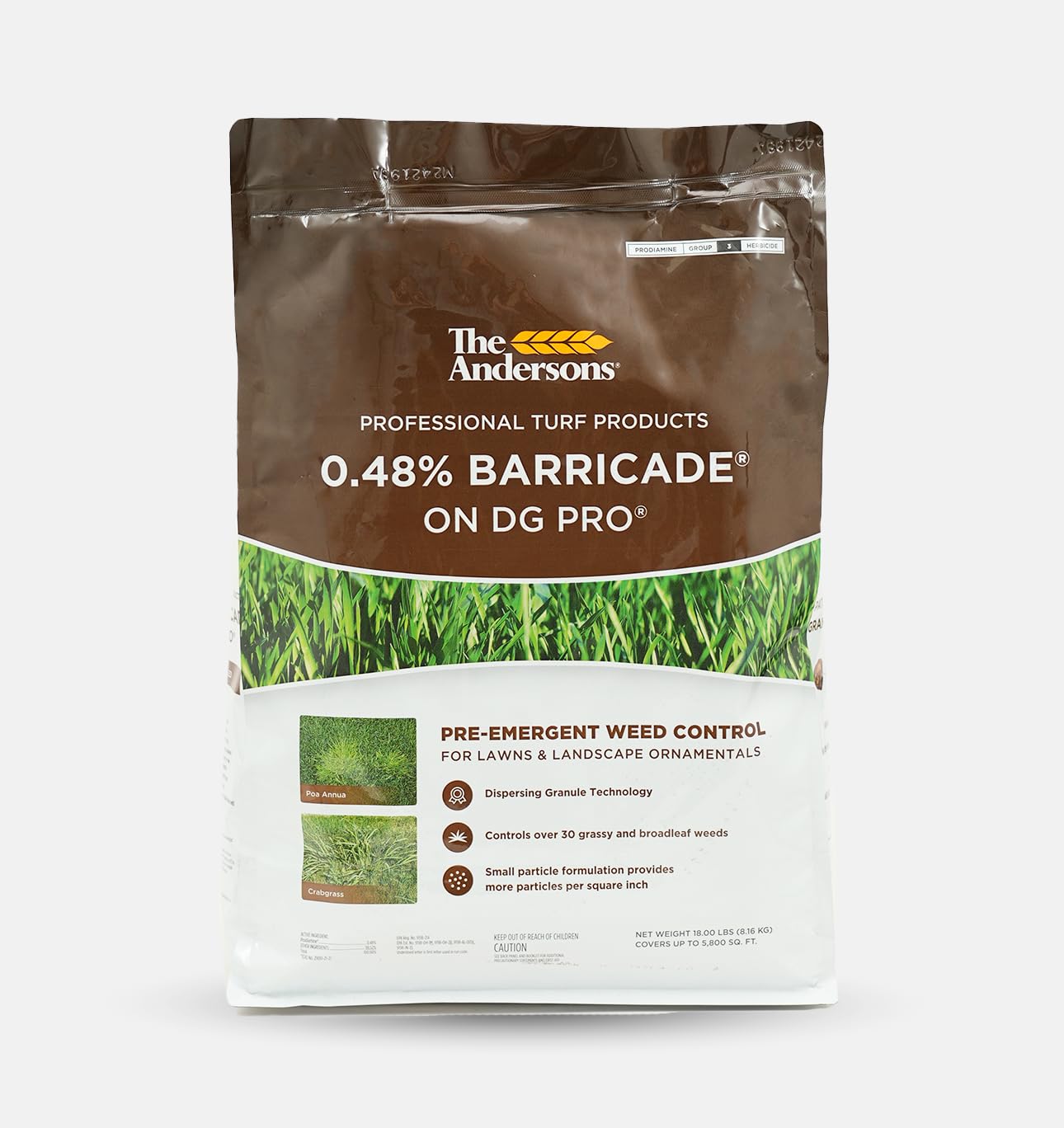
The Andersons Barricade Granular Pre-Emergent Weed Control (18 lb, covers 5,800 sq ft)
| Item Form | Granule |
|---|---|
| Coverage | 5800 square feet |
| Unit Count | 288 Ounce |
| Active Ingredients | Prodiamine 0.48% |
Barricade is a granular pre-emergent that stops common lawn weeds before they emerge, using 0.48% prodiamine in a dispersible granule formula. You apply it across the lawn in early spring or fall and water it in so the small DG Technology particles dissolve and move the active ingredient into the soil. That combination gives broader, more even coverage per square inch and is especially aimed at preventing crabgrass, poa annua and other annual grassy and broadleaf weeds across up to 5,800 square feet from a single 18 pound bag. The product is straightforward to use with a spreader and fits routine seasonal maintenance plans. Important limits are that it will not kill weeds already established and must be timed correctly for best effect. Also, because it is a professional-strength herbicide buyers should follow safety directions closely and keep pets and children off treated areas until safe.
Best for: Homeowners who plan seasonal lawn maintenance and want a single, high-coverage pre-emergent to prevent crabgrass and common annual weeds across medium to large yards.
Less Ideal for: People needing a post-emergent solution for existing weeds, or gardeners who prefer non-chemical weed control methods.
- Designed to prevent both grassy and broadleaf annual weeds including crabgrass and poa annua
- DG Technology dispersible granules dissolve quickly when watered for consistent soil incorporation
- Covers up to 5,800 square feet from a single 18 pound bag, suitable for typical residential lawns
- Contains professional-grade active ingredient prodiamine for season-long pre-emergent control
- Will not control weeds that are already established in the lawn
- Must be applied in the correct seasonal window (early spring or fall) to be effective
- Requires watering after application and careful safety handling around children and pets
Verdict: Pick Barricade when you want a professional-strength, high-coverage pre-emergent that reliably prevents crabgrass and other annual weeds across a typical residential lawn.
RM43 Concentrated Extended Control Weed Killer (1 gallon)

| Unit Count | 128 Fluid Ounces |
|---|---|
| Item Form | Spray |
| Coverage | 17297 square feet |
| Active Ingredients | glyphosate |
RM43 is a concentrated glyphosate‑based weed killer blended for broad, long‑lasting vegetation control on noncrop areas. You mix it with water and apply through a sprayer to drive down perennial weeds, fence lines, gravel areas, and other places where you want no plant growth. The formula pairs glyphosate with a second herbicide and a surfactant so it kills to the root and claims prevention of new growth for up to a year while becoming rainfast in about two hours. A single gallon treats a large area, making it suitable for larger properties or professional use. Important practical limits are safety and site restrictions: it must not be used near desirable plants or crops and requires cautious handling to avoid drift and contact with skin and eyes. For routine spot treatments it is concentrated enough that careful measuring is needed, and it is intended only for areas where total vegetation removal is acceptable.
Best for: Buyers who need a powerful, long‑lasting solution for clearing and keeping large nonplant areas free of vegetation, including property managers and professional landscapers focused on durable results.
Less Ideal for: Gardeners who need selective weed control around ornamentals or vegetable beds or those who want an organic or low‑toxicity option should choose a different product.
- Concentrated one‑gallon formula treats large areas, reducing trips to refill
- Combination of glyphosate and a second herbicide for deeper, longer control
- Rainfast in about two hours so results are less affected by light rainfall
- Designed for total vegetation control and claims up to 12 months of prevention
- Not selective so will kill desirable plants and must be applied only to noncrop areas
- Requires careful mixing and handling because of strong active ingredients
Verdict: Choose RM43 when you need a concentrated, professional‑strength herbicide that kills to the root and provides long‑term vegetation control on noncrop areas.
Roundup Dual Action 365 Weed & Grass Killer Plus 12 Month Preventer with Pump 'N Go 2 Sprayer

| Unit Count | 170 Fluid Ounces |
|---|---|
| Coverage | 400 sq.ft. |
| Item Form | Liquid |
This product combines an all-in-one herbicide and long‑term preventer in a 1.33 gallon ready-to-use formula with an integrated Pump 'N Go 2 sprayer. It is designed for non-lawn areas like driveways, patios, gravel and cracks where you want to both eliminate current weeds and stop new growth for up to a year. The concentrate-free container and extendable wand make spot and area spraying straightforward and reduce bending when treating edges and crevices. It claims visible results within hours and becomes rainproof in about 30 minutes, which helps when weather timing is tight. Practical benefits include broad-spectrum control of common tough weeds and a 400 sq ft coverage per container. Important limitations are that you must spray the entire target area—not just visible weeds—to get the preventer effect, and the product is intended for non-lawn surfaces only, so it is not for treating turf you want to keep. Follow the label for safety and reentry instructions since it is a strong herbicide.
Best for: Buyers who prioritize strong, long-lasting weed control for hardscape and non-lawn areas and want a ready-to-use product with a built-in sprayer for quick, targeted applications.
Less Ideal for: Gardeners who need a lawn-safe solution or who prefer spot-treatment of individual plants without treating whole areas should look for a turf-safe or selective product instead.
- Kills existing broadleaf and grassy weeds and prevents new growth for up to 12 months
- Ready-to-use formula with Pump 'N Go 2 sprayer for accurate, continuous spraying without mixing
- Rainproof in about 30 minutes for faster applications in variable weather
- Extendable wand improves reach and accuracy in cracks, edges, and under decks
- Must spray the entire area to activate the preventer effect, which can use more product
- Formulated for non-lawn areas only and will damage turf and desirable plants if applied there
Verdict: Choose this if you want a ready-to-use, long-lasting solution to both kill weeds now and prevent them from returning in non-lawn areas for up to a year.
Roundup Weed & Grass Killer4 with Pump 'N Go 2 Sprayer, 1.33 gal

| Unit Count | 170 Fluid Ounces |
|---|---|
| Item Form | Spray |
| Coverage | 300 Square_Feet |
| Active Ingredients | Triclopyr, Triethylamine Salt, Fluazifop-P-Butyl, Diquat Dibromide |
This packaged Roundup kit combines a 1.33 gallon formulated weed-and-grass killer with a Pump 'N Go 2 sprayer, letting you treat patches of weeds and grassy intruders without mixing chemicals or carrying a separate sprayer. The extendable wand and up to 10 minutes of continuous spray make targeted application around flower beds, patios, gravel, and edges easier and reduce bending. The formula claims visible results in hours, becomes rainproof in about 30 minutes, and permits replanting within the stated window. Practical benefits include convenience of an integrated sprayer, good coverage for small to medium areas, and a broad activity spectrum against dandelions, crabgrass, clover, and other common broadleaf weeds. Important limitations are safety precautions and restricted access after application since it is an herbicide that can harm desirable plants and requires protective clothing and keeping people and pets away until dry. Also, this product is for spot and surface treatments rather than long-term lawn renovation or nonchemical weed control approaches.
Best for: Buyers who want a convenient, ready-to-use herbicide for spot-treating visible weeds and grass around hardscapes and landscape beds and who prefer an integrated sprayer to simplify application.
Less Ideal for: People seeking organic, nonchemical weed control or a product for large-scale lawn renovation should consider alternative methods or professional services.
- Includes Pump 'N Go 2 sprayer with extendable wand for accurate, continuous spray
- Ready-to-use formulation so no measuring or mixing is required
- Produces visible results in hours and is rainproof in about 30 minutes
- Designed for use around beds, patios, driveways, gravel, and edging
- Contains potent active ingredients that require safety precautions and restrict access to treated areas
- Not suitable for nonchemical or preventive long-term weed management
Verdict: If you want a no-mixing, spot-treatment herbicide with a built-in sprayer for quick, targeted weed control, this all-in-one Roundup kit is a practical choice.
Choosing the Right Pre-Emergent Herbicide for Gravel: Key Factors to Consider
Residual Control Duration
How long a product prevents seed germination is the single biggest operational factor for gravel beds. Gravel exposes the treated surface directly to sunlight and temperature swings, and frequent disturbance from foot traffic or leaf litter can shorten effective life. Longer residuals reduce how often you need to reapply, but the local climate and seed bank pressure change expectations: high weed-pressure sites may still need follow-up seasons of treatment.
When judging duration, consider label claims in months, typical local germination windows for common weeds, and whether the product holds up under rain events. A product that promises extended control but is liable to wash away on sloped gravel is less useful than a shorter-acting formula that resists runoff.
Runoff and Leaching Potential
Gravel surfaces shed water quickly and can drain into lawns, flower beds, or municipal storm systems. A herbicide with high runoff or leaching potential risks moving active ingredient off the gravel and affecting non-target plants or aquatic systems. This is both an environmental concern and a practical one if you have nearby plantings you want to protect.
Assess label language about buffer zones, restrictions near water, and recommended timing relative to rainfall. In many cases, choosing a formulation and application method that minimizes soluble residues and avoids treating immediately before heavy rains will reduce off-site movement.
Application Ease on Gravel Surfaces
Applying a product on gravel is different from spraying a lawn. Granular formulations can fall between stones, while sprays may puddle or run off. Ease of application includes how uniformly the product can be distributed, whether calibration is straightforward, and how well the product reaches seed zones among the stones.
Look for products with clear spreader or sprayer settings for irregular surfaces, guidance for treating edges and seams, and tips for preventing drift or bouncing. For DIY gardeners, practical application instructions and simple equipment needs increase the chance of safe, effective results.
Non-Target Plant and Pollinator Safety
Gravel beds often sit next to borders, container plants, or turf. A pre-emergent that harms desirable plants or poses risks to pollinators when in bloom can create more problems than it solves. Consider label restrictions about planting intervals for nearby vegetation and instructions to avoid application during pollinator activity.
Evaluate whether the active ingredients have known restrictions or recommended buffer times for planting. Products with lower volatility and limited soil mobility generally present fewer non-target risks in mixed landscape settings.
Formulation Practicality and Residue Behavior
The physical form of the herbicide matters on gravel. Granules may lodge between stones and release slowly, while liquids can coat stones and either bind to particles or wash away. Dusty dry products can be hard to apply evenly and may drift onto adjacent areas. Consider how the residue behaves after application and whether cleanup or reapplication becomes necessary due to product movement.
Also assess storage, mixing needs, and the clarity of label instructions for treating hardscape areas. A product that is easy to mix, apply, and store, and that leaves predictable residues, will be more usable for most gardeners.
When to Apply Pre-Emergents on Gravel
Timing is critical for pre-emergent success because these products prevent seeds from sprouting rather than killing established plants. Apply before the main germination window for the weeds you want to block. In many climates that means a spring application timed to soil temperatures or a fall application for winter annuals.
On gravel, plan applications when ground is dry and no heavy rain is forecast for at least 24 to 48 hours. Immediate heavy rain can wash material off the stones before it binds to soil or organic pockets where seeds reside.
- Check local soil temperature guidelines for target weeds when planning timing
- Avoid applying right before irrigation or storm events
- Repeat applications only as recommended on the label, not on a fixed calendar
Best Application Methods for Stone Beds
Choose the application method that matches product form and bed layout. For small, contained gravel areas, a handheld spreader with low bounce works well for granular products. For liquids, use a low-pressure sprayer with a wide nozzle to reduce drift and avoid puddling in depressions.
Pay attention to edges and seams where gravel meets soil or planting beds. Use targeted, light applications there and consider physical barriers if necessary to protect adjacent plantings.
- Calibrate equipment on a test area to confirm even coverage
- Work from the perimeter inward to avoid walking on freshly treated surfaces
- Consider using a binder or watering-in step only when label permits to help granules adhere
Protecting Nearby Plants and Water Features
Gravel often borders planting beds, lawns, or water features. Maintain buffer zones and follow label rules about distance from desirable vegetation and bodies of water. When in doubt, leave an untreated strip near sensitive plants and use mechanical weed control in that zone.
If you have a rain garden, pond, or frequent drainage path near the gravel, select products with low aquatic toxicity and avoid treating immediately uphill of sensitive water features.
- Rinse equipment away from storm drains
- Avoid sweeping treated granules into planting beds
- Use physical barriers or edging to reduce off-site movement
Post-Application Maintenance for Longevity
After application, limit disturbance and foot traffic for as long as the product is active and as recommended on the label. Remove accumulated leaf litter and organic debris that can create pockets for seed germination despite a treated surface.
Reapply only according to label interval or if monitoring shows germination beyond expected control duration. Spot-treating localized failures can be more efficient and reduce chemical use.
- Sweep or rake lightly to clear debris that traps seeds
- Inspect treated areas monthly during the season of expected control
- Address seams and edges proactively to prevent reinvasion
Safe Storage and Handling Around Homes
Store pre-emergent products in a cool, dry place out of reach of children and pets. Keep containers tightly closed and in their original packaging with the label intact. For granular products, avoid storing near high-humidity areas to prevent caking; for liquids, prevent freezing and spills.
Mix and load products where accidental spills can be contained and cleaned. Follow label personal protective equipment requirements during handling and application.
- Keep a spill kit and absorbent material handy during mixing
- Wash equipment and PPE away from drains and plantings
- Dispose of empty containers according to local regulations
How We Chose the Best Pre-Emergent Herbicide for Gravel
We focused on attributes that determine real-world performance in gravel beds rather than laboratory-only metrics. Key evaluation criteria included length of residual control, which measures how long the active ingredient prevents seed germination on exposed stone; runoff and leaching potential, assessing how likely the chemistry is to move off the gravel into lawns, planting beds, or storm drains; application adaptability, meaning how well the product can be applied on loose stone, around pavers, and near edges; and environmental and non-target safety, covering labeled restrictions around water, pollinators, and desirable plants. We also looked at formulation practicality, checking whether granular or liquid forms are easier to calibrate on gravel and whether dust or drift are concerns. Products were excluded if they lacked clear labeling for use near hardscapes or had no guidance for gravel, if they required calibration that made safe coverage unlikely for typical homeowners, or if the active ingredients are broadly restricted in landscaped settings. The shortlist emphasizes products that balance long-lasting control with responsible application practices suited to gravel areas.
FAQ
Can I use a pre-emergent on gravel near flowering plants?
Often it depends on the product label. Many pre-emergents have buffer recommendations or planting interval instructions to protect flowering plants. When treating near blooms, avoid drifting spray and consider leaving a small untreated buffer or using physical barriers.
How long after application can I plant next to treated gravel?
Planting intervals vary by active ingredient and formulation. Some labels specify waiting periods before transplanting into treated areas. Always check the product label for recommended timing and follow safety guidance for root contact with treated zones.
Will rain wash away the herbicide on my gravel driveway?
Heavy rain immediately after application can move some formulations. Applying when no heavy rain is forecast and choosing products with low runoff potential reduces this risk. For sloped gravel, consider physical barriers or apply when conditions are drier.
Are granular or liquid pre-emergents better for gravel?
Both can work, but each has tradeoffs. Granules may lodge between stones and release slowly, which can be beneficial if they stay in place. Liquids can coat and bind to particles but may be more subject to runoff. The best choice depends on bed layout and local rainfall patterns.
Can I use a pre-emergent where pets walk frequently?
Many labels include pet-safety directions and re-entry intervals. Prevent pets from walking on freshly treated areas until product has settled or dried per label instructions. For high-traffic pet zones, consider mechanical weed control or products with clear low-exposure guidance.
Final Verdict
For gravel beds the priority is long residual control combined with minimal movement off the treated surface. Balance how long a product prevents germination against its propensity to run off or affect nearby plantings. Practical application on stone requires attention to formulation and method so the material contacts seed zones without creating drift or contamination. Focus on products with clear gravel or hardscape instructions, low leaching potential, and straightforward application guidance. That approach reduces repeat work and helps keep gravel areas tidy while protecting adjacent landscape features.
