

Note: This article contains affiliate links. If you click on these links and make a purchase, I may earn a small commission at no extra cost to you. This helps support my research and content. Read my full affiliate disclosure here.
A well-timed pre-emergent application is one of the most effective ways to stop weed seedlings before they establish in landscape beds. You want a product that creates a reliable barrier in the soil, persists long enough to cover peak germination windows, and is safe for the flowers, shrubs, or groundcovers you care for. This guide shortlists the top options suited specifically for landscape beds and explains how each product addresses key gardener concerns like longevity, plant safety, and application ease. Below are concise evaluations and the criteria we used so you can pick the solution that fits your planting types and seasonal timing.
Top Picks at a Glance
| Best Overall The best all-around choice for most situations | Dimension 2EW Specialty Herbicide, 64 oz |  |
| Best Quality Built to a higher standard if you want something more solid | The Andersons Barricade Granular Pre-Emergent Weed Control (18 lb, covers 5,800 sq ft) |  |
| Best Value The sweet spot between price and what you get | The Andersons Barricade 18-0-4 Granular Fertilizer with Pre-Emergent (18 lb, 5,000 sq ft) |  |
| Best Budget The cheapest option that still gets the job done reliably | Preen Garden Weed Preventer Plus Plant Food, 5.625 lb (covers 900 sq. ft.) |  |
| Highest Rated A top-rated pick with lots of positive feedback | Quali-Pro Prodiamine Pre-Emergent Herbicide, 5 lb Granules |  |
| Most Popular A crowd favorite that many people choose with confidence | Preen Extended Control Weed Preventer, 13.75 lb. |  |
| Best Seller A high-volume bestseller chosen again and again | Preen Garden Weed Preventer, Pre-Emergent Granules, 16 lb (covers 2,560 sq. ft.) |  |
Dimension 2EW Specialty Herbicide, 64 oz

| Unit Count | 64 Ounce |
|---|---|
| Item Form | Spray |
| Coverage | Annual |
| Active Ingredients | Herbicide |
Dimension 2EW is a concentrated liquid pre-emergent herbicide designed primarily to prevent crabgrass and control annual grassy and some broadleaf weeds in turf and ornamentals. It is applied as a spray at labeled rates and can be used as a single application or in sequential applications spaced several weeks apart, which gives flexibility for different germination windows. Notable features include its early post-emergence activity on crabgrass and broad turfgrass and ornamental safety across cool- and warm-season grasses and many ornamental species, so you do not usually need to switch products midseason. Practical benefits are extended protection through the germination period and the ability to treat larger areas from a single 64-ounce bottle. Important limitations are that it is a chemical herbicide requiring careful adherence to label safety and application rates, it is intended for pre-emergence use so it will not control established weeds, and state registrations and specific use directions should be followed for safe, legal application.
Best for: Homeowners and grounds managers who want reliable pre-emergent control of crabgrass and annual grassy weeds across both cool- and warm-season lawns and who value a product that can be applied early and optionally in sequences.
Less Ideal for: Gardeners seeking an organic or nonchemical solution or those needing a post-emergent product to remove already established weeds should look elsewhere.
- Formulated for pre-emergence control of crabgrass and annual grassy weeds
- Works on both cool- and warm-season turfgrasses with broad ornamental safety
- Concentrated 64 oz bottle covers large areas and supports sequential applications
- Allows early post-emergence activity on crabgrass so switching products is often unnecessary
- Not effective on established perennial weeds or large existing infestations
- Requires strict adherence to label directions and safety precautions
- Uses a chemical active ingredient, which some users may prefer to avoid
Verdict: Choose Dimension 2EW when you need a concentrated, turf-safe liquid pre-emergent that prevents crabgrass and covers large areas with flexible application timing.
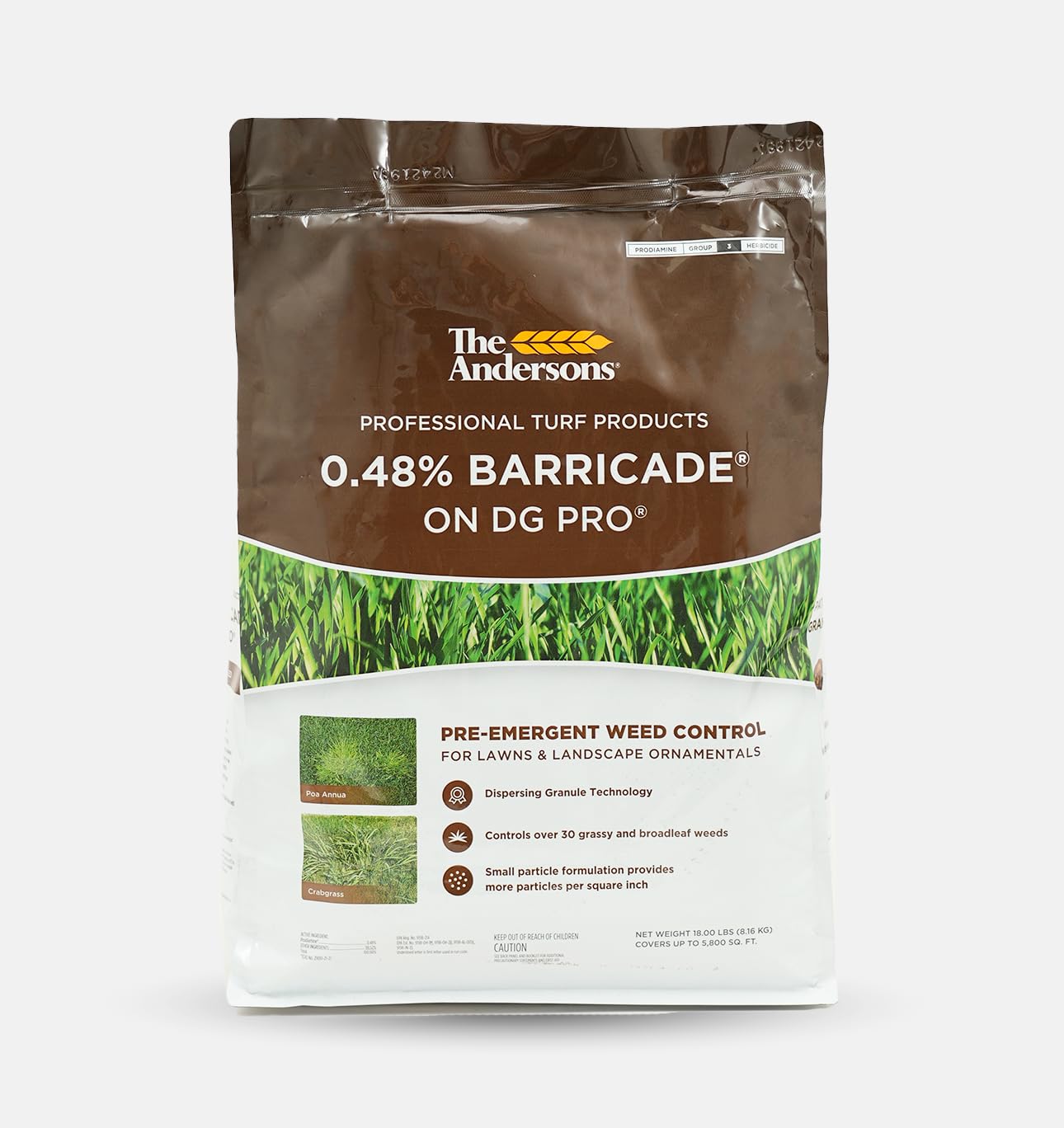
The Andersons Barricade Granular Pre-Emergent Weed Control (18 lb, covers 5,800 sq ft)
| Item Form | Granule |
|---|---|
| Coverage | 5800 square feet |
| Unit Count | 288 Ounce |
| Active Ingredients | Prodiamine 0.48% |
Barricade is a granular pre-emergent that stops common lawn weeds before they emerge, using 0.48% prodiamine in a dispersible granule formula. You apply it across the lawn in early spring or fall and water it in so the small DG Technology particles dissolve and move the active ingredient into the soil. That combination gives broader, more even coverage per square inch and is especially aimed at preventing crabgrass, poa annua and other annual grassy and broadleaf weeds across up to 5,800 square feet from a single 18 pound bag. The product is straightforward to use with a spreader and fits routine seasonal maintenance plans. Important limits are that it will not kill weeds already established and must be timed correctly for best effect. Also, because it is a professional-strength herbicide buyers should follow safety directions closely and keep pets and children off treated areas until safe.
Best for: Homeowners who plan seasonal lawn maintenance and want a single, high-coverage pre-emergent to prevent crabgrass and common annual weeds across medium to large yards.
Less Ideal for: People needing a post-emergent solution for existing weeds, or gardeners who prefer non-chemical weed control methods.
- Designed to prevent both grassy and broadleaf annual weeds including crabgrass and poa annua
- DG Technology dispersible granules dissolve quickly when watered for consistent soil incorporation
- Covers up to 5,800 square feet from a single 18 pound bag, suitable for typical residential lawns
- Contains professional-grade active ingredient prodiamine for season-long pre-emergent control
- Will not control weeds that are already established in the lawn
- Must be applied in the correct seasonal window (early spring or fall) to be effective
- Requires watering after application and careful safety handling around children and pets
Verdict: Pick Barricade when you want a professional-strength, high-coverage pre-emergent that reliably prevents crabgrass and other annual weeds across a typical residential lawn.
The Andersons Barricade 18-0-4 Granular Fertilizer with Pre-Emergent (18 lb, 5,000 sq ft)

| Item Form | Granule |
|---|---|
| Coverage | 5,000 sq ft |
| Active Ingredients | Prodiamine |
| Unit Count | 288 Ounce |
The Andersons Barricade is a combined pre-emergent weed controller and fertilizer intended for preventive lawn care over roughly 5,000 square feet. You apply it in early spring or fall to establish a chemical barrier that stops weed seeds such as crabgrass, poa annua, and goosegrass from germinating, while the 18-0-4 formulation supplies nitrogen and potassium to promote thicker turf. The product uses a dispersible granule technology so particles dissolve quickly with watering and move into the soil where prodiamine works most effectively. Practical users will appreciate that it is designed specifically for prevention rather than post-emergent weed removal, so it should be part of a seasonal maintenance plan rather than a quick fix for existing infestations. Directions limit application timing to early spring and fall, and it will not kill established weeds, so expect to combine this with spot treatments or mechanical removal if you already have visible weeds. Overall it simplifies routine turf care by pairing nutrition and preventive weed control in one product for landscape-scale yards.
Best for: Homeowners who plan seasonal lawn maintenance and want to prevent weed emergence while supplying nitrogen to encourage thicker turf; good for those who schedule spring and fall treatments into their yard care routine.
Less Ideal for: People needing an immediate solution for visible or mature weed problems or those who require year-round weed control without seasonal applications.
- Combines pre-emergent herbicide and fertilizer so one application both feeds turf and prevents seeded weeds
- Covers up to 5,000 sq ft per bag, suitable for medium to large lawns
- Dispersible granule (DG) technology dissolves quickly and moves active ingredient into the soil after watering
- Targets a broad range of common grassy and broadleaf weeds including crabgrass and poa annua
- Does not control or remove existing weeds because it is a preventive product
- Application is season-limited to early spring and fall for best efficacy
Verdict: A convenient single-bag solution for preventive lawn care that pairs prodiamine weed prevention with 18-0-4 feeding to keep lawns thicker and reduce new weed pressure.
Preen Garden Weed Preventer Plus Plant Food, 5.625 lb (covers 900 sq. ft.)

| Item Form | Granules |
|---|---|
| Application Method | spreader or by hand |
| Coverage | 900 square feet |
| Target Species | Flowers, Vegetables, Trees, Shrubs |
Preen Garden Weed Preventer Plus Plant Food is a ready-to-use granular product that combines a preemergent weed barrier with a balanced fertilizer so you can both stop many weed seeds from germinating and feed established plants in one application. It is applied by hand or with a spreader over mulch or bare soil, then watered to activate the invisible barrier; one 5.625 pound bottle treats about 900 square feet and claims protection for up to three months. Practical benefits include time saved by reducing repeat spot-weeding, and the convenience of feeding flowers, vegetables, trees, and shrubs at the same time. The flip-top applicator makes targeted distribution simple for smaller beds or around delicate plants. Limitations are that it will not kill existing weeds so beds must be cleared first, and it is a preemergent so timing matters for best results; it also contains common fertilizer salts, so avoid overapplication near seedlings or sensitive species. For gardeners wanting straightforward, combined weed prevention and feeding across landscape beds, this is an easy low-effort option.
Best for: Home gardeners who want a low-effort way to reduce weed emergence while feeding established flowers, vegetables, trees, and shrubs across beds and landscape areas.
Less Ideal for: Gardeners needing a post-emergent weed killer or those trying to rescue beds with heavy existing weed infestations should choose a different targeted solution.
- Combines preemergent weed prevention with balanced fertilizer in one step
- Covers approximately 900 square feet per bottle for broad area treatment
- Ready-to-use granules can be applied by hand or with a spreader for flexible use
- Flip-top applicator enables more precise application around plants
- Does not kill existing weeds so beds must be weeded before use
- Effectiveness depends on correct timing and watering to activate the barrier
Verdict: A convenient combined weed-preventer and plant food that treats large beds in a single application, ideal for gardeners wanting simple, low-maintenance weed control.
Quali-Pro Prodiamine Pre-Emergent Herbicide, 5 lb Granules

| Item Form | Granule |
|---|---|
| Coverage | Pre-emergent grass and broadleaf weed control, season long crabgrass control |
| Active Ingredients | Prodiamine 65% |
Quali-Pro Prodiamine is a granular pre-emergent herbicide designed to prevent germination of common annual grassy and broadleaf weeds across lawns and landscape beds. You apply it before weed seeds germinate in spring or as a fall treatment to build residual control through the growing season. The product contains 65% prodiamine, which is widely used for reliable, long-lasting control of crabgrass, annual bluegrass and several broadleaf weeds, and it mixes readily when tank-mixed with fertilizers or iron. In real-world use it offers predictable, season-long suppression when applied at the labeled rate and incorporated by irrigation or rainfall. Important practical limits are that it is preventive only and will not kill established weeds, and proper timing and rate are essential to avoid reduced effectiveness. For larger areas the 5 lb package covers moderate lawn acreage but may require multiple bags for extensive turf.
Best for: Homeowners and lawn care professionals who prioritize a dependable, season-long preventive solution to keep crabgrass and annual weeds from establishing in turf.
Less Ideal for: Gardeners needing a post-emergent solution for existing weeds or those who prefer liquid ready-to-use products for spot treatments.
- High active ingredient concentration (Prodiamine 65%) for long residual control
- Granular form allows easy broadcast application and tank mixing with fertilizers
- Effective season-long crabgrass and annual weed suppression when applied correctly
- Suitable for spring or fall applications to build preventive control
- Pre-emergent only and will not control established weeds
- 5 lb bag may be insufficient for large lawns without purchasing additional quantity
Verdict: Choose this prodiamine granule when you want a proven, season-long preventive herbicide to reliably stop crabgrass and other annual weeds before they start.
Preen Extended Control Weed Preventer, 13.75 lb.

| Item Form | Granule |
|---|---|
| Coverage | 2,245 sq. ft |
| Active Ingredients | Isoxaben, trifluralin |
| Unit Count | 220 Ounce |
Preen Extended Control is a ready-to-use granular pre-emergent that prevents weed seeds from germinating so you spend less time hand-weeding. It is applied to the soil surface or on top of mulch, then watered in to activate an invisible barrier; a flip-top applicator helps distribute granules evenly. The formula lists isoxaben and trifluralin as active ingredients and is labelled safe to use around many established perennials, shrubs, groundcovers, and trees when directions are followed. One application covers a large area and can protect beds for up to six months, reducing the need for frequent reapplications. Important limitations are that it will not kill existing weeds, is not for use on lawns, vegetable gardens, flower seedings, or food-producing areas, and granules must be kept off foliage to avoid damage. For gardeners who prefer a conservative, low-maintenance approach, this product offers long-lasting, predictable prevention when used according to label instructions.
Best for: Gardeners who want a cautious, low-maintenance solution to prevent new weeds in established beds and who follow label directions carefully.
Less Ideal for: Growers who need post-emergent weed control, people planting seeds or vegetables, or those who prefer organic or non-chemical weed management.
- Long single-application protection up to six months over large areas
- Ready-to-use granules with a flip-top applicator for even distribution
- Works around many established ornamentals when label directions are followed
- Contains two active ingredients for broad-spectrum pre-emergent control
- Does not control or remove existing weeds, only prevents new seeds from germinating
- Not safe for lawns, vegetable gardens, flower seeds, or food-producing plants
Verdict: Choose Preen Extended Control when you want a long-lasting, easy-to-apply pre-emergent that reliably prevents new weeds in established garden beds.
Preen Garden Weed Preventer, Pre-Emergent Granules, 16 lb (covers 2,560 sq. ft.)

| Item Form | Granule |
|---|---|
| Coverage | 2560 square_feet |
| Active Ingredients | Trifluralin |
| Unit Count | 256 Fluid Ounces |
Preen Garden Weed Preventer is a granular pre-emergent designed to prevent new weeds in flower beds, vegetable gardens, and around trees and shrubs rather than kill existing weeds. You apply it to prepared, weed-free soil or on top of mulch, water it in to activate the trifluralin-based barrier, and it blocks common broadleaf and grassy garden weeds for up to three months. The product includes an applicator scoop and can be broadcast with a hand spreader or fertilizer spreader for even coverage across the advertised 2,560 sq. ft. It is formulated for use around more than 200 established plants when directions are followed and is rain-resistant once activated. Important limitations are that it will not remove existing weeds, it should not be used on lawns or on very young seedlings, and repeated protection requires reapplication every 9 to 12 weeks. For gardeners prioritizing predictable season-long prevention, Preen reduces time spent hand-weeding but must be applied correctly and only around established plants.
Best for: Gardeners who want dependable, low-effort seasonal protection for planted beds and prioritize predictable prevention over reactive weed removal.
Less Ideal for: People needing an immediate solution for established or pervasive weeds, or those who want a product labeled for lawn use or for treating newly seeded beds.
- Pre-emergent action prevents weed seeds from germinating for up to 3 months
- Large 16 lb. granule container covers up to 2,560 sq. ft., suitable for medium to large beds
- Safe for use around many established flowers, vegetables, trees, and shrubs when used as directed
- Granular formula is rain-resistant once watered in and activates quickly with irrigation
- Does not kill or control existing weeds so beds must be cleared before use
- Contains trifluralin so it must be applied only as directed and kept away from children and pets
Verdict: Choose Preen when you want reliable, long-lasting pre-emergent weed protection for established garden beds so you can spend far less time hand-weeding.
Choosing the Right Pre-Emergent Herbicide for Landscape Beds: Key Factors to Consider
Active Ingredient and Spectrum
Different active ingredients control different groups of weed seedlings. Some compounds are broadly effective against both grassy and broadleaf weeds, while others chiefly prevent grasses or only certain broadleaf species.
Understanding which seedlings you need to target matters because it determines whether a single application will provide adequate coverage or if you will need a complementary product later in the season. Check label language for the spectrum of control and any stated limitations. That informs timing and whether spot treatments with post-emergent products will be necessary.
Residual Longevity and Reapplication Interval
Residual longevity indicates how long the herbicide remains active in the topsoil to prevent seed germination. Products with longer residuals reduce the number of applications but may increase risk if you plan to plant new ornamentals from seed or install sensitive transplants.
Consider local climate and rainfall patterns because heavy precipitation can shorten effective duration through movement or dilution. Match the product longevity to the primary germination periods of local weeds and to your gardening calendar so you do not leave gaps or inadvertently block desirable plantings.
Safety for Established Ornamentals
Labels differ on how close to ornamentals a pre-emergent can be applied and whether it is safe around roots of shrubs or new transplants. Some active ingredients are safe for use around established perennials and shrubs, while others require a buffer or limit on use near certain plant families.
Evaluate label restrictions and safe planting intervals, and consider whether plants are shallow- or deep-rooted. When in doubt, choose a product with explicit guidance for ornamental beds or use mechanical barriers to prevent herbicide contact with vulnerable root zones.
Application Method and Coverage Accuracy
Pre-emergent success depends on even placement across the seed zone. Products come in different formulations such as liquid concentrates, water-dispersible granules, and ready-to-use mixes, each requiring specific equipment or technique for uniform coverage.
If you maintain complex beds with irregular edges or mixed plantings, a sprayable formulation with a controllable nozzle may reduce drift and improve accuracy. For broad beds, granular spreaders can be faster but may need incorporation or irrigation to activate. Choose a method you can apply consistently and accurately.
Soil Type and Organic Matter Influence
Soil texture and organic matter affect how a pre-emergent binds, moves, and persists. Sandy soils with low organic matter tend to allow more leaching and shorter residual life, while heavy organic soils can bind certain chemistries and reduce their active concentration in the seed zone.
Account for this by adjusting timing or selecting a formulation labeled for your soil type. In beds with recent amendments or heavy compost, expect interactions that may reduce effectiveness and plan follow-up monitoring for germinating weeds.
Environmental and Waterway Considerations
Some pre-emergent active ingredients are more prone to runoff or movement into surface water. If your landscape beds slope toward sensitive areas, drains, or streams, choose products with lower mobility and follow buffer zone instructions on the label.
Also consider pollinator and beneficial insect exposure: apply when flowering is absent and avoid drift. Following label precautions and local regulations protects non-target organisms while achieving weed control.
Timing Applications for Seasonal Germination
Successful use of pre-emergents hinges on timing. Apply before weed seeds begin to germinate rather than after green-up. For cool-season weeds that sprout in early spring, target late winter to very early spring pre-emergent timing. For warm-season annuals, an early spring to late spring application is often needed.
Staggered climates and microclimates inside a landscape mean you may need slightly different timing across sites. Monitor soil temperature and local phenology-when forsythia or other indicator plants bloom-to choose the best application window.
- Apply before soil temperatures rise to the germination threshold of target weeds.
- Reapply according to label if conditions shorten residual activity, such as heavy rain.
Use Around New Plantings and Seeded Areas
Pre-emergents can prevent desirable seeds from establishing. If you plan to seed groundcovers or sow flower mixes, avoid applying long-residual products until after the seedlings are established or choose a product with a short plant-back interval.
For newly transplanted shrubs, check label intervals for safe application near roots. When plant-back restrictions conflict with planting plans, delay herbicide use or protect root zones with physical barriers during application.
- Wait the labeled planting interval before sowing seeds in treated soil.
- Protect root collars and young transplants when applying sprays to mixed beds.
Integrating Pre-Emergents with Cultural Practices
Combine pre-emergent applications with mulching and hand-weeding for best results. Mulch reduces light and moderates soil temperature, complementing the chemical barrier and suppressing germination.
Regular inspection and timely removal of escapes prevent seed set and reduce future pressure. Think of pre-emergents as one component of an integrated program rather than a standalone fix.
- Apply a thin layer of mulch after treatment if the label permits to avoid interfering with activation.
- Use targeted hand-weeding for established weeds that escaped pre-emergent protection.
Mixing and Applying Safely
Follow label mixing instructions to ensure correct concentration and activation. Overconcentrating does not extend residual life and can raise risk to ornamentals and the environment.
Wear recommended personal protective equipment and avoid application on windy days to reduce drift. Calibrate equipment so coverage is consistent across beds and avoid overlaps that cause double dosing.
- Measure carefully and test spray patterns before treating entire beds.
- Irrigate or wait for the recommended activation event stated on the label.
Monitoring Effectiveness and Following Up
After application, monitor beds for any signs of weed germination and for any stress on ornamentals. No product provides perfect control, so plan for spot treatments and record the timing and conditions of each application for future reference.
If you notice poor performance after a season, review soil conditions, rainfall, and whether the application was made before germination. Adjust timing or choose a different chemistry next season based on observed weaknesses.
- Keep a log of application dates, weather, and irrigation following treatment.
- Address escapes quickly to prevent seed production.
How We Chose the Best Pre-Emergent Herbicide for Landscape Beds
We prioritized products that deliver predictable weed-prevention performance in planted landscape beds while minimizing risk to desirable ornamentals. Our selection filters started with documented active ingredients known for pre-emergent activity, then examined label guidance for use in ornamental beds and restrictions near established plantings. We looked for clear residual duration claims and application flexibility across soil types and planting situations. Ease of calibration and application method was included because accurate coverage matters in beds with mixed plants. Environmental and safety considerations were assessed, including leaching potential and restrictions for use near sensitive species. Filters excluded granular or broadcast-only products intended solely for turf, products labeled only for agricultural use, and options that require equipment or licensing beyond typical homeowner or landscape pro capabilities. The resulting criteria reflect what actually matters for landscape bed weed prevention: active ingredient suitability, residual longevity, ornamental safety, application versatility, and environmental profile.
FAQ
Can pre-emergent herbicides harm my flowering perennials?
It depends on the active ingredient and the plant species. Many pre-emergents are safe for established perennials if applied according to label directions, but some can inhibit seedling establishment or damage very shallow-rooted plants. Always check label restrictions for ornamental beds and follow planting interval guidance.
How soon after applying a pre-emergent can I mulch the bed?
That varies by product. Some labels allow light mulching after application while others recommend waiting until the herbicide has been activated by irrigation or rainfall. Follow the product-specific instructions to avoid reducing activation or spreading the material unevenly.
Will rain wash the herbicide away after I apply it?
Moderate rainfall is often required to move many pre-emergents into the seed zone for activation. However, heavy runoff can reduce effectiveness by moving the chemistry out of the treatment area. Follow label guidance on activation requirements and avoid applying when heavy storms are expected.
Can I use a pre-emergent if I plan to reseed lawn or install seed-grown groundcover?
Most long-residual pre-emergents will prevent desirable seeds from establishing for the labeled plant-back interval. If you plan to seed, choose a product with a short planting interval or delay application until after seeded plants are established according to label directions.
How often should I reapply in a long, wet growing season?
Reapplication depends on the product's stated residual window and observed performance. In unusually wet seasons where residual is shortened, you may need to reapply at the labeled interval. Consult the label for maximum seasonal use rates and reapplication timing.
Are there waterway or runoff precautions I should follow?
Yes. Many pre-emergents include buffer zone and runoff warnings on the label. Avoid applications that could move into drains or streams and follow any specified no-application zones near water bodies. Adjust methods to reduce runoff risk, such as choosing low-mobility products and following irrigation guidance.
Final Verdict
Choosing the right pre-emergent for landscape beds means balancing weed spectrum, residual length, and safety for the ornamentals you value. Prioritize products with the appropriate active ingredient for the weeds you face, a residual that matches local germination patterns, and label guidance that fits your planting schedule. Account for soil type, application method, and environmental constraints when planning treatments. When used as part of cultural practices like mulching and timely hand-weeding, pre-emergents can significantly reduce seasonal weed pressure. Focus on timing and label adherence to protect desirable plants and get consistent season-long prevention.
