

Note: This article contains affiliate links. If you click on these links and make a purchase, I may earn a small commission at no extra cost to you. This helps support my research and content. Read my full affiliate disclosure here.
If you maintain gravel paths, rock gardens, or decorative stone beds, stopping weed seeds before they sprout saves hours of backbreaking pulling. Choosing a product formulated and applied for rocky surfaces matters because exposure, drainage, and soil depth change how long a barrier lasts and how evenly it distributes. This guide presents six shortlisted pre-emergent herbicides for rocks that performed well for common gardener concerns. We evaluate residual longevity, ease of application over stone, safety around desired plants, and how well each option tolerates sun, runoff, and foot traffic. Read on to see the practical strengths and tradeoffs that matter when protecting rock landscapes from annual weeds.
Top Picks at a Glance
| Best Overall The best all-around choice for most situations | The Andersons Barricade Professional-Grade Granular Pre-Emergent Weed Control (40 lb) |  |
| Best Quality Built to a higher standard if you want something more solid | Quali-Pro Prodiamine Pre-Emergent Herbicide, 5 lb Granules |  |
| Best Value The sweet spot between price and what you get | The Andersons Barricade Granular Pre-Emergent Weed Control (18 lb, covers 5,800 sq ft) |  |
| Highest Rated A top-rated pick with lots of positive feedback | LebanonTurf Prodiamine 0.58% Granular Pre-Emergent (covers 20,000 sq ft) |  |
| Most Popular A crowd favorite that many people choose with confidence | Preen Extended Control Weed Preventer, 4.93 lb (covers 805 sq. ft.) |  |
| Best Seller A high-volume bestseller chosen again and again | Preen Garden Weed Preventer, Pre-Emergent Granules, 16 lb (covers 2,560 sq. ft.) |  |
The Andersons Barricade Professional-Grade Granular Pre-Emergent Weed Control (40 lb)

| Item Form | Granule |
|---|---|
| Coverage | 12880 square_feet |
| Active Ingredients | Herbicide (prodiamine 0.48%) |
| Unit Count | 640 Ounce |
The Andersons Barricade is a granular pre-emergent designed to stop common weeds before they emerge rather than kill existing plants. It contains 0.48% prodiamine and uses a dispersible granule formulation that dissolves quickly with watering so the active ingredient moves into the soil where seeds germinate. Typical use is a broadcast application across established turf and ornamental beds in early spring or fall following label rates to cover up to the listed square footage. Notable features include small particle granules for broader coverage and a professional-strength active ingredient used to prevent crabgrass, poa annua, goosegrass and many broadleaf weeds. The practical benefits are long-lasting prevention when timed correctly and efficient coverage for larger yards thanks to the 40 lb bag. Limitations to plan for are that it will not remove existing weeds, it requires precise application timing and watering to activate, and safety precautions are necessary because the product is harmful if ingested or contacts skin.
Best for: Buyers who prioritize proven, professional-strength prevention for medium to large lawns and want a product backed by many user reviews and established performance.
Less Ideal for: Gardeners who need to eliminate established weeds, have very small yards where large-volume packaging is impractical, or prefer non-chemical weed control methods.
- Dispersible granule formula that dissolves quickly with water to move the active ingredient into the soil
- Professional-grade active ingredient prodiamine effective against common grassy and broadleaf weeds
- Small particle size for broader coverage per square inch
- Large 40 lb bag intended to cover a wide area without frequent repurchasing
- Does not control or kill existing weeds, only prevents new ones
- Requires correct timing and follow-up watering to be effective
- Contains herbicide active ingredients that require careful handling and adherence to safety directions
Verdict: Choose Barricade when you need a reliable, professional-strength pre-emergent to prevent common lawn weeds across a large area.
Quali-Pro Prodiamine Pre-Emergent Herbicide, 5 lb Granules

| Item Form | Granule |
|---|---|
| Coverage | Pre-emergent grass and broadleaf weed control, season long crabgrass control |
| Active Ingredients | Prodiamine 65% |
Quali-Pro Prodiamine is a granular pre-emergent herbicide designed to prevent germination of common annual grassy and broadleaf weeds across lawns and landscape beds. You apply it before weed seeds germinate in spring or as a fall treatment to build residual control through the growing season. The product contains 65% prodiamine, which is widely used for reliable, long-lasting control of crabgrass, annual bluegrass and several broadleaf weeds, and it mixes readily when tank-mixed with fertilizers or iron. In real-world use it offers predictable, season-long suppression when applied at the labeled rate and incorporated by irrigation or rainfall. Important practical limits are that it is preventive only and will not kill established weeds, and proper timing and rate are essential to avoid reduced effectiveness. For larger areas the 5 lb package covers moderate lawn acreage but may require multiple bags for extensive turf.
Best for: Homeowners and lawn care professionals who prioritize a dependable, season-long preventive solution to keep crabgrass and annual weeds from establishing in turf.
Less Ideal for: Gardeners needing a post-emergent solution for existing weeds or those who prefer liquid ready-to-use products for spot treatments.
- High active ingredient concentration (Prodiamine 65%) for long residual control
- Granular form allows easy broadcast application and tank mixing with fertilizers
- Effective season-long crabgrass and annual weed suppression when applied correctly
- Suitable for spring or fall applications to build preventive control
- Pre-emergent only and will not control established weeds
- 5 lb bag may be insufficient for large lawns without purchasing additional quantity
Verdict: Choose this prodiamine granule when you want a proven, season-long preventive herbicide to reliably stop crabgrass and other annual weeds before they start.
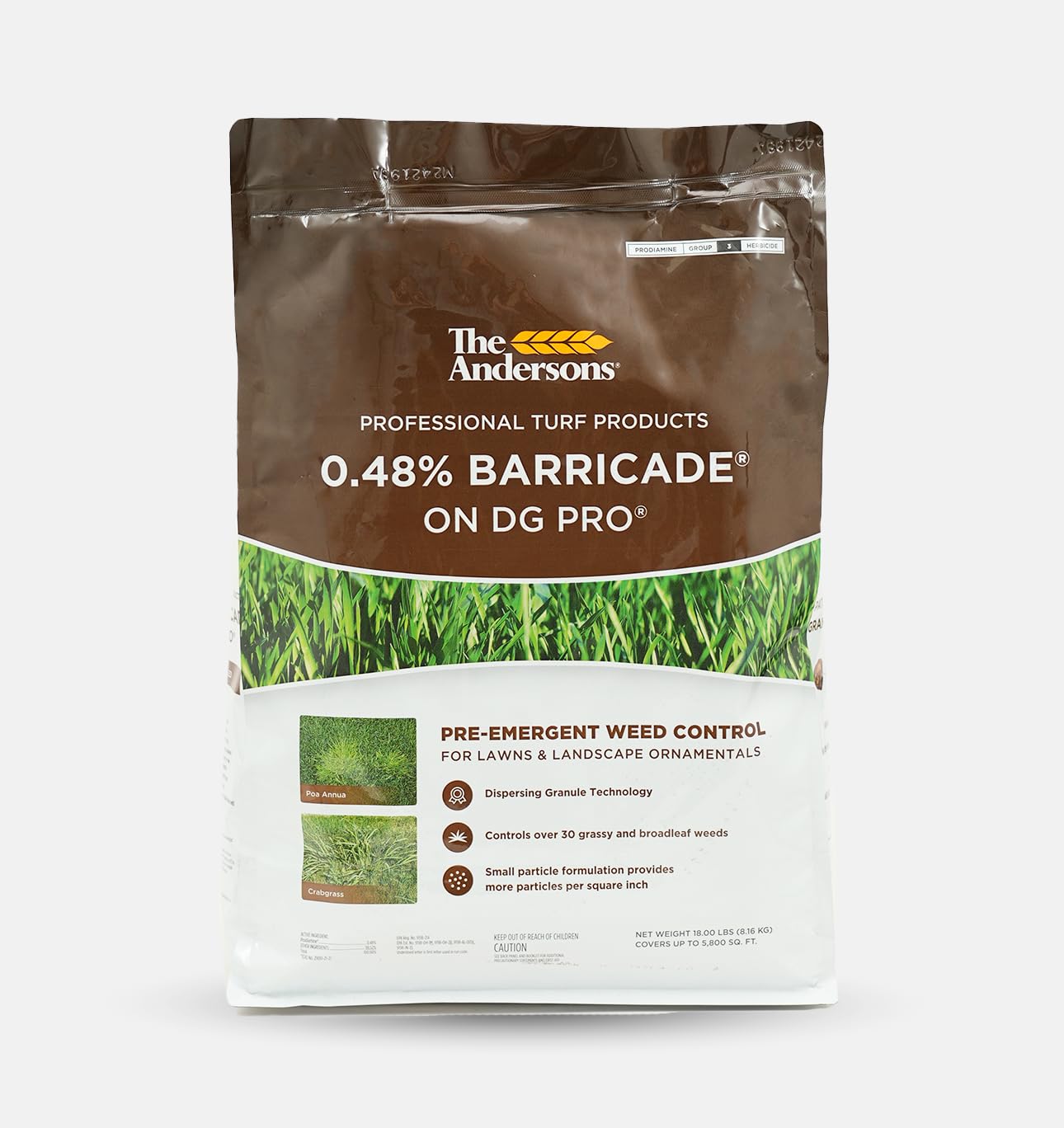
The Andersons Barricade Granular Pre-Emergent Weed Control (18 lb, covers 5,800 sq ft)
| Item Form | Granule |
|---|---|
| Coverage | 5800 square feet |
| Unit Count | 288 Ounce |
| Active Ingredients | Prodiamine 0.48% |
Barricade is a granular pre-emergent that stops common lawn weeds before they emerge, using 0.48% prodiamine in a dispersible granule formula. You apply it across the lawn in early spring or fall and water it in so the small DG Technology particles dissolve and move the active ingredient into the soil. That combination gives broader, more even coverage per square inch and is especially aimed at preventing crabgrass, poa annua and other annual grassy and broadleaf weeds across up to 5,800 square feet from a single 18 pound bag. The product is straightforward to use with a spreader and fits routine seasonal maintenance plans. Important limits are that it will not kill weeds already established and must be timed correctly for best effect. Also, because it is a professional-strength herbicide buyers should follow safety directions closely and keep pets and children off treated areas until safe.
Best for: Homeowners who plan seasonal lawn maintenance and want a single, high-coverage pre-emergent to prevent crabgrass and common annual weeds across medium to large yards.
Less Ideal for: People needing a post-emergent solution for existing weeds, or gardeners who prefer non-chemical weed control methods.
- Designed to prevent both grassy and broadleaf annual weeds including crabgrass and poa annua
- DG Technology dispersible granules dissolve quickly when watered for consistent soil incorporation
- Covers up to 5,800 square feet from a single 18 pound bag, suitable for typical residential lawns
- Contains professional-grade active ingredient prodiamine for season-long pre-emergent control
- Will not control weeds that are already established in the lawn
- Must be applied in the correct seasonal window (early spring or fall) to be effective
- Requires watering after application and careful safety handling around children and pets
Verdict: Pick Barricade when you want a professional-strength, high-coverage pre-emergent that reliably prevents crabgrass and other annual weeds across a typical residential lawn.
LebanonTurf Prodiamine 0.58% Granular Pre-Emergent (covers 20,000 sq ft)

| Item Form | Granule |
|---|---|
| Coverage | 20,000 sq. ft. |
| Active Ingredients | Prodiamine |
This granular pre-emergent uses 0.58% prodiamine on a BIODAC carrier to stop crabgrass and many grassy weeds from germinating across lawns and landscaped areas. It is applied with a broadcast spreader in early spring, with a recommended follow-up in late May or early June; the manufacturer warns not to overseed for three to four months after application. The product covers a large area per unit, making it suitable for whole-yard preventive programs and for professional maintenance of turf, trees, shrubs, and flowers. Its granular form simplifies handling compared with liquids and reduces immediate runoff risk, while the prodiamine chemistry provides season-long residual control when applied correctly. Limitations include the planting restriction after application and that it prevents seed germination so it cannot be used where you plan to establish new lawn from seed shortly after treatment. Also availability is restricted in several states, so check local regulations before planning use.
Best for: Buyers who prioritize a dependable, season-long preventive approach to crabgrass control and want a product that fits routine lawn maintenance schedules used by homeowners or pros.
Less Ideal for: Gardeners planning to establish new lawns from seed shortly after treatment or those needing an option legal in excluded states should consider alternatives.
- Granular formula on BIODAC carrier for easy broadcast spreading
- Contains 0.58% prodiamine, a proven pre-emergent for crabgrass and grassy weeds
- Large coverage of 20,000 sq. ft. per unit reduces application frequency
- Suitable for use across lawns and landscaped beds to protect turf and plantings
- Prevents seed germination so you cannot overseed or plant grass seed for 3–4 months after application
- Not labeled for sale or use in a number of states, limiting availability and compliance
Verdict: Choose this granular 0.58% prodiamine product when you need a reliable, large‑area pre-emergent to prevent crabgrass and other grassy weeds.
Preen Extended Control Weed Preventer, 4.93 lb (covers 805 sq. ft.)

| Item Form | Granule |
|---|---|
| Coverage | 805 sq. ft |
| Unit Count | 78.8 Ounce |
| Active Ingredients | Isoxaben, Trifluralin |
Preen Extended Control is a granular preemergent formulated to stop more than 125 broadleaf and grassy weeds from sprouting for up to six months with a single application. It is applied to dry soil or on top of mulch, then watered in to activate the active ingredients that create a barrier below the surface. The flip-top bottle makes spot or bed-wide spreading straightforward and the coverage claim of roughly 805 square feet suits medium-sized flower beds and perennial borders. Practical benefits include substantially reduced weeding labor through the season and compatibility with a long list of established perennials, shrubs, groundcovers, and trees when used as directed. Limitations to keep in mind are that it does not kill existing weeds, must be kept off foliage and plant roots, and is not for food-producing or edible plants. Users must follow application spacing and reapply every 9 to 12 weeks for continuous protection and avoid getting granules on desirable plants to prevent damage.
Best for: Gardeners who want to minimize seasonal weeding in ornamental flower beds and prefer a simple, one-application solution for established landscapes.
Less Ideal for: Vegetable gardeners or anyone treating newly seeded lawns or edible plantings should avoid this product and choose weed controls labeled for food crops or post-emergent use.
- Preemergent action prevents germination of many common broadleaf and grassy weeds for up to six months
- Flip-top applicator enables controlled, even spreading over beds and around plants
- Designed for use on mulched beds and compatible with many established ornamental plants
- One application covers about 805 sq. ft., reducing frequency of application during the season
- Does not kill existing weeds so beds must be weeded before application
- Not safe for food-producing or edible plants and must be kept off foliage and roots
Verdict: Use this granular preemergent if you want an easy, single-application way to keep ornamental flower beds largely weed-free for up to six months.
Preen Garden Weed Preventer, Pre-Emergent Granules, 16 lb (covers 2,560 sq. ft.)

| Item Form | Granule |
|---|---|
| Coverage | 2560 square_feet |
| Active Ingredients | Trifluralin |
| Unit Count | 256 Fluid Ounces |
Preen Garden Weed Preventer is a granular pre-emergent designed to prevent new weeds in flower beds, vegetable gardens, and around trees and shrubs rather than kill existing weeds. You apply it to prepared, weed-free soil or on top of mulch, water it in to activate the trifluralin-based barrier, and it blocks common broadleaf and grassy garden weeds for up to three months. The product includes an applicator scoop and can be broadcast with a hand spreader or fertilizer spreader for even coverage across the advertised 2,560 sq. ft. It is formulated for use around more than 200 established plants when directions are followed and is rain-resistant once activated. Important limitations are that it will not remove existing weeds, it should not be used on lawns or on very young seedlings, and repeated protection requires reapplication every 9 to 12 weeks. For gardeners prioritizing predictable season-long prevention, Preen reduces time spent hand-weeding but must be applied correctly and only around established plants.
Best for: Gardeners who want dependable, low-effort seasonal protection for planted beds and prioritize predictable prevention over reactive weed removal.
Less Ideal for: People needing an immediate solution for established or pervasive weeds, or those who want a product labeled for lawn use or for treating newly seeded beds.
- Pre-emergent action prevents weed seeds from germinating for up to 3 months
- Large 16 lb. granule container covers up to 2,560 sq. ft., suitable for medium to large beds
- Safe for use around many established flowers, vegetables, trees, and shrubs when used as directed
- Granular formula is rain-resistant once watered in and activates quickly with irrigation
- Does not kill or control existing weeds so beds must be cleared before use
- Contains trifluralin so it must be applied only as directed and kept away from children and pets
Verdict: Choose Preen when you want reliable, long-lasting pre-emergent weed protection for established garden beds so you can spend far less time hand-weeding.
Choosing the Right Pre-Emergent Herbicide for Rocks: Key Factors to Consider
Residual Longevity and Timing
How long a pre-emergent barrier remains effective directly determines how often you need to reapply in rock landscapes. Products with longer residual activity reduce the number of seasonal applications but may also limit what you can plant nearby after treatment. For seasonal annual weeds, a product that protects for several months covers the critical germination window and cuts back on repeated treatments.
Timing matters because many pre-emergents must be in place before seeds germinate. In rock beds that heat up faster than soil, germination can occur earlier in spring. Plan applications to match local germination cues and follow label guidance for temperature and soil-moisture windows to maximize effectiveness.
Application Method and Distribution
How you apply the product affects evenness of coverage across stones, edges, and uneven surfaces. Sprayable concentrates and ready-to-use liquids can be easier to distribute evenly over rocks than coarse granules that may roll into gaps. Walk-behind spreaders struggle on gravel; handheld sprayers or pump sprayers that deliver a fine, controlled spray usually give better results for irregular beds.
Consider nozzle type and spray overlap so you do not create untreated strips. For windy or hot days, choose an application window that reduces drift and evaporation so the active ingredient reaches interstitial soil where seeds germinate.
Non-Target Plant Safety
Rock gardens often include established perennials, succulents, or bulbs that you want to keep. Some pre-emergents can harm newly planted or shallow-rooted ornamentals if applied too close or at the wrong rate. Evaluate how long the product restricts seedling establishment and whether planted areas need buffering or protective barriers during application.
Read label directions for planting intervals and setback distances. If you plan to add new plants within the same season, choose a product and timing that allow planting windows compatible with your landscape plan.
Resistance Management and Active Ingredients
Using the same active ingredient repeatedly can select for resistant weed populations. For long-term rock-bed management, rotate products with different modes of action when labels and local guidance allow. Pay attention to which weeds are most troublesome in your area and whether a product targets those species effectively.
Know the active ingredient groups and stagger applications or alternate chemistries across years to reduce the chance that annual weeds adapt to a single control method.
Weather, Rainfastness, and Runoff
Rock surfaces often channel water rapidly, and heavy rain soon after application can wash product away before it binds in the topsoil. Choose products with label guidance on rainfast windows and apply during a forecasted dry period when possible. Some formulations bond with surface soils or require watering-in; others rely on rainfall to move the active ingredient into the seed zone.
Consider site slope and drainage. On sloped gravel beds, runoff may concentrate product at low points, so application technique and timing are critical to avoid uneven distribution and environmental runoff.
Coverage Rate and Practicality
Coverage per container affects how many units you will need to treat long paths or large rock areas. Highercoverage concentrates reduce storage and mixing time but may require accurate measuring to avoid overapplication. For contractors or gardeners managing many small beds, portability and mixing simplicity are key.
Also consider the frequency of reapplication implied by coverage rates. A product that requires frequent re-treatment but covers a large area per package may still be less practical than a longer-lasting option with lower spread per container.
Preparing Rock Beds Before Application
Clear loose debris, fallen leaves, and recent organic build-up from between stones before applying a pre-emergent. Organic matter traps seed and can interfere with uniform contact between the active ingredient and the topsoil where seeds germinate.
Repair any low spots or channels that concentrate water. If runoff channels exist, consider small erosion controls or rerouting water so the product does not pool and cause uneven protection.
- Rake or blow to expose the soil surface under gravel
- Remove large weeds and roots so new seeds do not hide under debris
- Address compaction or erosion that could concentrate runoff
Application Tools and Nozzles That Work on Rock
Handheld pump sprayers with adjustable nozzles give the best control across varied stone surfaces. A cone or fan nozzle helps deliver even overlap and reach into crevices without excessive drift. Backpack sprayers are useful for larger areas but require careful calibration.
Avoid spreaders meant for turf when working on loose rock because granules can roll or settle into gaps unevenly. If you use a granular product, lightly water it in only if the label requires and if you can do so uniformly.
- Use a medium-fine spray for even coverage
- Calibrate application rate by testing on a small area first
- Wear protective gear and avoid windy days to reduce drift
Timing Treatments Around Planting and Seasonal Cycles
Match application timing to the germination cues of your local weeds. In many climates that means early spring before soil temperatures routinely reach germination thresholds. In warm climates, an early fall application may be appropriate to block winter-germinating species.
If you plan to add new plants, schedule pre-emergent treatments and planting so the label-recommended planting interval is observed. For beds with bulbs or late-season plantings, choose a product and timing that will not interfere with those plants' establishment.
- Apply before weed seeds germinate for best effect
- Consider a follow-up application if the product's label supports split treatments
- Avoid applying right before heavy rain unless the product is rainfast
Safety, Storage, and Environmental Considerations
Store concentrates in a cool, dry location away from children and pets and keep original labeling for reference. Mix only the amount you need for the job and dispose of rinsate per local guidelines.
Be mindful of runoff entering storm drains or sensitive areas. Avoid treating immediately upslope of waterways and follow all label precautions to protect pollinators and nearby ornamental plantings.
- Follow label PPE recommendations during mixing and application
- Rinse sprayers safely and dispose of rinse water according to local rules
- Avoid applications near open water or exposed roots of desirable plants
Dealing with Established Perennials and Succulents
If your rock garden includes shallow-rooted ornamentals, protect them during application with physical barriers or by applying the product at a reduced rate when allowed by the label. Some mature perennials tolerate nearby pre-emergents, but seedlings and newly planted specimens are more vulnerable.
When in doubt, treat areas in phases and monitor plants for stress before treating adjacent beds. This staged approach reduces the risk of accidental damage and helps you determine the best application distance from desirable plants.
- Use protective sheeting or cardboard to shield plant crowns during spraying
- Test a small area and wait to observe any non-target effects before broad application
- Delay planting new transplants until the product's planting interval has passed
How We Chose the Best Pre-Emergent Herbicide for Rocks
We focused on attributes that directly affect performance in gravel beds, rock gardens, and other stony landscapes. Each product considered had to demonstrate reliable pre-emergent activity against common annual grassy and broadleaf weeds, a predictable window of residual control, and an application method that works on uneven, permeable surfaces. We prioritized formulations that can be broadcast or sprayed evenly across stone without excessive drift or clumping, and that tolerate the high sunlight and temperature swings typical of rock beds. Safety around nearby ornamentals and established perennials was another filter. Products likely to damage non-target plants when applied according to label directions were excluded. We also looked at how much product coverage practical gardeners receive per container or concentrate and how easy the product is to mix, measure, and apply accurately across irregular yard features. Excluded items included post-emergent spot treatments, granular products requiring burying beneath soil, and experimental mixes without documented pre-emergent active ingredients. The final list balances longevity, application practicality, non-target safety, and suitability for high-drainage, sun-exposed rock settings.
FAQ
Can I apply pre-emergent herbicide directly onto decorative gravel?
Yes. Many pre-emergents are designed to be applied over gravel, but you must ensure the active ingredient reaches the soil surface beneath the stones. Use a fine spray or a product recommended for broadcast application and follow label instructions for coverage and watering-in if required.
How long after application before I can plant in treated rock beds?
It depends on the product. Some treatments allow planting after a short waiting period, while others require several weeks to months before seeds or seedlings will establish safely. Always check label planting intervals and plan planting around those timelines.
Will rain wash a pre-emergent off my gravel beds?
Heavy rain immediately after application can reduce effectiveness by moving product away from the seed zone. Choose a formulation with known rainfastness or apply during a dry window and water in according to label directions if advised.
Can pre-emergent herbicides harm established succulents or stonecrop?
Established, well-rooted succulents are often tolerant of nearby pre-emergent applications, but shallow-rooted or newly planted specimens can be sensitive. Use label guidance, apply with care near vulnerable plants, and consider shielding crowns during application.
How often should I reapply pre-emergent in rock areas?
Frequency depends on the product's residual longevity and local weed pressure. Some products offer season-long control with one application, others require split treatments. Reapply according to label recommendations and monitor for breakthrough weeds.
Are granular pre-emergents suitable for uneven stone paths?
Granular products can be used, but they often settle unevenly on loose rock and may roll into crevices. Sprayable or liquid formulations generally give more uniform coverage on irregular surfaces and are easier to target in narrow or complex bed shapes.
Final Verdict
For rock beds and gravel landscapes, prioritize products that combine dependable residual control with an application method that delivers even coverage over stone. Balance longevity against planting restrictions and factor in weather windows and runoff potential when scheduling treatments. The best choice depends on how often you want to reapply, the proximity of desirable plants, and how large or irregular your rock areas are. Focus on a pre-emergent with a suitable active ingredient, clear label guidance for rock applications, and practical coverage rates to keep maintenance time low and weed pressure down.
