

Note: This article contains affiliate links. If you click on these links and make a purchase, I may earn a small commission at no extra cost to you. This helps support my research and content. Read my full affiliate disclosure here.
When you need to remove big limbs or reshape mature trees, a light garden saw will slow you down and create unsafe cuts. Choosing the right pruning saw for large branches matters because these saws must cut quickly, resist binding, and hold an edge while you work at awkward angles. This guide presents six top-rated pruning saws selected for heavy-cut tasks in yards and orchards. We looked at blade type, cutting speed, handle ergonomics, and durability so you can pick a saw that reduces effort and keeps cuts clean. Read on for the evaluation criteria and practical notes to match a saw to your size of work and comfort level.
Top Picks at a Glance
| Best Overall The best all-around choice for most situations | Corona Tools RazorTOOTH 18-Inch Curved Pruning Saw (RS 7510D) |  |
| Best Quality Built to a higher standard if you want something more solid | EZ Kut Kamikaze Curved Pruning Saw with Scabbard (19.3") |  |
| Best Budget The cheapest option that still gets the job done reliably | Corona Tools RazorTOOTH RS 7120 13" Curved Pruning Saw |  |
| Highest Rated A top-rated pick with lots of positive feedback | Corona Clipper 14-Inch RazorTOOTH Pruning Saw |  |
| Most Popular A crowd favorite that many people choose with confidence | REXBETI 14-Inch Folding Pruning Saw (SK-5 Steel) |  |
| Best Seller A high-volume bestseller chosen again and again | BlumeTrec 14.5 ft Manual Pole Saw with Mn Steel Blade and Adjustable Sections |  |
Corona Tools RazorTOOTH 18-Inch Curved Pruning Saw (RS 7510D)

| Blade Material | High carbon SK5 steel |
|---|---|
| Blade Shape | Bent |
| Blade Length | 18 inches |
| Number of Teeth | 14 |
| Power Source | Manual |
The Corona RazorTOOTH 18-inch pruning saw is built for aggressive, performance-focused tree work. Its curved high-carbon SK5 steel blade and RazorTOOTH impulse-hardened teeth keep more cutting edges engaged with each stroke, letting you slice through green or dry wood more quickly and with less binding. The D-handle is designed for gloved or two-handed use, which improves leverage and control when you need power on large limbs or when working overhead. In practice it shines for removing large branches, storm cleanup, and cutting firewood where speed and durability matter. The plastic D-handle keeps the saw manageable but is less premium-feeling than rubberized grips, and the fixed 18-inch blade is not collapsible for compact storage. For users who need a durable, straightforward hand saw that prioritizes cutting performance and longevity, this model delivers professional-grade results without complicated features.
Best for: Serious homeowners and pro landscapers who prioritize cutting speed and durability when tackling large branches, storm cleanup, or firewood cutting.
Less Ideal for: Small-plot gardeners, casual users, or anyone who needs a compact folding saw for storage or frequent travel.
- Curved 18-inch SK5 high-carbon blade engages more teeth for faster, smoother cuts on large branches
- RazorTOOTH impulse-hardened teeth maintain sharpness and reduce binding
- D-handle supports two-handed and gloved operation for extra leverage and control
- Heavy-duty construction suited to repeated landscaping and storm-cleanup tasks
- Handle is plastic rather than a softer, vibration-damping material
- Fixed long blade does not fold for compact storage
Verdict: If you want a rugged, high-performance hand saw that cuts large branches quickly and reliably, this Corona 18-inch RazorTOOTH delivers.
EZ Kut Kamikaze Curved Pruning Saw with Scabbard (19.3")

| Blade Material | High Carbon Steel |
|---|---|
| Blade Shape | Curved Serrated |
| Number of Teeth | 90 |
| Handle Material | Rubber |
This EZ Kut Kamikaze pruning saw is built for heavy pruning tasks where power and clean cuts matter. The 19.3 inch curved SK5 high-carbon steel blade has triple-beveled, pull-cut teeth that slice through green and dry wood efficiently, so it handles large limbs and overhead cuts with fewer strokes. The curved profile helps the blade maintain contact during long pulls and improves control in dense foliage. An ergonomic rubber grip reduces hand fatigue during extended jobs and stays secure when wet or gloved. The included locking scabbard with belt loop keeps the blade protected and ready on the go. Practical limitations are the saw’s fixed long blade and traditional hand-saw operation, which require upper-body effort on very thick trunks and may be slower than mechanical pole or powered saws for very large trees. The saw excels for arborists, landscapers, and experienced gardeners who want a durable manual saw that delivers fast, clean cuts on substantial branches.
Best for: Buyers who prioritize cutting performance and durable construction for frequent heavy pruning and want a reliable manual saw for large branches and overhead work.
Less Ideal for: Homeowners who need extended reach or faster cuts on very large trees should consider pole-mounted or powered options instead.
- Long 19.3" SK5 high-carbon steel blade for durable, aggressive cutting
- Triple-beveled tooth geometry that cuts cleanly on the pull stroke
- Curved blade profile improves bite and control on larger branches
- Ergonomic rubber handle reduces hand fatigue and improves grip
- Protective locking scabbard with belt loop for safe transport
- Manual sawing requires sustained physical effort on very thick trunks
- Fixed blade length limits reach compared with telescoping pole saws
Verdict: If you need a rugged manual saw that delivers fast, clean cuts on large branches, this long SK5 curved pruning saw is built for performance.
Corona Tools RazorTOOTH RS 7120 13" Curved Pruning Saw

| Blade Length | 13 inches |
|---|---|
| Cut Capacity | Up to 7 inches |
| Blade Material | SK5 high-carbon steel |
| Special Features | RazorTOOTH Saw® technology |
The Corona RS 7120 RazorTOOTH pruning saw is a purpose-built hand saw for tree and yard pruning that puts a curved 13-inch SK5 high-carbon steel blade and aggressive RazorTOOTH geometry into a one-handed design. The curve keeps more teeth engaged on each stroke so cuts go faster and bind less, and the chrome plating plus impulse-hardened teeth help the blade stay sharp and move through wood with lower friction. The ergonomic pistol-grip handle balances the tool for controlled overhead or angled cuts and reduces hand fatigue during longer sessions. In practice it is best used for mid-size limbs, storm cleanup, and routine tree maintenance where a compact, durable saw is preferable to a larger two-person saw or a folding pocket model. Limitations are that it is a solid non-folding saw so it is less packable for travel and the plastic handle is not as premium-feeling as some composite or rubberized grips, though it remains sturdy for typical yard work.
Best for: Buyers who want a reliable, easy-to-use pruning saw for regular tree and branch cutting around the yard and who value efficient one-handed cutting and durability.
Less Ideal for: Not a good choice for ultralight backpacking or carry-in work where a folding saw is preferred, and professional crews wanting a two-person crosscut solution should look at larger saws.
- Curved 13-inch SK5 high-carbon steel blade for fast, efficient cutting
- RazorTOOTH impulse-hardened teeth that remove more material per stroke and hold an edge
- Chrome-plated finish reduces friction for smoother cuts
- Ergonomic pistol-grip handle for one-handed control and reduced fatigue
- Non-folding solid design makes it bulkier to transport or store
- Handle is plastic rather than a softer, higher-grip material
Verdict: A durable, one-handed curved pruning saw that delivers fast, reliable cuts on mid-size branches, ideal for everyday tree maintenance.
Corona Clipper 14-Inch RazorTOOTH Pruning Saw

| Power Source | Manual |
|---|---|
| Blade Length | 14 inches |
| Blade Material | High Carbon Steel |
| Other Special Features of the Product | Curved Blade with RazorTOOTH Technology |
The Corona 14-inch RazorTOOTH pruning saw is a manual tree saw built for medium-to-large branch work. Its curved, tapered high-carbon steel blade and triple-ground RazorTOOTH profile remove more material with each stroke, which speeds up cutting on green or dry wood; impulse-hardened teeth and a chrome-plated finish help the blade stay sharp and reduce friction. The pistol-grip rubber handle is comfortable for extended use and gives a secure hold when working from ladders or in awkward positions. Typical use is limbing, pruning, and clearing branches up to roughly 8 inches across where a compact handsaw is more convenient than a chainsaw. Important limitations are that it is a non-folding fixed blade so it needs a sheath for safe transport and it requires physical effort on large cuts. For gardeners who want a durable, easy-to-control hand saw that delivers fast, clean cuts without power tools, this model performs consistently well.
Best for: Gardeners and property owners who want a reliable, professional-grade hand saw for regular pruning and limb removal and prefer a fast, controllable manual tool over powered equipment.
Less Ideal for: Users who need a compact folding saw for easy pocket carry or those who prefer a powered chainsaw for very frequent heavy-duty cutting.
- Curved 14-inch high-carbon steel blade with RazorTOOTH teeth cuts faster and hooks onto branches to reduce slipping
- Impulse-hardened, triple-ground teeth resist dulling for longer service life
- Chrome-plated blade reduces friction for smoother, cleaner cuts
- Ergonomic rubber pistol-grip handle provides a secure, comfortable hold during extended use
- Fixed blade design requires a separate sheath for safe transport and storage
- Manual operation demands significant physical effort on very thick or stubborn limbs
Verdict: Buy this if you want a durable, faster-cutting hand saw that handles medium-to-large branches with professional-level control.
REXBETI 14-Inch Folding Pruning Saw (SK-5 Steel)

| Blade Material | SK-5 steel |
|---|---|
| Blade Length | 14 inches |
| Teeth | 5.5 TPI staggered |
| Handle Material | Rubber coated polymer |
| Special Feature | Foldable |
The REXBETI 14-inch folding pruning saw is a portable hand saw built for cutting medium to large branches in the yard or on outdoor trips. Its full blade extends to about 28 inches when open while folding in half for safer storage and easy transport. The SK-5 hardened steel blade with 5.5 TPI staggered teeth cuts on both push and pull strokes, which helps you power through green and dry wood up to the manufacturer’s suggested 7 to 10 inch branch diameter. The long rubber-coated handle gives extra reach and a secure grip in wet or cold conditions. Practical benefits include fast, efficient cutting without power tools and a compact folded size that fits a backpack or tool bag. Important limitations are that it is a manual tool so heavy or prolonged cutting becomes tiring, and the aggressive teeth are optimized for thicker branches rather than detailed pruning or fine carpentry. Users should keep the blade clean and occasionally sharpen or replace it to maintain peak performance.
Best for: Buyers who want a dependable, portable saw for occasional to moderate branch cutting while gardening, camping, or maintaining property and who prioritize reliable performance and safety when carrying tools outdoors.
Less Ideal for: People who need a tool for fine pruning, detailed pruning work, or frequent heavy-duty cutting that would be better handled by a powered saw or pruning tool set.
- Long 14-inch SK-5 steel blade delivers reach for larger branches and faster cutting.
- Folding design makes it easy and safe to carry for camping, hiking, or storage.
- Aggressive 5.5 TPI staggered teeth cut on both push and pull strokes for efficient sawing.
- Rubber-coated polymer handle provides a secure grip in wet or cold conditions.
- Manual operation can be tiring for extended use or frequent heavy cutting.
- Aggressive tooth profile is not suited for delicate or precision pruning work.
Verdict: A robust, easy-to-carry manual saw that gives reliable cutting power for larger branches when you need a safe portable tool for garden or outdoor use.
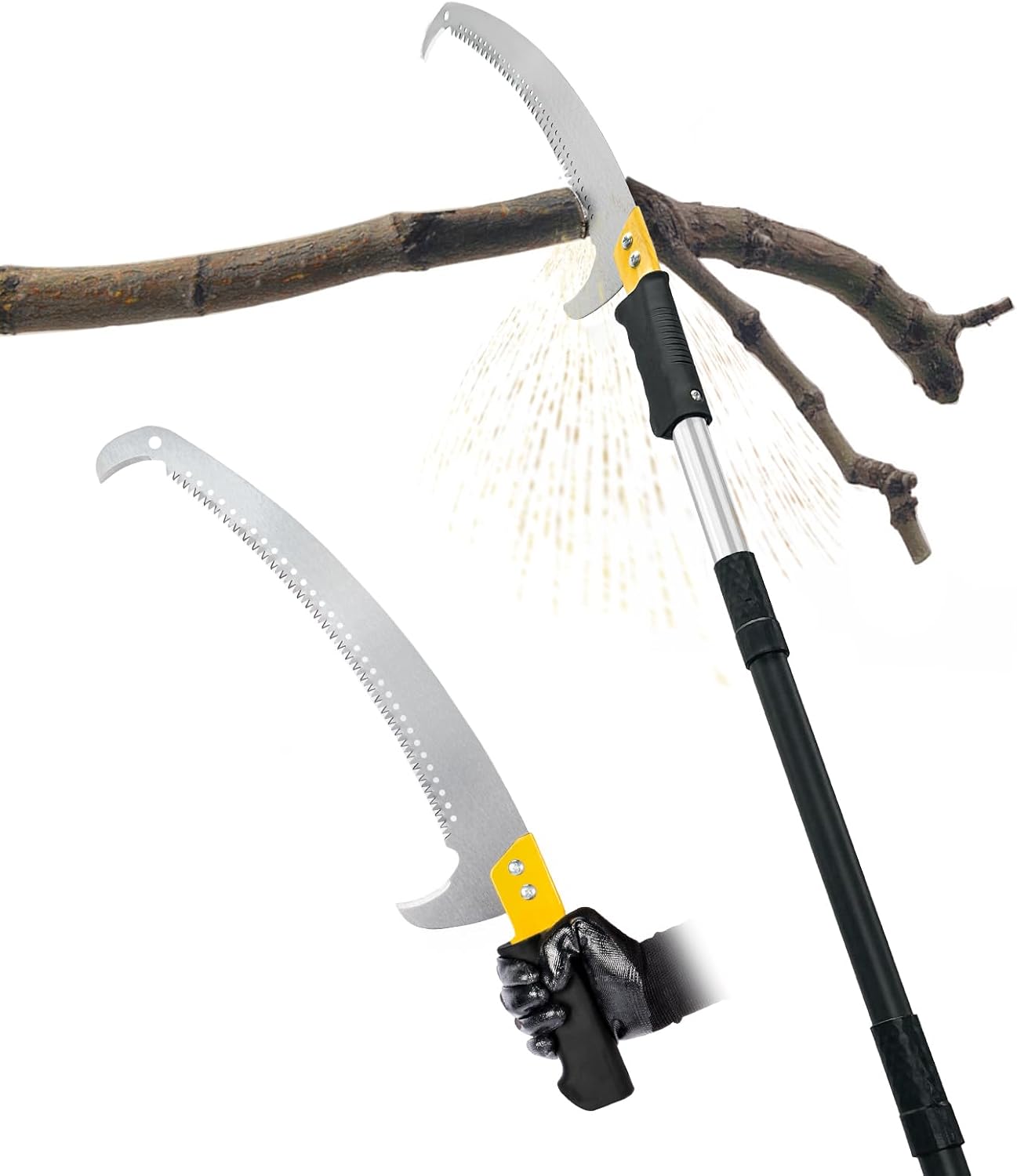
BlumeTrec 14.5 ft Manual Pole Saw with Mn Steel Blade and Adjustable Sections
| Power Source | Manual |
|---|---|
| Blade Material | Alloy Steel |
| Blade Length | 16.7 inches |
| Included Components | Wrench |
This BlumeTrec pole saw is a manual, multi-section pruning saw designed to let you trim high branches safely from the ground. The pole breaks down into sections so you can assemble it to three fixed lengths (8.5 ft, 11 ft, 14.5 ft) to match the task, and a manganese steel blade with a three-sided edge and double-sided barbs grips and slices branches for cleaner cuts. The stainless steel poles are powder-coated to resist rust and a tightening screw secures the saw head so it stays steady during use. In practice this is a basic, no-power tool that is quiet, low-maintenance, and lighter to carry than most motorized alternatives, making it easier for less experienced users to avoid ladders. Expect quicker work on small to medium branches but slower progress on very thick wood since it is manual. The plastic handle and anti-slip grip improve control but the modular pole means assembly time and storage space should be considered. Overall it is a straightforward, safety-minded option for everyday yard pruning when you want a simple, reliable tool rather than powered equipment.
Best for: Buyers who prioritize safety and simplicity and want to prune high branches from the ground without using power tools or climbing ladders; good for homeowners doing routine yard maintenance.
Less Ideal for: Professional arborists or anyone who needs to cut very large or numerous thick hardwood branches frequently should choose a powered pole saw or chainsaw instead.
- Adjustable multi-section pole offers three fixed reach lengths for flexible use.
- Mn steel blade with three-sided edge and barbs provides secure, clean cuts on small to medium branches.
- Powder-coated stainless poles resist rust for outdoor durability.
- Lightweight manual design reduces noise and maintenance compared with motorized saws.
- Anti-slip grip and extra screw to secure the saw head improve handling and safety.
- Manual cutting limits speed and effectiveness on very thick or hardwood branches.
- Plastic handle may feel less durable under heavy professional use.
Verdict: A simple, rust-resistant extendable manual pole saw that lets risk-conscious homeowners prune high branches from the ground without ladders.
Choosing the Right Pruning Saw for Large Branches: Key Factors to Consider
Blade Type and Tooth Geometry
The blade material and how the teeth are shaped determine how aggressively a saw bites into large-diameter wood. Coarse, widely spaced teeth remove material faster and reduce clogging when cutting through thick growth and knots. A blade heat-treated for hardness will hold an edge longer but can be more brittle if abused.
For large branches you want a blade profile that resists jamming and clears wood chips efficiently. Consider whether the saw uses impulse-hardened teeth or a replaceable blade system; both approaches affect long-term ownership and maintenance.
Cutting Technique and Tooth Orientation
Different pruning saws cut on the pull stroke or the push stroke, and that influences control when working overhead or on ladders. Pull-stroke saws tend to give more power with less effort because the blade tightens under load, while push-stroke designs can be faster in some hand positions.
Also consider whether the teeth are double-ground or single-ground. Double-ground teeth can cut faster and smoother, but they may clog more readily in wet wood. Think about the typical timber you cut and choose a tooth pattern that matches your technique and conditions.
Handle Comfort and Control
When cutting large branches you will often use longer strokes and more force, so a comfortable, secure handle is essential. Look for handles with non-slip surfaces and ergonomic shaping that reduces pinch points and wrist strain during extended use.
A handle that lets you change grip positions easily is useful for awkward cuts. If you do a lot of overhead work, a design that prevents rotation in the hand and funnels vibration away from the palm will reduce fatigue and improve safety.
Anti-Binding and Saw Geometry
Large branches compress as you cut, which can pinch the blade and stop progress. A saw that resists binding either through blade thickness, a tapered profile, or specific tooth angling will keep cuts moving and reduce the need for frequent back-cutting to relieve pressure.
Features like a slightly curved blade or a dedicated anti-bind taper help clear chips and maintain a straight cut line. Consider the typical diameter and weight of limbs you handle and prioritize geometry that minimizes stuck blades.
Maintenance, Sharpening, and Blade Replacement
A pruning saw that is easy to service will last longer and perform more consistently. Blades that accept common replacement parts or can be sharpened with standard files are more practical for gardeners who prefer to maintain tools themselves.
Evaluate how easy it is to remove the blade, whether replacement blades are widely available, and whether the saw design allows for safe blade changes without special tools. Consider rust resistance and whether the blade has protective coatings that reduce corrosion and pitch buildup.
Choosing the Right Blade Length
Blade length influences how many strokes you need and how well you can control long cuts. Longer blades reach around larger crotches and finish a cut in fewer passes, but they can be harder to manage in tight spaces and weigh more during sustained work.
For ground-level cutting of very large limbs, a longer blade reduces the need for repositioning. For branches in confined canopies or when working from ladders, a mid-length blade may offer a better balance of reach and control.
- Short blades are best for tight spaces and close trimming.
- Medium blades provide a balance for most yard trees.
- Long blades cut big limbs faster but require more control.
Working Safely With Large Branches
Always plan the cut and consider where the limb will fall. Large branches can swing or split unpredictably, so clear a safety zone and avoid standing under the load. Use wedges or controlled notch cuts to guide the direction of the fall when needed.
Wear appropriate eye protection, gloves, and a hard hat when working with heavy limbs. If you are on a ladder, have a helper hold the ladder steady or use an alternative stable platform. Take breaks to avoid fatigue, which increases the risk of slips and poor cuts.
- Clear bystanders from the drop zone.
- Make a relief cut before the final severing cut when needed.
- Use wedges or ropes for controlled lowering of heavy sections.
Sharpening and Care for Longer Life
Regular sharpening keeps teeth cutting cleanly and reduces the effort needed for each pass. Use the appropriate file size and follow the original tooth angle. For replaceable blades, inspect teeth for chips and rust and swap the blade when performance drops noticeably.
After use, clean resin and sap from the blade to prevent gumming and corrosion. Lightly oil metal parts and store saws dry and protected. Routine maintenance preserves edge life and lowers the chance of unexpected blade failure during a big cut.
- File toward the tip on pull-stroke saws when sharpening.
- Use blade cleaner or solvent to remove sap.
- Store blades flat or in a sheath to protect teeth.
When to Choose a Manual Saw Versus a Power Tool
Manual pruning saws excel when you need precision, low noise, and portability without fuel or batteries. They are ideal for occasional heavy cuts in urban settings, remote gardens, and for gardeners who prefer technique over motor power.
Power tools are faster on repeated large cuts but introduce additional safety concerns, greater maintenance, and the need for fuel or charging. If you only occasionally remove a few large limbs, a high-quality manual pruning saw can be a safer, simpler choice.
- Manual saws require more physical effort but offer finer control.
- Power tools are better for frequent, high-volume cutting.
- Consider accessibility and cleanup when choosing between them.
Transporting and Storing Heavy-Duty Saws
If you move between multiple job sites, think about protective sheaths and carry systems that prevent blade damage and reduce risk when loading tools. A well-fitted sheath keeps teeth from snagging and protects both the blade and surrounding gear.
For seasonal storage, clean and lightly oil saws, and keep them in a dry location where temperature swings do not promote condensation. Proper transport and storage prolong blade life and keep tools ready for safe use.
- Use a sheath with a secure retention strap.
- Keep blades dry and lightly oiled during storage.
- Organize tools so saws are not bent or dropped in transport.
How We Chose the Best Pruning Saw for Large Branches
We chose pruning saws for large branches by focusing on performance and durability characteristics that matter in real garden and tree work. Primary evaluation criteria included cut power and tooth geometry to judge how quickly a saw removes large-diameter wood, blade durability and steel quality to estimate edge life under rough use, handle ergonomics and grip security for sustained overhead or angled work, portability and weight for long pruning sessions, and ease of maintenance such as blade replacement or sharpening. We prioritized options built to handle repeated heavy cuts rather than light-duty or ornamental pruning tools. Excluded items included small hand saws and pole saw attachments designed primarily for light branches, because they do not deliver the cutting capacity or control required for large limbs. We also excluded specialty chains and motorized saws from this shortlist to keep the focus on handheld pruning saws suitable for gardeners who need robust manual cutting tools. The selected metrics reflect what gardeners notice first on the job: how fast the saw cuts, how it feels in hand, and how long the blade stays serviceable.
FAQ
What blade length is best for very large limbs?
Longer blades are usually better for very large limbs because they complete cuts in fewer strokes and can reach around crotches. However, longer blades require more control and may be awkward in tight canopies, so match length to your typical work environment.
How often should I sharpen a pruning saw used on big branches?
Frequency depends on use, wood hardness, and technique. For regular heavy cutting, expect to sharpen or replace the blade after several days to weeks of steady use. Monitor cutting speed and tooth condition to judge when sharpening is needed.
Can I use the same pruning saw for green and dry wood?
Many saws handle both, but dry, dead wood can be harder on teeth and cause more chipping. Coarser tooth patterns and tougher steel perform better on dry or knotty wood. Clean and inspect the blade more often when cutting dry branches.
Is a curved blade better than a straight blade for large branches?
Curved blades help maintain contact with the cut and can be less likely to bind on thick limbs. Straight blades offer better guidance in flush cuts and tight spaces. Choose curvature based on whether you prioritize speed on big cuts or precision in confined areas.
How do I avoid the saw getting stuck mid-cut?
Use a relief cut for heavy limbs to reduce weight on the blade, keep a steady, full-stroke rhythm to clear chips, and consider a blade with an anti-bind taper or thicker spine. If it does bind, reverse the cut slightly and clear sawdust before resuming.
Final Verdict
For large-branch pruning, prioritize a saw with aggressive tooth geometry, robust blade steel, and a comfortable handle that reduces fatigue during long cuts. Anti-binding features and ease of maintenance are vital because they keep work moving and extend blade life. Balance blade length with your working environment and choose a tool that matches how often and where you prune. When you match cutting power, ergonomics, and serviceability to your needs, you will make safer, cleaner cuts with less effort.
