

Note: This article contains affiliate links. If you click on these links and make a purchase, I may earn a small commission at no extra cost to you. This helps support my research and content. Read my full affiliate disclosure here.
Getting seedlings off to a strong start depends as much on the medium you plant them in as on light and water. The right seed starting soil gives fine texture for good seed-soil contact, holds moisture without becoming waterlogged, and resists damping-off pathogens that kill tender sprouts. This guide covers seven shortlisted seed starting soils chosen for real garden use, with clear notes on drainage, moisture retention, and nutrient profile. Below you will find practical evaluation criteria and helping points so you can pick the mix that fits your indoor seed-flat setup, heated mat routine, or greenhouse bench.
Top Picks at a Glance
| Best Overall The best all-around choice for most situations | FoxFarm Light Warrior Seed Starter Mix, 1 cu ft |  |
| Best Quality Built to a higher standard if you want something more solid | Espoma Organic Seed Starter Premium Potting Mix (16 qt) |  |
| Best Value The sweet spot between price and what you get | Old Potters Germination Mix (24 Quarts) |  |
| Best Budget The cheapest option that still gets the job done reliably | SunGro Seedling Mix Organic Seed Starting Mix, 8 Quart |  |
| Highest Rated A top-rated pick with lots of positive feedback | Premier Pro Mix BX with Mycorrhizae, 2.8 cu ft |  |
| Most Popular A crowd favorite that many people choose with confidence | Miracle-Gro Indoor Potting Mix for Seed Starting (2-pack, 8 qt each) |  |
| Best Seller A high-volume bestseller chosen again and again | Back to the Roots Organic Seed Starting Mix — Expanding 12 Quart Block |  |
FoxFarm Light Warrior Seed Starter Mix, 1 cu ft

| Brand Name | FoxFarm |
|---|---|
| Style Name | Seed Starting Mix |
| Volume | 1 cubic feet |
| Item Weight | 12 pounds |
FoxFarm Light Warrior Seed Starter is a pre-mixed medium aimed at getting seeds, cuttings and new seedlings off to a strong start. It combines sphagnum peat moss and perlite for light, airy texture and includes soil microbes, humic acids and earthworm-cast-derived nutrition to encourage root efficiency and nutrient uptake. The bag is ready to use straight from the package, which saves time compared with DIY mixes, and is suitable for both indoor flats and outdoor starter pots. Practical benefits include improved drainage and reduced compaction, a mild nutrient boost for very young plants, and the inclusion of beneficial microbes that can help reduce transplant shock. Important limitations are that it is a seed-starting mix rather than a long-term potting soil, so seedlings will need to be transplanted into richer media as they grow, and the peat content means users concerned about peat sustainability may prefer non-peat alternatives. Handle with care to avoid inhaling dust and follow local disposal guidance.
Best for: Gardeners who want a convenient, plug-and-play seed starting medium that promotes quick germination and healthy early root growth.
Less Ideal for: Growers looking for a long-term potting mix or an entirely peat-free substrate should consider other products tailored to mature plants or sustainable mixes.
- Ready-to-use out of the bag for quick seed sowing and cuttings
- Light, well-draining texture from sphagnum peat moss and perlite that reduces compaction
- Contains soil microbes and humic acids to support root efficiency and early nutrient uptake
- Includes gentle nutrition from earthworm castings suitable for delicate seedlings
- Designed specifically for starting seedlings so it lacks the long-term nutrients of potting mixes or garden soil
- Contains a high proportion of peat which may be a sustainability concern for some gardeners
Verdict: Choose this mix when you want a ready-made, microbe-enriched medium that reliably promotes fast germination and strong seedling roots.
Espoma Organic Seed Starter Premium Potting Mix (16 qt)

| Brand | Espoma |
|---|---|
| Unit Count | 598.4 Ounce |
| Volume | 16 quarts |
| Includes | Endo & ecto mycorrhizae |
Espoma Organic Seed Starter is a peat‑based mix designed specifically for germinating seeds and rooting cuttings. It combines sphagnum peat moss and perlite with yucca extract and lime to balance pH, plus a mycorrhizae blend to support early root development. In practice it produces a light, well‑draining medium that holds moisture without becoming waterlogged, which helps fragile seedlings establish strong roots. The absence of synthetic fertilizers makes it suitable for organic gardening and for people who want a clean start for vegetables, herbs and flowers. Because it is a seed starter rather than an all‑purpose potting soil, it lacks long‑term nutrients and will need fertilizing or transplanting into richer mix as seedlings grow. Also the peat basis means it compacts over time more than coir‑based alternatives if not handled gently. For gardeners focused on fast, reliable germination and healthier early roots, this mix delivers predictable results.
Best for: Gardeners who prioritize fast, reliable germination and stronger early root systems for vegetables, herbs, and flowers and who plan to transplant or fertilize seedlings as they grow.
Less Ideal for: People looking for an all‑in‑one potting soil with sustained nutrients for mature plants or those who prefer peat‑free mixes for environmental reasons.
- Formulated for seedlings with peat and perlite for good aeration and moisture balance
- Includes endo and ecto mycorrhizae to encourage early root development
- pH balanced with lime and contains yucca extract to improve moisture distribution
- Organic ingredients with no synthetic fertilizers, suitable for organic gardening
- Not fortified with long‑term nutrients so seedlings need feeding or transplanting to richer soil
- Peat‑based mix can compact more than alternatives if overwatered or handled roughly
Verdict: Choose this mix when you want an organic, root‑focused seed starter that improves germination and early root growth.
Old Potters Germination Mix (24 Quarts)

| Volume | 24 quarts |
|---|---|
| Unit Count | 768 Fluid Ounces |
| Composition | Peat moss, perlite, vermiculite |
| pH range | 5.4 – 6.3 |
| Electrical Conductivity | 1.0 – 1.5 mmhos/cm |
This Old Potters Germination Mix is built for starting seeds and young transplants. It is mainly finely milled Canadian sphagnum peat moss blended with fine perlite and vermiculite to keep the medium airy while retaining enough moisture for consistent germination. The mix includes calcitic and dolomitic limestone to bring pH into the 5.4–6.3 range, a wetting agent for even moisture distribution, and a starter nutrient charge to support first roots. In practice it works well in seed trays, plug flats, and when repotting cuttings, and it is compatible with both overhead watering and sub-irrigation. The fine texture promotes close seed-to-medium contact for fast germination but means you should watch watering closely since it holds moisture more than coarse mixes. It is not formulated as a long-term potting soil, so plan to transplant seedlings into a richer mix or potting soil as they grow. For growers who want a reliable, ready-to-use starting medium, this product delivers predictable results with minimal mixing required.
Best for: Gardeners who want a dependable, ready-to-use seed starting medium that simplifies the germination stage and reduces preparation time. Ideal for hobbyists and small-scale growers who prioritize reliable, uniform starts for seedlings and cuttings.
Less Ideal for: Large-scale growers needing a reusable or very fast-draining propagation medium and gardeners looking for an all-purpose potting soil for mature plants.
- High peat content for consistent moisture retention and good seed-to-medium contact
- Fine perlite and vermiculite improve aeration and root development
- pH adjusted with calcitic and dolomitic limestone for optimal nutrient availability
- Includes a wetting agent for even water distribution and a starter nutrient charge
- Designed for both overhead and sub-irrigation systems
- Fine texture holds moisture longer than coarser mixes so overwatering risk is higher
- Not intended as a long-term potting mix for mature plants
Verdict: Buy this mix if you want a plug-and-play, fine-textured seed starter that gives consistent germination and easy moisture management.
SunGro Seedling Mix Organic Seed Starting Mix, 8 Quart

| Volume | 8 quarts |
|---|---|
| Style Name | Peat Moss |
| Unit Count | 1 Count |
This SunGro Seedling Mix is a fine-textured, OMRI-listed organic seed starting mix made for flats, pots, and plug trays. It contains sphagnum peat moss and perlite with an organic wetting agent to promote even water absorption and consistent moisture around delicate seeds. The formula also includes a silicon-enriched additive called RESiLIENCE aimed at helping seedlings resist wilting during establishment. In practice the mix is easy to fill trays and pots with, holds moisture well without becoming waterlogged, and produces even germination for vegetables, herbs, and flowers. Because it is specifically formulated for starting seeds rather than long-term potting, you will typically transplant seedlings into a richer potting soil once true leaves form. Handle with gloves and avoid creating dust, since the product notes potential skin and eye irritation. For gardeners who want an affordable, organic seed starter that gives predictable germination and consistent moisture control, this is a practical choice.
Best for: Budget-minded gardeners who want an affordable, organic seed-starting mix that reliably produces uniform seedlings for vegetables, herbs, and flowers.
Less Ideal for: Gardeners who need an all-in-one potting mix for long-term container growth or those seeking a peat-free seed mix should consider other options.
- OMRI-listed organic formula suitable for edible and ornamental seedlings
- Fine texture and water-retentive structure promote even seed germination
- Contains organic wetting agent for uniform moisture absorption
- Includes silicon-enriched RESiLIENCE additive to help reduce wilting during establishment
- Formulated for seed starting and not intended as a long-term potting soil replacement
- Contains peat moss which can be dusty and may irritate skin or eyes during handling
Verdict: A budget-friendly, OMRI-listed seed starting mix that gives consistent germination and moisture control for reliable seedling production.
Premier Pro Mix BX with Mycorrhizae, 2.8 cu ft

| Brand | Premier Horticulture |
|---|---|
| Included Components | Pro Mix Loose with Mycorrhizae, 2.8 Cubic Feet |
| Unit Count | 400 Ounce |
| Mycorrhizal Inoculum | Glomus intraradices |
Premier Pro Mix BX with Mycorrhizae is a peat-based growing medium meant for greenhouse work, transplanting, and seed-starting where consistent, reliable results matter. It contains a mycorrhizal inoculum (Glomus intraradices) that colonizes roots and helps plants access water and nutrients more efficiently, which can speed early growth and improve establishment. In practice it is used straight from the bag for filling trays, pots, and liners or as a component in mixes for more specific crops. The loose texture and professional formulation give uniform moisture retention and drainage compared with garden soil, helping reduce uneven germination and damping-off risk when combined with good sanitation. Limitations are that it is peat-based, so growers preferring peat-free or fully organic-certified substrates will need an alternative, and the bagged volume covers a modest area so frequent replenishing is likely for larger operations. Overall it is a dependable starter medium for growers who prioritize steady, predictable performance in seed and transplant stages.
Best for: Growers who want a reliable, no-fuss seed-starting medium that promotes early root establishment and consistent germination in greenhouse or hobby setups.
Less Ideal for: People committed to peat-free growing or those needing bulk volumes for large-scale propagation should consider other substrates or larger commercial bags.
- Includes mycorrhizal inoculum to improve root nutrient and water uptake
- Professional peat-based formula provides consistent texture for germination and transplanting
- Loose, well-draining mix suitable for trays and pots used in seed starting
- Easy to use straight from the bag for greenhouse and hobby seed-starting workflows
- Peat-based formulation may not suit growers seeking peat-free or strictly organic-certified mixes
- 2.8 cubic feet bag is a modest volume for larger seed-starting needs
Verdict: A dependable professional seed-starting mix that boosts early root performance with a built-in mycorrhizal inoculum.
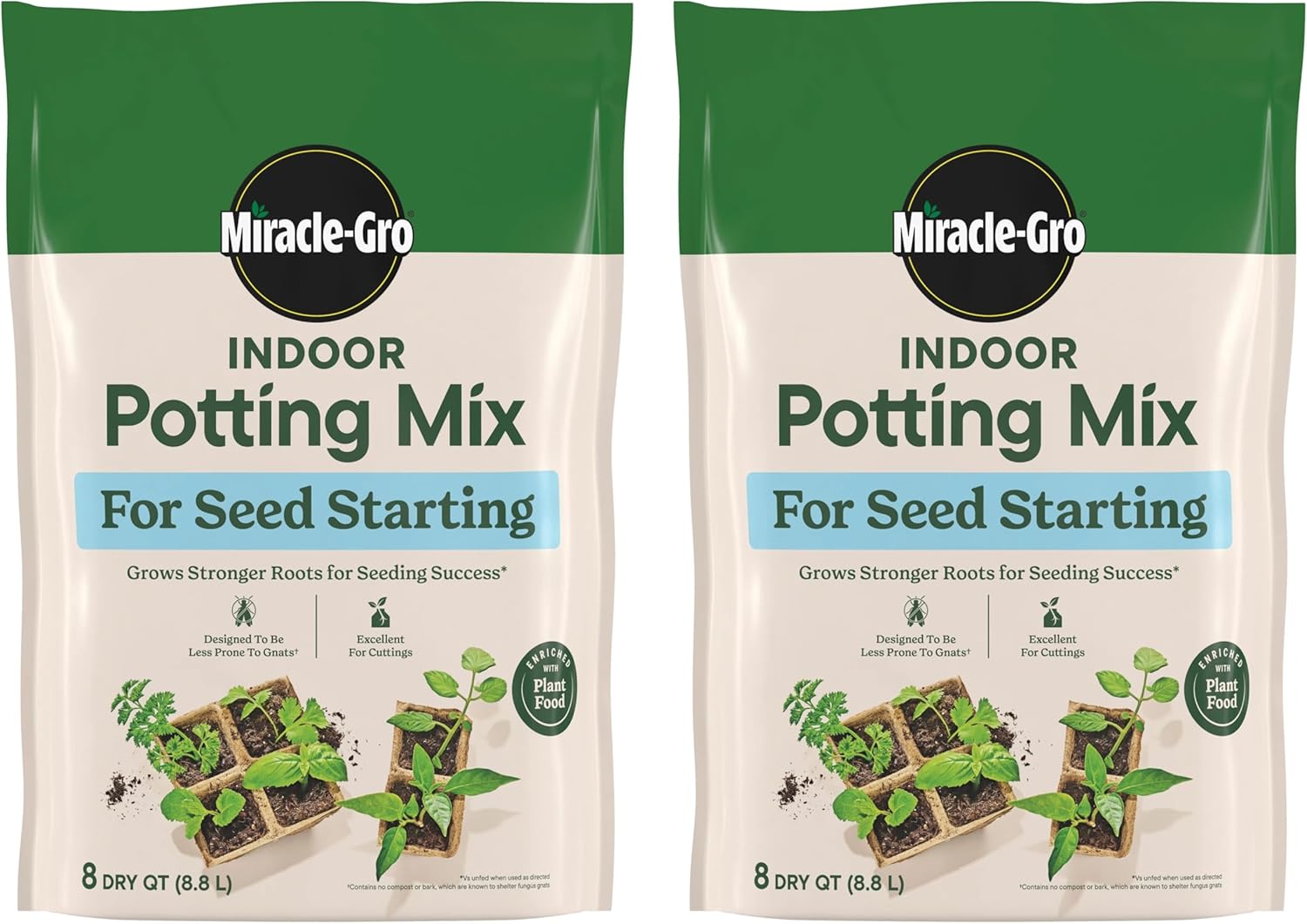
Miracle-Gro Indoor Potting Mix for Seed Starting (2-pack, 8 qt each)
| Brand Name | Miracle-Gro |
|---|---|
| Item Type Name | Potting Mix |
| Number of Packs | 2 |
| Volume | 8 quarts |
Miracle-Gro Indoor Potting Mix for Seed Starting is a lightweight, pre-fertilized potting medium intended for germinating seeds and rooting cuttings indoors. You use it straight from the bag to fill cell trays or small pots, keep it consistently moist and shaded until seedlings emerge, then transplant when true leaves form. Notable features include added plant food to support early root development and a formulation that omits compost and bark to reduce places where fungus gnats breed. Practically, that means fewer common pest headaches and stronger root systems compared with unfed mixes when used as directed. The mix is ready-to-use so it saves time versus custom blends and is easy for beginners to adopt. Important limitations: it contains fertilizer so care is needed with handling and dosing for very young seedlings, and because it is tailored for indoor seed starting it is not designed as a finishing potting mix for long-term container use or in-ground amendment. For risk-conscious buyers, the product’s widespread positive feedback and clear usage guidance make expected performance predictable for seed starting projects.
Best for: Gardeners who want a predictable, out-of-the-bag seed starting medium that reduces common indoor pest issues and simplifies propagation.
Less Ideal for: Those seeking a long-term potting soil or a mix to amend garden beds should choose a different product tailored for mature plants.
- Lightweight, ready-to-use mix optimized for seed germination and cuttings
- Contains added plant food to encourage faster root development vs unfed media
- Formulation excludes compost and bark to lower fungus gnat risk
- Comes as a two-pack so you have enough volume for multiple trays or seasons
- Contains fertilizer and dust that require careful handling and storage
- Not formulated for long-term pot use or as a garden soil amendment
Verdict: A convenient, pest-aware seed starting mix that helps beginners and cautious growers get reliable germination and root development.
Back to the Roots Organic Seed Starting Mix — Expanding 12 Quart Block

| Volume | 12 quarts |
|---|---|
| Item Type Name | Seed Starting Mix |
| Unit Count | 384 Fluid Ounces |
| OMRI Listed | Yes |
| Peat Free | Yes |
This compressed seed starting mix is a coir-based block that expands to 12 quarts of loose, ready-to-use seedling soil after adding water. It is designed for starting seeds, potting up seedlings, and amending small pots for herbs, vegetables, and flowers. Notable features include an OMRI-listed organic formulation, balanced pH and low electrical conductivity to support nutrient uptake, and compact storage compared with bulky soil bags. In practice the block is easy to hydrate and fluffs up quickly, producing a light, airy medium with good water retention and aeration for root development. The convenience of a single expanding block and beginner-friendly handling makes it a reliable choice for cautious gardeners who want predictable results without mixing multiple ingredients. Limitations are that it is a single-purpose starter mix rather than an all-in-one fertilized potting soil and larger projects will need multiple blocks, so plan quantities ahead.
Best for: Practical gardeners who want a reliable, easy-to-use organic starter medium for small-scale seed trays, pots, and indoor seedlings and who prioritize predictable, low-fuss results.
Less Ideal for: Gardeners needing a ready-to-use, fertilized all-purpose potting soil for large container gardens or immediate long-term container plantings should consider an enriched potting mix instead.
- Expands to 12 quarts from a compact compressed block for easy storage and transport
- OMRI-listed organic and peat-free formulation suitable for organic growing
- Neutral pH and low electrical conductivity support seedling nutrient uptake
- Light, fluffy texture promotes good aeration and root development
- Simple to hydrate and use, friendly for beginners and low-effort setups
- Sold as a bare starting mix without added fertilizer for later stages
- Single block size requires purchasing multiple units for larger seed batches
Verdict: A compact, OMRI-listed organic seed starter that reliably expands into a light, neutral-pH medium for predictable, beginner-friendly seed starting.
Choosing the Right Seed Starting Soil: Key Factors to Consider
Texture and Particle Size
Seedlings need a fine, even texture to make consistent contact with tiny seeds. A mix that is too coarse will leave air pockets beneath seeds and reduce germination rates. Conversely, an overly fine, dusty mix can compact when watered, starving roots of oxygen and encouraging damping-off. Aim for a balance where particles are small enough to hold seeds in place but large enough to allow air movement around emerging roots.
Texture also affects how the mix wets. A uniform particle size helps the soil absorb water evenly, preventing dry patches that can leave some seeds ungerminated. When choosing a seed starting soil, evaluate how it feels when you compress a small handful; it should crumble slightly and not form a hard cake.
Moisture Retention Versus Drainage
Good seed starting soils hold moisture at the seed level without staying saturated. Seed coats need steady moisture to soften and germinate, but constant waterlogging reduces oxygen and increases fungal risk. Mixes that include materials that retain some water, such as coco coir or fine peat alternatives, help sustain evenly moist conditions between waterings.
At the same time, a degree of drainage and aeration is essential. Ingredients that add structure, like perlite or coarse sand, prevent compaction and allow oxygen to reach tiny developing roots. Choose a mix that balances these two functions for the specific watering rhythm you use. If you tend to overwater, pick a faster-draining blend; if you rely on infrequent careful misting, choose a higher retention mix.
Pathogen Suppression and Sterility
Damping-off fungi and other pathogens are common killers of seedlings. Sterile or pasteurized starting soils reduce the initial pathogen load and lower the chance of early losses. Some mixes are pre-sterilized; others include ingredients like clean vermiculite that lower disease risk.
Beyond sterility, look for mixes that drain well and do not remain cold and wet, since those conditions favor fungal growth. If you use homemade mixes, follow safe composting and pasteurization practices. Using clean trays and avoiding reuse of contaminated flats are important complementary practices.
Nutrient Content for Early Growth
Seed starting soils should provide modest nutrition for the first weeks after germination without overwhelming tiny roots. Seeds carry enough energy to form their first leaves, but a small amount of starter fertility helps pushing true leaves and initial root development. Many mixes are intentionally low in soluble fertilizer to avoid burning.
Consider whether you want a mix with a light starter charge or a near-sterile base that requires weak fertilizing once the first true leaves appear. Your choice depends on how often you plan to fertilize seedlings and whether you prefer fewer early interventions.
Ease of Use and Prep
Practical handling matters when filling many trays or working in a small indoor space. A mix that wets easily and rehydrates uniformly saves time and reduces clumping when you sow. Lightweight mixes are easier to lift and move, while heavy or lumpy bags slow down routine work.
Also consider whether a mix needs pre-moistening, sieving, or other prep before sowing. Pre-moistened, ready-to-use blends simplify seeding sessions. If you prefer to customize mixes, look for components that blend smoothly and do not float excessively in trays when watered from below.
Choosing a Mix for Different Seed Types
Large, heavy seeds and small, dustlike seeds have different needs. Bigger seeds tolerate slightly coarser mixes and need less precise seed-soil contact, while tiny seeds require a very fine, even surface for consistent germination. Some mixes list suitability for fine seeds like lettuce and snapdragon; others are geared toward larger vegetable seeds.
For seed flats that will remain in place until transplanting, choose a mix that balances retention and drainage for the expected time in cells. For seeds you plan to prick out early, a slightly more structured mix helps develop stronger root systems for transplanting.
- Fine-textured mix for small seeds to ensure even contact
- Coarser, well-structured mix for larger seeds and longer bench time
- Adjust watering method to match your chosen mix and seed size
Preparing and Wetting Seed Starting Soil
Pre-wetting seed starting soil helps avoid floating seeds and creates a predictable moisture baseline. Add water slowly and mix until the medium feels like a wrung-out sponge. If a mix is very dry, allow time for it to absorb water completely before filling trays.
When sowing from below, ensure the mix is not hydrophobic. If it resists wetting, break it apart in a bucket and slowly add water while stirring until uniform moisture is achieved.
- Pre-moisten in a tub for consistent results
- Avoid over-saturating-aim for even dampness
- Use clean tools and trays to limit contamination
Adapting Seed Starting Soil for Greenhouse or Indoor Use
Greenhouse benches and indoor shelves present different temperature and humidity conditions. In warm, humid greenhouse spaces, faster-draining mixes help prevent soggy roots. On indoor shelves with dry air, mixes with slightly higher retention reduce how often you must mist or water.
If you use heated mats, faster germination combined with even moisture is typical, so choose a mix that will not stay saturated under consistent bottom heat. For misting rigs, pick a mix that retains surface moisture without compacting under frequent fine sprays.
- Use faster-draining mixes with bottom heat
- Choose higher retention mixes in dry indoor air
- Match your watering schedule to the mix's properties
Sustainable and Peat-Free Options
Many gardeners prefer to avoid peat-based components for environmental reasons. Peat alternatives such as coco coir can provide similar moisture retention while being renewable when sourced responsibly. Peat-free mixes often pair coir with perlite or vermiculite to maintain structure and aeration.
When selecting peat-free blends, check that coir is buffered and rinsed to avoid salt issues. Peat-free mixes may behave differently when wet, so adjust watering and expect a slightly different feel during handling.
- Coco coir offers good retention and renewable sourcing
- Perlite or vermiculite restores aeration in peat-free blends
- Rinse and buffer coir when possible to reduce salts
Transitioning Seedlings Out of Starting Soil
When seedlings are ready for their next container or the garden, the starting soil should allow gentle root expansion without holding too much moisture that can shock roots in a coarser potting mix or garden bed. Seedlings grown in very fine, low-nutrient starting mixes often respond well to being moved into a lighter potting mix with more organic matter.
Harden off seedlings gradually and match the new medium's moisture behavior to your outdoor conditions. Avoid moving plants straight into heavy, clay-rich soils without gradual acclimation and root development.
- Choose transplants' next medium to complement seed starting soil
- Ensure seedlings have some root mass before planting into heavier soils
- Harden off gradually to reduce transplant shock
How We Chose the Best Seed Starting Soil
We shortlisted seed starting soils using criteria that matter in real-world seed germination and early seedling care. We prioritized mixes with a fine, uniform particle size to ensure consistent seed-soil contact and predictable moisture behavior. Drainage and moisture retention were evaluated separately so options that stay evenly moist without staying soggy scored higher. Disease resistance was a key filter, favoring blends that minimize damping-off risk through sterile bases or pathogen-suppressing ingredients. Nutrient profile was considered for short-term seedling growth, looking for low to moderate starter nutrition that avoids burning tiny roots while supporting first true leaves. Ease of use and handling were assessed by how easy a mix is to wet uniformly, fill trays, and transplant from cells. Exclusions included heavy garden soils, unamended native soils, and potting mixes formulated for mature plants rather than delicate seedlings. We also excluded any mixes that require extensive on-site processing before use, such as compost-only blends that need sieving or pasteurization by the gardener.
FAQ
Do I need sterile seed starting soil for all seeds?
Not always. Sterile mixes reduce early fungal problems and are especially helpful for tiny, slow-germinating seeds or when you have had damping-off issues before. Hardier seeds can often germinate successfully in clean, well-draining blends that are not explicitly sterilized.
Can I make my own seed starting soil at home?
Yes, many gardeners blend components like fine coco coir or peat alternative, perlite, and a small amount of vermiculite to make effective mixes. Homemade blends must be free of weeds and pathogens, and gardeners should take care to pasteurize or use clean ingredients to avoid introducing damping-off organisms.
How often should I fertilize seedlings started in starting soil?
Usually seedlings need only a light feeding after the first true leaves appear. If the starting mix has minimal nutrition, begin with a weak liquid fertilizer every one to two weeks. Avoid high-strength feeds until plants have several sets of true leaves and more robust root systems.
Is coco coir a good substitute for peat in seed starting soil?
Coco coir is a good peat alternative because it holds water and has a fine texture suitable for seed contact. Make sure coir is buffered and rinsed if possible to reduce salts. Its water-holding behavior differs from peat, so you may need to adjust watering frequency.
What is the best way to water newly sown seeds?
Gentle bottom-watering or fine misting prevents seeds from being displaced and helps them make steady contact with the medium. Pre-wetting the mix before sowing also reduces the need for disruptive surface watering right after seeding.
Final Verdict
Pick a seed starting soil that matches the seeds you grow and the environment you have. Prioritize a fine, uniform texture, balanced moisture retention with good drainage, and low initial fertility if you plan to fertilize later. Consider sterility or pathogen-resistant components if damping-off has been an issue in the past. Balancing these tradeoffs will reduce losses and produce sturdier seedlings ready for transplant. Choose the mix that fits your watering routine and seed types, and you will see more consistent germination and healthier first-stage growth.
