

Note: This article contains affiliate links. If you click on these links and make a purchase, I may earn a small commission at no extra cost to you. This helps support my research and content. Read my full affiliate disclosure here.
Spiders can be useful in gardens but often become unwelcome inside homes, garages, and patios. Choosing the right spider repellent matters because it affects safety for people and pets, how long protection lasts, and whether you can use it around plants and food areas. This guide shortlists the top spider repellent options gardeners and homeowners turn to, evaluating them on proven effectiveness, safety profile, and real-world ease of use. Read on to see practical notes about application, where each type performs best, and which tradeoffs to expect before the product list.
Top Picks at a Glance
| Best Overall The best all-around choice for most situations | Mighty Mint Peppermint Oil Insect Repellent Spray, 1 Gallon |  |
| Best Value The sweet spot between price and what you get | Mighty Mint Peppermint Oil Spider Repellent Spray, 16 oz |  |
| Best Budget The cheapest option that still gets the job done reliably | STEM Plant-Based Bug Spray — Kills Ants, Roaches & Spiders, 10 oz |  |
| Highest Rated A top-rated pick with lots of positive feedback | Tubadros Peppermint Oil Spider Repellent Balls, 10-Pack |  |
| Most Popular A crowd favorite that many people choose with confidence | Mighty Mint Peppermint Oil Insect Repellent Spray, 16 oz |  |
| Best Seller A high-volume bestseller chosen again and again | Ortho Home Defense Insect Killer for Indoor & Perimeter, 1.33 gal. with Comfort Wand |  |
Mighty Mint Peppermint Oil Insect Repellent Spray, 1 Gallon

| Ingredients | Water, Glycerin, Polyglycerol Oleate, Soap, Peppermint Oil |
|---|---|
| Use areas | Indoor / Outdoor |
| Size | 128 oz |
Mighty Mint Peppermint Oil Insect Repellent is a large-format, plant-based spray formulated to deter spiders, ants, roaches, and common household pests using concentrated peppermint oil. It ships as a 128 oz gallon with a detachable nozzle so you can convert it into a high-strength ready-to-use sprayer or refill smaller bottles for targeted spot treatments. In practice it is applied around baseboards, entryways, patios, and other perimeter areas where pests enter or hide; the peppermint scent also leaves a fresh aroma rather than chemical fumes. Key practical benefits are its broad indoor and outdoor use and the economy of the gallon size for whole-home or yard coverage. Important limitations are that this is a repellent rather than a kill-all pesticide and effectiveness depends on reapplication and treating entry points; it is not labeled as an EPA pesticide and users should still follow safety directions around children and pets. The product is best used as part of an integrated approach to spider prevention rather than as a lone, long-term eradication solution.
Best for: Practical homeowners who want a natural, low-odor option to reduce spiders and common pests around entrances, baseboards, and outdoor perimeters and who prefer buying in bulk for regular maintenance.
Less Ideal for: People facing a heavy, established infestation or those who need a fast-acting registered insecticide should consider professional treatments or labeled pest control products instead.
- Plant-based peppermint oil formula suitable for indoor and outdoor use
- Gallon (128 oz) ready-to-use container allows economical coverage and refilling
- Detachable nozzle enables conversion to a high-strength sprayer for targeted application
- Fresh mint scent avoids harsh chemical odors
- Works as a repellent and requires repeated applications for ongoing control
- Not presented as a labeled pesticide for guaranteed knockdown of established infestations
Verdict: A cost-effective, plant-based gallon spray for homeowners seeking a natural, scent-friendly way to repel spiders and common household pests around the home.
Mighty Mint Peppermint Oil Spider Repellent Spray, 16 oz

| Size | 16 oz |
|---|---|
| Use areas | Indoor / Outdoor |
| Ingredients | Peppermint oil, geraniol, plant oils |
| Directions | Spray every few days for maintenance |
Mighty Mint Peppermint Oil Spider Repellent is a plant-based, ready-to-use 16 oz spray designed for quick, targeted pest control around the home. You use it by spraying baseboards, entryways, patios, and other problem spots a few times a week; the manufacturer also includes a microfiber cloth for precise application. The formula combines concentrated peppermint oil and geraniol to repel and kill spiders without harsh chemical fumes, making it suitable for households with pets or scent-sensitive people when directions are followed. Practical strengths are its ease of use, pleasant mint scent that is not overpowering, and versatility for both indoor and outdoor perimeter treatments. Limitations are typical for botanical repellents: it requires regular reapplication to maintain protection and may not offer the residual control or broad-spectrum knockdown of synthetic insecticides for heavy infestations. Also, like other sprays, direct contact is needed for best effect rather than system-wide elimination.
Best for: Buyers who want a low-odor, plant-based spider repellent for routine perimeter and spot treatments and prefer simple, ready-to-use solutions over chemical treatments.
Less Ideal for: People facing severe or widespread infestations who need long-lasting residual control or professional-strength pesticides should consider stronger alternatives.
- Plant-based formula using peppermint oil and geraniol for pest control
- Safe for use around people and pets when used as directed
- Ready-to-use spray with included microfiber cloth for targeted application
- Works indoors and outdoors on entryways, baseboards, patios, and similar areas
- Needs frequent reapplication to maintain effectiveness
- May be less effective than synthetic insecticides for heavy or established infestations
Verdict: A convenient, pet-friendly peppermint spray that keeps spiders away with regular spot treatments.
STEM Plant-Based Bug Spray — Kills Ants, Roaches & Spiders, 10 oz

| Item Form | Aerosol |
|---|---|
| Target Species | Ants, Roaches, Spiders |
| Unit Count | 10 Ounce |
| Active Ingredients | Geraniol 6.0%, Lemongrass Oil 0.5% |
This STEM plant-based bug spray is an aerosol insecticide formulated to kill ants, roaches and spiders using botanical actives such as geraniol and lemongrass oil. It is designed for spot treatments around the home and exterior entry points where insects congregate. The spray has no added dye or strong chemical odor, which makes it more pleasant for indoor use than many conventional aerosols. Practical benefits include an entomologist-tested formula, suitability for both indoor and outdoor application when used as directed, and marketing that highlights safety around people and pets. As a budget-friendly 10 oz option, it is easy to store and use for routine touch-ups. Limitations are typical for plant-based aerosols: effectiveness can vary by infestation size and species, and repeated applications may be needed for persistent problems compared with stronger synthetic insecticides. Use it for targeted spot control rather than expecting wholesale elimination of large infestations.
Best for: Buyers who want an affordable, lower-odor insect spray for routine spot control of spiders and common household pests and who prioritize milder botanical actives over stronger chemicals.
Less Ideal for: Homeowners facing large, established infestations or those who need long-lasting residual control should consider professional treatments or stronger synthetic options.
- Plant-based active ingredients (geraniol and lemongrass oil) that reduce harsh chemical odor
- Suitable for indoor and outdoor spot treatments when used as directed
- Entomologist-tested formulation intended to target ants, roaches and spiders
- Compact 10 oz aerosol is easy to store and convenient for quick applications
- May require repeated applications for larger or established infestations
- Less residual power than many synthetic professional insecticides
Verdict: A budget-friendly, low-odor botanical aerosol that is practical for spot control of spiders and common household pests.
Tubadros Peppermint Oil Spider Repellent Balls, 10-Pack

| Ingredients | peppermint |
|---|---|
| Item model number | TB-Spider4-10P |
| Manufacturer | Tubadros |
| Date First Available | August 13, 2026 |
These peppermint oil repellent balls use plant-based peppermint (with citronella mentioned in the description) to create an odor barrier that spiders find unpleasant. You place or hang the small pouches where spiders appear most often — closets, basements, garages, windowsills, RVs and other covered outdoor areas — and replace them as their scent fades. The manufacturer states the odor lasts roughly 30 to 60 days, so a 10-pack gives several months of coverage depending on how many you use per room. Because the formula is described as plant ingredients and labeled human and pet safe when used as directed, they are a low-risk choice for households that prefer non-chemical options. Limitations are that effectiveness can vary with ventilation, heavy drafts, or very large spaces and the scent may be noticeable to people who dislike peppermint. There are no dosing markers, so you will need to experiment with quantity and placement for best results.
Best for: Buyers who want a low-risk, plant-based way to reduce spiders in enclosed areas and who value a product that is easy to deploy and replace.
Less Ideal for: People needing immediate knockdown of heavy infestations or rapid results in large outdoor areas should choose stronger or professional pest-control options.
- Uses natural peppermint oil as the active ingredient
- Simple place-or-hang pouches require no mixing or tools
- Suitable for indoor and covered outdoor spaces where chemical sprays are undesirable
- 10-pack provides multiple applications or coverage of several rooms
- Scent lifespan advertised (30–60 days) may require frequent replacement in ventilated areas
- Performance can be inconsistent in large open or drafty spaces
Verdict: If you want a simple, plant-based repellent to quietly reduce spiders in enclosed rooms, this 10-pack of peppermint pouches is an easy, low-risk solution.
Mighty Mint Peppermint Oil Insect Repellent Spray, 16 oz
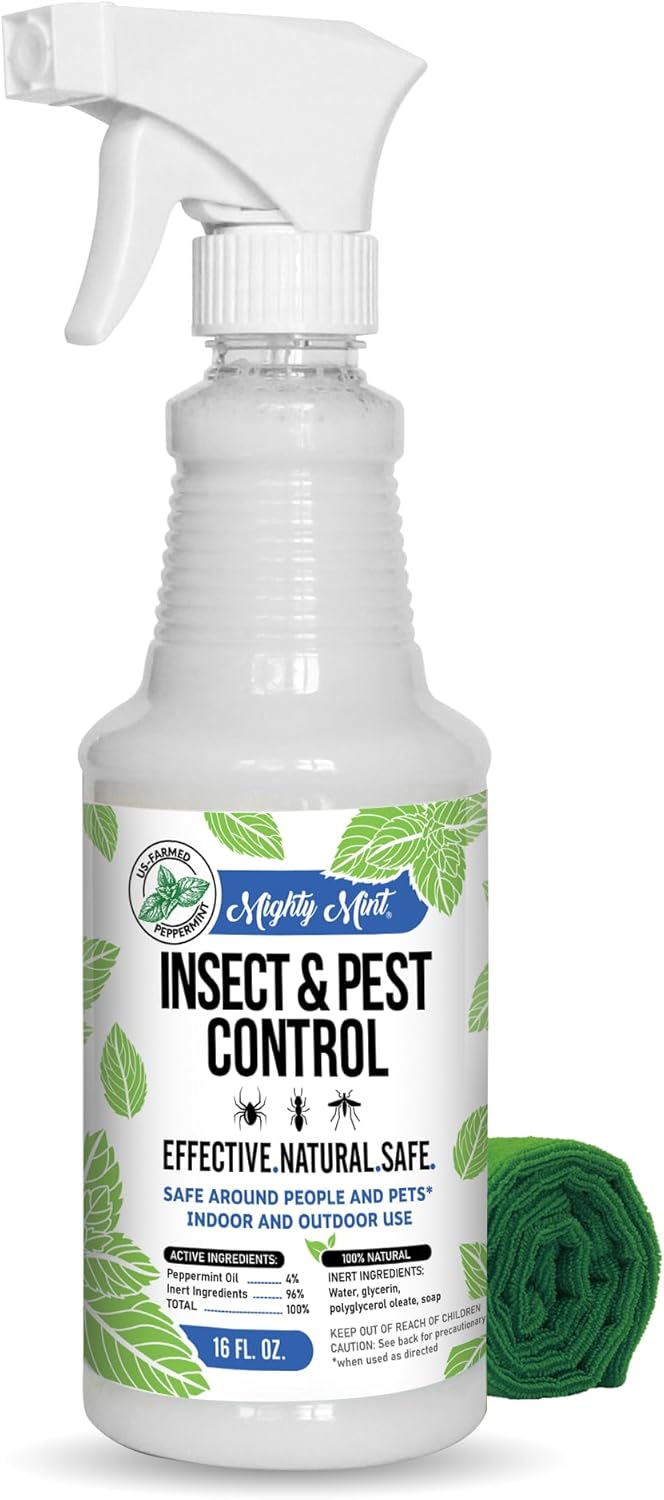
| Ingredients | Water, Glycerine, Polyglycerol oleate, Soap, Peppermint oil |
|---|---|
| Use areas | Indoor / Outdoor |
| Size | 16 oz |
Mighty Mint is a ready-to-use 16 oz peppermint oil spray that repels a range of common pests and can be used both indoors and outdoors. You apply it to entry points, baseboards, patios and other problem areas by spraying until surfaces are covered and reapplying a couple times per week for maintenance. The formula lists peppermint oil as the active plant-based ingredient, with water, glycerine and soap as carriers, so it works as a scent-based deterrent rather than a toxic insecticide. Practical benefits include an easy spray bottle for targeted treatments, a fresh mint scent that many households find pleasant, and a family- and pet-oriented marketing position when used as directed. Limitations are that it is a contact and repellent product rather than a kill-on-contact insecticide, so heavily infested areas or structural infestations may not be resolved by spraying alone, and it can be strong while wet so surfaces and pollinator exposure should be considered. Follow safety directions to avoid eye contact and keep children and pets away until treated areas are dry.
Best for: Buyers who prioritize low-toxicity, plant-based pest deterrents and want a visible, easy-to-use spray for preventing spiders and other common household insects in entryways and living spaces.
Less Ideal for: People dealing with large or established infestations, or those who need a fast-acting lethal treatment for crawling pests, should consider professional services or insecticides designed to kill on contact.
- Plant-based peppermint oil formula suitable for indoor and outdoor use
- Ready-to-use 16 oz spray bottle for quick, targeted applications
- Pleasant mint scent that masks chemical odors and may be acceptable to scent-sensitive households
- Manufacturer directions cover common application points like baseboards, entryways and patios
- Works as a repellent rather than a broad-spectrum insecticide, so it may not eliminate heavy infestations
- Strong concentration of peppermint oil can irritate sensitive people and should not contact eyes or be inhaled while wet
Verdict: A user-friendly peppermint oil spray to deter spiders and common household insects when you want a plant-based, nonchemical-feeling option for prevention.
Ortho Home Defense Insect Killer for Indoor & Perimeter, 1.33 gal. with Comfort Wand

| Item Form | Spray |
|---|---|
| Target Species | Insects |
| Liquid Volume | 1.33 gallons |
| Active Ingredients | Bifenthrin 0.05%, Zeta-Cypermethrin 0.0125% |
This large ready-to-use spray is designed to kill a wide range of household pests and to create a long-lasting barrier around the home. It is applied indoors around doors, windows and problem areas and outdoors along foundation perimeters, patios and decks using the included battery-powered Comfort Wand for continuous spray and easier reach. The formula lists bifenthrin and zeta-cypermethrin as active ingredients and claims up to 12 months of protection against ants, roaches and spiders on indoor non-porous surfaces. Practical benefits include broad-spectrum control, a wand that reduces bending and fatigue during application, and a fast-drying, low-odor formula that dries clear. Important limitations are that the 12-month protection claim applies to specific indoor surfaces only, and treated areas should not be soaked but merely left slightly wet; this product requires following label directions for safe indoor use around people and pets. For homeowners focused on reliable, home-perimeter spider control, this product simplifies repeated treatments while covering a wide list of target insects.
Best for: Homeowners who prioritize dependable, low-effort indoor and perimeter protection from spiders and other common pests and who prefer a ready-to-use product with an easy spray wand.
Less Ideal for: People seeking all-natural or pesticide-free spider control or those who need a solution designed specifically for porous outdoor surfaces or foliage treatment.
- Ready-to-use formula with included battery-powered Comfort Wand for continuous, easy application
- Claims up to 12 months barrier protection against ants, roaches and spiders on indoor non-porous surfaces
- Fast-drying, clear formula that gives off no noticeable fumes during application
- Broad-spectrum active ingredients (bifenthrin and zeta-cypermethrin) listed for many common household insects
- The long-lasting protection claim is specific to indoor non-porous surfaces and may not apply outdoors or on porous materials
- Contains synthetic insecticides that require careful following of safety directions around people, pets and plants
Verdict: A convenient, ready-to-use perimeter and indoor spray that delivers long-lasting, broad-spectrum spider and insect protection with an easy Comfort Wand applicator.
Choosing the Right Spider Repellent: Key Factors to Consider
Mode of Action and Efficacy
How a repellent works determines where and when it is useful. Some products emit odors or chemicals that deter spiders from entering treated areas, while others create loose residues that spiders avoid. Efficacy can vary with spider species, local climate, and the complexity of the site. A repellent that knocks down spiders immediately may still allow re-infestation if it lacks residual activity.
Understanding mode of action helps you match the product to the problem. For perimeter protection you may favor longer-lasting residuals or granular barriers. For spot treatments inside a garage or basement, a targeted spray or dispenser that affects entry points is often more practical.
Safety Around People, Pets, and Plants
Safety considerations shape where you can use a repellent and how frequently. Indoor application demands a low-odor, low-toxicity option, especially in homes with children, seniors, or pets. Outdoor use near flower beds, vegetable gardens, or bee-friendly plantings requires products that do not harm pollinators or stunt plants.
Read labels for re-entry intervals, pet exposure warnings, and compatibility with edible plantings. Choosing a formulation designed for indoor use versus outdoor perimeter treatment reduces the chance of accidental exposure and collateral damage to beneficial organisms.
Application Method and Coverage
Different forms suit different tasks. Trigger-spray bottles and pump sprayers are convenient for spot treatments and tight spaces. Hose-end sprayers and granular formulations cover larger landscapes quickly. Passive dispensers can offer steady low-level protection but may not be suitable for heavy infestations.
Consider how much area you need to protect, how often you want to reapply, and whether you need precision (cracks and crevices) or broad coverage (foundation perimeter). Ease of storage and refill options also matter if you plan to treat seasonally.
Residual Duration and Maintenance Frequency
Residual duration directly affects maintenance time and cost. Some repellents provide only hours of protection and need frequent reapplication, while others leave a barrier that lasts weeks. Climate factors such as rain, irrigation, and UV exposure can shorten the effective window outdoors.
Match the expected residual life to your capacity for reapplication. Properties with heavy rain or frequent watering will need products specified as rainfast or those intended for reapplication after moisture events.
Non-Target and Environmental Impact
A good repellent minimizes harm to pollinators, pets, wildlife, and beneficial predatory insects. Broad-spectrum chemical approaches may reduce spider numbers but can also affect insects that help control other pests. Consider formulations labeled as selective, low-toxicity, or biodegradable when environmental impact matters.
If you maintain vegetable beds or pollinator plantings near treatment zones, prioritize products with minimal soil persistence and clear guidance for safe use near edible crops.
Scent, Residue Appearance, and Indoor Suitability
Indoor use brings extra constraints. Many repellents have noticeable odors or leave visible residues on baseboards and window frames. Fragrance and appearance affect whether a product is acceptable for living spaces. For indoor kitchens and bedrooms choose low-odor, clear-finish options that do not stain surfaces.
Also consider ventilation needs after application and how residue cleans up during regular housecleaning. Ease of removal without damaging finishes can be important in rented spaces or finished basements.
When to Use Repellent Versus Exclusion and Sanitation
Repellent products are one tool among several. Before treating, inspect for entry points, remove cluttered harborage, and vacuum webs and egg sacs. Sealing cracks, installing door sweeps, and reducing outdoor lighting that attracts other insects will lower spider pressure and make repellents more effective.
Use repellents to supplement exclusion and sanitation when you need immediate reduction in spider activity or when structural gaps cannot be sealed right away. In long-term management, combine habitat modification with periodic targeted treatments rather than relying on repellents alone.
- Vacuum webs and sacs to reduce immediate population.
- Seal gaps and repair screens to block re-entry.
- Reduce exterior lighting or switch to yellow bulbs to cut insect attraction.
Best Application Practices for Indoor Areas
For interiors, focus treatments on baseboards, window frames, attics, and crawlspace entrances. Apply light, targeted amounts rather than saturating surfaces. Allow rooms to ventilate after applying any spray, and follow label wait times before re-entry if specified.
Keep household goods, clothing, and pet bedding away from treated zones until residues have settled or the product label permits contact. Regular cleaning and vacuuming will remove residual webs and help you spot reinfestation early.
- Treat cracks and crevices where spiders hide.
- Avoid treating food prep surfaces directly.
- Reapply only at intervals recommended for indoor use.
Perimeter and Outdoor Use Tips
Create a treated barrier around foundations and entryways rather than spraying indiscriminately across the yard. Focus on eaves, soffits, porch ceilings, and foundational gaps where spiders and their prey congregate. Use formulations labeled for outdoor use that tolerate sunlight and moisture.
Place granular products in narrow bands along the base of structures for longer-lasting protection, and refresh after heavy rain or irrigation events. Trim vegetation away from siding and windows to reduce sheltered corridors spiders use to access buildings.
- Apply treatments in dry weather for best residual performance.
- Keep mulch and plantings several inches away from foundation walls.
- Use targeted perimeter bands instead of blanket spraying the landscape.
Managing Expectations and When to Reapply
No repellent provides permanent elimination. Expect fluctuating results depending on seasonality and local insect prey abundance. Monitor treated areas and note how long you observe reduced spider activity to set a reapplication schedule that matches real conditions.
If you see increased spider activity after a rainstorm or after vegetation growth near the structure, plan a follow-up treatment. For heavy infestations, combine repellent use with physical removal and exclusion measures.
- Log treatment dates and observed results to refine timing.
- Reapply after significant weather events when needed.
- Combine strategies for best long-term control.
Safe Use Near Gardens and Pollinator Areas
If you treat near flower beds or vegetable gardens, choose products with low soil persistence and clear label guidance about application distance from edible plants. Avoid broadcast spraying of pollinator-forage areas during bloom times to protect beneficial insects.
Consider placing treatments on hardscape edges and foundation borders rather than over plant beds. For edible gardens, use physical exclusion and targeted habitat modification first, and reserve chemical repellents for severe situations where other measures are insufficient.
- Avoid treating flowering plants while in bloom.
- Prefer perimeter treatments on hard surfaces near gardens.
- Follow label wait times before harvesting if treatments approach edible areas.
How We Chose the Best Spider Repellent
We focused on repellents that deliver consistent reduction in spider presence without requiring constant reapplication. Selection prioritized products with documented efficacy in typical home and garden scenarios, clear directions for safe use around people, pets, and plants, and formats that suit common application patterns such as sprays, granular treatments, and passive dispensers. We scored options for short-term knockdown and longer residual protection, safety and non-target effects, ease of application and site coverage, and compatibility with indoor and outdoor use. We excluded items that rely solely on anecdote or that pose unacceptable risks to pets, beneficial insects, or garden plants. Products without clear usage instructions or that require specialized equipment were also filtered out. The final list emphasizes practical effectiveness, user safety, and predictable maintenance needs so gardeners can pick a solution that fits their routine and risk tolerance.
FAQ
Do spider repellents kill spiders or just deter them?
It depends on the formulation. Some products are designed to repel and discourage spiders from entering treated areas, while others contain agents that can incapacitate or kill on contact. Read the label to understand whether the product provides knockdown, deterrence, or both.
Are natural or botanical repellents effective?
Botanical options can reduce spider activity for short periods and are often preferred indoors for their lower toxicity and scent profiles. Their residual effect is usually shorter than synthetic alternatives, so they may require more frequent reapplication.
Can I use repellent around vegetable gardens and bees?
Use caution. Select products labeled as safe for use near edible plants and pollinators, apply to hardscape margins rather than blooms, and avoid treating during peak pollinator activity. When in doubt, favor mechanical exclusion and habitat changes.
How long should I wait before allowing pets back into treated areas?
Wait times vary by product. Many low-toxicity repellents allow re-entry once surfaces are dry, while others specify a re-entry interval. Always consult the product label for exact re-entry and pet exposure guidance.
Will outdoor treatments prevent spiders from coming inside entirely?
Outdoor treatments can reduce the number of spiders near a structure and cut entry pressure, but they rarely prevent all spiders from entering. Combine perimeter treatments with sealing and indoor spot treatments for best results.
How often should I reapply perimeter treatments?
Reapplication frequency depends on the product's residual claim and local conditions. Many perimeter products need refreshment every few weeks to months, and you should reapply after heavy rain unless the label states rainfast performance.
Final Verdict
Choose a spider repellent based on where you need protection, how long you want that protection to last, and who or what needs to be kept safe around treated areas. Prioritize safety and compatibility with nearby plants and pollinators for outdoor use, and pick low-odor, low-residue solutions for indoor spaces. Combine repellents with exclusion and sanitation measures to reduce reapplication and get the most reliable, long-term results.
