

Note: This article contains affiliate links. If you click on these links and make a purchase, I may earn a small commission at no extra cost to you. This helps support my research and content. Read my full affiliate disclosure here.
Japanese beetles can skeletonize leaves and damage flowers, fruit and young foliage quickly once populations build. Picking the right pesticide matters because timing, application method and safety around bees and beneficial insects determine whether you stop an outbreak or create new problems in the garden. This guide covers seven top pesticide options shortlisted for controlling Japanese beetles in home gardens and small landscapes. We evaluate each choice for speed of control, persistence, application practicality and risk to pollinators and pets, so you can choose a fit for your planting mix and timing needs.
Top Picks at a Glance
| Best Overall The best all-around choice for most situations | BioAdvanced 12-Month Tree & Shrub Insect Control Concentrate, 1 gal |  |
| Best Quality Built to a higher standard if you want something more solid | BioAdvanced 12-Month Tree & Shrub Protect and Feed Concentrate, 32 oz |  |
| Best Value The sweet spot between price and what you get | BioAdvanced Fruit, Citrus & Vegetable Insect Control Concentrate, 32 oz |  |
| Best Budget The cheapest option that still gets the job done reliably | GardenTech Sevin Insect Killer Dust, 1 lb |  |
| Highest Rated A top-rated pick with lots of positive feedback | Sevin Insect Killer Concentrate II, 32 oz |  |
| Most Popular A crowd favorite that many people choose with confidence | Bonide Captain Jack's Deadbug Brew 16 oz Concentrate |  |
| Best Seller A high-volume bestseller chosen again and again | Atticus Talak 7.9% Bifenthrin Indoor/Outdoor Insecticide Concentrate, 32 oz |  |
BioAdvanced 12-Month Tree & Shrub Insect Control Concentrate, 1 gal

| Unit Count | 128 Fluid Ounces |
|---|---|
| Liquid Volume | 1 gallons |
| Item Form | Spray |
| Target Species | Insects |
| Specification Met | EPA |
This concentrated systemic insect control uses imidacloprid to move from roots to branch tips and protect trees and shrubs for up to a year after a single application. It is applied to the soil around the base of the plant rather than sprayed on foliage, which makes it easier and less messy for treating mature trees or multiple specimens. The formula specifically lists pests such as Japanese beetles, emerald ash borer, aphids, adelgids, leafminers, and scale, so it is suited to both preventative treatment and active infestations of those insects. Because the product is rainproof once taken up, protection continues through wet weather without reapplication. Limitations include restricted sale in several states and the use of a neonicotinoid active ingredient, which requires following label safety and environmental precautions and means it is not an organic option.
Best for: Homeowners or property managers who want an easy, long-lasting soil-applied treatment to protect trees and shrubs from common pests without frequent reapplication.
Less Ideal for: People who prefer organic or non-neonicotinoid solutions or those who need a foliar spray for immediate contact kill on visible adults.
- Systemic action provides up to 12 months of protection from a single application
- Concentrated formula treats multiple or mature trees without repeated foliar sprays
- Targets a broad list of tree and shrub pests including Japanese beetles and emerald ash borer
- Rainproof after uptake so protection persists through wet weather
- Contains imidacloprid, a neonicotinoid that requires careful handling and environmental consideration
- Not available for sale in several U.S. states
Verdict: Choose this concentrate when you need a low-effort, single-application soil treatment that protects trees and shrubs from Japanese beetles and other listed pests for up to a year.
BioAdvanced 12-Month Tree & Shrub Protect and Feed Concentrate, 32 oz

| Item Form | Liquid |
|---|---|
| Target Species | Adelgids, Aphids, Japanese Beetles, Whiteflies, Scale |
| Liquid Volume | 32 fluid ounces |
| Specification Met | EPA |
This concentrated protect-and-feed formula is designed to be mixed and applied to the soil around trees and shrubs so plants take up insecticide and fertilizer through their roots. It controls listed pests such as aphids, scale, adelgids, Japanese beetles and emerald ash borer and provides slow-release nitrogen that moves systemically to new growth. Because it is root-absorbed there is no foliar spraying, which simplifies application and reduces contact with leaves and blooms. The product claims up to 12 months of protection after one application and is rainproof once absorbed. Important limitations are regulatory restrictions in several states and counties where it is not for sale or use, and the active ingredient is a neonicotinoid so users who avoid that class of chemistry should choose another option. For routine seasonal protection and improved vigor of established trees and shrubs this concentrate is a low-effort solution, but follow label directions carefully for correct mixing and application rates.
Best for: Gardeners who want a low-effort, season-long protection plan for established trees and shrubs and prefer a soil-applied systemic treatment over repeated foliar spraying.
Less Ideal for: People living in the states or counties where the product is restricted or gardeners who avoid neonicotinoid insecticides should look for alternative methods or products.
- Systemic, root-applied formula treats the whole plant including new growth
- Single-application control that can last up to 12 months
- Includes slow-release fertilizer to support plant vigor while controlling pests
- Not legal for sale or use in several U.S. states and specific counties
- Contains imidacloprid, a neonicotinoid class insecticide that some users avoid
Verdict: Choose this concentrate if you want a single, root-applied treatment that combines year-long systemic insect protection with slow-release feeding for trees and shrubs.
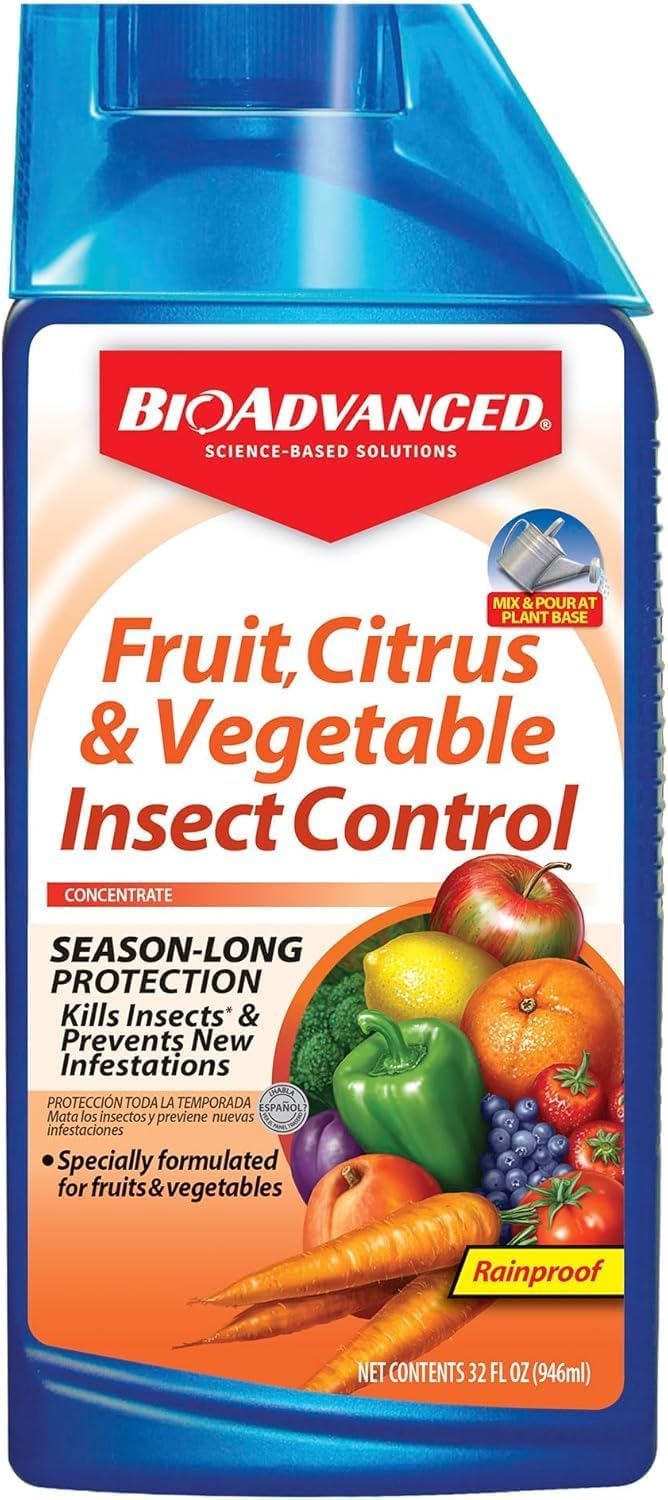
BioAdvanced Fruit, Citrus & Vegetable Insect Control Concentrate, 32 oz
| Item Form | Concentrate |
|---|---|
| Target Species | Aphid, Whiteflies, Japanese Beetles, Mealybugs, Asian Citrus Psyllid |
| Liquid Volume | 32 fluid ounces |
| Specification Met | EPA |
| Active Ingredients | avocado |
This BioAdvanced concentrate is designed as a season-long, systemic insect control for edible gardens. You mix the concentrate with water and pour it around the root zone, so no foliar spraying is required; after uptake the product protects plants from feeding pests such as aphids, whiteflies, leafhoppers, scale and Japanese beetles and is rainproof after one hour. A single application covers large areas and the label states protection for up to two months, which makes it useful for producers who want durable control without repeated sprays. Because it is systemic the active ingredient is taken up by the plant, protecting new growth as well as existing foliage. Important limitations are regulatory restrictions in several U.S. states and the fact that systemic chemistry can affect nontarget insects, so follow label directions and harvest intervals carefully. For gardeners focused on strong, low-effort insect control for edible crops, this product delivers predictable season-long protection when used as directed.
Best for: Gardeners and small-scale growers who prioritize reliable, low-effort, season-long protection for edible vegetables and fruit and who want a pour-in-root treatment instead of repeated foliar sprays.
Less Ideal for: People who prefer organic contact-only treatments or who manage pollinator-heavy plantings where nontarget exposure must be minimized should consider alternative products.
- Systemic mode of action protects new growth and does not require foliar spraying
- Provides rainproof protection one hour after application
- Single application gives season-long control for up to two months
- Covers a wide range of listed pests relevant to vegetables and fruit
- Not permitted for sale or use in several U.S. states and some New York counties
- Contains systemic insecticide chemistry that can impact nontarget insects if misused
Verdict: Choose this concentrate if you want dependable, season-long systemic protection for vegetables and fruit with a single pour-in application.
GardenTech Sevin Insect Killer Dust, 1 lb

| Item Form | Dust |
|---|---|
| Target Species | Insects |
| Active Ingredients | Bifenthrin |
| Unit Count | 1 Count |
Sevin Insect Killer Dust is a handheld dust formulation of bifenthrin for spot and perimeter treatment of garden pests, including Japanese beetles. You apply it by shaking a thin, uniform layer onto leaves, stems and around plants as a preventative or when you first see damage. The product kills by contact and lists more than 150 target insects, so it works across vegetables, fruit, ornamentals and turf. Practical features include a flip-open cap for easy dispensing and a 1 pound container sized for small-to-medium beds; the manufacturer states one pound treats about 2,000 sq. ft. The dust does not require mixing and settles quickly so treated areas can be reoccupied after it dries. Important limitations are typical for contact insecticides: it should not be applied to open blooms to protect pollinators and it provides little residual control if plants are watered or receive heavy rain within 24 hours of application. Users must follow label safety steps like avoiding the eyes and washing hands after use.
Best for: Gardeners who want a straightforward, no-mix contact treatment to quickly reduce visible beetle and chewing insect pressure in mixed vegetable, fruit and ornamental plantings.
Less Ideal for: People prioritizing pollinator-safe or long-residual biological controls should choose targeted or non-chemical methods instead.
- Kills by contact a wide range of garden pests including Japanese beetles and aphids
- Ready-to-use dust needs no mixing and is simple to apply with a flip-open cap
- Label lists use on vegetables, fruits, ornamentals and lawns so it fits mixed garden beds
- Contains bifenthrin which can harm beneficial insects if applied to open blooms or overused
Verdict: If you need a simple, ready-to-use contact treatment to quickly knock down Japanese beetles and other common garden pests, Sevin dust delivers fast, broad-spectrum control.
Sevin Insect Killer Concentrate II, 32 oz

| Item Form | Liquid |
|---|---|
| Target Species | Insects |
| Liquid Volume | 32 fluid ounces |
| Active Ingredients | Zeta Cypermethrin |
Sevin Insect Killer Concentrate II is a garden spray concentrate you mix with water and apply with a handheld, tank, or hose-end sprayer to control insects on lawns, vegetables, fruits, shrubs, and ornamentals. The label rate (for example 4 fl oz per gallon) and included measuring cap make mixing straightforward for routine applications. It kills by contact more than 500 listed pests and claims residual control for up to three months on most insects, which reduces how often you need to reapply. The formula lists zeta-cypermethrin as the active ingredient, so it is fast acting against chewing and sap-sucking pests but you must avoid spraying open blooms to protect pollinators and follow label precautions for personal safety. It is versatile for spot treatments or broader landscape use, but users should follow label restrictions for certain pests and regional regulations. Practical gardeners will appreciate the concentrated format and multi-plant label, while those needing an organic or pollinator-safe option will want alternatives.
Best for: Gardeners who want a practical, no-nonsense concentrate to control a wide range of insect pests across vegetable beds, ornamentals, and lawns and who prioritize effective, infrequent applications.
Less Ideal for: People seeking organic, pollinator-safe, or aquatic-friendly pest control should consider non-synthetic or targeted biological options instead.
- Concentrated formula lets you treat large areas from a single bottle when mixed as directed
- Kills over 500 listed insect pests by contact, covering many common garden problems
- Measuring cap and clear mixing instructions make preparation simple and consistent
- Works on both ornamental and edible plants so one product covers multiple garden zones
- Contains a synthetic pyrethroid (zeta-cypermethrin) which can harm pollinators and aquatic life if misused
- Not registered for certain pests or regions so users must check local label restrictions
Verdict: A versatile, concentrated insecticide that gives practical gardeners broad-spectrum, long-lasting control when used according to the label.
Bonide Captain Jack's Deadbug Brew 16 oz Concentrate

| Unit Count | 16 Ounce |
|---|---|
| Item Form | Spray |
| Target Species | Insects |
| Active Ingredients | Spinosad (Mixture of Spinosyn A and Spinosad D) |
Bonide Captain Jack's Deadbug Brew is a concentrated spinosad insecticide designed for use on vegetables, fruits, ornamentals, and other garden plants. You mix the 16 fl oz concentrate with water and apply it with a trigger, hand-held, backpack, or hose-end sprayer to target caterpillars, beetles, borers, leaf miners, and similar chewing pests. Because the active ingredient is spinosad, the product is approved for organic gardening and is selective enough that it does not significantly impact many predatory beneficial insects and mites when used as directed. In practical use it provides quick knockdown of listed pests and is suitable for protecting squash and other cucurbits from feeding damage. The main limitations are that it must be mixed and applied correctly following label rates and safety instructions and that repeated broad use can still affect non-target insects if timing and coverage are not careful. For gardeners focused on protecting food crops, it is a straightforward, effective option when integrated with scouting and spot treatments.
Best for: Gardeners who prioritize practical, effective pest control for edible gardens and want an organic-approved concentrate they can mix and apply themselves to protect squash and other crops.
Less Ideal for: Gardeners seeking a ready-to-use spray or those unwilling to follow label mixing and safety instructions should consider alternative formats or professional application.
- Contains spinosad, an active ingredient approved for organic gardening and effective against caterpillars and beetles
- Concentrate mixes with water for use with trigger, backpack, hand-held, or hose‑end sprayers
- Labeled for use on a wide range of vegetables, fruits, and ornamentals including cucurbits
- Designed to minimize impact on many predatory beneficial insects and mites when used as directed
- Requires careful mixing and application per label to avoid harming non-target insects
- Not a residual solution for all pests so repeat applications or scouting are often necessary
Verdict: A practical, organic-approved spinosad concentrate that reliably controls chewing pests on squash and other garden crops when mixed and applied correctly.
Atticus Talak 7.9% Bifenthrin Indoor/Outdoor Insecticide Concentrate, 32 oz

| Active Ingredient | Bifenthrin |
|---|---|
| Formulation | Suspension Concentrate |
| Liquid Volume | 32 fluid ounces |
| Length of Control | Up to three months |
| Target Species | Insects |
Talak 7.9% is a liquid concentrate for treating lawns, landscaping, outdoor living areas and indoor perimeter spots like baseboards and cabinets. You dilute the concentrate with water to create a spray for barrier treatments, spot applications or lawn mixes; label rates explain how much to mix per gallon depending on the use. The product uses bifenthrin, a proven broad-spectrum active ingredient, and the manufacturer states it controls over 75 species and can give residual control for as long as three months. Its water-based formula dries clear, leaves no odor or visible residue, and is not phytotoxic on plants when used per label. Practical benefits include flexible indoor and outdoor use, clear drying, and a bottle designed for easier pouring. Important limitations are that solutions should be mixed only for same-day use, it is not registered for sale in a few states, and it is not approved for fogger application, so professional-style misting methods are not appropriate.
Best for: Buyers who want a single, reliable product to protect yards, patios and building perimeters from a wide range of common pests and prefer conservative, label-driven application practices.
Less Ideal for: People seeking ready-to-use sprays or fogger-compatible products or those in states where this formulation is not registered should look at alternatives.
- Broad-spectrum control listed for 75+ indoor and outdoor pest species
- Water-based formula that dries clear and leaves no odor or residue
- Flexible label directions for lawns, landscapes, hardscapes and indoor perimeter treatments
- Long residual activity up to three months when applied at recommended rates
- Mixed spray solutions cannot be stored and must be used the same day
- Not approved for fogger application and not available for sale in some states
Verdict: A versatile, water-based bifenthrin concentrate that delivers long-lasting, broad-spectrum outdoor (and perimeter indoor) control when used according to the label.
Choosing the Right Pesticide for Japanese Beetles: Key Factors to Consider
Efficacy Against Adult Beetles
Adult Japanese beetles are the immediate visible problem, chewing foliage and flowers during peak activity. A pesticide that provides rapid knockdown reduces defoliation and flower damage on contact. When evaluating options consider whether the active ingredient works on contact only or has systemic activity that can protect new growth.
Fast-acting products are useful for stopping visible damage quickly, but contact-only materials may require repeat applications. Systemic materials can offer broader protection for treated plants, but they often require proper timing and root or foliar uptake to be effective.
Residual Protection Duration
How long a treatment suppresses beetle activity affects how often you need to reapply and how much labor or chemical you introduce to the garden. Residual duration depends on formulation, application rate, and environmental factors such as rainfall and UV exposure.
Longer residual control can be more convenient, but persistent residues can increase exposure risk to non-target insects. Balance the need for lasting protection with the site you are treating and how often beetles typically reinvade that area.
Pollinator and Beneficial Insect Safety
Many ornamentals share space with pollinator-attracting flowers and nearby vegetable beds. Choosing a pesticide with lower toxicity to bees and other beneficial insects, and using it in ways that reduce exposure, is critical. Look for products with clear label guidance on application timing relative to bloom, recommended application methods that limit drift, and re-entry intervals.
Consider non-chemical controls or spot-treating when pollinators are active. If a product has higher bee toxicity, plan applications for early morning or late evening when pollinator activity is low and avoid spraying open flowers.
Suitability for Edible Plants
If you are treating plants that will be harvested, label directions on pre-harvest intervals and allowed uses are essential. Some pesticides are cleared for ornamentals only and are not legal or safe for use on food crops.
Read label instructions carefully for application rates, harvest intervals, and whether the product can be used as a soil drench or foliar spray on edible crops. Choosing a product that is approved for edibles reduces the risk of residue issues and keeps homegrown produce safe.
Application Method and Ease
Products come as ready-to-use sprays, concentrates, granular soil treatments, or systemic drenches. Your garden size and the plants affected influence which format makes sense. Granules can be easier for turf and roots, while sprays are better for targeted foliar control on shrubs and ornamentals.
An easy-to-mix concentrate or a hose-end applicator can save time on larger properties. Consider whether the product requires special equipment or protective gear beyond standard garden gloves and eye protection.
Timing and Integrated Practices
Japanese beetle management benefits from timing applications to beetle life stages and activity. Targeting adults during peak flight reduces immediate damage, while treating soil or turf at the right time can reduce grub populations. Integrating cultural controls, such as handpicking, trapping strategies used cautiously, and maintaining healthy turf, improves long-term outcomes.
Plan treatments around beetle phenology in your region and combine chemical choices with non-chemical steps to reduce selection pressure and the need for frequent applications.
When to Treat During the Beetle Season
Japanese beetles are most damaging during summer when adults feed on leaves and flowers. Watch for the first wave of adults and treat quickly if feeding is visible. Early-season interventions often prevent large populations from building later.
For grub-focused tactics, time soil treatments or biological controls in late summer when larvae are small and most vulnerable. Coordinate foliar treatments for adults with the peak flight window in your local area to maximize effectiveness.
- Apply foliar control at first sign of adult feeding
- Consider soil or biological grub treatments in late summer
- Avoid spraying during bloom when pollinators are active
Non-chemical and Cultural Controls to Use Alongside Pesticides
Handpicking and shaking beetles into a container of soapy water can be highly effective on small shrubs and isolated plants. This method is labor intensive but controls beetles immediately without chemical exposure.
Maintain dense, healthy turf to reduce grub-susceptible areas and encourage beneficial predators. Avoid overfertilizing with high-nitrogen inputs that attract adult feeding. Using row covers or netting on high-value plants during peak activity offers physical protection without insecticide use.
- Handpick early morning or dusk when beetles are sluggish
- Use row covers for small fruiting plants during peak activity
- Encourage birds and predatory insects through habitat diversity
Safe Application Practices in Mixed Plantings
In gardens with both ornamentals and edibles, adopt strategies that limit non-target exposure. Spot-spray only affected plants, avoid broadcast applications when possible, and shield nearby blooms before spraying. Follow label directions for buffer zones and re-entry intervals.
Use low-drift nozzles and avoid spraying on windy days. When treating plants that attract pollinators, apply treatments in the evening and remove or cover nearby potted plants that might be contaminated.
- Spot-treat affected plants rather than whole beds
- Use protective measures to keep pollinators safe
- Follow label personal protective equipment recommendations
Understanding Labels and Legal Use
The product label is the law and contains critical information on where and how you may use a pesticide. Labels specify target pests, allowable crops, mixing instructions, required protective gear, and environmental precautions.
Before applying any material, confirm the label includes Japanese beetles and the specific plant type you intend to treat. Misuse can harm non-target organisms and may violate local regulations.
- Check crop and site allowances on the label before use
- Follow mixing rates and maximum applications per season
- Observe listed pre-harvest intervals for edible crops
Combining Biological Controls
Biological options such as entomopathogenic nematodes can reduce grub populations in turf when applied correctly. These tools work best as part of an integrated program and often require specific soil and moisture conditions for success.
Pairing biological grub control with targeted adult treatments lowers overall chemical use and supports longer-term suppression of beetle populations.
- Apply biologicals when soil temperatures and moisture favor efficacy
- Use biologicals as preventive measures rather than emergency fixes
- Monitor outcomes and repeat applications according to product guidance
How We Chose the Best Pesticide for Japanese Beetles
We selected products that are appropriate for home and small-scale garden use and that address the primary needs gardeners face when managing Japanese beetles. Evaluation focused on efficacy against adult beetles and larval stages when relevant, application method flexibility for beds and ornamentals, documented residual activity to balance follow-up treatments, and safety profile for pollinators and pets. We also assessed formulation practicality, including ready-to-use versus concentrate options and whether the product can be applied to edible plants with appropriate harvest intervals. Excluded items that are strictly commercial or agricultural-only formulations, products lacking clear label directions for home landscapes, and unverified or anecdotal remedies without reliable efficacy information. Our criteria emphasize real-world utility: how quickly beetles are controlled, how long protection lasts, how easy the product is to apply correctly, and how well the label mitigates risks to non-target organisms. These evaluation dimensions are reflected in the scoring labels used in each product block.
FAQ
How often should I reapply a pesticide during a heavy Japanese beetle outbreak?
Reapplication frequency depends on the active ingredient and residual life. Contact sprays often need repeating every 7 to 14 days during heavy feeding, while systemic treatments may provide weeks of protection. Always follow label interval directions and adjust timing based on rainfall and observed beetle pressure.
Can I treat flowering plants without harming bees?
Treating flowering plants risks harming bees unless you use products labeled as low-risk and apply when pollinators are inactive. The safest approach is to avoid spraying open blooms and to apply treatments in the evening or early morning when bee activity is minimal.
Are granular products safer for pollinators than sprays?
Granular products can reduce direct contact with foraging pollinators if applied to soil and not broadcast onto flowers. However, some granules contain systemic actives that can move into pollen and nectar, so label instructions and crop allowances should guide use.
Will treating the lawn for grubs reduce adult Japanese beetle numbers?
Reducing grub populations in turf can lower future adult emergence because fewer larvae survive to adulthood. Soil-focused treatments are a preventive measure and take time to affect adult counts; combine them with adult controls during the current season for best results.
What protective gear should I use when applying garden pesticides?
Wear basic protective equipment listed on the label, typically gloves, long sleeves, eye protection and sometimes a mask for concentrates. Use footwear and wash hands after handling. Follow all label safety directions to minimize exposure.
Final Verdict
Choose a pesticide for Japanese beetles by matching the product characteristics to your garden needs and risk tolerance. Prioritize how quickly you need control, whether you need residual protection, and how the product affects pollinators and pets. For mixed plantings, favor targeted or lower-risk options and integrate non-chemical steps to reduce reliance on repeated treatments. Balancing efficacy with safety and application practicality gives the best long-term result. Use label directions carefully, time treatments to beetle activity, and combine methods to protect plants while preserving beneficial insects.
