

Note: This article contains affiliate links. If you click on these links and make a purchase, I may earn a small commission at no extra cost to you. This helps support my research and content. Read my full affiliate disclosure here.
A reliable smart water watering timer takes the guesswork out of watering so you can keep beds, containers, and lawns hydrated on a schedule that matches plant needs and weather. The right timer blends dependable timing, easy programming, and sensible power consumption to avoid missed cycles or wasted water. This guide covers the top shortlisted options in the category, chosen for how they behave in real gardens and patios. We evaluate each pick on battery life, programmability, connection reliability, and physical durability to help you pick the best fit for your setup.
Top Picks at a Glance
| Best Overall The best all-around choice for most situations | Orbit B-hyve XD 2‑Port Smart Hose Watering Timer |  |
| Best Quality Built to a higher standard if you want something more solid | Rachio Smart Hose Timer with WiFi Hub (1 Valve + Hub) |  |
| Best Value The sweet spot between price and what you get | Insoma WiFi Smart Water Timer with Brass Inlet and Outlet |  |
| Best Budget The cheapest option that still gets the job done reliably | GIEX Bluetooth Smart Sprinkler Timer (App-Controlled) |  |
| Highest Rated A top-rated pick with lots of positive feedback | Grillum Smart WiFi Bluetooth Dual-Outlet Hose Timer |  |
| Most Popular A crowd favorite that many people choose with confidence | Orbit B-hyve XD 4-Port Smart Hose Watering Timer | 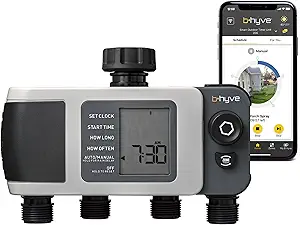 |
| Best Seller A high-volume bestseller chosen again and again | GoveeLife H5901 Smart WiFi Sprinkler Timer with Gateway (1‑Outlet) |  |
Orbit B-hyve XD 2‑Port Smart Hose Watering Timer

| Brand Name | Orbit |
|---|---|
| Item Type Name | Sprinkler Timer |
| Item Highlight | Dual Outlet Irrigation Control, App Controlled, Weatherproof |
| Number of settings | 5 |
The Orbit B-hyve XD 2-Port Smart Hose Watering Timer automates outdoor watering for two separate hose lines, letting you run independent schedules for different garden zones. It is typically attached to an outdoor faucet and either programmed directly on the device or via the B-hyve mobile app over Bluetooth, with additional remote smart features unlocked when paired to Orbit’s Wi‑Fi hub. Key features include dual outlets for simultaneous but independent watering, WeatherSense weather-based adjustments that reduce unnecessary watering, and an IPX5 weatherproof housing suited to outdoor use. In practice this means less manual watering and smarter timing that responds to rainfall and local drought alerts. The unit is battery powered for easy installation and has a simple app workflow for scheduling. Important limitations are that full remote control and some WaterSense benefits require purchasing Orbit’s separate Wi‑Fi hub, and advanced users who need multi-zone central irrigation support should consider larger zone controllers instead.
Best for: Homeowners who want a straightforward, weather-aware smart timer to automate watering for a couple of distinct garden areas without running wires or complex controllers.
Less Ideal for: People managing large, multi-zone irrigation systems or those who need built-in Wi‑Fi remote control without buying an additional hub.
- Dual independent outlets let you water two areas with separate schedules
- WeatherSense automatically adjusts run times based on local weather data
- Bluetooth app control for local programming with optional Wi‑Fi hub for remote access
- IPX5 weatherproof design suitable for outdoor installation
- Full smart, remote features require a separately sold Wi‑Fi hub
- Limited to two outlets so not ideal for larger multi-zone irrigation systems
Verdict: A practical two-outlet smart hose timer that saves water with weather-aware scheduling and easy app control for typical home gardens.
Rachio Smart Hose Timer with WiFi Hub (1 Valve + Hub)

| Included components | Smart Hose Timer Valve, WiFi Hub, Hub power supply and quick start guide |
|---|---|
| Number of settings | 3 |
| Material Type | Plastic |
| Manufacturer | Rachio |
The Rachio Smart Hose Timer replaces manual dial timers with app-based control and a small WiFi hub so you can schedule and run hose watering from anywhere. Installation is designed to be quick: attach the valve to a faucet, power the hub, and pair the valve in the Rachio app. The system supports weather-based scheduling and rain skips to avoid unnecessary runs, plus flow monitoring and low-battery alerts to flag leaks or failures. You can trigger instant watering from the valve button or the app, and expand the system by adding up to eight valves on a single hub. Practical benefits include automated, efficient watering that adapts to local conditions and remote control for precise irrigation. Limitations are that the valves require AA batteries and the hub needs a 2.4 GHz WiFi network, so it is not fully plug-and-play in locations without compatible WiFi or readily accessible batteries. The kit is focused on smart scheduling and diagnostics rather than heavy-duty commercial plumbing applications.
Best for: Gardeners who prioritize reliable, efficient irrigation and want remote, weather-aware control of hose watering for performance-driven yard care.
Less Ideal for: People without accessible 2.4 GHz WiFi at their faucet or those who prefer a fully wired or commercial-grade irrigation solution.
- App control with remote scheduling and instant run from phone
- Weather-based scheduling and rain skips reduce wasted water
- Flow monitoring and low-battery alerts help detect leaks or failures
- Expandable system supports up to eight valves per WiFi hub
- Requires a WiFi hub and 2.4 GHz network which may limit installation locations
- Valve operation depends on AA batteries that are not included
Verdict: Choose this kit if you want a performance-focused, weather-aware hose timer that gives remote control and diagnostics with room to expand.
Insoma WiFi Smart Water Timer with Brass Inlet and Outlet
| Material Type | Brass |
|---|---|
| Number of settings | 20 |
| Unit Count | 1 Count |
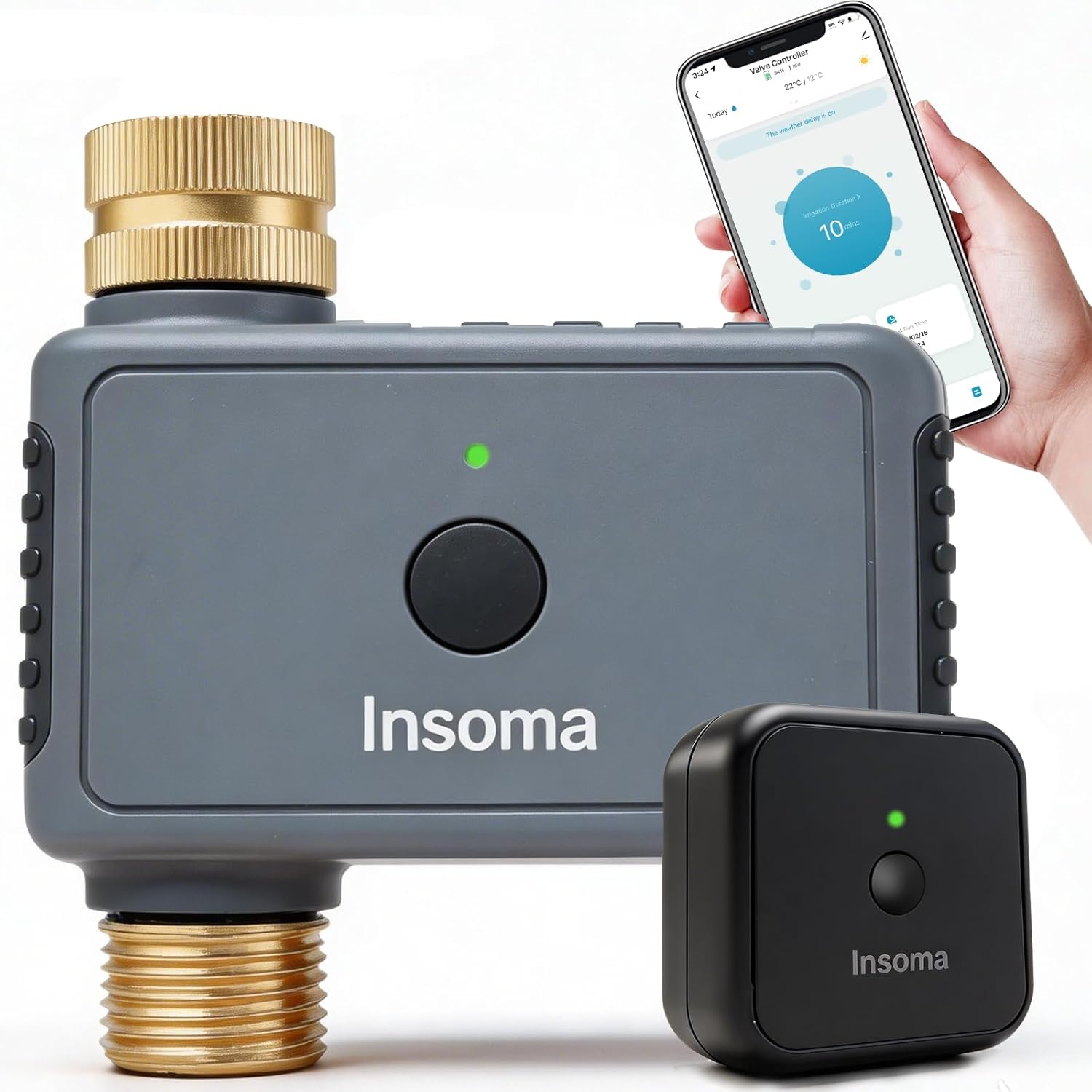
The Insoma WiFi water timer turns a standard outdoor faucet into a remotely controlled irrigation point that runs programmed schedules from the Smart Life app or via Alexa and Google Assistant. It is typically mounted at a hose bib and connected to a WiFi hub so you can create up to 20 independent programs with start times, durations and two irrigation modes for cycle or soak watering. Notable features include a brass swivel inlet and outlet with a metal filter gasket for improved thread durability and reduced debris entry, rain delay and a manual on-demand mode for spot watering. The unit supports only 2.4 GHz networks and can be managed alongside up to 32 timers from the same gateway, which makes it easy to expand across a yard. Limitations to expect are the single-zone hardware on this listing and the need to configure a separate 2.4 GHz SSID if your router defaults to dual-band naming, which may add a setup step for some users.
Best for: Gardeners who want to optimize watering with programmable schedules and remote control to save water and reduce hands-on time, and who plan incremental expansion rather than installing a full multi-zone controller.
Less Ideal for: Homeowners who need a ready-made multi-zone central controller for large automatic sprinkler systems or who cannot access a 2.4 GHz WiFi network.
- WiFi control plus Alexa and Google Assistant voice control for remote scheduling
- Brass swivel inlet and outlet with metal filter gasket for better durability and leak resistance
- Up to 20 customizable watering programs and cycle/soak modes for varied plant needs
- Rain delay and manual mode let you pause schedules and run on-demand watering
- Only supports 2.4 GHz WiFi which may require router reconfiguration
- This listing is a single-zone timer so multi-zone irrigation requires multiple units
Verdict: Use this brass-bodied WiFi timer to add reliable remote scheduling and voice control to a hose bib while easily scaling your irrigation with additional units.
GIEX Bluetooth Smart Sprinkler Timer (App-Controlled)

| Brand Name | GIEXSMART |
|---|---|
| Model Number | GX02BT |
| Number of settings | 5 |
| UPC | 752815306586 |
The GIEX Bluetooth Smart Sprinkler Timer is a basic app-controlled hose timer intended to automate small garden or lawn watering from a faucet. You set schedules in the Tuya or Smart Life app over Bluetooth and choose from up to five preset watering programs; the unit attaches to a hose with a brass inlet for increased durability at the connection. In practice it handles simple repeat schedules and short irrigation runs well and records basic water usage in its turbine meter, which helps track consumption over a seven-day period. The unit is compact and tool-free to install, making it convenient for renters or seasonal setups. Important limitations are the Bluetooth-only connectivity, which requires you to be within range of the controller to change schedules, and the limited number of programmable settings compared with higher-end Wi-Fi models. If you need remote cloud control or complex zone management, this will feel constrained, but for straightforward, low-cost automation it works as advertised.
Best for: Buyers wanting a low-cost, simple smart timer to automate a single faucet or small garden who prioritize straightforward app scheduling and easy installation.
Less Ideal for: Users who need cloud-based remote control, multi-zone irrigation, or advanced scheduling options should consider higher-end Wi-Fi or multi-valve controllers instead.
- Bluetooth app control with Tuya/Smart Life for easy scheduling
- Brass water inlet improves durability at the faucet connection
- Built-in turbine meter records short-term water usage
- Tool-free installation and compact footprint for simple setups
- Bluetooth-only connection restricts control to close range and no cloud access
- Only five programmable settings limit complex or highly customized schedules
Verdict: A straightforward, budget-friendly Bluetooth app timer that adds basic automation and durable brass connections for small garden watering needs.
Grillum Smart WiFi Bluetooth Dual-Outlet Hose Timer

| Outlets | 2 independent outlets |
|---|---|
| WiFi | 2.4 GHz |
| Battery | 4 AA batteries |
| Waterproof Rating | IP55 |
The Grillum Smart WiFi Bluetooth Dual-Outlet Hose Timer provides two independently controlled watering zones so you can run separate schedules for lawn, beds, or containers. It connects directly to a 2.4 GHz WiFi network and pairs with a smartphone app for setting up to 10 programs per outlet, choosing normal or cycle-and-soak modes, and applying rain delays when needed. Voice control via Alexa or Google Assistant adds hands-free start and stop commands. The unit is powered by four AA batteries and is built for outdoor use with a brass female thread, metal threads, an internal metal filter, and IP55 splash protection. In practice this makes it a reliable choice for routine irrigation where you need dependable schedules and basic automation without a hub. Limitations include the 2.4 GHz-only WiFi requirement and battery power rather than mains or solar, so long-term use requires periodic battery changes and placement within range of your router.
Best for: Gardeners who prioritize a dependable, low-maintenance irrigation solution for multiple zones and want simple app and voice control to automate regular watering.
Less Ideal for: Those who need wired power, advanced sensor integration, or support for 5 GHz WiFi should consider a different model.
- Two independent outlets allow separate schedules for different zones
- App control with multiple program modes and rain delay for flexible irrigation
- Works with Alexa and Google Assistant for voice operation
- Durable fittings and IP55 protection for outdoor reliability
- Only supports 2.4 GHz WiFi which can limit placement relative to the router
- Runs on four AA batteries so it requires periodic battery replacement
Verdict: A practical, reliability-focused dual-zone smart timer that automates routine watering with robust fittings and straightforward app and voice control.
Orbit B-hyve XD 4-Port Smart Hose Watering Timer
| Brand Name | Orbit |
|---|---|
| Item Type Name | Sprinkler Timer |
| Number of settings | 6 |
| Material Type | Plastic |
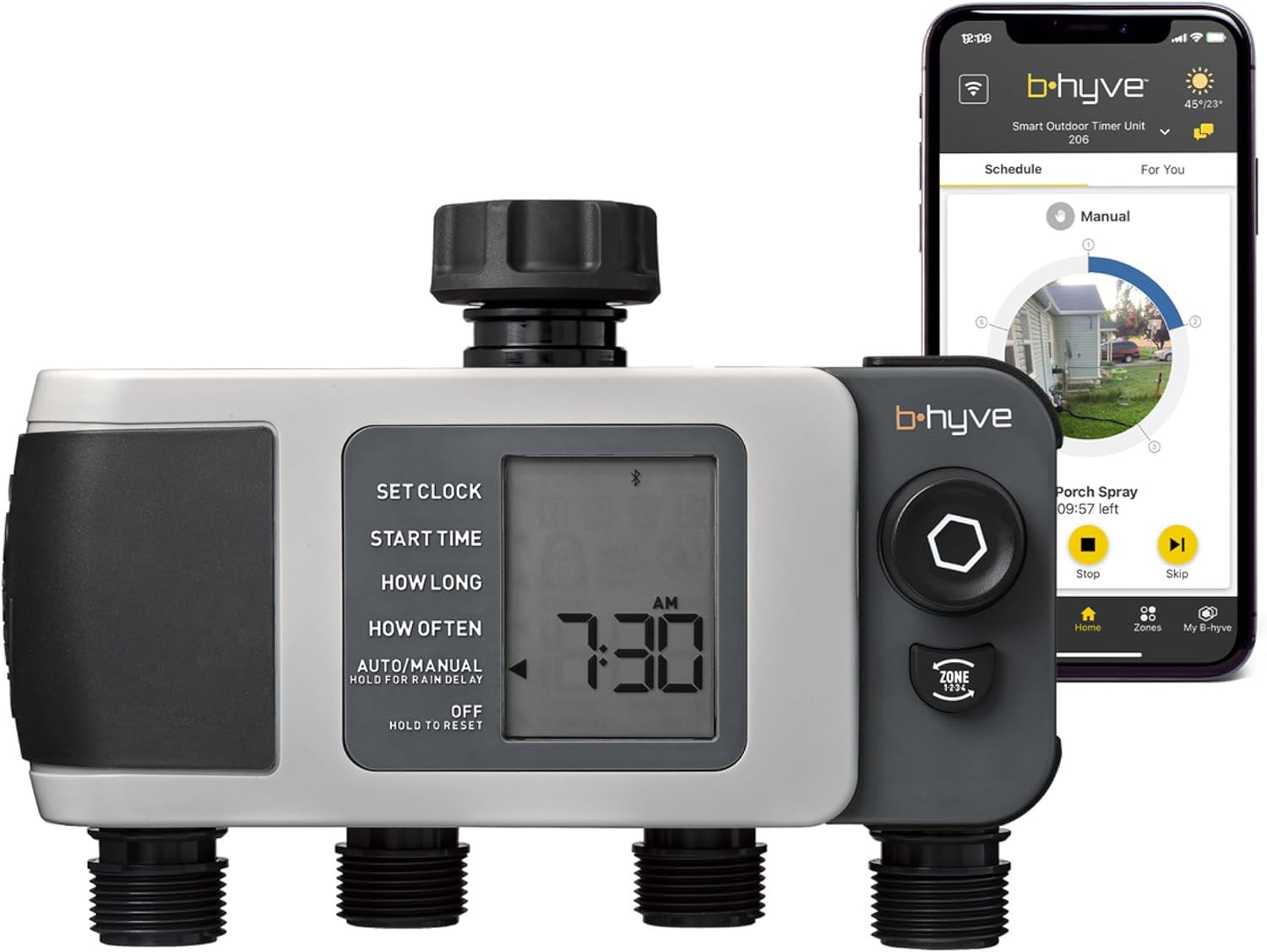
The Orbit B-hyve XD 4-Port Smart Hose Watering Timer turns a single outdoor faucet into a four-zone irrigation hub that is aimed at homeowners who want reliable, automated watering without constant fuss. Each of the four outlets can be scheduled independently using the B-hyve mobile app over Bluetooth, and the device supports remote smart functions when paired with an optional Wi-Fi hub. WeatherSense automatically adjusts watering based on local conditions and drought alerts so the system reduces overwatering during rainy or cool periods. The unit is rated IPX-5 for outdoor durability and includes a simple on-device interface for local programming when a phone is not handy. Practical benefits include consolidated control of multiple garden areas, water savings from weather-based adjustments, and straightforward Bluetooth setup for nearby control. Limitations to note are the dependency on a Wi-Fi hub for full remote/Wi-Fi features and that more advanced networked automation requires that additional accessory. For risk-averse buyers the proven brand, WeatherSense automation, and weatherproof design provide reassuring reliability for a smart sprinkler solution.
Best for: Homeowners who want a low-maintenance, dependable smart sprinkler that automates multiple garden zones and prioritizes water-efficient schedules and simplicity.
Less Ideal for: Users who need full cloud-based remote control out of the box or who require integration with wider smart-home systems without adding the Wi‑Fi hub.
- Four independently programmable outlets for separate zones
- WeatherSense adjusts schedules automatically using local weather data
- Bluetooth control with on-device programming for local access
- IPX-5 rated for outdoor use so it tolerates typical yard conditions
- Full remote Wi-Fi control requires purchasing and pairing a separate Wi‑Fi hub
Verdict: Buy this if you want a durable, water‑saving four-port smart hose timer that automates multiple zones with reliable weather-based scheduling.
GoveeLife H5901 Smart WiFi Sprinkler Timer with Gateway (1‑Outlet)

| Gateway‑device range | 1640 ft |
|---|---|
| Water pressure operating range | 7.25–116.03 PSI |
| Number of schedules | 10 |
| Watering modes | Continuous, intermittent, custom |
| Material type | Brass, Plastic |
The GoveeLife H5901 is a smart hose timer kit designed to replace a manual spigot with app-based, scheduled watering and basic water‑usage reporting. It installs on a standard 3/4‑inch threaded spigot and pairs to the included gateway so you can control the timer from anywhere within the gateway range. The system offers three watering modes (continuous, intermittent, custom) and up to 10 schedules, plus weather‑adaptive adjustments that skip rain or increase runtime in heat and low humidity. Brass inlet fittings and an IP67-rated housing aim to reduce leaks and stand up to outdoor conditions. The app shows charts of recent watering and supports Alexa and Google voice commands for hands‑free starts. Important limitations: the gateway requires 2.4 GHz Wi‑Fi, the valve needs a minimum starting pressure to operate properly, and only one outlet is controlled per timer so multi‑zone gardens require multiple units or devices.
Best for: Gardeners who prioritize reliable, data‑driven irrigation and want automated, weather‑responsive schedules controlled remotely or by voice.
Less Ideal for: People with multi‑zone irrigation needs who do not want to deploy multiple timers or those limited to 5 GHz‑only home networks.
- Weather‑adaptive scheduling that adjusts runtimes based on local rain and temperature data
- Gateway supports long range and multiple devices so you can centralize control across a property
- Brass connectors and IP67‑rated body reduce risk of leaks and stand up to outdoor exposure
- Up to 10 programmable schedules and three watering modes for flexible irrigation plans
- App provides watering charts and integrates with Alexa and Google Assistant for voice control
- Requires the separate gateway and 2.4 GHz Wi‑Fi which may limit some network setups
- Only a single water outlet per timer so larger multi‑zone systems need extra units or a different controller
Verdict: Choose this timer when you want a weather‑adaptive, remotely managed irrigation solution built for outdoor durability and centralized control.
Choosing the Right Smart Water Watering Timer: Key Factors to Consider
Battery Life and Power Options
Battery longevity determines how often you need to service the timer, which is important if the device is mounted in a hard-to-reach faucet or during winter shutoff. Some units run on AA or AAA cells, others use lithium packs or accept external power. Longer life reduces maintenance and the risk of missed cycles during vacation or hot stretches.
Consider whether the timer offers low-battery alerts or an easy way to replace cells without tools. If you plan year-round irrigation or rely on timers for containers and hanging baskets, prioritize models that advertise multi-season battery life or support external power.
Scheduling Flexibility
A useful timer supports multiple program types: daily, odd/even day schedules, interval modes, and multiple start times per day. Different plants and lawn areas require different frequencies and run times, so being forced into a single schedule often leads to overwatering or underwatering.
Look for timers that allow short-duration runs (for drippers and containers) as well as longer cycles for lawns. The ability to stack programs or temporarily suspend schedules for rain or maintenance is also valuable for real garden management.
Connection Reliability and App Control
If the product provides wireless control, connection reliability is crucial. Weak Wi-Fi or shaky Bluetooth links mean missed or late waterings. Local manual control remains important as a fallback when the network fails.
Check whether the timer stores schedules locally so it can run without the app or cloud access. App interfaces that confirm scheduled runs and show battery status reduce uncertainty. Consider how often firmware updates are pushed and whether the vendor documents connectivity requirements.
Weather Resistance and Durability
Outdoor timers face sun, rain, freezing temperatures, and hose pressure. A watertight housing and robust hose connectors help prevent leaks and corrosion. UV-stable plastics or coated metals resist cracking and degradation.
Also think about freeze protection or easy removal for winter. Devices meant to stay on the spigot year-round should have seals rated for outdoor conditions and clear IP ratings or equivalent durability descriptions.
Installation and Compatibility
A straightforward install means less time fumbling with washers, fittings, or adapters. Timers should match common faucet thread sizes and work with existing backflow preventers or pressure regulators. Some designs require tools or extra parts to attach securely.
Compatibility with your irrigation components, like multi-valve manifolds or soaker systems, matters. If you plan to integrate the timer into an automated manifold or pump system, verify the physical and electrical interfaces beforehand.
User Interface and Everyday Usability
Controls should be intuitive because many gardeners prefer quick schedule tweaks in the field. Clear displays, simple dial programming, or logical app flows make seasonal adjustments less of a chore. Features like one-touch manual watering and straightforward program copying between zones save time.
Consider how the device communicates status: visible LEDs, readable LCDs, or app notifications. If you share garden duties, look for multi-user access or simple password controls to prevent accidental changes.
How Smart Timers Change Routine Watering
Smart timers automate the repetitive work of turning water on and off and can reduce both under- and overwatering when set correctly. They let you schedule multiple start times per day, so morning and evening cycles are possible without manual intervention. In practice, this means flower beds and vegetable plots get consistent moisture when roots need it most.
Many smart timers also let you pause or override schedules quickly, which is handy during heavy rain or lawn maintenance. For gardeners who travel, robust automation maintains plant health without daily check-ins.
- Set-and-forget regular cycles for containers and drip systems
- Temporary suspension for heavy rain or frost risk
- Remote adjustments for unexpected weather
Integrating Timers with Drip and Soaker Systems
Drip and soaker setups benefit from shorter, more frequent runs that deliver water to the root zone without creating runoff. Smart timers that allow multiple short start times per day make this easy to implement. Avoid using long single runs that saturate the topsoil and cause runoff or wasted water.
When adding a timer to a multi-zone manifold, ensure the controller supports manual overrides and that the valve solenoids match expected power profiles. Some timers are meant as single-faucet controllers and need an additional irrigation controller to manage multiple zones.
- Prefer multiple short starts over single long cycles for drip
- Confirm compatibility with valve controllers before installation
- Use pressure-compensating emitters to keep runtimes consistent
Winter Care and Seasonal Storage
Smart timers can be damaged by freezing water left inside housings or connectors. If you live where temperatures drop below freezing, plan to drain and remove the unit for winter or choose a design rated for freeze resistance. Removing batteries and storing the timer indoors prevents corrosion and battery drain.
For climates with mild winters, make sure seals and gaskets remain in good condition and check for cracks at the start of the season. A quick inspection and test run before the peak watering months prevent surprises.
- Drain and store timers in freezing climates
- Inspect seals and connectors each season
- Replace batteries before peak watering months
Troubleshooting Common Setup Issues
Poor connection or missing schedule runs are often caused by weak Wi-Fi at the spigot location. Try temporary tethering, a Wi-Fi extender, or choosing a timer that uses Bluetooth with local storage. Also verify that the device firmware is current and that app permissions are granted.
Leaks typically stem from worn washers or cross-threaded fittings. Use the correct rubber washers, avoid overtightening, and rotate the body slightly during hand-tightening to seat the threads. If the timer has a removable valve adapter, inspect the O-rings for wear.
- Test signal strength before final mounting
- Keep spare washers and batteries on hand
- Run a manual cycle after installation to check for leaks
When to Choose Local Controls Over Cloud Features
Cloud-based scheduling and weather integrations are convenient, but reliance on remote servers introduces a failure point. If reliable watering is essential for a lot of plants or a remote property, prioritize a timer that stores schedules locally and can run independently of the app.
Conversely, if you want dynamic adjustments based on forecasts or seasonal programming from anywhere, a cloud-enabled timer can save water and simplify long-term changes. Balance the desire for remote features with the need for guaranteed local operation.
- Local schedules reduce failure points
- Cloud features add remote convenience and weather-based adjustments
- Choose based on how critical uninterrupted watering is
How We Chose the Best Smart Water Watering Timer
We selected products that demonstrated clear strengths on the practical dimensions gardeners care about. Key evaluation criteria included battery life and power options because frequent battery changes in seasonal setups are disruptive. We judged programmability and scheduling flexibility to ensure timers can handle multiple daily runs, odd intervals, and seasonal adjustments. Wireless connection stability and app responsiveness were measured where applicable, since unreliable links cause missed waterings. Build quality and weather resistance were assessed for outdoor longevity around faucets, valves, and hose fittings. Finally, ease of installation and everyday usability mattered because complex setup or cryptic programming undermines real-world reliability. We excluded devices that lacked clear weatherproofing specs, offered only proprietary irrigation integrations with no standard manual override, or had minimal scheduling options. Units with unclear power sources or without at least basic local controls were also omitted. The final list favors timers that balance battery life, flexible scheduling, dependable connections, and rugged outdoor design.
FAQ
Can a smart watering timer work without Wi-Fi?
Many smart timers include local schedule storage and will run programmed cycles without Wi-Fi. However, app control and remote adjustments typically require a connection. If you rely on remote changes, ensure the device maintains its settings offline.
How often should I replace the batteries in a watering timer?
Replacement frequency depends on battery type and usage. In moderate climates with daily cycles, expect to check batteries annually for alkaline cells and less often for lithium packs. Timers with battery alerts or low-power modes help extend replacement intervals.
Will a smart timer prevent overwatering during rainy periods?
Some timers have weather integrations or rain sensors that pause schedules automatically. If a device lacks these features, you can manually suspend watering. For consistent rain-based adjustments, choose a timer that supports an external sensor or forecast-based automation.
Are smart timers safe to leave on an outdoor faucet year-round?
That depends on the unit's weather resistance and your local winter conditions. Many timers are designed for year-round outdoor use if temperatures do not fall below freezing. In colder areas, it is safer to remove and store the timer during winter to avoid freeze damage.
Can a single smart timer run multiple irrigation zones?
Most single-faucet timers control one line and are best for a single zone or hose-run. To manage multiple zones, you will typically need a multi-zone controller or separate timers per zone. Verify whether the timer supports integration with valve manifolds if you plan to expand.
Final Verdict
Prioritize a Smart Water Watering Timer that matches how you water: long battery life and local schedule storage if reliability matters most, or cloud-enabled features if you value remote control and weather-based adjustments. Balance scheduling flexibility with durable outdoor construction so routines survive seasonal changes. Focus on the few criteria that will impact your daily garden tasks and choose the timer that offers the right mix of power options, programmability, and weather resistance for your site.
