

Note: This article contains affiliate links. If you click on these links and make a purchase, I may earn a small commission at no extra cost to you. This helps support my research and content. Read my full affiliate disclosure here.
Picking the right watering timer for drip irrigation changes how reliably your garden receives water. A good timer keeps regular cycles during heat spikes, avoids overwatering vulnerable seedlings, and prevents wasted runoff from slow-drip systems. In this guide we shortlisted seven top options suited specifically for drip setups and irrigation lines. The picks were evaluated for real-garden concerns like flexible scheduling, valve compatibility, and durability under outdoor conditions. Read on to understand the tradeoffs and the decision criteria behind each selection before you choose a timer for your beds or containers.
Top Picks at a Glance
| Best Overall The best all-around choice for most situations | Orbit 1-Outlet Programmable Digital Hose Watering Timer (2-Pack) |  |
| Best Quality Built to a higher standard if you want something more solid | QUOBAS Brass Programmable Hose Water Timer (WT11) |  |
| Best Value The sweet spot between price and what you get | RAINPOINT Brass Programmable Sprinkler Timer (1-Outlet) |  |
| Best Budget The cheapest option that still gets the job done reliably | Orbit Mechanical Water Timer (Model 62034) |  |
| Highest Rated A top-rated pick with lots of positive feedback | Underhill AquaZone HBT-1 Digital Hose Timer |  |
| Most Popular A crowd favorite that many people choose with confidence | Orbit Programmable Digital Hose Watering Timer (1-Outlet) |  |
| Best Seller A high-volume bestseller chosen again and again | Orbit Programmable Digital 2-Outlet Hose Watering Timer |  |
Orbit 1-Outlet Programmable Digital Hose Watering Timer (2-Pack)

| Number of Packs | 2 |
|---|---|
| Power Source | 2 AA batteries (not included) |
| Watering Duration | 1-240 minutes |
| Watering Frequency | 6 hours to 7 days |
| Rain Delay | 24, 48, or 72 hours |
The Orbit 1-Outlet Programmable Digital Hose Watering Timer converts a standard faucet into a simple programmable irrigation point and the two-pack makes it easy to cover multiple zones. You program start time, watering duration (1 to 240 minutes) and frequency (every 6 hours to once every 7 days) on the oversized LCD and dial, and the unit stores the schedule when you change batteries. Useful features include a 24/48/72-hour rain delay to avoid watering after rain and a manual button for immediate watering without disturbing the program. The timer is battery powered and water-resistant, so it mounts at an outdoor spigot without extra wiring and should tolerate routine weather exposure. Because it is a basic digital timer with a single outlet per unit, it is best for straightforward zone control rather than complex multi-valve systems or smart-home integration. If you want reliable automated watering for flower beds, containers, or small lawn zones and prefer simple, predictable programming, this Orbit pack is a practical choice.
Best for: Gardeners who want a straightforward, time-saving way to automate watering for flower beds, containers, or small lawn areas and who prioritize reliable, easy-to-use hardware over smart-home features.
Less Ideal for: Users needing multi-zone central irrigation control, remote app scheduling, or integration with weather-based smart systems should consider a multi-port or Wi-Fi-enabled controller instead.
- Programmable durations from 1 to 240 minutes and frequencies from every 6 hours to once every 7 days for flexible schedules
- Built-in rain delay (24/48/72 hours) reduces unnecessary watering after rainfall
- Large LCD and intuitive dial make programming quick and easy
- Two-pack lets you automate two separate faucet zones without buying multiples
- Single outlet per unit limits each device to one zone without additional plumbing
- No Wi-Fi or app connectivity for remote control or smart scheduling
Verdict: A reliable, no-frills dual-pack timer that automates basic watering schedules and saves time and water for small to medium garden zones.
QUOBAS Brass Programmable Hose Water Timer (WT11)

| Material Type | Brass |
|---|---|
| Battery Type | AA Alkaline |
| Pressure Rating | 8–120 PSI |
| Number of settings | 5 |
The QUOBAS WT11 is a single-valve, battery-powered hose timer built around a heavy brass inlet and outlet for reliable, leak-resistant connections to standard 3/4" faucets. You program start times, run durations from 1 to 240 minutes, and fixed frequency intervals (hourly to daily) on a clear IPX5 waterproof LCD, and it includes a 24/48/72 hour rain delay to pause cycles when needed. Typical use is as an automated controller for a drip line, soaker hose, or a single sprinkler head and it can also fill small tanks or feed pet waterers. The brass construction and 120 PSI rating make it sturdier than many plastic dial timers and better suited to higher-pressure or more-demanding outdoor setups. Limitations are that it controls only one zone and it is not Wi-Fi enabled, so multi-zone drip systems will need separate timers or a different multi-valve controller. Setup is straightforward using the knurled knob and gasket provided, and batteries last many months under normal schedules, so it is a low-maintenance way to get precise, water-saving drip irrigation on a single line.
Best for: Gardeners who prioritize durable, reliable hardware and need precise, on-site control of a single drip line or soaker hose for efficient irrigation.
Less Ideal for: People who need to manage multiple drip zones from one controller or who require remote app control and smart-home integration.
- Brass inlet and outlet for corrosion resistance and a tight, leak-resistant connection.
- Minute-resolution run times from 1–240 minutes for precise drip irrigation control.
- IPX5 waterproof LCD and controls suitable for outdoor exposure.
- Rain delay (24/48/72 hours) helps avoid unnecessary watering and saves water.
- Operates on 2 AA batteries with long expected battery life for low maintenance.
- Single-valve design only controls one watering zone at a time.
- No Wi‑Fi or app connectivity for remote scheduling or integration with smart systems.
Verdict: Choose this robust brass timer when you want precise, water-saving control of a single drip irrigation line with weather-aware scheduling.
RAINPOINT Brass Programmable Sprinkler Timer (1-Outlet)
| Material Type | Brass |
|---|---|
| Item Highlight | Programmable Water Timer for Garden Hose with Rain Delay/Manual Watering, Digital Irrigation System Kit for Lawns, 1 Outlet |
| Number of settings | 2 |
| Watering Duration | 1 min-3h59 min |
| Rain Delay | 24/48/72H |
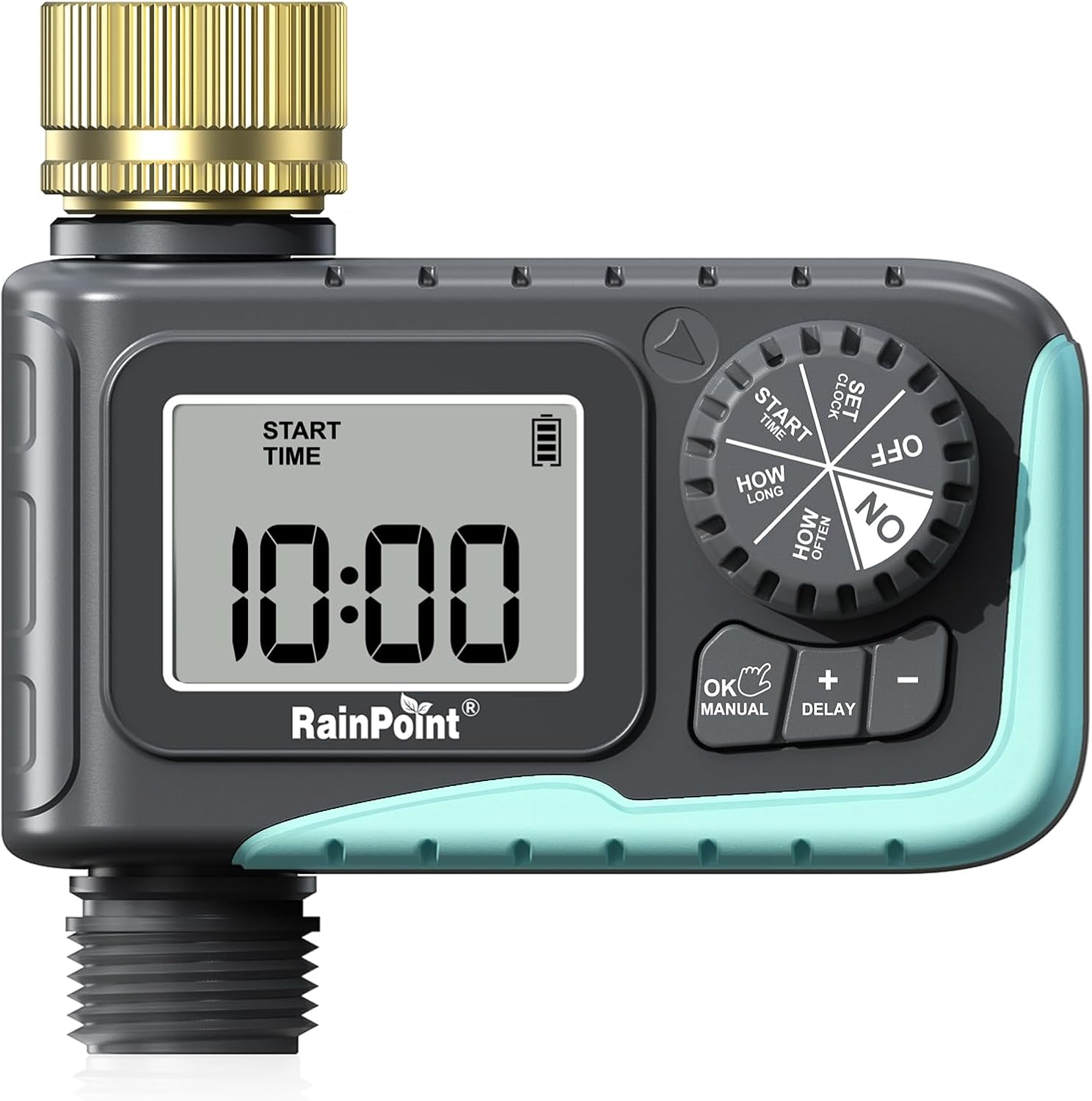
This RAINPOINT sprinkler timer turns a standard garden faucet into a programmable irrigation controller for a single zone. It mounts directly to the hose spigot and uses a large LCD to set start time, watering duration (1 minute to just under 4 hours) and frequency (every 1 hour up to every 7 days). The brass inlet and metal threads plus a built-in filter make it robust for outdoor use and help keep sediment out of drip lines or sprinklers. Useful features include a 24/48/72 hour rain delay and a manual mode with long run times for spot-watering without losing the program. Programming is straightforward and the range of duration and frequency settings covers most drip irrigation and soaker-hose needs for small lawns, raised beds and container gardens. It is limited to one outlet so you will need a splitter or a multi-zone unit for larger systems, and it appears to rely on batteries rather than Wi-Fi or app control, so you should expect local on-unit adjustments. For someone simplifying an existing drip setup this is a solid, no-frills controller with durable fittings.
Best for: Gardeners who want a durable, straightforward timer to automate a single drip or soaker zone and reduce hands-on watering without adding networked controls.
Less Ideal for: People who need multi-zone scheduling or remote app control for large landscapes should look at multi-outlet or smart Wi-Fi controllers instead.
- Pure brass inlet and metal threads for durability and resistance to outdoor wear
- Built-in metal filter gasket to reduce sediment entering irrigation lines
- Wide programmable range: start times, durations from 1 minute to 3h59m and frequencies from 1 hour to 7 days
- Rain delay (24/48/72h) and a long manual-watering mode for flexible control
- Large LCD makes schedule and settings easy to read and verify on-site
- Single outlet only so it cannot directly control multiple zones
- No mention of Wi-Fi or smart-home connectivity for remote scheduling
Verdict: A rugged, easy-to-program single-outlet timer that automates one drip or soaker zone with durable brass fittings and useful rain-delay and manual modes.
Orbit Mechanical Water Timer (Model 62034)

| Material Type | Plastic |
|---|---|
| Watering Duration | 15-120 minutes |
| Power Source | No batteries required |
| Included Components | Timer |
The Orbit Mechanical Water Timer is a simple, reliable hose faucet timer that works like an egg timer: twist the oversized dial to set watering from 15 to 120 minutes and the clockwork mechanism shuts the water off when the time is up. It installs directly on an outdoor faucet with a swivel coupling for quick hose connection and includes a manual bypass so you can water without removing the unit. Because it is fully mechanical there are no batteries or electronics to fail, which makes it low maintenance and dependable for routine lawn or garden watering. The clear, easy-grip dial is usable with wet or gloved hands, and the plastic housing is rust-proof for outdoor use. Limitations are its single fixed-duration runs and lack of programmable schedules or remote control, so it is best for straightforward tasks like run-once lawn watering, filling a watering can, or timed sprinkler sessions rather than automated multi-day schedules.
Best for: Buyers who want a low-cost, low-maintenance way to time single watering sessions for lawns or garden beds and prefer a straightforward mechanical solution over smart features.
Less Ideal for: Users who need multi-day automated schedules, app control, or multiple zone programming should consider programmable or smart timers instead.
- Battery-free mechanical operation eliminates the need for replacements or electronics maintenance
- Oversized, easy-grip dial that is usable with wet or gloved hands
- Manual bypass allows instant faucet use without removing the timer
- Swivel coupling for quick and secure hose and faucet connection
- Not programmable for recurring schedules or multiple daily runs
- No remote, app, or smart connectivity for off-site control
Verdict: Choose this if you want an inexpensive, maintenance-free mechanical timer that reliably times single watering runs without batteries or electronics.
Underhill AquaZone HBT-1 Digital Hose Timer

| Number of settings | 5 |
|---|---|
| Battery Life | 12 months |
| Material Type | Plastic |
| Manufacturer Warranty Description | 2 year warranty. |
The Underhill AquaZone HBT-1 is a straightforward digital hose timer built for homeowners who want dependable automatic watering without a steep learning curve. It attaches to a standard faucet and lets you program multiple start times, day-by-day control, rain delay and a child-lock mode via a large LCD. The unit is designed for outdoor use with rugged plastic housing and brass fittings at the connection points, and its feature set includes automatic valve clean to help reduce clogging for drip systems. Practical benefits include consistent, hands-off irrigation to prevent overwatering and simple conservation controls for lawns, beds and vegetable gardens. Battery life is listed around 12 months so maintenance is minimal, but programming options are limited to five preset settings and the interface is less advanced than multi-zone irrigation controllers. For single-zone home use this model offers strong reliability and useful protection features, while users needing advanced multi-valve scheduling should consider a dedicated controller instead.
Best for: Homeowners who want a reliable, low-maintenance automatic timer for a single faucet, sprinkler or drip line and who prioritize consistent, worry-free watering over multi-zone complexity.
Less Ideal for: Gardeners managing multiple irrigation zones or requiring advanced, multi-valve programming should look at a multi-station irrigation controller instead.
- Large, easy-to-read LCD simplifies programming and status checks
- Multiple start times, independent day control and rain delay enable precise watering schedules
- Durable outdoor design with brass fittings for reliable faucet connection
- Automatic valve clean helps reduce clogging for drip systems
- Long battery life reduces maintenance
- Limited to single-zone operation so not suitable for multi-valve irrigation systems
- Only five programmable settings may restrict complex schedules
Verdict: A sturdy, easy-to-program single-zone hose timer that delivers reliable, low-maintenance automatic watering for most home gardens.
Orbit Programmable Digital Hose Watering Timer (1-Outlet)

| Power Source | 2 AA batteries (not included) |
|---|---|
| Watering Duration | 1-240 minutes |
| Watering Frequency | Every 6 hours to once every 7 days |
| Rain Delay | 24, 48, or 72 hours |
The Orbit programmable digital hose timer converts a standard outdoor faucet into a simple, dependable automated watering station. You program start times, watering duration (1 to 240 minutes) and frequency (every 6 hours up to once every 7 days) on the oversized LCD and single dial, then let it run the schedule. Useful features include a manual water button for instant watering without reprogramming and a 24/48/72-hour rain delay to pause cycles after rainfall. The unit is water-resistant for outdoor use and runs on two AA batteries, making placement flexible where no power is available. Practical benefits are consistent, repeatable watering for lawns, beds, and containers and measurable water savings by avoiding overwatering. The main limitations are that it is a basic non-networked timer with only one outlet and no remote or app control, so managing multiple zones requires additional units and on-site programming for changes.
Best for: Buyers who prioritize a proven, straightforward timer with clear on-device controls and want reliable automated watering without needing smart-home features.
Less Ideal for: Gardeners who want central control of multiple zones or remote app scheduling should consider multi-outlet or smart Wi‑Fi-enabled controllers instead.
- Wide watering duration range (1–240 minutes) for flexible run times
- Clear, oversized LCD and single-dial controls for easy programming
- Built-in rain delay and manual watering button to conserve water and handle exceptions
- Water-resistant construction suitable for outdoor faucet mounting
- Battery power allows installation without external power source
- Single outlet only so multiple watering zones need extra timers or splitters
- No Wi-Fi or app control for remote scheduling or notifications
- Plastic construction may feel less durable than metal alternatives
Verdict: A dependable, easy-to-program single-outlet timer that saves water and removes guesswork when you want reliable on-site automation without smart features.
Orbit Programmable Digital 2-Outlet Hose Watering Timer

| Item Type Name | 2-Outlet Hose Timer |
|---|---|
| Power Source | Battery powered (2 AA recommended) |
| Watering Duration | 1 to 240 minutes |
| Watering Frequency | Every 6 hours to once every 7 days |
| Rain Delay | 24, 48, or 72 hours |
The Orbit Programmable Digital 2-Outlet Hose Watering Timer converts a standard outdoor faucet into a simple, reliable automated irrigation controller for lawns, garden beds, and containers. You program run time (1 to 240 minutes) and frequency (every 6 hours to once every 7 days) using the oversized LCD and intuitive dial, and the unit supports instant manual watering without reprogramming. A built-in rain delay (24, 48, or 72 hours) helps avoid unnecessary cycles after rain. The dual outlets let you run two hoses or zones from one faucet, which is handy for mixing a sprinkler and a drip line. Being battery powered and water-resistant makes it easy to mount at the spigot and use season after season, and Orbit backs it with a multi-year warranty. Limitations are that it is not app- or Wi-Fi-enabled, so scheduling must be done on the device rather than remotely, and advanced smart features like weather-based adjustments are not available on this model.
Best for: Homeowners who want a straightforward, dependable way to automate routine watering with minimal setup and hands-on management. It appeals to buyers who prioritize reliability and simple local controls over connectivity.
Less Ideal for: Users who need remote app control, integration with smart-home systems, or automated weather-based adjustments should consider a smart-enabled timer instead.
- Dual outlets allow two independent hoses or zones from one faucet for flexible watering
- Large, easy-to-read LCD and simple controls make programming quick and accessible
- Wide range of duration and frequency settings for most garden and lawn needs
- Built-in rain delay and manual watering option conserve water and simplify seasonal changes
- Water-resistant, battery-powered design is easy to install and suitable for outdoor use
- No smartphone app, Wi-Fi, or remote control functionality for off-site scheduling
- Does not include advanced weather-based or soil-moisture automation
Verdict: A dependable, easy-to-program dual-outlet timer that simplifies regular watering and conserves water without the complexity of smart features.
Choosing the Right Watering Timer for Drip Irrigation: Key Factors to Consider
Scheduling Flexibility
How many start times and on/off cycles a timer supports matters because drip irrigation often benefits from several short runs per day instead of one long soak. Timers that allow multiple start events and custom durations let you tailor runs for seedlings, established shrubs, and heat waves.
A unit with fine-grained scheduling also helps manage seasonal changes without reworking the irrigation layout. Look for options that support different schedules by day of week, interval scheduling, and multiple daily events so you can adapt to soil type and plant water needs.
Valve and Connector Compatibility
Drip systems use a mix of hose-threaded fittings, inline controllers, and 24VAC solenoid valves. Make sure a timer can interface cleanly with the components in your system to avoid retrofit headaches.
Adapters are sometimes available but add failure points. If you run a multi-zone manifold with solenoid valves, choose a controller that supports valve activation or can switch a pump relay. For backyard hose-fed drip, standard hose-thread outlets and adapter options are usually sufficient.
Weather Resistance and Housing Durability
Timers mounted outdoors face sun, rain, and temperature swings. Robust housing with good gaskets and UV-tolerant plastics prolongs life and preserves internal electronics.
Consider how and where you will mount the controller. Units rated for direct exposure are ideal for exposed beds; if you plan to keep the timer under a faucet or covered junction box, less rugged options may still work. Also check for corrosion-resistant connectors and clear weatherproofing around battery compartments.
Leak Resistance and Shutoff Reliability
A leaking timer or one that fails to fully close can create soggy spots and wasted water. Mechanical valves and solenoid-driven shutoffs behave differently, so select a controller type matched to your plumbing.
Assess how the device seals at connections and whether the internal valve design provides positive shutoff. For drip lines where low flow is critical, even small drips matter. Reliable sealing preserves plant health and reduces maintenance.
Power Options and Battery Life
Timers run on batteries, low-voltage wiring, or mains power through adapters. Battery-powered models offer easy placement but require periodic replacement; long battery life and low-power clock retention are practical advantages.
Wired options avoid battery maintenance but need safe outdoor cabling and sometimes a low-voltage transformer. If you rely on batteries, choose units with clear low-battery alerts and easy access to change cells without disturbing plumbing.
Installing a Timer on an Existing Drip Line
Installing a timer on an existing drip line starts with identifying a convenient, accessible location near the system manifold or the faucet that feeds the tubing. If your system uses multiple solenoid valves, determine whether a single-station timer is enough or if you need a multi-station controller to manage separate zones.
- Turn water off and depressurize the line before disconnecting fittings.
- Use thread tape on hose-thread connections to improve sealing.
- Mount battery-powered controllers where you can reach them without disturbing irrigation tubing.
Programming Practical Schedules for Drip Systems
Drip irrigation generally benefits from short, frequent runs rather than long saturations. For most soils, two to three brief cycles in the morning and one in the evening can keep moisture consistent without overwatering. Sandier soils may need more frequent short events, while heavy clay needs fewer, longer events to avoid surface runoff.
Programming tips include staggering start times across zones to avoid pressure drops and grouping similar plant water needs on the same schedule. Test a new schedule for a week and inspect soil moisture and plant response before committing to seasonal changes.
- Use multiple daily starts for shallow-rooted plants.
- Stagger zone starts to maintain consistent pressure.
- Adjust durations seasonally rather than daily for stability.
Mounting and Weatherproofing Best Practices
Even with weather-rated housings, modest additional protection extends control life. Mount controllers under eaves or on a covered post if possible, and orient connectors downward to shed water. Avoid locations where sprinklers spray directly at the unit.
If you install the timer in a small enclosure, ensure ventilation to prevent heat buildup and check battery compartments regularly for corrosion.
- Place timers out of direct sprinkler spray.
- Orient fittings downward to reduce water ingress.
- Inspect seals annually and replace worn gaskets.
Integrating Timers with Pumps and Pressure Regulators
If your drip system uses a pump, confirm the timer can switch the pump relay or trigger a low-voltage transformer safely. Some controllers include a pump master terminal or relay output to prevent dry-running and pressure spikes. Pressure regulation is essential for drip systems, so place pressure regulators upstream of emitters and ensure the timer does not open multiple zones at once if that would exceed pump capacity.
If using a gravity or rainwater-fed system, account for variable pressure in programming and avoid long simultaneous runs that drop flow below emitter thresholds.
- Use a pump-start relay if the controller does not have pump output.
- Always install a pressure regulator and filter upstream of drip lines.
- Avoid opening too many zones simultaneously on a single pump.
How We Chose the Best Watering Timer for Drip Irrigation
We focused on features and performance characteristics that matter when controlling low-pressure drip systems and microirrigation. Key evaluation criteria included scheduling flexibility, which covers the range of start times, multiple on/off cycles per day, and support for odd intervals that drip systems often use. Valve and connection compatibility checked whether a timer works with common solenoid valves, inline drip controllers, and standard garden hose threads. We measured durability factors such as weather sealing and UV-resistant materials because controllers are often exposed to sun and rain. Leak resistance and reliable flow shutoff were assessed conceptually to ensure timers do not allow slow weeps that can flood drip tubing or cause uneven zones. Power options were compared, including battery life and low-voltage compatibility for wired installations. Ease of programming and clarity of the interface were considered since simple, mistake-proof controls reduce mis-scheduled irrigation events. We excluded devices designed only for high-pressure spray irrigation, decorative indoor plant pots, or timers lacking the ability to run multiple daily start times. Units without clear documentation of outdoor rating or valve compatibility were also omitted.
FAQ
Can I use a watering timer with any drip emitter or tubing?
Often, yes for most hose-fed drip systems. Compatibility depends on the connection type and whether the timer supports the pressure and flow characteristics of your emitters. Inline solenoid valves and standard hose-thread controllers work with most common tubing and emitters, but confirm fittings match or that simple adapters are available.
How many start times per day do I need for drip irrigation?
It depends on soil and plants. Many gardeners use two to three short runs daily for shallow-rooted plants and one longer run for deep-rooted shrubs. Soils and seasonal needs determine exact frequency; timers that offer multiple daily starts give you flexibility.
Do battery-powered timers perform well year-round?
Battery-powered timers are convenient and perform well if you use quality cells and monitor battery status. Cold weather can reduce battery life, so check and replace batteries before the growing season or use a wired power option if maintenance is a concern.
Will a timer prevent leaks in my drip system?
A timer controls when water flows but will not fix existing leaks. Choose a timer with good shutoff reliability and weatherproof connections to reduce the chance of drips at the controller. Regularly inspect tubing, fittings, and emitter seals to catch leaks early.
Can smart or app-based timers work with my drip system?
Smart timers can work effectively if they expose the needed scheduling features and support your valve or pump setup. Ensure the smart controller offers the same multi-start and duration controls you need, and confirm outdoor reliability and power options before relying on remote scheduling.
Final Verdict
Prioritize scheduling flexibility, reliable shutoff, and compatibility with your valves and tubing when choosing a watering timer for drip irrigation. Durable weatherproofing and appropriate power options reduce maintenance and help the controller survive seasonal exposure. Balance the number of zones and daily starts you need with the unit's ability to interface with pumps or solenoids. Focus on the specific tradeoffs that matter in your garden – ease of programming versus advanced automation, battery convenience versus wired reliability – and pick the option that matches how you actually water.
