

Note: This article contains affiliate links. If you click on these links and make a purchase, I may earn a small commission at no extra cost to you. This helps support my research and content. Read my full affiliate disclosure here.
Finding the right insecticide for flying insects matters when you want quick relief without harming beneficials or plants. Whether you are defending a patio, greenhouse, or indoor living space, product choice affects how fast flies, gnats, and mosquitoes fall and how long protection lasts. This guide covers six top shortlisted insecticides for flying insects and explains the practical tradeoffs gardeners and homeowners should expect. We evaluated products for knockdown speed, residual coverage, application flexibility, and safety around people and plants. Read on for the criteria used and practical guidance to match a formula to your situation.
Top Picks at a Glance
| Best Overall The best all-around choice for most situations | Atticus Talak 7.9% Bifenthrin Indoor/Outdoor Insecticide Concentrate, 32 oz |  |
| Best Quality Built to a higher standard if you want something more solid | BASF Alpine WSG Water-Soluble Insecticide Granules (Dinotefuran 40%) |  |
| Best Value The sweet spot between price and what you get | HOT SHOT Flying Insect Killer Aerosol, 15 fl oz (3 pack) |  |
| Best Budget The cheapest option that still gets the job done reliably | STEM Plant-Based Bug Spray for Flies, Mosquitoes & Gnats, 10 oz |  |
| Highest Rated A top-rated pick with lots of positive feedback | Talstar One Insecticide Concentrate, 1 Gallon |  |
| Most Popular A crowd favorite that many people choose with confidence | Ortho Home Defense Insect Killer for Indoor & Perimeter, 1.33 gal. with Comfort Wand |  |
Atticus Talak 7.9% Bifenthrin Indoor/Outdoor Insecticide Concentrate, 32 oz

| Active Ingredient | Bifenthrin |
|---|---|
| Formulation | Suspension Concentrate |
| Liquid Volume | 32 fluid ounces |
| Length of Control | Up to three months |
| Target Species | Insects |
Talak 7.9% is a liquid concentrate for treating lawns, landscaping, outdoor living areas and indoor perimeter spots like baseboards and cabinets. You dilute the concentrate with water to create a spray for barrier treatments, spot applications or lawn mixes; label rates explain how much to mix per gallon depending on the use. The product uses bifenthrin, a proven broad-spectrum active ingredient, and the manufacturer states it controls over 75 species and can give residual control for as long as three months. Its water-based formula dries clear, leaves no odor or visible residue, and is not phytotoxic on plants when used per label. Practical benefits include flexible indoor and outdoor use, clear drying, and a bottle designed for easier pouring. Important limitations are that solutions should be mixed only for same-day use, it is not registered for sale in a few states, and it is not approved for fogger application, so professional-style misting methods are not appropriate.
Best for: Buyers who want a single, reliable product to protect yards, patios and building perimeters from a wide range of common pests and prefer conservative, label-driven application practices.
Less Ideal for: People seeking ready-to-use sprays or fogger-compatible products or those in states where this formulation is not registered should look at alternatives.
- Broad-spectrum control listed for 75+ indoor and outdoor pest species
- Water-based formula that dries clear and leaves no odor or residue
- Flexible label directions for lawns, landscapes, hardscapes and indoor perimeter treatments
- Long residual activity up to three months when applied at recommended rates
- Mixed spray solutions cannot be stored and must be used the same day
- Not approved for fogger application and not available for sale in some states
Verdict: A versatile, water-based bifenthrin concentrate that delivers long-lasting, broad-spectrum outdoor (and perimeter indoor) control when used according to the label.
BASF Alpine WSG Water-Soluble Insecticide Granules (Dinotefuran 40%)

| Item Form | Granules |
|---|---|
| Target Species | Ants, cockroaches, bed bugs, beetles, fleas, flies, mosquitoes |
| Active Ingredients | Dinotefuran 40% |
| Specification Met | EPA |
BASF Alpine WSG is a concentrated water-soluble granule insecticide designed for fast, broad-spectrum control of ants, cockroaches, bed bugs, flies, mosquitoes and other common pests. The granules dissolve into a clear spray solution for targeted treatments around foundations, garages, attics, eaves, patios and other indoor or outdoor sites. Notable features include a high concentration of dinotefuran (40%) and reduced-risk EPA status for public health and food-handling settings. In practical use one gallon of finished dilution treats about 1,000 square feet, so small sachets can cover multiple spot treatments when mixed properly. Benefits include quick knockdown, non-repellent action that helps insects pick up and transfer the active ingredient, and an odorless, nonstaining finished solution when used as directed. Important limitations are that it is a pesticide requiring careful adherence to label directions, attention to pollinator safety and potential state restrictions, and it is not a ready-to-use spray so users need proper measuring and sprayer equipment.
Best for: Best for homeowners or pros who prioritize fast, effective chemical control of a broad range of pests and are comfortable mixing and applying concentrated formulations safely.
Less Ideal for: Not a good choice for gardeners seeking organic or nonchemical options or for casual users who prefer ready-to-use sprays without measuring and mixing.
- High-concentration active ingredient (Dinotefuran 40%) for rapid pest knockdown
- Water-soluble granules mix into a clear, nonstaining spray for versatile indoor and outdoor use
- Reduced-risk EPA designation suitable for public health and food-handling areas
- Effective against a wide range of pests including ants, cockroaches, bed bugs and mosquitoes
- Requires mixing and application equipment rather than being ready-to-use
- Must follow label restrictions to protect pollinators and comply with state rules
Verdict: Choose Alpine WSG when you need a concentrated, fast-acting professional-grade solution for broad indoor and outdoor pest control.
HOT SHOT Flying Insect Killer Aerosol, 15 fl oz (3 pack)
| Unit Count | 45 Ounce |
|---|---|
| Included Components | 15 Fl Oz (3 Pack) |
| Item Form | Aerosol |
| Target Species | Insects |
| Active Ingredients | Permethrin (0.15%), Tetramethrin (0.15%) |
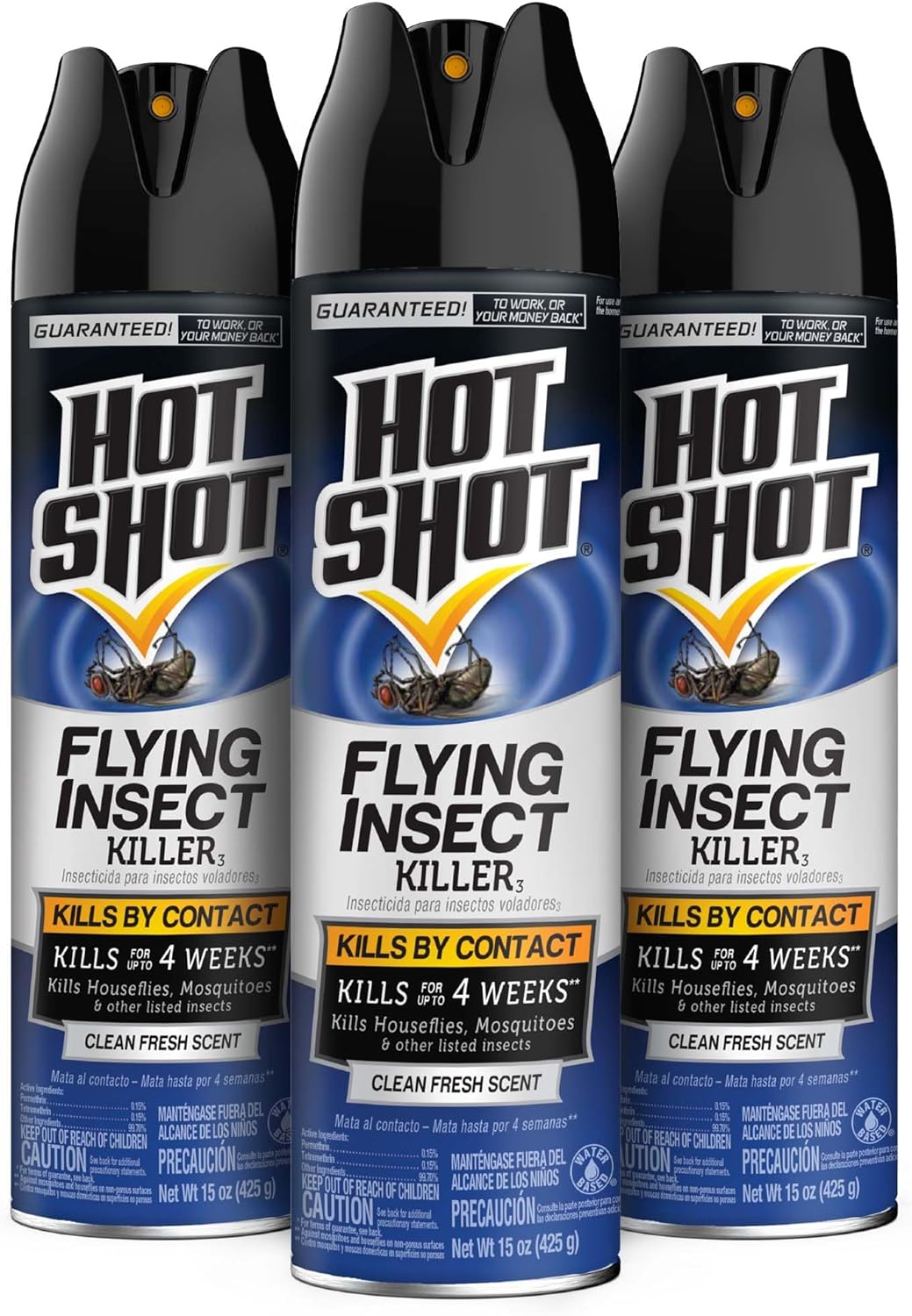
This HOT SHOT aerosol comes as a three-pack of 15 fl oz cans and is formulated to kill houseflies, mosquitoes and other listed flying insects by direct contact. You can use it indoors as a space spray to quickly knock down flies, gnats and moths by filling a room with mist and ventilating after 15 minutes, or apply it directly to nests, rafters and door frames outdoors where insects congregate. The formula lists permethrin and tetramethrin as active ingredients and the label says it leaves a clean, fresh scent rather than a strong chemical odor. Practical features include both immediate knockdown and a residual effect on nonporous surfaces for up to four weeks against certain pests, plus clear directions for timed room treatment and spot application. Important limitations are typical for pressurized aerosols: it is toxic to fish and should not be used near water, and precautions are needed to avoid skin contact and exposure to heat or flames. It is best used as a targeted control for nuisance flying insects rather than a broad landscape or aquatic application.
Best for: Buyers who want a convenient, ready-to-use spray for quick knockdown and short-term residual control of common indoor and porch/entryway flying pests.
Less Ideal for: People who need year-round landscape-wide pest control, aquatically sensitive sites, or low-toxicity solutions for homes with fish or heavily exposed outdoor wildlife should consider alternative methods.
- Kills a wide range of common flying nuisance insects on contact
- Provides residual control on nonporous surfaces for up to four weeks against mosquitoes and houseflies
- Clear label directions for indoor space-spray and targeted outdoor applications
- Aerosol format delivers quick knockdown and convenient spot treatment
- Contains pyrethroid active ingredients and is toxic to aquatic life
- Pressurized cans require careful storage and cannot be used near heat or open flame
Verdict: A practical, ready-to-use aerosol for fast knockdown and short-term residual control of common flying nuisance insects around the home.
STEM Plant-Based Bug Spray for Flies, Mosquitoes & Gnats, 10 oz

| Net volume | 10 oz |
|---|---|
| Active ingredients | Geraniol 1.47%, Lemongrass oil 0.10% |
| Intended use | Indoor and outdoor spot treatment |
STEM's 10 oz aerosol bug spray is a plant-based insecticide formulated to kill flies, mosquitoes and gnats around the home and patio. You use it like most aerosols: shake well, hold the nozzle 6–12 inches from target areas or visible insects, and mist surfaces or airspace where flying pests congregate. Notable features include geraniol and lemongrass oil as the active ingredients, no added dyes or harsh chemical odors, and directions that allow both indoor and outdoor spot treatments. In practice it is convenient for quick spot kills and temporary control around doorways, windowsills, potted areas and patios. Because it is formulated for people- and pet-occupied spaces when used as directed, it is a reasonable option for households that prefer botanical actives. Limitations are typical for short‑acting aerosols: protection is not long lasting so repeat applications are needed after rain or cleaning, and it is not for direct application to people, pets or edible plants.
Best for: Buyers who want an affordable, plant-based aerosol for quick spot control of gnats and other flying pests around living spaces and patios.
Less Ideal for: People seeking season-long residual protection or professional-grade control should consider products with longer-lasting actives or different application formats.
- Uses plant-based active ingredients (geraniol and lemongrass oil) rather than harsh synthetic chemicals
- Formulated for both indoor and outdoor spot treatments when used as directed
- No added dye or strong chemical fragrance, making indoor use less obtrusive
- Entomologist-tested formulation and clear directions for application
- Effect is short lived compared with long‑lasting residual insecticides
- Not intended for direct use on people, pets or edible plants
Verdict: A budget-friendly, plant-based aerosol that delivers fast, convenient knockdown of gnats and other flying pests for short-term control.
Talstar One Insecticide Concentrate, 1 Gallon

| Active ingredient | Bifenthrin 7.9% |
|---|---|
| Formulation | Concentrate, water-based |
| Coverage intent | Perimeter and structural applications |
| Pest range | Controls 75+ pests including ticks |
Talstar One is a professional-strength bifenthrin concentrate designed to provide broad-spectrum control of ants, spiders, roaches, fleas, ticks, mosquitoes, and many other pests. You mix the concentrate with water and apply it as a perimeter spray around foundations, doors, and windows or to targeted cracks and crevices indoors. Notable features include a water-based, low-odor formula that dries clear and a residual effect that reduces the need for frequent reapplications on lawns, ornamentals, shrubs, and structural surfaces. For yards with tick pressure, treating perimeters and vegetation provides a dependable barrier that helps reduce tick encounters when applied according to label directions. The product is concentrated so one gallon treats large areas, which makes it efficient for seasonal maintenance across multiple structures. Important limitations are that it is a pesticide that requires careful handling and strict adherence to label rates and application restrictions, and it is not a ready-to-use spray so you will need appropriate mixing and application equipment for safe, effective coverage.
Best for: Buyers who prioritize reliable, residual pest control for yards and perimeters and who are comfortable using concentrated pesticides with proper safety practices.
Less Ideal for: Casual users who want a ready-to-use product or those unwilling to follow pesticide label precautions and use appropriate application equipment.
- Broad-spectrum control that includes ticks and common yard pests
- Concentrated formula covers large areas and is cost-efficient for seasonal treatments
- Water-based, low-odor formula dries clear and is suitable for outdoor living spaces
- Suitable for both perimeter and targeted indoor/structural applications
- Concentrate requires proper mixing and application equipment for safe use
- Contains bifenthrin so users must follow label precautions to protect people, pets, and beneficial insects
Verdict: Choose Talstar One when you need a concentrated, long-lasting perimeter treatment that reliably reduces tick pressure across yards and structures.
Ortho Home Defense Insect Killer for Indoor & Perimeter, 1.33 gal. with Comfort Wand

| Item Form | Spray |
|---|---|
| Target Species | Insects |
| Liquid Volume | 1.33 gallons |
| Active Ingredients | Bifenthrin 0.05%, Zeta-Cypermethrin 0.0125% |
This 1.33 gallon Ortho Home Defense spray is designed to treat both indoor problem spots and the outdoor perimeter of a home to reduce ants, roaches, spiders and many other crawling and flying insects. It comes with a battery-powered Comfort Wand that delivers a continuous spray so you can apply a uniform band around foundations, patios and entry points without bending or pumping. The formula with bifenthrin and zeta-cypermethrin is intended to kill on contact and establish a barrier that the manufacturer says lasts up to 12 months for ants, roaches and spiders on non-porous indoor surfaces. In real-world use that means fewer repeat treatments in busy yard perimeters and around doors and windows. The spray dries clear with minimal fumes which helps for indoor use near kitchens and living areas. Limitations are that this is a chemical insecticide so users should follow safety directions around children, pets and plants and it is not a specific solution for pests not listed on the label. For homeowners focused on strong, perimeter-level protection this product simplifies application and covers a large area per container.
Best for: Homeowners who want a performance-focused perimeter treatment to reduce recurring yard and entry-point insect problems and prefer a ready-to-use product that is easy to apply.
Less Ideal for: People seeking organic or non-chemical control methods or those who need a targeted solution for pests not listed on the label should consider alternative products.
- Includes battery-powered Comfort Wand for continuous, fatigue-free application
- Ready-to-use 1.33 gallon container covers large perimeters without mixing
- Formula creates a barrier claimed to provide up to 12 months protection against ants, roaches and spiders on non-porous indoor surfaces
- Dries clear and gives off minimal fumes, making indoor use more practical
- Contains synthetic insecticides so precautions are required around children, pets and ornamentals
- Protection claims are specific to certain species and surfaces so results vary by pest and conditions
Verdict: A powerful, ready-to-use perimeter and indoor spray for homeowners who want long-lasting, performance-oriented protection against common yard and household insects.
Choosing the Right Insecticide for Flying Insects: Key Factors to Consider
Knockdown Speed and Initial Efficacy
Fast knockdown matters when flying insects are an immediate nuisance or when infestations risk spreading disease. A product that immobilizes or kills quickly reduces visible insect activity and lowers the chance of more insects moving into treated areas.
Look for active ingredients known for rapid action against flying pests, and follow label rates for spot treatments versus broadcast applications. Faster-acting formulas often need precise application to avoid overuse, so balance urgency with adherence to directions.
Residual Coverage and Duration
Residual coverage determines how long treated surfaces continue to repel or kill incoming insects, which affects how often you need to reapply. Longer residual action reduces labor and repeat disturbance, useful for patios, eaves, and greenhouse interior surfaces.
Residual duration can vary with formulation, exposure to rain and sunlight, and surface type. Porous surfaces and heavy rainfall shorten residual efficacy, while protected or indoor surfaces preserve activity longer. Consider expected weather and where you will treat when choosing a product.
Application Method and Versatility
Different situations call for sprays, foggers, baits, or concentrates. A versatile product that supports both targeted spot treatments and broader barrier applications gives you more options across patios, screens, and plant beds.
Check whether the formulation can be used indoors, outdoors under covered areas, or applied to vegetation. Some insecticides require special equipment for fogging or misting, while others are ready-to-use sprayers. Match method to the area size and access.
Safety for People, Pets, and Beneficials
Safety is a top concern when treating spaces used by people, children, or pets and when working near pollinators. Read label precautions carefully, including re-entry intervals, pet exposure guidance, and restrictions on flowering plants that attract beneficial insects.
Products differ in toxicity and required protective equipment. Choose lower-risk options or restrict applications to times when pollinators are absent. Proper storage and handling reduce accidental exposure and environmental contamination.
Plant Compatibility and Phytotoxicity
Not all insecticides are safe on all plants. Some formulations can burn foliage, damage blooms, or impair fruit set, especially under hot sun or when applied to tender new growth.
Confirm label directions for use on ornamental plants, edibles, and greenhouse crops. Timing applications for cooler parts of the day and avoiding treatment during plant stress reduces the chance of phytotoxic effects.
Label Clarity and Practical Instructions
A clear, comprehensive label matters for safe and effective use. Good labels spell out where and how to apply, required personal protective equipment, mixing instructions, and environmental precautions.
Products with concise, readable directions help gardeners apply correct rates and choose appropriate application timing. Labels that explain restrictions for pollinators and provide re-entry and pre-harvest intervals are easier to use responsibly.
Matching Active Ingredients to Target Insects
Active ingredients determine what flying insects the product will reliably control and how it behaves in the environment. Pyrethroids, pyrethrins, and certain botanicals differ in speed and residual activity. Choose an ingredient class based on whether you need immediate knockdown, short-term control, or longer-lasting barrier protection.
When you know the primary pest species present, select a formulation with demonstrated activity against that group. For mixed pest pressure, look for broad-spectrum options that still allow careful timing to protect beneficial insects.
- Pyrethrins often act quickly but degrade faster outdoors.
- Synthetic pyrethroids typically offer longer residual control on surfaces.
- Botanical options may be less persistent but are sometimes preferred near pollinators.
Application Timing and Weather Considerations
Timing applications to minimize wash-off and exposure to pollinators improves both efficacy and safety. For outdoor treatments, apply during calm, dry periods and avoid forecasted rain for at least 24 to 48 hours depending on product directions.
Early morning or evening applications reduce direct exposure of pollinators and lower the chance of sun-induced plant stress. For indoor or covered spaces, follow ventilation guidance to reduce inhalation risk.
- Avoid applying to blooming plants during daytime when bees are active.
- Reschedule treatments if heavy rain or irrigation is imminent.
Using Barrier Treatments Around Structures
Barrier treatments around eaves, window frames, and doorways can prevent flying insects from entering living spaces. Apply to undersides of eaves and shaded surfaces where insects rest, following label spacing and coverage rates.
Keep barrier applications away from flowering plants and avoid contact with soil that supports pollinator nesting. Reapply according to residual guidance and after heavy rains to maintain a protective band.
- Treat shaded resting sites rather than open sunlit surfaces for longer persistence.
- Use targeted barriers rather than broad sprays to limit non-target exposure.
Combining Mechanical Controls with Chemical Options
Physical measures such as screens, traps, and sanitation reduce pest pressure and let you use smaller, more focused insecticide applications. Remove breeding sources like standing water and decaying organic matter before treating to improve long-term results.
Traps help monitor activity and identify hotspots. When chemical control is needed, treat those hotspots rather than blanket-spraying to reduce environmental impact and conserve beneficials.
- Eliminate standing water and clean up organic debris to cut fly reproduction.
- Use traps to time and localize insecticide applications.
Safe Use Around Edible Plants and Greenhouses
When treating near edibles or inside greenhouses, follow pre-harvest intervals and label restrictions closely. Some insecticides are labeled for greenhouse use but require ventilation and restricted worker entry for a period after application.
Consider non-residual contact options for direct treatment of fruiting plants and reserve residual barrier products for surrounding structures rather than plant surfaces.
- Observe pre-harvest intervals before harvesting treated crops.
- Prefer products with explicit greenhouse instructions when working inside covered structures.
How We Chose the Best Insecticide for Flying Insects
We shortlisted insecticides based on factors that matter in real garden and home use, focusing on measurable performance and practical safety. Our primary evaluation criteria were knockdown speed, residual coverage duration, application versatility, and safety for non-targets and plants. We also considered formulation stability and ease of use in typical outdoor and indoor settings. Excluded from consideration were products marketed only for agricultural bulk use or those lacking clear label directions for residential or greenhouse environments. We avoided products with insufficient toxicological guidance or unclear re-entry intervals. Each candidate had to demonstrate clear label claims for flying insect control, supported by basic efficacy data or widely accepted active ingredients. During selection we prioritized products that let gardeners tailor application rates and methods, that offered a reasonable residual window for ongoing protection, and that minimized harm to pollinators when used as labeled. Packaging, mixing convenience, and availability of clear safety instructions were additional filters that guided inclusion.
FAQ
How soon after application will I see fewer flying insects?
Results often appear within minutes to hours for contact knockdown formulas, while residual-only products may take longer to affect incoming insects. Expect immediate reduction with fast-acting ingredients and progressive decline as residuals take effect.
Can I use outdoor insecticides on indoor surfaces?
Some formulations are labeled for both indoor and outdoor use, but not all. Check the label for indoor approval and ventilation requirements. Indoor use usually requires lower application rates and stricter safety precautions.
Are botanical insecticides safer for pollinators?
Botanical options can have lower persistence and sometimes lower toxicity to non-targets, but they are not automatically safe for pollinators. Timing and placement are critical to avoid exposure to foraging insects.
How often should I reapply treatments after rain?
Reapplication intervals depend on product residual claims and the severity of rainfall. Many surface treatments need reapplication after heavy rain washes residues away; consult label guidance for recommended wait times.
What protective equipment should I wear during application?
Most insecticide labels recommend gloves and eye protection at a minimum, with additional respiratory protection for fogging or when mixing concentrates. Follow label PPE directions for the specific formulation you are using.
Can insecticide use lead to resistant flying insect populations?
Repeated use of the same active ingredient can select for resistance over time. Rotate active ingredient classes and combine chemical control with sanitation and mechanical measures to reduce resistance risk.
Final Verdict
Choose an insecticide for flying insects by balancing how quickly you need knockdown with how long you want residual protection. Prioritize label guidance on application sites, re-entry intervals, and plant compatibility to minimize non-target harm. For most garden and home situations, combining targeted chemical treatments with sanitation and exclusion measures gives the best long-term control while reducing impacts on beneficial insects.
