

Note: This article contains affiliate links. If you click on these links and make a purchase, I may earn a small commission at no extra cost to you. This helps support my research and content. Read my full affiliate disclosure here.
Picking the right lawn fertilizer spreader changes how efficiently you feed your turf and how even the results look across a yard. The right spreader reduces overlap, cuts product waste, and makes regular fertilizing faster and less fiddly. This guide covers seven shortlisted lawn fertilizer spreaders selected for different yard sizes and gardener skill levels. We focus on how each option performs in the field, how easy it is to set and calibrate, durability for seasonal use, and how they handle common materials like granular fertilizer, seed, and ice melt. Read on for an overview of the decision factors and what to expect from the top picks.
Top Picks at a Glance
| Best Overall The best all-around choice for most situations | Scotts Turf Builder EdgeGuard Mini Broadcast Spreader |  |
| Best Quality Built to a higher standard if you want something more solid | EarthWay 2150 Commercial 50 lb Broadcast Fertilizer Spreader |  |
| Best Value The sweet spot between price and what you get | VEVOR 50 lb Capacity Broadcast/Drop Push Spreader with 10" Pneumatic Wheels |  |
| Best Budget The cheapest option that still gets the job done reliably | CHAPIN 8740A 64 oz Hand Shaker Spreader |  |
| Highest Rated A top-rated pick with lots of positive feedback | John Deere 130 lb Push Broadcast Spreader |  |
| Most Popular A crowd favorite that many people choose with confidence | Scotts Whirl Hand-Powered Spreader |  |
| Best Seller A high-volume bestseller chosen again and again | CHAPIN 88000A SaltPro 80 lb Walk-Behind Salt Spreader |  |
Scotts Turf Builder EdgeGuard Mini Broadcast Spreader
| Capacity | Up to 5,000 sq. ft. |
|---|---|
| Usage | Applies fertilizer, seed, granular weed control, salt, and ice melt |
| Storage | Fold-down handle for compact storage |
| Calibration | Pre-calibrated, adjustable rate control dial |
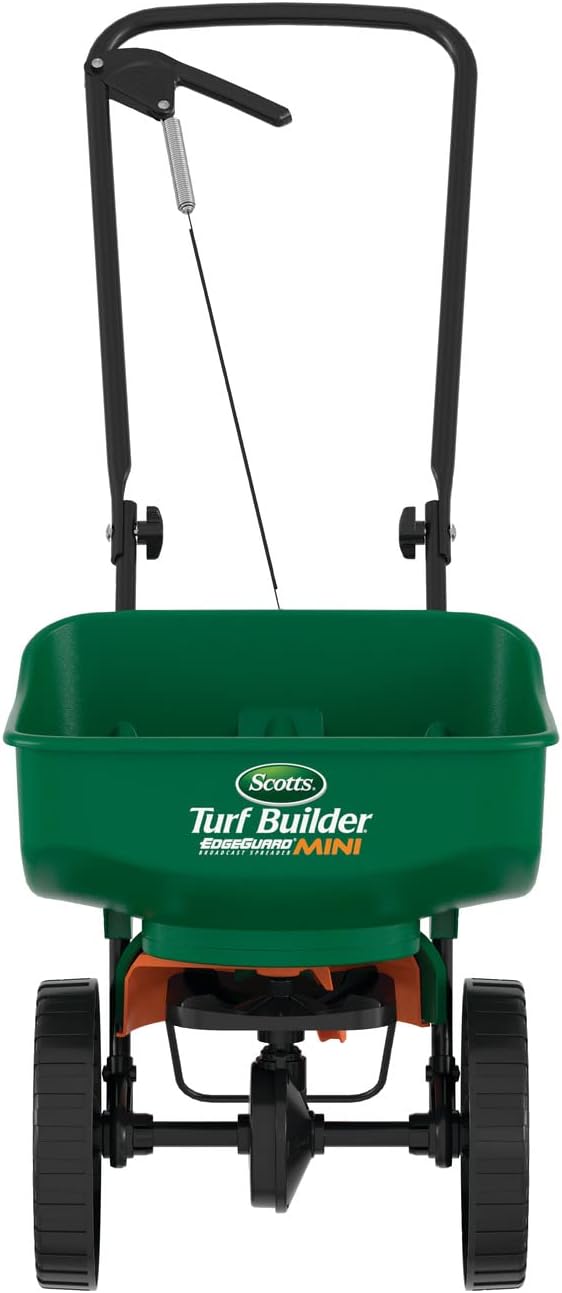
The Scotts Turf Builder EdgeGuard Mini is a ready-to-use broadcast spreader aimed at smaller yards and spot jobs. It holds up to 5,000 sq. ft. of product and comes pre-calibrated so you can pour granular fertilizer, seed, weed control, or ice melt into the hopper and walk the lawn immediately. Notable features include Scotts EdgeGuard side shield to prevent product from drifting onto driveways and a redesigned curved hopper with a dual-bladed agitator for smoother flow and more consistent coverage. The unit folds for compact storage and its open-spoke wheels handle typical lawn terrain without flats. Practical benefits are straightforward: quicker, more uniform application than hand-scattering, less waste along hard surfaces, and year-round use for fertilizing or spreading ice melt. Important limitations are its capacity and size, which make it best for small to medium yards rather than large properties, and because it is a simple mechanical spreader you will still need to follow product-specific settings for correct application rates.
Best for: Best for homeowners with small to medium lawns who want a no-fuss spreader that delivers even coverage and protects hardscape while saving time.
Less Ideal for: Not a good choice for large properties, commercial landscapers, or users who need high-capacity or motorized spreaders for frequent heavy-duty use.
- EdgeGuard side shield prevents product from spreading onto driveways and sidewalks
- Pre-calibrated and ready to use for quicker setup
- Redesigned hopper and dual-blade agitator promote smooth, consistent flow
- Fold-down handle and compact footprint for easy storage
- Capacity limited to smaller lawns, not suited for large acreage
- Simple mechanical design lacks motorized assist for very uneven terrain or heavy loads
Verdict: A compact, ready-to-use spreader that gives homeowners reliable, edge-protected coverage for small to medium lawns.
EarthWay 2150 Commercial 50 lb Broadcast Fertilizer Spreader

| Brand | EarthWay |
|---|---|
| Model Number | 2150 |
| Hopper Capacity | 50 lb |
| Tire Type | 13 inch pneumatic |
| Gearbox | Fully enclosed |
The EarthWay 2150 is a professional-grade broadcast spreader designed to deliver an even application of fertilizer, seed, or ice melt across turf. It is typically used as a push spreader for lawns where accuracy and durability matter. Notable features include EarthWay’s patented 3-hole drop shut off system and side-spread control for an approximately 50/50 spread pattern, a clog-free removable grate, an enclosed gearbox that resists moisture, and large 13 inch pneumatic tires that roll smoothly over uneven turf. The rustproof poly hopper is impact resistant and easy to wash down, and stainless-steel linkage replaces sticky cables for reliable operation. In practice this means fewer missed spots, less product waste, and consistent results across multiple passes. The unit is engineered for longevity with powder-coated steel and a sealed gearbox, but its commercial construction makes it heavier and bulkier than lightweight consumer models and requires storage space. Assembly and calibration take a bit more time up front, but the payoff is precise, repeatable spreading season after season.
Best for: Buyers who prioritize application accuracy and long-term durability for frequent or professional lawn care and who are willing to trade portability for performance.
Less Ideal for: Casual or infrequent users with very small yards who prefer a lightweight, compact spreader that is easier to store and transport.
- Patented 3-hole drop system plus side-spread control for a consistent, even spread pattern
- Fully enclosed gearbox allows use in moist or damp conditions and reduces maintenance
- Large 13 inch pneumatic tires provide smooth movement over rough or uneven lawns
- Rustproof poly hopper with removable grate is clog resistant and easy to clean
- Commercial-grade weight and size make it less convenient to move and store than lightweight spreaders
- Requires initial assembly and calibration to achieve optimal accuracy
Verdict: Choose the EarthWay 2150 when you need a durable, precision spreader that delivers consistent, professional results across uneven lawns.
VEVOR 50 lb Capacity Broadcast/Drop Push Spreader with 10" Pneumatic Wheels

| Hopper capacity | 50LB |
|---|---|
| Spread width | 18 in |
| Wheels | 10-in pneumatic |
| Frame | Powder-coated steel |
This VEVOR push spreader is built for homeowners who want one machine to handle seeding, fertilizing, and ice melt across small lawns. It uses a 50 lb hopper and an 18-inch spread width to cover ground quickly, while a 10-setting adjustable flow and dual broadcast/drop action let you dial in application rates for different materials. The powder-coated steel frame and corrosion-resistant finish increase durability for seasonal use, and the 10-inch pneumatic wheels make it easier to push across grass, gravel, or light snow. Assembly is tool-free and straightforward so you can get started fast, and the larger hopper cuts down on frequent refills. Expect solid value for routine lawn maintenance, though this is a push model suited to modest yards rather than commercial acreage and the plastic wheel components will be less heavy-duty than industrial alternatives. For homeowners who want dependable, adjustable coverage without specialized equipment, it delivers predictable, even results.
Best for: Homeowners and weekend gardeners who want one reliable, adjustable spreader for seeding, fertilizing, and ice melt on small to medium lawns and who prioritize efficiency and predictable coverage.
Less Ideal for: Landscaping professionals or owners of large acreage who need heavy-duty, motorized, or tow-behind spreaders for high-volume commercial work.
- 50 lb hopper reduces refill frequency for medium-sized lawns
- Adjustable 10-setting flow and combined broadcast/drop options for precise application
- Powder-coated steel frame resists corrosion for seasonal outdoor use
- 10-inch pneumatic wheels improve maneuverability on grass, gravel, and light snow
- Push-only design is tiring on large properties compared with tow-behind or motorized models
- Some wheel components are plastic which may wear faster under heavy commercial use
Verdict: A practical, adjustable push spreader that saves time on routine lawn fertilizing and seeding for small to medium yards.
CHAPIN 8740A 64 oz Hand Shaker Spreader

| Capacity | 1.8 kg |
|---|---|
| Bottle Type | Shaker Bottle |
| Reusability | Reusable |
| Material Type | Plastic |
The CHAPIN 8740A is a no-frills handheld shaker spreader built for spot jobs where a large broadcast spreader is overkill. You fill the wide 64-ounce poly bottle through the screw-top lid, choose one of three twist-openings for small, large, or wide flow, and apply material with one hand while walking paths, steps, planting patches, or small lawn patches. The large handle and glove-friendly design make filling and use easy in cold weather, and the plastic body is reusable and stores upright with product inside. It is especially convenient for targeting seed or fertilizer in tight spots and for winter de-icing on sidewalks. Limitations are that it is manual and best suited to small areas so it will be slow for whole-lawn applications and it lacks metered calibration for precise granular rates, so careful testing is needed to avoid over- or under-application.
Best for: Buyers who need an inexpensive, practical tool for spot-seeding, targeted fertilizer patches, or sidewalk de-icing rather than full-lawn coverage.
Less Ideal for: Those planning to treat large lawns regularly or who need precise, calibrated spread rates should choose a broadcast or drop spreader instead.
- Large 64-ounce capacity reduces refills during small jobs
- Three twist-open lid settings let you adapt flow to seeds, fertilizer, or ice melt
- Wide screw-top and large handle make filling and use easy with or without gloves
- Reusable poly construction stores upright with product inside for quick access
- Manual one-handed operation is slow for treating whole lawns
- No calibrated rate control for precise fertilizer application
Verdict: A budget-friendly handheld shaker that makes spot-seeding and small-area fertilizer or salt work fast and simple.
John Deere 130 lb Push Broadcast Spreader

| Capacity | 130 lbs |
|---|---|
| Approximate coverage | 25,000 sq ft |
| Spread width | 10 – 12 ft |
| Wheels | 13" x 4" pneumatic tires |
| Control | Direct rod control |
The John Deere 130 lb Push Broadcast Spreader is a walk-behind broadcast spreader built for larger lawns and frequent use. It holds up to 130 pounds in a rust-proof poly hopper so you can cover roughly a half acre before refilling, and its 10 to 12 foot spread width speeds up passes. The direct rod control with an adjustable flow stop makes opening, closing, and metering material straightforward, which helps cut down on waste and double coverage. Durability is emphasized with heat-treated bevel gears in an enclosed gearbox, a stainless steel axle and impeller shaft, and turf-tread pneumatic tires that ease pushing on uneven lawns. Typical uses include applying fertilizer, overseeding bare spots, distributing weed control products, and spreading ice melt in winter. Expect some assembly and a solid push effort on long runs because this is a manual unit without motorized assist. The spread pattern and coverage still depend on walking speed and product type, so plan passes accordingly for consistent results.
Best for: Homeowners who prioritize a dependable, long-lasting tool for routine lawn care and seasonal spreading on medium to large yards and value lower maintenance interruptions.
Less Ideal for: Small-plot gardeners who only need occasional spot treatments or buyers who want a motorized or tow-behind powered spreader for very large acres.
- Large 130 lb rust-proof poly hopper reduces refill frequency for up to 25,000 sq ft coverage
- Direct rod control with adjustable flow stop gives simple, precise material metering
- Enclosed gearbox with heat-treated steel bevel gears improves durability against corrosive materials
- Wide broadcast spread up to 12 ft shortens job time on larger lawns
- Turf-tread pneumatic tires improve maneuverability over uneven turf
- Manual push design can be tiring on long or hilly properties without powered assist
- Spread width and uniformity vary with walking speed and material, requiring user attention for even coverage
Verdict: Choose this spreader if you want a heavy-capacity, durability-focused push model that reduces refills and performs consistently across regular lawn maintenance tasks.
Scotts Whirl Hand-Powered Spreader

| Capacity coverage | Up to 1,500 sq. ft. |
|---|---|
| Material type | Metal, Plastic |
| Handle material | Rubber |
| Additional features | Adjustable Arm Support, Smooth Even Coverage |
The Scotts Whirl is a simple, hand-powered spreader built for small lawns and spot jobs. It comes ready to use and is held at the arm with an adjustable support for comfort while you walk a patch of turf, sidewalk, or driveway. The hopper is sized to cover roughly 1,500 square feet of Scotts products so you can seed, fertilize, or apply ice melt without repeatedly refilling a large cart. Its materials combine metal and plastic with a rubber handle for grip, and the mechanism is engineered to give smooth, even coverage when set correctly. Because it is hand-held and lightweight, it is easy to maneuver into tight spots and for quick winter salting. The main limitation is capacity and manual operation: it is not intended for larger yards or frequent full-property feeding and requires steady walking speed and correct setting for even spread. Users who need high throughput or a propulsion-driven spread pattern will want a larger tow-behind or broadcast spreader instead.
Best for: Buyers who want a low-effort, reliable tool for treating small lawns, patching seed, or applying ice melt around walkways and driveways and who value straightforward, proven products.
Less Ideal for: Homeowners with large properties or those who need to apply fertilizer frequently across many zones should consider larger broadcast or tow-behind spreaders instead.
- Compact, lightweight design makes it easy to maneuver and use for spot treatments.
- Adjustable arm support increases comfort during use for small jobs.
- Engineered hopper and mechanism deliver generally smooth, even coverage when properly set.
- Ready to use out of the box with no assembly required.
- Small capacity limits use to yards roughly 1,500 sq ft or less.
- Manual operation requires consistent pace and attention to settings for uniform application.
Verdict: A compact, easy-to-use hand spreader that reliably handles seeding, fertilizing, or salting for small lawns and spot treatments.
CHAPIN 88000A SaltPro 80 lb Walk-Behind Salt Spreader

| Capacity (lbs.) | 80 |
|---|---|
| Tire type | 10" pneumatic |
| Frame | Powder-coated steel |
| Auger | Spiked plastic |
The Chapin 88000A SaltPro is a residential walk-behind spreader made to apply pelletized or small ice-melt materials across driveways and sidewalks. You load the 80 lb polyethylene hopper, use the U-shaped flip-up handle to push, and control flow with the gate lever and adjustable side baffles to direct product where you need it. A plastic spiked auger reduces clumping and helps keep material moving, and the 10" pneumatic tires plus powder-coated steel frame make it reasonably easy to push over uneven surfaces. The included rain cover protects the hopper contents during use. This model is intended for ice-melt and similar pelletized products and is not recommended for rock salt, sand, or lime, so material compatibility limits what you can apply. For homeowners who want a durable, no-frills spreader that minimizes refills and keeps product dry, it is a practical choice; those needing professional contractor capacity or compatibility with coarser materials should consider other equipment.
Best for: Homeowners who prioritize predictable, low-maintenance winter care and want a straightforward spreader to cover driveways and walkways without frequent refills or fiddly setup.
Less Ideal for: Users who need a spreader for heavy commercial or contractor use or who plan to apply coarse materials like rock salt or sand should choose a more heavy-duty, compatible model.
- Large 80 lb rust-resistant polyethylene hopper reduces refills for typical residential areas
- Adjustable side baffles and gate offer directional control for sidewalks and driveways
- Spiked plastic auger breaks up clumps to reduce blockages at the gate
- 10" pneumatic tires and powder-coated steel frame make it easier to push over uneven surfaces
- Not compatible with rock salt, sand, or lime so material options are restricted
- Item is geared for residential use rather than heavy contractor workloads
Verdict: A dependable, homeowner-focused spreader that holds a large load, controls material direction, and reduces clogs for easy residential winter maintenance.
Choosing the Right Lawn Fertilizer Spreader: Key Factors to Consider
Spread Accuracy and Calibration
How evenly a spreader distributes granular fertilizer directly affects turf health and product efficiency. Accurate calibration settings and clear adjustment markings allow you to match the output to the label rate on your fertilizer. Poorly calibrated or inconsistent flow produces streaks of overfeed and underfeed that show as patchy color and growth. When choosing, look for spreaders with easy, repeatable settings and simple calibration procedures so you can reproduce recommended application rates across multiple passes.
Calibration also matters because different granule sizes and shapes fall at different rates. A spreader that offers a way to test and fine-tune output for specific products reduces the chance of applying too much or too little fertilizer.
Hopper Capacity and Flow Control
Hopper size determines how often you stop to refill during an application. For small urban lawns a small hopper is fine, but larger suburban or estate lawns benefit from bigger capacity to save time. Flow control features such as adjustable gates and anti-clog designs help maintain consistent distribution as the hopper empties.
Even with large capacity, the design of the hopper outlet and the ability to control the spread pattern are critical. A poorly designed outlet can cause bridging or sudden bursts of material. Evaluate how the hopper handles common amendments you will use, like slow-release fertilizer, seed, or ice melt, and whether it needs additional accessories to manage flow.
Durability and Weather Resistance
Garden equipment lives through seasons and storage conditions, so construction materials matter for long-term reliability. Metal parts should be rust-resistant or treated, and plastic components should be UV-stabilized to avoid brittle cracking after sun exposure. Wheels, bearings, and any exposed linkages need robust construction to survive rough turf, uneven driveways, and occasional bumps.
Consider how the spreader will be stored between uses. If it will sit in a damp shed, corrosion-resistant hardware and sealed bearings extend service life. Durable units also maintain calibration and flow characteristics across seasons, preventing the common problem of a spreader that drifts in performance after a year or two of use.
Ease of Use and Maintenance
A spreader that is easy to set up, adjust, and clean will be used correctly and more often. Look for clear rate markings, accessible gates, and components designed for tool-free cleaning. Hopper shapes that funnel material to the outlet reduce leftover product and simplify rinsing.
Maintenance considerations include how easy it is to remove and reattach wheels, whether bearings are serviceable, and if parts subject to wear are replaceable. Ease of storage also matters: some spreaders fold or have removable handles to save space in a garage or shed.
Maneuverability and Turf Impact
How a spreader moves across grass affects both the quality of your application and the condition of the lawn. Lighter units are easier to push but can bounce on uneven ground, leading to inconsistent distribution. Heavier models may track straighter but risk compacting sensitive turf if used repeatedly in the same pattern.
Wheel design and spacing influence how the tool handles slopes, obstacles, and wet conditions. Wider wheels spread weight and reduce rutting. For uneven yards, look for a spreader with a stable wheelbase and smooth-rolling bearings to maintain a consistent height and output during each pass.
Compatibility With Different Materials
Lawn care often requires multiple granular products: fertilizer, seed, lime, and sometimes ice-melt in colder climates. A good spreader can handle a range of granule sizes and densities without frequent modification. Gate designs that allow fine adjustments and spread patterns that can be narrowed or widened make the tool more versatile.
Check whether the manufacturer provides guidance for different material types and whether the spreader can be easily converted or adapted for seeding or ice melt. Versatility reduces the need to own multiple dedicated tools and makes seasonal tasks more efficient.
Choosing The Right Spreader Style
There are a few common spreader styles to consider: broadcast (rotary) spreaders, drop spreaders, and tow-behind models. Broadcast spreaders fling material across a wide swath, making them good for larger, open lawns where speed matters. Drop spreaders deposit material directly beneath the hopper and give the most precise line by line control, which suits small lawns or when you want to avoid treating beds and walkways.
Tow-behind spreaders attach to compact utility vehicles or garden tractors and are useful for large properties, where pushing by hand would be impractical. Choose the style that matches your yard layout and how precise you need applications to be.
- Broadcast spreaders cover more ground quickly but need careful overlap control.
- Drop spreaders deliver the most accurate placement for small yards.
- Tow-behind units are for very large lawns or when you want to eliminate manual pushing.
Calibration Tips For Consistent Application
Start by reading the fertilizer label for the recommended application rate in pounds per 1,000 square feet. Use the spreader's calibration chart if provided, then perform a small-field test to confirm output. Catch the output into a container over a measured distance to calculate actual release rate and adjust settings as needed.
Recheck calibration whenever you switch products or if you notice streaking. Wind, speed of push, and granule size all affect the distribution pattern, so testing under actual field conditions is the most reliable way to get consistent coverage.
- Test output over a set distance to verify real-world spread rate.
- Adjust walking speed and gate setting together for consistent results.
- Repeat calibration checks at the start of each season.
Maintaining Your Spreader Through The Seasons
Clean the hopper and outlet after every use to prevent caking and corrosion. Rinse residual fertilizer away and allow parts to dry before storing. Grease or lubricate bearings if the model calls for it, and inspect for worn hardware or cracked plastic before the next season.
In colder climates where ice-melt is used, clean thoroughly after winter to remove corrosive residues. Consider storing roll cages, handles, or removable parts indoors to protect them from long-term moisture and UV exposure.
- Rinse and dry the hopper after each use to prevent corrosion.
- Inspect moving parts for wear at least once per season.
- Store indoors or under cover to extend service life.
Application Patterns and Overlap Strategy
Plan your passes to minimize both skips and double application. Set up parallel runs with consistent overlap based on the spread width at your chosen setting. Walking at a steady pace and maintaining straight lines are as important as the spreader setting for even coverage.
Mark boundaries and avoid sidewalks, flower beds, and driveways. If you need extra precision near borders, consider switching to a drop-style approach for those edges or hand-applying small amounts to keep material off hard surfaces.
- Use consistent overlap to avoid stripes of over- and under-application.
- Slow down on slopes and rough ground to maintain even release.
- Protect non-lawn areas by stopping the gate or using edge control techniques.
Safety And Environmental Considerations
Handle fertilizer carefully to avoid inhalation and skin contact. Use a mask when pouring dusty materials and wash hands after handling. Prevent runoff by avoiding application before heavy rain and by following label rates to limit nutrient leaching into waterways.
Consider using products and spreader settings that reduce bounce and drift of granules into planting beds or pavement. Proper calibration and careful application protect plants, pets, and local water quality.
- Wear gloves and a dust mask when filling and calibrating.
- Avoid fertilizing before expected heavy rain to reduce runoff.
- Store unused fertilizer in sealed containers away from moisture.
How We Chose the Best Lawn Fertilizer Spreader
We evaluated options using criteria that matter to real gardeners applying fertilizer across lawns of varying sizes and conditions. Key dimensions included spread accuracy and calibration, because an uneven spread produces patchy growth and waste; hopper capacity and flow control, since larger yards need fewer refills and consistent flow avoids clumping; durability and weather resistance, given equipment is stored outdoors or in damp sheds; ease of use and maintenance, covering setup, calibration markings, and how simple it is to clean; and maneuverability and turf impact, evaluating how easy the tool is to push or tow and whether it damages grass or compacts soil. We excluded tools designed strictly for broadcast seeding, specialized agricultural machinery, or single-season disposables that lack durability. Products were filtered for compatibility with common lawn materials and for clear calibration instructions. The final shortlist emphasizes dependable field performance, straightforward calibration for common granule sizes, robust construction for seasonal use, and features that reduce product waste. These evaluation points align with the scoring metrics used in each product card.
FAQ
What spreader type is best for a small urban lawn?
A drop spreader is often best for small urban lawns because it places material directly below the hopper for precise coverage and minimal waste. It is easier to avoid sidewalks and beds with a drop spreader, though it covers less area per pass than rotary models.
How often should I calibrate my spreader?
Calibrate at the start of each season and whenever you change products or notice uneven results. Also recalibrate if you adjust walking speed significantly. Regular checks help maintain accurate application rates.
Can one spreader handle both fertilizer and seed?
Many spreaders can handle both, but performance depends on the granule size and flow characteristics of each material. Check that the spreader allows fine adjustments and test output for each product to ensure even distribution.
How do I avoid clumping and clogging in the hopper?
Use dry materials and avoid compacting the hopper. Models with anti-bridging designs or agitators are less likely to clog. Clean the hopper after use and store fertilizer in dry conditions to minimize moisture-related clumping.
Is a tow-behind spreader necessary for medium lawns?
For medium lawns, tow-behind units are usually not necessary unless you already use a garden tractor or want to avoid manual pushing entirely. Hand-push broadcast or larger-capacity walk-behind models typically cover medium yards efficiently.
Final Verdict
Choosing the right lawn fertilizer spreader comes down to matching spreader style, capacity, and accuracy to the size and shape of your lawn. Prioritize accurate calibration and consistent flow if you need even, stripe-free results. For larger properties, hopper capacity and maneuverability become more important, while small lawns benefit from the precision of drop-style units. Balance durability and ease of use against how often you will apply fertilizer. A spreader that is simple to calibrate and maintain will give better results season after season. Focus on the decision factors discussed here to pick a tool that delivers dependable, even feeding for your turf.
