

Note: This article contains affiliate links. If you click on these links and make a purchase, I may earn a small commission at no extra cost to you. This helps support my research and content. Read my full affiliate disclosure here.
Choosing the right natural insect repellent for your garden matters because gardeners need protection that controls pests without harming beneficial insects or plants. You want a solution that reduces chewing, sap-sucking, and biting pests while fitting into your planting plan and maintenance routine. This guide summarizes seven shortlisted natural repellents suited for garden use. We evaluate each pick for how well it deters common garden pests, how easy it is to apply, and how safe it is around plants, pollinators, and soil life. Read on to quickly compare practical differences and pick the approach that matches your garden size and maintenance style.
Top Picks at a Glance
| Best Overall The best all-around choice for most situations | Garden Safe Crawling Insect Killer Diatomaceous Earth, 4 lb |  |
| Best Quality Built to a higher standard if you want something more solid | Wondercide Outdoor Pest Control Spray — 32 oz Ready-to-Use |  |
| Best Value The sweet spot between price and what you get | Garden Safe Insecticidal Soap Ready-to-Use Spray, 32 oz |  |
| Best Budget The cheapest option that still gets the job done reliably | Natria Neem Oil Ready-to-Use Spray, 24 oz |  |
| Highest Rated A top-rated pick with lots of positive feedback | Monterey Spinosad Insecticide Concentrate, 1 Gallon |  |
| Most Popular A crowd favorite that many people choose with confidence | Bonide Captain Jack's Ready-to-Use Neem Oil Spray, 32 oz |  |
| Best Seller A high-volume bestseller chosen again and again | Mighty Mint Peppermint Oil Insect Repellent Spray, 1 Gallon |  |
Garden Safe Crawling Insect Killer Diatomaceous Earth, 4 lb

| Item Form | Powder |
|---|---|
| Target Species | Insects |
| Active Ingredients | Silicon Dioxide |
| Specification Met | EPA |
Garden Safe Crawling Insect Killer is a powdered diatomaceous earth formulation intended for outdoor, plant-side use to control crawling pests. It is applied as a thin dust to soil around plants or directly onto insects where the fine granules abrade and absorb oils from exoskeletons, causing dehydration and death. Typical uses include edging vegetable beds, dusting under potted plants, and treating areas where ants, fleas, cockroaches, beetles, and mealybugs are active. The product is labeled for organic gardening and meets EPA specification guidance, so it is a low-chemical option for routine garden pest control. Practical benefits are persistence in dry, calm conditions and a non-spray, hands-on application that targets contact exposures. Important limitations are that it must stay dry to remain effective, can be dusty to apply so ventilation and a mask are advised, and it is not effective against insects that are not contacted by the dust or for wood-destroying beetles and certain ant species listed on the label. Follow label directions and reapply after heavy rain or disturbance for continued protection.
Best for: Gardeners who prefer practical, low-chemical pest control and want a contact-based solution for crawling insects around plants and beds.
Less Ideal for: People seeking a fast-acting, systemic treatment for flying pests or infestations inside structures should consider other control methods.
- Works by physical action so no chemical insecticides are required
- Approved for use in organic gardening and meets EPA specification guidance
- Can be applied directly to soil and plants to target crawling pests
- Long-lasting when kept dry and undisturbed
- Ineffective if the treatment area becomes wet or is washed away
- Creates airborne dust during application so respiratory protection is recommended
Verdict: A practical, organic-friendly diatomaceous earth powder for gardeners who want a non-chemical contact treatment for crawling garden pests.
Wondercide Outdoor Pest Control Spray — 32 oz Ready-to-Use
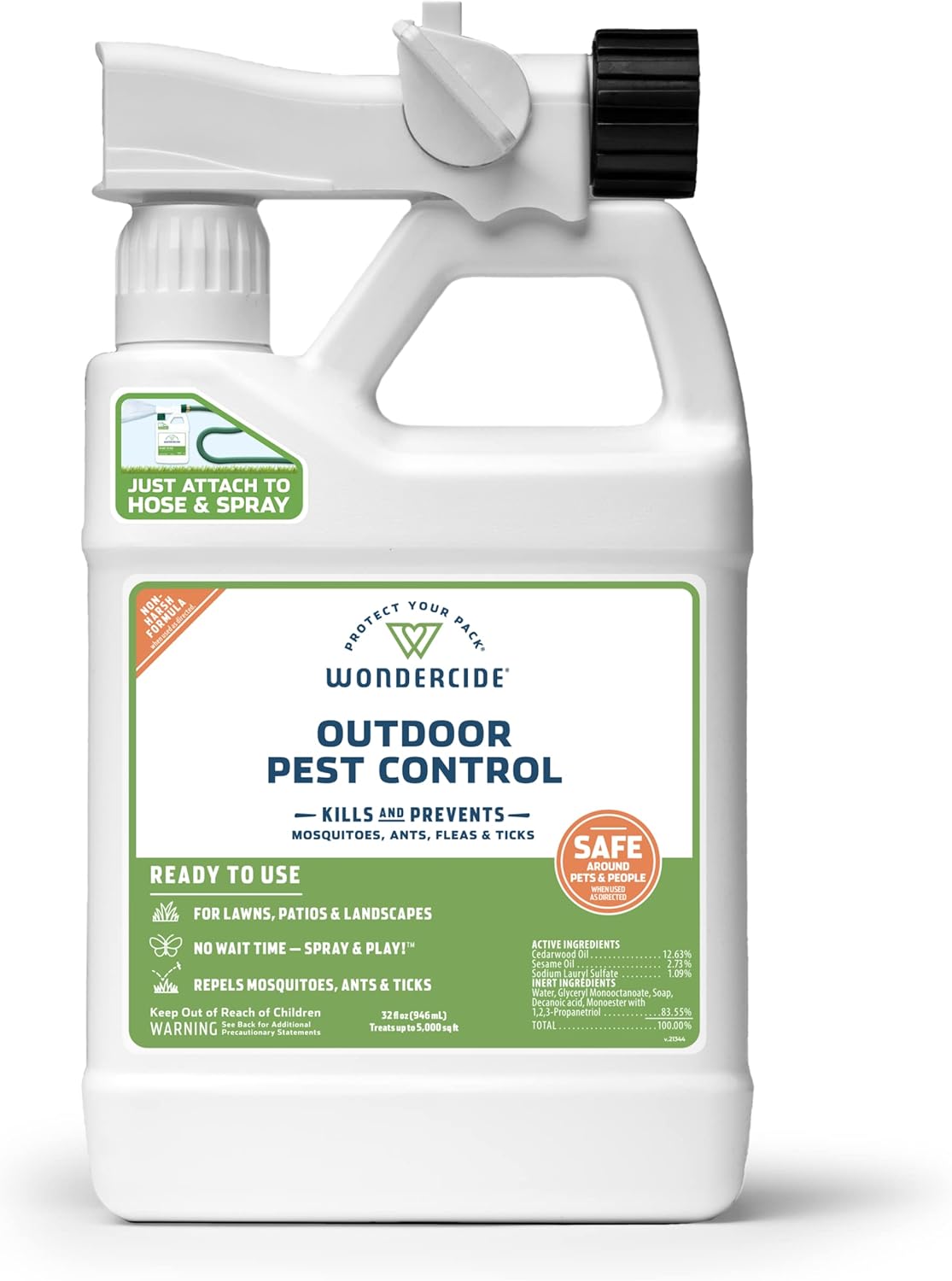
| Format | Pre-mixed, hose-end spray |
|---|---|
| Active ingredients | Cedarwood Oil 12.63%, Sesame Oil 2.73% |
| Coverage | Up to 5,000 sq ft (general); 2,500 sq ft (ticks/mosquito repel) |
Wondercide Ready-to-Use Outdoor Pest Control is a hose‑end spray designed for treating yards up to 5,000 sq ft for general pests and 2,500 sq ft for ticks and mosquito repellency. You attach the bottle to a garden hose, sweep the nozzle across lawns, patios, and foundation lines, and the cedarwood‑based formula delivers quick coverage with no dry time required. Notable features include plant-powered active ingredients (cedarwood and sesame oils), ready-to-use convenience, and instructions for both active infestations and preventative maintenance. Practical benefits are that it is safe to use around people and pets when directions are followed, residues are reported to be non-harmful to pollinators, and the hose attachment makes treating large areas fast. Important limitations are that effectiveness depends on water pressure, walking speed, and weather, heavy rain may require reapplication, and spraying in temperatures above 90°F or direct sun can cause plant burn. Users who need an all‑season, high‑durability pesticide for heavy infestations should plan on repeated applications and follow label precautions to protect sensitive plants.
Best for: Buyers who prioritize effective, plant‑based mosquito and tick control for medium to large yards and want a fast hose‑attached solution that is safe around families and pets when used as directed.
Less Ideal for: Gardeners who need a single, long‑lasting professional‑grade pesticide for severe, persistent infestations or who cannot reapply after rain should consider alternative, heavier‑duty treatments.
- Ready-to-use hose-end applicator for fast coverage of large yards
- Plant-based active ingredients (cedarwood and sesame oils) that target common yard pests
- No dry time required so kids and pets can re-enter treated areas quickly
- Covers up to 5,000 sq ft for general pest control and 2,500 sq ft for ticks/mosquito repellency
- May cause phytotoxic burning if applied in direct sun or temperatures above 90°F
- Performance depends on water pressure and user walking speed which can lead to uneven coverage
- Heavy rain can wash it away and requires reapplication
Verdict: If you want a fast, family- and pet-friendly plant‑based spray to reduce mosquitoes and ticks across a medium to large yard, this ready‑to‑use hose‑end formula delivers practical, repeatable results.
Garden Safe Insecticidal Soap Ready-to-Use Spray, 32 oz

| Item Form | Spray |
|---|---|
| Target Species | Insects |
| Liquid Volume | 32 fluid ounces |
| Active Ingredients | Potassium Salts Of Fatty Acids |
Garden Safe Insecticidal Soap is a ready-to-use contact spray formulated with potassium salts of fatty acids to control aphids, mealybugs, mites, whiteflies and similar soft-bodied pests. You use it like a normal garden spray: thoroughly coat insects and all plant surfaces including undersides of leaves, ideally in calm weather and not in full sun. It is safe for use on vegetables, fruit trees, ornamentals, shrubs, flowers and in greenhouses and may be applied to edibles up to the day of harvest, which simplifies timing for vegetable growers. The spray works on direct contact so thorough coverage is essential and multiple applications may be needed for heavy infestations. The product is convenient because no mixing is required, but it can be washed off by rain and is hazardous to aquatic invertebrates so care is needed to avoid runoff into water. For routine control of common garden pests this soap is a practical, low-toxicity option when used as part of an integrated pest management approach.
Best for: Gardeners who prioritize practical, low-toxicity pest control and want a ready-made spray that can be used on edible crops without pre-harvest delays.
Less Ideal for: People needing a long-residual or systemic pesticide for heavy infestations or for pests hidden inside plant tissues should consider other control methods.
- Ready-to-use formula requires no mixing for quick spot treatments
- Labeled for use on vegetables and may be applied up to the day of harvest
- Controls a broad list of soft-bodied pests including aphids, mites and whiteflies
- Plant-safe when used as directed and usable indoors, outdoors and in greenhouses
- Only kills pests by direct contact so it has limited residual or systemic activity
- Can be washed off by rain and must be reapplied after watering or heavy rainfall
- Harmful to aquatic invertebrates so it requires careful application near water
Verdict: A convenient, low-toxicity ready-to-use soap spray that gives effective contact control of common soft-bodied garden pests and is safe to use up to harvest.
Natria Neem Oil Ready-to-Use Spray, 24 oz

| Unit Count | 24 Fluid Ounces |
|---|---|
| Item Form | Spray |
| Target Species | Insects |
| Active Ingredients | Clarified Hydrophobic Extract of Neem Oil – 0.9% |
Natria Neem Oil Spray is a 24 oz ready-to-use botanical spray formulated to kill common pests like aphids, whiteflies, spider mites and to suppress fungal diseases such as powdery mildew and black spot. You simply point and spray for spot treatments or broader coverage on roses, vegetables, ornamentals and houseplants without measuring or mixing. The product’s active ingredient is a clarified neem oil extract (0.9%) and the label allows use up to the day of harvest, which makes it practical for vegetable gardens and edible container crops. The spray combines insecticidal and fungicidal action, so it can reduce the number of separate products you need to keep on hand. Limitations to expect are that it is a contact product, so thorough coverage and repeat applications are required for good control, and it will be less effective against pests hidden in dense foliage or inside buds. For gardeners who prefer a low-toxicity botanical option and want a convenient ready-to-use format, this is an easy-to-use, multi-purpose choice.
Best for: Gardeners who want a low-toxicity, all-purpose spray they can use on vegetables, ornamentals and houseplants without mixing or juggling multiple products.
Less Ideal for: Growers needing a systemic or long-residual insecticide or those managing severe, established infestations that require professional-strength treatments.
- Ready-to-use trigger spray requires no mixing for quick application
- Controls both listed insects and several fungal diseases with a single product
- Label allows use up to the day of harvest, so safe for many edible crops when used as directed
- Active ingredient concentration is relatively low, so repeated applications may be needed for heavy infestations
- Effectiveness depends on thorough contact coverage and will be limited against hidden or systemic pests
Verdict: A convenient ready-to-use neem spray that delivers combined insect and fungal control for gardeners who want a low-toxicity, easy application.
Monterey Spinosad Insecticide Concentrate, 1 Gallon

| Unit Count | 128 Fluid Ounces |
|---|---|
| Item Form | Oil |
| Target Species | Insects |
Monterey Spinosad Insecticide Concentrate is a 1-gallon, concentrated treatment formulated around spinosad to control caterpillars, leafminers, borers and many other chewing insects on ornamentals, vegetables and fruit trees. It is OMRI listed for organic gardening, fast acting and essentially odorless, and can be mixed into a trigger, backpack or hose-end sprayer for standard backyard or small-farm applications. For bagworm control the active ingredient targets chewing larvae effectively when applied to foliage while they are feeding. Practical benefits include a versatile application method, a large concentrate size that covers multiple treatments, and suitability for organic systems. Important limitations are that it is a contact/stomach poison so thorough coverage is required for good control and repeat applications may be needed to catch newly hatched larvae. Users must follow label safety directions and wear protective clothing when mixing and applying concentrated product.
Best for: Gardeners who prioritize effective, performance-oriented control of chewing pests and want a concentrated, organic-compatible option for treating bagworms on ornamentals and fruiting plants.
Less Ideal for: Casual users who want a ready-to-use product or those unwilling to mix concentrates and follow protective-gear instructions should consider an RTU product instead.
- Contains spinosad, a fast-acting active ingredient effective against caterpillars and other chewing insects
- OMRI listed for organic gardening, suitable for organic beds and fruit trees
- Large 1-gallon concentrate supports multiple treatments and different sprayer types
- Odorless formula that is easier to apply around people and pets when label directions are followed
- Requires thorough coverage because it is primarily a contact and stomach-active insecticide
- Concentrate requires mixing and protective gear during handling
Verdict: A high-volume, spinosad concentrate that delivers effective, organic-compatible control of bagworms and other chewing caterpillars when applied for full foliage coverage.
Bonide Captain Jack's Ready-to-Use Neem Oil Spray, 32 oz

| Item Form | Liquid |
|---|---|
| Target Species | Insects |
| Liquid Volume | 32 fluid ounces |
| Active Ingredients | Clarified Hydrophobic Extract of Neem Oil |
This ready-to-use neem oil spray is a multipurpose garden treatment that kills insects at all life stages while also serving as a miticide and preventative fungicide. Packaged in a 32-ounce trigger bottle, it is applied by shaking and thoroughly spraying plant surfaces, including leaf undersides, at the first sign of pests or disease and reapplying every 7 to 14 days as needed. The active ingredient is a clarified hydrophobic extract of neem oil, which is approved for organic gardening and labeled safe to use on vegetables up to the day of harvest. Practical benefits include broad pest coverage (aphids, whiteflies, spider mites and others), disease suppression such as powdery mildew, and convenience from a ready-to-use sprayer. Important limitations are that results are slower than synthetic contact insecticides and application timing matters to avoid leaf burn in full sun; repeated applications may be needed for heavy infestations. Follow label safety directions and keep the product away from children and pets.
Best for: Gardeners who want a single, organic-approved product to manage common vegetable garden pests and fungal problems and who prefer products with strong user feedback.
Less Ideal for: Growers needing rapid knockdown of severe infestations or commercial producers who require fast-acting, high-throughput treatments.
- Kills multiple pest stages including eggs, larvae and adults for more complete control.
- Also acts as a fungicide and miticide so one product covers pests and common fungal issues.
- Ready-to-use trigger bottle requires no mixing and is easy to apply to leaves and undersides.
- Approved for organic gardening and can be used on vegetables up to day of harvest.
- Slower-acting than many synthetic contact insecticides, so it may take several applications to see control.
- Must avoid spraying in peak sunlight to reduce risk of leaf burn.
Verdict: A convenient, organic-approved all-in-one neem spray that controls common vegetable garden pests and fungal issues with minimal fuss.
Mighty Mint Peppermint Oil Insect Repellent Spray, 1 Gallon

| Volume | 128 oz |
|---|---|
| Ingredients | Water, Glycerin, Polyglycerol Oleate, Soap, Peppermint Oil |
| Use areas | Indoor / Outdoor |
| Scent | Peppermint |
Mighty Mint’s 1-gallon peppermint oil spray is a plant-based insect repellent intended for broad indoor and outdoor use. The product is supplied as a large ready-to-use bottle with a detachable nozzle for spraying around entryways, baseboards, patios, and gardens or for refilling smaller spray bottles. Its formula lists peppermint oil along with water, glycerin, and soap, so it works by delivering a strong peppermint scent that repels spiders, ants, roaches and similar pests without synthetic pesticides. Practical benefits include the large 128 oz volume for extended coverage and a scent that many households find more pleasant than chemical sprays. The label notes it is safe for use around people and pets when used as directed, and the concentrate-style packaging simplifies repeat applications. Limitations to keep in mind are that it is a deterrent rather than a lethal insecticide, so it may not eliminate established infestations, and effectiveness can vary by pest and environmental conditions. Users should follow safety directions and reapply after heavy rain or watering for outdoor use.
Best for: Buyers who prioritize safer, plant-based pest control and want a proven, widely used product with visible social proof for routine outdoor and perimeter pest prevention.
Less Ideal for: People facing severe infestations who need a fast-acting, residual insecticide or professional pest control should consider stronger, targeted treatments instead.
- Large 128 oz ready-to-use gallon provides long-lasting coverage and value
- Plant-based formula using peppermint oil rather than synthetic pesticides
- Versatile for indoor and outdoor application and can refill smaller bottles
- Pleasant mint scent that is less intrusive than chemical alternatives
- Designed as a repellent and deterrent so it may not eradicate heavy or established infestations
- Performance can be inconsistent depending on pest type and weather conditions
Verdict: Choose this gallon peppermint spray if you want a plant-based, widely adopted repellent for routine outdoor perimeter and home pest prevention.
Choosing the Right Natural Insect Repellent for Garden: Key Factors to Consider
Which Pests You Need To Control
Different repellents work better on different insect behaviors. Some natural options deter chewing pests like caterpillars and beetles, while others are more effective against sap-feeding insects such as aphids and whiteflies or against flying pests that bother people. Identify the primary pests in your garden before choosing an approach, because the active ingredients and delivery method strongly influence what the product will actually reduce.
Knowing pest life cycles also helps. Seasonal pests or those that overwinter nearby may require repeated or timed applications. If you have mixed plantings, expect to treat for a broader range of insects and choose a repellent with a wider deterrence spectrum or combine complementary methods.
Safety for Edible Plants and Sensitive Species
When using repellents around vegetables, herbs, and young transplants, plant safety is critical. Some natural oils and botanical extracts can burn tender foliage when applied in hot sun or at full concentration. Look for options labeled safe for edible crops and follow temperature and timing guidance to avoid leaf scorch or residue on harvestable parts.
Also consider proximity to young seedlings and ornamentals known to react poorly to oils or soaps. If you maintain pollinator-friendly plantings, prioritize products with lower risk to bees and butterflies and apply them in ways that reduce direct contact with visiting insects.
Application Method and Garden Scale
Ease of application is a practical consideration that affects how consistently you will use a repellent. Foliar sprays, ready-to-use mist bottles, and hose-end applicators can cover beds and containers quickly, while granular barriers and soil drenches require different setup and timing. For small patios and container gardens, hand-sprays or concentrated DIY recipes are often sufficient. For larger beds, choose options compatible with backpack sprayers or concentrated mixes that dilute cleanly.
Also think about drift, overspray, and the need to reach undersides of leaves where many pests hide. Some delivery methods give better coverage for cryptic pests, which can make the difference between sporadic control and a meaningful reduction in damage.
Persistence and Reapplication Frequency
Natural repellents typically break down faster than synthetic chemicals, which means many require more frequent reapplication. Consider how long a product's active ingredients persist after rain or irrigation and how often you are willing to reapply. Some options form a short-lived barrier that needs weekly attention, while others offer a multi-week deterrent at lower strength.
Balancing persistence with safety is important. Longer-lasting natural approaches may still be gentle on the environment but could have greater incidental effects on non-target insects if applied indiscriminately. Choose a cadence that matches your tolerance for repeat work and the pest pressure you face.
Impact on Beneficial Insects and Soil Health
Protecting pollinators, predators, and soil organisms is a central reason many gardeners choose natural repellents. Even botanical products can harm non-target insects if applied when pollinators are active or directly to blossoms. Apply repellents selectively and time treatments for early morning or late evening to reduce contact with bees.
Consider soil-contact methods carefully because soil biology supports plant health. Avoid materials that suppress microbial life or earthworm activity. When in doubt, choose products with explicit guidance on pollinator safety and minimal soil residue.
Scent, Residue, and Human Comfort
Some natural repellents use essential oils that leave a noticeable scent on foliage or in the air. While that can deter pests, it may also affect enjoyment of outdoor spaces or the flavor of aromatic herbs if residues linger. Residual oils or soaps can also attract dust or cause sooty buildup over time if applied excessively.
Consider whether you or household members have scent sensitivities and whether the repellent will be used near outdoor living spaces. Choose formulations and application schedules that minimize unwanted odors and residue on edible foliage.
How Botanical Ingredients Work in the Garden
Botanical actives such as pyrethrum-derived extracts, neem, garlic, and various essential oils act by repelling, disrupting feeding, or affecting insect behavior rather than by instant knockdown. Their modes of action influence where and how they are best used. For example, oils coat insect bodies and can block breathing pores of small soft-bodied pests, while sulfur or botanical extracts may alter host plant cues so insects overlook treated plants.
Understanding these mechanisms helps you match an ingredient to a pest problem and to choose application timing that maximizes effect while minimizing harm to beneficial species.
- Contact-based botanicals need good coverage, especially underside of leaves.
- Repellents that act through odor work best when concentrated around new growth and blossoms are not present.
- Soil-applied botanical drenches can affect root-feeding pests while leaving foliage less exposed.
DIY Recipes and When to Use Them
Simple homemade repellents can be effective for light pest pressure and small gardens. Common DIY options include dilute soap sprays for soft-bodied insects, garlic or onion extracts to mask plant scents, and oil emulsions to suffocate certain pests. These mixes are inexpensive and reduce chemical exposure but vary in strength and persistence.
Use DIY recipes for spot treatments, seedlings, or container gardens where you can apply carefully and observe plant response. Avoid blanket spraying flowering plants and always test a small area for phytotoxicity before widespread use.
- Start with the weakest effective concentration and increase only if needed.
- Apply DIY sprays in the cool parts of the day to reduce leaf scorch.
- Label and date homemade mixes; they can lose potency quickly.
Timing Applications to Protect Pollinators
To reduce harm to bees and other pollinators, schedule treatments for early morning or late evening when flowers are less visited. Avoid spraying open blooms whenever possible and target foliage or the soil line instead. Many products include explicit guidance on timing that will help protect beneficial insects.
Where pollinator activity is heavy, consider physical barriers or trap cropping as complementing strategies that reduce the need for foliar treatments on flowering plants.
- Apply repellents before pest populations explode to reduce repeated sprays.
- Use targeted spot treatments rather than broad garden-wide applications.
- Integrate companion plants that repel pests to reduce reliance on sprays.
Using Repellents in Vegetable Beds and Container Gardens
Edible plantings and containers require particular care because residues can contact harvest. Choose repellent methods labeled safe for vegetable use and observe pre-harvest guidance when present. For containers, rinsing leaves before harvest and applying treatments to non-harvestable foliage can further reduce residue on produce.
Containers tend to dry faster and may need more frequent reapplication. Also consider root health when using soil-applied botanical treatments in pots, and use products designed for container culture when possible.
- Avoid spraying edible flowers and herbs right before harvest.
- Rotate treatment methods to avoid stress from repeated oil or soap use.
- Monitor moisture and root health after soil-applied repellents in pots.
Integrating Repellents with Cultural Controls
Natural repellents work best as one part of a broader integrated pest management plan. Regular scouting, good sanitation, and encouraging predators reduce overall pressure so repellents remain effective. Practices like removing infested leaves, handpicking large pests, and maintaining plant vigor through proper watering and nutrition support long-term pest suppression.
Use repellents to protect vulnerable growth during critical periods rather than as a first response. This reduces overall treatment frequency and helps preserve beneficial insect populations.
- Combine repellents with physical barriers such as row covers for heavy infestations.
- Encourage predator insects by planting nectar sources and avoiding daytime sprays.
- Use crop rotation and resistant varieties to lower inherent pest risk.
How We Chose the Best Natural Insect Repellent for Garden
We focused on garden-specific performance rather than broad household use. Selection prioritized formulas and application methods appropriate for edible and ornamental plantings, including foliar sprays, soil treatments, granular barriers, and simple DIY recipes. We evaluated products and approaches across four to six concrete, repeatable criteria that reflect everyday gardener needs. Key evaluation points included pest deterrence spectrum and measured effectiveness against chewing and sap-feeding insects, application ease and coverage for beds and containers, plant safety with attention to sensitive species and edible crops, persistence and reapplication cadence in typical outdoor conditions, and environmental impact focusing on pollinator safety and soil biology. Packaging and labeling clarity were also checked to ensure gardeners know where and how to use each option safely. We excluded household insect-control products designed for indoor use or those that rely primarily on synthetic neurotoxins. We also filtered out products with unclear ingredient lists or that lacked guidance for use in vegetable gardens and flower beds. The resulting shortlist favors options that balance real-world pest control with minimal risk to beneficial insects and plants.
FAQ
Are natural insect repellents safe to use on vegetables?
Often they are, but safety depends on the active ingredient and how it is applied. Choose products labeled for edible plants, avoid spraying blooms, and follow any pre-harvest guidance. Test a small area first to check for leaf sensitivity.
How frequently do natural repellents need reapplying?
It usually depends on the product and weather; many need reapplication every 7 to 14 days or after heavy rain. Some oil-based or granular options may last longer, while DIY sprays often require more frequent attention.
Will natural repellents harm bees and other pollinators?
They can if applied to open flowers or when pollinators are active. To reduce risk, treat in early morning or evening, avoid spraying blossoms, and use targeted spot treatments rather than broad applications.
Can I use essential oil mixes around young seedlings?
Use caution. Concentrated essential oils and homemade mixes can scorch tender tissue. Start with a dilute concentration and test on a single seedling before broader use, and avoid application during the heat of the day.
Do natural repellents affect beneficial soil organisms?
Some soil-contact treatments can alter microbial activity if used heavily. Prefer products with documented low soil impact for root zones and follow label guidance to avoid overapplication in pots and beds.
Are DIY repellents as effective as commercial natural products?
DIY recipes can be effective for light pest pressure and small areas, but commercial formulations often offer more consistent concentration, stability, and guidance for garden-scale use. Consider DIY for spot treatments and commercial options for persistent issues.
Final Verdict
When choosing a natural insect repellent for garden use, prioritize the pests you need to control, plant safety, and application methods that fit your scale. Balance persistence against the need to protect pollinators and soil life by timing treatments and using targeted applications. Decide whether you need a quick spot treatment or a longer-lasting approach, and integrate repellents with cultural controls to reduce repeat applications. With attention to these tradeoffs, you can protect plants effectively while preserving beneficial insects and overall garden health.
