

Note: This article contains affiliate links. If you click on these links and make a purchase, I may earn a small commission at no extra cost to you. This helps support my research and content. Read my full affiliate disclosure here.
A tidy edge along sidewalks makes a yard look finished and reduces grass that creeps onto concrete. The right sidewalk lawn edger makes a noticeable difference in how straight and durable that edge stays through mowing, foot traffic, and seasons. This guide shortlists seven top sidewalk edgers selected for real-world yard use and practical durability. We focus on how precisely each tool cuts, how long blades and components last, and how easy each is to handle for routine or seasonal cleanup. Read on to find the style of sidewalk edger that fits the load of your walks and the type of turf you maintain.
Top Picks at a Glance
| Best Overall The best all-around choice for most situations | Greenworks 40V 8" Brushless Cordless Lawn Edger with 4.0Ah Battery and Charger |  |
| Best Quality Built to a higher standard if you want something more solid | Greenworks 80V 8" Brushless Cordless Lawn Edger (Tool Only) |  |
| Best Value The sweet spot between price and what you get | BLACK+DECKER 12 Amp 2-in-1 Electric Lawn Edger and Trencher (LE760FF) |  |
| Best Budget The cheapest option that still gets the job done reliably | DIIG Manual Lawn Edger with 8.5" Steel Blade and Long Handle |  |
| Highest Rated A top-rated pick with lots of positive feedback | Radius Garden Pro‑Lite Carbon Steel Half‑Moon Edger |  |
| Most Popular A crowd favorite that many people choose with confidence | WORX WG896 7.5" 12-Amp Corded Electric Lawn Edger & Trencher |  |
| Best Seller A high-volume bestseller chosen again and again | CKLT 41in Lawn Border Edger with Spring Steel Serrated Blade |  |
Greenworks 40V 8" Brushless Cordless Lawn Edger with 4.0Ah Battery and Charger

| Blade size | 8 in |
|---|---|
| Voltage | 40V |
| Battery capacity | 4.0 Ah |
| Motor type | Brushless |
The Greenworks 40V 8" cordless edger is built to give a neat, professional edge without the noise and fuss of gas equipment. It pairs a brushless motor with an 8-inch hardened steel blade to cut cleanly through grass and compacted soil, and the kit includes a 4.0Ah 40V battery and charger so it is ready to use out of the box. Tool-less depth adjustment makes it simple to change cutting depth for sidewalks, driveways, patios, and garden beds, and the unit is designed to stay stable on uneven or sloped terrain for consistent results. Practical benefits include quieter operation, lower maintenance than gas models, and lighter weight that reduces fatigue during longer sessions. Limitations to note are the runtime limits inherent to a single 4.0Ah battery for large properties and the 8-inch blade size, which is ideal for detail work but slower for very long edges. For typical residential yards it balances power, convenience, and ease of use effectively.
Best for: Homeowners who want a low-maintenance, cordless edger that produces clean, professional-looking borders around driveways, sidewalks, patios, and beds and who value quieter operation and easy setup.
Less Ideal for: Landscapers or property owners with very large lawns who need extended runtime or faster coverage should consider a model with larger batteries or a wider cutting capacity.
- Brushless motor for stronger cutting performance, quieter operation, and longer motor life
- Includes 4.0Ah 40V battery and charger so the tool is ready to use immediately
- Tool-less depth adjustment allows quick changes without tools
- Designed for stable, controlled edging on uneven or sloped terrain
- Single 4.0Ah battery may limit continuous runtime on larger yards
- 8-inch blade is better for precision edging than rapid coverage of long borders
Verdict: A convenient, brushless 40V cordless edger that delivers precise, quiet edging and is ready to use with the included 4.0Ah battery and charger.
Greenworks 80V 8" Brushless Cordless Lawn Edger (Tool Only)

| Power Source | Battery Powered |
|---|---|
| Cutting width | 8 inches |
| Speed | 7000 rpm |
The Greenworks 80V 8" brushless edger is built for aggressive, precise edging on yards, driveways, and sidewalks without the noise and maintenance of gas. It uses an industrial steel blade and a brushless motor to cut up to 2.25" deep with a tool-free 5-position depth lever, so you can switch from shallow decorative edges to deeper cuts around embedded stones mid-job. The curb wheel and guided-wheel stability help keep the blade steady on inclines and transitions, while the tri-grip suspension and pneumatic turf tires reduce vibration and user fatigue during longer runs. It runs on Greenworks 80V batteries, delivering approximately 45 minutes on a 2Ah pack, and is intended for users who already own or plan to buy into the 80V platform. Important limitations are that batteries and charger are not included and runtime will vary with battery capacity and heavy-duty conditions; the unit remains a tool-only package requiring additional purchases for standalone use.
Best for: Buyers who prioritize cutting power and professional-level edge precision and who either own Greenworks 80V batteries or are prepared to build into that battery platform for regular heavy edging tasks.
Less Ideal for: Casual users who want a complete out-of-the-box edger without buying batteries and chargers or those with only occasional light trimming needs.
- Powerful brushless motor with 8" military-grade steel blade for cutting compacted soil and concrete curbs
- Tool-free 5-position depth adjustment for quick mid-job changes from 0.75" to 2.25"
- Stability features including curb wheel and guided weight distribution to keep consistent cutting depth on slopes
- Lightweight design and tri-grip suspension reduce vibration and operator fatigue during extended use
- Sold as tool-only so battery and charger must be purchased separately
- Actual runtime depends on battery size and workload and may be shorter on heavy or continuous jobs
Verdict: Choose this if you want a gas-class cutting performance and deep, precise edges from a quiet, low-maintenance battery edger.
BLACK+DECKER 12 Amp 2-in-1 Electric Lawn Edger and Trencher (LE760FF)

| Power Source | Corded Electric |
|---|---|
| Cutting width | 7.5 inches |
| Power | 12 Amp |
The BLACK+DECKER LE760FF is a straightforward corded electric edger that doubles as a trencher for small landscaping tasks. It uses a 12 amp, high-torque motor to cut clean lines along driveways, sidewalks, and garden beds and to dig shallow trenches for irrigation, cable, or edging material. Switching between edger and trencher modes is quick, and the three-position blade depth adjustment plus a pull-up edge guide make it easy to control cut depth and follow hard edges. The right- or left-hand assist grip improves handling when working long runs, and the accessible blade guard simplifies clearing debris. Because it is corded, runtime is unlimited but you will need an outdoor-rated extension cord and practical access to power. The 7.5-inch blade handles typical yard borders and light overgrowth but is not intended for heavy-duty root or deep trench work. For homeowners wanting a reliable, no-frills edging tool to tidy lawns and install shallow trenches on a budget, this model delivers solid performance and easy maintenance.
Best for: Homeowners who want an affordable, reliable power tool to create clean lawn borders and shallow trenches without fuss and who prioritize consistent corded power over cordless convenience.
Less Ideal for: Landscapers or gardeners who need deep trenching, heavy root removal, or cordless mobility for large properties should choose a more heavy-duty or battery-powered model.
- 2-in-1 design converts quickly between edging and trenching
- 12 amp high-torque motor provides consistent power for typical yard tasks
- Three blade-depth positions and pull-up edge guide for accurate, repeatable cuts
- Accessible blade guard and assist grips make cleaning and handling easier
- Corded design requires an extension cord and limits reach without one
- 7.5-inch blade and shallow trench capability are not suited for heavy roots or deep excavation
Verdict: A cost-effective corded edger that reliably produces clean borders and shallow trenches for typical home lawn maintenance.
DIIG Manual Lawn Edger with 8.5" Steel Blade and Long Handle

| Blade width | 8.5 inches |
|---|---|
| Handle length | 39 inches |
| Material | Steel |
This DIIG manual lawn edger is a straightforward, budget-friendly tool for defining lawn edges and light sod cutting without gas or batteries. It uses an 8.5-inch thickened steel blade with a V-shaped cutting edge to slice through grass and shallow roots, while the wide foot plate and reinforced steel shaft let you apply controlled downward force from a standing position. Typical use is edging sidewalks, garden beds, and creating shallow trenches or sod lines where a precise, manual cut is needed. The long handle reduces bending and makes repeated passes less tiring than short-handled models. Practical benefits include low maintenance, simple construction, and portability for small to medium yards. Important limitations are that it is a manual tool intended for lighter sod and edging work rather than heavy-duty sod removal or deep trenching, and the steel blade will require occasional sharpening and rust prevention to keep cutting cleanly.
Best for: Buyers who want an inexpensive, no-frills manual tool to create tidy lawn edges and perform light sod cutting around beds and walkways without power equipment.
Less Ideal for: People with large areas of compacted soil, heavy clay, or who need to remove deep strips of sod regularly should choose a powered sod cutter or heavier-duty tool.
- Wide 8.5-inch steel blade with V-shaped edge for clean, precise cuts
- Long 39-inch handle allows edging from a standing position to reduce bending
- Wide foot plate improves stability and control when cutting
- Reinforced steel construction for routine garden use with low maintenance
- Designed for light to moderate sod cutting and not for heavy-duty sod removal
- Blade will need periodic sharpening and care to prevent rust
Verdict: A cost-conscious, low-maintenance manual edger that lets you cut clean lawn edges and light sod lines while avoiding power tools.
Radius Garden Pro‑Lite Carbon Steel Half‑Moon Edger

| Material Type | Carbon Steel |
|---|---|
| Handle Material | Fiberglass |
| Grip Type | Ergonomic |
| Item Type Name | Carbon Steel Edger |
The Radius Garden Pro‑Lite is a straightforward manual half‑moon edger built for reliable, long‑term use. Its heat‑treated carbon steel blade slices a crisp turf edge without fuel, noise, or complicated maintenance, while the elevated step and ergonomic grip make it easy to apply body weight for leverage. The fiberglass shaft keeps the tool light and resists rot so it stays usable season after season, and the blade profile is well suited for irregular curves and beds where a powered edger would be clumsy. You will need to wipe the blade after use to prevent surface rust and it requires more physical effort than a gas or electric unit on heavy clay or very thick turf. For routine edging work on typical lawns and borders this edger delivers a predictable, durable performance and avoids the upkeep of powered options.
Best for: Buyers who prioritize a dependable, low‑maintenance tool for regular lawn and garden edging and who prefer a simple manual solution over powered equipment.
Less Ideal for: People who need to edge very large areas quickly or who have extremely compacted clay soils should consider a powered or more heavy‑duty option instead.
- Heat‑treated carbon steel blade provides durable, sharp cutting for clean edges
- Fiberglass handle resists rot and keeps the tool lighter than all‑metal shafts
- Elevated forward step and ergonomic grip improve leverage and balance during use
- Manual design is quiet and low maintenance compared with gas or electric edgers
- Requires manual physical effort and is slower than powered edgers on heavy or compacted turf
- Blade needs to be wiped after use to prevent surface corrosion
Verdict: A durable, low‑maintenance manual edger that delivers quiet, reliable crisp edges without the upkeep of powered equipment.
WORX WG896 7.5" 12-Amp Corded Electric Lawn Edger & Trencher
| Power Source | Corded Electric |
|---|---|
| Cutting width | 7.5 inches |
| Motor | 12 Amps |
| Depth settings | 1", 1-1/4", 1-1/2" |
| Included components | 7.5" blade |
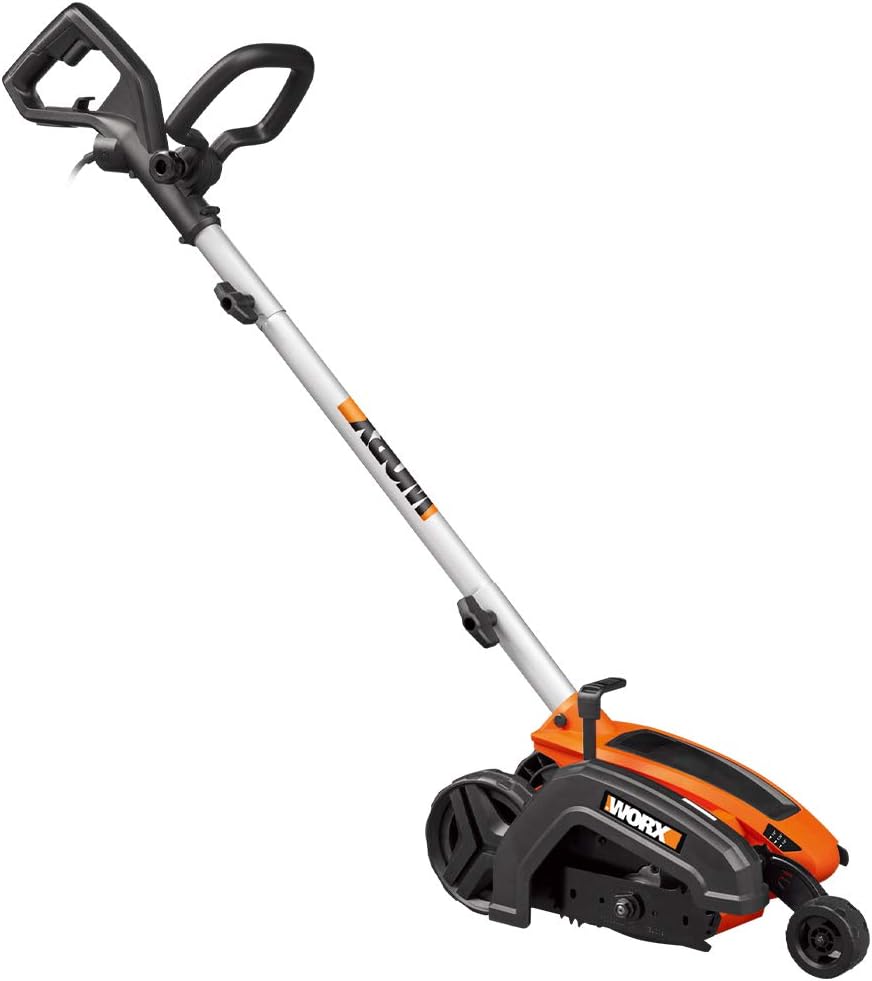
The WORX WG896 is a corded electric edger that uses a 7.5" serrated steel blade driven by a 12‑amp motor to cut clean, deep edges around sidewalks, driveways, and planting beds or to trench for low‑voltage wire. It is typically used by walking the unit along the lawn edge while aligning the cutting line indicator for straight results; a three‑position depth selector (1", 1‑1/4", 1‑1/2") and an adjustable shaft make it comfortable for most users. Notable features include a high‑speed blade (about 4700 rpm), a wear indicator on the blade, and a relatively lightweight 14 lb body that is easier to maneuver than heavier gas machines. Because it is corded, you get consistent power for extended jobs without battery swaps, but you must use a proper outdoor extension cord and avoid wet conditions. The serrated blade delivers more defined edges than string trimmers, yet it requires occasional blade replacement and cannot be used in saturated soil. For buyers who prefer straightforward, powerful electric equipment, this model balances performance and ease of use for tidy, professional‑looking edges.
Best for: Buyers who want reliable, no‑surprises electric power and a tool that makes crisp, professional lawn edges with minimal fuss and maintenance.
Less Ideal for: Those who need cordless portability for large properties away from outlets or who frequently work in very wet conditions should consider battery or gas alternatives.
- Powerful 12‑amp motor for consistent cutting performance
- Three adjustable cutting depths for edging and shallow trenching
- 7.5" serrated steel blade with wear indicator for defined, professional edges
- Lightweight design and adjustable shaft improve maneuverability and user comfort
- Corded power requires an outdoor extension cord and limits mobility
- Not suitable for use in wet or saturated ground
Verdict: A dependable, corded electric edger that delivers professional, deeply defined lawn edges with simple controls and low maintenance.
CKLT 41in Lawn Border Edger with Spring Steel Serrated Blade

| Material Type | Manganese Steel |
|---|---|
| Blade Type | Serrated Spring Steel |
| Footplate Width | 8-inch |
| Handle | Long Rubber Handle |
The CKLT 41in lawn edger is a straightforward manual tool for creating clean edges along driveways, sidewalks, and flower beds. It uses a serrated spring steel blade that resists bending and holds an edge longer than standard flat blades, and a rust-resistant finish that simplifies cleaning after use. The 8-inch wide footplate gives good leverage so you can apply steady pressure without awkward footing, while the long rubber handle improves reach and control for straight lines and smooth curves. Assembly is basic and guided with included fasteners and an L-shaped wrench. This is best for homeowners who prefer a quieter, eco-friendly alternative to powered trimmers and who want a durable hand tool for regular lawn maintenance. Limitations are those common to manual edgers: it requires physical effort for long runs and is slower than a powered trimmer for large properties, and deep compacted soil may need prior loosening for optimal cutting performance.
Best for: Homeowners who want a reliable, low-maintenance hand tool to keep lawn and garden borders tidy without using powered equipment, and who value durability and precise, neat edging.
Less Ideal for: Large properties or commercial landscaping where faster, motorized edging is needed or where users have limited ability to perform physical yard work.
- Serrated spring steel blade holds a sharp edge and resists deformation
- Rust-resistant finish and water-resistant design for easier cleaning and durability
- 8-inch wide footplate provides good leverage for comfortable pressure application
- Long rubber handle improves reach and control for straight and curved edging lines
- Manual tool requires physical effort and is slower for large areas
Verdict: Choose this edger if you want a durable, low-tech tool that delivers crisp, precise lawn edges without power tools.
Choosing the Right Sidewalk Lawn Edger: Key Factors to Consider
Blade Type and Edge Geometry
The blade design determines how cleanly the edger severs the turf at the sidewalk's edge. A thin, sharp blade with a defined bevel will slice roots and stems with less tearing, leaving a neater vertical face. Wider or rounded blades can be better for trimming across soft soil but may struggle to keep a crisp edge against compacted turf.
Edge geometry also affects how often you need to resharpen. A very acute bevel cuts cleanly but dulls faster when used against gritty, sandy soils. Hardened steels or replaceable blades reduce downtime and keep performance consistent across seasons.
Construction Materials and Corrosion Resistance
Materials and finish matter because sidewalk edging is abrasive and often wet. High-carbon or heat-treated steel blades resist deformation when cutting into roots and compacted soil. Shafts and fasteners exposed to moisture should have rust-resistant coatings or be made from stainless alloys to avoid weakening or seizing up.
Lightweight aluminum handles reduce carry weight but can bend under side loads. Forged steel components at attachment points and robust welds add longevity where leverage and impact are highest.
Operator Comfort and Reach
Edging sidewalks requires sustained straight motion, so handle height, grip texture, and overall reach affect fatigue and accuracy. Taller users need longer shafts to avoid bending, while adjustable-length tools let multiple people share a job comfortably. Padded grips, offset handles for better wrist alignment, and balanced weight distribution reduce soreness during longer stretches.
Consider how the tool feels when walking alongside a path. Excessively heavy heads may force uneven strokes, while poorly placed grips increase wrist strain and make keeping a straight line harder.
Sharpening, Replacement, and Serviceability
No blade stays sharp forever, especially when edging near gritty or sandy soil. Tools that allow blade removal with common hand tools make field sharpening or replacement faster. Simple bolt patterns and accessible edges save time and avoid trips back to the workshop.
Also consider how easy it is to clean debris and sap from moving parts. Sealed bearings or simple pivot joints reduce maintenance frequency and keep motion smooth under repeated use.
Ground Conditions and Blade Interaction
Soil type, compaction, and the presence of stones determine how an edger performs. In loose loam you can get away with thinner blades and lighter strikes. In compacted clay or gravelly fills you need sturdier blades and more robust construction to resist chipping and bending.
If your sidewalk runs through varied conditions, choose a versatile tool or one with replaceable blade options so you can swap to a sturdier edge when needed.
Portability and Storage
A sidewalk edger should be easy to store and move between sections of yard. Folding shafts or quick-detach handles make transport and winter storage simpler, especially if you keep gear in a small shed. Weight matters when you carry the tool between properties or up steps; lightweight designs help but should not compromise durability.
Also think about whether the tool needs seasonal removal and whether components can be disassembled without specialized equipment to save space during the off-season.
Manual Versus Powered Approaches
Hand-operated sidewalk edgers are simple, quiet, and require little maintenance. They give fine control for short runs and are ideal if you tidy sidewalks infrequently or prefer a low-cost, low-tech solution. You get predictable results with minimal setup, but manual tools demand more physical effort along long walks.
Powered options reduce labor on long stretches and in commercial settings but add weight, noise, and more maintenance items such as belts, motors, and fuel systems. For most homeowners maintaining a single sidewalk, a robust manual tool often offers the best balance of precision and upkeep.
- Manual tools: low maintenance, precise control, lighter cost to own
- Powered tools: less physical strain, higher upfront and ongoing maintenance needs
Maintaining a Straight Edge Over Time
Consistent technique is half the job. Walk the same pace, keep the blade vertical, and make overlapping cuts rather than trying to remove too much in one pass. For seasonal cleanup, start by removing loose debris, then make a shallow pass to establish the line and a second pass to deepen it if needed.
Routine sharpening and occasional blade replacement keep edges crisp. If a section sits in wet shade and the soil stays soggy, check the cut face more often because roots exposed to moisture can break down faster and create ragged edges.
- Use two passes for cleaner results
- Sharpen blades regularly based on soil grit
- Watch wet areas for faster edge degradation
Adapting Edging Technique to Sidewalk Shapes
Straight sidewalks are easiest, but many paths have curves, expansion joints, and slight grade changes. For curves, take smaller steps and use the tool at a slight angle to follow the contour while maintaining a vertical cut face. Expansion joints may require careful work to avoid knocking out filler material.
When encountering steps or elevated curbs, approach slowly and avoid levering the blade into hard edges. In tight spots, shorter-handled or offset tools help maintain control without damaging the concrete or the blade.
- Smaller steps and angled cuts for curves
- Avoid levering into expansion joints
- Use compact tools in tight or intricate sections
Seasonal Care and Winter Preparation
Before winter, clean soil and plant debris from blades and moving parts and apply a light coat of rust-inhibitor oil to steel components. For tools with removable blades, consider storing the blade separately in a dry place. Tighten fasteners and check for wear so the tool is ready when spring cleanup begins.
In early spring, inspect for bent blades and re-sharpen as necessary. Frozen ground can damage blades, so avoid heavy edging when the soil is hard; wait for ground to thaw to preserve edge integrity.
- Clean and lightly oil steel parts before storage
- Store removable blades in a dry place
- Avoid edging on frozen ground
Accessory Options That Improve Results
Look for accessories that make the task easier such as blade guards for safe transport, quick-release shafts for storage, and sharpening jigs that match the blade angle. Some edgers offer interchangeable blades tailored for soft soil or compacted turf.
Simple add-ons like an adjustable depth guide or foot-operated step plates can help keep a uniform cut depth and reduce the need for rework later.
- Sharpening jigs preserve blade angle
- Depth guides produce uniform edges
- Quick-release shafts simplify storage and transport
How We Chose the Best Sidewalk Lawn Edger
We evaluated sidewalk lawn edgers on concrete, performance, durability, ergonomics, and maintenance needs to create a practical shortlist for homeowners and groundskeepers. Cut precision and blade design were primary considerations because a consistent, vertical cut is what keeps sidewalks clean and prevents turf encroachment. Durability focused on blade steel, corrosion resistance, and overall construction so tools last through abrasive use and moisture exposure. Ease of handling and operator fatigue were assessed by looking at shaft length, grip comfort, and required user force to maintain straight lines. Maintenance and serviceability included how easy it is to sharpen or replace blades, access fasteners, and perform routine cleaning. Terrain adaptability covered how well a tool handles different soil compaction levels and small grade changes along sidewalks. We excluded specialty landscape machinery and solutions intended for commercial heavy-construction crews, focusing instead on tools suitable for residential or light commercial sidewalk maintenance. The final picks met minimum standards across the concrete-cutting precision, structural robustness, user ergonomics, and serviceability criteria listed above.
FAQ
How often should I sharpen my sidewalk edger blade?
It depends on soil grit and frequency of use. For sandy or gravelly soils sharpen every few sessions. In softer loam, a couple of times per season is often enough. Inspect the edge visually; if it tears grass instead of slicing, it needs attention.
Can I use a lawn edger on both grass and soil next to a sidewalk?
Usually yes. Most sidewalk edgers handle turf and the shallow soil next to concrete. For deeply compacted soil or heavy roots you may need a sturdier blade or a different tool to avoid damage and maintain a clean edge.
Is it better to do multiple shallow passes or one deep pass?
Multiple shallow passes are gentler on blades and give a cleaner finish. A shallow first pass sets the line and a second pass deepens it without forcing the blade through too much material at once, which reduces chipping and operator fatigue.
What should I avoid when edging near expansion joints?
Avoid levering the blade into the joint or applying heavy side force that could dislodge filler material. Work carefully along the joint edge and, if needed, use a smaller or angle-adjustable tool to avoid damage.
How do I prevent rust and corrosion on my edger?
Clean soil and moisture off metal parts after use and apply a light coat of oil before storage. Store the tool in a dry place and tighten or replace any corroded fasteners to keep components operating smoothly.
Final Verdict
Prioritize a sidewalk lawn edger that balances cut precision and durable construction for the conditions along your walkways. If you have compacted soil, choose sturdier blade materials and serviceable designs. If you maintain short runs and value low maintenance, a well-built manual edger with comfortable ergonomics will often be the best fit. Consider the tradeoffs between lightweight portability and long-term durability. Focus on blade geometry, corrosion resistance, and how the tool feels in use. With those priorities in mind you can choose a sidewalk edger that keeps sidewalks neat and reduces time spent on seasonal touchups.
