

Note: This article contains affiliate links. If you click on these links and make a purchase, I may earn a small commission at no extra cost to you. This helps support my research and content. Read my full affiliate disclosure here.
A professional lawn edger makes the difference between a neat, finished landscape and a yard that looks unfinished even after mowing. If you manage large properties, commercial jobs, or simply demand clean, repeatable edges around beds, walkways, and driveways, the right edger saves time and keeps lines crisp. This guide covers the top shortlisted professional lawn edgers suitable for heavy-use yards and frequent maintenance. We assessed durability, cut precision, serviceability, and real-garden handling so you can pick a tool that stands up to regular work. Read on for the evaluation criteria and practical buying guidance before the product list.
Top Picks at a Glance
| Best Overall The best all-around choice for most situations | EARTHQUAKE 41273 79cc 4-Cycle Walk-Behind Edger |  |
| Best Quality Built to a higher standard if you want something more solid | DEWALT 60V MAX Cordless Attachment-Capable Lawn Edger Kit (DCED472X1) |  |
| Best Value The sweet spot between price and what you get | Greenworks 40V 8" Brushless Cordless Lawn Edger with 4.0Ah Battery and Charger |  |
| Highest Rated A top-rated pick with lots of positive feedback | Milwaukee M18 FUEL Edger (Bare Tool, Model 3011-20) |  |
| Best Seller A high-volume bestseller chosen again and again | WORX WG896 7.5" 12-Amp Corded Electric Lawn Edger & Trencher |  |
EARTHQUAKE 41273 79cc 4-Cycle Walk-Behind Edger

| Engine | 79cc 4-Cycle Viper engine |
|---|---|
| Blade speed | Spins at 3400 RPMs |
| Cutting angles | 5 positions up to 20 degrees each direction |
| Edging depth | Adjustable from 0.5 to 3.5 inches |
The Earthquake 41273 is a robust walk-behind edger designed to create crisp borders around lawns, sidewalks, driveways and flowerbeds. It uses a 79cc 4-cycle Viper engine so you do not need to mix gas and oil, and a variable-speed throttle helps you start cuts and slow down for corners. The tri-tip steel blade spins at high speed and the head pivots through multiple angles to do straight or beveled edges, while ten depth settings let you trim shallow touch-ups or cut deep into roots for cleaner regrowth control. The balanced four-wheel layout improves stability and handling compared with handheld units, and the built-in cup and tool holder is a practical convenience for short jobs. Because it is a gas machine it delivers power for longer runs and light trenching work such as burying cables, but it is heavier and needs fuel and basic engine maintenance compared with electric or battery models. Expect clearer, more professional-looking edges if you are comfortable storing and servicing a gas engine tool.
Best for: Buyers who prioritize efficient, professional-looking edging and need a durable gas tool for frequent or larger jobs around lawns, driveways and beds. Ideal for users who value cutting power and precise control over convenience of cordless options.
Less Ideal for: Not a good fit for small yards or users who prefer low-maintenance, quieter cordless or electric tools or who cannot accommodate gas engine upkeep.
- Powerful 79cc 4-cycle engine removes need to mix gas and oil and supplies sustained cutting power
- Variable-speed throttle for controlled starts and maneuvering around corners
- Tri-tip steel blade and multi-angle head produce cleaner, straighter and beveled edges
- Ten depth settings let you match shallow touch-ups or deeper cuts into roots
- Four-wheel design improves stability and handling versus three-wheel or handheld edgers
- Heavier and bulkier than electric or battery options so it requires more storage space and effort to move
- Requires regular engine maintenance and fuel unlike cordless electric alternatives
Verdict: Choose the Earthquake 41273 if you want a powerful, stable gas edger that delivers precise, professional borders and handles heavier edging and light trenching tasks.
DEWALT 60V MAX Cordless Attachment-Capable Lawn Edger Kit (DCED472X1)

| Power Source | Battery Powered |
|---|---|
| Cutting width | 7.5 inches |
| Number of Batteries | 1 Lithium Ion (included) |
The DEWALT 60V MAX cordless edger is a high-power, battery-operated tool designed for neat lawn borders and trimming overgrowth along walkways and beds. It uses a brushless motor for improved runtime and durability, a 7.5-inch hardened steel blade for clean cuts, and an adjustable blade depth up to 2.5 inches so you can control how deep you cut. The large guide wheel and variable trigger with hi/lo speed settings make it easier to move and dial in performance depending on turf thickness. A practical advantage is its universal attachment capability so you can expand the platform with compatible add-ons for other tasks. Expect straightforward operation and robust cutting for typical yard sizes, though the unit is optimized around its battery runtime and will perform best when used in increments or with charged spare batteries for larger jobs.
Best for: Buyers who want a durable, cordless edger that balances power, maneuverability, and expandability for regular home lawn maintenance and occasional heavier edging tasks.
Less Ideal for: Property managers or pros who need uninterrupted heavy-duty, all-day edging should consider commercial gas-powered models instead.
- Brushless motor for better efficiency and longer runtime compared with brushed designs
- 7.5-inch hardened steel blade delivers clean edging and can handle overgrowth
- Adjustable blade depth up to 2.5 inches for precise control of cut depth
- Large guide wheel and variable speed trigger improve maneuverability and user control
- Universal attachment capability expands the tool into a multi-task platform
- Runs on a single included battery so long sessions may require a spare or breaks to recharge
- Not aimed at heavy commercial continuous-use workflows where dedicated gas equipment may be preferred
Verdict: Choose this DEWALT edger if you want a powerful, cordless, and expandable tool that delivers clean professional-style edges for regular home lawn care.
Greenworks 40V 8" Brushless Cordless Lawn Edger with 4.0Ah Battery and Charger

| Blade size | 8 in |
|---|---|
| Voltage | 40V |
| Battery capacity | 4.0 Ah |
| Motor type | Brushless |
The Greenworks 40V 8" cordless edger is built to give a neat, professional edge without the noise and fuss of gas equipment. It pairs a brushless motor with an 8-inch hardened steel blade to cut cleanly through grass and compacted soil, and the kit includes a 4.0Ah 40V battery and charger so it is ready to use out of the box. Tool-less depth adjustment makes it simple to change cutting depth for sidewalks, driveways, patios, and garden beds, and the unit is designed to stay stable on uneven or sloped terrain for consistent results. Practical benefits include quieter operation, lower maintenance than gas models, and lighter weight that reduces fatigue during longer sessions. Limitations to note are the runtime limits inherent to a single 4.0Ah battery for large properties and the 8-inch blade size, which is ideal for detail work but slower for very long edges. For typical residential yards it balances power, convenience, and ease of use effectively.
Best for: Homeowners who want a low-maintenance, cordless edger that produces clean, professional-looking borders around driveways, sidewalks, patios, and beds and who value quieter operation and easy setup.
Less Ideal for: Landscapers or property owners with very large lawns who need extended runtime or faster coverage should consider a model with larger batteries or a wider cutting capacity.
- Brushless motor for stronger cutting performance, quieter operation, and longer motor life
- Includes 4.0Ah 40V battery and charger so the tool is ready to use immediately
- Tool-less depth adjustment allows quick changes without tools
- Designed for stable, controlled edging on uneven or sloped terrain
- Single 4.0Ah battery may limit continuous runtime on larger yards
- 8-inch blade is better for precision edging than rapid coverage of long borders
Verdict: A convenient, brushless 40V cordless edger that delivers precise, quiet edging and is ready to use with the included 4.0Ah battery and charger.
Milwaukee M18 FUEL Edger (Bare Tool, Model 3011-20)

| Speed | 6000 rpm |
|---|---|
| Voltage | 18 volts |
The Milwaukee M18 FUEL Edger is a cordless, brushless edger intended for homeowners or pros who want a reliable electric alternative to small gas machines. It uses Milwaukee's POWERSTATE brushless motor to reach 6000 rpm, which translates to fast, consistent cutting along lawn edges and sidewalks without the fuss of fuel mixing or choke systems. As a bare tool the unit is lightweight and balanced for reduced fatigue during longer edging runs, and compatibility with the larger M18 battery ecosystem means you can reuse batteries if you already own Milwaukee tools. Practical benefits include quieter operation, simpler maintenance, and instant starts compared with gas models. Important limitations are that the listing is for the bare tool only so you must provide an M18 battery and charger, and run time will depend on the battery you pair with it. For buyers prioritizing a durable, high-performance cordless edger that integrates into an existing M18 setup, this model delivers dependable power and easy upkeep; if you need a complete kit with battery included look elsewhere.
Best for: Homeowners or contractors who prioritize a durable, low-maintenance cordless edger and who already own or plan to use Milwaukee M18 batteries to maximize uptime and reliability.
Less Ideal for: Buyers who want an all-in-one kit with battery and charger included or those who need very long runtime per charge without owning high-capacity M18 batteries.
- Brushless POWERSTATE motor rated at 6000 rpm for consistent, high-speed edging
- Cordless M18 platform compatibility lets owners reuse existing Milwaukee batteries
- Lightweight, balanced design reduces operator fatigue during extended use
- Quieter and lower-maintenance operation compared with small gas edgers
- Sold as a bare tool so battery and charger are not included
- Run time and performance depend on which M18 battery you supply
Verdict: Choose this M18 FUEL edger if you want a dependable, high-speed cordless edger that fits into the Milwaukee battery ecosystem.
WORX WG896 7.5" 12-Amp Corded Electric Lawn Edger & Trencher
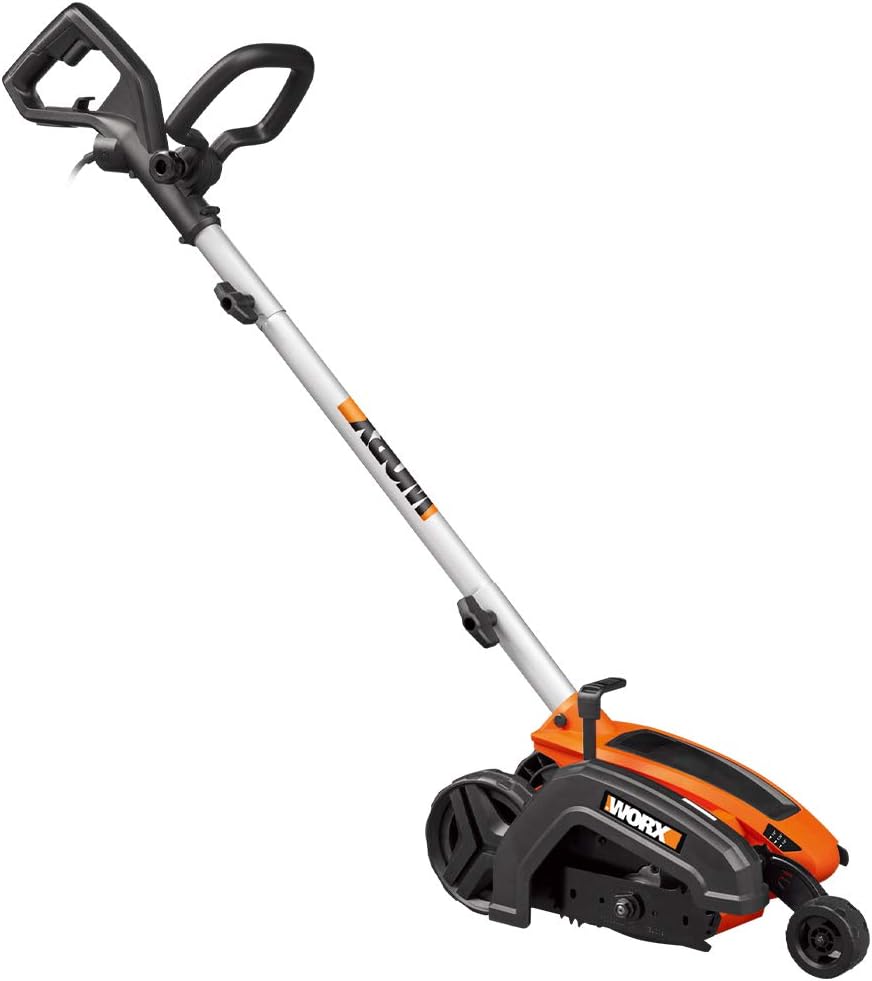
| Power Source | Corded Electric |
|---|---|
| Cutting width | 7.5 inches |
| Motor | 12 Amps |
| Depth settings | 1", 1-1/4", 1-1/2" |
| Included components | 7.5" blade |
The WORX WG896 is a corded electric edger that uses a 7.5" serrated steel blade driven by a 12‑amp motor to cut clean, deep edges around sidewalks, driveways, and planting beds or to trench for low‑voltage wire. It is typically used by walking the unit along the lawn edge while aligning the cutting line indicator for straight results; a three‑position depth selector (1", 1‑1/4", 1‑1/2") and an adjustable shaft make it comfortable for most users. Notable features include a high‑speed blade (about 4700 rpm), a wear indicator on the blade, and a relatively lightweight 14 lb body that is easier to maneuver than heavier gas machines. Because it is corded, you get consistent power for extended jobs without battery swaps, but you must use a proper outdoor extension cord and avoid wet conditions. The serrated blade delivers more defined edges than string trimmers, yet it requires occasional blade replacement and cannot be used in saturated soil. For buyers who prefer straightforward, powerful electric equipment, this model balances performance and ease of use for tidy, professional‑looking edges.
Best for: Buyers who want reliable, no‑surprises electric power and a tool that makes crisp, professional lawn edges with minimal fuss and maintenance.
Less Ideal for: Those who need cordless portability for large properties away from outlets or who frequently work in very wet conditions should consider battery or gas alternatives.
- Powerful 12‑amp motor for consistent cutting performance
- Three adjustable cutting depths for edging and shallow trenching
- 7.5" serrated steel blade with wear indicator for defined, professional edges
- Lightweight design and adjustable shaft improve maneuverability and user comfort
- Corded power requires an outdoor extension cord and limits mobility
- Not suitable for use in wet or saturated ground
Verdict: A dependable, corded electric edger that delivers professional, deeply defined lawn edges with simple controls and low maintenance.
Choosing the Right Professional Lawn Edger: Key Factors to Consider
Blade Material and Edge Holding
The blade is the part that actually cuts through turf, sod, and occasional roots, so metallurgy and heat treatment make a big difference. Hardened steel or alloy blades maintain a sharp edge longer and resist chipping when contacting small stones or compacted soil. Longer edge life reduces downtime for resharpening and keeps lines clean across multiple passes.
Blade mounting and replacement design also affect maintenance time. Look for blades that are easy to remove and replace without specialty tools. Consider whether the blade profile suits the kind of edge you want – a narrow vertical profile slices turf cleanly for crisp borders, while wider or fluted blades can be better for removing thicker sod.
Power Source and Torque Delivery
Professional edgers may use petrol engines, commercial electric motors, or hydraulic drives, and each delivers power differently. High torque at low revs helps push through thick roots and firm soil without bogging, which matters more in compacted or clay-heavy yards. Fuel and power delivery characteristics also affect how smooth the cut feels and how often you need to reposition the tool.
Consider how the power source fits your work style. Gas engines offer runtime and quick refueling for long jobs, while electric options give quieter operation and cleaner emissions in urban or noise-restricted areas. Also evaluate cooling, air intake protection, and drive components since these influence longevity in dusty outdoor conditions.
Depth Control and Cut Precision
Accurate depth control determines how deep the edger will cut and how uniform the finished line looks. Adjustable depth systems let you set consistent cutting across different turf heights and soil conditions, which is essential for professional-grade edges. A reliable guide wheel or adjustable skid helps maintain a steady stance and prevents the blade from wandering when you are walking along long borders.
Precision features matter for aesthetic results and to avoid overcutting into plant beds or irrigation lines. Controls that lock firmly in place reduce mid-job drift, and repeatable settings speed up work when you need to recreate the same profile across multiple sites.
Frame Construction and Impact Resistance
A professional edger must withstand knocks from curbs, stones, and repeated transportation. Heavy-gauge steel frames, reinforced mounts, and vibration-dampening connections reduce metal fatigue and keep components aligned. Robust construction also protects internal drive components from shock and helps preserve factory tolerances for cut accuracy over time.
Evaluate how the frame handles service points such as bearings and seals. Frames that provide easy access to wear items speed repairs on the jobsite and lower long-term maintenance costs. Corrosion resistance and quality coatings extend service life in wet or salty environments.
Operator Comfort and Usability
Comfort matters when you run an edger for hours. Ergonomic handles, vibration isolation, and logically placed controls reduce fatigue and improve accuracy on long straight runs. Good balance and adjustable handle height make it easier to maintain a consistent walking pace and blade angle, which directly correlates with the finished edge quality.
Usability also covers tool setup and transport. Quick-adjust depth systems, foldable or removable handles, and simple controls speed transitions between jobs. Consider how intuitive the tensioning, blade swap, and maintenance points are, since straightforward design means less downtime and fewer mistakes in the field.
When a Professional Edger Is Worth the Upgrade
If you manage multiple properties, maintain commercial landscapes, or simply need perfectly repeatable edges, professional edgers repay their upfront effort in longevity and consistency. They are built to tolerate frequent impacts and extended runtime, which keeps lines true and maintenance intervals longer than consumer-grade units.
For homeowners with a single small lawn, a professional unit may be overkill unless you expect to scale up maintenance tasks or need heavy-duty performance around thick turf and compacted soil.
- High-use properties and commercial contracts
- Large yards with extensive paved borders
- Landscape contractors needing quick serviceability
Maintenance Routines That Prolong Life
Regular cleaning, proper blade sharpening, and routine inspection of bearings and seals keep a professional edger operating at peak. After each use, remove soil and debris from the blade housing and drive area to prevent abrasive wear. Inspect blade edges for nicks and regrind before damage propagates.
Scheduled lubrication of pivot points and checking belt or chain tension prevents premature failure. Replace wear parts proactively rather than waiting for catastrophic failure, especially before heavy seasons.
- Clean cutting area after each job
- Sharpen or replace blades on visible wear
- Lubricate bearings and check drive tension periodically
Operating Techniques for Cleaner Lines
Walk at a steady pace and keep the blade vertical where possible to maintain an even cut. For stubborn turf, make two shallower passes rather than trying to gouge the full depth in a single pass. Use depth stops as your reference rather than relying on sight alone, which helps maintain consistency across long runs.
When edging next to beds or planted areas, angle the blade slightly away from root balls and watch for hidden irrigation lines. Slow down near curves and obstacles to avoid wandering or digging too deep.
- Use steady walking speed and consistent depth settings
- Make multiple shallow passes for dense turf
- Slow down around curves and planted beds
Transport, Storage, and Jobsite Safety
Secure the edger in a truck bed or trailer with straps that do not rub on critical controls or exposed bearings. Use blade covers or position the blade away from other equipment during transport to prevent accidental damage. Store in a dry, ventilated space to reduce corrosion risk and relieve tension on belts or sprockets during long storage.
On the jobsite, use hearing protection and eye protection as standard. Keep bystanders away from the cutting area and follow local regulations for engine noise and emissions. If working in wet conditions, be mindful of traction and electrical safety for corded models.
- Secure and protect blades during transport
- Store in dry, ventilated area
- Use PPE and manage bystander safety
How We Chose the Best Professional Lawn Edger
We prioritized durability and consistent cutting performance because professional operators need tools that stay true under heavy use. Key criteria included blade metallurgy and mount design for edge holding, motor or drive robustness for steady torque, and overall chassis strength to withstand repeated impacts from curbs and compacted soil. Serviceability and parts availability were essential for reducing downtime, while ergonomic controls and vibration damping mattered for long shifts and operator comfort. We also weighed precision features such as depth control and guide systems that influence line consistency in real yards. Excluded were light-duty consumer models and hobby-grade tools that lack replaceable heavy-duty components or commercial-rated drives. We focused on units built for frequent, prolonged use and giving reliable results across a range of landscape conditions. The shortlisted picks meet these filters and score well across the specific criteria described above.
FAQ
How deep should I set a professional lawn edger for a clean border?
Depth depends on turf type and desired look, but many pros use a setting that severs roots just below the soil surface, typically 1.5 to 3 inches. Shallow cuts suffice for maintenance, while deeper passes are used when establishing a new edge.
Can a professional edger handle compacted soil and small roots?
Yes, units with higher torque and hardened blades are designed for compacted soil and light roots. For large roots or very compacted clay, plan for multiple passes or preliminary loosening to avoid excessive blade wear.
How often should blades be sharpened or replaced on a professional edger?
Frequency depends on use intensity and soil conditions. Inspect blades after each job and sharpen when edges show dulling or chipping. Heavy commercial use may require blade attention every few weeks, while lighter schedules allow longer intervals.
Are electric professional edgers practical for long jobs?
Electric options can work well in areas with access to power or with industrial battery systems. They offer quieter operation and lower maintenance, but consider runtime and power delivery for extended jobs. Gas-driven models generally provide longer continuous runtime without recharging.
What maintenance should I do before storing the edger for winter?
Clean all soil from the blade and housing, remove or protect blades, drain or stabilize fuel in gas models, and lubricate moving parts. Store in a dry place off the ground and inspect seals and belts before returning to service in spring.
Final Verdict
Choosing a professional lawn edger comes down to matching build robustness and torque delivery with the kinds of soil and workload you face. Prioritize blade metallurgy and chassis strength if you expect constant impacts and heavy turf, and favor precise depth controls and comfortable ergonomics if finish quality and operator endurance matter most. Consider serviceability and parts access as a practical tie-breaker because downtime costs add up. Focus on the criteria that align with your daily tasks, and you will find a professional edger that delivers consistent, long-lasting edges.
