

Note: This article contains affiliate links. If you click on these links and make a purchase, I may earn a small commission at no extra cost to you. This helps support my research and content. Read my full affiliate disclosure here.
Choosing the right balanced lawn fertilizer affects more than color. The right ratio and application schedule influence root depth, even growth, and how your turf responds to drought, mowing, and traffic. This guide looks at six top options shortlisted for home lawns with an emphasis on steady, balanced nutrient delivery and gardener-friendly application. We assess each option on nutrient profile, ease of application, and turf response to give you practical choices for improving uniformity and long-term lawn health. Read on to compare the characteristics that matter most for common lawn care plans.
Top Picks at a Glance
| Best Overall The best all-around choice for most situations | Supply Solutions 10-10-10 Complete Granular Fertilizer with Micronutrients (50 lb) |  |
| Best Quality Built to a higher standard if you want something more solid | The Andersons PGF Balanced 10-10-10 Granular Fertilizer with Micronutrients and 2% Iron (18 lb, 5,000 sq ft) |  |
| Best Value The sweet spot between price and what you get | GreenView Multi-Purpose Fertilizer 10-10-10, 33 lb |  |
| Best Budget The cheapest option that still gets the job done reliably | Southern Ag All Purpose Granular Fertilizer 10-10-10 (5 lb) |  |
| Highest Rated A top-rated pick with lots of positive feedback | CountryMax 15-15-15 All Purpose Granular Fertilizer (50 lb) |  |
| Most Popular A crowd favorite that many people choose with confidence | Scotts Turf Builder WinterGuard Fall Lawn Food, 10 lb. |  |
Supply Solutions 10-10-10 Complete Granular Fertilizer with Micronutrients (50 lb)

| Item Form | Granules |
|---|---|
| Application Method | Soil application |
| Coverage | 1000 square feet |
| Target Species | Plants, Lawn Grass, Vegetables, Fruits |
| Mixing Ratio | 10:10:10 |
This Supply Solutions 10-10-10 granular fertilizer provides an all-purpose NPK blend with added micronutrients to support lawns, vegetables, and ornamentals. It is designed for soil application and typically broadcast across turf or worked into garden beds during soil preparation or regular feeding cycles. Notable features include a balanced 10-10-10 ratio, micronutrients such as iron and zinc to correct deficiencies, and Nutripaction technology that produces uniform, low-dust granules for even spread and gradual nutrient release. Practical benefits are consistent feeding for foliage, blooms, and root strength, easier mixing with compost or other NPK products, and guidance to adjust application rate based on soil tests. Important limitations are that it is a conventional granular fertilizer rather than a slow-release polymer-coated product, so feeding longevity depends on application rate and soil conditions, and recommended rates reference acres which may require conversion for small lawns. This is a straightforward, multi-use option for gardeners who want a balanced starter or maintenance fertilizer with the convenience of even spreading.
Best for: Gardeners and homeowners who want a practical, no-frills balanced fertilizer to maintain lawns and mixed garden beds and who prefer an easy-to-spread granular product they can tailor with soil test results.
Less Ideal for: People seeking a guaranteed multi-month slow-release fertilizer or those who need pre-measured, super-fine dosing for small container or indoor plants.
- Balanced 10-10-10 NPK supports foliage, blooms, and root development
- Includes micronutrients (iron, zinc, manganese, copper, boron) to correct common soil deficiencies
- Uniform low-dust granules for even spreading and easier mixing
- Designed for versatility across lawns, vegetables, fruits, and ornamentals
- Not a polymer-coated slow-release formula so longevity varies with soil and weather
- Application guidance given in lbs/acre which may be less convenient for small residential lawns
Verdict: A reliable, balanced granular fertilizer with added micronutrients that makes it easy to maintain healthy lawns and mixed garden beds when you want straightforward, adjustable feeding.
The Andersons PGF Balanced 10-10-10 Granular Fertilizer with Micronutrients and 2% Iron (18 lb, 5,000 sq ft)

| Item Form | Granules |
|---|---|
| Application Method | spreader |
| Coverage | 5000 square feet |
| Mixing Ratio | 10-10-10 |
| Target Species | Lawns and Gardens |
The Andersons PGF Balanced 10-10-10 is a fine-particle granular fertilizer designed for broad, even coverage across lawns and garden beds. It is typically applied with a broadcast spreader and then watered in to activate the quick-release nutrients. The unusually small particle size means a single 18 lb bag claims coverage up to 5,000 sq ft and helps reduce patchy feeding compared with coarse granules. The formula is balanced for nitrogen, phosphorus and potassium and includes micronutrients plus 2% iron for enhanced greening. It works well for spring and fall applications, for establishing new turf or boosting established lawns, and can be worked into soil for vegetable or flower beds. Users should sweep or blow product off paved surfaces to avoid iron staining and store any leftover in a dry area. Because the fertilizer is quick-release, expect faster visible response but shorter duration between applications than slow-release products.
Best for: Homeowners who prioritize consistent, dependable feeding and want a straightforward granular option that gives quick visible results across lawns and planting beds.
Less Ideal for: Gardeners seeking a long-duration, slow-release feeding program or those who need a no-iron product to avoid any risk of surface staining.
- Very fine particle size for more even coverage and less patchy feeding
- Balanced 10-10-10 formula with added micronutrients and 2% iron for deeper greening
- Suitable for lawns, gardens, trees and shrubs and can be applied at planting or during the season
- Covers up to 5,000 sq ft from a single 18 lb bag when applied as directed
- Quick-release nutrients mean results appear sooner but may require more frequent reapplication versus slow-release formulas
- Contains iron that can stain sidewalks and driveways if not cleaned off immediately
Verdict: Choose this fine-particle 10-10-10 if you want a reliable, fast-acting granular fertilizer that delivers even coverage and deeper greening for summer lawn care.
GreenView Multi-Purpose Fertilizer 10-10-10, 33 lb

| Item Form | Granules |
|---|---|
| Application Method | broadcast or drop spreader |
| Specific Uses For Product | Plant Growth, Root Development, Seed Development, Soil Conditioning |
| Target Species | Trees, Shrubs, Vegetables, Flowers, Ornamental Gardens |
GreenView 10-10-10 is a granular, balanced fertilizer designed for routine feeding across mixed garden beds. It is applied with a broadcast or drop spreader and can be used when planting or as a general feed to support plant growth, root development, and seed establishment. The product's NPK 10-10-10 formulation supplies nitrogen, phosphorus, and potassium in equal measure, which makes it a safe choice when you need broad-spectrum nutrition without strengthening one growth phase excessively. The bag covers a large area so it is convenient for medium to large beds and mixed plantings. Important practical notes are that it is intended to be distributed with a spreader rather than hand spread and that label directions differ by plant type, so following coverage and timing guidance is important. For gardeners that prefer tailored, soil-test-based fertilization or slow-release formulations targeted to a single crop, this general-purpose granular will be less specific than specialty blends.
Best for: Gardeners who want a single, straightforward fertilizer to maintain mixed garden beds and prefer a practical, easy-to-apply solution that covers multiple plant types.
Less Ideal for: Growers seeking a slow-release feed, highly targeted nutrient program, or formulas tuned to a specific crop or diagnosed soil deficiency.
- Balanced 10-10-10 NPK suitable for a wide range of vegetables, flowers, shrubs, and trees
- Granular form works with broadcast or drop spreaders for fast, even coverage
- Large coverage per bag makes it practical for multiple garden beds
- Supports plant growth, root development, and seed establishment
- Not a crop-specific or soil-test tailored formula for addressing particular nutrient deficiencies
Verdict: A single balanced granular fertilizer that delivers broad-spectrum nutrition and easy spreader application for maintaining mixed garden beds.
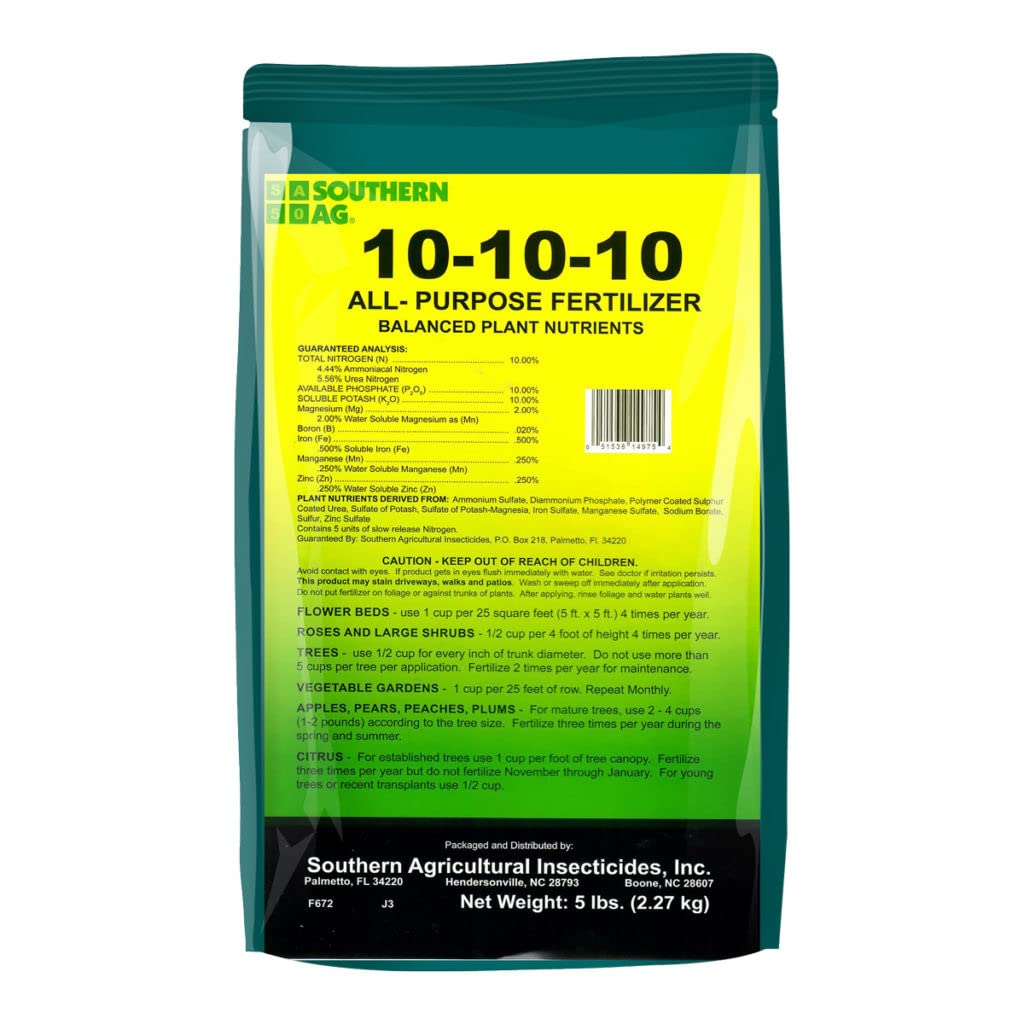
Southern Ag All Purpose Granular Fertilizer 10-10-10 (5 lb)
| Item Form | Granules |
|---|---|
| Specific Uses For Product | Citrus and Fruit Trees, Flowerbeds, Roses, and Large Shrubs, Vegetable Gardens |
| Application Method | Broadcast evenly over area and water in. |
| Mixing Ratio | 10:10:10 |
This 5 lb bag of Southern Ag 10-10-10 granular fertilizer is a straightforward, balanced all-purpose feed for vegetable beds, fruit trees, roses, and shrubs. You spread the granules uniformly over soil or beds and water them in; directions and recommended cup measurements are printed for common uses so dosing is easy. The formula supplies equal parts nitrogen, phosphorus, and potassium plus trace minerals like magnesium, iron, manganese, zinc, and boron, which supports steady vegetative growth and overall plant health. For asparagus specifically it can be used as a periodic maintenance feed during the growing season to support fern growth and energy storage in crowns. The product is simple to store and apply, and the small bag size is convenient for trialing on a single bed or patch. Limitations are that it is a general blend rather than a tailored asparagus formula, so heavy feeders or soils needing specific nutrient correction may require additional amendments, and granular broadcast feedings require careful placement to avoid contact with foliage or runoff risks described on the label.
Best for: Gardeners on a budget who want a simple, balanced fertilizer to maintain small asparagus patches and other mixed beds without buying specialty formulas.
Less Ideal for: Growers managing large asparagus plantings, or who need a targeted high-potassium or soil-specific amendment, should choose a crop-specific or soil-test-driven fertilizer.
- Balanced 10-10-10 N-P-K supports general growth and root development.
- Includes micronutrients (iron, manganese, zinc, boron) for broader plant nutrition.
- Clear application instructions and coverage rates for common garden uses.
- Small 5 lb size is convenient for testing on a single asparagus bed or small garden.
- Not formulated specifically for asparagus so may lack the higher potassium or phosphorus some heavy beds benefit from.
- Granular broadcast application can stain hard surfaces and requires watering after application to activate nutrients.
Verdict: A low-cost, easy-to-use balanced granular fertilizer that is a practical maintenance feed for small asparagus beds and mixed gardens.
CountryMax 15-15-15 All Purpose Granular Fertilizer (50 lb)

| Item Form | Granules |
|---|---|
| Application Method | Granular |
| Target Species | Plants |
| Mixing Ratio | 15-15-15 |
| Unit Count | 800 Ounce |
CountryMax 15-15-15 is a straightforward, balanced granular fertilizer intended for routine feeding across a farm or home landscape. You apply it by broadcasting or spreading over beds, lawns, or around shrubs and then watering it in; the equal N-P-K ratio is designed to support steady vegetative growth, root development, and overall plant performance without pushing one growth phase at the expense of others. The granular form makes it easy to store, measure, and apply with a spreader, and the product notes compatibility with edible crops when used as directed. For reliability-focused users the clear mixing ratio and simple directions reduce the chance of overapplication or inconsistent results. Limitations are that it is a general-purpose formula rather than a tailored blend for specific high-demand crops or soil deficiencies, so soil testing and supplemental amendments may still be needed for intensive production situations. Also, it is a dry bulk product that requires safe storage and standard handling precautions.
Best for: Farmers and landowners who want a dependable, general-purpose fertilizer for routine seasonal feeding and prefer straightforward application and predictable results.
Less Ideal for: Growers who need crop-specific, high-analysis blends or custom nutrient programs for intensive production should consider specialty or custom-mix fertilizers instead.
- Balanced 15-15-15 formula supports steady, all-around nutrient supply
- Granular form is easy to apply with a spreader and to store
- Suitable for a wide range of uses including flowers, vegetables, lawns, and shrubs
- Clear mixing ratio and directions lower the risk of inconsistent application
- Not formulated for crop- or soil-specific nutrient needs so may require additional amendments
- Bulk granular product requires dry, secure storage and handling precautions
Verdict: Buy this if you need a reliable, easy-to-apply balanced fertilizer for routine feeding across diverse farm or landscape plantings.
Scotts Turf Builder WinterGuard Fall Lawn Food, 10 lb.

| Item Form | Granules |
|---|---|
| Specific Uses For Product | Lawn Fertilizer |
| Application Method | spread |
| Coverage | 4000 |
| Target Species | lawn grasses |
Scotts Turf Builder WinterGuard is a granular fall lawn food designed to build strong, deep roots and help turf recover from summer heat, drought, and regular wear. It is applied with a broadcast or drop spreader over a lawn in autumn and can be used on any grass type. The bag covers about 4,000 sq. ft., and the package directions include recommended spreader settings and note that watering-in is optional for fast results. In practice this product provides a straightforward, DIY-friendly way to add nutrients before winter; the granules are easy to spread and work with standard spreaders. Notable features are its all-grass compatibility and clear application guidance. Limitations are that it is a single-season bag sized for small to medium yards and it does not include weed or insect control functions found in some other Scotts formulas, so you may need additional products if those issues are a concern. For homeowners wanting a simple autumn boost to root strength, this is an effective, no-frills option.
Best for: Homeowners who want a simple, reliable fall fertilizer to strengthen roots and help lawns recover from summer stress without complicated application steps.
Less Ideal for: People managing large lawns who need wide-coverage bulk fertilizer or those who want combined weed or insect control in the same product.
- Formulated specifically for fall to build deep, winter-ready roots
- Works on all grass types so it fits mixed lawns
- Clear application instructions and spreader settings for easy DIY use
- Covers 4,000 sq. ft. from a single 10 lb. bag for small to medium yards
- No built-in weed or insect control so additional products may be needed
- Single 10 lb. bag may be small for larger properties
Verdict: Choose this bag if you want an easy-to-apply fall fertilizer that strengthens roots and helps your lawn recover before winter.
Choosing the Right Balanced Lawn Fertilizer: Key Factors to Consider
Nutrient Ratio and Label Clarity
A true balanced fertilizer lists similar proportions of nitrogen, phosphorus, and potassium on the guaranteed analysis. That matters because maintenance feeding aims to support steady growth and root health rather than forcing a rapid green-up that increases mowing and water demand.
Clear labeling tells you exact nutrient percentages and any secondary nutrients or micronutrients included. That information helps you match the fertilizer to soil test recommendations and avoid unnecessary phosphorus or salt loads. Always check application rates in the context of your spreader settings and lawn square footage.
Release Type and Feeding Duration
Fertilizers come as quick-release, slow-release, or blends. Slow-release sources feed the grass over weeks, producing steadier color and reducing the risk of burn. Quick-release products deliver rapid green-up but can cause uneven patches and require more frequent mowing.
For balanced feeding, consider a product with a significant slow-release fraction or controlled-release coating. That reduces application frequency and helps turf maintain steady growth between treatments, which is especially useful if you have a busy yard care calendar.
Application Method and Spreader Compatibility
How a fertilizer spreads determines coverage uniformity. Granular blends should work with common broadcast or drop spreaders and list recommended settings. Liquid options need proper dilution and sprayer calibration. Uneven application is the most common cause of patchy growth after feeding.
Choose a formulation that matches the equipment you already own or are willing to use. Also consider how easy it is to calibrate and whether the product provides clear guidance for different spreader models and walking speeds.
Soil Conditions and Timing
Soil texture, drainage, and existing nutrient levels influence how turf responds to a balanced feed. Sandy soils leach nutrients faster and may benefit from smaller, more frequent applications, while heavier soils retain nutrients longer.
Timing matters too. Apply maintenance balanced fertilizer when grass is actively growing so plants can take up nutrients, and avoid applications right before heavy rain. Align feeding with your mowing and irrigation schedule to reduce runoff and get the most consistent results.
Turf Type and Performance Goals
Different grass species have different nutrient demands. Cool-season grasses typically benefit from earlier spring and fall feeding, while warm-season grasses respond to summer maintenance. Your performance goals – whether denser turf, slower growth, or stress tolerance – will influence the exact balance and feeding frequency you choose.
Match the fertilizer approach to the grass type and desired outcome rather than chasing the highest nitrogen number. Steady, balanced feeding often produces a healthier, more resilient lawn over time.
Environmental Impact and Responsible Use
Balanced fertilizers can still contribute to runoff and nutrient pollution if applied improperly. Look for products with directions that emphasize correct rates, buffer zones near water, and incorporation steps where appropriate.
Avoid overapplication and follow local guidelines for phosphorus use if your area restricts it. Responsible scheduling and proper calibration reduce environmental risk while delivering the benefits of balanced feeding to your lawn.
When to Use Balanced Fertilizer Versus Other Strategies
Balanced lawn fertilizer is best for regular maintenance when you want even growth without pushing explosive shoot flushes. It suits established lawns that need steady nourishment for color, density, and root strength rather than rapid green-up from high-nitrogen treatments.
- Maintenance feeding schedule: small to moderate doses during active growth periods
- Avoid heavy nitrogen spike treatments unless recovering from severe stress
- Coordinate with soil test recommendations to correct specific deficiencies
Calibrating Your Spreader for Even Coverage
Proper calibration is critical to avoid striping and over- or under-application. Use the product's recommended spreader settings as a starting point, then do a test pass over a measured area to confirm delivery rate. Adjust walking speed and hopper opening until measured application matches the target pounds per 1,000 square feet.
- Measure a 100 square-foot area for test runs
- Collect and weigh product applied to confirm rate
- Record settings for future applications to ensure consistency
Adjusting Rates for Lawn Size and Soil Type
Calculate fertilizer needs based on the square footage of turf and the product's nutrient percentages. For sandy soils or slopes, use lower rates more frequently to reduce leaching. For heavier soils, you can often use the recommended rate less frequently because nutrients remain available longer.
- Convert product label percentages into pounds of nutrient per 1,000 sq ft
- Reduce single-application rates on sandy sites and increase frequency
- Consider split applications in spring and fall for cooler climates
Combining Balanced Feeding with Cultural Practices
Fertilizer works best alongside good cultural care. Mow at the recommended height for your grass species, overseed bare patches, and maintain a sensible irrigation schedule to support nutrient uptake. Aeration in the fall or spring improves root access to applied nutrients and boosts long-term results.
- Aerate compacted areas before feeding for better root absorption
- Keep clippings short when aiming for thicker turf; leave clippings when practicing grasscycling
- Water lightly after application if the label permits, but avoid heavy irrigation that causes runoff
Monitoring Results and Adjusting the Plan
Track turf response after each application. Look for uniform color and growth rate rather than intense short-term green-up. If growth is too rapid, reduce the nitrogen fraction or lengthen the interval between feedings. If patches persist, check soil tests for pH or micronutrient issues that fertilizer alone will not fix.
- Keep a lawn journal with application dates and observed responses
- Use soil tests every 2 to 3 years to refine feeding strategy
- Adjust timing and rate based on season and stress events
How We Chose the Best Balanced Lawn Fertilizer
Our selection process focused on features that actually affect lawn health and ease of use. We prioritized balanced nutrient ratios that deliver comparable amounts of nitrogen, phosphorus, and potassium suited to maintenance feeding rather than aggressive surge growth. Application flexibility was essential, so we looked for products compatible with common spreaders and that allow for even coverage at typical residential rates. Release profile and feeding duration were evaluated to favor steady uptake over unpredictable spikes that can scorch turf or prompt excessive mowing. We also considered formulation stability and storage behavior so products maintain consistent nutrient content between uses. Environmental handling was part of the filter: we excluded products with unclear nutrient labeling or that relied primarily on excessive soluble salts likely to cause runoff. Finally, we filtered out products with inadequate directions for application timing or no guidance for different grass types. The resulting shortlist reflects items that balance turf response, user control, and responsible nutrient delivery.
FAQ
How often should I apply a balanced lawn fertilizer?
It depends on the release type and your soil. Slow-release formulas often need two to four applications per growing season, while quick-release products may be applied more frequently. Match frequency to the product label, soil type, and the grass species' growth cycle.
Will a balanced fertilizer prevent weeds?
No. Fertilizer feeds turf but does not control weeds. Dense, healthy turf can outcompete many weeds over time, but targeted weed control or overseeding may be necessary for problem areas.
Can I use balanced fertilizer after aeration?
Yes. Aeration improves root zone contact with nutrients and is a good time to apply balanced fertilizer. Apply at recommended rates and water lightly if the product instructions suggest it.
Is balanced fertilizer safe for pets and children?
Many products are safe once dry and applied per label directions, but safety varies by formulation. Keep people and pets off treated areas until the product has settled or the recommended re-entry time has passed.
Should I adjust rates based on soil test results?
Usually. Soil tests reveal existing nutrient levels and pH, which helps you choose an appropriate feeding rate. If tests show sufficient phosphorus or potassium, select a fertilizer and rate that avoids overapplication of those nutrients.
Final Verdict
Balanced feeding is about steady support rather than dramatic transformations. Prioritize a clear nutrient label, a release profile that suits your schedule, and a product that works with your spreader or sprayer. Combine feeding with aeration, proper mowing, and soil testing to get consistent results. With attention to application technique and timing, a balanced fertilizer will produce uniform growth and healthier turf over the long term.
