

Note: This article contains affiliate links. If you click on these links and make a purchase, I may earn a small commission at no extra cost to you. This helps support my research and content. Read my full affiliate disclosure here.
Summer is the time your lawn is under heat, drought stress, and heavy use. Choosing the right lawn fertilizer for mid summer affects color, recovery, and the risk of scorching or pushing growth when conditions are poor. The options shortlisted here are formulated to work in high temperatures and drier soils so you can maintain a healthy turf without encouraging weak, water-hungry flushes. This guide covers five top picks selected for mid-summer performance and includes clear evaluation criteria gardeners can use to match a fertilizer to their grass type and watering routine. Read on for practical notes about application timing, nutrient ratios, and safety precautions before the product list.
Top Picks at a Glance
| Best Quality Built to a higher standard if you want something more solid | The Andersons Professional PGF Complete 16-4-8 Granular Lawn Fertilizer (covers 5,000 sq ft) |  |
| Best Value The sweet spot between price and what you get | Scotts Green Max Lawn Food (16.67 lb) |  |
| Best Budget The cheapest option that still gets the job done reliably | Southern Ag All Purpose Granular Fertilizer 10-10-10 (5 lb) |  |
| Highest Rated A top-rated pick with lots of positive feedback | Milorganite 6-4-0 Slow-Release Fertilizer, 32 lb (with Feeding Tips Brochure) |  |
| Most Popular A crowd favorite that many people choose with confidence | Scotts Turf Builder Lawn Food, 12.5 lb |  |
The Andersons Professional PGF Complete 16-4-8 Granular Lawn Fertilizer (covers 5,000 sq ft)

| Item Form | Granules |
|---|---|
| Specific Uses For Product | Soil Conditioning |
| Target Species | lawn grasses |
| Unit Count | 288 Ounce |
| Mixing Ratio | 4-1-2 ratio |
This granular fertilizer is built to boost turf performance with a 16-4-8 N-P-K ratio that delivers both immediate and extended nitrogen release for up to eight weeks. It is typically applied with a broadcast spreader at the recommended rate on dry foliage, then lightly watered to activate the Humic DG technology that helps nutrients move into the root zone. Notable features include super-fine particles for even coverage, added iron and micronutrients for richer color, and a mix of quick and slow-release nitrogen for steady growth without frequent reapplication. Practical benefits for a performance-focused buyer are visibly greener turf, reduced application frequency, and improved soil conditioning from humic acids. Important limitations are that it is a granular product so precise spreader calibration and steady walking are required for uniform results, and it is not labeled for sale in California which restricts availability in that state.
Best for: Gardeners focused on high-performance, visibly greener lawns who want a single application product that delivers both immediate and extended feeding and supports soil health.
Less Ideal for: Small container gardeners or people who prefer liquid or organic-only fertilizer programs should consider other formats or formulations.
- Balanced 16-4-8 N-P-K with both quick- and slow-release nitrogen for immediate color and sustained feeding
- Super-fine particles designed for even distribution across the lawn
- Includes iron and multiple micronutrients to improve turf color and overall plant nutrition
- Humic DG additive to help move nutrients into the soil and support soil conditioning
- Requires correct spreader settings and consistent walking speed to avoid streaking
- Not available for sale in California
Verdict: Choose this fertilizer when you want a performance-focused granular formula that delivers quick color boost plus up to eight weeks of sustained feeding for greener grass.
Scotts Green Max Lawn Food (16.67 lb)

| Item Form | Granules |
|---|---|
| Coverage | 5000 square feet |
| Specific Uses For Product | Lawn |
| Target Species | lawn grass |
Scotts Green Max Lawn Food is a granular, all-purpose lawn fertilizer formulated to deliver fast greening with a 2-in-1 feed plus 5% iron supplement. It is applied with a broadcast or drop spreader to any grass type and is recommended for routine spring, summer, or fall applications. Notable features include a guaranteed nonstaining formula when used as directed and settings provided for Scotts spreaders to help get an even application across the advertised 5,000 sq ft coverage. The iron content speeds visible greening in as little as three days and the granules are ready to water in for faster uptake. For a risk-averse homeowner growing fescue in spring, the product is straightforward to use and safe to re-enter the lawn immediately after application. Limitations are that proper spreader settings and sweeping up excess product are important to avoid runoff and that it is a general lawn food rather than a specialized product for nutrient-deficient soils, so a soil test is still useful for targeted corrections.
Best for: Homeowners who want a low-risk, easy-to-apply lawn food that produces quick green results on fescue lawns in spring and prefer established brand guidance for application.
Less Ideal for: Gardeners seeking a product to correct a specific nutrient imbalance or those who prefer liquid or organic-only fertilizing approaches.
- Includes 5% iron for faster, deeper greening visible in about three days
- Premeasured granular form covers up to 5,000 sq ft from one bag
- Manufacturer provides spreader settings to simplify even application
- Formulated not to stain concrete or driveways when used as directed
- Not a tailored corrective fertilizer for specific soil deficiencies
- Requires correct spreader settings and cleanup to prevent runoff
Verdict: A simple, fast-acting granular lawn food with added iron that reliably greens fescue lawns when applied with a spreader.
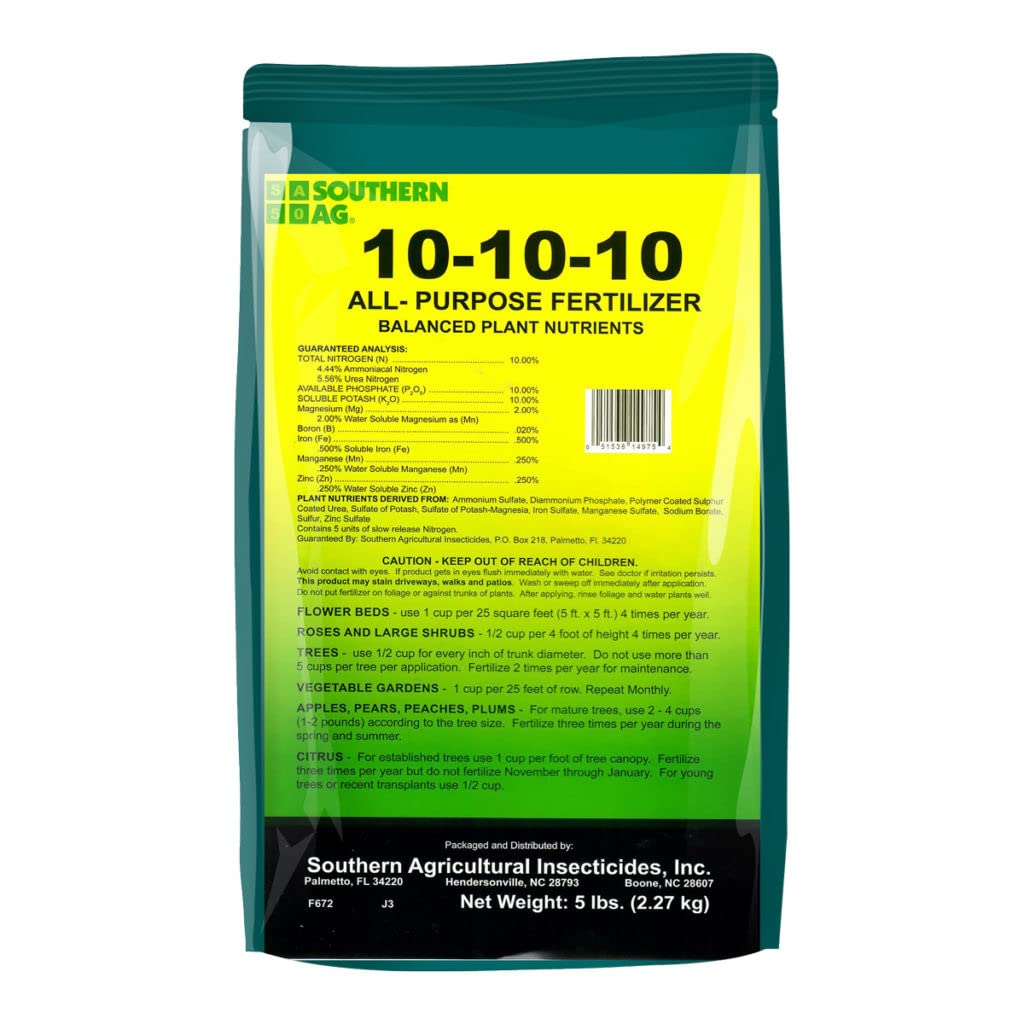
Southern Ag All Purpose Granular Fertilizer 10-10-10 (5 lb)
| Item Form | Granules |
|---|---|
| Specific Uses For Product | Citrus and Fruit Trees, Flowerbeds, Roses, and Large Shrubs, Vegetable Gardens |
| Application Method | Broadcast evenly over area and water in. |
| Mixing Ratio | 10:10:10 |
This 5 lb bag of Southern Ag 10-10-10 granular fertilizer is a straightforward, balanced all-purpose feed for vegetable beds, fruit trees, roses, and shrubs. You spread the granules uniformly over soil or beds and water them in; directions and recommended cup measurements are printed for common uses so dosing is easy. The formula supplies equal parts nitrogen, phosphorus, and potassium plus trace minerals like magnesium, iron, manganese, zinc, and boron, which supports steady vegetative growth and overall plant health. For asparagus specifically it can be used as a periodic maintenance feed during the growing season to support fern growth and energy storage in crowns. The product is simple to store and apply, and the small bag size is convenient for trialing on a single bed or patch. Limitations are that it is a general blend rather than a tailored asparagus formula, so heavy feeders or soils needing specific nutrient correction may require additional amendments, and granular broadcast feedings require careful placement to avoid contact with foliage or runoff risks described on the label.
Best for: Gardeners on a budget who want a simple, balanced fertilizer to maintain small asparagus patches and other mixed beds without buying specialty formulas.
Less Ideal for: Growers managing large asparagus plantings, or who need a targeted high-potassium or soil-specific amendment, should choose a crop-specific or soil-test-driven fertilizer.
- Balanced 10-10-10 N-P-K supports general growth and root development.
- Includes micronutrients (iron, manganese, zinc, boron) for broader plant nutrition.
- Clear application instructions and coverage rates for common garden uses.
- Small 5 lb size is convenient for testing on a single asparagus bed or small garden.
- Not formulated specifically for asparagus so may lack the higher potassium or phosphorus some heavy beds benefit from.
- Granular broadcast application can stain hard surfaces and requires watering after application to activate nutrients.
Verdict: A low-cost, easy-to-use balanced granular fertilizer that is a practical maintenance feed for small asparagus beds and mixed gardens.
Milorganite 6-4-0 Slow-Release Fertilizer, 32 lb (with Feeding Tips Brochure)

| Item Form | Pelletized |
|---|---|
| Application Method | Broadcast, Rotary or Manual |
| Coverage | 2,500 Square Feet |
| Specific Uses For Product | Lawns, Flowers and Gardens, Education |
Milorganite 6-4-0 is an organic, pelletized slow-release fertilizer intended for routine lawn and garden feeding. It is typically broadcast with a rotary or manual spreader and provides nitrogen slowly over 8 to 10 weeks, which reduces the need for frequent applications and lowers burn risk. The product contains organically complex iron for greening without the strong staining associated with iron salts and is low in soluble salts, so it performs well in warm or drier conditions. The 32 lb bag covers roughly 2,500 square feet and comes with a printed feeding and spreader tips brochure to simplify seasonal timing and application rates. Because it is made from heat-dried microbes, it also adds organic matter to improve soil structure in heavy clay or sandy soils. Limitations are that nutrient release is gradual so it is not suited to quick color fixes or rapid turf recovery, and users seeking tightly controlled N-P-K ratios or fast-acting synthetic performance may prefer a different product.
Best for: Buyers who want a low-maintenance, environmentally minded fertilizer that steadily feeds established lawns and mixed garden beds with minimal risk of burn and fewer repeat applications.
Less Ideal for: If you need rapid turf recovery, immediate color correction, or precise synthetic nutrient control for athletic fields or newly sodded lawns, choose a fast-release or specialty fertilizer instead.
- Slow-release nitrogen feeds lawns and plants for 8–10 weeks, reducing application frequency
- Low-salt formulation minimizes fertilizer burn and streaking in hot or dry conditions
- Organically complex iron promotes deep greening without heavy staining of concrete
- Pelletized form works with broadcast, rotary, or manual spreaders for easy application
- Adds organic matter that can improve drainage and soil structure in clay or sandy soils
- Not fast-acting, so it will not deliver an immediate green-up after application
- Contains biosolids which some buyers may prefer to avoid for personal or local reasons
Verdict: Pick this if you want a reliable, low-salt slow-release fertilizer that feeds lawns and gardens for weeks with minimal maintenance.
Scotts Turf Builder Lawn Food, 12.5 lb

| Item Form | Powder |
|---|---|
| Specific Uses For Product | Lawn |
| Coverage | 5,000 sq. ft. |
| Mixing Ratio | 32:0:4 |
Scotts Turf Builder Lawn Food is a general-purpose granular fertilizer formulated for use on any grass type to thicken turf and improve root strength. You spread it with a broadcast or drop spreader (Scotts provides recommended settings) and can apply it to wet or dry lawns in spring, summer, or fall. The formula is pesticide-free and emphasizes building deeper roots so the lawn better absorbs water and nutrients, which helps turf resist stress over the season. One 12.5 lb bag covers about 5,000 sq. ft., making it a simple option for small to medium yards or spot treatments. Practical benefits include clear application guidance, compatibility with common spreaders, and the option to water in for faster greening. Limitations are that this single bag covers a modest area compared with larger homeowner bags and it does not include weed control or insect protection, so you may need additional products for comprehensive lawn care.
Best for: Buyers who want a reliable, easy-to-apply granular fertilizer to strengthen and green a small to medium lawn and prefer products with widespread user approval and clear instructions.
Less Ideal for: Homeowners needing one-step weed or pest control, or those with large properties who want a single bag to cover many thousands of square feet.
- Works on all common grass types so one product fits mixed lawns
- Builds stronger, deeper roots to improve water and nutrient uptake
- Clear spreader settings and can be applied to wet or dry turf for flexibility
- Pesticide-free formula suitable when you only want fertilization
- Covers only about 5,000 sq. ft. per bag, requiring multiple bags for larger yards
- Does not include weed or insect control so additional products may be needed
Verdict: A reliable, easy-to-use granular lawn food that builds stronger roots and is a solid choice for feeding small to medium lawns.
Choosing the Right Lawn Fertilizer for Mid Summer: Key Factors to Consider
Nutrient Release Type
Whether a fertilizer delivers nutrients immediately or over time directly affects how a lawn responds during mid summer. Rapid-release fertilizers give a quick color boost but can overstimulate growth and increase water demand, raising scorch risk in hot weather. Controlled- or slow-release formulas spread nitrogen delivery out over weeks, reducing the chance of a flush of lush growth that wilts under heat.
Consider how often you can realistically water and mow. If irrigation is limited or rainfall is scarce, a slow-release product helps maintain steady nutrition without repeatedly pushing the plant into high metabolic activity that it cannot sustain.
Nutrient Ratios and Micronutrients
The NPK ratio determines what the fertilizer promotes: higher nitrogen favors leaf growth, phosphorus supports root development, and potassium helps stress tolerance. In mid summer, formulations with moderate nitrogen and adequate potassium tend to support heat and drought resilience rather than excessive shoot growth.
Micronutrients such as iron, magnesium, and sulfur can influence color and enzyme function; small additions of iron often improve greenness without adding growth pressure. Avoid high-phosphorus blends unless you have a documented soil deficiency, because extra phosphorus does not speed summer leaf recovery and can be environmentally harmful when runoff occurs.
Salt Index and Scorch Potential
Fertilizer salts can draw moisture out of grass blades and soil, increasing the risk of burn in already-hot conditions. Products differ in their salt index depending on formulation and carrier. Low-salt or coated slow-release granules typically present a lower scorch risk than fast-release soluble fertilizers.
Take into account your turf's current health and soil moisture. Applying a high-salt product to dry turf on a hot day elevates the chance of leaf desiccation. Where possible, choose blends known for low burn incidence and follow label guidance about immediate irrigation after application when indicated.
Application Timing and Method
When and how you apply fertilizer in mid summer matters as much as what you apply. Early morning or evening applications avoid the hottest part of the day and reduce immediate stress on foliage. Granular products spread with a broadcast or drop spreader give even coverage for lawns, while liquid options can be applied through hose-end sprayers for quicker uptake.
Calibrate your spreader before use and avoid overlapping passes that concentrate granules. If you plan to water in after application, check the label-some slow-release products are designed to be left on the surface, while others need light irrigation to activate. Timing application relative to expected rainfall can also reduce runoff concerns.
Compatibility with Turf Type and Mowing Practices
Different grass species have different nutrient needs and stress responses. Warm-season grasses and cool-season grasses perform differently under mid-summer heat; a formulation suited to one may not be ideal for the other. Match the fertilizer profile to your turf type and adjust application rates accordingly.
Mowing height and frequency also interact with fertilization. Higher mowing heights can improve shade and moisture retention, which affects how your lawn uses applied nutrients. If you maintain a low-cut lawn, prefer gentler nutrient delivery to avoid pushing too much tender growth that will scorch.
When to Fertilize During Mid Summer
Timing fertilizer in mid summer requires balancing lawn needs against environmental stress. Apply on a calm, cooler morning or just before an anticipated light rainfall to reduce immediate heat exposure and improve nutrient activation. Avoid application during heatwaves or extended drought unless you can water afterward to ease uptake.
- Plan applications for cooler parts of the day
- Avoid fertilizing before heatwaves or prolonged droughts
- Light irrigation after application can reduce scorch risk if recommended on the label
Watering Strategies After Application
How you water after applying fertilizer determines both safety and uptake. For many controlled-release granules, a light, even watering within 24 hours helps move nutrients into the root zone without washing them away. For soluble feeds, follow label guidance-some require immediate watering to prevent burn, others are formulated to be watered in lightly.
- Use short, frequent cycles to move nutrients into soil without runoff
- Adjust the watering schedule to maintain consistent soil moisture in top few inches
- Avoid heavy runoff by splitting irrigation into multiple passes if slopes are present
Adjusting Rates for Lawn Size and Condition
Application rates are not one-size-fits-all. For thin or stressed turf, cut rates back to avoid overloading the grass and increasing scorch risk. For healthy, actively growing areas, follow recommended mid-summer rates but avoid the highest nitrogen options which can trigger excessive, thirsty growth. Measure your lawn area accurately before applying; over-application is a common source of problems and environmental runoff. If you are unsure of soil fertility, a simple soil test will help you choose a product with the right nutrient proportions.
- Measure lawn area to determine correct product quantity
- Reduce rates on drought-stressed or recently aerated lawns
- Consider a soil test for more precise nutrient planning
Safety Around Pets and Children
Many fertilizers have precautions about pet and child access after application. Granular products often require you to keep people and pets off the treated area for a short period or until product has been watered in. Liquid formulations can leave residues until the grass dries or is watered. Store fertilizers in a secure, dry place away from pets and children. Follow label directions for safe reentry intervals and clean up any accidental spills promptly to avoid concentrated patches that could harm animals.
- Keep pets and children off treated grass per label guidance
- Store products securely in a dry area
- Clean up spills immediately to avoid concentrated exposure
Environmental Considerations and Runoff Prevention
Fertilizer applied during heavy summer rains can wash into storm drains and waterways. To minimize runoff, avoid fertilizing just before heavy downpours and use light, frequent waterings instead of heavy applications. Buffer strips of unmowed vegetation near water bodies reduce the chance of nutrient transport off-site. Use products with lower soluble phosphorus unless soil tests indicate a need, and apply at recommended rates to limit excess that could be carried away by runoff. Proper timing and conservative application protect both turf health and local water quality.
- Avoid fertilizing before heavy rains
- Use buffer zones near waterways
- Prefer lower-soluble phosphorus formulations unless needed
How We Chose the Best Lawn Fertilizer for Mid Summer
We focused on attributes that matter for fertilizing during the warmest part of the growing season. Primary evaluation criteria included nutrient release type, formulation ratio and micronutrients, scorch and salt index, ease of application, and compatibility with common turf types and irrigation schedules. Each product was assessed for how its nutrient delivery behaves at high soil temperatures and whether it limits excessive top growth that requires more water. We excluded formulations designed specifically for spring green-up, overseeding blends with high phosphorus intended for establishment, and any product meant only for cool-season timing. We also filtered out options that require specialized equipment beyond homeowner spreaders unless they offered a clear turf-health benefit. Practical concerns such as safety around pets, residue, and clumping in humid conditions were considered alongside the fertilizer chemistry. Final selections represent a balance of controllable nutrient release, realistic homeowner application, and reduced scorch risk under mid-summer conditions.
FAQ
Can I fertilize my lawn during a heatwave?
Fertilizing during an intense heatwave is usually inadvisable because high temperatures increase scorch risk and stress. If you must feed, choose a slow-release, low-nitrogen option and water lightly to reduce leaf desiccation. When possible, wait for cooler conditions.
How often should I apply fertilizer in mid summer?
Frequency depends on the product type. Slow-release formulas often need a single application that lasts several weeks to months, while soluble feeds may require more frequent, lighter passes. Base timing on product directions and your irrigation ability.
Will mid-summer fertilizer make my lawn need more water?
High-nitrogen quick-release fertilizers can stimulate rapid growth and raise water demand. Controlled-release and moderate-nitrogen blends minimize that effect and help maintain color without dramatically increasing irrigation needs.
Is iron safe to use in mid summer for greening?
Iron can darken turf color without stimulating much top growth, making it a useful supplemental treatment. Use it at recommended rates because concentrated iron can stain sidewalks or lead to leaf burn if misapplied.
Should I change my mowing height after fertilizing in mid summer?
Consider raising mowing height slightly during hot weather to increase shade on the crown and reduce evaporation. Taller grass conserves moisture and can handle nutrient applications with less scorch risk than a very short-cut lawn.
Final Verdict
Mid-summer fertilizing is about maintaining color and resilience without pushing thirsty, weak growth. Prioritize low-salt, controlled-release nitrogen sources and formulations with potassium and targeted micronutrients to support stress tolerance. Match application rate and timing to your irrigation capacity, turf type, and current lawn condition. By balancing nutrient delivery and scorch risk, you can sustain a healthy lawn through the hottest weeks with minimal additional water demand.
