

Note: This article contains affiliate links. If you click on these links and make a purchase, I may earn a small commission at no extra cost to you. This helps support my research and content. Read my full affiliate disclosure here.
If you manage several acres of yard, pasture, or wooded edge, mosquito control needs different tools than a small patio setup. A trap designed for acreage focuses on covering large zones, running reliably for long intervals, and surviving outdoor conditions. This guide presents seven shortlisted mosquito traps for acreage that perform well in those real-world conditions. We evaluated each option for coverage area, attractant effectiveness, durability, and ease of maintenance so you can choose a device that fits the size and access patterns of your land. Read on for what matters when protecting broad properties from mosquito pressure before the product list below.
Top Picks at a Glance
| Best Overall The best all-around choice for most situations | DynaTrap DT1775 AtraktaGlo 1-Acre Mosquito and Flying Insect Trap |  |
| Best Quality Built to a higher standard if you want something more solid | Mosquito Magnet Executive Propane Mosquito Trap |  |
| Best Value The sweet spot between price and what you get | DynaTrap DT2030SR 1-Acre Outdoor Insect Trap |  |
| Best Budget The cheapest option that still gets the job done reliably | Aion Outdoor Mosquito Barrier and Trap — 4-Pack (1 Acre Coverage) |  |
| Highest Rated A top-rated pick with lots of positive feedback | OWLTRA MT2410 Upgraded Outdoor Mosquito Trap (Propane CO2 + UV Light) |  |
| Most Popular A crowd favorite that many people choose with confidence | SPARTAN MOSQUITO Pro Tech Tubes — 4‑Count 1‑Acre Mosquito Control |  |
| Best Seller A high-volume bestseller chosen again and again | Flowtron BK-80D Outdoor Bug Zapper, Two 40W UV Bulbs, 5600V Grid |  |
DynaTrap DT1775 AtraktaGlo 1-Acre Mosquito and Flying Insect Trap

| Target Species | Beetle, Fly, Gnat, Mosquito, Moth, Wasp |
|---|---|
| Power Source | corded-electric |
| Included Components | Dynatrap, screwdriver, manual |
| Material Type | Plastic |
The DynaTrap DT1775 is a plug-in, fan-based insect trap designed to protect up to one acre of outdoor space by attracting flying pests with UV AtraktaGlo light and a TiO2 diffuser and pulling them into a catch basket. Typical use is straightforward: mount or place the unit 3 to 6 feet off the ground and 20 to 40 feet from people, plug it in continuously during the season, and empty the removable basket as needed. Notable features include a whisper-quiet fan that avoids the noise and zapping of traditional zappers and an all-weather plastic housing for outdoor placement. In practice this delivers steady, passive reduction of mosquitoes, gnats, flies, moths, and wasps without bright flashing or electric shocks. Limitations are that it requires a continuous power source and works best as part of a broader pest-management plan rather than an instant one-night fix; effectiveness can vary with local insect pressure and placement. The DT1775 is best for homeowners who want a low-maintenance, discreet device to reduce flying insects across a yard-sized property.
Best for: Buyers who want a quiet, low-maintenance trap to reduce mosquitoes and other flying insects across a yard-sized property and prefer a non-zapping solution they can run continuously.
Less Ideal for: People without reliable outdoor power access or those who need a quick knockdown solution for very heavy infestations should consider other control methods.
- Covers up to one acre, suitable for yard-scale protection
- Fan-based capture uses UV light and TiO2 diffuser for silent, zap-free operation
- All-weather design intended for continuous outdoor use
- Removable catch basket for straightforward cleaning
- Requires a nearby electrical outlet and continuous operation to be effective
- Performance depends on correct placement and local insect populations
Verdict: Choose the DT1775 if you want a quiet, low-maintenance, non-zapping trap that can provide continuous insect reduction across about an acre.
Mosquito Magnet Executive Propane Mosquito Trap

| Target Species | Fly |
|---|---|
| Power Source | Battery Powered |
| Recommended Uses For Product | Yards |
| Material Type | Metal, Plastic |
The Mosquito Magnet Executive is a propane-powered CO2 mosquito trap built for large yards and continuous operation. It uses Counterflow Technology—generating carbon dioxide, heat, and moisture—to attract mosquitoes, then a vacuum pulls them into a capture net. Typical use is outdoor placement away from family areas and running continuously to disrupt breeding cycles; the unit is cordless and rechargeable so it can sit where mosquitoes are most active. Notable features include an LCD control panel for runtime management and rechargeable operation so you do not need a permanent outlet near the placement. Practical benefits are broad coverage (up to one acre), fast population reduction often noticeable within 7 to 10 days, and a hands-off approach after setup. Important limitations are the need for propane fuel and periodic replacement nets for best performance, plus the unit is aimed at larger properties rather than small patios. Buyers should also plan for regular maintenance of the capture net and occasional refueling to keep the trap effective.
Best for: Garden and property owners who prioritize proven, high-coverage mosquito control for yards up to an acre and want a continuous, low‑intervention solution.
Less Ideal for: People with very small outdoor spaces, balcony gardeners, or anyone who prefers chemical sprays or handheld repellents instead of a stationary CO2 trap.
- Designed to protect up to one acre, suitable for large yards
- CO2, heat, and moisture lure combined with a vacuum provides effective attraction and capture
- Cordless rechargeable design allows flexible placement away from living areas
- LCD control panel offers user-friendly runtime and efficiency controls
- Requires propane fuel and replacement nets to maintain peak performance
- More suitable for larger properties than small patios or balconies
Verdict: If you need a performance-oriented, continuous CO2 mosquito trap to reduce biting insects across a large yard, the Mosquito Magnet Executive is built for that job.
DynaTrap DT2030SR 1-Acre Outdoor Insect Trap

| Target Species | Gnat |
|---|---|
| Power Source | manual |
| Material Type | Plastic |
| Recommended Uses For Product | Mosquitoes,Flies,Wasps,Gnats |
The DynaTrap DT2030SR is a plug-in outdoor insect trap that pairs a UV-LED lure with a quiet fan to pull mosquitoes, wasps, gnats, flies, and similar flying insects into a catch basket. It is designed for continuous 24/7 operation and is typically mounted 3 to 6 feet off the ground and placed away from seating areas to draw pests out of the spaces you want to protect. Notable features include a long-life LED bulb that the manufacturer says lasts much longer than fluorescent options, a patented damper that keeps captured insects contained, and a push-button basket for easy emptying. The unit is weather resistant and intended to cover up to one acre, making it suitable for large yards. For someone focused on performance it offers effective, chemical-free control and quiet operation, but it does require a constant power source and placement planning to work optimally, and its effectiveness depends on local insect pressure and proper setup.
Best for: Buyers who prioritize effective, non-chemical pest control for large outdoor areas and want a hands-off, continuously operating device to reduce wasp and mosquito activity.
Less Ideal for: People who need a portable battery-powered or short-term solution for small patios or who prefer traps tailored exclusively to a single species rather than a broad spectrum of flying insects.
- Designed to protect up to one acre, suitable for large yards
- UV-LED plus fan system attracts and traps a wide range of flying insects including wasps
- Weather-resistant construction supports season-long outdoor use
- Long-lasting LED bulb reduces the need for frequent replacements
- Push-button catch basket makes emptying fast and hygienic
- Requires continuous plug-in power so placement is limited by outlet access
- Performance varies with local insect populations and correct placement
Verdict: If you need quiet, continuous, chemical-free wasp and mosquito control for a large yard, this trap delivers broad-spectrum performance and low-maintenance operation.
Aion Outdoor Mosquito Barrier and Trap — 4-Pack (1 Acre Coverage)

| Unit Count | 4 Count |
|---|---|
| Target Species | Mosquito |
| Number of Pieces | 4 |
The Aion Outdoor Mosquito Barrier and Trap combines a passive repellant barrier with trapping action in a four‑unit pack intended to cover about an acre. Each tube is made from natural ingredients and is marketed as safe for families, pets, and the environment, so you can place devices around patios, yard perimeters, and common outdoor gathering spots without running power or fans. Setup appears straightforward and the lightweight units are easy to hang or stake where mosquitoes concentrate. For a budget-minded buyer this pack is attractive because it treats a relatively large area with multiple placement points and requires little maintenance. Expect gradual population reduction rather than an immediate knockdown since the product relies on sustained barrier and trapping effects. If you need fast, heavy-duty suppression for large wetland acreage or professional pest control level results, this consumer product may not match those expectations. Still, for routine backyard protection and lower-cost seasonal control it provides a convenient, low-effort option.
Best for: Buyers who want a low-cost, low-maintenance way to reduce backyard mosquitoes across roughly an acre and prefer safer, nonpowered solutions for family and pet areas.
Less Ideal for: Property owners needing rapid, high-intensity mosquito eradication or professional pest control should look at stronger commercial systems or service options.
- Four units cover approximately one acre for multi‑point placement
- Uses natural ingredients and requires no electrical power
- Simple setup and lightweight for easy hanging or relocation
- Reduction is gradual and not intended for immediate heavy infestation control
- Not suited as a standalone solution for large wetlands or professional-level suppression
Verdict: An affordable, easy-to-use four‑unit system that provides safe, low‑maintenance mosquito reduction across about an acre.
OWLTRA MT2410 Upgraded Outdoor Mosquito Trap (Propane CO2 + UV Light)

| Power Source | propane |
|---|---|
| Unit Count | 1 Count |
| Number of Pieces | 1 |
| UPC | 199874228471 |
The OWLTRA MT2410 is a performance-focused outdoor mosquito trap that combines propane-generated CO2, a heating element and a 5V blue-purple UV LED to mimic human presence and lure biting insects into a capture chamber. Designed for continuous, all-weather use, it runs quietly and odorless from a standard 20 or 30 lb propane tank and is intended to reduce local mosquito numbers within weeks when placed 20 to 40 feet from activity areas. The unit’s patented counterflow design helps distribute CO2 evenly and prevents escapes while trapped insects dehydrate in the collection box. Setup and routine upkeep are straightforward, with recommended maintenance about every 21 days to keep attractants and propane topped up. Important limitations are that it requires a propane supply and continuous operation for best results and will be most effective as part of a broader yard plan rather than as a single quick fix for immediate bites. For buyers focused on sustained reduction of biting insects, it delivers a strong, low-maintenance approach.
Best for: Gardeners and homeowners who prioritize measurable, continuous mosquito control across a yard and are willing to run and maintain a propane-powered unit for season-long performance.
Less Ideal for: People who need an instant or portable bite-free solution for small gatherings or who prefer devices that do not require fuel or continuous operation.
- Uses propane CO2 plus heat and UV LED to closely mimic human attractants for stronger capture rates
- Patented counterflow technology reduces escape and improves trapping efficiency
- Quiet and odorless operation suitable for continuous backyard use
- Designed for all-weather use with simple setup and low maintenance every 21 days
- Requires a separate 20 lb or 30 lb propane tank and ongoing fuel refills for continuous operation
- Not an immediate solution—population reduction typically appears after 7–10 days with best results after several weeks
Verdict: Choose the OWLTRA MT2410 if you want a high-performance, continuously operating propane trap that reduces biting insect populations across an entire yard over time.
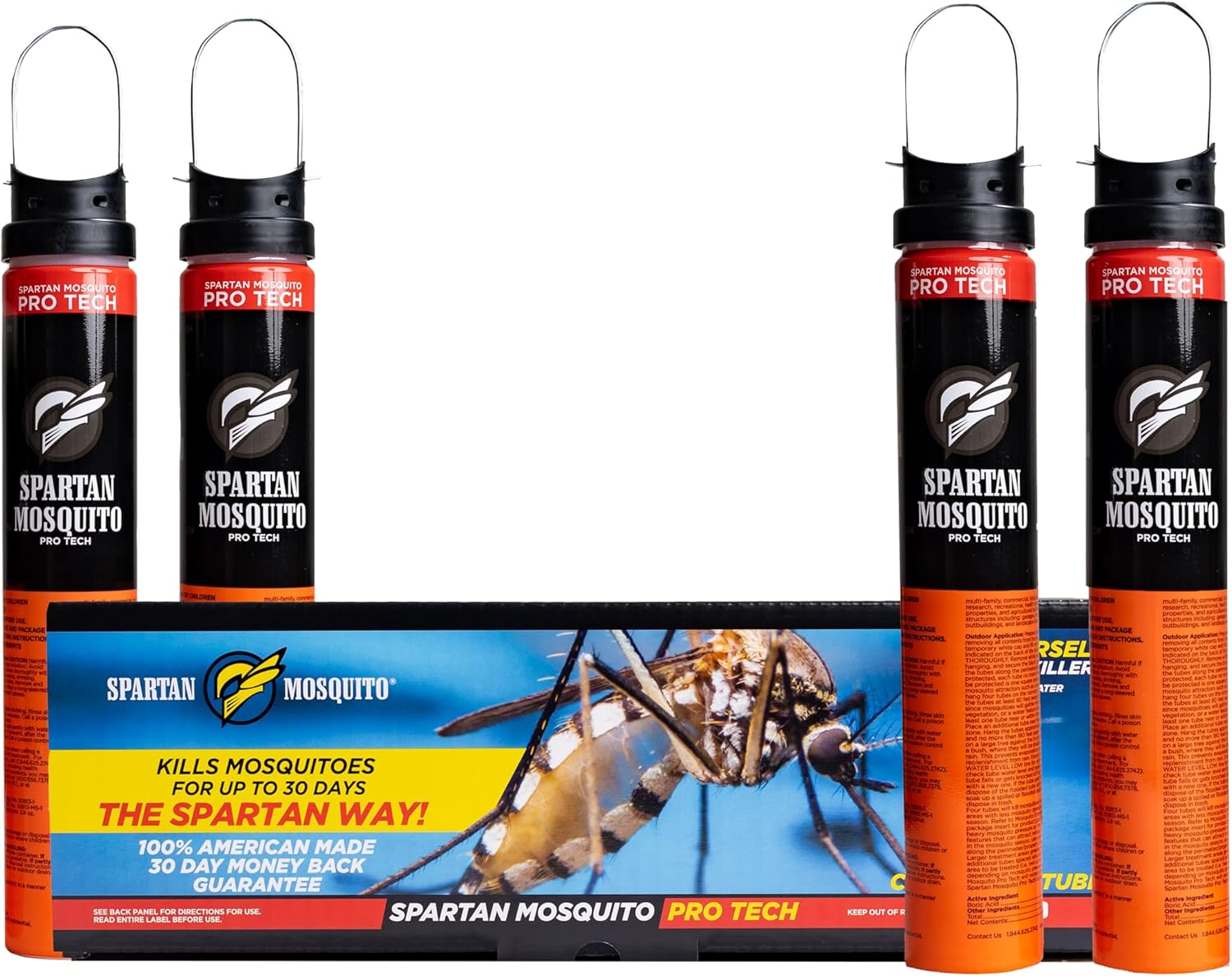
SPARTAN MOSQUITO Pro Tech Tubes — 4‑Count 1‑Acre Mosquito Control
| Unit Count | 4 Count |
|---|---|
| Item Form | Stick |
| Target Species | Mosquito |
| Specification Met | Epa Registered Solution |
| Active Ingredients | Sucrose, Yeast, Sodium Chloride |
The SPARTAN MOSQUITO Pro Tech tubes are a simple, no-power mosquito control option designed for perimeter protection of yards and large outdoor spaces. Each pack contains four sealed tubes that you activate by adding warm water and shaking, then hang in shaded locations roughly six feet high and spaced per label guidance. The active formula is EPA registered and lists sucrose, yeast, and sodium chloride among its ingredients; the product claims up to 30 days of continuous mosquito control and is intended to treat up to one acre with four tubes under moderate pressure. Practical benefits include fast setup, no electricity or batteries, and low maintenance beyond monthly replacement and water-level checks. Limitations are that effectiveness drops in heavy mosquito pressure or wooded, water-featured sites where more tubes are required, and the tubs must be positioned away from gathering areas. Also this approach provides area-wide suppression rather than immediate knockdown at a single spot, so expect gradual reduction rather than instant relief.
Best for: Buyers who want a low-effort, perimeter-focused mosquito suppression method for large yards and prioritize easy deployment and monthly maintenance over instant spot treatments.
Less Ideal for: People needing immediate knockdown for small patios, or those with very high mosquito pressure or dense wooded properties who should consider higher-capacity or professional treatments.
- Easy DIY setup—activate with warm water, shake, and hang; no tools or power required
- EPA registered formulation aimed at continuous control for up to 30 days
- Designed coverage of up to one acre with four tubes under normal mosquito pressure
- Low ongoing maintenance—monitor water level and replace monthly
- May require additional tubes and more frequent replacement in heavy mosquito pressure or complex landscapes
- Placement constraints—must be hung in shaded areas about 6 feet high and kept well away from people
Verdict: A straightforward, battery-free perimeter system that gives month-long mosquito suppression for up to one acre with minimal setup and upkeep.
Flowtron BK-80D Outdoor Bug Zapper, Two 40W UV Bulbs, 5600V Grid

| Power Source | Battery Powered |
|---|---|
| Target Species | Birds, Mosquito |
| Maximum Range | 5 meters |
The Flowtron BK-80D is a heavy-duty outdoor bug zapper designed for medium to large yards and farmsteads. It combines two 40W UV bulbs with an octenol cartridge to lure mosquitoes and other flying insects, then instantly kills them on a 5,600-volt vertical grid so carcasses fall to the ground rather than clogging an internal tray. Typical use is hanging the unit about 25 feet from outdoor living areas and plugging it into a standard outlet for continuous coverage. The weatherproof polycarbonate housing and simple bulb replacement mean it can run year-round with minimal upkeep, and octenol cartridges provide long-duration attraction without messy sprays or traps. Limitations are that it attracts a broad range of light-attracted insects so you may see kills well away from seating areas, and the unit is best suited to properties with enough open space for the recommended placement to be effective. It is a practical, low-maintenance option for homeowners who want chemical-free, around-the-clock mosquito control for larger outdoor areas.
Best for: Homeowners with medium to large yards who want continuous, low-maintenance, chemical-free mosquito control across a wide outdoor area and prefer a hands-off solution.
Less Ideal for: People with very small patios, balconies, or enclosed spaces where the unit cannot be positioned 25 feet away from living areas or where attracting insects farther from the unit would be problematic.
- Two 40W UV bulbs plus octenol cartridge provide strong multi-signal attraction for mosquitoes and flying pests.
- 5,600V non-clogging vertical grid kills on contact and lets remains fall to the ground for hygienic operation.
- Weatherproof polycarbonate housing rated for outdoor year-round use.
- Easy maintenance with tool-free bulb replacement and no trays or sticky pads to empty.
- Attracts all light-loving insects so activity may concentrate away from the area you want insect-free.
- Requires an outdoor power source and appropriate placement distance to reach full coverage.
Verdict: Choose the Flowtron BK-80D if you need powerful, weatherproof, hands-off mosquito and flying-insect control for medium to large outdoor properties.
Choosing the Right Mosquito Trap for Acreage: Key Factors to Consider
Coverage Area and Placement
How many acres a trap can effectively influence determines how many units you need and where to site them. Coverage area depends on the attractant plume, local wind patterns, and line of sight across vegetation and terrain. In open fields you get farther reach than in dense woods, so placement on windward edges, near wetland margins, or along flyways increases impact.
Think in terms of overlapping zones rather than single-point coverage; for acreage you often use multiple traps spaced to create a curtain or network. Also consider access for servicing: traps that need regular refills or cleaning should be reachable without long off-road walks or difficult climbs.
Attractant Type and Effectiveness
Different traps use CO2, chemical lures, light, heat, or combinations to mimic hosts. CO2 is the most universally attractive to many mosquito species but requires a source such as a tank, generator, or on-board production, which affects logistics on large properties. Synthetic lures that mimic human scent are less maintenance-heavy but can be species-selective and sometimes less powerful at distance.
Evaluate attractant longevity and whether the lure works on the primary mosquito species in your region. For acreage, stronger long-range attractants reduce the number of units needed, but also increase the risk of drawing insects toward human activity if traps are improperly sited.
Runtime, Power Options, and Automation
Extended operation matters on acreage. Look for traps with multi-day runtimes, options for external power like solar panels or 12V battery hookups, and simple automation such as timers or dusk-to-dawn sensors. A trap that requires daily attention is impractical on large properties.
Consider how you will power multiple units: solar plus battery tends to suit remote sites, while AC power works for areas near buildings. Also check whether the unit allows staggered cleaning or swap-out of collection canisters to minimize trips across the property.
Durability and Weather Resistance
Acreage traps are exposed to sun, rain, wind, dust, and wildlife. Metal parts should be corrosion-resistant and housings UV-stabilized. Seals and drainage will prevent standing water and internal damage. Rattling parts, weak fasteners, or exposed electronics shorten effective service life and increase maintenance work.
Also account for winter storage or winterizing steps if your region has freezing conditions. A trap that can remain outdoors without frequent repairs reduces labor on larger properties.
Maintenance Requirements and Consumables
Maintenance frequency drives the total time cost of running traps across acres. Consumables include lures, CO2 cartridges or tanks, baits, and collection bag replacements. Some systems require weekly attention, others monthly. For acreage pick options that balance lure longevity with proven effectiveness.
Factor in how easy it is to inspect and empty the capture chamber and whether replacement parts are user-serviceable. Units that let you swap an insert or cartridge quickly minimize time spent servicing multiple stations.
Non-target Safety and Environmental Impact
Mosquito control on acreage means working in an ecosystem. Consider traps that reduce bycatch of pollinators and other beneficial insects by using targeted attractants or placement strategies. Avoid broad-spectrum lights or attractants known to catch high numbers of non-targets.
Also think about trap placement relative to waterfowl, livestock, and garden areas. Traps that concentrate mosquitoes away from human and animal traffic without creating new hotspots are preferable for integrated outdoor pest management.
Sizing a Control Strategy for Different Acreages
A single trap rarely covers an entire pasture or wooded lot. For small multi-acre parcels you can often get away with one centrally placed high-capacity unit, but for larger or irregularly shaped acreages plan a network with overlapping attraction zones. Map wet areas and shade lines where mosquitoes breed or rest, and place traps downwind of those spots so the attractant plume carries toward mosquito flight paths.
- Use wind patterns to guide placement for maximum reach
- Prioritize edges of marshy ground, fence lines, and tree boundaries
- Space traps to create overlapping coverage rather than gaps
Powering Traps in Remote Areas
Remote sites require creative power solutions. Solar panels paired with deep-cycle batteries let traps run through cloudy stretches if panels are sized to local sun availability. Some systems accept 12V inputs from vehicle or wind setups. If you have utility hookups near buildings, hardwiring reduces servicing chores but limits placement to those access points.
- Estimate daily power draw when sizing batteries
- Consider modular solar kits so you can relocate panels seasonally
- Keep power components elevated and shielded from wildlife
Seasonal Deployment and Timing
Mosquito pressure changes through the season. Start traps before peak emergence in spring to reduce population buildup. In late season, concentrate traps near human-use areas rather than evenly across whole acreage to protect activity zones with fewer units. Winterize traps by cleaning and storing attractants that degrade in cold temperatures, or follow manufacturer guidance for leaving units in place if rated for freezing conditions.
- Begin operation ahead of peak season for best population suppression
- Shift coverage toward high-use areas later in the season
- Document service dates to maintain consistent lure replacement schedules
Integrating Traps With Other Control Methods
Traps work best as part of an integrated approach. Combine trapping with source reduction such as draining or treating breeding sites, targeted larviciding in standing water, and strategically timed vegetation management. Traps reduce adult populations but do not eliminate breeding habitat, so pairing tactics reduces long-term pressure. Also coordinate with neighbors if mosquito sources cross property lines; landscape-scale control benefits from cooperative placement and timing.
- Pair traps with habitat modification to reduce larval pools
- Use targeted vegetation management to cut resting sites near human activity
- Coordinate with local landowners when sources cross borders
How We Chose the Best Mosquito Trap for Acreage
We prioritized criteria that matter for controlling mosquitoes across multiple acres rather than interpersonal comfort on a porch. Key evaluation points included coverage area and lure effectiveness, since a trap must attract insects at landscape scale; runtime and power options, because large properties demand long, unattended operation or alternative power; weather resistance and build quality to withstand sun, rain, and rodents; maintenance demands such as lure refills and cleaning; and safety and non-target impact so nearby beneficial insects and wildlife are not unduly affected. Products were included only if documentation or specifications indicated suitability for multi-acre operation and if they offered at least one robust lure or attractant option appropriate for the species found in temperate or rural landscapes. We excluded units clearly intended only for patios, indoor use, or single-person campsite scenarios. We also filtered out traps lacking basic durability features or those that require constant hands-on servicing to remain effective. The scoring emphasized measurable, gardener-relevant dimensions: advertised coverage, run time, construction and weather protection, maintenance frequency, and selectivity for mosquitoes over non-target insects.
FAQ
How many traps do I need for a 10-acre property?
It depends on habitat layout and attractant range. A single high-coverage trap may influence several acres in open terrain, but wooded or marshy properties usually need multiple units spaced to create overlapping attraction zones. Map breeding sites and wind patterns to determine spacing.
Are CO2 traps practical for remote acreage?
CO2 is highly effective but requires fuel or generation. On remote sites you can use tanked CO2 or on-site production systems, but factor in logistics for refill and safety. Solar-powered traps with other attractants are lower-maintenance alternatives if CO2 refills are impractical.
Will traps reduce mosquitoes around livestock and animals?
Traps can lower mosquito numbers near livestock if sited to intercept insects leaving nearby breeding areas. However, you should avoid placing traps that draw mosquitoes toward animals or people. Position units downwind of activity areas to pull insects away from livestock.
Do traps harm beneficial insects or pollinators?
Some trap types catch non-target insects, especially light-based systems. Choose traps with species-targeted attractants and place them away from flowering plants and pollinator foraging routes to reduce bycatch. Reviewing capture design helps limit impacts on beneficial species.
How often do I need to service traps on large properties?
Service frequency varies by lure type and trap design. Many systems need weekly to monthly attention. For acreage, prefer traps with longer-lived lures or cartridge swaps so you can minimize trips; solar and battery systems also reduce the need for daily checks.
Final Verdict
On acreage the right mosquito trap balances reach, durability, and low servicing demands. Prioritize units with proven coverage area and attractant effectiveness, then match power and maintenance needs to how remote your sites are. Expect tradeoffs: more powerful attractants or CO2 systems reduce the number of units needed but increase logistical work. Plan traps as part of an integrated strategy that includes habitat reduction and seasonal timing. With a clear map of breeding sites, thoughtful placement, and realistic maintenance plans you can reduce mosquito pressure across large properties without excessive labor.
