

Note: This article contains affiliate links. If you click on these links and make a purchase, I may earn a small commission at no extra cost to you. This helps support my research and content. Read my full affiliate disclosure here.
Picking the right slow release fertilizer for houseplants matters because indoor plants have limited soil volume and rely on steady nutrient delivery rather than frequent dosing. The wrong product can overfeed compact pots or leave key micronutrients lacking. This guide shortlists the top slow release options suited to typical houseplant setups, from small desktop pots to large living-room specimens. We evaluated products for nutrient balance, longevity, safety for common houseplant types, and how easy they are to apply and monitor. Below you will find the practical strengths and tradeoffs for each shortlisted option and the criteria we used to choose them.
Top Picks at a Glance
| Best Overall The best all-around choice for most situations | Better-Gro Orchid, Bromeliad & Houseplant Slow Release Plant Food |  |
| Best Quality Built to a higher standard if you want something more solid | Smart Grower Genius+ BioActive Slow-Release Granular Plant Fertilizer 200 g |  |
| Best Value The sweet spot between price and what you get | Osmocote Smart‑Release Plant Food Plus Outdoor & Indoor, 2 lb |  |
| Best Budget The cheapest option that still gets the job done reliably | RAINFLOW Slow‑Release Plant Fertilizer Sticks (90 Count) |  |
| Highest Rated A top-rated pick with lots of positive feedback | Cute Farms Succulent Slow Release Fertilizer Pellets (6 oz) |  |
| Most Popular A crowd favorite that many people choose with confidence | Miracle-Gro Indoor Plant Food Spikes, 48 Count |  |
| Best Seller A high-volume bestseller chosen again and again | Jobe's Organics Houseplant Fertilizer Spikes, 50 Count |  |
Better-Gro Orchid, Bromeliad & Houseplant Slow Release Plant Food

| Unit Count | 10 Ounce |
|---|---|
| Application Method | Sprinkle |
| Target Species | Orchids, Bromeliads, Houseplants |
| Mixing Ratio | No mixing |
| Coverage | Medium |
This is a no-fuss slow-release granular fertilizer intended for indoor growers who want long-lasting nutrition without regular dosing. You sprinkle the granules on potting mix around orchids, bromeliads, and general houseplants and the nutrients are released over months, so a single application can reduce how often you need to fertilize. The formula provides the primary macronutrients nitrogen, phosphorus, and potassium plus minor elements to help prevent common deficiencies. Practical benefits include easy application with no mixing or mess, a resealable bag for storage, and predictable medium coverage suited to typical houseplant pots. Limitations to expect are that it is a one-size-fits-most product so heavy feeders or specific-stage needs like bloom boosting may require supplemental, soluble feeds, and the presence of phosphorus means users near sensitive waterways should follow local guidance. For someone wanting steady baseline feeding with minimal effort, this delivers consistent results; for precision feeding schedules or rapid corrective treatments, combine it with targeted products.
Best for: Buyers who want steady, low-effort nutrition for a mixed houseplant collection and prefer one application that lasts through months of growth.
Less Ideal for: Growers seeking precise, stage-specific feeding plans or immediate corrective fertilization for chronically deficient or heavy-feeding specimens.
- Long-lasting slow-release action that reduces how often you must fertilize
- Contains N, P, and K plus minor elements to address common nutrient deficiencies
- Simple sprinkle application with no mixing required
- Resealable bag keeps product fresh and is easy to store
- Not ideal as the sole feed for heavy-feeding plants or for rapidly correcting deficiencies
Verdict: Choose this if you want a simple, single-application slow-release fertilizer to keep a variety of houseplants fed with minimal upkeep.
Smart Grower Genius+ BioActive Slow-Release Granular Plant Fertilizer 200 g

| Item Form | Granules |
|---|---|
| Specific Uses For Product | Plant Growth |
| Coverage | Full |
| Target Species | plants |
This Smart Grower Genius+ granular fertilizer is a slow-release, all-purpose formula aimed at steady, low-risk feeding for houseplants and garden beds. It delivers a balanced 6-5-6 NPK combined with active carbon, humic acid, mycorrhizal fungi, and beneficial microbes to support root development and nutrient uptake rather than quick green-up. You apply it with the included scoop to potting soil or garden beds and it releases nutrients over time, which reduces the chance of burning sensitive indoor plants when used as directed. The product is marketed as clean-formula with no biosolids, PFAS, or plastic coatings, and its granules are homogenous for even application. Practical benefits include simplified feeding across many plant types and improved soil biology that can boost long-term plant performance. Limitations are the small 200 g unit size for larger collections of houseplants and the need to follow application rates closely to match each plant's watering and potting mix characteristics.
Best for: Houseplant owners and gardeners who prioritize consistent, performance-focused nutrition and want a bioactive slow-release fertilizer that supports root health and soil microbiology without quick-release spikes.
Less Ideal for: Growers who need fast-acting corrective feeding or who prefer liquid fertilizers for immediate results should look elsewhere.
- Balanced 6-5-6 NPK formula provides steady macro nutrient supply
- Contains active carbon, humic acid, mycorrhizae and beneficial microbes to support soil biology and root health
- Slow-release granules reduce spike feeding and lower risk of burning houseplants when used as directed
- Clean formula tested free of biosolids and PFAS and without plastic coatings
- Small 200 g package may not be cost-effective for large collections or outdoor gardens
- Specific application rates must be followed for different plant types and potting mixes
Verdict: Choose this if you want a cleaner slow-release fertilizer that promotes steady, long-term growth and stronger roots for houseplants.
Osmocote Smart‑Release Plant Food Plus Outdoor & Indoor, 2 lb

| Item Form | Granules |
|---|---|
| Application Method | Sprinkle |
| Target Species | All plants |
| Mixing Ratio | 1 capful (3 tablespoons) per 2 gallons soil or per 4 sq. ft. |
| Unit Count | 32 Ounce |
Osmocote Smart‑Release Plant Food Plus is a granular, resin‑coated fertilizer designed to feed flowers and other plants steadily for up to six months with 11 essential nutrients. You apply it by sprinkling the recommended amount into the top inch or two of potting mix or garden soil, watering it in, and reapplying every six months; indoor plants use about half the outdoor rate. The resin coating times nutrient release to moisture and temperature, which reduces the need for frequent feedings and lowers the risk of fertilizer burn when used as directed. It works across containers, raised beds, and in‑ground flower beds and covers up to roughly 75 square feet per 2 lb container. Limitations are that a single 2 lb container is only enough for small gardens or several pots, and the slow‑release formula is not suitable when an immediate corrective boost is needed for acute nutrient deficiencies. For gardeners focused on steady, maintenance feeding for flowering plants this is an easy, low‑effort option.
Best for: Gardeners who want reliable, low‑maintenance feeding for flowers and mixed plantings and prefer a consistent supply of nutrients over months rather than frequent liquid feedings.
Less Ideal for: Growers who need fast corrective feeding for visible nutrient deficiencies or those managing very large beds who want bulk fertilizer options to reduce trips to reapply.
- Feeds continuously up to six months with a single application
- Resin coating times nutrient release to plant needs based on moisture and temperature
- Formulated with 11 essential nutrients suitable for a wide range of flowering plants
- No-burn pledge when used as directed reduces risk of overfeeding
- 2 lb container only covers about 75 sq. ft., so frequent repurchase is needed for larger gardens
- Slow‑release formulation does not provide a rapid corrective nutrient boost
Verdict: Choose this product if you want a hands-off, long‑lasting fertilizer that keeps flowering plants fed for months with a single application.
RAINFLOW Slow‑Release Plant Fertilizer Sticks (90 Count)

| Number of Items | 90 |
|---|---|
| Item Form | Sticks |
| Application Method | Insert into soil |
| Specific Uses For Product | Plant Growth |
| Target Species | orchids, succulents, cacti, foliage plants, hydrangea, vegetables, fruits, flowering species |
These RAINFLOW fertilizer sticks provide a simple, low-effort way to feed houseplants for months at a time. Each stick is pushed into potting soil and releases a balanced mix of nitrogen, phosphorus, potassium and micronutrients slowly so plants get steady nutrition without weekly feeding. The product is aimed at indoor use and lists compatibility with orchids, succulents, cacti, herbs, vegetables and common foliage and flowering houseplants. Use is straightforward: moisten soil, insert the recommended number of sticks for pot size, and water normally. Practical benefits include minimal mess, predictable dosing for busy plant owners, and long intervals between applications (instructions suggest 3 months in spring and summer, 4 months in cooler seasons). Limitations are that dosing guidance is based on pot diameter rather than plant vigor, so very heavy feeders or large plants may need supplemental feeding, and sticks can be hard to insert in compacted soil without predrilling. Also the formulation is generic so it may not replace specialized fertilizers for specific blooms or nutrient deficiencies.
Best for: Budget-minded indoor gardeners who want a low-maintenance, no-mess way to keep multiple potted plants regularly fed with minimal time or skill.
Less Ideal for: Collectors seeking precise, bloom-specific nutrient programs or growers with very large or high-demand plants that need tailored or more frequent fertilization.
- Long slow-release feeding that lasts up to several months per application
- Easy, clean application by inserting sticks into potting soil
- Balanced NPK plus micronutrients suitable for a wide range of indoor species
- Large 90-count pack provides many feedings for multiple small pots
- Dosing uses pot diameter guidelines which may underfeed very heavy feeders
- Sticks can be difficult to insert into hard or compacted soil without a predrilled hole
Verdict: A cost-effective, low-effort slow-release feeding solution for keeping multiple houseplants healthy without weekly fertilizing.
Cute Farms Succulent Slow Release Fertilizer Pellets (6 oz)

| Item Form | Granules |
|---|---|
| Specific Uses For Product | Plant Growth, Root Development, Soil Conditioning |
| Coverage | 2 square feet |
| Target Species | Succulents |
| Mixing Ratio | 1/2 teaspoon for every 4 inches of pot width |
This 6 oz bag of Cute Farms slow release fertilizer pellets is designed to feed succulents over several months with a simple, low‑effort application. You measure by pot width (1/2 teaspoon per 4 inches), sprinkle the granules on the soil surface and water so the pellets begin to dissolve. The formula is presented as balanced for root development, steady growth and improved leaf color, and the slow release format means one application reportedly lasts 7 to 8 months. Practical benefits include a resealable pouch for storage, no mixing or measuring liquids, and coverage suited to small potted collections and terrariums. For reliability‑minded users the clear dosing instructions and long interval between feedings reduce the chance of overfertilizing or missed applications. Important limitations are the small 6 oz quantity and the stated 2 square foot coverage, so frequent users or larger collections will need repeat purchases; the ingredient listing is generic and does not show guaranteed analysis percentages for NPK, which some experienced growers prefer to see.
Best for: Buyers who want a low‑maintenance, dependable feeding schedule for indoor succulents and terrariums and value clear instructions and long intervals between applications.
Less Ideal for: Collectors with large numbers of plants, big containers, or growers who require precise NPK information and lab‑grade nutrient breakdowns.
- Slow release pellets feed plants for 7 to 8 months per application
- Simple dosing instructions using teaspoons tied to pot width
- Resealable 6 oz bag keeps product fresh between uses
- Ready‑to‑use granules eliminate mixing liquid fertilizers
- Small 6 oz size limits coverage for larger collections
- No detailed NPK or guaranteed analysis provided on listing
Verdict: A simple, low‑maintenance slow release pellet fertilizer that reliably feeds individual succulents for several months with minimal effort.
Miracle-Gro Indoor Plant Food Spikes, 48 Count

| Item Form | Sticks |
|---|---|
| Application Method | Insert spike into soil |
| Coverage | Full |
| Target Species | Houseplants |
| Unit Count | 48 Count |
These Miracle-Gro indoor plant food spikes are sticks of slow-release NPK fertilizer designed for low-effort feeding of houseplants, including peace lilies. You use the included aerator to make a small hole, press a spike into the soil, and water as normal; each spike delivers nutrients for up to two months so you do not need frequent dosing. The pack of 48 covers many pots and the dosing guidance scales with pot size, which makes it simple to treat multiple plants on a budget. Practical benefits include tidy, mess-free application and predictable feeding that reduces the risk of over- or under-fertilizing compared with liquid mixes. Limitations are that spikes are a fixed NPK formulation so you cannot tailor ratios to a specific plant need, and they are intended for routine maintenance rather than correcting major nutrient deficiencies. Also coverage varies by pot size so very large containers require multiple spikes.
Best for: Budget-minded houseplant owners who want an easy, low-maintenance fertilizer for regular feeding of peace lilies and other indoor plants without measuring liquids.
Less Ideal for: People who prefer to tailor fertilizer formulas to specific deficits or who need a concentrated corrective treatment for severely deficient plants.
- Feeds houseplants for up to two months per spike for low-maintenance care
- Pack of 48 provides enough spikes to treat many pots without frequent repurchase
- Simple, mess-free application using an aerator reduces fiddly measuring
- Clear coverage guidance by pot size makes dosing straightforward for multiple plants
- Fixed NPK formulation cannot be adjusted for specific nutrient imbalances
- Not designed to correct serious deficiencies or replace targeted treatments
Verdict: A cost-effective, no-fuss way to keep peace lilies fed on a regular schedule without measuring or mixing plant food.
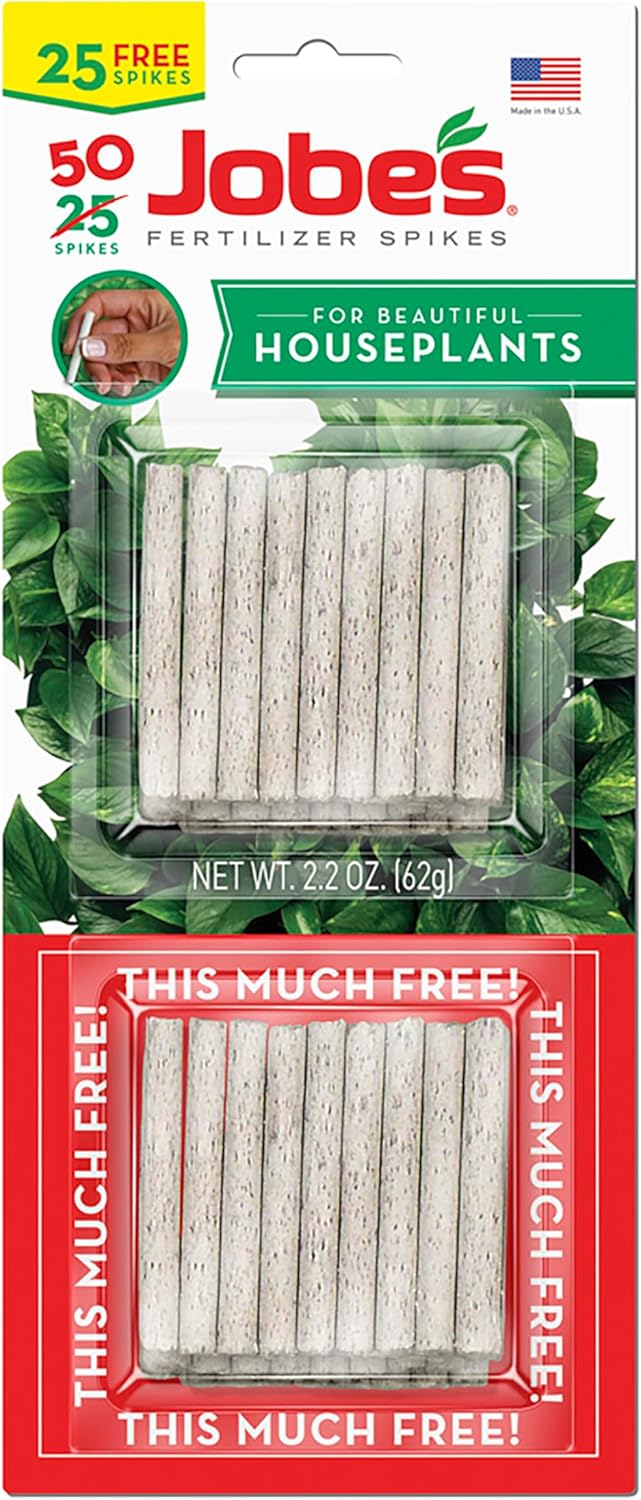
Jobe's Organics Houseplant Fertilizer Spikes, 50 Count
| Unit Count | 50 Count |
|---|---|
| Application Method | Insert spikes into soil |
| Item Form | Granules, Liquid, Sticks |
| Target Species | Houseplant |
| Mixing Ratio | 13-4-5 |
Jobe's Organics fertilizer spikes are pre-measured, slow-release sticks you insert directly into potting soil to feed indoor flowering and foliage houseplants. Each pack includes 50 spikes formulated at 13-4-5 NPK, designed to supply nutrients at the roots for roughly 60 days before replacement. Use is straightforward: push the recommended number of spikes into the soil around the root zone and forget them until the next application. The spikes eliminate mixing, reduce mess and runoff, and help prevent accidental overfeeding because each spike contains a set dose. For small pots and casual plant owners this delivers consistent feeding with minimal effort, especially where you want steady bloom and leaf color without daily attention. Limitations are the fixed nutrient ratio and dosing schedule so you cannot fine-tune feeding for specific species or correct nutrient imbalances quickly, and spikes may be less practical for very large containers or heavy feeders that need more frequent or soluble feeding.
Best for: A practical, budget-minded houseplant owner who prefers low-effort, scheduled feeding and wants reliable bloom and foliage maintenance without mixing fertilizers.
Less Ideal for: Enthusiasts who need customizable nutrient ratios, rapid corrective feeding, or who primarily care for very large or heavy-feeding plants.
- Pre-measured slow-release spikes remove mixing and reduce mess
- Continuous root-zone feeding for about 60 days per application
- Formulated 13-4-5 NPK suited to flowering and foliage development
- Pack of 50 provides multiple applications for several small plants
- Fixed NPK ratio and dose cannot be adjusted for individual plant needs
- Not ideal for very large pots or plants requiring frequent soluble feeding
Verdict: If you want an inexpensive, no-mess way to provide steady root-zone nutrition to multiple houseplants, these pre-measured spikes are a simple and reliable choice.
Choosing the Right Slow Release Fertilizer for Houseplants: Key Factors to Consider
Nutrient Ratio and Balance
Houseplants typically benefit from balanced N‑P‑K ratios that support foliage growth and root health without promoting excessive, leggy growth. A fertilizer with an appropriate ratio helps maintain steady leaf color and new growth while avoiding sudden flushes that can stress roots.
Look for clear labeling of nitrogen, phosphorus, and potassium and consider the plant types you grow. Flowering houseplants need more phosphorus at bloom time, while foliage plants do better with a modestly higher nitrogen level. Consistent, predictable N‑P‑K output matters more indoors than peak strength.
Release Longevity and Predictability
Slow release products advertise durations like 3, 6, or 12 months, but indoor temperature and moisture cycles affect how fast nutrients are liberated. A predictable release profile means you can plan repotting and watering without surprise nutrient spikes.
Choose products whose release mechanism-coated granules, resin beads, or organic slow mineralization-is appropriate for your indoor conditions. Shorter advertised durations may be better for small pots where salt build-up is a concern; longer durations suit large planters or gardeners who prefer low-maintenance feeding.
Form Factor and Application Method
Slow release fertilizers come as granules, spikes, or lightly coated prills. Granules allow you to blend into potting mix or topdress, while spikes are tidy but may deliver uneven distribution if used alone. Coated prills provide gradual release with minimal handling.
Think about how you repot and water. If you often refresh topsoil, a topdressing granular product is convenient. For decorative pots where visible granules are undesirable, consider buried application or a product with small, unobtrusive prills.
Salt Buildup and Root Safety
In confined containers, salts from fertilizers can accumulate and harm roots or cause leaf tip burn. Slow release formulas reduce the intensity of salt pulses, but some still leave residues that concentrate over time.
Assess your watering routine and pot size. Shallow pots and infrequent leaching increase buildup risk. Pick a product with lower salt index or shorter duration, and plan occasional flushes of the potting mix to remove accumulated salts.
Micronutrients and Secondary Elements
Micronutrients such as iron, magnesium, and manganese keep houseplants green and actively growing. A slow release fertilizer that includes a balanced micronutrient suite prevents subtle deficiencies that show up as chlorosis or stunted growth.
Organic-sourced slow releases may supply trace elements naturally, while synthetic coated products often add a tailored micronutrient mix. Check labels for essential trace elements if you grow sensitive or high-demand species.
Compatibility With Potting Mix and Watering Habits
Different potting mixes vary in organic content, cation exchange capacity, and drainage. A fertilizer that performs well in a moisture-retentive mix may release differently in an airy mix. Similarly, frequent light watering speeds up release compared with infrequent deep watering.
Match the fertilizer style to your potting medium and watering cadence. If you water lightly every day, choose products formulated for steady release under frequent moisture cycling to avoid overfeeding.
When Slow Release Is Better Than Liquid Feeding
Slow release options reduce the need for weekly liquid feeds and cut down on dosing errors that commonly overfertilize indoor pots. They are particularly useful for busy households or decorative displays where routine fertilizing is overlooked.
However, liquid feeding still has advantages for rapid correction of deficiencies and for precise control during active growth phases. Use slow release for baseline maintenance and reserve liquids for targeted boosts when you need immediate results.
- Steady background nutrition without weekly measuring
- Lower risk of sudden nutrient spikes that stress roots
- Reduced mess compared with frequent liquid mixing
Applying Slow Release Fertilizer to Different Pot Sizes
Small pots require much smaller absolute amounts of any fertilizer. Measure carefully to avoid over-application and consider split applications across multiple pots rather than a single concentrated dose.
Large containers and floor planters can handle higher total quantities and longer-duration products. In these cases, you can rely on multi-month formulas that cut down on maintenance.
- Topdressing is simplest for established pots
- Work granules into fresh potting mix when repotting
- For decorative topsoil, gently push prills below the surface for aesthetics
How Indoor Conditions Affect Release Rate
Temperature and moisture are the main drivers of slow release behavior. Warmer, more consistently moist indoor environments accelerate nutrient release, while cool, dry rooms slow it down. That means identical products can behave differently across homes.
If your indoor air is dry in winter, expect a slower release and plan for supplementary feeding during top growth periods. Conversely, heated bathrooms or sunrooms may liberate nutrients faster, so choose shorter-duration formulas to avoid buildup.
- Higher temperatures speed up nutrient liberation
- Frequent watering increases release rate
- Adapt duration choice to seasonal indoor conditions
Safe Use and Troubleshooting
Monitor plants for subtle signs of overfeeding such as leaf tip burn, slowed new growth, or crusty residue on the soil surface. These often indicate salt accumulation and may call for a gentle flush of the potting mix with water.
If you see deficiency symptoms despite using slow release fertilizer, consider root-bound pots or depleted micronutrients as causes. Repotting into fresh mix and supplemental liquid feeds targeted at the lacking element can correct problems.
- Flush soil occasionally to manage salt buildup
- Repot every 12-24 months for best nutrient balance
- Use targeted liquid corrections for specific deficiencies
Combining Slow Release With Seasonal Care
Adjust your feeding strategy through the year. Many houseplants slow growth in winter and need less supplemental nutrition. Using a long-duration slow release in late spring lets plants draw steady nutrients through the growing season without repeated interventions.
For plants that remain actively growing year-round, shorter-duration products applied more frequently give you better control and reduce the chance of long-term salt accumulation.
- Choose longer duration for low-maintenance seasonal coverage
- Opt for shorter duration when you want more control
- Coordinate repotting and fertilizing for best results
How We Chose the Best Slow Release Fertilizer for Houseplants
We focused on practical, measurable attributes that matter in indoor container culture. Primary evaluation criteria included nutrient composition and balance for common houseplant needs, release longevity and predictability under typical indoor temperatures, physical form and application ease, safety for potting mixes and root systems, and the presence of beneficial secondary elements such as micronutrients and slow-release coatings. We also considered how the product interacts with common indoor watering patterns and whether it risks salt buildup in small pots. Products that relied on unclear ingredient lists, lacked clear longevity claims, or were unsuitable for confined containers were excluded. We favored formulas whose release profile and nutrient ratios matched the steady, moderate feeding houseplants require rather than aggressive, fast-release formulations intended for outdoor landscape use. The scoring emphasized concrete dimensions gardeners can compare: nutrient balance, release consistency, application simplicity, root and soil compatibility, and micronutrient completeness.
FAQ
How often should I repot if I use slow release fertilizer?
Repotting every 12 to 24 months is typical for many houseplants. Repot more often for fast-growing species or if you notice root crowding, because compacted roots can reduce nutrient uptake even with slow release products.
Will slow release fertilizer burn my plants?
Slow release formulas are designed to reduce burn risk by releasing nutrients gradually, but overapplication or using a high-concentration product in a small pot can still cause tip burn. Follow label dosage and adjust for pot size and plant sensitivity.
Can I use slow release fertilizer with organic potting mixes?
Yes. Many slow release products are compatible with organic mixes, but the organic content and microbial activity in the mix can change release dynamics. Monitor plants after application and consider a shorter-duration option if microbial mineralization accelerates release.
Should I water differently after applying slow release fertilizer?
Water as you normally would for the species. Initial watering helps settle granules and start the release process. Avoid heavy, frequent watering intended to push nutrients out quickly because that can increase leaching and speed release unexpectedly.
Are spikes better than granular slow release for decorative pots?
Spikes are tidy and convenient, but they may deliver uneven distribution if placed too far from the root ball. Granular topdressing or mixing into the potting mix gives more even coverage, especially in wider or irregular root zones.
Do slow release fertilizers supply micronutrients?
Many slow release formulations include a suite of micronutrients, but mixes vary. Check the composition if you grow sensitive species that show micronutrient deficiency easily, and plan supplemental feeding if the product lacks specific trace elements.
Final Verdict
For most indoor gardeners, prioritize a slow release fertilizer with an appropriate nutrient ratio, predictable release lifespan, and low salt characteristics that match your pot sizes and watering habits. Consider form factor and micronutrient content based on how you repot and the sensitivity of your plants. Match duration to maintenance preferences: choose longer-lasting formulas for low-effort displays and shorter durations when you want seasonal control or have many small pots. With those tradeoffs in mind, you can select a steady feeding approach that keeps houseplants healthy without constant measuring.
