

Note: This article contains affiliate links. If you click on these links and make a purchase, I may earn a small commission at no extra cost to you. This helps support my research and content. Read my full affiliate disclosure here.
Picking the right slow release fertilizer for plants matters because it controls how often you feed and how reliably nutrients reach roots throughout the season. In many gardens and patios, a steady, predictable release reduces burn risk and cuts down on weekly maintenance, which is particularly helpful for containers, mixed borders, and vegetable beds with varying watering schedules. This guide covers seven top shortlisted slow release options suited for the typical plant gardener, from containers to in-ground beds, and explains practical tradeoffs in nutrient ratios, release duration, and application method. Below you will find the picks followed by clear criteria used to evaluate them and the factors to consider when choosing the best fit for your growing situation.
Top Picks at a Glance
| Best Overall The best all-around choice for most situations | Osmocote Smart-Release Plant Food Plus, Indoor & Outdoor, 8 lb |  |
| Best Quality Built to a higher standard if you want something more solid | Osmocote Smart-Release Plant Food Flower & Vegetable, 8 lb. |  |
| Best Value The sweet spot between price and what you get | Milorganite Slow-Release Organic Fertilizer, 5 lb |  |
| Best Budget The cheapest option that still gets the job done reliably | RAINFLOW Slow-Release 17-17-17 Granular Fertilizer, 11.28 oz |  |
| Highest Rated A top-rated pick with lots of positive feedback | Osmocote 4 Month Slow Release Plant Food for Vegetables & Flowers, 2 lb (pack of 2) |  |
| Most Popular A crowd favorite that many people choose with confidence | Osmocote Smart‑Release Plant Food Plus Outdoor & Indoor, 2 lb |  |
| Best Seller A high-volume bestseller chosen again and again | Miracle-Gro Shake 'N Feed All Purpose Plant Food, 4.5 lb |  |
Osmocote Smart-Release Plant Food Plus, Indoor & Outdoor, 8 lb

| NPK | 15-9-12 |
|---|---|
| Nutrients | Contains 11 essential nutrients |
| Coverage | Feeds approximately 300 sq. ft. per 8 lb. |
| Duration | Feeds up to 6 months |
Osmocote Smart-Release Plant Food Plus is a granular slow-release fertilizer designed for both container and in-ground use around the garden and home. Each granule contains a balanced nutrient mix (15-9-12 NPK plus secondary nutrients) that releases over time, so you apply and then water normally while the product steadily feeds plants for up to six months. It is typically used by sprinkling measured scoopfuls into potting soil or mixing into the top inch or two of garden beds; directions give simple rates for pots and square footage to make dosing straightforward. The main benefits are long-lasting feed so you do not need frequent applications, broad compatibility with many plant types and growing conditions, and ease of use for routine maintenance. Limitations are that it is not instant-acting for urgent nutrient deficiencies and the fixed NPK ratio may not match specialist needs like high-phosphorus flowering mixes or specific crop programs. For regular home gardeners wanting reliable, low-maintenance feeding, this product covers most bases efficiently.
Best for: Gardeners who want a low-maintenance, broadly effective fertilizer for routine feeding of mixed household and garden plants and prefer scheduled, infrequent applications.
Less Ideal for: Growers who need rapid corrective fertilization, are managing nutrient-sensitive crops, or who require customized NPK formulations for specific flowering or vegetable programs.
- Smart-release granules provide up to six months of steady feeding
- Balanced 15-9-12 NPK formula with secondary nutrients for general plant health
- Suitable for both indoor containers and outdoor in-ground use
- Simple application rates for pots and garden areas make dosing easy
- Does not provide immediate correction for acute nutrient deficiencies
- Fixed nutrient ratio may not suit specialty crops or targeted feeding programs
Verdict: A dependable, low-maintenance slow-release fertilizer that keeps most indoor and outdoor plants fed for up to six months with a single application.
Osmocote Smart-Release Plant Food Flower & Vegetable, 8 lb.

| Item Form | Granules |
|---|---|
| Specific Uses For Product | Root Development |
| Target Species | Perennials |
| Mixing Ratio | 1:22 (1 lb.:1 cubic foot) |
Osmocote Smart-Release Flower & Vegetable is a granular slow-release fertilizer designed to provide steady nutrition to vegetable beds, raised beds, and perennial planting areas for up to four months. It is applied by mixing the measured scoop into the top 1 to 3 inches of soil or broadcasting over mulched areas, with 1 lb treating roughly 40 sq ft. The balanced 14-14-14 NPK formula supports root development and consistent above-ground growth without frequent reapplication. Notable practical benefits include the no-burn reputation that makes it forgiving if you misapply, and the temperature-responsive release that aligns feeding with plant uptake. It comes with an applicator and clear coverage guidance, so it is straightforward to use for typical home gardeners. Limitations are that release rate depends on soil temperature so feeding timing can vary between climates, and as a granular product it requires incorporation into the soil rather than being foliar or water-soluble for quick correction of deficiencies. For gardeners seeking a low-maintenance, season-long feed for edible and ornamental plantings, this performs predictably and safely.
Best for: Home gardeners who want a reliable, low-maintenance fertilizer for vegetable plots, raised beds, and perennial borders and prefer a product that reduces the need for frequent feeding.
Less Ideal for: Growers who need fast corrective feeding or who prefer liquid or foliar fertilizers for immediate nutrient delivery should consider other options.
- Balanced 14-14-14 NPK supports both root and top growth across vegetables and flowers
- Slow-release formula feeds up to four months, reducing reapplication frequency
- Included scoop and clear coverage guidance make application easy and consistent
- Formulation is forgiving and unlikely to burn plants even if over-applied
- Nutrient release depends on soil temperature so timing can vary by climate
- Granular form must be mixed into soil and cannot correct nutrient deficiencies quickly
Verdict: Choose this if you want a dependable, mistake-proof slow-release fertilizer that feeds vegetables and flowers for an entire season.
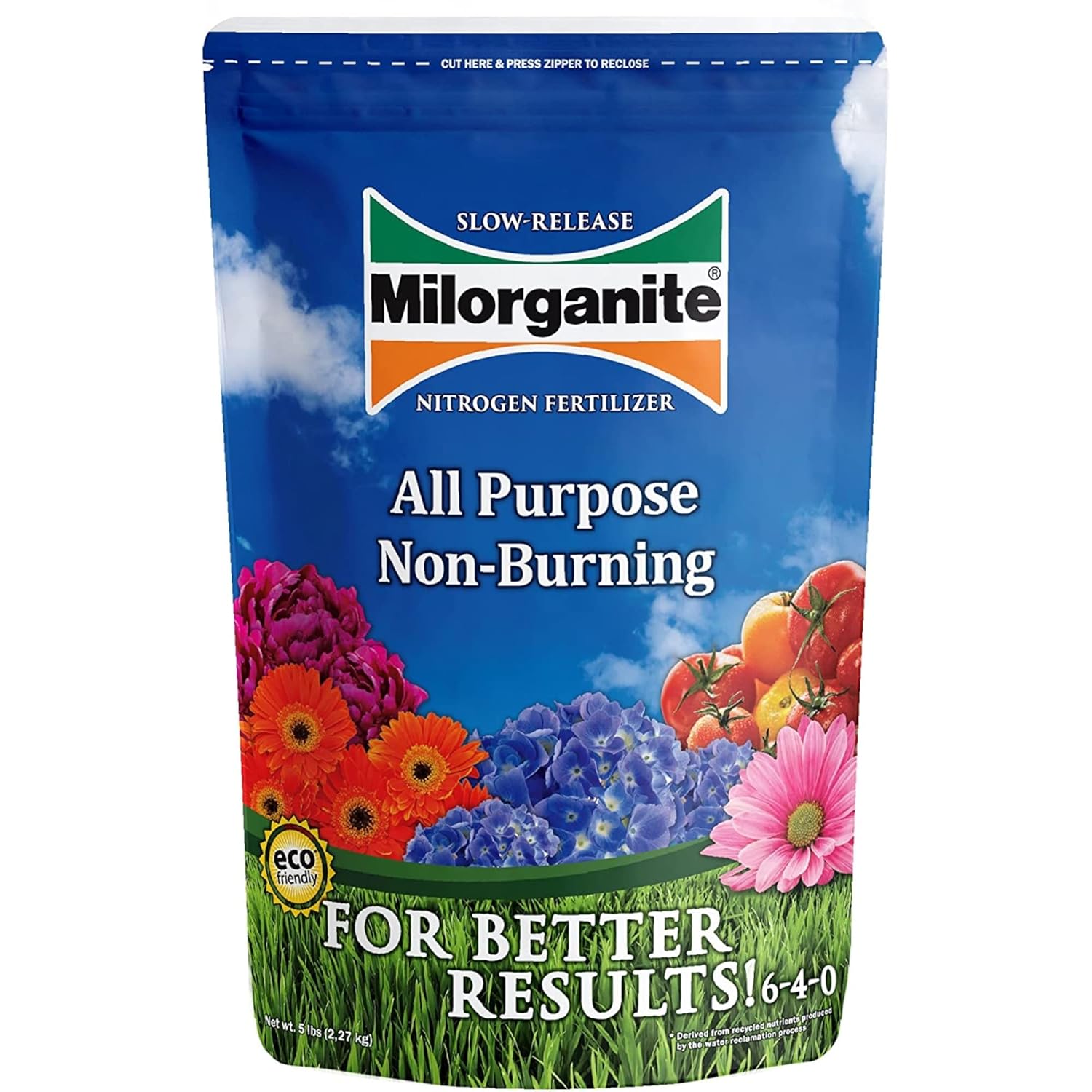
Milorganite Slow-Release Organic Fertilizer, 5 lb
| Item Form | Granules |
|---|---|
| Specific Uses For Product | Lawns, Flowers and Gardens |
| Coverage | 390 Square Feet |
| Ingredients | Nitrogen |
Milorganite is a granular, slow-release organic fertilizer formulated to feed lawns and garden plants for about 8 to 10 weeks per application. It is typically broadcast by hand or with a spreader and does not require immediate watering in, making it easy to fit into routine maintenance. Notable features include a low-salt formula that greatly reduces the risk of burning turf, organically complex iron that greens grass without staining hard surfaces, and about 85% organic matter that helps improve soil structure over time. The product covers roughly 390 square feet from a 5 pound bag and is positioned as safe for use on lawns, shrubs, flowers, trees, and edible gardens. Limitations are that nutrient release is gradual, so it is not a quick fix for severe nitrogen deficiency, and the bag has an earthy odor at first that some pets may find attractive until it dissipates or is watered in. For someone managing Empire Zoysia, use on the recommended schedule and expect steady, low-risk green-up rather than instant color change.
Best for: Gardeners who prioritize steady, low-risk nutrient delivery and soil health and who prefer a hands-off feeding schedule for fine-textured lawns like Empire Zoysia.
Less Ideal for: Homeowners wanting rapid color correction or fast-acting synthetic nitrogen boosts should choose a quick-release fertilizer instead.
- Slow-release nitrogen feeds lawns for 8–10 weeks reducing application frequency
- Low salt formulation minimizes risk of burning sensitive turf like Zoysia
- Provides organically complex iron that greens grass without staining concrete
- High organic matter improves soil structure and water retention over time
- Slow-release action means it will not correct severe yellowing immediately
- Initial earthy odor that may attract some pets until it is watered in or dissipates
Verdict: Choose Milorganite for Empire Zoysia when you want a safe, slow-release organic feed that greens turf steadily without burning or staining.
RAINFLOW Slow-Release 17-17-17 Granular Fertilizer, 11.28 oz

| Item Form | Granules |
|---|---|
| Mixing Ratio | 17:17:17 |
| Unit Count | 11.28 Ounce |
| Application Method | Spread and mix into the soil |
| Coverage | general-purpose, suitable for various plants and gardens |
This RAINFLOW granular fertilizer supplies a balanced 17-17-17 NPK blend in a slow-release form designed to feed plants for about 60 days. You apply it by spreading or lightly mixing the granules into potting soil or garden beds and watering as usual; the product gives straightforward, timed nutrition without frequent reapplication. Notable features include the even NPK ratio that supports foliage, roots, and blooms and clear dosing guidance for different pot sizes. For cannas, which benefit from steady nitrogen and potassium for vigorous foliage and flowering, this product can support healthy growth when used at the recommended rates. Practical benefits are convenience and reduced application frequency, making it suitable for busy gardeners on a budget. Important limitations are the small pack size—11.28 ounces limits coverage for larger beds—and the fixed 17-17-17 ratio that does not allow tailoring to soil tests that show specific nutrient deficiencies. Follow recommended rates to avoid overfeeding, especially in pots and newly established outdoor plantings.
Best for: Gardeners seeking an inexpensive, low-effort fertilizer to provide steady, general nutrition to cannas in pots or small garden plots and who prefer fewer feedings.
Less Ideal for: Large-scale plantings, intensive vegetable beds, or gardeners working from a soil test who need custom NPK ratios should choose a larger or specialist fertilizer.
- Balanced 17-17-17 NPK supports foliage, roots, and blooms
- Slow-release formula feeds up to about 60 days, reducing application frequency
- Granular form is easy to spread and mix into potting soil
- Clear dosing recommendations for different pot sizes
- Small 11.28 oz package gives limited coverage for garden beds or multiple rhizomes
- Single NPK ratio cannot be adjusted to specific soil nutrient needs
Verdict: A budget-friendly, easy-to-use slow-release 17-17-17 granular fertilizer that provides convenient, steady nutrition ideal for keeping cannas healthy with minimal reapplication.
Osmocote 4 Month Slow Release Plant Food for Vegetables & Flowers, 2 lb (pack of 2)

| Item Form | Granules |
|---|---|
| Target Species | Vegetables, Flowers |
| Mixing Ratio | 14:14:14 |
| Number of Packs | 2 |
| Unit Count | 64 Ounce |
This Osmocote product is a slow-release granular fertilizer designed to provide steady, balanced nutrition to vegetables and flowering plants for up to four months from a single application. Users sprinkle the granules around the root zone, water them in, and the encapsulated nutrients gradually become available, which reduces the need for frequent refeeding. The 14-14-14 NPK ratio supports both top growth and root development, making it suitable for annuals, perennials, and most edible garden crops. The package includes two 2 lb canisters so you can treat multiple beds or keep a spare container for follow-up plantings. Practical benefits include predictable, low-maintenance feeding and ease of application for gardeners who want consistent results without monthly dosing. Important limitations are that the product supplies a general-purpose, balanced feed rather than a target formula for specific needs like high-phosphorus bloom boosters or high-nitrogen leafy crops, and slow-release timing can vary with soil temperature and moisture so results may be slower in cool or very dry conditions.
Best for: Gardeners who prioritize predictable, low-maintenance feeding for mixed vegetable and flower beds and want consistent growth without frequent applications.
Less Ideal for: Growers seeking specialized fertilization programs for specific crops, aggressive bloom stimulation, or rapid correction of nutrient deficiencies should consider targeted fertilizers instead.
- Slow-release encapsulation provides up to four months of continuous feeding
- Balanced 14-14-14 NPK supports both foliage and root development
- Granular form is easy to apply around established plants and beds
- Two 2 lb canisters give enough product for multiple beds or follow-up plantings
- Not formulated for crop- or bloom-specific feeding needs such as high-phosphorus or high-nitrogen schedules
Verdict: Buy this if you want a reliable, set-and-forget balanced fertilizer that feeds vegetables and flowers for up to four months.
Osmocote Smart‑Release Plant Food Plus Outdoor & Indoor, 2 lb

| Item Form | Granules |
|---|---|
| Application Method | Sprinkle |
| Target Species | All plants |
| Mixing Ratio | 1 capful (3 tablespoons) per 2 gallons soil or per 4 sq. ft. |
| Unit Count | 32 Ounce |
Osmocote Smart‑Release Plant Food Plus is a granular, resin‑coated fertilizer designed to feed flowers and other plants steadily for up to six months with 11 essential nutrients. You apply it by sprinkling the recommended amount into the top inch or two of potting mix or garden soil, watering it in, and reapplying every six months; indoor plants use about half the outdoor rate. The resin coating times nutrient release to moisture and temperature, which reduces the need for frequent feedings and lowers the risk of fertilizer burn when used as directed. It works across containers, raised beds, and in‑ground flower beds and covers up to roughly 75 square feet per 2 lb container. Limitations are that a single 2 lb container is only enough for small gardens or several pots, and the slow‑release formula is not suitable when an immediate corrective boost is needed for acute nutrient deficiencies. For gardeners focused on steady, maintenance feeding for flowering plants this is an easy, low‑effort option.
Best for: Gardeners who want reliable, low‑maintenance feeding for flowers and mixed plantings and prefer a consistent supply of nutrients over months rather than frequent liquid feedings.
Less Ideal for: Growers who need fast corrective feeding for visible nutrient deficiencies or those managing very large beds who want bulk fertilizer options to reduce trips to reapply.
- Feeds continuously up to six months with a single application
- Resin coating times nutrient release to plant needs based on moisture and temperature
- Formulated with 11 essential nutrients suitable for a wide range of flowering plants
- No-burn pledge when used as directed reduces risk of overfeeding
- 2 lb container only covers about 75 sq. ft., so frequent repurchase is needed for larger gardens
- Slow‑release formulation does not provide a rapid corrective nutrient boost
Verdict: Choose this product if you want a hands-off, long‑lasting fertilizer that keeps flowering plants fed for months with a single application.
Miracle-Gro Shake 'N Feed All Purpose Plant Food, 4.5 lb

| Item Form | Granules |
|---|---|
| Application Method | Shake onto soil and work into top 1-3 inches |
| Target Species | flowers, vegetables, herbs |
| Unit Count | 72 Ounce |
| Feeds For | up to 3 Months |
Miracle-Gro Shake 'N Feed All Purpose is a granular, continuous-release fertilizer you sprinkle onto soil and lightly work into the top inch or three before watering. It is typically used on in-ground garden beds, raised beds and established container plants to provide slow feeding across the season; the label recommends reapplying every three months. Notable features include natural ingredients that feed soil microbes, added micronutrients, and an easy shake-on application that requires no mixing. In practice this product is convenient for routine garden maintenance because one application supports steady nutrient availability without frequent dosing. For garden beds it helps promote root strength and consistent growth while reducing the need to remember weekly feedings. The main limitations are that it is a general-purpose formula rather than a crop-specific blend and that application rates must be followed to avoid overfeeding; it also provides broad coverage but not the fast boost of a water-soluble feed if plants need immediate recovery.
Best for: Gardeners who want a low-maintenance, reliable feeding method for flower and vegetable beds and containers and prefer scheduled, less frequent fertilizing over weekly applications.
Less Ideal for: Growers seeking fast corrective feeding, precise NPK ratios for fruiting crops, or specialty blends for roses or acid-loving plants should consider targeted fertilizers instead.
- Continuous-release formula feeds plants for up to three months per application
- Granular shake-on application is simple and requires no mixing
- Contains micronutrients and ingredients that support soil microbes and root health
- Suitable for both in-ground garden beds and container plants
- All-purpose formula may not match nutrient ratios for specific crops or problems
- Slower acting than water-soluble fertilizers when immediate nutrient correction is needed
Verdict: Use this granular, three-month continuous-release fertilizer when you want a simple, low-maintenance feed that keeps garden beds and containers nourished through the season.
Choosing the Right Slow Release Fertilizer for Plants: Key Factors to Consider
Release Duration and Timing
How long a slow release fertilizer provides nutrients matters because different plants and container sizes need different feeding intervals. A product that advertises a duration of eight to twelve weeks will behave differently in dry, hot weather versus cool, moist conditions. Consider whether you want a single-season feed or a product you can rely on for many months, and match the expected release curve to your irrigation frequency.
When planning, remember release duration is a range rather than a fixed day. If you water heavily or use automatic irrigation, nutrients may release faster. Conversely, dry spells can slow the process. Choose a duration that leaves a buffer so plants do not become nutrient-starved between applications.
Nutrient Ratio and Plant Needs
The N-P-K ratio defines what the fertilizer emphasizes: growth, rooting, or bloom and fruiting. Ornamental foliage plants and lawns typically benefit from higher nitrogen, while flowering perennials and fruiting vegetables often need a boost of phosphorus and potassium at key stages. Match the stated analysis to the types of plants you grow and the stage they are in when you apply the product.
Also check for secondary nutrients and micronutrients. Trace elements like iron, magnesium, and zinc can correct common deficiencies, especially in container media that have limited natural reserves. If your soil tests show a specific deficiency, pick a slow release formula that addresses it rather than a generic all-purpose mix.
Application Method and Labor
Slow release fertilizers come in several forms: coated granules, resin-encapsulated prills, polymer-coated pellets, and organic granules. Application method affects how evenly nutrients are distributed and how much physical effort is needed. Granules spread across a bed or mixed into potting media work well for broader coverage, while prills designed for top-dressing are simple for containers.
Consider whether you prefer an annual top-dress, a one-time soil incorporation at planting, or periodic scatter applications. If you maintain many containers, ease of broadcast or a pre-mixed potting medium may save significant time over the season.
Watering Pattern and Environmental Loss
Your irrigation style influences both nutrient availability and the risk of leaching. Products that depend on consistent moisture to release will perform well with regular irrigation but may underperform in drought. Conversely, highly soluble materials risk losing nutrients below the root zone in heavy rainfall or overwatering.
Choose a release technology suited to your climate and irrigation setup. In regions with heavy rain or soaked soils, a polymer- or resin-encapsulated product that meters release can reduce nutrient loss. For dry, infrequently watered containers, a product with moisture-activated but slower kinetics is usually better.
Compatibility With Soil and Potting Mixes
Some slow release fertilizers are formulated to work specifically in potting mixes, while others are designed for in-ground soils. Particle size and formulation determine how well the product mixes into media and how evenly plants draw nutrients. In compacted or clay soils, nutrients may accumulate near the surface unless mixed deeply at planting.
When using containers, ensure the fertilizer will not change media structure or pH dramatically. For garden beds, consider whether you will incorporate the product into planting holes, top-dress, or apply with side-dressing. Choose a form that integrates cleanly with your typical soil management routine.
Safety and Handling
Slow release fertilizers often contain concentrated nutrients that can irritate skin or harm pets if misused. Look for products with clear handling instructions and low dust if safety and cleanliness are concerns in a household with children or animals. Also check whether the product requires special storage to protect moisture-sensitive coatings.
Consider whether the product leaves visible residues on foliage or pot rims, which can be unsightly or require extra cleaning. Choose safer formulations if you grow edible plants and want minimal contact or if you refill planters frequently.
Matching Release Duration to Planting Schedules
Think about when plants need the most nutrients in relation to the fertilizer release curve. For annuals and containers that peak over a single season, a product with a predictable three-month window may be ideal. For perennials or shrubs that need steady feeding across wet and dry spells, longer-duration formulas reduce reapplication frequency.
Adjust application timing to coincide with growth phases. Apply a slow release product at planting for rooting and early growth, then choose subsequent top-dressing only if growth slows before the expected release window ends.
- Short-duration feeds for fast-growing annuals and vegetables
- Long-duration feeds for established perennials and landscaping
- Time application to match peak nutrient demand
Using Slow Release Fertilizer in Containers
Containers have limited soil volume and nutrients deplete faster than in-ground beds. Incorporating a slow release fertilizer into the potting mix at planting gives an even start, while top-dressing mid-season can top up feeding without disturbing roots. Pay attention to particle size; very large granules may not distribute evenly in shallow pots.
Because containers dry out quickly, choose a product whose release rate tolerates occasional dry spells or use consistent watering to maintain the expected release curve.
- Mix small-dose granules into potting mix at planting
- Top-dress large pots rather than deep mixing in established containers
- Monitor foliage for signs of excess or deficiency and adjust future applications
Environmental Considerations and Responsible Use
Responsible gardeners think beyond plant performance and consider runoff and leaching. Slow release technologies that meter nutrients reduce spikes in soluble nitrogen after heavy rain, which lowers the chance of nutrients escaping the root zone. Avoid applying near storm drains, water features, or steep slopes where runoff is likely.
Follow label instructions for rates and timing. Overapplication of any fertilizer, including slow release types, increases environmental risk and can harm plants. When possible, pair fertilization with mulching and soil-building practices to improve nutrient retention.
- Avoid applying before heavy rain where runoff can carry nutrients away
- Use soil tests to avoid unnecessary applications
- Combine with organic matter to hold nutrients in the root zone
Feeding Edibles Versus Ornamentals
Edible plants often need predictable nutrient levels that support fruiting and root development. For vegetables, choose formulations with clear N-P-K ratios suited to the crop and avoid high-salt products late in fruiting stages. Ornamentals may tolerate a broader range of ratios but respond to timing for foliage or bloom.
When growing vegetables and herbs in containers or raised beds, pay closer attention to micronutrients and potential residue on edible surfaces. Wash harvests thoroughly and select low-residue formulas when practicality requires minimal cleaning.
- Tailor N-P-K to plant type and growth stage
- Prefer low-residue options for container-grown edibles
- Supplement with foliar feeds if a targeted nutrient deficiency appears
Storing and Applying Safely
Store slow release fertilizers in a cool, dry place to prevent moisture from breaking down coatings prematurely. Keep bags sealed and out of reach of children and pets. Wear gloves and a dust mask if you are handling large volumes or if the product is dusty.
Apply with a spreader for beds to get even coverage, and use a scoop or small measuring tool for individual pots to avoid over-application. Clean any spilled granules from walkways to prevent tracking.
- Keep products sealed and dry
- Use personal protective equipment when handling large quantities
- Measure carefully for containers to avoid fertilizer burn
How We Chose the Best Slow Release Fertilizer for Plants
We shortlisted options that deliver predictable nutrient release for common garden uses and that match the feeding needs of containers, ornamentals, and edibles. Selection prioritized products with clearly stated release duration and nutrient analysis, because gardeners need dependable timing and the right N-P-K balance for different plant types. We assessed application method and coverage so options work for both small containers and larger beds without frequent reapplication. Environmental performance was considered, including whether the release mechanism reduces leaching risk under normal watering. Ease of use and compatibility with common watering and soil practices were important; products that required specialized handling or incompatible timing were excluded. Excluded from the list were any fertilizers with unclear labeling on nutrient content or release profile, and materials intended primarily as soil amendments rather than controlled nutrient sources. The final picks scored well on these dimensions: nutrient longevity, application ease and coverage, nutrient profile suitability, environmental release behavior, and handling safety. These criteria align with the scoring metrics used in the product cards so gardeners can compare tradeoffs that matter in real planting situations.
FAQ
How often should I reapply slow release fertilizer in containers?
It depends on the labeled release duration and your watering routine. Many container-focused products last two to four months in normal conditions. If containers dry out frequently, expect faster release and plan to monitor plants and top-dress earlier if signs of deficiency appear.
Can I use slow release fertilizer with newly planted transplants?
Yes. Mixing a moderate amount into planting holes or potting mix gives young roots steady nutrients as they establish. Avoid high initial rates that can stress tender roots; follow recommended starter rates for transplants.
Will slow release fertilizers harm soil life or microbes?
Most slow release formulations are compatible with healthy soil biology, but extremely high salt or concentrated applications can stress microbes. Using recommended rates and combining fertilization with organic matter supports beneficial soil organisms.
Are organic slow release options better for edible crops?
Organic slow release products can be a good choice for edibles because they often contain fewer synthetic salts and more complex organic matter. However, release timing can be less predictable, so watch plant performance and supplement if necessary.
How does heavy rainfall affect slow release fertilizers?
Heavy rain can accelerate nutrient release for moisture-activated products and increase the risk of leaching for more soluble formulas. Polymer-encapsulated or coated products tend to resist sudden release spikes, lowering loss risk during storms.
Can I combine slow release fertilizer with liquid feeds?
You can, but monitor total nutrient input to avoid excess. Liquid feeds are useful for quick correction of deficiencies while slow release fertilizer provides baseline nutrition. Use reduced-rate liquids and observe plant response before repeating.
Final Verdict
Choose a slow release fertilizer by matching release duration and nutrient ratio to how and when your plants grow. Prioritize a release technology that suits your irrigation pattern and your plot type, whether containers, raised beds, or in-ground borders. Balance ease of application against environmental risk and handling needs. With those tradeoffs in mind, pick the formula that aligns with timing and nutrient priorities so you get steady feeding and minimal maintenance through the growing season.
