

Note: This article contains affiliate links. If you click on these links and make a purchase, I may earn a small commission at no extra cost to you. This helps support my research and content. Read my full affiliate disclosure here.
Potassium is one of the key nutrients that governs flowering, fruit development, and plant stress tolerance in a garden. Choosing the right natural potassium fertilizer for plants matters because different sources release potassium at different rates, affect soil biology, and require distinct application methods. This guide shortlists seven top natural potassium fertilizers that are commonly used in gardens, raised beds, containers, and small orchards. We evaluated each option for nutrient availability, how it interacts with soil and compost, and how easy it is to apply so you can match a source to your soil test results and planting plan. Read on to see what to consider before applying potassium and which characteristics matter most for your situation.
Top Picks at a Glance
| Best Overall The best all-around choice for most situations | Down To Earth Solution Grade Potassium Sulfate (0-0-50), 1 lb |  |
| Best Quality Built to a higher standard if you want something more solid | Cz Garden Supply Organic Sulfate of Potash (0-0-50), Water Soluble 3 lb |  |
| Best Value The sweet spot between price and what you get | Down To Earth Langbeinite Organic Fertilizer 0-0-22, 5 lb |  |
| Best Budget The cheapest option that still gets the job done reliably | RAW Potassium Fertilizer 0-0-50 Water-Soluble Potash, 2 oz |  |
| Highest Rated A top-rated pick with lots of positive feedback | Lancaster Agriculture Products Potassium Sulfate, 5 lb |  |
| Most Popular A crowd favorite that many people choose with confidence | Cz Garden Muriate of Potash (0-0-60) Potassium Fertilizer, Granules, Resealable Pouch |  |
| Best Seller A high-volume bestseller chosen again and again | Espoma Potash 0-0-60 Granular Potassium Fertilizer, 6 lb |  |
Down To Earth Solution Grade Potassium Sulfate (0-0-50), 1 lb

| Ingredients | 50% Potassium (K2O), 17% Sulfur (S) |
|---|---|
| Grade | 0-0-50 |
| Form | Solution grade, water-soluble powder |
| OMRI Listed | Yes |
This 1 lb bag of Down To Earth Solution Grade Potassium Sulfate supplies concentrated, water-soluble potassium (0-0-50) in a fine powder that dissolves quickly for fertigation, hydroponics, or foliar use. It is OMRI listed and free of chloride, making it suitable for chloride-sensitive crops and organic systems. In practice it is used as a targeted potassium boost during flowering and fruit set or when plants show potassium deficiency symptoms; a little goes a long way because of the high 50% K2O content. The solution-grade texture makes measuring and dissolving straightforward and reduces clogging in injectors and sprayers. Limitations are the narrow nutrient profile—it supplies potassium and sulfur only—so it should be used alongside a balanced N-P-K program or complete nutrient solution rather than as an all-in-one fertilizer. Also the small 1 lb pack is convenient for trial runs or small gardens but will require frequent repurchase for larger beds or orchards.
Best for: Gardeners who want a focused, organic-friendly potassium supplement for flowering and fruiting stages and who use solution feeding, foliar sprays, or small-scale hydroponic setups.
Less Ideal for: People seeking an all-in-one granular fertilizer or those managing very large landscapes who need bulk, multi-nutrient products.
- High potassium concentration (0-0-50) delivers an efficient, targeted K boost
- Water-soluble solution-grade powder dissolves quickly for fertigation, hydroponic, or foliar applications
- Chloride-free formula is safe for chloride-sensitive crops and soil biology
- OMRI listed for use in certified organic production
- Provides only potassium and sulfur so it is not a complete fertilizer
- Small 1 lb size may be inconvenient for larger gardens or frequent applications
Verdict: Choose this OMRI-listed, chloride-free potassium sulfate when you need a concentrated, water-soluble potassium boost for flowering, fruiting, or solution-fed plants.
Cz Garden Supply Organic Sulfate of Potash (0-0-50), Water Soluble 3 lb

| Item Form | Powder |
|---|---|
| Specific Uses For Product | Hydroponics, Organic Gardening, Plant Growth, Root Development, Seed Development |
| Application Method | Water Soluble |
| Target Species | plants and flowers |
This Cz Garden Supply Sulfate of Potash is a concentrated, water-soluble potassium fertilizer intended to correct potassium deficiencies and promote stronger stems, fuller blooms, and improved fruit quality. Sold in a resealable 3 lb pouch, the fine pH-neutral powder dissolves for use in hydroponic reservoirs, fertigation, drip lines, foliar sprays, or hand-mixed soil drenches. Notable features include OMRI listing for organic production, low chlorine content (under 0.5%), and a high 0-0-50 potassium formulation that supplies potassium and sulfur without added nitrogen. In practice it is useful as a focused potassium boost during fruiting and blooming stages or when leaf margins show potassium deficiency. Practical benefits are efficient uptake when dissolved, reduced risk of chloride-sensitive burn, and flexible application methods for greenhouse or outdoor beds. Limitations are that it supplies only potassium and sulfur so it must be combined with a balanced N-P-K plan, and concentrated dosing requires care to avoid overapplication in small containers or young plants.
Best for: Gardeners and growers who prioritize consistent, certified organic potassium supplementation for flowering and fruiting stages and who want a product that fits into greenhouse, hydroponic, or field routines.
Less Ideal for: Beginners seeking an all-in-one fertilizer or growers who need complete N-P-K feedings without mixing separate products.
- OMRI listed for use in organic production
- High 0-0-50 potassium concentration for effective bloom and fruit support
- Water-soluble, pH-neutral powder suitable for hydroponics, fertigation, and foliar use
- Low chlorine content reduces risk to chloride-sensitive crops
- Resealable pouch keeps product dry and easy to store
- Provides only potassium and sulfur so additional nutrients are required for balanced fertilization
- Concentrated formula demands careful measuring to avoid overfeeding
Verdict: Choose this OMRI-listed, low-chlorine sulfate of potash when you need a reliable, high-strength potassium boost for blooms and fruiting.
Down To Earth Langbeinite Organic Fertilizer 0-0-22, 5 lb

| N-P-K | 0-0-22 |
|---|---|
| Item Form | Granules |
| Specific Uses For Product | Organic |
| Target Species | Vegetables |
Down To Earth Langbeinite 0-0-22 is a simple, performance-focused potassium source for gardeners who want a natural, mineral-based fertilizer. It is a crystalline, water-soluble langbeinite that delivers potassium along with magnesium and sulfur, which helps strengthen stems, improve fruit set and correct magnesium deficiencies without changing soil pH. Typical use is a broadcast or side-dress application to vegetable beds, fruit trees and shrubs where extra potassium is needed during the growing season. The granular form is easy to spread by hand or with a small spreader and the low chlorine content reduces risk of salt burn. Because it supplies only K, Mg and S it pairs well with a balanced organic base fertilizer or compost when nitrogen and phosphorus are also required. Limitations are that it is not a complete NPK feed and results depend on correct timing and rates for your crop, so soil testing or following crop-specific guidance is advisable.
Best for: Gardeners focused on maximizing fruit and vegetable performance who want a clean, mineral potassium source to correct K or Mg deficiencies and boost crop quality.
Less Ideal for: Beginners wanting an all-in-one fertilizer for general feeding or growers who need immediate high-nitrogen correction without supplemental products.
- Provides high soluble potassium plus magnesium and sulfur in one natural mineral
- Low chlorine content reduces risk of fertilizer burn
- Granular form is easy to broadcast or side-dress by hand or with a small spreader
- OMRI-listed and suited for organic gardening practices
- Contains no nitrogen or phosphorus so it is not a complete fertilizer
- Performance depends on correct timing and soil nutrient status which may require testing
Verdict: Choose this langbeinite when you want a concentrated, organic potassium boost with added magnesium and sulfur to improve fruiting and plant strength.
RAW Potassium Fertilizer 0-0-50 Water-Soluble Potash, 2 oz

| Item Form | Powder |
|---|---|
| Specific Uses For Product | Gardening |
| Target Species | Flowers, Vegetables, Fruits |
| Unit Count | 2 Ounce |
This RAW potassium fertilizer is a high-potash, water-soluble powder formulated to supply quick-acting potassium during bloom and fruit development. You dissolve the powder into water (manufacturer directions suggest about one teaspoon per gallon) and apply it via hand watering, fertigation, hydroponic systems, or as a foliar feed. The product contains 50% potassium (K2O) so small amounts deliver a significant dose, making it useful for boosting flowering, fruit set, and overall plant vigor in vegetables, flowers, and ornamentals. Its water solubility means it mixes cleanly into nutrient programs with minimal sludge, and the small 2 oz unit is easy to store and handle for hobby gardeners or container growers. Important limitations are the high concentration, which requires careful dosing to avoid nutrient imbalance or leaf burn, and the small pack size may not be economical for larger plots without buying a bigger size. Follow safety guidance to avoid skin or eye contact and adjust your regular feeding schedule when adding a concentrated potassium source.
Best for: Gardeners who prioritize getting a targeted potassium boost for blooms and fruit while keeping initial purchase cost and storage simple, especially those growing in containers, small beds, or hydroponic setups.
Less Ideal for: Large-scale growers or anyone needing a long-term bulk supply should consider larger pack sizes or alternative bulk potassium sources.
- High potassium content (50% K2O) provides effective bloom and fruit support.
- Water-soluble powder mixes cleanly into soil drench, hydroponic, and foliar applications.
- Small, lightweight package is convenient for hobbyists, containers, and trial use.
- Very concentrated formulation requires precise measuring to avoid overfeeding.
- 2 oz pack may be too small for larger gardens or heavy feeders.
Verdict: A concentrated, water-soluble potassium boost that delivers fast bloom and fruit support in a convenient small package for budget-conscious small-scale growers.
Lancaster Agriculture Products Potassium Sulfate, 5 lb

| Item Form | Granules |
|---|---|
| Target Species | plants, vegetables, fruits, flowers, herbs |
| Unit Count | 80 Ounce |
| Included Components | Soil Amendment |
This 5 lb bag of granulated potassium sulfate supplies potassium and sulfur to improve plant vigor, fruit quality, and stress tolerance in vegetable, fruit, and flower beds. It is used by sprinkling the recommended amount around the root zone and watering it in, or by incorporating it into potting mixes for container plants. The product is mined and presented as a single-ingredient soil amendment, which makes it straightforward to add targeted potassium without introducing chloride. Practical benefits include supporting stronger root systems, helping crops resist drought and disease stress, and enhancing flavor and bloom development. Because it is a concentrated mineral, it is easy to store and apply at measured rates, but users must follow label directions to avoid over-application and potential nutrient imbalance. This is a good fit for gardeners who want an uncluttered, natural potassium source for improving yields and plant health, though it does not supply other major nutrients so a balanced fertility program may still be required.
Best for: Gardeners who prioritize dependable, natural soil amendments and want a straightforward way to correct potassium deficiency and improve crop quality.
Less Ideal for: People seeking an all-in-one complete fertilizer or those unwilling to follow dosage instructions and monitor soil nutrient balance.
- Single-ingredient potassium sulfate for targeted potassium and sulfur delivery
- Granular form is easy to measure, spread, and water in
- Suitable for vegetables, fruits, flowers and herbs as stated by the manufacturer
- Mined source marketed as natural and sustainable
- Provides only potassium and sulfur so additional fertilizers may be needed for nitrogen or phosphorus
- Requires careful application rates to avoid nutrient imbalance
Verdict: Choose this product when you want a simple, naturally sourced potassium and sulfur supplement to reliably boost plant vigor and crop quality.
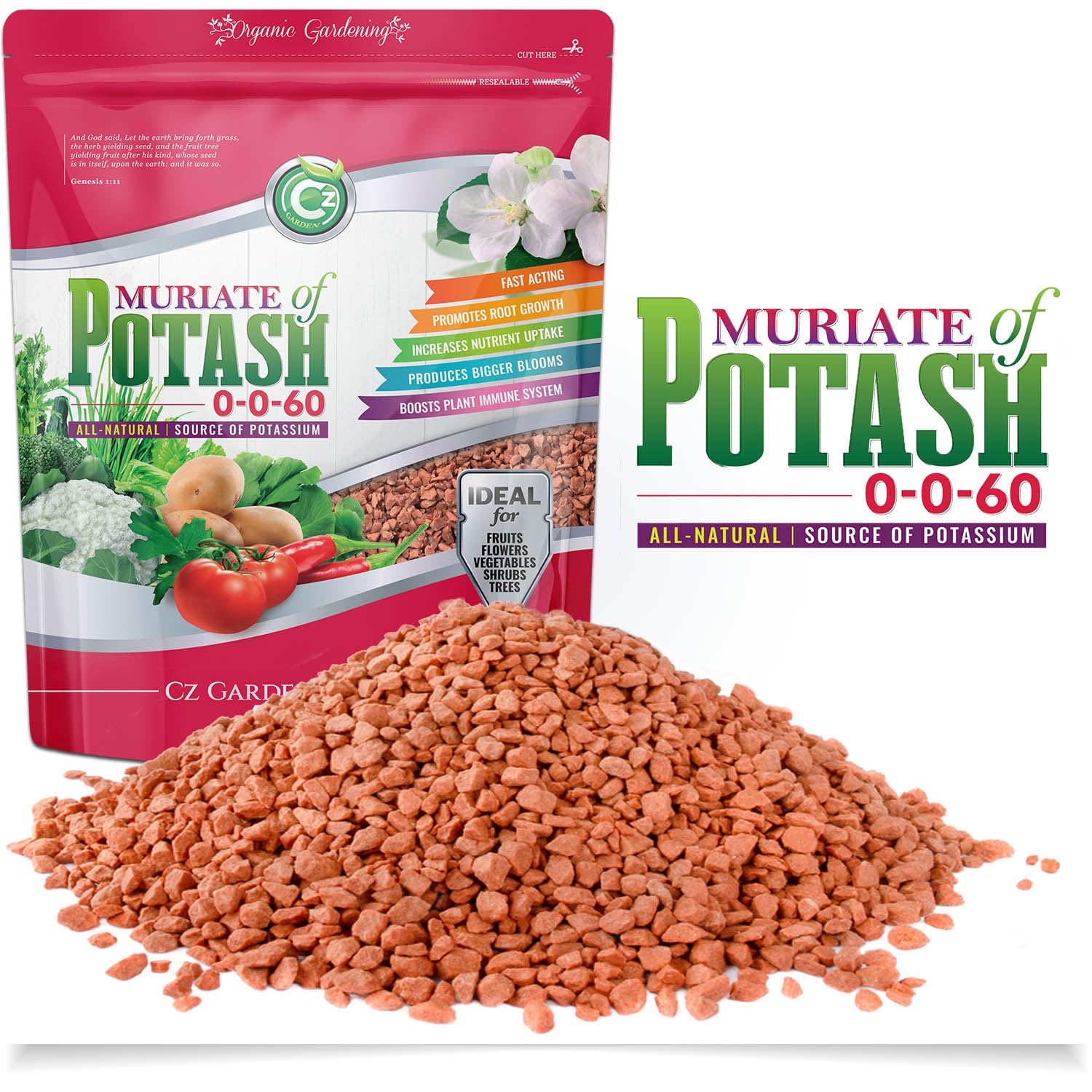
Cz Garden Muriate of Potash (0-0-60) Potassium Fertilizer, Granules, Resealable Pouch
| Item Form | Granules |
|---|---|
| Specific Uses For Product | Plant Food |
| Coverage | Resealable |
| Mixing Ratio | 0-0-60 |
| Unit Count | 80 Ounce |
This Cz Garden Muriate of Potash is a straight potassium source (0-0-60) sold as water-soluble granules in a resealable pouch. It is used as a supplemental feed when crops need a strong potassium boost to improve tuber development, fruiting, and stress tolerance. For Irish potatoes growers it is typically applied as a sidedress or soil amendment according to recommended rates, supplying potassium to support starch formation and overall tuber quality. Notable features include its high concentration, water solubility for easy mixing, and consumer-friendly resealable packaging for repeated small applications. Practical benefits are focused potassium delivery without added nitrogen or phosphorus, which helps correct K deficiencies without upsetting N:P balance, and straightforward handling when following safety guidance. Important limitations are that it is a single-nutrient product so it should be used alongside a balanced fertilizer program and soil test results; incorrect rates can harm plants or soil salinity, and users must wear gloves and eyewear to avoid irritation.
Best for: Buyers who prioritize proven, concentrated potassium for improving potato tuber size and quality and who will follow soil test guidance and application rates.
Less Ideal for: Gardeners seeking an all-in-one fertilizer or those unwilling to test soil or manage application rates should consider multi-nutrient blends or complete fertilizers instead.
- High potassium concentration (0-0-60) delivers a strong, targeted K boost.
- Water-soluble granules that mix easily for sidedressing or foliar solutions.
- Resealable pouch for convenient storage and repeated small applications.
- Made in the USA, produced for consistent ingredient sourcing.
- Single-nutrient product so it cannot replace a balanced complete fertilizer.
- Can increase soil salinity if overapplied or used without monitoring soil tests.
Verdict: Use this high-strength potassium concentrate when your potatoes need a direct, tested K boost to improve tuber size and quality.
Espoma Potash 0-0-60 Granular Potassium Fertilizer, 6 lb

| Analysis | 0-0-60 |
|---|---|
| Item Form | Granules |
| Application Method | Granular |
| Unit Count | 96 Ounce |
This granular potash supplies a concentrated potassium boost (analysis 0-0-60) intended to improve plant vigor and help disease resistance for a wide range of garden plants. It is typically applied by sprinkling around the drip line of trees, shrubs, flowers or vegetables and then watered in; the product is ready to use and requires no mixing. The 6 pound resealable bag makes it convenient for small- to medium-size gardens and spot applications, and the high potassium content means you need less product to raise soil potassium than lower-analysis mixes. Because it is a single-nutrient amendment, it is best used when a soil test or plant symptoms show a potassium deficiency rather than as a general all-purpose fertilizer. Also, it does not supply nitrogen or phosphorus, so plan to pair it with a balanced feed when other nutrients are needed. For gardeners seeking a simple, concentrated natural-source potassium supplement, this is an easy-to-use option with straightforward application.
Best for: Gardeners who want a simple, reliable potassium supplement to correct or prevent K deficiencies and prefer straightforward, low-risk application methods.
Less Ideal for: Gardeners looking for an all-in-one balanced fertilizer or those managing large-scale lawns or commercial plantings where bulk or multi-nutrient feeds are required.
- High potassium concentration (0-0-60) delivers a strong, targeted potash dose
- Granular, ready-to-use form requires no mixing and is easy to apply
- Resealable 6 lb bag is convenient for small to medium garden use and storage
- Promotes vigor and disease resistance in trees, shrubs, vegetables and flowers
- Supplies only potassium and does not address nitrogen or phosphorus needs
- Not suitable as a complete fertilizer for routine feeding without additional products
Verdict: Choose this granular potash if you need a concentrated, easy-to-apply potassium supplement to correct deficiencies and boost plant vigor.
Choosing the Right Natural Potassium Fertilizer for Plants: Key Factors to Consider
Potassium Availability and Concentration
Potassium content varies widely among natural sources, so concentration affects how much material you need to apply. A higher percentage of available potassium reduces bulk and labor but may release faster; lower concentrations often require larger volumes and more frequent applications.
Matching the potassium concentration to the results of a soil test is essential. Over-applying bulky, low-concentration materials can alter soil texture and salinity over time, while under-applying a weak source will not correct deficiencies. Consider the math of pounds per acre or grams per pot and how the stated potassium percentage translates to practical dosing in your beds or containers.
Release Rate and Timing
Different natural potassium fertilizers release their nutrient on different schedules. Some materials release potassium quickly and are useful for a rapid corrective response before bloom or fruit set. Others break down slowly and provide a steadier supply through the season.
Think about your crop timing and whether you need a quick boost for budding flowers or a long-term reserve for perennial fruiting plants. Release behavior also affects how often you need to reapply and whether the source pairs well with mulches, compost, or living roots that stimulate decomposition.
Soil Biology and Microbial Compatibility
Natural potassium sources interact with soil microbes and organic matter differently. Some feed the microbial community and work synergistically with compost and cover crops; others are more inert and primarily a mineral amendment.
If you maintain an active living soil, selecting a potassium source that supports microbial activity will help nutrients cycle and remain plant-available. In low-organic soils, pairing a potassium source with compost or microbial inoculants can improve uptake and reduce lock-up.
Application Method and Convenience
Ease of application matters when you garden at scale or manage many containers. Granular or powdery materials are easy to broadcast and incorporate into soil, while soluble or crushed sources may require dissolving or side-dressing. Some natural sources are dusty or bulky and need protective handling.
Consider whether you want something you can sprinkle at planting, a top-dress you can add to established beds, or a soluble preparation for foliar or drip irrigation use. The right format reduces waste and ensures more uniform distribution across beds and pots.
Effect on Soil Chemistry and Salinity
Even natural potassium sources can affect soil pH and salinity differently. Materials with accompanying salts or other mineral ions can raise soil electrical conductivity if applied in large amounts. Those changes influence nutrient balance and water relations for sensitive plants.
If you grow salt-sensitive species or use container culture with limited leaching, choose sources with low soluble salts or apply in smaller, repeated doses. Monitor soil EC and pH after major amendments to avoid unintended stress on roots.
Longevity and Frequency of Reapplication
Some natural potassium fertilizers provide a seasonal pulse while others persist and feed plants over multiple months. Longevity affects labor and timing because long-lasting sources reduce reapplication but may take longer to show effects.
Decide whether you prefer scheduled seasonal boosts or a set-and-forget amendment at planting. Consider how annual tillage, heavy rains, or irrigation practices will move or dilute the amendment and plan reapplication intervals accordingly.
Matching Potassium Sources to Common Garden Situations
Different garden settings have different constraints. In containers you need concentrated, low-salt options applied in measured doses. In raised beds and in-ground vegetable plots you can use bulkier organic sources incorporated with compost. Small fruit trees and berry patches benefit from longer-lasting, slower-release potassium that supports seasonal fruit development.
Assess your water quality and drainage when choosing a potassium source. Poorly drained soils or high-salt irrigation water means you should favor low-solubility materials and lighter application rates to avoid compounding salinity stress.
- Containers: concentrated, soluble options or measured granular top-dressings
- Vegetable beds: compost-amended granular sources mixed at planting
- Orchards and berries: slower-release mineral sources applied around the dripline
Application Timing Around Flowering and Fruit Set
Timing potassium applications to precede flowering and early fruit development can improve fruit set, size, and overall plant health. Apply a corrective dose when soil tests show low potassium several weeks before bud break or bloom so roots have time to access the nutrient.
For crops with multiple harvests, split applications during the growing season can sustain potassium levels without causing spikes in soluble salts. For perennials, a single slow-release amendment in early spring often suffices.
- Corrective boost: apply 3 to 6 weeks before bloom when deficiency is diagnosed
- Maintenance: small, repeated doses during active growth
- Perennials: incorporate slow-release sources in early spring
How to Read Labels and Interpret Nutrient Claims
Natural fertilizer labels vary in how they report potassium. Some list elemental potassium as K or K2O equivalent; others describe guaranteed analysis in percentages. Learn to convert those percentages into pounds or grams required for your bed or pot volume.
Pay attention to suggested application rates and whether the product is intended for broadcast, incorporation, or soluble use. Look for guidance on how the material interacts with compost or lime so you can avoid unintended pH shifts.
- Check whether potassium is listed as elemental K or K2O equivalent
- Note recommended rate per square foot, per plant, or per container volume
- Follow label guidance on incorporation depth and reapplication timing
Safe Handling and Storage for Natural Amendments
Even natural fertilizers can be dusty, irritant, or attract pests if stored improperly. Keep materials dry in sealed containers and away from pets or rodents. Wear gloves and a dust mask when handling fine powders and wash hands after use.
Store concentrated bags off the ground on pallets or shelves. Clearly label containers with the product and date received so you can rotate older material and avoid degradation or caking that interferes with application.
- Use sealed, dry storage to prevent mold and caking
- Wear basic PPE when handling dusty materials
- Label and rotate stock to maintain effectiveness
Pairing Potassium Sources with Compost and Soil Amendments
Combining a potassium source with quality compost helps buffer release and supports microbes that liberate mineral-bound potassium. If you work with cover crops or regular compost additions, choose potassium sources that complement that biological cycling rather than competing or creating salt spikes.
When adding lime or sulfur to adjust pH, plan those changes separately from potassium applications to avoid disrupting microbial activity. Stagger amendments so you can monitor soil response and avoid overloading the system.
- Top-dress potassium after a compost layer to improve microbial access
- Avoid applying large mineral doses immediately before heavy lime applications
- Use soil testing between major amendments to track nutrient balance
How We Chose the Best Natural Potassium Fertilizer for Plants
We focused on attributes that matter when gardeners pick a natural potassium fertilizer for plants rather than synthetic salts. Evaluation prioritized nutrient release behavior, compatibility with garden soil life, ease and flexibility of application, and measurable effects on flowering and fruit development. We also considered concentration and required dosage so gardeners can match a product to their garden size and soil-test recommendations. Excluded items included processed chemical potassium salts and blends marketed primarily as complete synthetic NPK fertilizers. We did not consider products that lack clear nutrient labeling or that require industrial processing to be effective. The shortlist reflects sources that are widely used in organic and low-impact gardening and that provide verifiable potassium levels or predictable release characteristics. Concretely, we scored each option on nutrient release profile, soil and microbiology compatibility, application convenience, longevity in the soil, and visible plant response potential. Those evaluation points guided selection so gardeners see options that fit container growers, small-scale orchards, and home vegetable plots.
FAQ
How do I know if my plants need potassium?
Symptoms often include poor fruit development, small or misshapen fruit, and older leaf margins turning brown or scorched. A soil test is the most reliable way to confirm potassium deficiency and to determine how much to apply.
Can I use natural potassium fertilizers in containers?
Yes, but choose concentrated sources with low soluble-salt levels or use very small, measured doses. Containers have limited leaching so salts can build up quickly, making modest, repeated applications safer than one large dose.
Will adding potassium change soil pH?
Most potassium sources have minimal direct impact on pH, but some mineral amendments can carry accompanying ions that influence soil chemistry. If pH is a concern, check product composition and monitor soil pH after major applications.
How often should I reapply natural potassium fertilizers?
Frequency depends on the source and release rate. Fast-release materials may need reapplication during the season, while slower-release mineral sources can last for months. Follow label guidance and use soil tests to time reapplications.
Are natural potassium fertilizers safe for edible gardens?
Many natural potassium sources are appropriate for edible gardens, especially when they are certified or described for use with food crops. Rinse produce if dust lands on surfaces and follow recommended pre-harvest intervals if provided.
Can compost supply enough potassium for my garden?
Compost contributes potassium but its content varies with feedstock. Compost alone may not correct a clear deficiency in high-demand crops. Use soil testing to determine whether compost needs to be supplemented with a dedicated potassium source.
Final Verdict
When choosing a natural potassium fertilizer for plants, prioritize a source that matches your soil test results, garden scale, and application preferences. Balance concentration, release rate, and compatibility with soil biology to get the desired effect on blooms and fruit. Decide whether you need a quick corrective dose or a longer-term reserve, and plan applications so they work with compost, irrigation, and crop timing. With the right match, you can support stronger flowering and fruit set without disrupting soil health.
