

Note: This article contains affiliate links. If you click on these links and make a purchase, I may earn a small commission at no extra cost to you. This helps support my research and content. Read my full affiliate disclosure here.
Finding an effective organic fungicide matters when you grow food. Diseases like powdery mildew, blight, and leaf spots can quickly reduce yield and quality, and conventional chemical options may not fit an organic or low-toxicity plan. This guide focuses on Organic Fungicide for Vegetable Gardens and explains how different active ingredients and application methods behave in real garden conditions. We shortlisted six top-performing products and evaluated them on disease control, safety for people and beneficial insects, and ease of use. Below you will find practical guidance on selecting the right solution for your plot, application timing, and tank-mix considerations before the product list.
Top Picks at a Glance
| Best Overall The best all-around choice for most situations | Bonide Captain Jack's Tomato & Vegetable 3-in-1 Ready-to-Use Spray, 32 oz |  |
| Best Quality Built to a higher standard if you want something more solid | Root 98 Warehouse Garden Friendly Biofungicide (8 oz) |  |
| Best Budget The cheapest option that still gets the job done reliably | Garden Safe Fungicide3 with Neem Oil, Ready‑to‑Use Spray (32 oz) |  |
| Highest Rated A top-rated pick with lots of positive feedback | MilStop SP Organic Foliar Fungicide, 5 lb Bag (includes pruning scissors) |  |
| Most Popular A crowd favorite that many people choose with confidence | Bonide Captain Jack's Liquid Copper Fungicide Ready-to-Use, 32 oz |  |
| Best Seller A high-volume bestseller chosen again and again | Bonide Captain Jack's Ready-to-Use Neem Oil Spray, 32 oz |  |
Bonide Captain Jack's Tomato & Vegetable 3-in-1 Ready-to-Use Spray, 32 oz
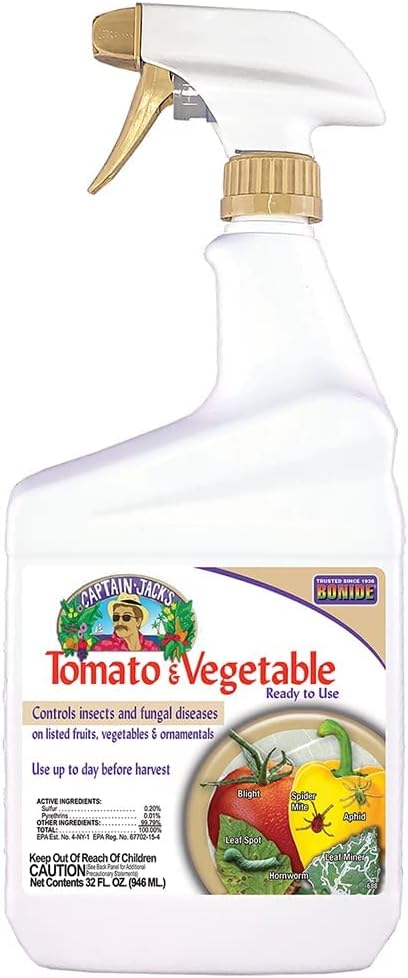
| Unit Count | 32 Ounce |
|---|---|
| Active Ingredients | sulfur |
| Item Type Name | Tomato & Vegetable 3-in-1 Ready-To-Use |
| Special Features | organic |
Bonide Captain Jack's Tomato & Vegetable Ready-to-Use is a 32 oz spray formulated to control common insect pests and a range of fungal diseases on tomatoes and other garden plants. It is used as a contact spray applied to foliage and new growth with a trigger nozzle that makes spot or whole-plant coverage straightforward. The product lists sulfur as an active ingredient and claims control of aphids, spider mites, caterpillars and more while also suppressing problems like powdery mildew, leaf spot and blight when applied preventively. Practical benefits include the convenience of a pre-mixed bottle, suitability for many listed vegetables and ornamentals, and a broad target list that lets one treat mixed beds without swapping products. Limitations are that it works by contact so thorough coverage is required and it is intended for preventive or early-season use rather than curing severe established infections. Users who need systemic control or highly targeted biological products may prefer an alternative formula.
Best for: Gardeners who want a simple, all-in-one spray to prevent and manage common insect pests and early fungal problems on tomatoes and mixed vegetable beds.
Less Ideal for: Growers seeking systemic fungicides, targeted biological controls, or solutions for severe, established diseases should consider other products.
- Ready-to-use bottle with trigger nozzle for quick application
- Controls a broad range of common garden insects and several fungal diseases
- Suitable for use on tomatoes, many vegetables and ornamentals
- Contains sulfur, a long-established option for organic-compatible fungal control
- Contact-only action requires thorough coverage and repeat applications for good control
- Not formulated for systemic action so it will not cure deep or established infections
Verdict: Pick this ready-to-use spray if you want a convenient, broad-spectrum preventive product to manage common tomato pests and early fungal issues.
Root 98 Warehouse Garden Friendly Biofungicide (8 oz)

| Active ingredient | Bacillus amyloliquefaciens strain D747 (98.85%) |
|---|---|
| Form | Spray concentrate |
| Liquid volume | 8 fluid ounces |
| Use sites | Turf, fruits, vegetables, nuts, trees, ornamentals, potted plants |
This biofungicide is a concentrated, water-mixable spray that uses Bacillus amyloliquefaciens strain D747 to suppress many common fungal and bacterial diseases on vegetables, fruit, ornamentals and turf. Typical use is mixing about 1 teaspoon per gallon and applying as a foliar or soil drench to prevent and reduce issues like powdery mildew, damping off, leaf spots, blight and certain root rots. The product lists an exceptionally broad set of target diseases and labeled uses, which makes it convenient for gardeners who want one treatment to cover multiple crops and problems. Practical benefits include suitability for organic gardens, low mammalian toxicity relative to synthetic fungicides, and the ability to treat both foliar and soil pathogens. Limitations are that it is a biological product so results can be slower or more variable than chemical fungicides, efficacy depends on correct timing and thorough coverage, and repeated applications may be needed for lasting control. Follow the label for safe handling and application rates for different uses.
Best for: Gardeners who prioritize effective, organic-compatible disease management across vegetable beds and mixed plantings and who are willing to apply treatments proactively and follow label directions.
Less Ideal for: Growers who need immediate knockdown of severe disease outbreaks or prefer single-application chemical solutions for rapid symptom suppression.
- Contains 98.85% Bacillus amyloliquefaciens D747, a biological agent effective against many fungal and bacterial diseases
- Concentrated formula that mixes at 1 teaspoon per gallon for customizable spray volumes
- Labeled for use on vegetables, fruit, ornamentals and turf, reducing need for multiple specialty products
- Appropriate for organic home garden use and lower toxicity to people and pets compared with many synthetic fungicides
- Biological mode of action can produce slower or less consistent results than fast-acting synthetic fungicides
- Requires correct timing, thorough coverage and potentially repeated applications for good control
Verdict: A concentrated, organic-compatible biofungicide that lets vegetable gardeners treat a wide range of fungal and bacterial diseases with a single, preventive spray product.
Garden Safe Fungicide3 with Neem Oil, Ready‑to‑Use Spray (32 oz)

| Item Form | Spray |
|---|---|
| Target Species | Fungus |
| Liquid Volume | 32 fluid ounces |
| Active Ingredients | Neem Oil Extract |
Garden Safe Fungicide3 with Neem Oil is a ready-to-use spray that combines fungicidal, insecticidal and miticidal action for use on houseplants, ornamentals and edible garden plants. You spray for full coverage of leaves and stems, preferably in the early morning or late evening to reduce the chance of leaf burn from the oil base. The active clarified neem oil extract helps control common fungal problems such as black spot, rust and powdery mildew while also targeting soft-bodied pests like aphids, whiteflies and spider mites at egg, larval and adult stages. For houseplant use it is convenient because it needs no mixing and can be applied as a preventative or at first signs of disease or infestation. Limitations to keep in mind are that oil-based sprays can cause phytotoxicity on sensitive foliage if applied in hot sun or too frequently, and this product is a broad botanical rather than a fast-acting synthetic, so pests may take longer to clear. Follow label directions carefully for dilution and reapplication intervals when treating indoor plants.
Best for: For plant owners who prioritize a dependable, low-prep treatment that controls both fungal diseases and common soft-bodied pests on houseplants and nearby ornamentals.
Less Ideal for: Not the best choice for growers wanting an immediate knockdown chemical for severe infestations or for those who prefer non-oil contact products for very sensitive foliage.
- Three-in-one action: fungicide, insecticide and miticide in one ready-to-use spray.
- Contains clarified neem oil extract, a botanical active ingredient suitable for organic gardening.
- Ready-to-use spray form requires no mixing and is easy to apply to houseplants and containerized ornamentals.
- Targets multiple life stages of pests including eggs and larvae, improving control over repeat infestations.
- Oil-based formula can cause leaf burn if applied in direct sun or at the wrong time of day.
- Not a fast-acting contact poison for all pests so multiple applications may be required for heavy infestations.
Verdict: Choose this ready-to-use neem oil spray when you want a reliable, multi-purpose botanical solution to prevent and manage common fungal diseases and soft-bodied pests on houseplants.
MilStop SP Organic Foliar Fungicide, 5 lb Bag (includes pruning scissors)

| Item Form | Powder |
|---|---|
| Item Weight | 5 pounds |
| Included Components | scissors |
| Ingredients | bicarb |
MilStop SP is an organic foliar fungicide in powder form intended for regular spray applications to prevent and control common fungal diseases in vegetable gardens and ornamentals. You mix the powder with water and apply it as a foliar spray, targeting both upper and lower leaf surfaces to manage powdery mildew, black spot, rust, and botrytis. The 5 lb resealable bag supplies multiple treatments for small-to-medium vegetable plots and the included trimming scissors are a practical extra for light pruning while treating plants. Because the active ingredient is bicarbonate based, it provides broad-spectrum protection without synthetic chemicals and is labeled safe for edible crops when used as directed. Practical limitations are that it requires thorough coverage to be effective so multiple applications may be needed during disease pressure, and it is a contact-type control rather than a systemic one so it will not cure infections inside tissue. For gardeners seeking a dependable organic spray, MilStop SP is a straightforward, usable option.
Best for: Gardeners who prioritize dependable, organic disease control for vegetable beds and want a ready-to-mix product that covers multiple seasons without frequent repurchasing.
Less Ideal for: Growers looking for a one-time systemic cure or those who need a completely hands-off, rarely applied solution should consider alternative products.
- Organic, bicarbonate-based formulation suitable for use on edible crops
- Large 5 lb resealable bag provides enough powder for multiple garden applications
- Simple mix-and-spray powder makes preparation and storage convenient
- Includes trimming scissors for light pruning while treating plants
- Contact-only action requires thorough coverage and repeated applications under heavy disease pressure
- Not systemic so it will not eliminate infections already inside plant tissue
Verdict: A reliable, bicarbonate-based organic foliar spray in a large resealable bag for vegetable gardeners who want consistent, repeatable disease control.
Bonide Captain Jack's Liquid Copper Fungicide Ready-to-Use, 32 oz

| Unit Count | 32 Ounce |
|---|---|
| Item Form | Spray |
| Active Ingredients | copper |
Bonide Captain Jack’s Liquid Copper Fungicide is a trigger-spray, ready-to-use copper solution designed to prevent and treat common fungal diseases on fruits, vegetables, nuts, herbs and ornamentals. It is applied by shaking the bottle and thoroughly spraying tops and undersides of leaves, with repeat applications every 7 to 10 days or as needed. The product is labeled for organic gardening and can be used up to the day of harvest, making it practical for vegetable beds and fruit trees where residue concerns matter. Notable features include its broad-spectrum activity against powdery mildew, leaf spot, blight and peach leaf curl, and the convenience of a pre-mixed spray bottle that removes measuring or mixing. Limitations are inherent to copper products: it treats fungal problems but does not replace cultural controls like good airflow and sanitation, and overuse of copper can accumulate in soil so following label directions is important. As a ready-to-use option, it is best for gardeners who want a simple, approved solution for recurring fungal issues without handling concentrates.
Best for: Gardeners who prioritize proven, labeled products and want an easy-to-use organic-approved fungicide for edible beds and ornamentals based on real-world effectiveness and peer recommendations.
Less Ideal for: Gardeners seeking an all-in-one pest control product or those who prefer to avoid any copper-based treatments should look at non-copper alternatives or integrated disease-management approaches.
- Ready-to-use trigger spray requires no mixing or measuring
- Approved for organic gardening and can be applied up to day of harvest
- Effective against a broad range of common fungal diseases
- Convenient repeat-application interval (7–10 days) for ongoing control
- Contains copper which can build up in soil with excessive use
- Does not address non-fungal problems like insects or bacterial diseases
Verdict: A convenient, ready-to-use copper fungicide for gardeners who want an effective organic-approved spray to manage common fungal diseases.
Bonide Captain Jack's Ready-to-Use Neem Oil Spray, 32 oz

| Item Form | Liquid |
|---|---|
| Target Species | Insects |
| Liquid Volume | 32 fluid ounces |
| Active Ingredients | Clarified Hydrophobic Extract of Neem Oil |
This ready-to-use neem oil spray is a multipurpose garden treatment that kills insects at all life stages while also serving as a miticide and preventative fungicide. Packaged in a 32-ounce trigger bottle, it is applied by shaking and thoroughly spraying plant surfaces, including leaf undersides, at the first sign of pests or disease and reapplying every 7 to 14 days as needed. The active ingredient is a clarified hydrophobic extract of neem oil, which is approved for organic gardening and labeled safe to use on vegetables up to the day of harvest. Practical benefits include broad pest coverage (aphids, whiteflies, spider mites and others), disease suppression such as powdery mildew, and convenience from a ready-to-use sprayer. Important limitations are that results are slower than synthetic contact insecticides and application timing matters to avoid leaf burn in full sun; repeated applications may be needed for heavy infestations. Follow label safety directions and keep the product away from children and pets.
Best for: Gardeners who want a single, organic-approved product to manage common vegetable garden pests and fungal problems and who prefer products with strong user feedback.
Less Ideal for: Growers needing rapid knockdown of severe infestations or commercial producers who require fast-acting, high-throughput treatments.
- Kills multiple pest stages including eggs, larvae and adults for more complete control.
- Also acts as a fungicide and miticide so one product covers pests and common fungal issues.
- Ready-to-use trigger bottle requires no mixing and is easy to apply to leaves and undersides.
- Approved for organic gardening and can be used on vegetables up to day of harvest.
- Slower-acting than many synthetic contact insecticides, so it may take several applications to see control.
- Must avoid spraying in peak sunlight to reduce risk of leaf burn.
Verdict: A convenient, organic-approved all-in-one neem spray that controls common vegetable garden pests and fungal issues with minimal fuss.
Choosing the Right Organic Fungicide for Vegetable Gardens: Key Factors to Consider
Active Ingredient and Mode of Action
Knowing the active ingredient is central because it determines which fungi the product controls and how resistance may develop. Some actives are contact protectants that must coat leaves to work, while others have limited translaminar or systemic activity. For vegetable gardens, contact protectants often require thorough coverage and more frequent applications, so factor in whether you are comfortable with repeat sprays.
Different modes of action also affect rotation plans. To reduce resistance risk, gardeners should rotate among fungicides with different biochemical targets when facing repeated disease pressure. Consider products whose mode of action fits your crop rotation and disease history rather than relying on a single chemistry.
Safety for People, Pets, and Pollinators
Safety is usually a top concern in edible gardens. Look at toxicity categories, reentry intervals, and preharvest intervals on labels to understand risk to children, pets, and harvest timing. Low-toxicity actives and those labeled for minimal reentry are easier to integrate into family gardens.
Also assess pollinator risk. Some organic actives are safe when applied in early morning or late evening, but others can be harmful if applied while bees are foraging. Choose formulas with documented low impact on beneficial insects or plan applications outside peak pollinator activity.
Crop-Specific Labeling and Approved Uses
A fungicide must be labeled for the vegetable species you are growing. Labels list crops, disease targets, and maximum application rates. Using a product outside labeled crops is illegal and can harm plants or leave unsafe residues. Check whether the label permits use on leafy greens, fruiting vegetables, root crops, or seedlings since coverage needs and sensitivity vary across these groups.
Pay attention to application limits per season. Some products have strict caps on how many applications or how much active ingredient you can use in a growing season; exceeding these can affect both safety and regulatory compliance.
Ease of Application and Equipment Needs
Consider whether you will spray by hand with a pump sprayer, use a hose-end applicator, or apply by watering can. Some formulations are ready-to-use and simple for small plots, while concentrates require measuring and mixing. For contact fungicides, achieving good leaf coverage often requires a fine spray and time to treat both upper and lower leaf surfaces.
Also consider clean-up and storage. Concentrates may require more careful handling and rinsing of equipment. If you prefer low-effort treatments, choose products that require minimal mixing, have stable shelf life, and do not demand specialized nozzles.
Residue, Rainfastness, and Reapplication Interval
How long a fungicide protects leaves and how quickly it washes off in rain affects application scheduling. Contact protectants can wash off and need reapplication after heavy rain, which matters in wetter climates or during storms. Products with longer residual activity reduce labor but may still require adherence to preharvest intervals.
Understand the recommended reapplication interval on the label and plan sprays around weather forecasts. Frequent reapplications increase labor and potential cumulative residue, so weigh residual protection against safety and harvest intervals.
Compatibility With Cultural Controls and Integrated Management
Fungicides work best as part of an integrated approach that includes good air circulation, resistant varieties, crop rotation, and sanitation. Choose a product whose label allows tank mixes with compatible insecticides or foliar nutrients if you plan integrated sprays.
Also consider timing relative to cultural practices. Some fungicides are most effective as preventive treatments and should be applied at first sign of disease or in high-risk weather. Others can reduce existing infections but may need to be combined with pruning, spacing, or other measures for long-term control.
When to Use Preventive Versus Curative Applications
Preventive sprays are most effective for contact protectants and for managing diseases that spread rapidly under certain weather conditions. Apply preventive treatments when cool, wet weather or dense canopy growth makes infection likely. For seedlings and transplants, early preventive applications can keep infections from establishing in a dense bed.
- Preventive: apply before symptoms, better for contact fungicides
- Curative: used when infection is visible, often requires products with some systemic activity
- Time sprays to weather forecasts to avoid wash-off
Application Timing to Protect Pollinators
To minimize impact on bees and other beneficial insects, schedule sprays for early morning or late evening when pollinators are less active. Avoid spraying flowering crops while blossoms are open unless the product label specifically allows it and indicates low pollinator toxicity. Rinsing foliage after label-specified interval can further reduce exposure in some cases.
- Avoid spraying during bloom when possible
- Follow label directions for pollinator safety
- Consider using physical barriers or spot-treating heavily infected areas
Mixing and Tank Compatibility Basics
Not all foliar inputs are compatible. Always read label instructions for tank-mix partners and conduct a small jar test before mixing new combinations. Add products to the tank in the label-recommended order, and avoid combinations that cause phytotoxicity on sensitive crops.
- Do a jar test to check compatibility
- Follow label order when mixing
- Rinse sprayer thoroughly between different chemistries
Managing Resistance in Home Vegetable Beds
Rotate fungicides with different modes of action and avoid repeated use of the same active for multiple seasons. When resistance is suspected because control is declining, increase cultural controls, remove heavily infected plants, and switch to a different mode of action. Using products at labeled rates and intervals reduces the chance of resistance developing.
- Rotate modes of action across applications
- Use cultural sanitation to reduce inoculum
- Avoid underdosing, which encourages resistance
Recordkeeping and Timing Around Harvest
Keep a simple log of application dates, product used, rate, and weather conditions. This helps ensure you meet preharvest intervals and do not exceed seasonal application limits. Recordkeeping also lets you correlate weather events and disease outbreaks with treatment outcomes for better planning next season.
- Track dates, rates, and weather
- Note reentry and preharvest intervals
- Use records to refine spray timing annually
How We Chose the Best Organic Fungicide for Vegetable Gardens
To assemble this list we prioritized products suited to edible gardens and small-scale vegetable plots. Selection centered on four to six concrete, garden-relevant criteria: the spectrum of pathogens controlled, human and pollinator safety profiles, application ease for backyard growers, residual activity and reapplication interval, and compatibility with organic certification standards. We considered label instructions for use on common vegetables, recommended rates, and tank-mix guidance to assess real-world usability. We excluded broad ornamental-only formulations and industrial chemicals that lack clear instructions for food crops or have high mammalian toxicity. Products that required complex calibration or specialized equipment were deprioritized for typical home gardeners. The result is a set of options that balance practical disease control in vegetable beds with low-toxicity handling and simple application routines.
FAQ
Can organic fungicides be used on young transplants?
Often yes, but check the label. Some organic actives are safe on seedlings at lower rates, while others can stress very young foliage. Apply cautiously and consider spot-testing on a few plants first.
How often should I reapply after rain?
It depends on the product. Contact protectants typically need reapplication after heavy rain; labels will state rainfastness and recommended reapplication intervals. Reapply sooner in prolonged wet weather.
Are organic fungicides safe for edible harvests?
Many are formulated for food crops and have labeled preharvest intervals. Safety depends on following label instructions for application timing and harvest intervals to ensure residue levels meet regulatory guidance.
Will organic sprays harm beneficial insects in my vegetable patch?
Some organic actives have low toxicity to beneficials if applied outside bloom and when bees are not active. However, certain botanicals and oils can still affect non-target insects, so follow label guidance and avoid spraying during peak pollinator activity.
Can I tank-mix an organic fungicide with fertilizer or insecticide?
Sometimes, but only when labels permit. Perform a jar test for compatibility and follow the label order for mixing. Avoid untested mixes that can cause phytotoxicity or reduce effectiveness.
How do I choose between a contact and a systemic organic option?
Contact products protect leaf surfaces and are best for prevention but require thorough coverage and repeat sprays. Systemic or translaminar options can move slightly into tissue and sometimes offer curative benefit, which may be useful when infection is already present.
Final Verdict
Prioritize safety, labeled crop use, and the mode of action when choosing an organic fungicide for vegetable gardens. Preventive applications, good coverage, and rotation among different active classes reduce disease pressure and slow resistance development. Match the product to your crops and your preferred application routine, and integrate sprays with cultural controls like spacing and sanitation for the best results. Choose based on the diseases you see most often, how frequently you can spray, and your tolerance for handling concentrated formulations. With careful timing and adherence to label instructions, organic fungicides can be an effective part of a low-toxicity disease management plan.
