

Note: This article contains affiliate links. If you click on these links and make a purchase, I may earn a small commission at no extra cost to you. This helps support my research and content. Read my full affiliate disclosure here.
If you grow St. Augustine grass, choosing the right organic fertilizer changes how the lawn looks and how the soil performs over seasons. St. Augustine tolerates heat, shade, and coastal conditions, but it responds best to steady, biology-friendly fertility rather than quick synthetic boosts. This guide focuses on organic fertilizers appropriate for St. Augustine lawns and explains how each short-listed option supports turf color, root depth, and soil life. We evaluated candidates for nutrient balance and soil-building effects, plus application ease. Below are the top picks for organic fertilizer for St. Augustine grass, followed by practical buying guidance and answers to common questions. Use these notes to pick the product that matches your soil, mowing routine, and lawn goals.
Top Picks at a Glance
| Best Overall The best all-around choice for most situations | Lawnbox Grass Genie 100% Organic Spring Lawn Fertilizer, 16 lb |  |
| Best Quality Built to a higher standard if you want something more solid | Organic Plant Magic Slow-Release Granular Lawn Fertilizer (20 lb) |  |
| Best Value The sweet spot between price and what you get | Espoma Organic Spring Lawn Booster 8-0-0, 30 lb |  |
| Highest Rated A top-rated pick with lots of positive feedback | Espoma Turf-Tone All Season Organic Lawn Food with Bio-Tone, 28 lb |  |
| Most Popular A crowd favorite that many people choose with confidence | Jonathan Green Organic Lawn Food 10-0-1 (5,000 sq ft) |  |
| Best Seller A high-volume bestseller chosen again and again | Milorganite 6-4-0 Slow-Release Fertilizer, 32 lb (with Feeding Tips Brochure) |  |
Lawnbox Grass Genie 100% Organic Spring Lawn Fertilizer, 16 lb

| Item Form | Granules |
|---|---|
| Specific Uses For Product | Lawn,Lawns,Organic |
| Target Species | lawn grasses |
| Mixing Ratio | 10:0:6 |
Lawnbox Grass Genie is a 100% organic granular fertilizer designed for spring applications on lawns, including established and newly planted turf. It supplies a 10-0-6 N-P-K ratio that combines an immediate nitrogen boost with slower-release sources to promote quick green-up and feeding for up to six weeks. The formula includes humic acid to improve soil health and nutrient uptake, and it is labeled safe for family use with no wait time after application. Typical use is broadcast spreading across full lawn areas according to package directions; a 16 pound bag covers a substantial area for a single-season treatment. Practical benefits include organic ingredients with no animal byproducts or biosolids and suitability for all turf types, which makes it a good fit for gardeners who prefer natural inputs. Important limitations are that phosphorus is absent so it will not correct P deficiencies, and it is not available for sale in CA and OR, which restricts use for growers in those states.
Best for: Gardeners seeking a natural, family-safe spring fertilizer to kick-start warm-season lawns and who prioritize organic inputs and improved soil health.
Less Ideal for: Homeowners who need to correct soil phosphorus shortages or who live in California or Oregon should look for alternatives.
- 100% organic formula without animal byproducts or biosolids
- Provides both immediate and slow-release nitrogen for green-up and up to six weeks of feeding
- Includes humic acid to support soil health and nutrient uptake
- Contains no phosphorus so it will not address P deficiencies
- Not approved for sale in California and Oregon
Verdict: Choose this organic granular fertilizer if you want a family-safe spring treatment that quickly greens warm-season turf while improving soil health.
Organic Plant Magic Slow-Release Granular Lawn Fertilizer (20 lb)
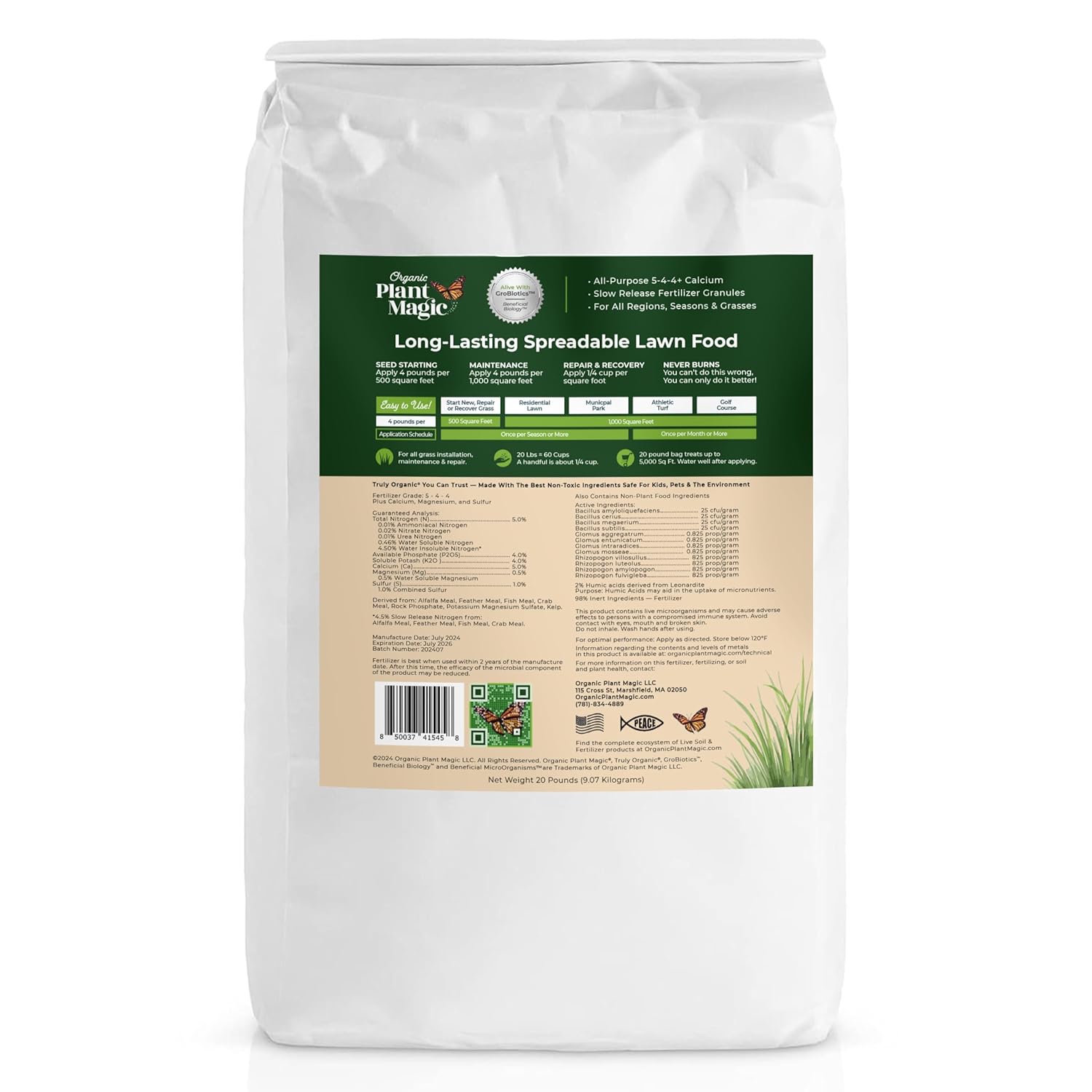
| Item Form | Granules |
|---|---|
| Application Method | Spread |
| Coverage | 5,000 Square Feet |
| Target Species | Grass, Bermuda, St. Augustine |
| Mixing Ratio | 16-4-8 |
This 20 lb Organic Plant Magic granular lawn fertilizer is a slow-release, organic formula designed for routine feeding, repair, and establishment of warm-season grasses like St. Augustine and Bermuda. You apply it with a spreader following the included mixing/application guidance; one bag claims coverage up to 5,000 square feet so it is aimed at whole-yard feeding. Notable features include an organic nutrient blend with GroBiotics biology, a 16-4-8 NPK mixing ratio, and a granular form that flows through standard spreaders for even distribution. In practice it should promote steady green-up without the rapid flush of synthetic quick-release products, and the brand emphasizes low burn risk and pet- and kid-safe ingredients. The main limitations are that the product is a slow-release organic option so results will be gradual compared with fast-acting synthetics, and a single 20 lb bag is best suited to small-to-medium lawns rather than very large properties. For performance-focused users it offers steady, biologically active feeding tailored to warm-season turf but it is not a quick-fix solution for severe nutrient deficiencies.
Best for: Gardeners who prioritize consistent, long-term turf performance and prefer an organic, biologically active feed for St. Augustine lawns rather than rapid green-up.
Less Ideal for: Homeowners who need immediate color and fast growth recovery after extreme stress or those managing very large properties who want fewer refill trips.
- Formulated for warm-season grasses including St. Augustine and Bermuda
- Slow-release granular formula provides steady nutrient delivery and low burn risk
- Covers up to 5,000 square feet from one 20 lb bag under recommended rates
- Contains biological additives (GroBiotics) and a clear 16-4-8 NPK ratio
- Slower visible results compared with synthetic quick-release fertilizers
- One 20 lb bag may be insufficient for larger lawns or repeated heavy feedings
Verdict: Choose this organic slow-release granular if you want steady, biologically supported feeding that improves St. Augustine turf health without burning or aggressive quick-release effects.
Espoma Organic Spring Lawn Booster 8-0-0, 30 lb
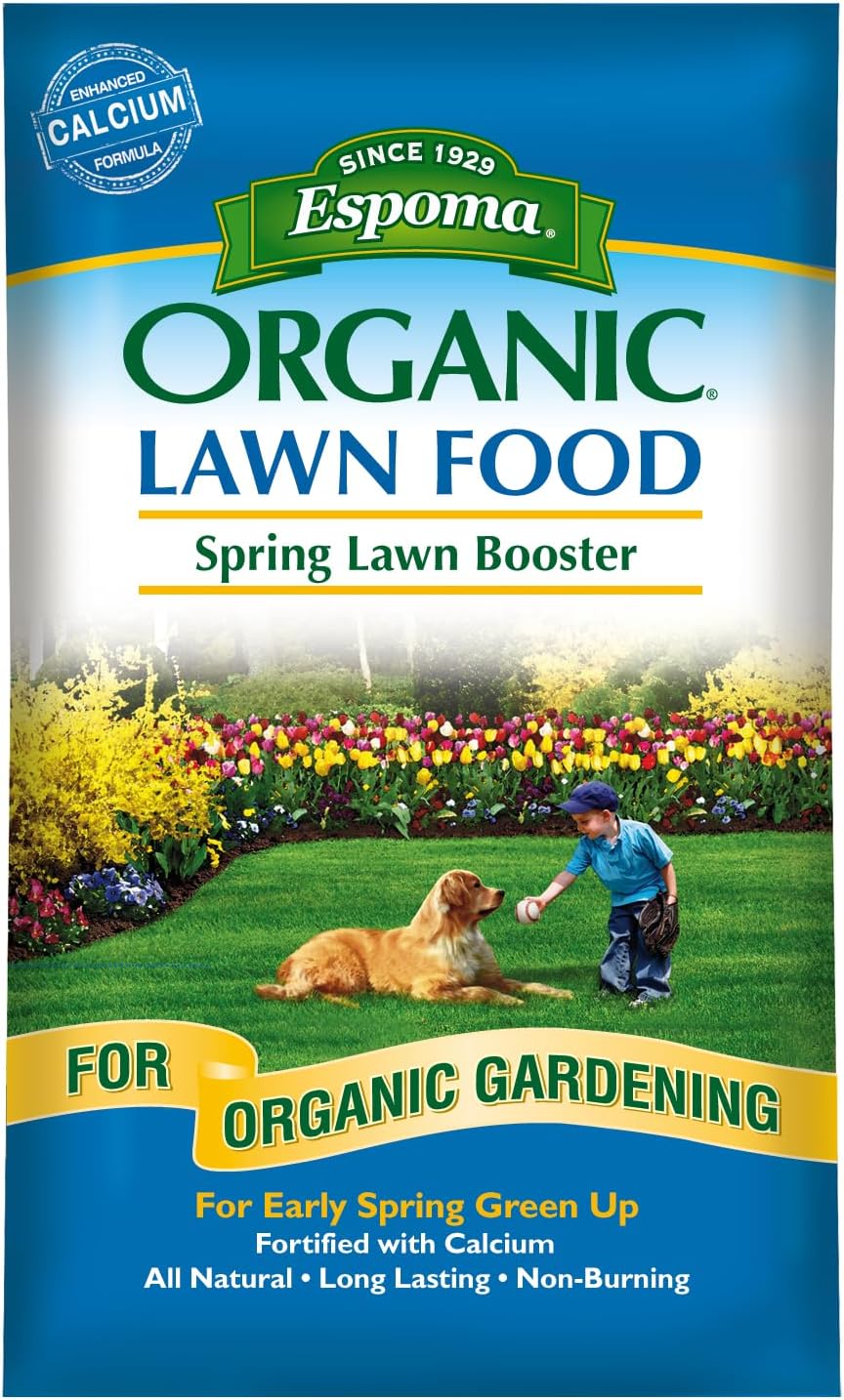
| Item Form | Granules |
|---|---|
| Application Method | broadcast spreader |
| Coverage | up to 5,000 sq ft |
| Mixing Ratio | 8-0-0 |
| Specific Uses For Product | Lawn,Organic |
Espoma Organic Spring Lawn Booster is a granular, organic fertilizer designed for spring application to turf grasses, including tall fescue. Applied with a broadcast or drop spreader, it supplies slow-release nitrogen (8-0-0) and added calcium to promote deep green color and steady early-season growth without burning. Its slow-release formula means you get longer-lasting feeding compared with quick-release synthetics, so lawns develop gradually rather than surging and then fading. Because it is OMRI-listed for organic gardening, it fits into organic lawn programs and is suitable for yards where pet and child safety is a priority. The bag covers up to 5,000 square feet, which makes it practical for typical suburban lawns but may be bulky for very small yards or hard-to-store for those with limited space. Users should plan application timing in early spring and have a spreader capable of handling granular fertilizers to get even coverage. For tall fescue, the steady nitrogen and calcium support early green-up and stronger blades without the risk of scorch from high salt fertilizers.
Best for: Homeowners who want an organic, low-risk spring feed for cool-season grasses like tall fescue and prioritize steady early-season green-up and safety around family and pets.
Less Ideal for: Gardeners who need a quick green-up from fast-release fertilizers or who prefer liquid or foliar feeds for spot treatments should look elsewhere.
- Slow-release nitrogen provides steady, long-lasting feeding for early-season growth
- Organic formulation approved for organic gardening and safer for kids and pets
- Contains added calcium to support turf color and plant health
- Covers up to 5,000 sq ft per 30 lb bag, suitable for typical lawns
- Granular format requires a spreader for even application
- Large 30 lb bag can be cumbersome to store or handle for small yards
Verdict: A reliable organic spring fertilizer that steadily greens and strengthens tall fescue without the burn risk of conventional quick-release products.
Espoma Turf-Tone All Season Organic Lawn Food with Bio-Tone, 28 lb

| Item Form | Granules |
|---|---|
| Application Method | Spread evenly on a dry, mowed lawn |
| Target Species | Lawn Grass |
| Unit Count | 448 Ounce |
Espoma Turf-Tone is a 28 lb granular, slow-release lawn fertilizer designed for routine feeding of lawns including Kentucky bluegrass. It supplies a low-rate nitrogen formula that releases slowly to encourage steady greening and reduced frequency of applications. The product is intended to be applied with a drop or broadcast spreader to a dry, mowed lawn and claims coverage up to about 5,000 sq ft. Notable features are its organic ingredients and Bio-Tone microbial formula, which aim to support soil biology while minimizing risk of burn or leaching compared with high-salt synthetic feeds. Practical benefits for bluegrass include gentler, longer-lasting color improvement and less chance of creating quick flushes of top growth that demand more mowing. Important limitations are that its nutrient numbers are modest (9-0-1) so it is not a quick corrective for severe nitrogen deficiency and may require multiple seasonal applications to build vigor; large or very depleted lawns may need supplemental treatments or higher-analysis products for rapid recovery.
Best for: Homeowners who prioritize reliable, low-risk feeding and steady seasonal improvement for cool-season lawns like Kentucky bluegrass and who prefer organic products over synthetic quick fixes.
Less Ideal for: Gardeners needing a fast green-up or immediate corrective treatment for very nutrient-deficient or large commercial lawns should consider higher-analysis or targeted products instead.
- Slow-release nitrogen that promotes steady greening without rapid top growth
- Organic and natural ingredient base that reduces burn risk and supports soil health
- Formulated with Bio-Tone microbes to help root and soil biology
- Easy to apply with a broadcast or drop spreader and suitable for all-season use
- Lower analysis (9-0-1) so it is not ideal for rapid correction of severe nutrient deficiencies
- Coverage claim depends on even spread; may require multiple bags for large or thin lawns
Verdict: Choose this organic, slow-release Turf-Tone when you want dependable, low-risk seasonal feeding that supports Kentucky bluegrass and soil biology.
Jonathan Green Organic Lawn Food 10-0-1 (5,000 sq ft)

| Analysis | 10-0-1 |
|---|---|
| Form | Granules |
| Coverage | 5000 sq ft |
| Application method | Spread |
Jonathan Green Organic Lawn Food is a slow-release granular fertilizer designed to feed established and newly seeded lawns for eight to ten weeks. It is spread with a broadcast, drop, or hand-held spreader and supplies steady nitrogen plus iron to improve color without relying on fast-release synthetics. In practice the granules are easy to apply and the formula is gentle enough that it will not burn turf, which makes it suitable for homes with children and pets. The product covers about 5,000 square feet per bag and is described as containing natural ingredients and no sludge- or manure-based fillers. Important limitations are that its nutrient mix is low in phosphorus and potassium so it is mainly a green-up and maintenance fertilizer rather than a one-step solution for soil deficiencies, and feeding is gradual so results are not instant. For typical home lawns looking for an organic maintenance feed this is a practical, low-risk option.
Best for: Homeowners who want an easy, low-risk organic maintenance feed that improves color and sustains turf between major treatments.
Less Ideal for: Gardeners needing rapid greening, immediate repair of nutrient-poor soil, or a complete fertilizer with higher P and K for soil correction.
- Organic, natural ingredient formula that avoids fast-release synthetic nitrogen
- Slow-release feed provides 8–10 weeks of steady nutrition
- Contains iron to promote deeper green color
- Easy-to-spread homogeneous granules compatible with broadcast, drop, or handheld spreaders
- Low phosphorus and potassium content makes it unsuitable as a complete soil correction
- Gradual action means visible improvement can take multiple weeks
Verdict: A reliable organic slow-release lawn food that delivers steady green-up and maintenance for average home lawns.
Milorganite 6-4-0 Slow-Release Fertilizer, 32 lb (with Feeding Tips Brochure)

| Item Form | Pelletized |
|---|---|
| Application Method | Broadcast, Rotary or Manual |
| Coverage | 2,500 Square Feet |
| Specific Uses For Product | Lawns, Flowers and Gardens, Education |
Milorganite 6-4-0 is an organic, pelletized slow-release fertilizer intended for routine lawn and garden feeding. It is typically broadcast with a rotary or manual spreader and provides nitrogen slowly over 8 to 10 weeks, which reduces the need for frequent applications and lowers burn risk. The product contains organically complex iron for greening without the strong staining associated with iron salts and is low in soluble salts, so it performs well in warm or drier conditions. The 32 lb bag covers roughly 2,500 square feet and comes with a printed feeding and spreader tips brochure to simplify seasonal timing and application rates. Because it is made from heat-dried microbes, it also adds organic matter to improve soil structure in heavy clay or sandy soils. Limitations are that nutrient release is gradual so it is not suited to quick color fixes or rapid turf recovery, and users seeking tightly controlled N-P-K ratios or fast-acting synthetic performance may prefer a different product.
Best for: Buyers who want a low-maintenance, environmentally minded fertilizer that steadily feeds established lawns and mixed garden beds with minimal risk of burn and fewer repeat applications.
Less Ideal for: If you need rapid turf recovery, immediate color correction, or precise synthetic nutrient control for athletic fields or newly sodded lawns, choose a fast-release or specialty fertilizer instead.
- Slow-release nitrogen feeds lawns and plants for 8–10 weeks, reducing application frequency
- Low-salt formulation minimizes fertilizer burn and streaking in hot or dry conditions
- Organically complex iron promotes deep greening without heavy staining of concrete
- Pelletized form works with broadcast, rotary, or manual spreaders for easy application
- Adds organic matter that can improve drainage and soil structure in clay or sandy soils
- Not fast-acting, so it will not deliver an immediate green-up after application
- Contains biosolids which some buyers may prefer to avoid for personal or local reasons
Verdict: Pick this if you want a reliable, low-salt slow-release fertilizer that feeds lawns and gardens for weeks with minimal maintenance.
Choosing the Right Organic Fertilizer for St. Augustine Grass: Key Factors to Consider
Nutrient Ratio and Release Profile
St. Augustine is a warm-season grass that benefits from steady, moderate nitrogen rather than large quick-release spikes. Look for organic fertilizers that supply nitrogen in slow-release forms such as feather meal, blood meal blends, or plant-based proteins so the turf receives a measured supply over weeks.
The N-P-K ratio matters because excess phosphorus can build up if your soil test already shows sufficient levels. An organic formula with balanced or nitrogen-focused numbers will help green-up without encouraging thatch or excessive top growth. Consider how often you want to feed: materials with longer release profiles reduce application frequency and lower the risk of scorch.
Soil Biology and Organic Matter
One of the main advantages of organic fertilizers is their ability to feed the soil food web. Look for products that contain organic carbon sources, composted ingredients, or microbes that support root health and nutrient cycling. Over time, these inputs improve soil structure, water retention, and resilience against pests and drought.
If your lawn sits on sandy or compacted soil, choosing an organic fertilizer that also adds organic matter will help roots access moisture and nutrients between feedings. Expect soil-quality gains to happen gradually; repeated seasonal applications build the biggest benefits.
Salt Index and Turf Safety
St. Augustine can be more sensitive to salts than some cool-season grasses, especially in high-heat or drought conditions. Organic formulations generally have lower soluble salt content, but not all are equal. Check labels for low-salt claims or prefer slow-release organics that minimize the concentration of soluble salts entering the root zone.
Applying any fertilizer during extreme heat or drought raises burn risk. Plan feedings for early morning or cooler parts of the day and water in according to product guidance to reduce salt concentration at the leaf surface and root zone.
Application Method and Timing
Consider whether you prefer granular or liquid organic fertilizers. Granular slow-release blends often work well with standard spreaders and offer one-pass coverage, while liquid or soluble organics can be easier to apply in small patches and during active growth periods. Your choice should match your equipment and comfort level with calibrating applications.
Timing matters for warm-season turf: plan primary applications in late spring to early summer when St. Augustine moves into active growth, and consider light follow-up feeds in summer if needed. Avoid heavy fall applications that push late-season top growth and invite winter stress.
Cost Per Feeding and Longevity
Organic fertilizers typically cost more per pound than synthetic alternatives but often feed longer and improve soil health. Evaluate cost per feeding by estimating how long a single application lasts and how frequently you will reapply. A product that feeds for eight to twelve weeks may reduce labor and repeated purchases compared with a shorter-lived option.
Also account for how coverage rates change with yard size and spreader efficiency. Choosing a slightly more concentrated organic may be more economical if it reduces application frequency.
Environmental and Neighborhood Considerations
If you live near waterways or in a community with runoff restrictions, organic fertilizers are generally a lower-risk choice because they release nutrients slowly and bind more readily to soil. Still, follow label directions to avoid nutrient runoff during heavy rains and apply away from curbs and storm drains.
Consider smell and pet safety as well. Some organic amendments have strong odors initially; if the lawn is used heavily by family or pets, choose options with milder profiles and follow re-entry guidance on packaging.
When to Apply Fertilizer to St. Augustine Lawns
Timing fertilizer applications to the growth cycle helps St. Augustine use nutrients efficiently. The main window is late spring through early summer once active green-up begins. Applying during this growth surge supports root expansion and tiller development without wasting nutrients when the grass is dormant.
Avoid heavy feeding during periods of heat stress or drought. If you need to patch thin areas, a light, targeted application can help, but save broader applications for when the grass is actively growing and soil temperatures are favorable.
- Primary application: late spring to early summer
- Light follow-ups: mid-summer if growth warrants
- Avoid major feeds during extreme heat or drought
Granular Versus Liquid Organic Options
Granular organics are convenient for covering larger lawns with a broadcast or drop spreader and often have a longer release profile. They can be easier to calibrate for uniform coverage and require less frequent reapplication.
Liquid organics and soluble feeds deliver nutrients faster and can be useful for spot treatments or when you want a quicker visible response. They may require more frequent applications and precise measurement to avoid overfeeding.
- Granular: longer-lasting, easier spreader use
- Liquid: quicker uptake, better for spot treatments
- Match choice to lawn size and application equipment
Soil Testing and Tailoring Your Program
A soil test is the most reliable way to match fertilizer to your lawn. Tests reveal existing nutrient levels, pH, and organic matter percentage so you can avoid unnecessary phosphorus or lime additions. Many extension services offer affordable testing with clear recommendations for warm-season turf.
Use test results to adjust application rates and supplement with targeted amendments. For example, if phosphorus is already adequate, choose a fertilizer that emphasizes nitrogen and soil-building carbon instead.
- Test soil every 2 to 3 years for steady maintenance
- Adjust N-P-K choices based on test results
- Address pH issues before routine fertilization
Integrating Fertilizer with Mowing and Irrigation
Mowing height and irrigation influence how St. Augustine responds to fertilizer. Keep blades at recommended heights to promote dense turf and deeper roots, which then use nutrients more effectively. Taller mowing during summer helps shade crowns and reduce stress.
Watering after granular applications helps move nutrients into the root zone, but avoid heavy irrigation that produces runoff. For slow-release organics, light irrigation or natural rainfall within a day or two is generally sufficient.
- Mow at recommended height for St. Augustine to maximize uptake
- Water lightly after application to incorporate nutrients
- Avoid overwatering that causes nutrient loss
Common Mistakes to Avoid With Organic Fertilizers
A frequent error is overapplying organic fertilizers under the assumption that more organic material is always better. Excess organic inputs can lead to poor turf responses, thatch buildup, or uneven growth. Follow recommended rates and factor in previous applications.
Another mistake is applying during dormancy or severe drought. When grass is not actively growing, nutrients are not used efficiently and can remain in the soil, potentially shifting microbial activity in unwanted ways. Space applications to seasonal growth patterns.
- Do not exceed label application rates
- Avoid feeding during dormancy or extreme drought
- Spread evenly to prevent patchy growth
How We Chose the Best Organic Fertilizer for St. Augustine Grass
We narrowed candidates by focusing on traits that matter for St. Augustine lawns. First, nutrient balance: products needed to supply appropriate ratios of nitrogen, phosphorus, and potassium for warm-season turf or to deliver slow-release nitrogen sources suitable for gradual green-up. Second, soil biology impact: we prioritized fertilizers that feed microbial activity and increase organic matter rather than only providing soluble salts. Third, application practicality: we looked for materials that spread evenly with common broadcast or drop spreaders and that have manageable dust and odor profiles. Fourth, salt safety and turf tolerance: because St. Augustine can be sensitive to excess salts and soluble fertilizers, we favored low-salt or slow-release formulations that reduce burn risk. Exclusions included products designed solely for vegetables, high-phosphate starter blends intended for seeding, and any inputs that rely entirely on synthetic quick-release nitrogen. We also excluded lawn amendments that require complex on-site processing. The final list represents fertilizers that balance steady nutrition, soil health benefits, and straightforward application for typical home lawns.
FAQ
How often should I apply organic fertilizer to St. Augustine grass?
Most organic fertilizers for warm-season turf are applied every 8 to 12 weeks during the active growing season. The exact frequency depends on the product release profile and your lawn's vigor. If you use a shorter-lived liquid, expect to reapply more often; slow-release granules reduce application frequency.
Can I use organic fertilizer if my soil test shows low phosphorus?
Yes. Many organic options include modest phosphorus or compost-based phosphorus that can help raise low test levels over time. Match the fertilizer to the test recommendation and avoid overcorrecting in a single application. Incorporating organic matter and subsequent testing will show progress.
Will organic fertilizer reduce thatch on my lawn?
Organic fertilizers feed soil microbes that can help break down thatch over time by improving decomposition. However, organics alone will not instantly eliminate severe thatch. Regular core aeration and combined cultural practices are usually needed for heavy thatch issues.
Is it safe to apply organic fertilizer near sidewalks and driveways?
Apply organic fertilizers carefully around hard surfaces to minimize runoff and staining. Use a shielded spreader setting or hand-apply near edges, and avoid sweeping clumps onto pavement. Water lightly after application to move nutrients into the turf and reduce surface residues.
How soon will I see results after applying organic fertilizer?
Expect gradual improvement rather than overnight color change. Visible greening can begin within one to three weeks depending on the product and conditions, with stronger root and soil benefits building over several months and repeated applications.
Final Verdict
For St. Augustine lawns, prioritize organic fertilizers that deliver steady nitrogen, support soil biology, and pose low salt risk. Match the release profile and application method to your lawn size and maintenance routine. Use soil testing to refine N-P-K choices and schedule applications for the active growth window to get the best results. Balancing immediate color with long-term soil health is the main tradeoff. If you want fewer applications and improved soil structure, choose a longer-lasting organic; if you need quicker responses for thin patches, combine a targeted liquid feed with a soil-building granular program.
