

Note: This article contains affiliate links. If you click on these links and make a purchase, I may earn a small commission at no extra cost to you. This helps support my research and content. Read my full affiliate disclosure here.
If fire ants are turning outdoor spaces into hazards, choosing the right natural treatment matters for safety, soil health, and long-term control. Natural options can reduce risk to children, pets, and beneficial insects while still targeting mounds effectively. This guide covers seven carefully shortlisted natural fire ant killers that work in yards, flower beds, and vegetable gardens. We evaluated each product for how quickly it works, how safe it is around people and pollinators, and how easy it is to apply in everyday garden situations. Read on to understand the tradeoffs and pick the approach that fits your landscape and tolerance for follow-up treatments.
Top Picks at a Glance
| Best Overall The best all-around choice for most situations | EcoVenger Roach & Ant Killer 64 oz — Natural, Non-Toxic Spray |  |
| Best Quality Built to a higher standard if you want something more solid | EcoVenger Ant Killer & Nest Treatment, 32 oz |  |
| Best Value The sweet spot between price and what you get | Garden Safe Crawling Insect Killer Diatomaceous Earth, 4 lb |  |
| Best Budget The cheapest option that still gets the job done reliably | Harris Diatomaceous Earth Crawling Insect Killer, 8 oz |  |
| Highest Rated A top-rated pick with lots of positive feedback | NCSIFDD Ant Away Ant Repellent Gel, 6-Pack |  |
| Most Popular A crowd favorite that many people choose with confidence | Mighty Mint Peppermint Oil Insect Repellent Spray, 16 oz |  |
| Best Seller A high-volume bestseller chosen again and again | Wondercide Outdoor Pest Control Spray — 32 oz Ready-to-Use |  |
EcoVenger Roach & Ant Killer 64 oz — Natural, Non-Toxic Spray

| Active ingredients | Geraniol, Cedarwood Oil, Peppermint Oil, Sodium Lauryl Sulfate |
|---|---|
| Formulation | Water-based spray |
| Residual protection | Up to 4 weeks |
| Intended pests | Roaches, ants and other crawling insects |
This EcoVenger formula is a water-based, plant-extract spray designed to knock down roaches and ants on contact while leaving a lingering repellent barrier. You use it like a standard trigger spray for spot treatments, perimeter applications, or to flush and eliminate active infestations in kitchens, garages, and commercial food areas. Notable features include botanical active ingredients (geraniol, cedarwood and peppermint oils), a pleasant peppermint scent that dissipates, and lab testing that supports safety around people and pets when used as directed. Practical benefits are rapid visible control without harsh chemical odor and a residual effect lasting up to about four weeks, which reduces repeat treatments. Important limitations are that it is a surface spray rather than a bait or granular nest treatment so it may not reach deep nest queens in large soil-based fire ant mounds, and effectiveness against severe mound infestations may require repeated or complementary mound-specific methods. The product is best suited for indoor and perimeter use where a non-toxic option and low odor are priorities.
Best for: Buyers seeking an all-around, low-odor natural insect control for indoor spaces, perimeter spraying, and light to moderate ant problems who prioritize safety around family and pets.
Less Ideal for: People who need a targeted, soil-penetrating fire ant mound killer for large outdoor infestations should consider specialized mound or bait products instead.
- Plant-derived active ingredients offer a non-toxic alternative to synthetic pesticides
- Kills on contact and provides residual repellency for up to four weeks
- Water-based with a mild peppermint scent that dissipates quickly
- Lab-tested for low dermal, inhalation and irritation risks enabling use around children and pets
- Designed as a spray for surfaces and perimeters rather than a dedicated mound treatment for deep-rooted fire ant colonies
Verdict: Choose this if you want a science-backed, non-toxic spray that kills crawling insects on contact and provides weeks of low-odor residual protection for indoor and perimeter use.
EcoVenger Ant Killer & Nest Treatment, 32 oz

| Unit Count | 32 Fluid Ounces |
|---|---|
| Item Form | Spray |
| Target Species | Odorous House Ants, Fire Ants, Roaches, Fleas, Spiders |
| Active Ingredients | Citronella Oil, Geraniol, Cedarwood oil, Sodium Lauryl Sulfate |
EcoVenger Ant Killer is a plant-extract spray formulated to kill house ants on contact, treat fire ant mounds, and leave a residual barrier that deters re-entry for up to four weeks. You use it like a standard ready-to-use spray: spot-treat visible trails, spray around entry points and saturate mound tops or nest openings to reach the colony. Notable features include a citronella/cedarwood/geraniol active blend, a user-friendly trigger sprayer and claims of university testing and professional use. In practice the product offers fast knockdown for foraging ants and the ability to deliver treatment down tunnels using the spray wand, which helps target queens in mounds. The botanical formulation is marketed as non-staining and safe to use around pets and children when directions are followed, and the light citrus scent dissipates quickly. Limitations are that efficacy details beyond labeled target species rely on manufacturer testing and heavier infestations may need repeated treatments or perimeter work; the nozzle has delicate parts so care is needed when handling.
Best for: Homeowners who prioritize effective, fast-acting ant control but want a pet- and child-friendly botanical option for indoor and outdoor use.
Less Ideal for: People needing an industrial-strength chemical treatment for very large or persistent infestations or those who prefer products supported by multiple independent field trials.
- Kills odorous house ants on contact and eradicates fire ant mounds when applied to the colony
- Botanical active ingredients (citronella, geraniol, cedarwood) offer a lower-toxicity alternative to conventional pesticides
- Provides residual repellency for up to four weeks to help prevent re-entry
- Suitable for indoor and outdoor use and formulated to be non-staining on carpets and fabrics
- Nozzle contains delicate parts that can be damaged and may require careful handling
- Manufacturer efficacy claims are based on internal or cited studies rather than independent third-party field trials
Verdict: A fast-acting, plant-powered ant spray that balances quick colony knockdown with a formulation designed for use around pets and children.
Garden Safe Crawling Insect Killer Diatomaceous Earth, 4 lb

| Item Form | Powder |
|---|---|
| Target Species | Insects |
| Active Ingredients | Silicon Dioxide |
| Specification Met | EPA |
Garden Safe Crawling Insect Killer is a powdered diatomaceous earth formulation intended for outdoor, plant-side use to control crawling pests. It is applied as a thin dust to soil around plants or directly onto insects where the fine granules abrade and absorb oils from exoskeletons, causing dehydration and death. Typical uses include edging vegetable beds, dusting under potted plants, and treating areas where ants, fleas, cockroaches, beetles, and mealybugs are active. The product is labeled for organic gardening and meets EPA specification guidance, so it is a low-chemical option for routine garden pest control. Practical benefits are persistence in dry, calm conditions and a non-spray, hands-on application that targets contact exposures. Important limitations are that it must stay dry to remain effective, can be dusty to apply so ventilation and a mask are advised, and it is not effective against insects that are not contacted by the dust or for wood-destroying beetles and certain ant species listed on the label. Follow label directions and reapply after heavy rain or disturbance for continued protection.
Best for: Gardeners who prefer practical, low-chemical pest control and want a contact-based solution for crawling insects around plants and beds.
Less Ideal for: People seeking a fast-acting, systemic treatment for flying pests or infestations inside structures should consider other control methods.
- Works by physical action so no chemical insecticides are required
- Approved for use in organic gardening and meets EPA specification guidance
- Can be applied directly to soil and plants to target crawling pests
- Long-lasting when kept dry and undisturbed
- Ineffective if the treatment area becomes wet or is washed away
- Creates airborne dust during application so respiratory protection is recommended
Verdict: A practical, organic-friendly diatomaceous earth powder for gardeners who want a non-chemical contact treatment for crawling garden pests.
Harris Diatomaceous Earth Crawling Insect Killer, 8 oz

| EPA registration | No. 3-18 |
|---|---|
| Active ingredient | 100% freshwater diatomaceous earth |
| Intended use | Indoor & outdoor |
This ready-to-use diatomaceous earth product provides a non-chemical way to control ants and other crawling pests around the home. You apply the fine powder in cracks, along baseboards, near entry points, or in crawlspaces using the included puffer tip for targeted placement. The diatomaceous earth works mechanically by abrading insect exoskeletons and causing dehydration, so insects that contact the dust typically die within 48 hours. Because the material is 100% freshwater diatomaceous earth with no additives and is EPA registered, it is a good fit when you want a low-toxicity option usable near people and pets when directions are followed. It stays effective indefinitely as long as it stays dry, making it a convenient barrier treatment in attics, basements, garages, and around foundations. Limitations are that it must remain dry to work and it is a contact-only control method, so heavy infestations or nesting insects may require repeated application or combined methods for faster results.
Best for: Practical households that prioritize low-toxicity, long-lasting ant control and want a simple, targeted treatment they can apply themselves around entry points and inside cracks.
Less Ideal for: People facing severe or widespread infestations who need rapid knockdown or prefer liquid chemical treatments should consider professional services or a different product.
- 100% freshwater diatomaceous earth with no additives for a non-chemical control option
- Built-in puffer tip allows precise application into cracks and crevices
- Remains effective indefinitely when kept dry, providing long-lasting barrier protection
- Mechanically kills a wide range of crawling insects including ants, roaches, fleas, and bed bugs
- Only effective on insects that contact the powder and must stay dry to work
- Not a fast-acting spray alternative for large, established infestations
Verdict: Choose this product if you want a low-toxicity, long-lasting mechanical barrier to control ants and other crawling insects around the home.
NCSIFDD Ant Away Ant Repellent Gel, 6-Pack

| Unit Count | 12 Count |
|---|---|
| Number of Pieces | 1 |
This ant repellent gel is a concentrated applicator product intended for targeted spot treatments around entry points, baseboards, window frames, and known ant trails. You remove the cap, attach the precision tip, and apply pea‑sized drops into crevices or along trails; the manufacturer notes it can take 3–5 days to work through a colony and helps keep ants away for up to 60 days in treated areas. Practical benefits include the narrow applicator for neat placement in tight gaps, suitability for both indoor and outdoor problem spots, and a formulation presented as family and pet safe when used as directed. Important limitations are that results are not instantaneous and multiple applications or placements may be needed to control larger or multiple colonies, and effectiveness depends on correctly locating trails and nest access points. For someone who wants a low‑mess, targeted solution rather than broad broadcast treatments, this gel is a convenient option.
Best for: Buyers who prioritize dependable, low‑mess spot treatment for recurring ant sightings and prefer a product they can place precisely where ants travel.
Less Ideal for: People needing rapid elimination of very large or widespread infestations or those who prefer broadcast sprays or professional colony eradication services.
- Precision applicator allows neat, pea‑sized placements in tight crevices and along ant trails
- Labeled for both indoor and outdoor use so the same product can treat kitchens, baseboards, and patios
- Formulation described as family and pet safe when used according to directions
- Single placements can provide protection in treated areas for up to 60 days
- Not an immediate knockdown—can take 3–5 days to affect a colony
- May require several placements and correct trail identification to fully control larger infestations
Verdict: Use this precision gel when you want a neat, family‑safe spot treatment that targets ant trails and entry points rather than a broad spray solution.
Mighty Mint Peppermint Oil Insect Repellent Spray, 16 oz
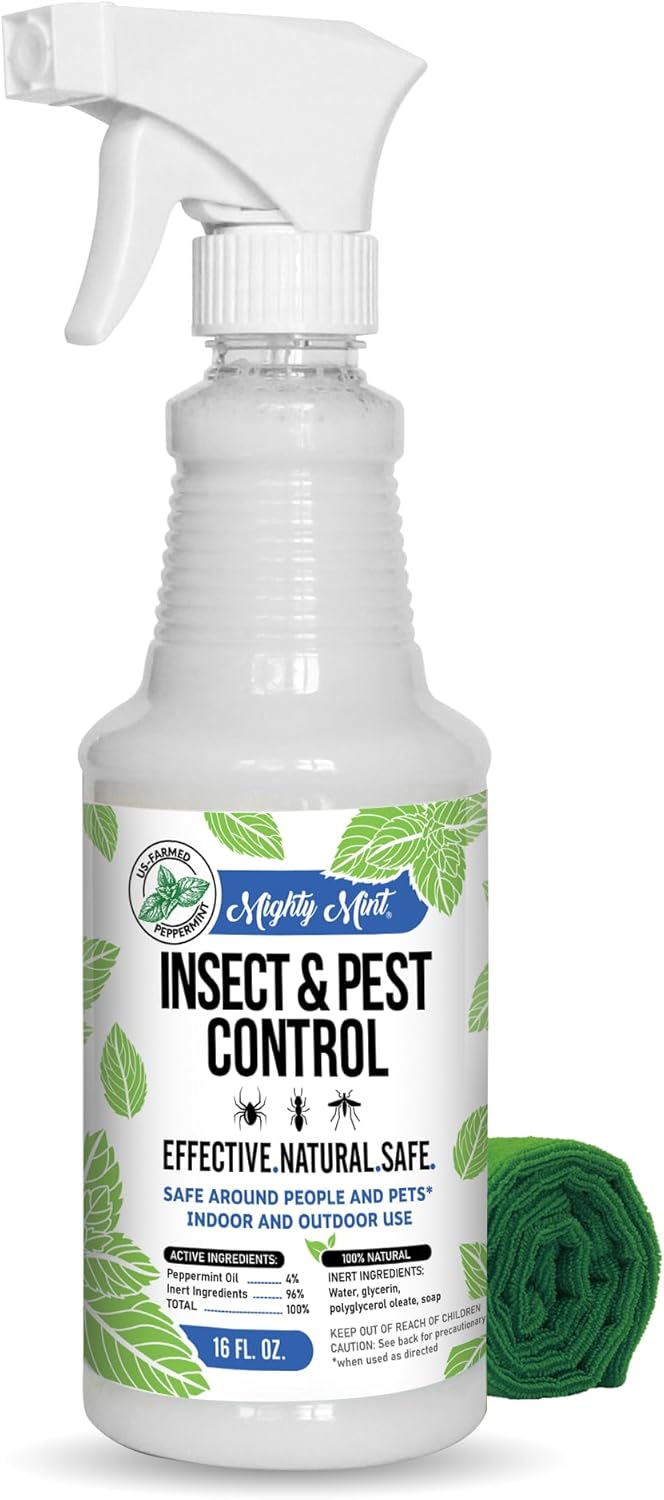
| Ingredients | Water, Glycerine, Polyglycerol oleate, Soap, Peppermint oil |
|---|---|
| Use Areas | Indoor / Outdoor |
| Size | 16 oz |
Mighty Mint is a plant-based, ready-to-use spray that uses concentrated peppermint oil to repel a broad range of household and patio pests. You apply it directly to problem areas such as baseboards, entryways, patios and around outdoor seating; the manufacturer recommends shaking and spraying until surfaces are covered and repeating applications two or more times per week for best results. Notable features include a peppermint-only scent profile, a formulation that avoids synthetic fragrances and the convenience of a 16 oz spray bottle for targeted spot treatments. Practical benefits are that it is safe to use around people and pets when dry and does not leave obvious stains on most surfaces, and the scent can make treated areas smell fresher than chemical alternatives. Important limitations are that it is a repellent rather than a pesticide so it works by discouraging pests rather than killing them, effectiveness depends on regular reapplication and it should not be applied when pollinators are present or to skin or food-contact surfaces.
Best for: Buyers who prioritize natural, low-toxicity solutions and want a targeted spray to reduce insects around patios and entryways while keeping family and pets in mind.
Less Ideal for: Anyone needing a one-time extermination or long-term residual pesticide for severe infestations should consider professional treatments or products formulated to kill pests rather than repel them.
- Plant-based peppermint formula that avoids synthetic fragrances
- Ready-to-use spray for quick, targeted indoor and outdoor applications
- Safe for people and pets when used as directed and allowed to dry
- Nonstaining on most surfaces and leaves a fresh mint scent
- Repels rather than kills insects so regular reapplication is needed to maintain protection
- Strong peppermint concentration may bother scent-sensitive individuals and requires keeping children and pets away until dry
Verdict: Choose Mighty Mint when you want a pet-friendly, plant-based spray to reduce patio and entryway insects with a fresh peppermint scent.
Wondercide Outdoor Pest Control Spray — 32 oz Ready-to-Use

| Format | Pre-mixed, hose-end spray |
|---|---|
| Active ingredients | Cedarwood Oil 12.63%, Sesame Oil 2.73% |
| Coverage | Up to 5,000 sq ft (general); 2,500 sq ft (ticks/mosquito repel) |
Wondercide Ready-to-Use Outdoor Pest Control is a hose‑end spray designed for treating yards up to 5,000 sq ft for general pests and 2,500 sq ft for ticks and mosquito repellency. You attach the bottle to a garden hose, sweep the nozzle across lawns, patios, and foundation lines, and the cedarwood‑based formula delivers quick coverage with no dry time required. Notable features include plant-powered active ingredients (cedarwood and sesame oils), ready-to-use convenience, and instructions for both active infestations and preventative maintenance. Practical benefits are that it is safe to use around people and pets when directions are followed, residues are reported to be non-harmful to pollinators, and the hose attachment makes treating large areas fast. Important limitations are that effectiveness depends on water pressure, walking speed, and weather, heavy rain may require reapplication, and spraying in temperatures above 90°F or direct sun can cause plant burn. Users who need an all‑season, high‑durability pesticide for heavy infestations should plan on repeated applications and follow label precautions to protect sensitive plants.
Best for: Buyers who prioritize effective, plant‑based mosquito and tick control for medium to large yards and want a fast hose‑attached solution that is safe around families and pets when used as directed.
Less Ideal for: Gardeners who need a single, long‑lasting professional‑grade pesticide for severe, persistent infestations or who cannot reapply after rain should consider alternative, heavier‑duty treatments.
- Ready-to-use hose-end applicator for fast coverage of large yards
- Plant-based active ingredients (cedarwood and sesame oils) that target common yard pests
- No dry time required so kids and pets can re-enter treated areas quickly
- Covers up to 5,000 sq ft for general pest control and 2,500 sq ft for ticks/mosquito repellency
- May cause phytotoxic burning if applied in direct sun or temperatures above 90°F
- Performance depends on water pressure and user walking speed which can lead to uneven coverage
- Heavy rain can wash it away and requires reapplication
Verdict: If you want a fast, family- and pet-friendly plant‑based spray to reduce mosquitoes and ticks across a medium to large yard, this ready‑to‑use hose‑end formula delivers practical, repeatable results.
Choosing the Right Natural Fire Ant Killer: Key Factors to Consider
Active Ingredient Type and Mode of Action
Different natural products work in different ways. Some use botanical oils or soaps that destroy ants on contact, while others use biological agents, baits with slow-acting toxicants, or inert dusts that desiccate. Knowing the mode of action helps set expectations for how quickly mounds collapse and whether the queen is affected.
If the goal is immediate relief from aggressive ants, contact treatments give fast visible results but may not eliminate the queen, requiring repeat applications. Baits and biological controls act more slowly but can reduce colony reproduction and satellite nests when foraging workers carry material back to the queen. Choose a mode of action that matches whether you need rapid control or longer-term suppression.
Safety for People, Pets, and Pollinators
Natural does not automatically mean harmless. Some botanical insecticides can irritate skin or be toxic to bees at certain application rates. Consider where children and pets play and whether treated areas include flowering plants frequented by pollinators.
Products formulated for spot treatment of mounds minimize exposure compared with broadcast applications across lawns. Read label precautions about reentry intervals for children and pets and avoid applying treatments to open blooms when pollinators are active. For edible gardens, check whether any product requires removal of produce before application or specifies safe distances from planting beds.
Application Method and Timing
Application practicality affects whether you will follow label directions correctly. Granular baits need calibration for mound placement or broadcast rate, while liquids or foams require different equipment or mixing. Some biologicals may need moist conditions or warm temperatures to be effective.
Timing matters because foraging behavior changes with season and temperature. Early morning or late afternoon applications often coincide with active foragers bringing bait back to the nest. For contact treatments, applying during peak activity increases the chance of reaching more workers. Consider whether you want a ready-to-use solution for spot treatments or something that covers larger areas with multiple applications.
Coverage, Quantity, and Cost-Per-Area
Gardeners should estimate how many square feet or how many mounds they need to treat and compare coverage claims. A treatment designed for spot mound control may come in small volumes but still be economical if you have few colonies. Conversely, large yards with many visible mounds will need products sold in larger volumes or that are safe for broadcast use.
Packaging that clearly lists coverage rates for both spot and broadcast applications reduces guesswork. Also consider how often reapplications are recommended, as a low-cost product that needs frequent re-treatment can be less convenient long term than one requiring fewer visits.
Environmental Persistence and Soil Health
Natural options vary in how long residues remain in soil. Some biological controls and inert dusts have negligible persistence, while certain botanical extracts can linger enough to affect sensitive soil organisms temporarily. If you maintain vegetable beds or have companion plantings, choose a product with minimal soil persistence or that allows targeted mound treatment away from root zones.
Think about beneficial insects and earthworms as part of soil health. Products that minimize non-target impacts help preserve natural predators that can aid longer-term ant control. Where possible, integrate cultural controls like reducing food and water sources to complement chemical or biological treatments.
Local Regulations and Label Directions
Even natural formulations are subject to label directions and sometimes local restrictions. Always follow the label for application rates, protective equipment, and disposal instructions. Labels also specify legal uses, such as whether a product can be applied in certain landscapes or near water features.
Local extension services may have region-specific advice about fire ant biology and recommended timing. Checking these resources ensures you comply with municipal rules and use products in ways that are both effective and lawful.
When to Use Spot Treatments Versus Broadcast Applications
Spot treatments focus on individual mounds and are best when infestation is limited to a handful of colonies. They concentrate active material where ants are active, reducing exposure to non-target organisms and saving product. Use spot treatments for ornamental beds, play areas, and vegetable patches where you want to minimize collateral impact.
Broadcast applications are useful when mounds are widespread across a lawn or when baiting to reach multiple foraging paths. Broadcasting is more labor efficient for large yards but increases the area of exposure for beneficial insects and soil life. Consider broadcast only when infestation density justifies wider coverage.
- Spot treatment: lower non-target exposure, ideal for sensitive areas
- Broadcast: covers more ground, better for heavy infestations
- Combine approaches: spot treat high-value areas and broadcast lower-risk turf
Integrating Cultural Controls with Natural Treatments
Natural products work best when incorporated into a broader management plan. Reduce attractants by keeping pet food indoors, cleaning up fallen fruit, and fixing irrigation leaks that create moist foraging sites. Mowing and raking can disturb foraging trails and expose satellite nests to treatments.
Improving soil drainage and avoiding excessive mulch depth near foundations can make yards less hospitable to fire ant colonization. These cultural steps reduce the need for repeated chemical or biological interventions and support long-term suppression.
- Eliminate food and water sources that attract colonies
- Adjust landscape features to reduce nesting sites
- Use treatments as part of an integrated approach, not the only step
Safe Application Practices Around Gardens and Play Areas
When treating near vegetable gardens or children's play spaces, choose methods that limit drift and avoid treating flowering plants. For granular baits, place material directly on the mound rather than broadcasting over garden beds. For liquid or foam contact products, avoid overspray and follow reentry intervals on the label.
Wear basic protective gear recommended on the product label, and keep pets and children away during application and until the product has settled or dried. Store materials securely and dispose of leftover product according to label instructions.
- Treat mounds in the early morning or late evening to reduce pollinator exposure
- Cover or wash edible produce if label guidance recommends it
- Keep treatment records to track what was applied where and when
Monitoring and Follow-Up After Treatment
Check treated mounds within a few days and again after two weeks to judge effectiveness. Some natural baits and biologicals require time to reduce the queen's activity, so patience is needed. If worker activity resumes, reapply using the same method or switch to a complementary approach to reach residual or satellite nests.
Maintain a seasonal monitoring routine, especially during spring and late summer when colonies expand. Recording mound locations helps you detect new infestations early and minimizes the amount of treatment needed over time.
- Inspect treated mounds at 3 days and 14 days
- Mark treated spots to avoid unnecessary retreatment
- Adjust strategy if new satellite mounds appear nearby
Organic Certification and Label Claims to Watch For
Some products carry organic or low-toxicity claims, but certifications vary by program. Look for clear ingredient lists and third-party certifications when available. Certification can indicate stricter sourcing or manufacturing practices, but it does not guarantee rapid colony elimination.
Pay attention to label claims about non-target safety and read the fine print. Labels that provide clear use instructions for different landscape types and cautionary statements are preferable because they help you apply the product responsibly.
- Verify certification details and what they specifically cover
- Prefer labels with explicit instructions for turf, beds, and edibles
- Don't assume 'natural' equals immediate or complete control
How We Chose the Best Natural Fire Ant Killer
We prioritized products that use botanical, biological, or low-toxicity active ingredients and that have documented field use against fire ant colonies. Key evaluation criteria included knockdown speed, colony reduction over repeated treatments, and application practicality for typical yards and garden beds. Safety for children, pets, and pollinators was treated as a primary filter, with preference for materials that break down without leaving persistent residues in soil. We also judged ease of use, including whether products come in ready-to-use formulations or require safe mixing, and assessed coverage rates to estimate how much material a homeowner would need for common lawn sizes. Environmental compatibility, such as impact on earthworms and beneficial insects, influenced placement on the shortlist. Exclusions: products that rely on high-toxicity insecticides, unverified home remedies without supporting field guidance, or treatments that are impractical for home gardeners were not considered. The final list reflects options that balance practical effectiveness with lower ecological risk and straightforward application.
FAQ
How long does a natural fire ant treatment typically take to show results?
It depends on the product. Contact-based treatments often show visible reduction in worker activity within hours to a couple of days. Baits and biological controls generally take longer, sometimes one to three weeks, because foraging workers must spread the material through the colony.
Are natural fire ant killers safe to use around vegetable gardens?
Many natural options can be used near edibles if applied according to label instructions and if you avoid treating edible parts directly. Some products advise covering produce or delaying harvest for a short period. Always follow label precautions for food-bearing plants.
Will treating visible mounds remove the entire colony?
Spot-treating visible mounds often reduces worker numbers but may not eliminate all queens if satellite nests exist. Combining mound-focused treatments with area-wide baiting or repeated follow-ups increases the chance of suppressing the whole colony network.
Can natural treatments harm beneficial insects or earthworms?
Some natural formulations have low non-target impact, but others can still harm beneficial insects, especially when applied to blooming plants. Inert dusts and biologicals tend to be gentler on soil organisms. Choosing targeted mound treatments and timing applications away from pollinator activity reduces risks.
How often should I reapply a natural control?
Reapplication intervals vary by product and infestation severity. Some contact treatments recommend retreating after a week or two if activity persists, while bait programs may require follow-up applications across a season. Monitor activity and follow label guidance before repeating applications.
Final Verdict
Prioritize safety and the specific control goal when choosing a natural fire ant killer. If you need immediate relief from aggressive mounds, contact-based options deliver fast results but may require follow-up to reach queens. If long-term suppression across a yard is the aim, baits and biological controls used thoughtfully can reduce colony networks over time. Balance application practicality, non-target risk, and coverage needs to select the approach that fits your landscape, and be prepared to combine cultural measures with treatments for the best long-term outcome.
