

Note: This article contains affiliate links. If you click on these links and make a purchase, I may earn a small commission at no extra cost to you. This helps support my research and content. Read my full affiliate disclosure here.
A non burning lawn fertilizer matters when you want steady green-up without the risk of scorch or stressed turf. Using a fertilizer designed to release nutrients gradually or with a gentle nutrient ratio lowers the chance of leaf-tip browning and keeps grass roots healthy through hot, dry spells. This guide covers six shortlisted non burning lawn fertilizers suited for home lawns and small yards and explains the decision factors that matter in real gardens. We'll focus on nutrient formulation, release type, and application practicality so you can pick a product that fits your mowing, watering, and seasonal plans.
Top Picks at a Glance
| Best Overall The best all-around choice for most situations | Safer Brand Lawn Restore Natural Lawn Fertilizer (20 lb, 9-0-2) |  |
| Best Value The sweet spot between price and what you get | Purely Organic Products Lawn Food 10-0-2, 15 lb |  |
| Best Budget The cheapest option that still gets the job done reliably | Milorganite Slow-Release Organic Fertilizer, 5 lb |  |
| Highest Rated A top-rated pick with lots of positive feedback | Espoma Turf-Tone All Season Organic Lawn Food with Bio-Tone, 28 lb |  |
| Most Popular A crowd favorite that many people choose with confidence | Milorganite 6-4-0 Slow-Release Fertilizer, 32 lb (with Feeding Tips Brochure) |  |
| Best Seller A high-volume bestseller chosen again and again | Scotts Green Max Lawn Food (16.67 lb) |  |
Safer Brand Lawn Restore Natural Lawn Fertilizer (20 lb, 9-0-2)

| NPK ratio | 9-0-2 |
|---|---|
| Form | Granules |
| Coverage | Up to 5,000 sq ft |
| Specific uses | Root Development |
Safer Brand Lawn Restore is a granular, naturally derived lawn fertilizer designed to encourage rapid greening and stronger root systems without burning turf. It is typically broadcast across the lawn at the recommended rate (4–8 lb per 1,000 sq ft) and the 20 lb bag covers up to about 5,000 sq ft. The high nitrogen 9-0-2 formula uses feather meal and blood meal to feed grass and soil microbes over time, which helps lawns green up within a few days and supports thicker turf and improved stress tolerance through heat, cold, or drought. Because it contains no phosphorus, it focuses on leaf growth and root development without encouraging unwanted flowering. The product is marketed as safe for children and pets immediately after application when directions are followed and is described as non-burning, so it can be used year-round on established lawns and for new seeding when applied carefully. Expect slower initial nutrient release than a synthetic quick-release fertilizer, so results build sustainably rather than spiking and fading quickly.
Best for: Buyers who want a balanced, all-purpose lawn fertilizer that improves turf color and root strength with naturally derived ingredients and minimal burn risk.
Less Ideal for: Not ideal for gardeners seeking immediate, high-impact greening from synthetic quick-release products or for situations where soil tests show a specific phosphorus deficiency.
- Naturally derived ingredients that feed both turf and soil microorganisms
- Non-burning formula safe for typical family lawns when used as directed
- High nitrogen 9-0-2 mix promotes quick greening and sustained growth
- Covers up to 5,000 sq ft per 20 lb bag, suitable for whole-yard applications
- Slower nutrient release compared with synthetic fast-release fertilizers, so peak results take longer to build
- No phosphorus, so it will not help lawns that specifically need phosphorus for establishment
Verdict: Choose this if you want a non-burning, naturally derived granular fertilizer that greens lawns and builds stronger roots without harsh chemical shock.
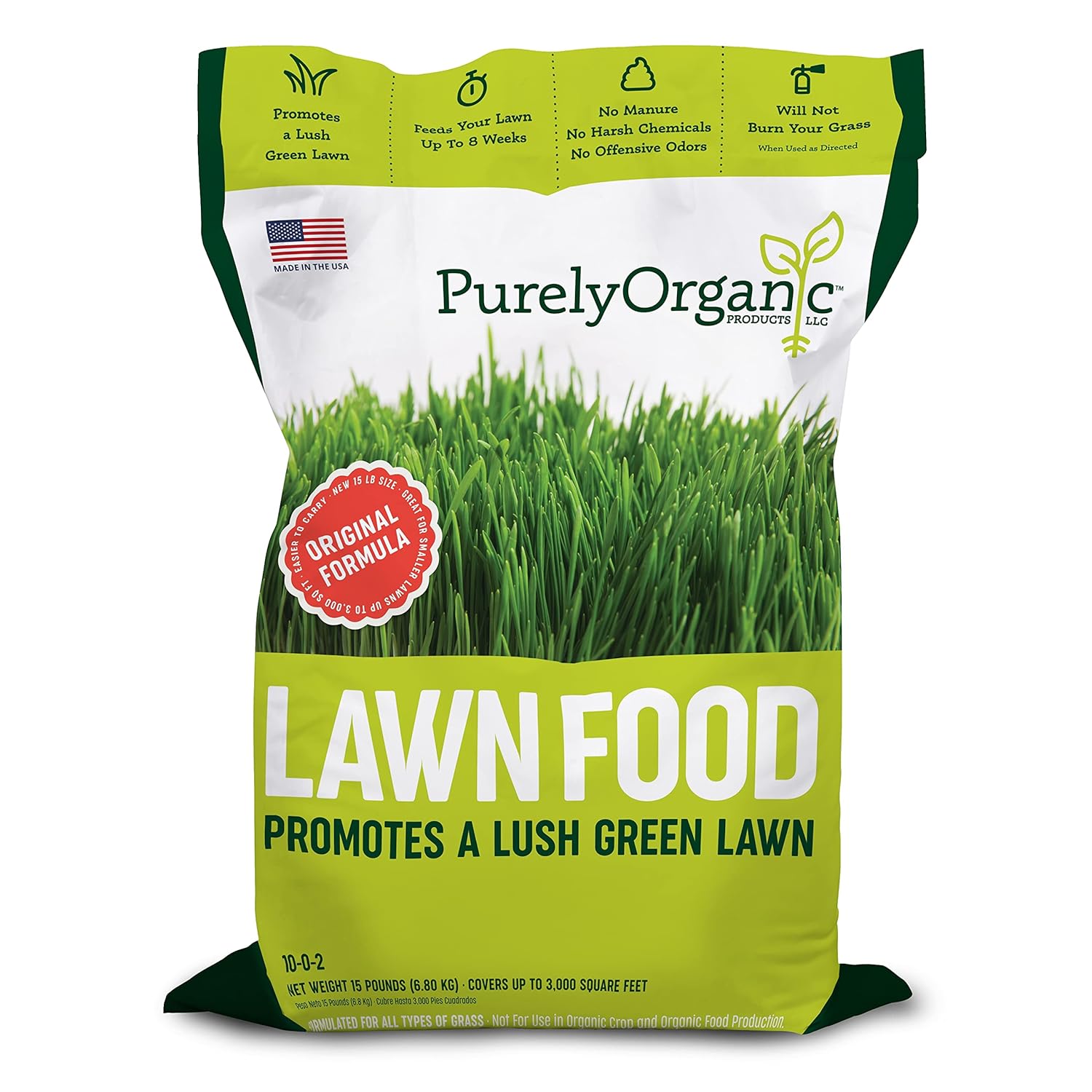
Purely Organic Products Lawn Food 10-0-2, 15 lb
| Item Form | Granules |
|---|---|
| Application Method | Drop or rotary spreader |
| Coverage | 3,000 Square Feet |
| Specific Uses For Product | Plant Growth, Root Development, Soil Conditioning |
| Mixing Ratio | 10:0:2 |
This Purely Organic Lawn Food is a granular, plant-based fertilizer designed for routine lawn feeding on cool- and warm-season grasses. It spreads with a drop or rotary spreader at the recommended 4–8 lbs per 1,000 sq ft and supplies nitrogen-heavy nutrition (10-0-2) for greener leaf growth while also contributing to root development and soil conditioning. The blend uses soybean meal and distillers dried grains instead of synthetic chemicals, which reduces odor and eliminates phosphorus to comply with phosphate-restriction rules in some towns. It is family and pet friendly with no re-entry restrictions noted, making it practical for yards with animals. Expect slower, steady green-up compared with quick-release synthetic fertilizers, so results are gradual rather than instant. Also, coverage is calibrated to the 15 lb bag for roughly 3,000 sq ft, so larger lawns will need multiple bags and more storage space.
Best for: Buyers who want a pet- and family-friendly, plant-based lawn fertilizer that supports steady, natural green-up and prefers practical, regulation-compliant choices over fast-acting chemical feeds.
Less Ideal for: Homeowners who need rapid, dramatic color change or who manage very large lawns and expect each application to cover extensive acreage.
- Plant-based formula using soybean meal and distillers grains instead of synthetic chemicals
- No phosphorus in the 10-0-2 formula to meet phosphate-restriction rules
- Can be applied with common drop or rotary spreaders and covers about 3,000 sq ft per bag
- Family and pet friendly with no re-entry time required
- Slow-release effect means slower visible results compared with synthetic quick-release fertilizers
- 15 lb bag may be insufficient for larger lawns requiring multiple applications or bags
Verdict: Choose this product if you want a practical, pet-safe, plant-based fertilizer that steadily builds greener turf while avoiding phosphorus.
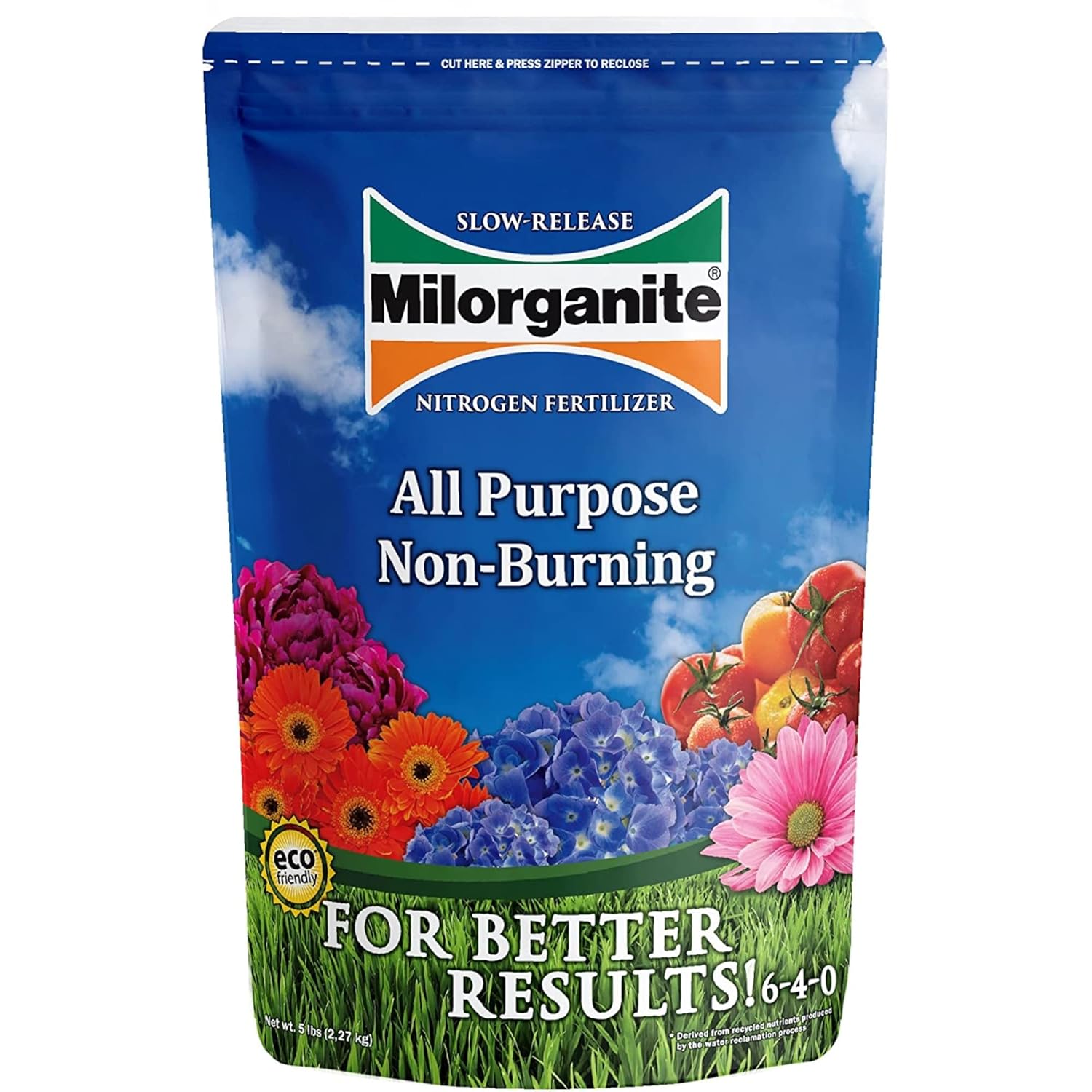
Milorganite Slow-Release Organic Fertilizer, 5 lb
| Item Form | Granules |
|---|---|
| Specific Uses For Product | Lawns, Flowers and Gardens |
| Coverage | 390 Square Feet |
| Ingredients | Nitrogen |
Milorganite is a granular, slow-release organic fertilizer formulated to feed lawns and garden plants for about 8 to 10 weeks per application. It is typically broadcast by hand or with a spreader and does not require immediate watering in, making it easy to fit into routine maintenance. Notable features include a low-salt formula that greatly reduces the risk of burning turf, organically complex iron that greens grass without staining hard surfaces, and about 85% organic matter that helps improve soil structure over time. The product covers roughly 390 square feet from a 5 pound bag and is positioned as safe for use on lawns, shrubs, flowers, trees, and edible gardens. Limitations are that nutrient release is gradual, so it is not a quick fix for severe nitrogen deficiency, and the bag has an earthy odor at first that some pets may find attractive until it dissipates or is watered in. For someone managing Empire Zoysia, use on the recommended schedule and expect steady, low-risk green-up rather than instant color change.
Best for: Gardeners who prioritize steady, low-risk nutrient delivery and soil health and who prefer a hands-off feeding schedule for fine-textured lawns like Empire Zoysia.
Less Ideal for: Homeowners wanting rapid color correction or fast-acting synthetic nitrogen boosts should choose a quick-release fertilizer instead.
- Slow-release nitrogen feeds lawns for 8–10 weeks reducing application frequency
- Low salt formulation minimizes risk of burning sensitive turf like Zoysia
- Provides organically complex iron that greens grass without staining concrete
- High organic matter improves soil structure and water retention over time
- Slow-release action means it will not correct severe yellowing immediately
- Initial earthy odor that may attract some pets until it is watered in or dissipates
Verdict: Choose Milorganite for Empire Zoysia when you want a safe, slow-release organic feed that greens turf steadily without burning or staining.
Espoma Turf-Tone All Season Organic Lawn Food with Bio-Tone, 28 lb

| Item Form | Granules |
|---|---|
| Application Method | Spread evenly on a dry, mowed lawn |
| Target Species | Lawn Grass |
| Unit Count | 448 Ounce |
Espoma Turf-Tone is a 28 lb granular, slow-release lawn fertilizer designed for routine feeding of lawns including Kentucky bluegrass. It supplies a low-rate nitrogen formula that releases slowly to encourage steady greening and reduced frequency of applications. The product is intended to be applied with a drop or broadcast spreader to a dry, mowed lawn and claims coverage up to about 5,000 sq ft. Notable features are its organic ingredients and Bio-Tone microbial formula, which aim to support soil biology while minimizing risk of burn or leaching compared with high-salt synthetic feeds. Practical benefits for bluegrass include gentler, longer-lasting color improvement and less chance of creating quick flushes of top growth that demand more mowing. Important limitations are that its nutrient numbers are modest (9-0-1) so it is not a quick corrective for severe nitrogen deficiency and may require multiple seasonal applications to build vigor; large or very depleted lawns may need supplemental treatments or higher-analysis products for rapid recovery.
Best for: Homeowners who prioritize reliable, low-risk feeding and steady seasonal improvement for cool-season lawns like Kentucky bluegrass and who prefer organic products over synthetic quick fixes.
Less Ideal for: Gardeners needing a fast green-up or immediate corrective treatment for very nutrient-deficient or large commercial lawns should consider higher-analysis or targeted products instead.
- Slow-release nitrogen that promotes steady greening without rapid top growth
- Organic and natural ingredient base that reduces burn risk and supports soil health
- Formulated with Bio-Tone microbes to help root and soil biology
- Easy to apply with a broadcast or drop spreader and suitable for all-season use
- Lower analysis (9-0-1) so it is not ideal for rapid correction of severe nutrient deficiencies
- Coverage claim depends on even spread; may require multiple bags for large or thin lawns
Verdict: Choose this organic, slow-release Turf-Tone when you want dependable, low-risk seasonal feeding that supports Kentucky bluegrass and soil biology.
Milorganite 6-4-0 Slow-Release Fertilizer, 32 lb (with Feeding Tips Brochure)

| Item Form | Pelletized |
|---|---|
| Application Method | Broadcast, Rotary or Manual |
| Coverage | 2,500 Square Feet |
| Specific Uses For Product | Lawns, Flowers and Gardens, Education |
Milorganite 6-4-0 is an organic, pelletized slow-release fertilizer intended for routine lawn and garden feeding. It is typically broadcast with a rotary or manual spreader and provides nitrogen slowly over 8 to 10 weeks, which reduces the need for frequent applications and lowers burn risk. The product contains organically complex iron for greening without the strong staining associated with iron salts and is low in soluble salts, so it performs well in warm or drier conditions. The 32 lb bag covers roughly 2,500 square feet and comes with a printed feeding and spreader tips brochure to simplify seasonal timing and application rates. Because it is made from heat-dried microbes, it also adds organic matter to improve soil structure in heavy clay or sandy soils. Limitations are that nutrient release is gradual so it is not suited to quick color fixes or rapid turf recovery, and users seeking tightly controlled N-P-K ratios or fast-acting synthetic performance may prefer a different product.
Best for: Buyers who want a low-maintenance, environmentally minded fertilizer that steadily feeds established lawns and mixed garden beds with minimal risk of burn and fewer repeat applications.
Less Ideal for: If you need rapid turf recovery, immediate color correction, or precise synthetic nutrient control for athletic fields or newly sodded lawns, choose a fast-release or specialty fertilizer instead.
- Slow-release nitrogen feeds lawns and plants for 8–10 weeks, reducing application frequency
- Low-salt formulation minimizes fertilizer burn and streaking in hot or dry conditions
- Organically complex iron promotes deep greening without heavy staining of concrete
- Pelletized form works with broadcast, rotary, or manual spreaders for easy application
- Adds organic matter that can improve drainage and soil structure in clay or sandy soils
- Not fast-acting, so it will not deliver an immediate green-up after application
- Contains biosolids which some buyers may prefer to avoid for personal or local reasons
Verdict: Pick this if you want a reliable, low-salt slow-release fertilizer that feeds lawns and gardens for weeks with minimal maintenance.
Scotts Green Max Lawn Food (16.67 lb)

| Item Form | Granules |
|---|---|
| Coverage | 5000 square feet |
| Specific Uses For Product | Lawn |
| Target Species | lawn grass |
Scotts Green Max Lawn Food is a granular, all-purpose lawn fertilizer formulated to deliver fast greening with a 2-in-1 feed plus 5% iron supplement. It is applied with a broadcast or drop spreader to any grass type and is recommended for routine spring, summer, or fall applications. Notable features include a guaranteed nonstaining formula when used as directed and settings provided for Scotts spreaders to help get an even application across the advertised 5,000 sq ft coverage. The iron content speeds visible greening in as little as three days and the granules are ready to water in for faster uptake. For a risk-averse homeowner growing fescue in spring, the product is straightforward to use and safe to re-enter the lawn immediately after application. Limitations are that proper spreader settings and sweeping up excess product are important to avoid runoff and that it is a general lawn food rather than a specialized product for nutrient-deficient soils, so a soil test is still useful for targeted corrections.
Best for: Homeowners who want a low-risk, easy-to-apply lawn food that produces quick green results on fescue lawns in spring and prefer established brand guidance for application.
Less Ideal for: Gardeners seeking a product to correct a specific nutrient imbalance or those who prefer liquid or organic-only fertilizing approaches.
- Includes 5% iron for faster, deeper greening visible in about three days
- Premeasured granular form covers up to 5,000 sq ft from one bag
- Manufacturer provides spreader settings to simplify even application
- Formulated not to stain concrete or driveways when used as directed
- Not a tailored corrective fertilizer for specific soil deficiencies
- Requires correct spreader settings and cleanup to prevent runoff
Verdict: A simple, fast-acting granular lawn food with added iron that reliably greens fescue lawns when applied with a spreader.
Choosing the Right Non Burning Lawn Fertilizer: Key Factors to Consider
Nitrogen Release Type
How nitrogen becomes available to grass is central to burn risk. Slow-release mechanisms such as polymer coatings, sulfur coatings, or stabilized nitrogen sources release nutrients gradually over weeks, avoiding sudden high concentrations on leaf blades that can cause tip browning. Quick-release fertilizers deliver fast color but increase scorch potential if applied too heavily or during heat stress.
Choose a release type that matches how often you mow and water. If you water inconsistently or prefer less frequent feeding, a longer-duration slow-release product reduces the chance of a high short-term dose reaching the turf surface.
Nutrient Ratio and Secondary Nutrients
The guaranteed analysis and nutrient ratio determine whether the fertilizer encourages leaf growth, root development, or a balance of both. Products with moderate nitrogen paired with adequate potassium and some phosphorus or micronutrients support stress tolerance and root strength, lowering burn risk compared with high-nitrogen mixes.
Secondary nutrients and micronutrients like iron, magnesium, and zinc can improve color and disease resilience without needing high nitrogen. For lawns with specific soil deficiencies, choose a formula that addresses those needs rather than adding excess nitrogen.
Application Rate Clarity and Spreader Fit
Clear application instructions and spreader calibration guidance reduce dosing errors that lead to burn. Labels that provide coverage rates in pounds per 1,000 square feet and recommended spreader settings make even coverage much easier for homeowners.
Spreader-friendly granule size and uniform granulation help prevent uneven distribution and patched burn spots. If a label lacks spreader guidance or lists only vague rates, the risk of overapplication rises.
Residue Characteristics and Lawn Appearance
Some slow-release coatings leave visible dust or small fragments on the grass that can be noticeable on dark lawns or near patios. Other formulations dissolve cleanly with watering. Residue that crumbles or sticks to blades can temporarily affect appearance but does not necessarily signal burn risk.
Consider how visible residue will matter in your yard, especially around walkways and driveways. Products that leave minimal visible residue are preferable for lawns where aesthetics are a priority immediately after application.
Tolerance to Environmental Stress
A non burning fertilizer should be forgiving when weather is hot, when watering is inconsistent, or when light overapplication occurs. Formulations that emphasize stress tolerance-through balanced potassium levels and defensive micronutrients-help lawns recover from heat or drought without showing scorch as readily.
If your site experiences heat waves, compacted soils, or sporadic irrigation, prioritize a fertilizer described as stress-supportive rather than one aimed only at rapid color.
When to Apply Non Burning Lawn Fertilizer
Timing affects both uptake and burn risk. Apply maintenance feeds during active growth periods when the turf is not under extreme heat or drought. For cool-season grasses, early fall and late spring are often ideal. For warm-season grasses, late spring through mid-summer applications work well when growth is vigorous.
Avoid applying non burning formulations during prolonged heat waves or when grass is dormant. Even gentle formulas can stress blades if uptake is slow and environmental heat prevents adequate recovery. Light irrigation after application often helps activate slow-release products without washing nutrients away.
- Match application timing to grass species growth cycle.
- Water lightly after application unless the label advises otherwise.
- Space feeds according to the product's longevity recommendations.
How to Calibrate Your Spreader
Proper spreader calibration is one of the easiest ways to avoid localized burn. Follow the label's setting guidance, then do a test pass over a measured area and adjust as needed to reach the listed pounds per 1,000 square feet. Broadcast spreaders and drop spreaders behave differently, so adjust settings when switching spreader types.
Walk at a steady pace during application and overlap passes slightly to maintain even coverage. Clean the spreader after use to prevent old granules or dust from skewing future output.
- Measure a 1000 sq ft test area for calibration.
- Empty and level the hopper between bag openings to avoid clumping.
- Store leftover product dry and sealed to maintain spreader performance.
Watering Strategies After Application
Most non burning fertilizers perform best with a light irrigation after application to wash granules off blades and begin nutrient release. The goal is to move nutrients into the thatch and root zone without heavy runoff. A short, gentle watering for five to ten minutes is typically sufficient for home lawns.
If rain is imminent, check label guidance: many slow-release formulas tolerate light rain whereas heavy downpours soon after application can cause nutrient loss. Adjust irrigation based on soil type and recent rainfall to ensure the fertilizer is used efficiently.
- Use gentle, short watering to activate granules.
- Avoid heavy irrigation that creates runoff in sloped yards.
- Delay watering if the label explicitly instructs to leave product on the surface.
Managing Spot Treatments and Overseeding
Spot treating thin or yellow patches requires caution. Use lower rates for targeted applications and avoid applying high-nitrogen quick-release mixes to small areas that will receive concentrated doses. For overseeding, choose a starter-appropriate product distinct from regular maintenance fertilizer; many non burning maintenance formulas do not provide the phosphorus boost seedlings need.
When overseeding and feeding at the same time, follow instructions for seed safety and prefer mixes labeled safe for new seed or apply starter fertilizer in the seeding rows only.
- Use reduced rates for spot treatments to prevent local scorch.
- Confirm seed-safe labeling before applying around new grass.
- Hand-apply to small patches to control distribution more precisely.
Environmental and Soil Considerations
Soil test results influence which non burning fertilizer will perform best. A test helps you match nutrient ratios and avoid unnecessary additions that could harm water quality. In sandy soils that drain quickly, choose a formula that provides moderate, repeatable feeding rather than a single high dose.
In clay or compacted sites, improved soil structure and biological activity reduce fertilizer stress on roots. Consider combining cultural practices like aeration with a balanced fertilizer to reduce scorch risk and improve nutrient uptake.
- Use soil tests to guide nutrient choices.
- Combine fertilizer with cultural care for long-term turf health.
- Adjust feeding frequency for fast-draining or compacted soils.
How We Chose the Best Non Burning Lawn Fertilizer
We selected products that meet practical needs gardeners face when feeding turf while minimizing burn risk. Our filters prioritized fertilizers with clearly stated release mechanisms such as slow-release coated granules or stabilized nitrogen sources, moderate nitrogen percentages appropriate for regular maintenance, and nutrient ratios that support root growth as well as top growth. Application ease was important, including spreader compatibility and clear coverage instructions. We assessed longevity of feeding and how forgiving the formula is to common homeowner mistakes like light overapplication or irregular watering. Environmental considerations such as reduced runoff potential and the presence of secondary nutrients were factored in. Exclusions: we excluded formulations with high quick-release nitrogen levels aimed at aggressive growth, products intended solely for turf repair or starter fertilizers for new sod, and any fertilizer lacking transparent label information on guaranteed analysis or release type.
FAQ
Can a non burning fertilizer completely eliminate the risk of turf scorch?
No. Non burning fertilizers greatly reduce the chance of scorch by controlling nutrient release, but risk still exists if you overapply, apply during extreme heat, or fail to water appropriately. Follow label rates and timing to minimize problems.
How often should I apply a non burning lawn fertilizer?
Frequency depends on the product's release duration. Many slow-release formulas feed for 8 to 12 weeks, so 2 to 4 applications per growing season are common. Always follow the label for the intended schedule.
Is there a difference between coated granules and stabilized nitrogen?
Yes. Coated granules use a physical barrier to slow nutrient release over time, while stabilized nitrogen relies on chemical inhibitors that slow microbial conversion. Both reduce quick spikes in available nitrogen but behave differently in wet or dry soils.
Will non burning fertilizers work during drought?
They can be gentler under drought conditions because release is slower, but applying any fertilizer to drought-stressed grass can increase risk. Delay application during extended dry spells and resume feeding when the lawn shows active recovery.
Can I mix a non burning fertilizer with other lawn products?
Mixing is product-dependent. Granular non burning fertilizers are usually spread separately from liquid treatments. If combining with herbicides or other amendments, check labels for compatibility to avoid unintended stress on the turf.
Does non burning mean low nitrogen?
Not necessarily. Non burning refers to how the nitrogen is delivered, not just the amount. Some non burning formulas contain moderate nitrogen in slow-release form, providing steady nutrition without a high immediate dose.
Final Verdict
Prioritize fertilizers that match your lawn's growth pattern and environmental conditions. Focus on release control, balanced nutrients, and clear application guidance to reduce scorch risk while maintaining steady color and root health. For most home lawns, selecting a non burning formula with a clear spreader setting and moderate nitrogen will deliver predictable results with fewer stress-related issues.
