

Note: This article contains affiliate links. If you click on these links and make a purchase, I may earn a small commission at no extra cost to you. This helps support my research and content. Read my full affiliate disclosure here.
Tackling dandelions, clover, and plantain without damaging turf requires a targeted approach. If you want a healthier, more uniform lawn, choosing the right broadleaf weed killer matters because some formulas are selective while others stress grass or need precise timing. This guide looks at five top lawn broadleaf weed killers suited for home lawns and common turf grasses. We shortlisted options that balance selectivity, ease of application, and seasonal timing. Below you will find practical evaluation criteria and guidance to help you pick the product that fits your lawn size, grass type, and timing needs.
Top Picks at a Glance
| Best Overall The best all-around choice for most situations | Ortho WeedClear Weed Killer for Lawns Concentrate, 1 gal. |  |
| Best Value The sweet spot between price and what you get | Spectracide Weed Stop for Lawns Concentrate, 40 oz |  |
| Best Budget The cheapest option that still gets the job done reliably | Spectracide Weed Stop for Lawns Ready-to-Use Spray, 32 oz | 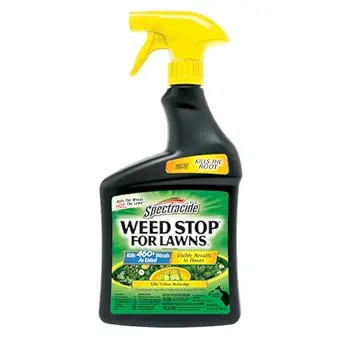 |
| Highest Rated A top-rated pick with lots of positive feedback | Factory Hardware Store Hi-Yield 2,4‑D Broadleaf Weed Killer Concentrate, 32 oz (2-Pack) |  |
| Most Popular A crowd favorite that many people choose with confidence | Scotts Turf Builder Weed & Feed (14.29 lb) |  |
Ortho WeedClear Weed Killer for Lawns Concentrate, 1 gal.

| Unit Count | 128 Fluid Ounces |
|---|---|
| Item Form | Spray |
| Coverage | 64000 square_feet |
| Included Components | Fertilizer |
| Active Ingredients | Herbicide |
Ortho WeedClear Concentrate is a ready-to-dilute herbicide designed for lawn broadleaf weed control. Mix the concentrate with water per label directions and apply with a tank sprayer or a hose-end applicator to actively growing weeds in spring or fall. It targets common broadleaf weeds such as dandelion, clover, chickweed and oxalis, killing down to the root and showing visible results within hours; treated areas become rainproof in about an hour. The product lists compatibility with many common lawn grasses and covers up to 64,000 sq ft per gallon when diluted at recommended rates, which makes it a practical choice for homeowners with medium to large lawns. Important limitations are usual safety precautions and application timing: wear protective clothing and keep people and pets off the lawn until sprays dry, and avoid use during very hot days above 90°F. Also, follow specific grass exclusions (for example Floratam St. Augustine) and label directions to prevent damage to sensitive turf types.
Best for: Homeowners who want an effective, large-coverage solution for broadleaf weeds and are comfortable following dilution and safety instructions for seasonal spot or whole-lawn treatments.
Less Ideal for: Small-plot gardeners who prefer spot treatments without mixing concentrates or anyone unwilling to follow chemical safety precautions should consider ready-to-use or nonchemical alternatives.
- Concentrated formula treats a very large area from one gallon when mixed correctly
- Kills a wide range of common broadleaf weeds down to the root with visible results in hours
- Becomes rainproof in about one hour allowing faster turnaround after application
- Compatible with many common lawn grass types when used according to label
- Requires careful dilution and protective gear during handling and application
- Not suitable for all turf types; label lists exclusions and different rates for northern versus southern lawns
Verdict: Choose this concentrate if you need a fast-acting, high-coverage broadleaf weed control for common lawns and will follow label dilution and safety directions.
Spectracide Weed Stop for Lawns Concentrate, 40 oz

| Item Form | Liquid |
|---|---|
| Coverage | 20000 square_feet |
| Unit Count | 40 Fluid Ounces |
Spectracide Weed Stop for Lawns Concentrate is a liquid herbicide designed for homeowners who want to remove broadleaf weeds without damaging their turf. You mix the concentrate with water and apply it with a garden sprayer to treat up to 20,000 sq ft from a single 40 fl oz bottle. The formula is made to kill more than 200 listed weeds by contact down to the root, with visible results in hours and full effect overnight; it is rainfast after about six hours. Typical use is mowing first, spraying in spring when weeds are actively growing or in fall to reduce next year’s weed pressure, and spot-treating any persistent plants after three weeks. Practical benefits include high coverage per bottle, quick visible control, and compatibility with common garden sprayers. Important limitations are that it targets broadleaf weeds only, requires careful mixing and application per label to avoid turf injury, and may need repeat spot treatments for very tough weeds or heavy infestations.
Best for: Homeowners who want an efficient, no-nonsense way to clear broadleaf weeds across a lawn and who prefer products that deliver wide coverage and quick visible results.
Less Ideal for: People needing control of grassy weeds or those seeking an organic or non-chemical approach should consider alternative methods or products.
- Concentrated formula covers a large area from one bottle (treats up to 20,000 sq ft)
- Kills more than 200 listed broadleaf weeds and acts down to the root
- Shows visible results within hours and is rainfast after 6 hours
- Works when sprayed with a standard garden sprayer and fits into common lawn care routines
- Not effective against grassy weeds or moss
- Requires correct mixing and timing to avoid harming desirable turf
- Tough perennial weeds may need repeat spot treatments
Verdict: A high-coverage, fast-acting concentrate for homeowners who want to quickly eliminate broadleaf weeds across large lawns.
Spectracide Weed Stop for Lawns Ready-to-Use Spray, 32 oz

| Item Form | Spray |
|---|---|
| Liquid Volume | 32 |
| Coverage | Up to 10,000 square feet (for cool season grasses) |
Spectracide Weed Stop for Lawns is a pre-mixed spray designed for quick spot and broadcast applications on common turfgrasses. You simply spray until weeds are wet and wait for visible decline, often within hours, because the formula kills by contact down to the root. It lists control for more than 460 weed types including dandelion, clover and chickweed and is labeled for use on bluegrass, fescue, ryegrass, Bermuda and established zoysia. The ready-to-use bottle requires no mixing, which keeps application straightforward and reduces setup time for homeowners. Practical benefits include broad weed spectrum, fast visible results and instructions for safe use (temperature window and re-entry guidance). Important limitations are that it can damage turf if applied outside temperature recommendations or on grass just coming out of dormancy, and coverage claims are for cool-season grasses only. For larger properties you may need multiple bottles or a concentrate product to be more economical.
Best for: Homeowners who want a simple, no-mix weed control that gives fast visible results and prefer a straightforward spray solution for small to medium lawns.
Less Ideal for: Large-property owners or landscape professionals who need a cost-per-acre solution or who require year-round, temperature-agnostic applications.
- Ready-to-use spray requires no mixing or extra equipment
- Kills over 460 listed weeds including common broadleaf and grassy weeds
- Produces visible results within hours by killing weeds down to the root
- Labeled for use on multiple common lawn grasses when directions are followed
- Can harm turf if applied outside the 45° to 90° F window or to grass just emerging from dormancy
- Ready-to-use format may be less economical for treating large lawns compared with concentrates
Verdict: A convenient ready-to-use spray that delivers fast control of common broadleaf weeds for budget-minded homeowners treating small to medium lawns.
Factory Hardware Store Hi-Yield 2,4‑D Broadleaf Weed Killer Concentrate, 32 oz (2-Pack)

| Number of Packs | 2 |
|---|---|
| Unit Count | 32 Fluid Ounces |
| Item Form | Liquid |
| Active Ingredient | Dimethylamine Salt of 2,4‑Dichlorophenoxyacetic Acid |
This Hi‑Yield 2,4‑D concentrate is a selective post‑emergent broadleaf weed control intended for established lawns and other labeled outdoor areas. You dilute the liquid concentrate according to the label and apply with a pump sprayer to target common broadleaf weeds such as dandelion, chickweed, and plantain. The product’s active ingredient is the dimethylamine salt of 2,4‑D, a longstanding herbicide ingredient that provides systemic control of many broadleaf species rather than just burning foliage. The two 32 ounce bottles give extra coverage for repeat seasonal treatments or larger properties, and the concentrate format keeps storage and transport compact compared with ready‑to‑spray mixes. Important limitations are that it is selective only to certain broadleaf weeds and must be used on labeled turf species and conditions, and proper mixing, timing, and safety precautions are required to avoid injury to desirable plants. Follow label directions precisely for timing, dilution, and buffer zones near sensitive plants.
Best for: Homeowners who prioritize a dependable, proven solution for recurring broadleaf weed problems and who will follow label directions for precise mixing and application.
Less Ideal for: Gardeners who need a non‑chemical or broad‑spectrum grass and weed control, or those who plan to treat sensitive ornamental beds or young lawns without consulting the label.
- Selective broadleaf control targeting common lawn weeds rather than grasses
- Concentrate format allows flexible dilution for small or large areas
- Two 32 oz bottles provide extra coverage for repeat treatments or larger yards
- Uses an established active ingredient (2,4‑D dimethylamine salt) with systemic action
- Requires careful mixing and application and is only labeled for certain turf and landscape uses
Verdict: Buy this concentrate if you want a reliable, proven selective herbicide in a two‑bottle pack for seasonal control of common broadleaf lawn weeds.
Scotts Turf Builder Weed & Feed (14.29 lb)

| Item Form | Granule |
|---|---|
| Coverage | 5000 square_feet |
| Active Ingredients | 2,4-D 1.220%, Mecoprop 0.081% |
Scotts Turf Builder Weed & Feed is a granular combined fertilizer and broadleaf weed killer designed for routine lawn maintenance. You apply it with a broadcast or drop spreader to a wet lawn when weeds are actively growing and temperatures are between 60°F and 90°F; the package covers about 5,000 sq ft. The formula uses WeedGrip technology and contains active herbicide ingredients that control common broadleaf weeds while feeding grass to encourage thicker turf that can crowd out future weeds. Practical benefits include one-step application for both feeding and weed control and clear spreader settings recommended by the manufacturer for even coverage. Important limitations: it is not safe for several grass types including St. Augustine and bentgrass so check compatibility before use, and you must avoid watering or rainfall for 24 hours after application and keep people and pets off treated areas until dust settles. It is a seasonal, preventive/curative product rather than a spot-treatment solution, so small patches or sensitive lawns may require alternative methods.
Best for: Buyers who want a proven, all-in-one seasonal treatment to reduce broadleaf weeds across a medium lawn and prefer products with a long track record and widespread user adoption.
Less Ideal for: Homeowners with sensitive or excluded grass species, very small lawns needing spot treatment, or those who need an immediate knockdown solution for individual weed patches.
- Combines weed control and fertilizer in a single application for time savings
- WeedGrip technology formulated to stick to weed leaves for improved contact
- Covers up to 5,000 sq ft per 14.29 lb bag, suitable for medium-sized lawns
- Clear application guidance with recommended spreader settings for even distribution
- Not safe for several grass types such as St. Augustine and bentgrass
- Requires specific temperature and moisture conditions and no watering for 24 hours after application
Verdict: A reliable, single-application lawn treatment that feeds grass while controlling common broadleaf weeds across a medium-sized lawn.
Choosing the Right Lawn Broadleaf Weed Killer: Key Factors to Consider
Turf Selectivity
Selective action determines whether a product controls broadleaf weeds without harming turf grass. Different active ingredients target broadleaf species while leaving grasses intact, but selectivity varies with grass type and stressors. Applying a selective herbicide on a drought-stressed or newly sodded lawn increases the risk of grass injury.
Check label language for the turf varieties listed and recommended use windows. If your lawn is a cool-season grass versus a warm-season grass, choose a formulation and timing aligned with that grass's active growth period to maximize safety and uptake.
Target Weed Spectrum
Not all broadleaf weed killers control the same species. Some formulations excel at tough perennials like creeping buttercup and plantain, while others are optimized for common annuals such as chickweed or clover. Knowing the dominant weeds in your lawn helps you match a product's labeled species list to your problem.
Labels usually list controlled weeds; focus on products that list the weeds you see. For mixed infestations, consider broader-spectrum options or plan for targeted spot treatments combined with cultural controls.
Application Method and Accuracy
Products come ready-to-use, hose-end sprayers, or concentrated liquids that require dilution. Ready-to-use sprays are convenient for small spot treatments but can be expensive for larger areas. Concentrates lower cost per area but demand careful measuring and mixing to avoid overapplication.
Application accuracy affects both efficacy and turf safety. Look for clear measuring marks, calibrated sprayer tips, or dilution tables. Use a pump sprayer with a strap and calibrated nozzle for even coverage when treating larger lawns.
Timing and Lawn Conditions
Herbicide uptake is driven by active weed growth and favorable weather. Most broadleaf weed killers work best when weeds are actively growing, typically in spring and fall for many species. Avoid applications during drought, extreme heat, or immediately after heavy fertilization or mowing by less than 24 to 48 hours.
Follow label directions about watering: some products require dry foliage before application and delay irrigation afterward. Seasonal timing also affects turf safety, especially for newly seeded or sodded lawns that need a waiting period before herbicide use.
Persistence and Re-treatment Interval
Persistence describes how long the active ingredient remains effective in the plant or soil. Shorter persistence often means safer use around desirable plants but may require follow-up treatments. Longer persistence can control resprouting and tough perennials but might restrict reseeding or overseeding schedules.
Read the re-treatment interval and reseeding wait times on the label. Plan any renovation, overseeding, or new plantings around those timelines to avoid injury to young grass seedlings.
Environmental Safety and Lawn Care Integration
Consider runoff potential, buffer zone requirements, and precautions for pollinators when choosing a product. Some broadleaf herbicides have restrictions near water or recommended setbacks from wells and drainage paths. Take note of any pollinator protection language and avoid spraying flowering weeds when bees are active.
Integrate herbicide use with cultural practices such as mowing height, adequate fertilization, and overseeding to reduce future weed pressure rather than relying solely on chemical control.
When to Treat Broadleaf Weeds
Timing influences both safety and effectiveness. Apply when broadleaf weeds are actively growing and not under drought stress. For many temperate lawns, spring and fall applications catch weeds during key growth spurts when herbicide translocation is strongest.
Avoid spraying during very hot or very cold conditions. If you plan to overseed or renovate, check label instructions for required waiting periods after application to protect new grass seedlings.
- Treat in cool, calm weather to reduce volatilization and drift
- Avoid mowing 24-48 hours before application to leave foliage for herbicide uptake
- Delay irrigation as directed on the label to allow foliar absorption
Spot Treatment Versus Broadcast Applications
Spot treatments are efficient when weeds are clustered or sparse and reduce chemical use. Use a ready-to-use sprayer, foam applicator, or a syringe-style applicator for single plants to limit turf exposure.
Broadcast applications suit heavy infestations across the lawn but require careful calibration to avoid overdosing. Measure your lawn area, mix concentrates precisely, and use a consistent walking pace and nozzle to ensure even coverage.
- Spot treat visible weeds to conserve product and limit turf stress
- Use broadcast only when weed coverage justifies whole-lawn treatment
Protecting Beneficial Lawn Plants and Pollinators
Some flowering broadleaf weeds attract pollinators. If bees are foraging, avoid spraying those blooms until petals are gone or apply in early morning or late evening when bees are less active. Maintain a buffer around ornamental beds and flowering trees.
Follow label directions for setbacks from water and avoid application before heavy rain to reduce runoff. Use precise application tools to minimize off-target drift that could harm desirable plants.
- Do not apply to blooming plants frequented by bees during active pollination
- Respect buffer zones near water and ornamental beds
Combining Chemical and Cultural Control
Herbicides are most effective when combined with cultural practices that strengthen turf and reduce future weed pressure. Raise mowing height slightly to shade young weed seedlings, apply appropriate fertility based on a soil test, and overseed thin areas to prevent weed establishment.
Regular irrigation and correct mowing practices reduce stress that makes grasses more susceptible to weeds. Use herbicides as one tool in an integrated lawn care plan rather than a stand-alone solution.
- Overseed bare spots in the right season after label-required wait times
- Use soil tests to match fertility to turf needs and reduce excessive weed-favoring conditions
Safe Mixing and Storage Practices
Follow label mixing instructions exactly and wear the recommended personal protective equipment. Never mix different herbicides unless the labels explicitly permit tank mixes, and avoid mixing with fertilizers unless directed.
Store concentrates in a cool, dry place away from children and pets. Keep labels intact and retain mixing instructions for future applications.
- Calibrate sprayers before use and rinse them thoroughly after mixing
- Store unused product in original container with the label
How We Chose the Best Lawn Broadleaf Weed Killer
We focused on attributes that matter to gardeners managing home lawns where broadleaf weeds are the main problem. Selection favored products with demonstrated selectivity for common turf grasses, clear application methods for spot or broadcast use, and guidance for safe timing around fertilization and mowing. We prioritized formulations that allow accurate dilution or ready-to-use convenience, depending on typical homeowner preferences. Concrete evaluation criteria included turf selectivity and safety to minimize grass injury, efficacy against common broadleaf weeds, ease and accuracy of application, and label guidance for timing and rates. We also considered persistence and re-treatment intervals since those affect follow-up care. Excluded items were nonselective herbicides intended for driveways or vegetation removal and specialty products meant only for ornamental beds or aquatic use. The shortlist reflects products that balance effective broadleaf control with practical application details, clear safety instructions, and label-backed timing recommendations important for successful real-world lawn care.
FAQ
Can I apply broadleaf weed killer to a newly seeded lawn?
Usually you must wait before applying herbicide to newly seeded lawns. Labels commonly specify a waiting period to protect fragile seedlings. Timing depends on the active ingredient and the grass species, so follow the product label for reseeding intervals.
Will a broadleaf weed killer harm my grass if I apply it incorrectly?
Applying at too high a rate, during heat stress, or to an unsupported grass type can injure turf. Use the label-specified rate, avoid applications during drought or extreme temperatures, and choose products labeled for your grass species.
How long before I can overseed after using a broadleaf herbicide?
Re-seeding intervals vary by product and active ingredient. Some require waiting several weeks to months to avoid damage to new seedlings. Check the label for specific wait times and plan overseeding accordingly.
Is it better to spot treat weeds or apply a whole-lawn treatment?
Spot treatment is efficient for isolated weeds and limits chemical use and turf exposure. Whole-lawn treatments are more practical for widespread infestations but require careful calibration and timing to avoid turf stress.
Can I mix a broadleaf weed killer with fertilizer or other lawn products?
Do not mix products unless the labels explicitly allow the tank mix. Combining incompatible products can reduce effectiveness, increase turf injury risk, or create hazardous mixtures. Follow label guidance for compatibility.
What can I do if weeds return after treatment?
Weed regrowth can result from incomplete coverage, resistant species, or new seed germination. Re-treat according to label intervals, improve cultural controls like overseeding and fertility, and consider rotating active ingredients if the label supports it.
Final Verdict
Focus first on matching product selectivity to your turf type and the specific weeds you need to control. Prioritize clear label instructions for timing, mixing, and re-treatment intervals to avoid turf injury and conflicting lawn-care activities. Balance spot treatments for small problems with broadcast applications only when infestations justify them, and pair herbicide use with cultural practices to reduce future weed pressure. With attention to application accuracy, seasonal timing, and label restrictions, you can choose a broadleaf weed killer that effectively manages weeds while protecting and strengthening your lawn over time.
