

Note: This article contains affiliate links. If you click on these links and make a purchase, I may earn a small commission at no extra cost to you. This helps support my research and content. Read my full affiliate disclosure here.
If you plant and manage food plots, the right ATV seed spreader saves hours and reduces missed spots. Properly matched equipment helps you cover ground faster, place seed at the right rate, and avoid waste from uneven distribution. This guide looks at seven top ATV seed spreaders for food plots shortlisted for their durability, hopper capacity, and control over spread pattern and rate. We'll explain the real-world tradeoffs-capacity versus maneuverability, simple controls versus fine adjustment-and outline the features that matter in fields, corners, and rough ground. Read on to see which attributes to prioritize for your acreage and soil conditions.
Top Picks at a Glance
| Best Overall The best all-around choice for most situations | SORQINOTER ATV/UTV Adjustable Seed and Fertilizer Spreader (100/200 lb) |  |
| Best Quality Built to a higher standard if you want something more solid | Buyers Products UTVS16 150 lb UTV/ATV Receiver-Mount Broadcast Spreader |  |
| Best Value The sweet spot between price and what you get | MAXXTUFF ATV Spreader with Electronic Feed Gate, 100 lb Hopper |  |
| Best Budget The cheapest option that still gets the job done reliably | Yard Commander 80 lb ATV/UTV Broadcast Spreader (12V Motor, Adjustable Drop Rate) |  |
| Highest Rated A top-rated pick with lots of positive feedback | JARYANNIX Front-Mount ATV Broadcast Spreader, 265 lb Capacity, 12V/24V Motor |  |
| Most Popular A crowd favorite that many people choose with confidence | Buyers Products ATVS100 100 lb ATV Rear Rack Broadcast Spreader with Rain Cover |  |
| Best Seller A high-volume bestseller chosen again and again | Agri-Fab 185 lb Tow-Behind ATV/UTV Broadcast Spreader |  |
SORQINOTER ATV/UTV Adjustable Seed and Fertilizer Spreader (100/200 lb)

| Capacity | 200 lbs salt or 100 lbs grain |
|---|---|
| Power connection | 4-pin plug, 12V |
| Motor type | Sealed brushless motor |
This SORQINOTER ATV/UTV spreader mounts to a 2-inch receiver and is designed to broadcast seed, fertilizer, salt, lime or grain across food plots and large lawns. Typical use is hitching the unit to an ATV or UTV, filling the hopper, setting the adjustable nozzle and shut-off gate, then controlling flow from the included wireless remote while driving. Notable features include an adjustable-height quick hitch, a sealed brushless motor for longer life, and a 4-pin electrical plug for direct connection to vehicle systems. The wide spreading coverage and precise flow control let you cover acres faster than a hand spreader and reduce repeat passes when establishing plots. Side handles and a durable hopper make it straightforward to move and store. The main limitations are its weight and size which require a vehicle with a compatible receiver and enough payload capacity, and the need to calibrate for different seed sizes to avoid uneven distribution. For balanced buyers managing medium to large food plots, it speeds work and reduces labor compared with manual spreading.
Best for: Buyers managing medium to large food plots who want to cut planting time and control spreading from an ATV or UTV while keeping installation simple.
Less Ideal for: People with only small garden beds, those without a compatible hitch vehicle, or anyone who needs a very lightweight, handheld spreader.
- Adjustable flow nozzle and shut-off gate for precise output control with different granular materials
- Wireless remote lets you operate without leaving the driver’s seat for faster, safer spreading
- Quick-hitch adjustable-height mount fits most ATVs/UTVs with a 2-inch receiver for easy installation
- Sealed brushless motor and durable hopper designed for long-term outdoor use
- Relatively heavy and bulky, requiring an ATV/UTV with sufficient hitch and payload capacity
- Requires calibration for different seed types to achieve even distribution
Verdict: A durable, remote-controlled ATV/UTV spreader that speeds seeding and fertilizing of medium to large food plots while giving precise flow control.
Buyers Products UTVS16 150 lb UTV/ATV Receiver-Mount Broadcast Spreader

| Compatible with Vehicle Type | ATV, UTV |
|---|---|
| Load Capacity | 15 gallon |
| Fastener Type | Hitch Pin |
| Material Type | Polyethylene, Polyurethane |
The Buyers Products UTVS16 is a receiver-mounted broadcast spreader built to turn a UTV or ATV into a year-round spreading tool for seed, fertilizer, salt, or animal feed. It mounts to a standard 2-inch hitch and uses a sealed 12V motor and an 8.5-foot wiring harness with on/off switch to power a spinner that can broadcast material up to about 30 feet. The 15-gallon polyethylene hopper resists corrosion from salt and fertilizer and holds roughly 150 lb for longer runs between refills. An adjustable shut-off gate and manual control rod let you fine-tune flow rate for different materials, and stainless hardware improves durability where metal parts are exposed. Practical benefits include straightforward hitch installation, weather-resistant construction, and wide coverage so you can seed or treat larger acres more quickly than with a handheld spreader. Important limitations are that it requires a compatible receiver and power source, the motor is 12V so heavier-duty hydraulics are not available, and setup or wiring routing can add a bit of installation time. For buyers focused on proven, rugged gear this model provides a dependable, well-supported option for UTV-based spreading.
Best for: Buyers who want a rugged, proven UTV-mounted spreader to cover acres more quickly and prefer gear with established user feedback and solid build quality.
Less Ideal for: People who need a tow-behind or tractor-mounted high-volume commercial spreader or those without a compatible receiver hitch and on-board 12V power.
- Durable 15-gallon polyethylene hopper resists corrosion from salt and fertilizer
- Sealed 12V motor with wiring harness and switch for reliable powered spreading
- Adjustable flow gate and control rod for precise output with different materials
- Receiver-hitch mount installs to standard 2-inch hitches for easy attachment
- Requires a vehicle with a 2-inch receiver and a 12V power source for operation
- No hydraulic or heavier-duty drive option for very high-volume commercial use
Verdict: If you want a sturdy, receiver-mounted spreader that reliably broadcasts seed and amendments from a UTV with minimal fuss, the UTVS16 is a practical, well-built choice.
MAXXTUFF ATV Spreader with Electronic Feed Gate, 100 lb Hopper

| Hopper capacity | 100 lb |
|---|---|
| Motor | 12V |
| Flow control | Electronic feed gate with 6 settings |
The MAXXTUFF ATV Spreader is built for practical, regular use on food plots and deer feeding areas. Its tapered, rust-resistant plastic hopper holds up to 100 pounds and is shaped to promote complete unloading, while the quick-release mounting and universal bracket make it straightforward to attach and remove from most ATVs. A 12V motor powers an electronic feed gate that can be adjusted with the included wired handheld controller across six flow settings, so you can meter fine seed or heavier material like corn without constant manual intervention. The large deflection shield keeps material away from the vehicle and the easy on/off lid helps keep contents dry in wet conditions. For users who want durability and simple controls, this spreader handles routine planting and fertilizing tasks efficiently. Expect the unit to be heavier and bulkier than small broadcast spreaders and require a powered vehicle for operation, so it is best suited to property owners who need a robust, mounted solution rather than a lightweight handheld option.
Best for: Landowners and hunters who manage food plots and need a durable, mounted spreader that delivers consistent, adjustable application with minimal fuss.
Less Ideal for: Gardeners with very small plots, homeowners who need a lightweight handheld spreader, or anyone who cannot power the unit from an ATV.
- Large 100 lb tapered hopper promotes complete unloading and reduces bridging
- Electronic feed gate with 6-setting handheld controller for precise rate control
- Durable rust and corrosion-resistant plastic construction suitable for seed and fertilizer
- Universal mounting bracket and quick-release system for easy attachment to most ATVs
- Included deflection shield protects the vehicle from stray material
- Requires a 12V power source and an ATV for operation
- Relatively heavy and bulky compared with handheld or tow-behind spreaders
Verdict: A rugged, ATV-mounted 100 lb spreader that gives practical, adjustable control for planting and feeding large food plots.
Yard Commander 80 lb ATV/UTV Broadcast Spreader (12V Motor, Adjustable Drop Rate)

| Capacity | 80 pounds |
|---|---|
| Motor | 12‑volt vinyl coated motor |
| Spread radius | Up to 12 feet |
| Frame finish | Powder‑coated steel |
| Includes | Hopper rain cover |
The Yard Commander 80 lb ATV/UTV broadcast spreader mounts quickly to an ATV or UTV utility rack and uses a vinyl‑coated 12‑volt motor to fling material up to about 12 feet for wide coverage. It is built around a powder‑coated steel frame and a corrosion‑resistant hopper that holds up to 80 pounds of seed, fertilizer, salt, or feed, and includes a rain cover to prevent clumping in wet conditions. The drop rate is controlled by an easy access handle and an on/off switch can be mounted to handlebars for convenient operation while driving. Practical benefits include fewer hopper refills on larger jobs, year‑round versatility for winter salt and seasonal lawn tasks, and a durable finish that tolerates corrosive materials. Expect a straightforward install and simple controls rather than advanced metering electronics. The unit is compact and rugged but depends on your vehicle for power and mobility and may require occasional cleaning if using fine or damp materials to avoid buildup in the hopper and motor area.
Best for: Buyers who want a no‑fuss, durable spreader to cover medium to large acres from an ATV/UTV and who prioritize uptime and year‑round versatility over electronic precision.
Less Ideal for: Not a great fit for users who need ultra‑precise small‑rate fertilizing or a self‑powered walk‑behind solution; homeowners with only small lawns should consider smaller walk‑behind units.
- High 80 lb hopper capacity reduces refill frequency on larger properties
- 12‑volt vinyl‑coated motor allows up to ~12 ft spread radius for wide coverage
- Corrosion‑resistant hopper and powder‑coated frame stand up to salt and fertilizer
- Included rain cover prevents material clumping in wet conditions
- Simple adjustable drop rate and handle make calibration quick in the field
- No onboard battery; relies on ATV/UTV 12V power source and wiring
- Lacks electronic metering or precision calibration for very small application rates
Verdict: Choose this ATV/UTV spreader if you want a rugged, high‑capacity, year‑round tool that covers ground quickly with simple, reliable controls.
JARYANNIX Front-Mount ATV Broadcast Spreader, 265 lb Capacity, 12V/24V Motor

| Hopper capacity | 265 lbs |
|---|---|
| Spread range | 1–10 m |
| Motor power | 180 W copper turbine |
| Power source | 12 V/24 V compatible |
This front-mount broadcast spreader is built for straightforward, repeatable coverage of food plots and larger turf areas. It mounts to the front of most ATVs and provides a 265 pound hopper so you spend more time spreading and less time refilling. A 16-gear output control with a 3.5 m cable lets you adjust spread width from about 1 to 10 meters from the seat, which is useful when switching between seed rates or when treating variable-size plots. The horizontal 180 W all-copper turbine motor runs on 12 V or 24 V systems and vinyl-coated components are intended to resist corrosion and wear in outdoor use. An integrated over-spray shield helps keep material off the ATV. Practical limits include its relatively heavy build and the need to verify fit and mounting points for your specific ATV; also it is primarily a broadcast spreader so it is not designed for precision row planting. For hunters and land managers who value robust, simple operation and less frequent hopper fills, this unit delivers reliable, wide-area spreading.
Best for: Buyers who need a dependable, heavy-capacity spreader to treat medium to large food plots quickly and prefer simple in-seat control over precision application.
Less Ideal for: Gardeners who need fine precision for row crops or very small planting areas and users with very small or incompatible ATV mounting setups should look elsewhere.
- Large 265 lb hopper reduces refill frequency for sizeable food plots
- In-seat 16-gear spread control with 3.5 m cable for on-the-go adjustment
- Copper turbine motor compatible with 12 V and 24 V systems for consistent drive power
- Protective over-spray shield helps keep ATV front and controls clean
- Heavy construction that may require stronger mounting points and makes handling off the vehicle more difficult
- Designed for broadcast application only, not for precision row planting
Verdict: If you want a robust, high-capacity ATV-mounted spreader that lets you adjust spread width from the seat for fast, reliable coverage of food plots, this is a practical choice.
Buyers Products ATVS100 100 lb ATV Rear Rack Broadcast Spreader with Rain Cover

| Material Type | Polyethylene (PE) |
|---|---|
| Maximum Weight Recommendation | 100 pounds |
| Included Components | Spreader with raincover |
| Drive | 12V motor |
The Buyers Products ATVS100 converts an ATV rear rack into a year-round spreader for seed, fertilizer, animal feed, bagged rock salt, and ice melt. Mount it to a compatible ATV utility rack, fill the rustproof polyethylene hopper (max 100 lb) and use the enclosed 12V motor to broadcast material across a wide path — the manufacturer states up to about 30 feet — while the manual feed-gate lets you fine tune flow for different materials. The included rain cover keeps moist or bagged material drier during transport. Practical benefits include quick coverage of lawns, fields, driveways, and larger properties and straightforward control of application rate. Important limitations are the need to confirm your ATV rack and vehicle load limits before use and to clean the unit after spreading corrosive materials to avoid damage; heavier loads also increase strain on smaller racks. Assembly and mounting are typical for ATV attachments and the unit favors free-flowing granules rather than sticky mixes.
Best for: Buyers who prioritize proven, work-ready outdoor equipment and want a powered ATV attachment that covers large areas quickly for seasonal tasks like seeding, fertilizing, feeding, or winter salt application.
Less Ideal for: Owners with small ATVs or lightweight racks that cannot safely support large loads or users who need to spread non free-flowing, wet, or sticky products without additional processing.
- Large 100 lb polyethylene hopper resists rust and carries substantial loads
- Enclosed 12V motor provides powered broadcast coverage up to roughly 30 feet
- Adjustable manual feed-gate for matching flow rate to different materials
- Included rain cover protects material from moisture during use and transport
- Requires a compatible ATV rear rack rated for the combined weight of spreader plus loaded material
- Needs thorough cleaning after spreading corrosive materials to prevent damage
Verdict: Choose the ATVS100 if you want a sturdy, powered ATV-mounted spreader that moves large, free-flowing materials quickly and reliably across big properties.
Agri-Fab 185 lb Tow-Behind ATV/UTV Broadcast Spreader
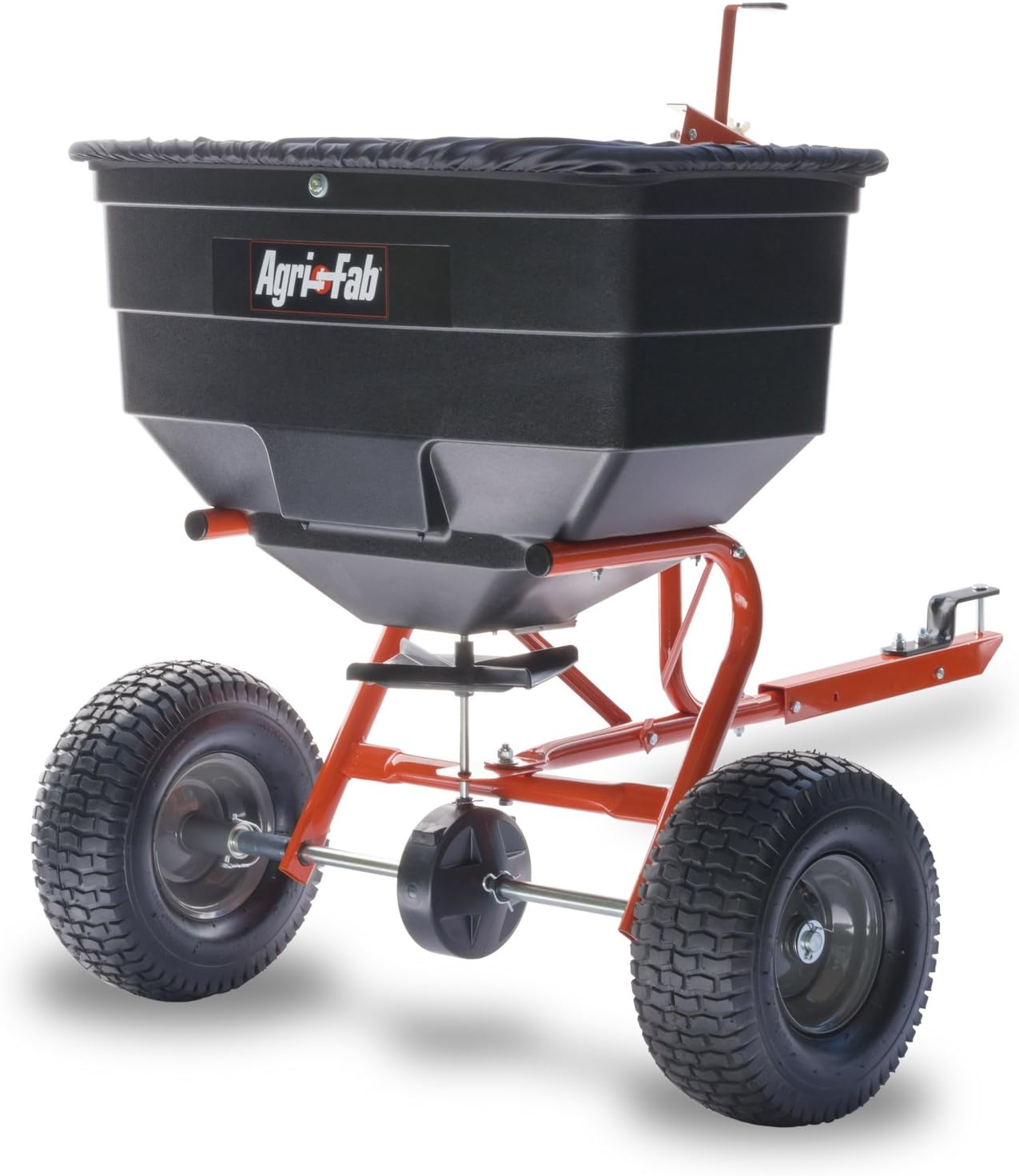
| Weight Capacity Maximum | 185 pounds |
|---|---|
| Tire Type | Pneumatic Tires |
| Number of Wheels | 2 |
| Material Type | Metal, Polypropylene (PP) |
The Agri-Fab 185 lb tow-behind broadcast spreader is built to cover large yards and properties from the seat of an ATV, UTV, or small tractor. Its large polypropylene hopper holds enough material to cover roughly an acre on one fill, letting you finish jobs with fewer stops. Operation is straightforward: a raised on/off rod flow control is reachable from the vehicle seat, and a heat-treated steel gear drive with enclosed gearbox helps protect internals when spreading corrosive materials like salt or ice melt. The spread pattern reaches up to about 12 feet for fast, even coverage, and the pneumatic turf tires with ball bearings smooth transport over uneven ground. Durable alloy steel frame and rust-proof components make it suitable for year-round use. The unit is practical for homeowners and property managers who need efficient, repeatable distribution across larger areas. It is fairly large and requires a tow vehicle and storage space, and assembly and maintenance of the gearbox and tires add some upkeep compared with small hand spreaders.
Best for: Buyers who need a durable, vehicle-towed spreader to cover large lawns, acreage, or commercial properties efficiently without frequent refills.
Less Ideal for: Not a good fit for small urban yards, gardeners who prefer walk-behind or handheld tools, or anyone without a compatible tow vehicle.
- Large 185 lb hopper covers up to about 40,000 sq ft per fill to reduce downtime
- Raised flow-control rod usable from ATV/tractor seat for convenient operation
- Enclosed gearbox and rust-proof poly components resist corrosion from salt and fertilizer
- Wide spread pattern up to 12 ft speeds coverage and promotes even distribution
- Pneumatic turf tires with ball bearings improve transport over rough ground
- Requires a tow vehicle and significant storage space when not in use
- Heavier, larger unit that needs occasional gearbox and tire maintenance
Verdict: If you want a robust tow-behind spreader that handles large areas with fewer refills and seat-mounted control, this 185 lb Agri-Fab model is a practical choice.
Choosing the Right ATV Seed Spreader for Food Plots: Key Factors to Consider
Hopper Size and Shape
Hopper capacity directly affects how long you can seed between refills. Larger hoppers reduce downtime on bigger food plots, but they add weight and can change how the ATV handles on slopes and tight trails.
Shape matters as much as raw volume. A tapered or steep-walled hopper helps free-flowing seeds and mixes, while wide, shallow hoppers may be easier to refill but more prone to bridging. Think about the seed types you plan to spread-large grains behave differently than small seeds and mixes-when balancing capacity and flow design.
Spread Pattern and Calibration
An adjustable spread pattern lets you tailor distribution width and overlap to avoid strips of over- or under-seeding. Look for simple, repeatable calibration steps so you can set a target seeding rate and verify it in the field.
Uniform distribution matters for germination and crop stand. Controls that allow both coarse and fine adjustments let you adapt to different seed sizes, wind conditions, and ground speeds, which is especially useful when planting plots near woods, ridges, or irregular boundaries.
Metering Mechanism Reliability
The metering system is the heart of consistent application. Paddle, auger, or fluted-drum metering all behave differently under vibration and varying load in the hopper. Choose a mechanism known to resist clogging and to move seed at an even rate as the hopper empties.
Durable seals and simple guards help protect moving parts from grit and moisture. A spreader that maintains consistent output while bouncing over ruts will give you a more even stand across the plot.
Mounting Options and ATV Compatibility
How the spreader mounts to your ATV affects stability, towing clearance, and how easily you can remove the unit for transport or storage. Some mount to racks, some hitch to a rear receiver, and others use quick-attach plates.
Consider the fit to your ATV's payload and balance. A heavy back-mounted hopper changes handling, especially uphill and downhill. Confirm compatibility with your ATV's rack dimensions, receiver size, and electrical system if the spreader uses a powered drive.
Durability in Outdoor Conditions
Materials and construction determine how long a spreader will last in a food-plot environment. UV-stabilized plastics resist cracking in sun, while powder-coated steel frames stand up to impact and moisture better than untreated metal.
Check for wear-prone parts like bearings and drive linkages that are easy to service or replace. Corrosion resistance on fasteners and hardware matters because fertilizer, seed coatings, and wet storage accelerate degradation.
Practical Use and Maintenance
Ease of filling, simple controls, and straightforward cleaning reduce time in the field and help you maintain consistent results. A spreader with clear rate markings, easy-access gates, and removable components will be faster to calibrate and winterize.
Think about how you store and maintain gear between seasons. Units that disassemble without tools or that have drainable hoppers make post-season cleaning and seed removal easier, reducing long-term maintenance headaches.
Choosing the Right Capacity for Your Plot Size
Match hopper volume to the size of your typical plot and how many refill trips you are willing to make. For small test plots or edge plantings, a lighter, lower-capacity spreader makes turning and transport easier. For regular acreage, a larger hopper saves time but requires more attention to mounting and balance.
Also consider the seed mix. High-volume mixes or cover-crop blends fill capacity faster and may need anti-bridging features or internal agitators to keep flow steady.
- Smaller hoppers: easier handling, more refills
- Larger hoppers: fewer stops, added weight and balance effects
- Internal agitators help with mixed seed flow
How Ground Speed and Terrain Affect Application
Spread rate is directly linked to ATV speed. Faster travel increases swath width and reduces seed per area unless you compensate by changing the metering setting. If your plots include trails, hills, or uneven ground, plan calibration runs at realistic field speeds rather than flat test tracks.
Steep slopes and rough terrain increase the risk of uneven distribution as the hopper angle changes. Mount location and a low center of gravity help keep the spread pattern consistent across varying terrain.
- Calibrate at the speed you will actually use in the field
- Watch for drift wind on exposed plots; adjust spread width
- Prefer lower-mounted hoppers for stability on slopes
Seed Types, Coatings, and Mixtures
Different seeds flow differently. Large seeds like corn or sorghum need wider openings and stronger metering, while small seeds and coated seed may need finer control and gentler handling. If you plan to use seed coatings or pelleted mixes, verify that the spreader's metering tolerates treated seed without breaking pellets.
For mixed blends, look for spreaders that reduce segregation and keep the mix homogeneous as it feeds into the metering system.
- Large seed requires larger orifices and robust metering
- Coated or pelleted seed may need gentler feed mechanisms
- Test mixed blends to confirm even composition across the plot
Routine Calibration and Field Verification
A quick catch-test at the beginning of a session is the best way to confirm your settings. Measure the amount collected over a known distance to verify seeding rate and make adjustments before you cover the whole plot. Keep a simple log of settings that worked for each seed type and speed so you can repeat good results.
Regularly inspect and clean metering components. Debris, damp seed, or seed dust can change flow characteristics and throw off calibrated rates.
- Perform a catch test after any setup change
- Record settings by seed and speed for repeatability
- Clean and inspect metering parts before the season
Transporting, Storage, and Off-Season Care
Think about how the spreader will be moved between fields and stored. A design that detaches quickly or folds reduces wear during transport and saves space in a shed. Drain any seed and clean residual dust to prevent rodents and corrosion.
Lubricate bearings and protect exposed metal with coatings or covers to extend life through variable weather between seasons.
- Remove seed and dry hopper before long storage
- Protect drive components from moisture and grit
- Use lifting or unloading aids if hopper volume is large
How We Chose the Best ATV Seed Spreader for Food Plots
We prioritized features and performance aspects that matter when using an ATV seed spreader to plant food plots. Key evaluation criteria included hopper capacity and geometry because larger or well-shaped hoppers reduce refill trips and improve flow for mixes of large and small seeds. Spread pattern control and calibration were essential; even, adjustable distribution affects germination uniformity and seed savings. Drive and agitation systems were vetted for consistent seed metering under vibration and uneven terrain. Mounting versatility and build durability were considered, focusing on frames and materials that withstand ATV bumps and outdoor exposure. Ease of use factors such as simple rate adjustment, cleaning access, and refill ergonomics guided selections. We excluded products intended only for broadcast lawn seeding or handheld use and any spreaders without meaningful calibration controls. The result is a list of spreaders suitable for food-plot planting tasks across typical small to mid-size parcel scenarios.
FAQ
What spread pattern width should I aim for with an ATV-mounted spreader?
Typical spread widths vary with seed type and speed, but aim for a pattern that overlaps slightly with each pass to avoid missed strips. Narrower, controlled patterns are safer near plot edges and woodlines; wider patterns speed coverage in open areas.
How often should I calibrate my spreader while planting a food plot?
Calibrate at the start of each session and after changing seed types, speed, or hopper level. A quick catch-test every few passes helps catch drift or clogging before it affects a large area.
Can I use the same ATV spreader for seed and granular fertilizer?
Often you can, but check that the metering and materials tolerate fertilizer granules and any corrosive effects. Some spreaders require different settings or inserts for consistent fertilizer distribution.
Will seed coatings or pelleting affect flow through an ATV spreader?
Coatings and pellets change friction and bulk density, which affects flow. Many spreaders handle coated seed fine, but you should run a test and adjust metering to prevent breakage or bridging.
How do I prevent seed bridging in the hopper?
Choose a hopper with steeper walls or internal agitators, and avoid overfilling. Periodically tapping or running the agitator while seeding helps keep seed moving, especially for sticky or irregular mixes.
Is a rear-mount or rack-mount spreader better for an ATV?
Each has tradeoffs. Rear-mount units often hitch to a receiver and keep weight low, while rack-mount spreaders sit higher and can be easier to load. Consider handling, ground clearance, and how the mount affects balance when loaded.
Final Verdict
Choosing an ATV seed spreader for food plots means balancing capacity, control, and durability against how you use your ATV and the seed types you plant. Prioritize reliable metering and an adjustable spread pattern if uniform stands matter most. If you cover larger plots, favor hopper capacity and robust mounting; for tight or irregular plots, compact units with fine adjustments are better. Focus on a spreader that matches your typical field speed, seed mixes, and storage practices. With the right tradeoffs prioritized, you will seed more efficiently and get more consistent plant establishment across your food plots.
