

Note: This article contains affiliate links. If you click on these links and make a purchase, I may earn a small commission at no extra cost to you. This helps support my research and content. Read my full affiliate disclosure here.
If you plant more than a few rows or cover more than a small patch, a shoulder seed spreader can cut the time and strain of hand-seeding. The right model helps you lay out seed consistently, reduces bending and repetitive motions, and keeps seed rate adjustment and flow control within easy reach while you walk. This guide covers seven shortlisted shoulder seed spreaders suited to backyard gardens and small plots. We evaluated practical factors gardeners care about, including hopper capacity, distribution control, carry comfort, and durability. Read on for what to consider and how different features change planting speed and accuracy.
Top Picks at a Glance
| Best Overall The best all-around choice for most situations | SOLO 421S 20 lb Portable Chest-Mount Spreader |  |
| Best Quality Built to a higher standard if you want something more solid | EarthWay 3100 40 lb Professional Hand-Crank Chest Spreader |  |
| Best Value The sweet spot between price and what you get | EarthWay 25 lb Nylon Bag Seeder/Spreader (27501) |  |
| Best Budget The cheapest option that still gets the job done reliably | Charles Walters CW500 Shoulder-Mounted Lawn and Garden Spreader |  |
| Highest Rated A top-rated pick with lots of positive feedback | Solo 421 9 kg Manual Shoulder Spreader with Adjustable Strap |  |
| Most Popular A crowd favorite that many people choose with confidence | EarthWay 2750 25 lb Nylon Bag Seeder/Spreader |  |
| Best Seller A high-volume bestseller chosen again and again | CHAPIN TurfPro 25 lb Handheld Bag Spreader |  |
SOLO 421S 20 lb Portable Chest-Mount Spreader

| Capacity | 20 lbs |
|---|---|
| Drive | Crank/gear drive |
| Controls | Fingertip flow and direction levers |
| Hopper material | Polyethylene |
The SOLO 421S is a purpose-built chest-mounted spreader for precision broadcast application on uneven or confined terrain. You carry it on a padded cross-shoulder strap while a crank-driven, gear-driven impeller disperses material; fingertip levers let you adjust flow rate, volume, and direction for accurate placement. The 20-pound polyethylene hopper and agitator handle everything from fine seeds to rock salt without frequent refills, and the twist-on cap prevents spills when loading or transporting. Stainless steel components and a fully enclosed, lubricated gearbox reduce clogging and extend service life for frequent use. Because it is chest-mounted rather than wheeled, it excels in beds, islands, and slopes where maneuverability matters, but you will be carrying the load rather than pushing it, which can be tiring over long distances. Setup and cleaning are straightforward, and the unit is versatile across seasons for seed, fertilizer, ice melt, and absorbents.
Best for: Buyers who prioritize precise, efficient application in beds, islands, slopes, or other confined or uneven areas and want a durable tool that gives fine control over spread patterns.
Less Ideal for: People who need to cover very large, flat lawns quickly or who prefer a push-or tow-style spreader to avoid carrying the material on their body.
- 20 lb hopper reduces refill frequency for larger jobs
- Fingertip controls for precise flow, volume, and spread direction
- Durable polyethylene body with stainless steel parts and enclosed lubricated gearbox
- Agitator and impeller design prevents clogs and promotes even distribution
- Chest-mounted design requires carrying the full load which can be tiring for long jobs
- Not suited for very large lawns where wheeled tow-behind or walk-behind spreaders are faster
Verdict: Choose the SOLO 421S when you need a durable, highly controllable handheld spreader for precise application in tight or uneven areas.
EarthWay 3100 40 lb Professional Hand-Crank Chest Spreader

| Capacity | 40 lb |
|---|---|
| Spread width | 8-12 ft (typical use) |
The EarthWay 3100 is a chest-mounted hand-crank broadcast spreader built for precision work on lawns, banks, and wet or uneven ground where wheeled spreaders struggle. You strap the harness on like a backpack, adjust the front straps for a comfortable height, set the rate and crank to distribute material across an 8 to 12 foot swath; the dual-port EVEN-SPREAD PRO shut-off lets you fine-tune the pattern for different granules. The sealed, factory-lubed gearbox and chrome-plated crank reduce maintenance, and the 40 lb hopper cuts down refill trips when seeding or applying fertilizer. The epoxy-coated steel frame and hopper cover help protect material from moisture and dust. Because it is hand-cranked and chest-mounted, it excels in access-limited spots but requires physical effort for long runs and offers less speed than walk-behind commercial spreaders. It is a durable, no-frills tool well suited to precision applications rather than high-acreage fast work.
Best for: Buyers who prioritize accurate, professional-grade distribution in spots wheeled spreaders cannot reach and who value durability over maximum speed.
Less Ideal for: Not a good fit for contractors or users who need to cover very large lawns quickly or who prefer powered or walk-behind spreaders for minimal manual effort.
- 40 lb hopper reduces refill frequency for medium jobs
- EVEN-SPREAD PRO dual-port adjustable shut-off for precise spread pattern control
- Comfortable backpack-style harness with quick-adjust straps for extended use
- Sealed, factory-lubed gearbox and chrome-plated crank lower maintenance needs
- Hand-crank operation requires continuous user effort and is slower than walk-behind models
- No wheels limits sustained speed and makes very large-area work more tiring
Verdict: Choose the EarthWay 3100 when you need a durable, shoulder-worn spreader that delivers highly adjustable, professional-grade distribution in areas wheeled units cannot access.
EarthWay 25 lb Nylon Bag Seeder/Spreader (27501)

| Capacity | 25 lb |
|---|---|
| Bag material | 600 denier nylon |
| Metering | Integrated agitator and gate |
| Broadcast range | 8 to 12 feet |
The EarthWay 27501 is a shoulder-style bag spreader built for small lawns, tight spots, and targeted patching. You load up to 25 pounds of seed, fertilizer, or ice melt into the 600-denier nylon bag, sling it over your shoulder, and walk typical paths while the integrated agitator and sloped floor keep fine materials flowing to the metering gate. The factory-sealed, lubricated gearbox meters material and broadcasts between about 8 and 12 feet depending on product, so you can cover narrow strips and spot-treat without over-applying. The nylon bag resists moisture and tearing, which helps when working damp conditions or storing treated materials. Because it is sized for portability rather than broad coverage, expect more frequent refills and slightly slower coverage than a cart or walk-behind spreader, but that smaller footprint makes it easier to use around beds, steps, and landscaped areas. The design is straightforward and built for repeated use, making it a practical choice for homeowners who need precise, reliable spot spreading rather than high-volume lawn projects.
Best for: Homeowners who prioritize precise, efficient spot seeding and maintenance around beds, walkways, and small lawns and who want a durable, easy-to-carry tool for repeat use.
Less Ideal for: Those who need to cover large lawns quickly or want a push or tow-behind spreader for high-volume commercial use.
- Durable 600-denier nylon bag resists moisture and tearing for longer service life
- Integrated agitator and sloped floor keep fine seeds flowing to the metering gate
- Factory-sealed, lubricated gearbox for reliable metering and low maintenance
- Compact 25 lb capacity is easy to carry and maneuver in tight or landscaped areas
- Smaller capacity means more frequent refills for larger lawns
- Broadcast range (8–12 feet) is narrower than larger walk-behind spreaders
Verdict: Choose this EarthWay shoulder spreader if you need a durable, portable tool for precise spot seeding and small-area maintenance.
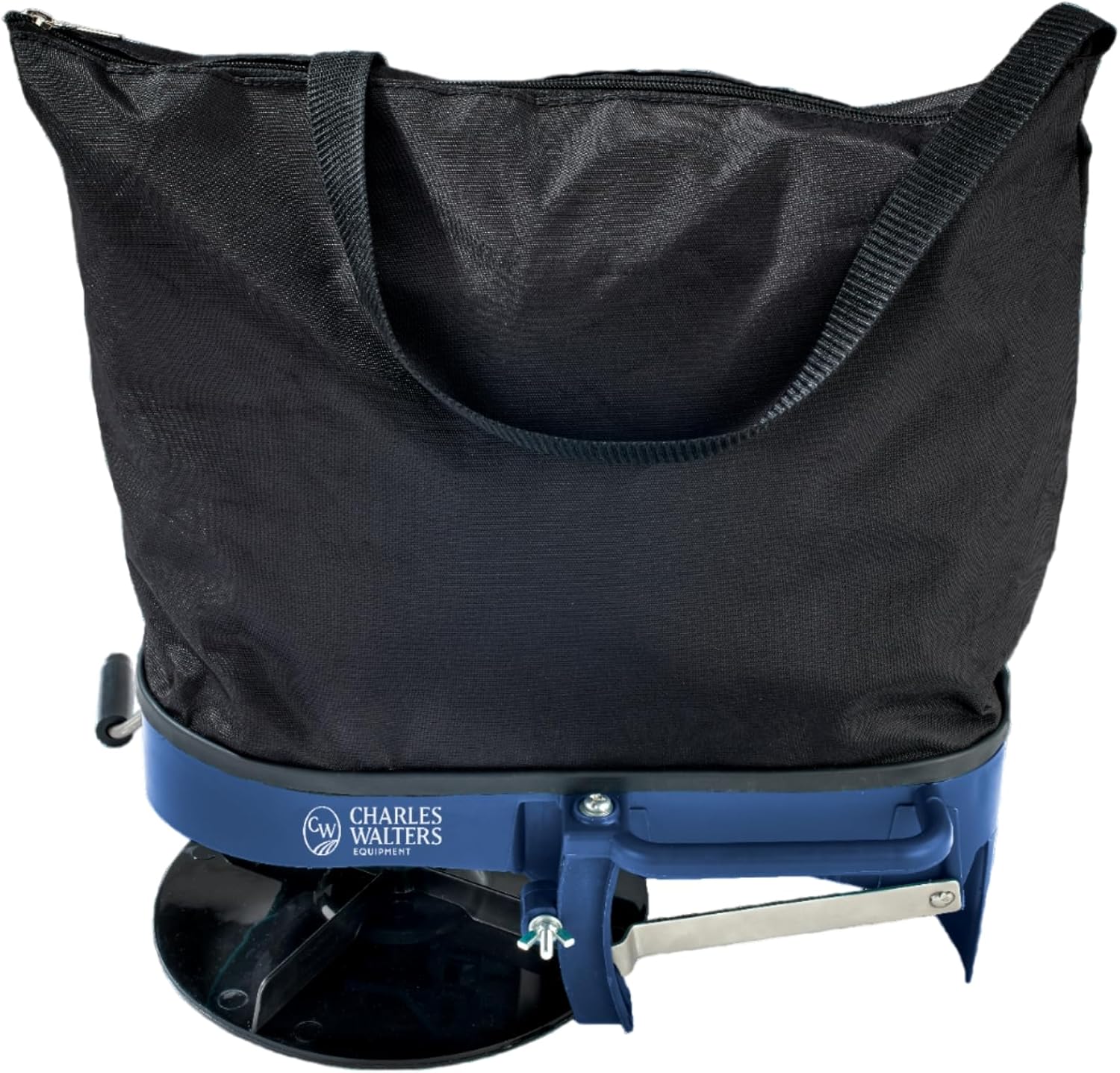
Charles Walters CW500 Shoulder-Mounted Lawn and Garden Spreader
| Capacity | 25 pounds |
|---|---|
| Volume | 8 liters |
The CW500 is a straightforward shoulder-mounted spreader aimed at homeowners who need an affordable way to distribute seed and granular fertilizer over small to medium lawns. It mounts on one shoulder with an adjustable strap and a large zippered bag that holds up to 25 pounds (about 8 liters). A positive on/off lever with a spring-loaded shutoff helps control flow and avoids pinching fingers while a heavy-duty gearbox is intended to keep the crank action smooth. Setup is minimal since the unit ships nearly assembled and only requires the crank handle to be attached. Practical benefits include its large capacity for fewer refills, compatibility with a wide range of fertilizers and seed, and the simple mechanical design that is easy to maintain. Limitations are its basic feature set and manual crank drive, which means slower coverage than wheeled tow spreaders and less precision for very fine or specialty materials like coarse salt. For routine lawn overseeding and standard granular fertilizers this spreader covers the essentials without unnecessary complexity.
Best for: Buyers who want a low-cost, no-frills shoulder spreader for routine overseeding and standard granular fertilizers and who prioritize simplicity and capacity over speed.
Less Ideal for: People who need to cover large properties quickly or who require precise application of very fine or specialty particulates should consider wheeled or calibrated options instead.
- Large 25-pound capacity reduces the frequency of refills during jobs
- Spring-loaded positive on/off control prevents finger pinching and gives reliable flow shutoff
- Heavy-duty gearbox and crank deliver smoother manual operation and longer service life
- Ships mostly assembled for quick setup with only the crank handle to install
- Manual crank drive makes covering large areas slower than wheeled or powered spreaders
- Not optimized for coarse materials like wet or chunky salt
Verdict: A budget-friendly shoulder spreader that delivers large capacity and simple, reliable controls for everyday seeding and fertilizing tasks.
Solo 421 9 kg Manual Shoulder Spreader with Adjustable Strap

| Capacity | 9 kg |
|---|---|
| Hopper opening | 6 inch screw-on cap |
| Carry style | Shoulder strap with padded cross-shoulder design |
| Drive | Manual crank with enclosed gearbox |
The Solo 421 is a shoulder-carried manual spreader built for steady, controlled distribution of granular materials like seed, fertilizer, grit and salt. You wear it on a padded, cross-shoulder strap and feed material through a large hopper aperture that drops onto an internal agitator and impeller for more even coverage. The crank-driven, fully enclosed gearbox with lubricated metal gears gives a simple, durable transmission and the adjustable settings let you change drop rate and direction to suit different materials. The upright hopper stands steady when set down and the screw-on cap reduces dust exposure while filling. This is a low-tech, serviceable option that favors reliability over automation: it requires manual effort to operate and is best for small-to-medium areas rather than large lawns where a wheeled spreader is faster. Expect straightforward maintenance and long life from the metal gear train, but budget extra time when spreading larger areas by hand.
Best for: Buyers who prioritize a dependable, low-maintenance spreader for seasonal yard work and prefer a simple, mechanically robust tool they can rely on year after year.
Less Ideal for: People who need to cover large lawns or commercial areas quickly or who prefer a push or tow-behind spreader that reduces manual effort.
- Padded cross-shoulder strap for comfortable, hands-free carry
- Enclosed gearbox with lubricated metal gears for durable, low-maintenance operation
- Large hopper aperture and screw-top cap make filling easier and reduce dust
- Adjustable drop rate and direction for different materials and application patterns
- Hopper stands upright when set down to simplify refills
- Manual operation is slower and more physically demanding than wheeled or motorized spreaders
- Capacity and speed not suited for large commercial plots
Verdict: Choose the Solo 421 when you want a simple, tough shoulder spreader that prioritizes durability and consistent, adjustable distribution for small to medium jobs.
EarthWay 2750 25 lb Nylon Bag Seeder/Spreader

| Item Type Name | Nyl Bag Spreader |
|---|---|
| Brand Name | EarthWay |
| Item Weight | 2 pounds |
| Indoor Outdoor Usage | Outdoor |
| Unit Count | 1 Count |
The EarthWay 2750 is a professional-style 25 lb nylon bag seeder and spreader for broadcast applications like reseeding, food plots, and spot fertilizer work. It uses a 600-denier nylon hopper with a zipper top and built-in stand so the bag stays upright during filling and storage. A sloped floor and integrated rocking agitator promote complete emptying and steady flow of fine seeds, while the spring-close shutoff and adjustable flow let you meter material for 8 to 12 foot spread widths by changing crank speed. The fully lubricated, sealed gearbox avoids the common seizure problems of cheaper cast gears and helps the unit run smoothly under repeated use. The adjustable shoulder strap makes it easier to carry across larger areas, but because it is a handheld bag system it is best for small to medium plots rather than continuous, high-acreage work. Expect strong durability and precise metering but plan on manual cranking effort for long sessions and occasional cleaning to keep the agitator free of debris.
Best for: Buyers who prioritize precise, reliable spreading on small to medium plots and want a rugged handheld tool built to professional standards.
Less Ideal for: Not a good choice for landscapers or landowners who need to cover many acres continuously or who prefer motorized walk-behind spreaders for minimal physical effort.
- Durable 600-denier nylon hopper keeps seed dry and resists tears in outdoor conditions.
- Sealed, lubricated gearbox reduces risk of gear seizure and delivers smoother, reliable operation.
- Integrated rocking agitator and sloped floor promote complete emptying and steady flow of fine seeds.
- Adjustable flow control and spring-close shutoff enable precise metering for different seed sizes and spread widths.
- Built-in stand and shoulder strap improve ease of filling, transporting, and using the bag in the field.
- Hand-crank operation becomes tiring for very large areas compared with wheeled or tow-behind spreaders.
- 25 lb capacity limits continuous coverage area before refilling for larger properties.
Verdict: Choose the EarthWay 2750 when you want a tough, professional handheld spreader that delivers accurate, clog-resistant seeds and fertilizer distribution for small to medium jobs.
CHAPIN TurfPro 25 lb Handheld Bag Spreader

| Item Type Name | Garden Spreader |
|---|---|
| Brand Name | CHAPIN |
| Indoor Outdoor Usage | Outdoor |
| Number of Pieces | 1 |
The Chapin TurfPro 25 lb handheld bag spreader is built for small lawns and tight spaces where a cart or walk-behind spreader is impractical. You fill the zippered bag with seed, fertilizer, or granular pest control and use the adjustable gate to set the flow rate while walking or standing in place. Enclosed gears and waterproof construction make it reasonably durable for routine seasonal use, and the rear baffle helps keep material off your clothes. The padded shoulder strap and compact profile make it easy to carry around beds, fences, and steps, and the gate adjustment gives real control over output for light overseeding or spot treating. It is not meant for very large properties where coverage speed matters or for materials that require precise calibration on heavier commercial jobs. If you need a simple, rugged handheld option that minimizes mess and gives control in small areas, this model performs well; expect to refill more often than with larger spreaders and to handle light maintenance of the gears over time.
Best for: Homeowners and gardeners who need a compact, no-fuss spreader for spot seeding, small lawns, and tight or hard-to-reach areas and who prioritize control and portability over coverage speed.
Less Ideal for: Those with large properties, landscapers, or anyone who needs high-speed coverage or precise commercial-grade calibration should consider a larger walk-behind or tow-behind spreader.
- Adjustable gate and flow control for precise spreading of seed and granular products
- Zippered bag and rear baffle reduce spills and keep material off clothes
- Padded shoulder strap and compact handheld design for easy use in tight spaces
- Waterproof construction with enclosed gears improves durability in outdoor conditions
- 25 lb capacity requires frequent refills on larger lawns
- Not suitable for commercial-scale spreading or heavier calibration needs
Verdict: A compact, durable handheld spreader that gives precise control for overseeding and spot treatments on small lawns and tight spaces.
Choosing the Right Shoulder Seed Spreader: Key Factors to Consider
Hopper Capacity and Refill Convenience
Hopper size determines how long you can seed between refills. A larger hopper reduces downtime when covering multiple beds or longer rows, but it also adds weight on the shoulders and can make the spreader harder to carry for long periods. Consider how much seed you plan to sow in one session and whether you prefer fewer refills or a lighter load.
Refill convenience matters for field workflow. Wide openings and clear fill markings let you top up without spilling seed, and designs with removable hoppers or quick-release lids make it easier to clean and switch seed types. If you work with multiple seed sizes, a hopper that allows fast emptying and rinsing will save time and reduce cross-contamination.
Distribution Control and Seed-Rate Adjustment
Precise distribution control affects planting density and germination success. Look for spreaders with adjustable metering that handle a range of seed sizes and rates, from fine flower seed to larger vegetable seed. A reliable, repeatable setting helps you match the packet's recommended sowing rate without guessing.
Controls located within easy reach let you change the rate on the go, which is useful when moving between bed edges and open rows. Some mechanisms use stepped dials, sliding gates, or interchangeable plates. The key is predictability: the control should produce even output across a walk and not clog when humidity or seed dust is present.
Harness Design and Carry Comfort
Shoulder spreaders rely on harnesses or straps to transfer load from hands to shoulders and back, so a comfortable carry system reduces fatigue and improves accuracy. Padded, adjustable straps spread weight and let you balance the hopper against your back or side. Breathable materials help if you work in hot weather.
Check how the spreader sits when loaded. A well-balanced unit stays stable as you walk and keeps the metering mechanism level. Easy on/off straps and quick adjustments let multiple gardeners share the same tool without lengthy re-fitting between shifts.
Durability and Weather Resistance
Outdoor use means exposure to sun, moisture, and rough handling. Hoppers and metering parts made from UV-stable plastics or corrosion-resistant metals last longer and avoid brittle failure. Metal fasteners and reinforced hinges resist bending when the unit is dropped or set down on hard ground.
Sealers and tight-fitting lids reduce moisture ingress that can cause seed clumping or corrosion. Consider how the spreader will be stored between seasons. Units that tolerate occasional dampness and are easy to dry will perform better in climates with variable weather.
Metering Mechanism and Clogging Resistance
The metering mechanism determines how reliably seed flows at the chosen rate. Open, simple gates are easier to clean but may be less precise at very low rates. More intricate metering can be accurate but may trap fines or sticky seed if not designed to handle residue. Evaluate the mechanism for accessible inspection points and removable parts.
Materials and tolerances also matter. Smooth surfaces and generous clearances resist bridging and friction that lead to clogs. If you commonly plant damp or pelleted seed, choose a mechanism that allows quick clearing and has fewer hidden cavities where material can build up.
Ease of Cleaning and Maintenance
Seed dust, chaff, and damp residues build up over repeated use and affect long-term performance. A spreader designed for easy cleaning will have removable panels or a hopper that lifts off to expose the metering area. Look for parts that can be rinsed or brushed without special tools.
Routine maintenance also extends service life. Common gardener-friendly features include replaceable wear plates, accessible fasteners, and simple instructions for winter storage. Minimizing tools and steps needed for maintenance makes seasonal upkeep less of a chore.
Matching Spreader Size to Garden Scale
Think about the area you usually seed in one outing. Small backyard plots and raised beds benefit from compact, lighter units that are easy to maneuver among plantings. Larger vegetable rows or multiple beds in a community garden setting justify a bigger hopper so you do fewer refills.
Also consider how you move between beds. If you frequently cross paths, gates, or terraces, a lower-profile hopper that does not snag will save time and reduce accidental spills.
- Small plots: prioritize low weight and maneuverability
- Medium plots: balance capacity with carry comfort
- Larger plots: favor larger hopper and robust harness
Adjusting for Different Seed Types
Not all seeds behave the same. Fine seeds need lower rates and gentler metering, while larger seeds require larger openings and firmer gates. Some spreaders include interchangeable inserts or plates to handle a range of sizes without guesswork.
When switching seed types, empty and clean the hopper to avoid cross-seeding. Test a short run on spare soil to confirm the setting before sowing into prepared beds.
- Use inserts for precision with small seeds
- Open the gate wider for larger vegetable seed
- Always test settings on a sample area
Walk Speed, Path Consistency, and Overlap
Your walking pace affects seed distribution. Consistent speed yields even seeding, while variable pace creates strips of heavy or sparse coverage. Consider marking a comfortable stride and practicing a steady rhythm before starting a long run.
Overlap the edges of each pass slightly to avoid gaps, but avoid excessive overlap that creates double-dense bands. If you plant around curves or irregular shapes, pause and make short controlled passes to maintain even distribution.
- Maintain a steady walking speed for uniform distribution
- Overlap passes by a small margin to avoid gaps
- Use short controlled passes on curves and corners
Storage and Off-Season Care
Proper storage keeps mechanisms working year after year. Empty the hopper and lightly brush or rinse the metering area to remove all seed dust before storing. Dry thoroughly to prevent moisture damage and mold.
Store the spreader in a cool, dry place away from UV exposure. Inspect straps and fasteners before the planting season and replace any worn components to avoid mid-season failures.
- Empty and clean hopper before storage
- Dry fully to prevent corrosion and mold
- Inspect harness and fasteners each season
Adapting Spreader Use to Soil and Weather
Soil texture and moisture change how seed lands and germinates. In very loose or windy conditions, use slightly higher seed rates or make shorter passes to avoid drift. In damp soil, watch for clumping that can clog metering parts and slow distribution.
Avoid seeding in heavy rain or immediately after watering. Wet conditions increase the risk of clogs and uneven placement. If moisture is unavoidable, reduce hopper fill and clean more often during use.
- Increase seed rate slightly in windy conditions
- Reduce hopper fill when soil and seed are damp
- Avoid seeding in heavy rain
How We Chose the Best Shoulder Seed Spreader
We focused on features that directly affect everyday seeding tasks. Key evaluation criteria were hopper capacity and refill logistics, distribution control and seed-rate adjustment, harness and carry comfort, material durability and weather resistance, and ease of cleaning and maintenance. Each product needed to offer clear controls for different seed sizes and rates, a realistic carry system for long walks, and accessible cleaning or access points so clay or damp seed residues do not clog the mechanism. We excluded designs intended strictly for bulk commercial acreage or tow-behind utility spreaders because those use cases require different capacity and power. We also filtered out models with unclear adjustment ranges or fragile hopper materials. The final shortlist balances user comfort, consistent distribution across common garden seed sizes, and components built to withstand repeated outdoor use.
FAQ
Can a shoulder seed spreader handle both small flower seed and larger vegetable seed?
Often, yes. Many shoulder spreaders include adjustable metering or interchangeable plates that cover a range of seed sizes. You may need to change settings and test on sample soil to dial in an accurate rate for each type.
How should I set the spreader if my rows are narrow or in raised beds?
Use a lower seed rate and a narrower gate setting so seed falls closer to your intended line. Walk at a controlled pace and make short passes along the bed edge to avoid scattering seed onto established plants.
Will damp seed or humid weather make a shoulder spreader clog?
It can. Damp seed tends to clump and can bridge in metering mechanisms. To reduce clogs, work with smaller hopper fills, clean the metering area regularly, and choose a spreader with smooth surfaces and accessible inspection points.
How do I carry a heavy hopper without getting sore shoulders?
Look for padded, adjustable straps that distribute weight across both shoulders and the upper back. Balance the load and avoid overfilling the hopper. Taking short breaks and alternating hands when adjusting or refilling helps reduce fatigue.
Is it necessary to clean the spreader after each use?
Usually it is wise to at least empty the hopper and brush out obvious debris after each session. A deeper rinse and inspection should happen regularly or when switching seed types. Routine cleaning prevents residue buildup and prolongs the mechanism's life.
Can a shoulder seed spreader be used for granular soil amendments?
Sometimes. If the granules are similar in size and flow characteristics to the seeds the spreader handles, metering can work. However, abrasive or very fine dust-like materials may accelerate wear or clog finer mechanisms, so verify compatibility and clean thoroughly afterward.
Final Verdict
Choose a shoulder seed spreader by balancing hopper capacity against carry comfort and by prioritizing a metering system that handles the seed sizes you plant. Durability and easy cleaning matter most if you seed often or work in damp conditions. Focus on predictable distribution control and a harness that fits comfortably. Those tradeoffs will determine whether the spreader speeds your work and improves germination consistency across beds and rows.
