

Note: This article contains affiliate links. If you click on these links and make a purchase, I may earn a small commission at no extra cost to you. This helps support my research and content. Read my full affiliate disclosure here.
If you plant many small seeds in beds, containers, or long rows, the right seed dispenser makes a real difference in how fast and accurately you sow. A well-chosen dispenser helps you space tiny seeds consistently, reduces accidental overseeding, and saves you time on cleanup and thinning. This guide covers seven shortlisted seed dispensers that performed well in practical gardener-use criteria. We evaluated each option for seed placement accuracy, ease of loading and cleaning, build durability, and suitability for common garden seed sizes. Read on to find the seed dispenser style that fits your planting routine and garden layout.
Top Picks at a Glance
| Best Overall The best all-around choice for most situations | Scotts Turf Builder EdgeGuard DLX Broadcast Spreader |  |
| Best Quality Built to a higher standard if you want something more solid | EarthWay 10001 Precision Garden Seeder with 7 Seed Plates |  |
| Best Value The sweet spot between price and what you get | PERSZEN Handheld 3-in-1 Spreader for Seed, Fertilizer and Ice Melt (84 oz) |  |
| Best Budget The cheapest option that still gets the job done reliably | Portable Mini Handheld Seed Dispenser (Precision Garden Seeder) |  |
| Highest Rated A top-rated pick with lots of positive feedback | Scotts Whirl Hand-Powered Spreader |  |
| Most Popular A crowd favorite that many people choose with confidence | Scotts Turf Builder EdgeGuard Mini Broadcast Spreader |  |
| Best Seller A high-volume bestseller chosen again and again | CHAPIN 8740A 64 oz Hand Shaker Spreader |  |
Scotts Turf Builder EdgeGuard DLX Broadcast Spreader

| Brand | Scotts |
|---|---|
| Item Type | EdgeGuard DLX Broadcast Spreader |
| Additional Features | EdgeGuard Technology, Pre-calibrated |
| Capacity Coverage | Up to 15,000 sq. ft. |
The Scotts Turf Builder EdgeGuard DLX is a straightforward broadcast spreader for homeowners who need even coverage across medium to large lawns. It arrives pre‑calibrated and uses a curved hopper with a dual‑bladed agitator to keep granular seed and fertilizer flowing smoothly while the EdgeGuard side shield blocks product from driveways, flower beds, and sidewalks. Settings are matched to Scotts product recommendations so setup is quick: pick the dial setting, pour in the product, and walk at a steady pace. The large capacity covers up to 15,000 sq. ft. per fill, and the robust hopper and agitator help prevent clumping with common lawn products. Downsides are that it is a broadcast spreader, so fine tuning application rate beyond the preset settings is limited and it requires steady walking speed for uniform results. It is also a single‑model design without specialty attachments for precision corridors or narrow strips. For routine seeding, fertilizing, or winter ice melt, it delivers consistent, reliable performance for the typical homeowner.
Best for: Homeowners who want a reliable, easy-to-use spreader for regular seeding, fertilizing, and winter salt tasks and who value convenience and consistent coverage across medium to large lawns.
Less Ideal for: Users who need highly precise application rates, professional landscapers, or those who work mainly in very tight or narrow planting areas.
- Pre-calibrated dial matched to Scotts product settings for quick setup
- EdgeGuard side shield prevents spread onto sidewalks, driveways, and beds
- Curved hopper and dual-bladed agitator reduce clumping and ensure smooth flow
- Large capacity covers up to 15,000 sq. ft. per fill for fewer refills
- Limited fine-tune control beyond preset calibration for precise application
- Not optimized for very narrow strips or beds where a drop spreader is better
Verdict: A user-friendly, pre-calibrated broadcast spreader that delivers consistent coverage and protects borders, making it a strong all-round choice for home lawn care.
EarthWay 10001 Precision Garden Seeder with 7 Seed Plates

| Included Components | Seed Plates |
|---|---|
| Material | Aluminum frame with poly hopper |
| Number of Pieces | 7 |
| Indoor Outdoor Usage | Outdoor |
| Plant or Animal Product Type | Vegetable |
The EarthWay 10001 Precision Garden Seeder is a walk-behind style hand seeder designed to lay straight rows with consistent spacing and controlled seed depth. It uses a pulley-driven seed metering wheel and seven interchangeable seed plates to handle many common vegetable seeds from corn and peas to carrots and lettuce. In practice you push the unit along prepared, relatively loose soil, set the plow for depth, and the packing wheel closes the furrow for good soil-to-seed contact. The aluminum frame and rustproof poly hopper make it durable for repeated seasonal use, and the included plates plus optional extras let you expand what you can plant. Important limitations are that it needs well-prepared, mostly weed-free soil to work reliably and very small or irregularly shaped seeds may require custom plates or slower passes. It is not an automated or motorized tool so planting long runs still takes physical effort but rewards you with accurate spacing and fewer missed seeds compared with hand-dropping.
Best for: Buyers who want predictable, consistent row planting and value proven equipment backed by visible customer feedback and brand longevity; good for homeowners and small-scale growers planting neat vegetable rows.
Less Ideal for: Those who need a motorized or high‑capacity planter for large acreage or gardeners who primarily plant broadcast or container crops.
- Interchangeable seed plates support a wide range of vegetable seeds for precise spacing
- Adjustable plow and packing wheel give consistent seed depth and good soil contact
- Durable aluminum frame and rustproof hopper for season-to-season use
- Performs best in well-prepared loose soil and struggles in heavy clay or un-tilled ground
- Very small or unusually shaped seeds may need custom plates or additional adjustment
Verdict: Choose this seeder if you want a durable, manual tool that delivers repeatable row spacing and seed depth for small-scale vegetable gardens.
PERSZEN Handheld 3-in-1 Spreader for Seed, Fertilizer and Ice Melt (84 oz)

| Capacity | 84 oz (2.5 L) |
|---|---|
| Flow settings | 3 (small, medium, large) |
| Material | Plastic |
The PERSZEN handheld spreader is a simple, multi-use tool for small to medium lawns and driveways. It holds about 84 ounces of material and offers three flow settings so you can switch between fine seed, granular fertilizer, and ice-melt salt without swapping tools. The plastic construction keeps it light and corrosion-resistant against fertilizers and salt, and the ergonomic non-slip handle plus included scoop make filling and carrying straightforward. In practice it delivers even coverage when set correctly, and the larger hopper reduces refill frequency compared with very small hand spreaders. The main compromises are that plastic parts are less impact-resistant than metal and the manual control can require a steady walk and occasional calibration for very coarse or very fine materials. For routine seasonal tasks where portability and minimal storage are priorities, this spreader is an efficient, no-frills choice.
Best for: Buyers who want a compact, easy-to-store spreader that handles seasonal tasks efficiently and values portability and straightforward operation over heavy-duty construction.
Less Ideal for: People who need a heavy-duty, long-lasting metal spreader for very large properties or commercial use should look at larger tow-behind or metal broadcast models.
- Three adjustable flow settings for matching different material sizes
- Large 84 oz hopper reduces the need for frequent refills
- Lightweight, rust-resistant plastic construction for easy handling
- Ergonomic non-slip handle and included scoop improve usability
- Plastic construction is less durable against impacts than metal alternatives
- Manual flow control needs careful walking speed to ensure perfectly even coverage
Verdict: A practical, lightweight 3-in-1 handheld spreader that makes seasonal seed, fertilizer, and ice-melt tasks quicker with minimal storage and fuss.
Portable Mini Handheld Seed Dispenser (Precision Garden Seeder)
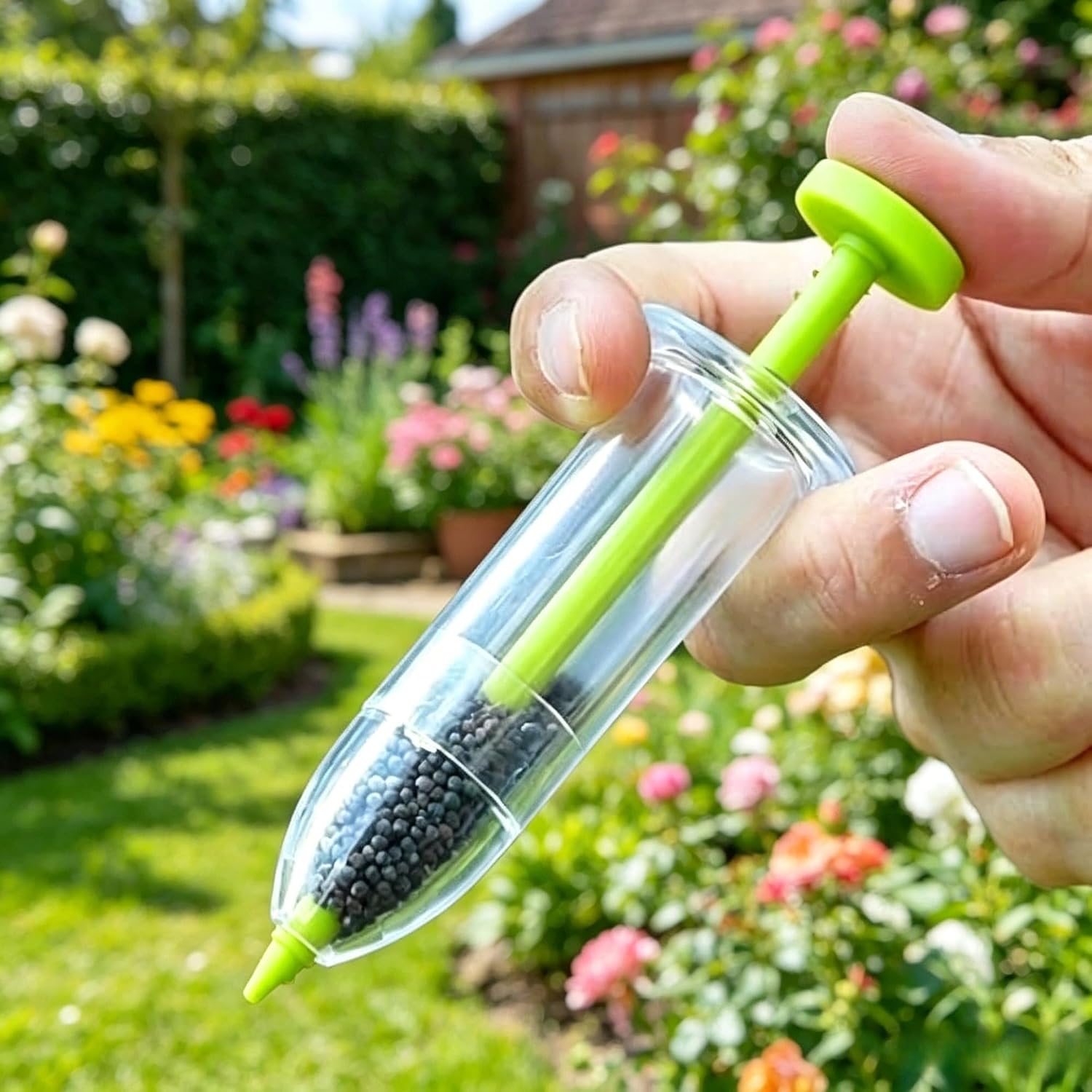
| Product type | Handheld seed dispenser |
|---|---|
| Intended use | Small seeds for vegetables and flowers |
| Portability | Pocket-sized, lightweight |
| Image | Primary product image provided |
This compact handheld seed dispenser makes single-handed precision planting quick and easy for small seeds like lettuce, carrot, and flower varieties. You fill the small reservoir, squeeze the trigger to dispense one seed at a time, and can use the pointed tip to place the seed into soil or starter trays. The lightweight plastic construction keeps it inexpensive and easy to carry while the simple mechanism reduces clogging with properly sized seeds. It is best used for sowing seeds in seedling flats, pots, or small garden rows where accuracy matters more than speed. Limitations are its basic build and simple mechanism, which may not hold up under heavy daily commercial use and works poorly with very large or oddly shaped seeds. Cleaning is straightforward but the small parts require care. For gardeners on a budget who want neater, less wasteful sowing than hand-dusting, this dispenser is a practical, low-cost tool.
Best for: Buyers who want an inexpensive, no-frills tool to plant small seeds accurately in seed trays, pots, or small garden rows and prefer simplicity over industrial durability.
Less Ideal for: Commercial growers or gardeners who need a high-volume, heavy-duty seeder or those who work with large irregular seeds.
- Enables single-seed dispensing for more accurate sowing
- Very compact and lightweight for easy handling and storage
- Simple mechanism that is easy to use and clean
- Affordable option for budget-conscious gardeners
- Basic plastic build may not be durable for heavy commercial use
- Not suitable for large or irregularly shaped seeds
Verdict: A very affordable, easy-to-use handheld dispenser that lets home gardeners plant small seeds one at a time for neater, less wasteful sowing.
Scotts Whirl Hand-Powered Spreader

| Material Type | Metal, Plastic |
|---|---|
| Handle Material | Rubber |
| Capacity Coverage | Up to 1,500 sq. ft. |
| Additional Features | Adjustable Arm Support, Smooth Even Coverage |
The Scotts Whirl is a compact, hand-powered spreader built for small lawns and spot treatments. It comes ready to use and is designed to distribute grass seed, granular fertilizer, ice melt, or salt with an agitator that promotes smooth, even coverage. Its adjustable arm support and light weight make it comfortable for short jobs like overseeding patches, treating narrow strips, or spreading ice melt on walkways. Because it is hand-held and intended for up to 1,500 square feet, it delivers control and reduced waste compared with tossing product by hand. The main limitation is capacity and speed: for larger lawns you will need a wheeled spreader or multiple refills, and fine-tuning the setting for very light seed rates can take a few test passes. Materials are basic metal and plastic with a rubber handle, so it is practical for seasonal use rather than heavy commercial work.
Best for: Homeowners with small lawns or those who need precise control for patch seeding, fertilizing, or winter ice-melting, who prioritize reliability and simplicity over high capacity.
Less Ideal for: Owners of medium to large lawns who need fast coverage or professional users who require higher durability and throughput.
- Compact handheld design ideal for small yards and spot treatments
- Engineered to deliver smooth, even product coverage across application area
- Adjustable arm support increases comfort during use
- Ready to use out of the box with simple hand-powered operation
- Limited capacity suitable only up to about 1,500 sq. ft., requiring frequent refills for larger lawns
- Not ideal for high-volume or commercial spreading tasks
Verdict: A simple, reliable handheld spreader that gives risk-averse homeowners controlled, even application for small lawns and spot jobs.
Scotts Turf Builder EdgeGuard Mini Broadcast Spreader
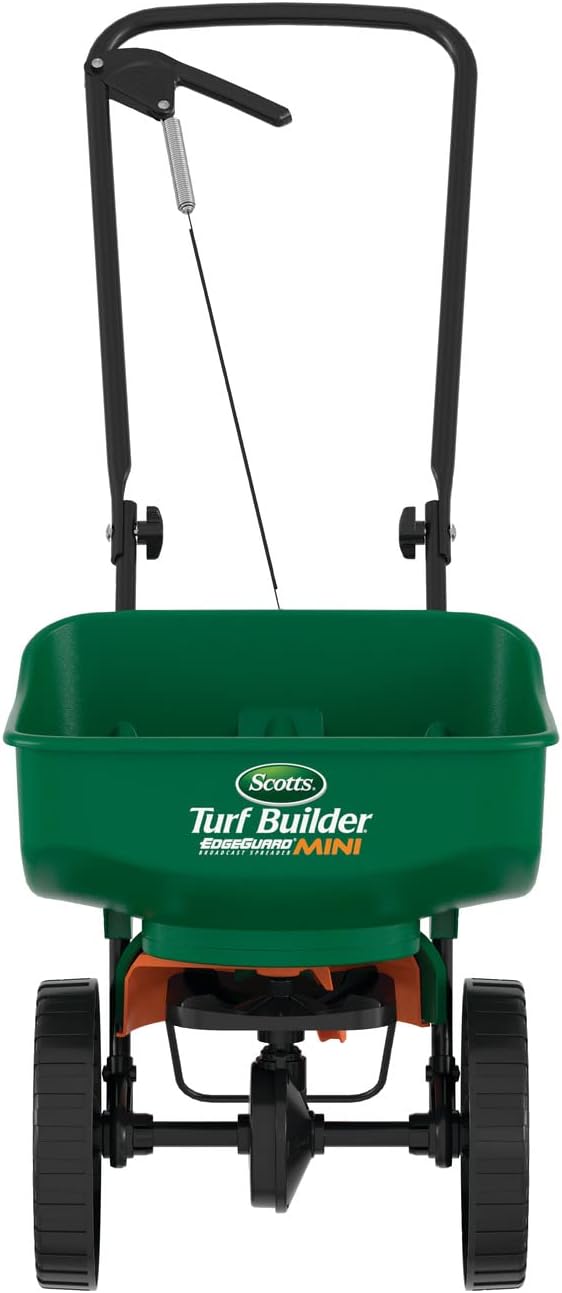
| Capacity | Up to 5,000 sq. ft. |
|---|---|
| Usage | Applies fertilizer, seed, granular weed control, salt, ice melt |
| Features | EdgeGuard side shield; dual-bladed agitator; fold-down handle |
The Scotts Turf Builder EdgeGuard Mini is a ready-to-use broadcast spreader aimed at smaller lawns and targeted spot work. It comes pre-calibrated so you set the dial to the recommended setting, pour in fertilizer, seed, ice melt, or granular weed control, and walk the lawn for even coverage. The hopper and dual-bladed agitator are redesigned to funnel product smoothly and reduce clogging, while open-spoke wheels and a fold-down handle make it easy to maneuver and store. Scotts' EdgeGuard feature blocks product on the right side of the pattern, which helps avoid deposits on sidewalks and landscape beds when edging. Capacity is geared to yards up to about 5,000 sq ft, so it handles typical small properties without being bulky. The main limitations are its smaller coverage area and basic mechanical design compared with larger, more precise spreaders, so it may require more passes on bigger lawns and offers fewer fine-control adjustments for professional users.
Best for: Buyers who want a simple, reliable spreader for small to medium yards and who prioritize ease of use and avoiding overspread onto hard surfaces.
Less Ideal for: Professional landscapers or owners of large properties who need higher capacity and finer control should consider larger commercial-style spreaders.
- Pre-calibrated and ready to use for quick setup
- EdgeGuard side shield reduces product on driveways and sidewalks
- Redesigned hopper and dual-blade agitator for consistent flow
- Fold-down handle and compact size for easy storage and maneuvering
- Smaller capacity suited for lawns up to about 5,000 sq ft so larger lawns need more refills or a larger spreader
- Limited fine adjustment compared with premium or professional models
Verdict: A user-friendly mini broadcast spreader that delivers even coverage for small lawns while keeping product off sidewalks and driveways.
CHAPIN 8740A 64 oz Hand Shaker Spreader

| Capacity | 1.8 kg |
|---|
The CHAPIN 8740A is a straightforward hand shaker that makes targeted spreading tasks quick and low-effort. Fill the 64-ounce poly bottle through a wide screw-top, select one of three lid openings by twisting for fine, medium, or wide flow, and apply product with one hand while walking small areas like sidewalks, steps, lawn patches or garden beds. The large handle and glove-friendly design make scooping and pouring easier in cold weather. Because it uses no motors or complex parts it is extremely durable and inexpensive to maintain, and it can stand upright on a shelf even with material inside. The trade-offs are its manual operation and limited reach compared with broadcast or wheeled push spreaders, so it is best for spot jobs rather than treating an entire lawn. Plastic construction keeps it lightweight but means it is less robust than metal tools for heavy-duty commercial use.
Best for: Small‑scale homeowners or renters who need an affordable, no-fuss tool for spot seeding, fertilizing, or deicing around walkways and small lawn areas.
Less Ideal for: Those who need to cover large lawns, commercial properties, or want a precise motorized broadcast spreader for even whole‑lawn applications.
- High 64-ounce capacity reduces refills for small jobs
- Three twist-select lid openings for fine, medium and wide distribution
- Large, glove-friendly handle that is easy to scoop and operate one-handed
- Simple, no-maintenance plastic design that stores upright with contents inside
- Manual operation limits speed and is inefficient for large yards
- Plastic construction is less durable under heavy commercial use
Verdict: A cheap, durable hand shaker perfect for budget-minded gardeners who need an easy, no-frills tool for spot spreading tasks.
Choosing the Right Seed Dispenser: Key Factors to Consider
Seed Placement Accuracy
Accurate placement determines how many seedlings you get per linear foot and how much thinning you must do later. A dispenser that meters a single seed or a controlled stream reduces clumps and uneven germination, which saves time and preserves seed stock. Look for mechanisms that consistently drop seeds at the same spacing under typical planting speeds and on common soil textures.
Accuracy also affects germination rate and plant vigor because evenly spaced seeds avoid nutrient competition at an early stage. Consider whether the dispenser provides a visible delivery point so you can verify placement as you sow.
Seed-Size Adaptability
Gardeners use a range of seed sizes from tiny alyssum and carrot seeds to larger bean and pea seeds. A useful dispenser either has adjustable settings or interchangeable plates/nozzles to handle that range without clogging or dropping too many seeds. If you mostly sow one seed size, a simpler device can suffice. If you rotate many crops, prioritize models with fine adjustment so you do not need separate tools for different seed types.
Adaptability also reduces the need for repeated calibration during a planting session, which keeps the process efficient and lowers the chance of user error.
Ease of Loading and Use
How fast you can refill the hopper and how intuitive the control are matter in real-world planting. Wide-loading hoppers, clear fill-level indicators, and one-handed operation make it easy to keep a planting rhythm, especially when moving between beds. Controls should be reachable without interrupting your stride and require minimal fiddling to change spacing settings.
Ergonomic grips and manageable weight are important if you sow long rows or multiple containers in a single session. Simple assembly and straightforward calibration reduce frustration during the busiest planting days.
Durability and Weather Resistance
Garden tools see moisture, soil, and sunlight. Materials that resist rust, cracking, and UV degradation hold up longer and maintain calibrated performance. Check whether moving parts are sealed or simple to dry after wet use, and whether plastics are thick enough to avoid brittle failure but not so heavy they make the tool unwieldy.
Durability also affects resale value and long-term reliability. A sturdier dispenser saves replacement time and prevents mid-season failures that interrupt planting.
Cleaning and Maintenance
Seeds, dust, and fines from potting mixes will build up in crevices and adjustment slots. A design that disassembles easily or offers smooth surfaces speeds cleaning and prevents jams. Consider whether parts that contact seed are removable and washable, and whether the manufacturer suggests simple maintenance steps that a gardener can perform without special tools.
Low-maintenance designs are especially valuable if you store the dispenser between seasons or move it between wet and dry environments.
Types of Seed Dispensers and How They Work
Seed dispensers come in several practical styles: hand-held plate or wheel meters, hopper-fed tube dispensers, and precision single-seed tools. Plate or wheel meters use a rotating plate with holes sized to pick up individual seeds and drop them at set intervals. Hopper-fed tubes rely on gravity and a metering tip to control flow for broadcasting or row sowing. Precision single-seed tools let you place one seed at a time and are useful for very large or irregular seeds.
Understanding the mechanism helps you match a dispenser to your planting pattern. Wheel meters are fast for small, uniform seeds; hopper tubes are good for longer rows and mixed-size sowing; single-seed tools are best when you need perfect spacing and no thinning.
- Wheel or plate meters: fast and repeatable for small round seeds
- Hopper-fed tubes: versatile for longer rows and container work
- Single-seed placers: slowest but most precise, ideal for large seeds
Matching Dispenser Type to Garden Tasks
For dense vegetable beds and seed trays where speed matters, choose a dispenser that offers continuous metering and easy control over spacing. For wide, shallow beds and direct sowing, a device that lets you walk steadily and dispense seeds at a set cadence will reduce fatigue. Container gardeners benefit from adjustable tips that avoid overfilling small pots.
If you plant a mix of microgreens, carrots, and larger brassicas, prioritize seed-size adaptability so you do not need multiple specialized tools. For very small plots or ornamental bulbs, a single-seed placer gives the tidy, spaced results that save thinning time.
- Seed trays and flats: precise single-drop or adjustable wheel meters
- Long row crops: hopper-fed or walk-behind-style for steady coverage
- Container gardening: small, low-volume dispensers with fine control
Tips for Using a Seed Dispenser Effectively
Calibrate before you sow by testing on a tray or a strip of soil to confirm spacing and adjust for seed size. Walk at a steady pace when using metered dispensers so the interval remains consistent. Keep a small brush or compressed-air can handy to clear fines from holes or slots that can cause clumping.
Refill hoppers away from soil to avoid contamination and check for moisture in seed mixes that can cause sticking. Store interchangeable plates and nozzles together and labeled so you can quickly swap them as you move between seed types.
- Test on scrap soil to confirm spacing
- Maintain steady walking speed for consistent drops
- Keep seeds dry and clean hopper regularly
Common Maintenance Tasks to Prolong Lifespan
Rinse removable parts after use with dry seeds to remove dust and debris and let them dry fully before storage. Lubricate any metal pivot points lightly if exposed to repeated wetting, and check for wear on adjustment teeth or seals. Replace fragile plastic tips as soon as they show cracking to maintain accurate metering.
Store the dispenser indoors or in a dry shed to avoid prolonged UV exposure and moisture cycles that accelerate material breakdown. Regular, simple maintenance prevents jams and keeps calibration stable season after season.
- Disassemble and dry removable seed-contact parts
- Inspect adjustment mechanisms for wear
- Store in a dry, shaded place between seasons
Integrating a Dispenser Into Your Planting Workflow
Plan planting runs by grouping beds or pots that need the same seed size so you minimize adjustments and downtime. Use shallow starter rows for testing new seed mixes rather than wasting seeds across prime beds. When sowing long runs, take short breaks to check spacing and make minor calibration tweaks.
Combine the dispenser with simple tools like a hand rake for covering seeds or a short board to tamp rows gently after sowing. These small workflow refinements speed planting and improve germination uniformity.
- Batch similar seed sizes together to reduce adjustments
- Use small test rows before full runs
- Pair with cover and tamp tools for consistent soil contact
How We Chose the Best Seed Dispenser
We prioritized tools and accessories that deliver repeatable seed placement and simple operation in real garden conditions. Evaluation centered on seed placement accuracy across a variety of small seed types, ease of reloading and cleaning to keep planting fast, durable construction that stands up to outdoor use, and ergonomic handling for long rows or multiple containers. We also considered adjustability for different seed sizes and compatibility with standard seed trays and soil types. Products were excluded if they lacked clear adjustment for small-seed spacing, required frequent single-seed reloading that slows work, or used materials likely to corrode or fail under regular outdoor use. Final selections favored designs that reduce thinning and seed waste while remaining straightforward to maintain. The criteria used here map directly to our scoring bars: accuracy, seed-size adaptability, ease of use, durability, and maintenance.
FAQ
Will one seed dispenser work for all seed sizes?
It depends. Some dispensers offer adjustable plates or interchangeable tips that cover a broad range of seed sizes, but very tiny seeds and large irregular seeds may still require separate approaches. Choose a dispenser with good adjustability if you plant many seed types.
How do I calibrate a dispenser for consistent spacing?
Test the dispenser on a tray or strip of soil before sowing, adjusting the metering plate or flow control until the drops match the desired spacing. Walk at a steady speed when using metered devices because pace affects spacing.
Can seed dispensers prevent the need for thinning seedlings?
They can reduce thinning by improving spacing, especially for small round seeds. However, some crops still benefit from manual thinning for ideal plant vigor, so expect less thinning rather than none in every case.
What maintenance keeps a dispenser working well?
Regularly clear seed fines from holes and crevices, dry removable parts after cleaning, and inspect adjustment teeth or tips for wear. Storing the tool dry and out of sunlight also extends its life.
Are hopper-style dispensers better for long rows?
Hopper-style dispensers are often more convenient for long rows because they hold more seed and allow steady walking. The choice depends on the seed type and desired precision; hoppers balance capacity with decent accuracy for many garden tasks.
Final Verdict
Choosing the right seed dispenser is about balancing speed, accuracy, and adaptability to the seeds you plant most. Prioritize seed placement accuracy and seed-size adjustability if you want to cut thinning time and get uniform germination. If you sow long rows or many pots, favor ease of loading and durable construction to keep planting efficient. Weigh the tradeoffs between single-seed precision and higher-capacity metering tools based on your garden layout and planting volume. With the right dispenser and a little calibration, you will sow faster, waste fewer seeds, and get more consistent stands across beds and containers.
