

Note: This article contains affiliate links. If you click on these links and make a purchase, I may earn a small commission at no extra cost to you. This helps support my research and content. Read my full affiliate disclosure here.
If slugs are turning up in pots, trays, or basement plantings, you need a control method that works inside without harming pets, people, or delicate containers. Choosing the right slug killer for indoors matters because exposure risk, application mess, and damage to plant roots are real concerns in a confined space. This guide covers five shortlisted indoor-suitable options and focuses on how they perform on safety, ease of application, and effectiveness in typical indoor settings. Read on to see which approaches minimize tracking and contamination while protecting houseplants and the people who care for them.
Top Picks at a Glance
| Best Overall The best all-around choice for most situations | Monterey Sluggo Plus Granular Slug & Snail Bait, 1 lb (bundled with measuring spoon) |  |
| Best Quality Built to a higher standard if you want something more solid | Nisus Niban Granular Bait, Weather‑Resistant 4 lb |  |
| Best Value The sweet spot between price and what you get | Monterey Sluggo Plus Granular Slug & Snail Killer, 2.5 lb |  |
| Highest Rated A top-rated pick with lots of positive feedback | Monterey Sluggo Snail & Slug Killer, 2.5 lb Jug |  |
| Best Seller A high-volume bestseller chosen again and again | Garden Safe Slug & Snail Bait Granules, 2 lb |  |
Monterey Sluggo Plus Granular Slug & Snail Bait, 1 lb (bundled with measuring spoon)

| Active ingredients | Spinosad; Iron phosphate |
|---|---|
| Form | Granular bait |
| Coverage | 1 lb treats up to 2,000 sq ft |
| Effective duration | Up to 4 weeks per application |
| OMRI Listed | Yes |
Sluggo Plus is a granular bait designed for performance-focused gardeners who need reliable slug and snail control across beds, lawns and container areas. You scatter the granules around vulnerable plants or along travel paths where slugs and snails feed; one pound claims to treat up to 2,000 sq ft and stays effective through light rain or sprinkler use for as long as four weeks. The formula pairs spinosad, an insect neurotoxin derived from natural bacteria, with iron phosphate which both attracts mollusks and breaks down into soil-friendly iron. Practical benefits include broad placement options (vegetables, ornamentals, fruit trees and greenhouses), OMRI listing for organic gardening, and reduced need for frequent reapplication in normal weather. Important limitations are that heavy rain may wash away bait and require reapplication, and spinosad can affect beneficial insects if misused so follow safety directions. For someone chasing decisive, long-lasting slug knockdown across a mid-to-large garden, this product delivers clear, manageable results when applied according to label instructions.
Best for: Gardeners who prioritize effective, long-lasting control of slugs and snails across beds, containers and small orchards and who follow label safety guidance.
Less Ideal for: People who need a purely non-toxic, insect-free option for delicate pollinator-attractive plantings or those who cannot reapply after very heavy rain should consider alternative methods.
- OMRI listed for use in organic gardens
- Granular formula treats up to 2,000 sq ft and remains effective through light rain for up to four weeks
- Dual active ingredients (spinosad and iron phosphate) provide fast knockdown and soil-safe breakdown
- Suitable for a wide range of plantings including vegetables, ornamentals and greenhouses
- May need reapplication after heavy rainfall
- Contains spinosad which can harm non-target beneficial insects if not applied carefully
Verdict: A high-performance, OMRI-listed granular bait that delivers dependable multi-week slug and snail control for gardeners who need decisive results.
Nisus Niban Granular Bait, Weather‑Resistant 4 lb

| Item Form | Granules |
|---|---|
| Target Species | Insects |
| Active Ingredients | boric acid |
| Specification Met | EPA |
Nisus Niban Granular Bait is a granular boric‑acid bait sold in a refillable shaker designed for spot treatments and perimeter applications. For indoor slug and snail control it is applied around entry points, cracks, basements and other hiding spots where mollusks travel. The granules are formulated to resist rain and heat so they retain attractiveness longer than some soft baits, and the food‑grade attractants make the product appealing to a range of insects and mollusks. The comfortable applicator makes it easy to broadcast 2–4 lb per 1,000 sq ft when treating larger areas or to place discrete lines for targeted indoor use. Because it uses boric acid rather than fast‑acting toxicants, results are not instantaneous and control requires placement where pests feed and carry bait back to harborage areas. It is EPA‑specified and suitable for residential settings when used according to label directions, but care is needed to keep granules away from children and pets and to follow indoor placement recommendations for safe, effective control.
Best for: Buyers who prioritize reliable, lasting control and intend to place bait in targeted indoor locations or around building perimeters where slugs, snails and other pests forage.
Less Ideal for: Those who need instant knockdown or who cannot prevent pets or children from accessing treated areas should consider alternative rapid‑action products or non‑bait control methods.
- Weather‑resistant granules that hold up to moisture and sunlight for longer residual attractiveness
- Food‑grade attractants make it appealing to ants, cockroaches, slugs and snails
- Refillable shaker with a comfort grip for easy, even application indoors or around perimeters
- EPA‑specified active ingredient (boric acid) with no known resistance among listed pests
- Not an immediate knockdown—works through ingestion and can take days to reduce populations
- Contains boric acid so requires careful placement to avoid access by children or pets
Verdict: Choose Nisus Niban when you want a durable, bait‑based indoor solution that attracts and controls slugs, snails and common household insects over time.
Monterey Sluggo Plus Granular Slug & Snail Killer, 2.5 lb

| Unit Count | 40 Fluid Ounces |
|---|---|
| OMRI Listed | Yes |
| Active ingredients | Iron phosphate, Spinosad |
| Coverage | 1 lb treats ~2,000 sq ft |
Sluggo Plus is a ready-to-use granular bait designed to protect vegetable beds, ornamentals, lawns and greenhouse crops from slugs and snails as well as earwigs, cutworms and sowbugs. Applied by scattering across the soil surface it attracts mollusks to feed on the pellets; iron phosphate provides a non-toxic baiting mechanism while spinosad adds a faster-acting insecticidal effect. One pound treats roughly 2,000 sq ft and the manufacturer states the bait remains effective for up to four weeks and is rain-tolerant, so light irrigation will not immediately reduce efficacy. The OMRI listing makes it suitable for organic gardens when used per label instructions. Practical considerations: you will need to reapply after heavy rain or if high pest pressure exhausts the bait, and personal protective measures are advised when handling the concentrate. For gardeners focused on noticeable, reliable reductions in slug and snail damage, this combines two active ingredients for broader control than iron phosphate alone.
Best for: Gardeners and small-scale growers who want a performance-focused, organic-compatible bait to quickly reduce visible slug and snail damage across beds and containers.
Less Ideal for: Those who prefer strictly non-insecticidal options or who need an instant-contact solution should consider alternative controls or traps.
- OMRI listed for use in organic gardening
- Two active ingredients (iron phosphate and spinosad) for broader and faster control
- Treats a large area per pound (approx. 2,000 sq ft) and is rain-tolerant
- Granular form is easy to scatter across beds, lawns, and greenhouse floors
- Requires reapplication after heavy rainfall or under very high pest pressure
- Contains spinosad so users should follow safety precautions when handling
Verdict: Choose Sluggo Plus when you want a reliable, organic-compatible granular bait that combines iron phosphate and spinosad for stronger, faster slug and snail control.
Monterey Sluggo Snail & Slug Killer, 2.5 lb Jug
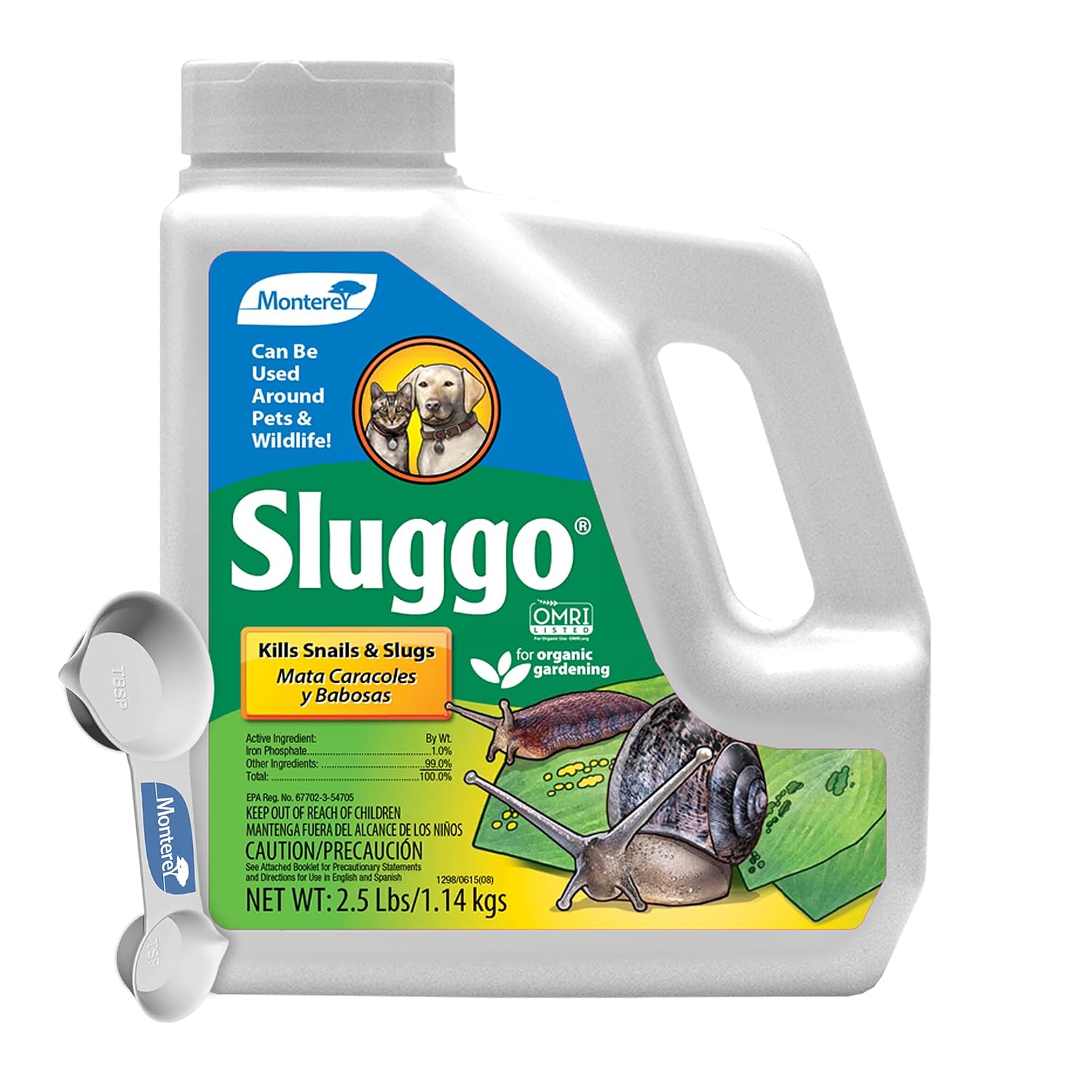
| Item Form | Powder |
|---|---|
| Target Species | Slug |
| Active Ingredient | Iron Phosphate 1.0% |
| Unit Count | 40 Ounce |
Monterey Sluggo is a granular iron phosphate bait intended to protect vegetables, ornamentals, lawns and container plants from slug and snail feeding. Applied by scattering granules around plants or with a broadcast spreader for larger areas, it attracts gastropods which feed on the bait and stop feeding soon after. The product is OMRI listed so it fits into organic garden programs, and its active ingredient, iron phosphate, is low risk to pets and wildlife when used as directed. Notable practical benefits are that the granules remain effective after normal rain or light sprinkling and that it works across many garden settings including greenhouses and berry rows. Important limitations are that heavy rain may wash enough bait away to require reapplication and that it controls slugs and snails specifically rather than a broader range of garden pests. Users should follow label safety directions when handling the concentrate or mixing and wear protective clothing where recommended.
Best for: Gardeners who prioritize reliable, low-toxicity slug and snail control and want a product that fits organic gardening practices and scales from beds to larger lawn areas.
Less Ideal for: People looking for a multi-pest insecticide or for an immediate contact kill of visible slugs should consider other targeted options.
- OMRI listed for use in organic gardening
- Iron phosphate active ingredient is considered safe for pets and wildlife when used as directed
- Granular formula can be broadcast with a spreader for larger areas
- Remains effective after normal rainfall or light sprinkling
- Heavy rainfall can wash away bait and require reapplication
- Targets only slugs and snails and will not manage other pests
Verdict: Choose Monterey Sluggo if you want an effective, pet-friendly granular bait that fits organic garden use and can be applied across small beds and larger areas.
Garden Safe Slug & Snail Bait Granules, 2 lb

| Item Form | Granules |
|---|---|
| Included Components | Slug & Snail Bait, 2 lb |
| Item Type Name | Slug and Snail |
Garden Safe Slug & Snail Bait uses iron phosphate granules to control slugs and snails in lawns, vegetable beds, ornamentals and greenhouses. Scatter the granules in the evening or early morning where slugs travel, avoid application if rain is expected within 24 hours, and reapply as directed. The active iron phosphate is a common garden nutrient so the product is labeled for use around pets, wildlife and edible plants when used according to instructions, and pests typically stop feeding and die within three to six days. Practical benefits include easy broadcast application, compatibility with organic gardens, and minimal risk to birds or mammals compared with metaldehyde baits. Limitations are that results are not instant and repeated applications may be needed during heavy infestations or wet weather, and the bait can wash away if applied before rain or on steep slopes.
Best for: Buyers who want a low-toxicity, pet- and wildlife-friendly bait with established user acceptance for routine slug and snail control in edible and ornamental plantings.
Less Ideal for: People needing instant elimination for extreme infestations or a bait suitable for aquatic or heavily rainy sites should consider different control methods.
- Uses iron phosphate which is accepted for use around pets and wildlife when label directions are followed
- Designed for use on lawns, vegetable gardens, ornamentals and greenhouses
- Granular form is easy to scatter for spot treatments or larger areas
- Kills slugs and snails within three to six days after ingestion
- Not an immediate knockdown; pests stop feeding and die over several days
- Can be washed or blown away if applied before rain or windy conditions
Verdict: A practical low-toxicity granular bait for gardeners who prioritize safety around pets and edible plants while controlling slugs and snails.
Choosing the Right Slug Killer for Indoors: Key Factors to Consider
Toxicity and Household Safety
Toxicity matters more indoors than in a yard because people and pets share the same air and surfaces as treated plants. Low-toxicity products reduce the risk from accidental contact or ingestion, and options designed for indoor use often have clear guidelines for where to place baits, traps, or barriers to limit exposure.
Consider whether the product leaves dust or residues that can be tracked from floors into living spaces. If you have pets that explore pots or children who play near plants, prioritize treatments with minimal oral toxicity and strong containment or placement guidance. Always read label directions for indoor scenarios and follow recommended use restrictions.
Application Method and Cleanliness
How a slug control is applied affects your willingness to use it regularly. Liquid treatments may require careful dosing and can wet potting mix, while granular baits can spill and leave particles on trays. Traps and physical barriers typically create less ongoing mess but need more manual maintenance.
Think about cleanup effort, whether the product leaves stains or sticky residues, and whether application tools are included or needed. For indoor use, choose methods that keep active material contained, are easy to remove, and do not disrupt normal watering and care routines.
Effectiveness in Container Environments
Indoor slug behavior differs from outdoor populations. Slugs inside homes or greenhouses often concentrate in damp pots, under plant saucers, or in dense foliage. Effective control in containers means the method can reach hiding spots without saturating soil or harming roots.
Assess whether a product targets adult slugs, traps juveniles, or interferes with egg survival. Long-term suppression usually requires addressing both active slugs and breeding sites, so opt for solutions that can be monitored and re-applied without disturbing plants.
Residue Persistence and Reapplication Frequency
Residue persistence is a double-edged sword indoors. Longer-lasting products can reduce reapplication needs but increase the chance of contact with people and pets. Conversely, options that break down quickly may be safer but require more frequent attention and replacement.
Decide how comfortable you are with periodic maintenance versus leaving a treatment in place for weeks. For high-traffic indoor plant areas, shorter-lived, easily removed controls often strike the best balance between safety and convenience.
Compatibility With Pots, Saucers, and Soil
Some slug controls can stain plastic saucers, alter potting mix chemistry, or harm beneficial soil organisms when applied directly to containers. Indoor gardeners should consider how a treatment interacts with common pot materials and whether it can be positioned without touching soil or roots.
If you use propagation trays, self-watering pots, or indoor hydro setups, check that the method will not clog reservoirs or leach into water lines. Favor systems that allow separation from root zones, such as contained traps or barrier applications.
Nonchemical Barriers and Physical Control
Physical barriers and traps are often the best first step indoors because they reduce slug numbers without introducing toxic residues. Copper strips, sticky barriers, or small baited traps placed near pots interrupt slug movement and provide an easy way to monitor activity.
These options require regular checks to remove captured slugs and to replace barrier material as it wears. They work particularly well around individual pots, seed trays, and under benches where slugs travel repeatedly.
- Place barriers at pot rims and around the edge of shelving.
- Inspect traps daily at first, then less often when activity drops.
- Wear gloves when disposing of captured slugs to avoid touching slime trails.
Placement Strategies for Indoor Use
Where you position control measures matters as much as which method you choose. Slugs favor dark, moist microhabitats, so check under saucers, inside dense foliage, and beneath humidity trays. Target placement reduces the amount of material you need and lowers exposure risk.
Create an inspection routine that includes moving pots slightly to look underneath and checking the soil surface after watering. Placing traps at the edge of shelving or beside windows where slugs travel to sunlight will often intercept them before they reach valuable plants.
- Keep humidity trays clean and dry between waterings to reduce shelter.
- Elevate plant stands slightly to make barrier placement easier.
- Avoid scattering materials on open floors where pets or children may contact them.
Managing Moisture to Reduce Slug Habitat
Slugs need moisture to survive and are most active in damp conditions. Changing watering habits can make indoor environments less hospitable. Allow the top layer of potting mix to dry between waterings when plants tolerate it, and empty saucers after irrigation to remove hidden damp shelters.
Improve airflow with small fans or by spacing pots further apart. Reducing unnecessary humidity will lower slug activity and make other control measures more effective.
- Water from the bottom when possible to keep surface drier.
- Use well-draining mixes to prevent prolonged wet pockets in pots.
- Check for slow leaks or overwatering around humidifiers or benches.
Integrated Monitoring and Long-Term Prevention
An indoor slug program works best when it combines immediate removal with monitoring and habitat modification. Keep a simple log of trap counts and visible slime trails to spot trends and adjust methods. Regularly inspect plants and pot bottoms, especially after rainy weather if you bring plants indoors.
Long-term prevention includes sealing entry points where slugs access indoor spaces and maintaining cleanliness under benches and in storage areas. Early detection makes control easier and reduces the need for stronger measures.
- Record where and when you find slugs to identify hotspots.
- Seal gaps near doors, vents, and drainage pipes to limit entry.
- Rotate barrier placement to avoid missed areas where slugs hide.
Safe Disposal and Handling
Disposing of captured slugs and contaminated materials safely is a key part of indoor control. Use a dedicated container or bag for collected slugs and avoid rinsing them into sinks where they could spread eggs or leave residues. Dispose in sealed trash or relocate outdoors far from plantings if local rules allow.
When handling traps or barrier materials, wear gloves and wash hands afterward. Clean any tools or pots that came into contact with slimed surfaces to prevent accidental transfer to other plants or living spaces.
- Seal used traps or disposable barriers in a bag before discarding.
- Sanitize reusable traps with hot water and a mild detergent.
- Keep cleaning supplies near plant areas for quick response.
How We Chose the Best Slug Killer for Indoors
We prioritized treatments and devices that are explicitly appropriate for confined indoor use and that limit residue, dust, or tracking. Our filters favored products and methods with clear labeling for indoor application, low toxicity to pets and people when used as directed, and options that reduce mess on floors and in pots. Evaluation criteria focused on three practical dimensions: safety profile and exposure risk for indoor households; application method and cleanup requirements; and proven effectiveness at reducing slug activity in potted plants, trays, or growing benches. We also considered longevity of control and how easily the option integrates with common indoor plant care routines. We excluded outdoor-only granular baits that rely on rainfall or broad broadcast treatments that create persistent residues. We also removed options with unclear indoor labeling or those that require extensive protective gear for routine household use. The remaining picks reflect solutions that balance minimal indoor impact with real slug suppression.
FAQ
Are indoor slug controls safe around pets and kids?
Safety depends on the method. Nonchemical traps and barriers pose the lowest risk, while some baits carry higher toxicity. Choose products labeled for indoor use, place them out of reach, and follow all directions to reduce exposure.
How quickly will I see results after starting indoor slug control?
You can often see fewer visible slugs within a few days of active trapping or barrier placement. Long-term reduction depends on addressing breeding sites and moisture, so expect monitoring and follow-up for several weeks to confirm control.
Can changing watering prevent slug problems indoors?
Yes. Allowing the soil surface to dry between waterings and removing standing water in saucers reduces the moist refuges slugs need. Combining moisture management with traps or barriers improves overall success.
Will slug control products harm my houseplants?
Some treatments can affect sensitive roots or beneficial soil life if applied directly to potting mix. Favor containment-based methods or those designed to stay outside the root zone and follow label guidance to avoid plant stress.
How often should I check traps and barriers indoors?
Check traps daily when starting control, then reduce frequency as counts decline. Barriers should be inspected weekly for wear and replaced or cleaned if they accumulate debris or lose effectiveness.
Final Verdict
When dealing with slugs indoors, prioritize methods that combine safety and containment with targeted effectiveness. Start with nonchemical barriers, traps, and moisture management to reduce numbers and limit the need for active toxicants. Balance residue persistence against reapplication needs, and choose approaches that fit your household activity and plant types. Ultimately, the best indoor slug control is the one that you can maintain consistently: keep monitoring, adjust placement as you learn slug patterns, and focus on removing shelter and moisture to prevent reinfestation.
