

Note: This article contains affiliate links. If you click on these links and make a purchase, I may earn a small commission at no extra cost to you. This helps support my research and content. Read my full affiliate disclosure here.
If slugs and snails are chewing holes in your seedlings, choosing the right snail bait for gardens makes a big difference to plant survival and harvests. You want a product that reduces population fast without creating new hazards for pets, wildlife, or beneficial insects. This guide covers seven shortlisted options that work well in typical garden beds, raised planters, and around container plantings. We evaluated each option for how quickly it reduces visible feeding, how easy and safe it is to place in a garden setting, and how it affects soil and non-target animals. Read on for practical notes on using bait effectively and how to match a product to your garden layout and safety needs.
Top Picks at a Glance
| Best Overall The best all-around choice for most situations | Monterey Sluggo Slug & Snail Bait (10 lb) |  |
| Best Quality Built to a higher standard if you want something more solid | Monterey Sluggo Snail & Slug Killer, 2.5 lb Jug |  |
| Best Value The sweet spot between price and what you get | Nisus Niban Granular Bait, Weather-Resistant, 10 lb |  |
| Best Budget The cheapest option that still gets the job done reliably | Corry's Slug and Snail Killer Pellets, 1.75 lb |  |
| Highest Rated A top-rated pick with lots of positive feedback | Monterey Sluggo Maxx Slug and Snail Killer, 10 lb |  |
| Most Popular A crowd favorite that many people choose with confidence | Garden Safe Slug & Snail Bait Granules, 2 lb |  |
| Best Seller A high-volume bestseller chosen again and again | Nisus Niban Granular Bait, Weather-Resistant, 4 lb |  |
Monterey Sluggo Slug & Snail Bait (10 lb)

| Included Components | iron phosphate which naturally occurs soil |
|---|---|
| Item Type Name | Wildlife and Pet Safe Slug Killer |
| Item Form | Spray |
| Target Species | Insects |
Sluggo is a ready-to-use granular bait that uses iron phosphate to control slugs and snails in garden beds and lawns. You scatter the granules around vulnerable plants or along likely slug pathways; the bait is attractive to gastropods and works as both a bait and killer. Because it uses iron phosphate, it is marketed as safe around pets and wildlife and will not break down with light rain or sprinkling, so its effectiveness holds after watering or wet weather. The 10 pound bag is suited to treating multiple beds or a medium-sized garden without frequent refills. Limitations to bear in mind are that results are gradual rather than instantaneous and repeated applications may be necessary in heavy infestations; it targets slugs and snails specifically and will not control other garden pests. Also check local regulations about phosphorus use near waterways before widespread application.
Best for: Gardeners who want an all-purpose, pet- and wildlife-safe solution to reduce slugs and snails across multiple beds and who prefer a granular, easy-to-scatter product.
Less Ideal for: People needing immediate knockdown of a severe infestation or those who want a product that controls a wide range of insect pests beyond slugs and snails.
- Uses iron phosphate which is considered safe for pets and wildlife when used as directed
- Granular, ready-to-use formula is easy to apply around plants and in beds
- Resists light rain and watering so it remains effective after moisture events
- Large 10 lb bag treats multiple beds without frequent refills
- Works specifically on slugs and snails and does not affect other pests
- Can require repeated applications for heavy infestations because effect is not instant
Verdict: Choose Monterey Sluggo when you want a pet- and wildlife-safe, easy-to-apply granular bait that reliably reduces slugs and snails across a garden.
Monterey Sluggo Snail & Slug Killer, 2.5 lb Jug
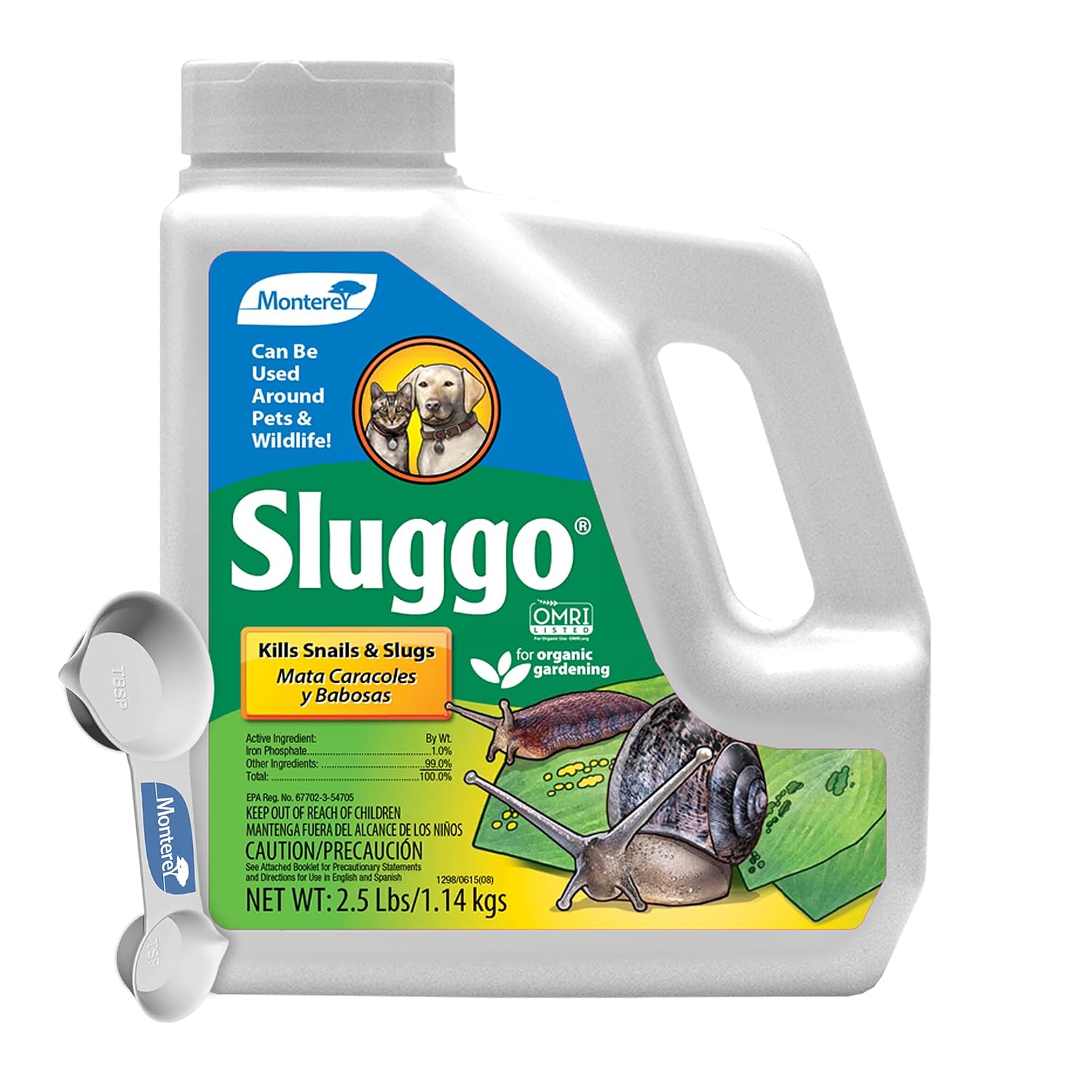
| Item Form | Powder |
|---|---|
| Target Species | Slug |
| Active Ingredient | Iron Phosphate 1.0% |
| Unit Count | 40 Ounce |
Monterey Sluggo is a granular iron phosphate bait intended to protect vegetables, ornamentals, lawns and container plants from slug and snail feeding. Applied by scattering granules around plants or with a broadcast spreader for larger areas, it attracts gastropods which feed on the bait and stop feeding soon after. The product is OMRI listed so it fits into organic garden programs, and its active ingredient, iron phosphate, is low risk to pets and wildlife when used as directed. Notable practical benefits are that the granules remain effective after normal rain or light sprinkling and that it works across many garden settings including greenhouses and berry rows. Important limitations are that heavy rain may wash enough bait away to require reapplication and that it controls slugs and snails specifically rather than a broader range of garden pests. Users should follow label safety directions when handling the concentrate or mixing and wear protective clothing where recommended.
Best for: Gardeners who prioritize reliable, low-toxicity slug and snail control and want a product that fits organic gardening practices and scales from beds to larger lawn areas.
Less Ideal for: People looking for a multi-pest insecticide or for an immediate contact kill of visible slugs should consider other targeted options.
- OMRI listed for use in organic gardening
- Iron phosphate active ingredient is considered safe for pets and wildlife when used as directed
- Granular formula can be broadcast with a spreader for larger areas
- Remains effective after normal rainfall or light sprinkling
- Heavy rainfall can wash away bait and require reapplication
- Targets only slugs and snails and will not manage other pests
Verdict: Choose Monterey Sluggo if you want an effective, pet-friendly granular bait that fits organic garden use and can be applied across small beds and larger areas.
Nisus Niban Granular Bait, Weather-Resistant, 10 lb

| Brand | Nisus |
|---|---|
| Included Components | Orthoboric Acid |
| Item Form | Liquid |
| Target Species | Insects |
| Liquid Volume | 1.8 liters |
Nisus Niban Granular Bait is a granular insect bait intended for perimeter and targeted spot treatment in gardens, around foundations, and inside crawl spaces or attics. The formula uses boric acid with food-grade attractants so pests feed and carry the bait back to colonies, which helps control ants, cockroaches, slugs, and snails rather than just killing individual foragers. The granules are described as weather-resistant, so they tolerate rain and sun better than many baits and remain effective longer when applied to mulch, soil, and garden edges. The refillable applicator makes it easier to broadcast over larger areas or apply precisely in crevices. Important limitations: it is a bait rather than a contact killer so results take several days and repeated applications may be needed for heavy infestations, and it should be used carefully to avoid non-target exposure in areas accessible to pets or wildlife. For gardeners focused on steady, preventive control of snails and other pests, this product is a practical option to include in an integrated plan.
Best for: Gardeners who want a low-fuss, preventive bait to reduce snail and general insect pressure around beds and borders and who prefer product longevity and easy application.
Less Ideal for: People needing immediate knockdown of a large active infestation or those who cannot restrict access to baited areas from pets or beneficial wildlife.
- Attractive food-grade formulation encourages feeding and transfer to nests
- Weather-resistant granules hold up to rain and sun for longer residual activity outdoors
- Refillable comfort-grip applicator speeds coverage of garden edges and problem zones
- Effective against multiple garden pests including slugs and snails
- Works as a delayed-action bait so control takes days and may require repeat applications
- Contains boric acid which requires cautious placement to minimize exposure to pets and wildlife
Verdict: Choose this weather-resistant boric-acid bait when you want a durable, easy-to-apply product for steady snail and insect control in garden borders and perimeter areas.
Corry's Slug and Snail Killer Pellets, 1.75 lb

| Item Form | Pellets |
|---|---|
| Target Species | Insects |
| Unit Count | 1 Count |
| Item Weight | 1.8 pounds |
Corry's Slug and Snail Killer is a pellet bait designed to control common slugs and snails around the home. You scatter the pellets around plants or on soil in the morning or evening, where pests eat the bait then retreat to hide and die over three to six days. The formula stays effective when wet and is cleared for use in vegetable and fruit gardens up to and including day of harvest, which makes it practical for edible beds. It is marketed as safe for people and pets to re-enter treated areas immediately after application, and the product is easy to apply without special equipment. Limitations include the need to reapply after heavy disturbance of the area and that control is gradual rather than immediate, so expect a few days before populations drop. Also follow basic safety steps to avoid eye or skin contact when handling the pellets.
Best for: Gardeners who want a straightforward, low-effort way to reduce slug and snail damage in lawns and edible beds while keeping costs down.
Less Ideal for: Users seeking an immediate kill or a non-bait mechanical solution should consider traps or barriers instead of a bait-based product.
- Effective pellet formulation that kills slugs and snails within about 3–6 days
- Approved for use in vegetable and fruit gardens up to day of harvest
- Remains effective in wet conditions so performance is less impacted by rain
- People and pets can re-enter treated areas immediately after application
- Control is not instantaneous and requires several days for full effect
- Requires periodic reapplication if soil is disturbed or after heavy rain events
Verdict: A simple, budget-friendly pellet bait that reliably reduces slug and snail populations in lawns and vegetable gardens within a few days.
Monterey Sluggo Maxx Slug and Snail Killer, 10 lb

| Ingredients | Iron Phosphate (3.0%) |
|---|---|
| Weight | 10 lb |
| OMRI Listed | Yes |
| Water Resistance | Remains effective after rain or sprinkling |
Monterey Sluggo Maxx is a concentrated iron phosphate bait designed to control slugs and snails across large areas. Applied as granular bait around vulnerable plants, it delivers a 3.0% iron phosphate formula that the manufacturer says is roughly three times stronger than standard 1% products, so you can expect quicker reductions in slug activity. The granules are water resistant, so they retain effectiveness after rain or irrigation and reduce the need for immediate reapplication. It is OMRI listed for organic gardening and labeled safe to use around pets, wildlife, and edible crops when used as directed, which makes it suitable for vegetable beds, ornamentals, lawns, and greenhouses. The product claims high coverage per pound, letting a single container treat a large area, which helps keep labor and repeat purchases down. Limitations to note are that it still relies on correct placement to intercept pests and that effectiveness depends on slug pressure and environmental conditions rather than being an instant fix.
Best for: Gardeners and landscapers who prioritize dependable, long‑lasting slug control and want a product that is safe to use around edibles and pets while covering large areas efficiently.
Less Ideal for: People who need immediate knockdown of heavy infestations or who prefer non‑bait mechanical controls like traps or barriers.
- Higher concentration iron phosphate formula for faster control than standard 1% baits
- Water-resistant granules remain effective after rain or sprinkler events
- OMRI listed and labeled safe for use around edible crops, pets, and wildlife when used as directed
- High coverage per pound reduces frequency of reapplication and treats large areas
- Performance still depends on correct bait placement and local slug pressure
- Not an instant kill; results occur over days as slugs feed and stop damaging plants
Verdict: Choose Sluggo Maxx when you want a reliable, pet‑ and edible‑safe iron phosphate bait that covers large areas and holds up after rain.
Garden Safe Slug & Snail Bait Granules, 2 lb

| Item Form | Granules |
|---|---|
| Included Components | Slug & Snail Bait, 2 lb |
| Item Type Name | Slug and Snail |
Garden Safe Slug & Snail Bait uses iron phosphate granules to control slugs and snails in lawns, vegetable beds, ornamentals and greenhouses. Scatter the granules in the evening or early morning where slugs travel, avoid application if rain is expected within 24 hours, and reapply as directed. The active iron phosphate is a common garden nutrient so the product is labeled for use around pets, wildlife and edible plants when used according to instructions, and pests typically stop feeding and die within three to six days. Practical benefits include easy broadcast application, compatibility with organic gardens, and minimal risk to birds or mammals compared with metaldehyde baits. Limitations are that results are not instant and repeated applications may be needed during heavy infestations or wet weather, and the bait can wash away if applied before rain or on steep slopes.
Best for: Buyers who want a low-toxicity, pet- and wildlife-friendly bait with established user acceptance for routine slug and snail control in edible and ornamental plantings.
Less Ideal for: People needing instant elimination for extreme infestations or a bait suitable for aquatic or heavily rainy sites should consider different control methods.
- Uses iron phosphate which is accepted for use around pets and wildlife when label directions are followed
- Designed for use on lawns, vegetable gardens, ornamentals and greenhouses
- Granular form is easy to scatter for spot treatments or larger areas
- Kills slugs and snails within three to six days after ingestion
- Not an immediate knockdown; pests stop feeding and die over several days
- Can be washed or blown away if applied before rain or windy conditions
Verdict: A practical low-toxicity granular bait for gardeners who prioritize safety around pets and edible plants while controlling slugs and snails.
Nisus Niban Granular Bait, Weather-Resistant, 4 lb

| Item Form | Granules |
|---|---|
| Target Species | Insects |
| Active Ingredients | boric acid |
| Specification Met | EPA |
Nisus Niban Granular Bait is a granular insecticide bait formulated with boric acid and organic food-grade attractants that targets a range of pests including slugs and snails. It is designed for outdoor and indoor perimeter use and comes in a shaker-style container with a comfort-grip applicator for quick, even coverage over soil, mulch, and around foundations. The granules are weather-resistant so they retain effectiveness after rain and sunlight, which helps maintain control in garden beds and high-traffic outdoor spots. Because it relies on boric acid rather than synthetic neurotoxins, it offers a method that pests are unlikely to develop resistance to and is suitable for use around homes when applied as directed. Limitations include the need to reapply according to spacing guidelines for sustained control and caution around children and pets since it is an active insecticide; it is also not labeled for fire ants and will not replace mechanical slug barriers for heavy infestations. For gardeners seeking a low-maintenance, long-lasting bait for routine snail and slug control, this product is straightforward to use and holds up well in variable weather.
Best for: Gardeners who want a reliable, low-maintenance granular bait to reduce snails and slugs around beds and perimeters and prefer products with a slower-acting, nonresistance formulation.
Less Ideal for: Those who need immediate knockdown of large infestations, who require a fire ant treatment, or who cannot store or apply insecticides safely around children and pets.
- Targets multiple garden pests including slugs and snails in addition to ants and cockroaches
- Weather-resistant granules maintain effectiveness after rain and sun exposure
- Comfort-grip shaker makes application quick and easy for perimeter and bed treatments
- Formulated with boric acid and food-grade attractants to reduce likelihood of resistance
- Contains an active insecticide so users must follow safety and storage instructions around children and pets
- Not effective against fire ants and not a standalone solution for very heavy slug populations
Verdict: A weather-resistant, easy-to-apply granular bait that provides long-lasting control of snails and slugs for gardeners seeking a low-resistance solution.
Choosing the Right Snail Bait for Gardens: Key Factors to Consider
Active Ingredient and Mode of Action
Knowing the active ingredient matters because it determines how bait affects snails and what other animals might be at risk. Some active ingredients offer quick stomach toxicity while others cause slow dehydration or behavioral changes. Different modes of action also affect whether dead snails remain attractive to others and how frequently you must reapply.
Check label directions for whether the product is intended for use around edible plants or only non-food ornamentals. The active ingredient will also dictate legal usage limits and required precautions for handling, storage, and disposal.
Safety Around Pets, Children, and Wildlife
Safety is a top concern when you apply any toxic or deterrent material in a garden that people and pets frequent. Look for baits designed to reduce secondary poisoning risk and read placement recommendations carefully. Some baits are formulated into granules that are less likely to be picked up by pets if hidden under covers or placed in bait stations, while others require more careful exclusion.
Also consider the garden layout: small yards and container gardens often need baiting strategies that limit access by curious dogs, cats, or birds. If you keep poultry or have frequent visits from wildlife, choose approaches that prioritize non-target safety and use physical barriers or stations when possible.
Formulation and Placement Practicalities
Bait comes in pellets, granules, pellets with attractants, or enclosed stations. The formulation affects how easy it is to apply evenly and how long it stays effective after rain. Granules can be scattered but may wash or be displaced; pelletized baits are easier to spot and remove when no longer needed; enclosed baits reduce non-target exposure but require periodic checks.
Consider whether you need something that can be tucked into tight spaces, placed in drip-line areas, or used in containers without contaminating potting mix. Also evaluate whether the product needs special tools or stations for placement and whether that fits your maintenance routine.
Effect Duration and Reapplication Frequency
Some baits break down quickly and need frequent reapplication, while others persist through multiple weather events. Persistence affects labor and the likelihood of residue in soil or on nearby plants. A longer-lasting bait can reduce the frequency of checks but may increase exposure risk to non-targets if not used carefully.
Balance the desire for lasting control with the need to limit environmental footprint and safeguard beneficial organisms. Match reapplication frequency to your garden's infestation pressure and seasonal risk periods.
Attractiveness to Local Snail Species
Different snail and slug species vary in feeding preferences and activity patterns. A bait that works well on one species may be less effective on another. Attractants, carbohydrate carriers, or flavors influence whether local pests will consume the bait instead of garden plants.
If you can identify the species causing damage, select a formulation known to be palatable to that type. Otherwise, favor baits with broad appeal and plan to monitor effectiveness after the first application so you can switch strategies if needed.
Compatibility with Edible Plantings
If you are using bait near vegetables, herbs, or fruiting plants, confirm that the product is labeled for use in edible gardens or follow placement instructions that prevent contamination. Some products require removal from areas where produce will be harvested, or specify a waiting period before replanting or harvesting.
When in doubt, use physical barriers, apply baits only in perimeter zones, or choose formulations meant for ornamental use only in non-food areas.
How to Place Bait for Best Results
Place bait where snails are active, such as under foliage, near moisture-retaining mulch, or along the edges of plant beds. Avoid scattering bait randomly in exposed sun because snails prefer cool, damp microclimates where bait will be more attractive.
Use small, frequent placements rather than a single large deposit. This increases the chance that foraging snails encounter a dose and reduces the amount of bait exposed to non-target animals. In small gardens and containers, tuck bait under pots or inside shallow covers to limit access.
- Set bait near drip lines and under dense groundcover where snails travel.
- Check placements after rain and replace or reposition as needed.
- Use shallow covers or stations where dogs, cats, or birds are present.
Integrating Bait With Cultural Controls
Bait is most effective when combined with cultural practices that reduce shelter and moisture. Remove heavy ground litter, avoid overwatering in the evening, and keep pathways and bed edges trimmed so snails have fewer daytime hiding spots.
Hand-picking at dusk or dawn, when snails are most active, you can materially reduce population pressure and make baiting more efficient. Combining these tactics reduces reliance on chemicals and shortens the time you need to maintain bait placements.
- Water in the morning to dry the surface by evening.
- Clear debris and dense mulch patches where snails hide.
- Encourage predators like ground beetles and birds by providing habitat and avoiding broad-spectrum pesticides.
Using Bait Safely Around Children and Pets
Always follow label instructions for safe placement and storage. If the bait label warns about pet exposure, use covered bait stations, place bait out of reach, or choose a formulation with lower secondary toxicity. Keep unused bait sealed and stored away from food and animal areas.
Monitor the garden after application for signs of non-target interest. If pets or wildlife show curiosity around placements, move bait into enclosed containers or remove it entirely until you can supervise the area.
- Keep a dedicated scooping tool and gloves when handling bait.
- Store bait in a locked or high cabinet.
- Dispose of used containers per label directions.
When to Apply During the Season
Start baiting at first signs of nibbling or when conditions favor snail activity, typically in cool, damp parts of the growing season. Early action prevents population build-up and reduces damage to young transplants.
Continue monitoring through wet periods and after heavy rains when snails become more active. Reduce or stop baiting during dry spells when snail pressure is low to limit unnecessary exposure to non-targets.
- Apply at dusk or early morning when snails are actively feeding.
- Check placements weekly during high-pressure periods.
- Scale back applications as weather dries and populations decline.
Combining Bait With Physical Barriers
Physical barriers like copper tape, crushed eggshells, or raised collaring can complement bait use by protecting high-value plants. Barriers reduce contact area and force snails to encounter bait placed outside the protected zone.
Use barriers on container rims, around seedling trays, or at the base of vulnerable plants. When paired with strategically placed bait, you get targeted control with less overall bait in the garden.
- Place copper or abrasive barriers around young stems and containers.
- Renew barriers after heavy rain or when they become fouled.
- Use barriers selectively on your most vulnerable or valuable plantings.
How We Chose the Best Snail Bait for Gardens
We focused on products formulated for direct garden use and rated them on several practical, gardener-facing dimensions. Key evaluation criteria included knockdown speed, which measures how quickly visible snail activity declines after placement; application safety for pets and wildlife, covering formulation toxicity and recommended placement; persistence and reapplication needs, meaning how long a bait remains effective under typical garden conditions; and ease of application, including bait form, placement options, and whether covers or stations are required. Our selection process excluded products that are intended for turf-only use, industrial formulations not labeled for food crops, or treatments requiring specialized protective equipment. We prioritized items that balance efficacy with straightforward, low-risk garden application and clear label instructions. Where label guidance suggested particular precautions for children, pets, or wildlife, we factored that into the evaluation. The result is a shortlist of options that reflect common gardener priorities: reliable reduction in feeding, simple field use, minimal persistence where not wanted, and clear safety guidance.
FAQ
Is snail bait safe to use around edible vegetables?
It depends on the formulation and label instructions. Some baits are approved for use in edible gardens with specific precautions, while others are restricted to ornamental areas. Always read the product label for harvest intervals and placement rules before using near food plants.
How soon will I see fewer snails after applying bait?
You will often see reduced feeding within a few days, though the timeline depends on bait type, snail density, and weather. In heavy infestations, combine baiting with hand removal and habitat modification for faster results.
Can pets be poisoned by snail bait?
Some active ingredients pose a risk to pets if they ingest significant amounts. Use covered stations, place bait out of reach, and follow label safety guidance to reduce risk. If a pet shows signs of illness after possible exposure, contact a veterinarian promptly.
Will bait wash away when it rains?
Some formulations break down or displace after heavy rain, while others are designed to resist light moisture. Expect to check and possibly reapply bait after prolonged wet weather, especially in exposed placements.
Do natural or non-toxic baits work as well as conventional ones?
Natural deterrents and non-toxic baits can reduce snail activity in some cases, but they often require more frequent application and integrated tactics. Their effectiveness varies with species and infestation level, so monitor results and adjust tactics if needed.
Final Verdict
Selecting the right snail bait for gardens comes down to balancing quick control with safety and practical placement. Prioritize formulations and application methods that match your garden layout, presence of pets or wildlife, and whether you are treating edible plantings. Combine bait with cultural controls, barriers, and monitoring to reduce reliance on repeated applications. In most cases, start with targeted placements and observe how local snail species respond. That approach reduces exposure risks, conserves product use, and helps you choose the most effective long-term strategy for your garden.
