

Note: This article contains affiliate links. If you click on these links and make a purchase, I may earn a small commission at no extra cost to you. This helps support my research and content. Read my full affiliate disclosure here.
If you manage a large lawn, garden, or expansive planting bed, a long range sprinkler head changes how efficiently you water. The right head covers more ground per unit, reduces the number of risers or runs needed, and helps keep turf and shrubs uniformly hydrated without constant repositioning. This guide presents six shortlisted long range sprinkler heads chosen for their spray distance, pattern control, and durability in outdoor conditions. We evaluate options by how far they throw water, how evenly they distribute it, and how simple they are to adjust or maintain. Read on to compare practical pros and cons and find the best fit for your yard size and irrigation layout.
Top Picks at a Glance
| Best Overall The best all-around choice for most situations | Strongway Wheeled Sprinkler with 63 GPM and 5 Nozzles |  |
| Best Quality Built to a higher standard if you want something more solid | Hunter PGP-ADJ 3/4" Gear-Drive Rotor Sprinkler Head (4" Pop-Up) |  |
| Best Value The sweet spot between price and what you get | Biswing Metal Impact Sprinkler Head on Adjustable Tripod |  |
| Best Budget The cheapest option that still gets the job done reliably | Rain Bird 52SA Stainless Steel Gear-Drive Rotor Sprinkler (25–50 ft) |  |
| Highest Rated A top-rated pick with lots of positive feedback | WOVSTNOV 1" Heavy-Duty Impact Sprinkler Head (0–360°) |  |
| Most Popular A crowd favorite that many people choose with confidence | Orbit Tripod Brass Impact Sprinkler, Adjustable Height |  |
Strongway Wheeled Sprinkler with 63 GPM and 5 Nozzles
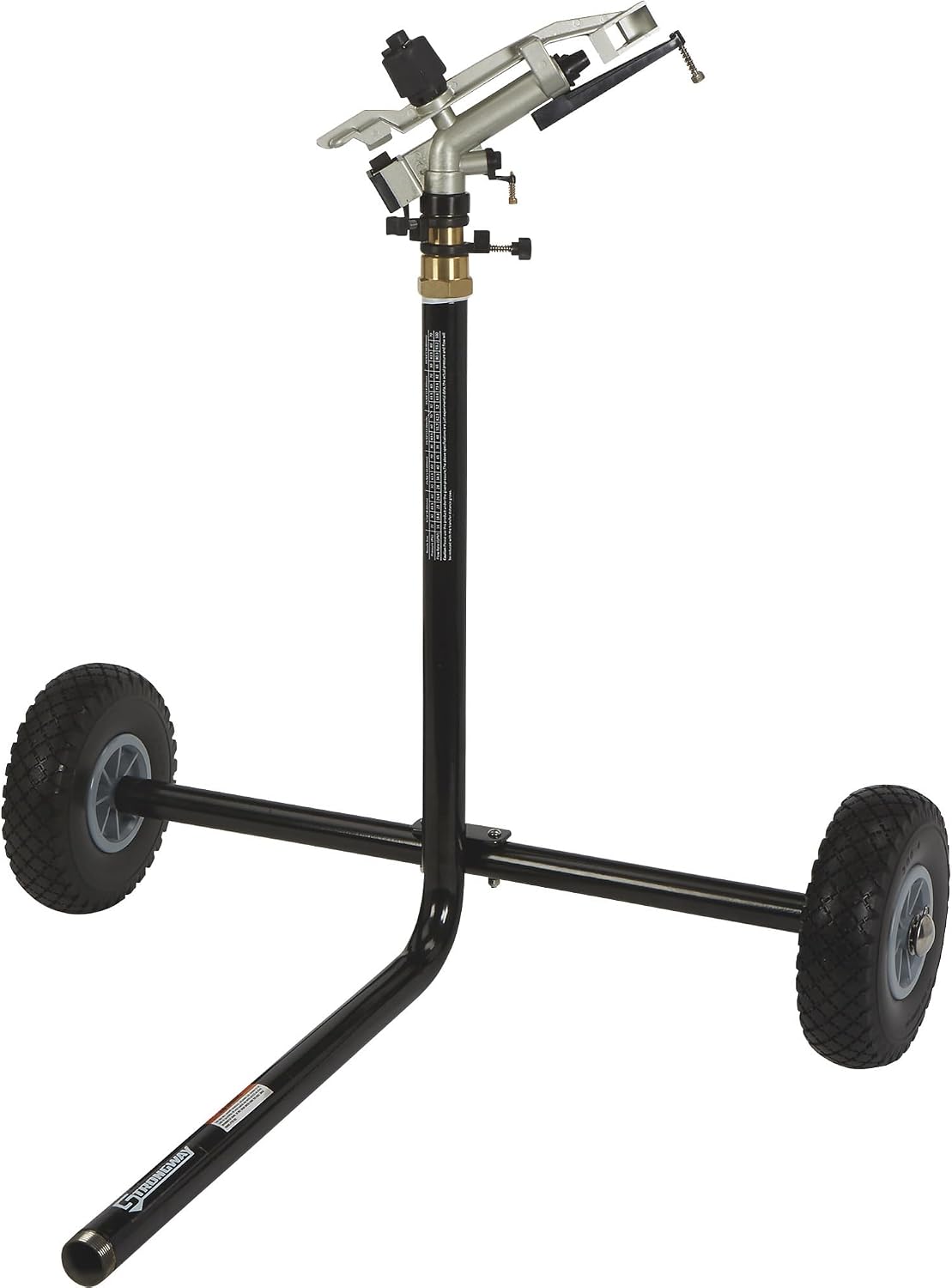
| Maximum Flow Rate | 63 gpm |
|---|---|
| Inlet Connection Size | 1.25 inches |
This Strongway wheeled sprinkler is built for large lawns and acreage where fast, high-volume watering matters. It mounts a 1-1/4 inch die-cast aluminum head with a brass union and five nozzles that together can deliver up to 63 gallons per minute at a 28 degree trajectory, giving coverage up to a 150 foot diameter. The unit rides on two 10 inch flat-free tires on a solid steel axle, so it rolls across grass, gravel, and uneven terrain without worrying about flats. You can set the head for a full 360 degree circle or lock it to a partial arc to avoid watering structures or beds. Stainless hardware and a powder-coat finish improve outdoor durability. The practical benefits are rapid coverage of large areas and easy repositioning across rough ground, but the high flow rate means it is best for properties with sufficient water supply and good water pressure; it is not intended for small yards or delicate irrigation needs. Assembly and moving a relatively heavy unit will require some effort.
Best for: Homeowners or property managers with large lawns, pastures, or athletic fields who need fast, broad coverage and a durable, mobile sprinkler that handles rough ground.
Less Ideal for: Owners of small yards, drip irrigation users, or those with limited water pressure who need low-flow or highly precise watering solutions.
- High maximum flow rate (63 gpm) for fast watering of very large areas
- Adjustable full or partial circle pattern lets you target zones and avoid structures
- 10-inch flat-free tires and solid axle for easy movement over rough terrain
- Durable construction with die-cast aluminum head, stainless hardware, and powder-coat finish
- Requires strong water supply and pressure to achieve peak flow and range
- Relatively heavy and large, so repositioning and storage need space
Verdict: Choose this Strongway wheeled sprinkler when you need a tough, mobile sprinkler that delivers rapid, large-diameter coverage for big lawns and open acreage.
Hunter PGP-ADJ 3/4" Gear-Drive Rotor Sprinkler Head (4" Pop-Up)

| Maximum Pressure | 100 psi |
|---|---|
| Maximum Flow Rate | 14.1 gpm |
| Inlet Connection Size | 0.75 inches |
| Operating Pressure Range | 20 to 100 PSI |
| Preinstalled Nozzle Flow | 3.0 GPM |
The Hunter PGP-ADJ is a workhorse rotor sprinkler designed for reliable, long-range coverage on larger lawns. It installs on a standard 3/4" inlet and pops up 4" above the turf to deliver an adjustable 40° to 360° arc using a preinstalled 3.0 GPM nozzle, with a spray radius of about 22 to 52 feet depending on pressure and nozzle choice. The gear-driven, water-lubricated mechanism runs quietly and resists clogging, producing even rotation and consistent coverage that lets you space heads farther apart and reduce the number of zones. It handles a wide operating pressure range (20–100 PSI, recommended 25–70 PSI) and offers nozzle trajectory options for windy or sloped sites. Practical benefits include heavy-duty reliability favored by professionals and straightforward arc adjustment for mixed full- and part-circle zones. The main limitations are that it is a single head without integrated pressure regulation or water-saving MP rotator technology, so optimizing efficiency on very large or irregular lawns may require complementary nozzles or additional heads for the best uniformity and water use.
Best for: Homeowners setting up or upgrading irrigation on medium to large lawns who want durable, long-throw coverage and professional-grade reliability.
Less Ideal for: Those prioritizing maximum water savings or very small gardens where compact spray heads or MP Rotator nozzles would be a better match.
- Adjustable 40°–360° arc for full- and part-circle coverage
- Long spray radius (22–52 ft) reduces number of heads per zone
- Gear-driven, water-lubricated mechanism for quiet, durable operation
- Standard 3/4" inlet and 4" pop-up height for easy compatibility and installation
- No built-in pressure regulation or dedicated water-saving rotor nozzle included
Verdict: Choose the Hunter PGP-ADJ when you need a rugged, long-range rotor that delivers dependable, professional-grade coverage for large lawns.
Biswing Metal Impact Sprinkler Head on Adjustable Tripod

| Maximum Pressure | 60 psi |
|---|---|
| Inlet Connection Size | 0.75 inches |
| Style Name | Impulse |
This Biswing impact sprinkler pairs a solid zinc‑alloy impact head with a lockable tripod so you can water large areas without permanent installation. The head adjusts from 20 to 360 degrees and the top dial and diffuser screw let you fine‑tune spray distance and droplet size, from a focused jet to a gentle mist. Extendable legs (16 to 37 inches) raise the spray to increase radius, and the unit accepts standard 3/4‑inch hose fittings with a rubber O‑ring filter to help keep grit out of the nozzle. In practice it is useful for lawns, large flower beds, greenhouse cooling and spot irrigation where you need variable patterns and long reach; with sufficient supply pressure it can cover up to about a 90‑foot diameter. Expect occasional maintenance to clear debris from the nozzle or mechanism and to unstick the trip action if minerals build up. The metal construction improves durability compared with plastic heads but also makes it heavier and a bit less convenient to move for very frequent repositioning.
Best for: Buyers who need a robust, high‑coverage sprinkler for large lawns or agricultural plots and value adjustable patterns and durable metal construction.
Less Ideal for: Users seeking a lightweight, handheld or ultra‑portable sprinkler for frequent spot moves or those with very low water pressure who need a low‑pressure emitter.
- Durable zinc alloy impact head and sturdy metal tripod for long service life
- Adjustable spray arc (20–360°) and top dial for precise distance control
- Extendable tripod height (16–37 in) to increase coverage radius
- 3/4‑inch standard connector with rubber filter O‑ring to reduce nozzle clogging
- Requires adequate water pressure to reach maximum advertised radius
- Metal parts can seize if debris or mineral deposits are not periodically cleaned
Verdict: Choose this heavy‑duty impact sprinkler when you want durable metal construction and flexible, long‑reach coverage for large lawns and gardens.
Rain Bird 52SA Stainless Steel Gear-Drive Rotor Sprinkler (25–50 ft)

| Maximum Pressure | 70 psi |
|---|---|
| Maximum Flow Rate | 3 gpm |
| Inlet Connection Size | 0.75 inches |
| Material Type | Stainless Steel |
The Rain Bird 52SA is a contractor-grade gear-drive rotor built for dependable, long-range lawn irrigation. It delivers a 25 to 50 foot throw with a preinstalled 3.0 gpm nozzle and uses Rain Curtain nozzle technology to create large, wind-resistant droplets for more even coverage and less overspray. Top-of-head adjustments let you set arc (40° to 360°) and distance with a flat screwdriver while the quick check arc/fast-forward feature makes setup and troubleshooting simple while the head is running. The closed-case design, stainless-steel shaft, water-lubricated gears, and dual-action wiper seal protect internal parts from grit and creeping grasses, which helps the rotor run reliably in sandy or harsh soils. It pops up 4 inches to clear taller turf and has a 3/4" NPT female bottom inlet for contractor plumbing. Limitations are that it requires matching pressure and flow to reach the longest distances and replacement nozzles are sold separately if you need different flow rates or finer tuning for irregular lawns.
Best for: Buyers who prioritize a low-maintenance, long-lasting rotor for large lawns and want reliable, contractor-grade coverage without frequent servicing.
Less Ideal for: Homeowners with very low water pressure systems or those needing a compact spray head for small, densely planted beds should consider alternatives.
- Robust stainless-steel shaft and water-lubricated gear drive for long service life
- Rain Curtain nozzle produces large, wind-resistant droplets for uniform coverage
- Top-access arc and distance adjustments plus quick check feature speed installation and tuning
- Closed-case design and wiper seal protect internal components from debris and gritty water
- Requires sufficient system pressure and flow to achieve the full 25–50 ft throw and optimal uniformity
Verdict: Choose the 52SA when you need a dependable, long-range rotor built to withstand gritty soils and deliver consistent 25–50 foot coverage.
WOVSTNOV 1" Heavy-Duty Impact Sprinkler Head (0–360°)

| Maximum Flow Rate | 3 cubic meter per hour |
|---|---|
| Inlet Connection Size | 1 inches |
| Material Type | Metal, Plastic |
This WOVSTNOV impact sprinkler is built for large lawns and commercial-style irrigation where long reach and continuous use matter. It connects via a 1-inch female thread and uses a rocker-arm impact mechanism to deliver a fan-shaped spray that can reach roughly 98 to 130 feet and cover up to a full 360 degrees. The alloy main body paired with plastic components is intended to resist rust and tolerate higher pressures, which reduces maintenance compared with all-plastic heads. Flow is substantial, listed at roughly 3 to 8 cubic meters per hour, so it provides even coverage across wide areas but requires adequate supply pressure or a pump to hit the top range. The head is straightforward to install and adjust for partial or full-circle watering, and the simple mechanical design makes it durable and serviceable in the field. Expect good longevity and few moving-part failures, though performance depends on system pressure and the unit is large, so it is most effective on open turf rather than tight beds or delicate plantings.
Best for: Buyers who prioritize a dependable, heavy-duty sprinkler for wide-area irrigation and want a low-maintenance head that holds up to frequent use.
Less Ideal for: Those watering small ornamental beds, container plants, or low-pressure systems should consider a gentler or smaller sprinkler designed for close-range coverage.
- Long spray radius suitable for large lawns and fields (about 98–130 ft).
- Adjustable 0–360° rotation for partial or full-circle coverage.
- Robust alloy body designed to resist rust and tolerate higher pressure for extended service life.
- Simple impact rocker-arm mechanism that is easy to maintain and service.
- Requires strong water pressure or pump to achieve the upper-range spray distances.
- Contains plastic parts alongside metal, so not entirely full-brass construction for the highest durability.
Verdict: Choose this impact sprinkler when you need a reliable, long-range head built for large lawns and continuous, low-maintenance irrigation.
Orbit Tripod Brass Impact Sprinkler, Adjustable Height

| Material Type | Aluminum |
|---|---|
| Maximum Pressure | 80 psi |
| Maximum Flow Rate | 25 gpm |
| Inlet Connection Size | 0.5 inches |
The Orbit Tripod Brass Impact Sprinkler is a heavy-duty, elevated sprinkler built for large lawns and landscaping areas. The brass impact head and precision high-pressure nozzle deliver long-range, 360-degree coverage while the adjustable metal tripod raises the spray 22 to 48 inches to clear taller grass and obstacles. Typical use is hooking it to a 1/2-inch hose inlet, setting the tripod where you need broad coverage, and adjusting the spray pattern and rotation for the target area. Practical benefits include stable placement on uneven ground thanks to the tripod legs, reliable operation at higher pressures up to 80 psi, and a maximum flow rated at 25 gpm for rapid watering of larger zones. The aluminum construction listed and brass-style head suggest good durability for seasonal outdoor use. Important limitations are that it is a single-head, stationary sprinkler so it is best for covering one large zone at a time and requires manual repositioning to water multiple, nonadjacent areas. It also needs adequate water pressure and supply to reach maximum range.
Best for: Homeowners or landscapers who need a durable, elevated sprinkler to water large lawns or continuous landscaping areas and who prioritize proven, heavy-duty components over multi-zone automation.
Less Ideal for: People who want automated zone scheduling, coverage of many small, separated beds, or a portable pop-up system that integrates with in-ground irrigation controllers.
- Adjustable tripod raises sprinkler 22–48 inches for more even coverage over tall grass and landscaping
- 360-degree brass impact head with a precision nozzle supports long-range, consistent rotation
- Rated for up to 80 psi and 25 gpm, suitable for large lawns and higher-pressure systems
- Sturdy tripod design provides stable placement on uneven terrain
- Single stationary head covers one zone at a time and must be moved for nonadjacent areas
- Requires sufficient water pressure and flow to achieve advertised long-range performance
Verdict: Choose this tripod brass impact sprinkler when you want a robust, elevated sprinkler that reliably covers large lawns with long-range, 360-degree watering.
Choosing the Right Long Range Sprinkler Head: Key Factors to Consider
Throw Distance and Operating Pressure
How far a sprinkler head can throw water matters first because it determines how many heads you need and where they go in an irrigation layout. Rated distance is often given at a specific operating pressure, so you should match head specs to your system pressure to avoid underperformance.
Higher-pressure settings usually increase radius but can make droplets finer and more susceptible to wind drift. In contrast, some heads are optimized to maintain distance at lower pressures, which can save on pumping energy or make them better for gravity-fed systems. Think about the spacing you need across your lawn and whether the head's published throw is realistic in your local wind and elevation conditions.
Pattern Control and Arc Adjustment
Good pattern control lets you shape the spray to match rectangular lawns, irregular beds, or borders without wasting water on sidewalks or structures. Look for heads that allow precise arc adjustment across partial and full-circle settings; some models offer continuous adjustment while others use fixed stops.
Arc controls should be easy to set in the field so you can fine-tune coverage during installation or seasonal changes. Consider whether you need adjustable radius as well as arc, since reducing reach without changing sprinkler head type can prevent overlapping wet spots and reduce runoff.
Water Distribution Uniformity
Uniform distribution reduces dry patches and overwatered zones, which improves plant health and conserves water. Distribution depends on nozzle design, droplet size, and how the head maintains its spray pattern at different pressures.
Evaluate reports or specs about precipitation rate and pattern consistency across the operating range. In practice, look for patterns that deliver even coverage at typical spacing so you do not rely on excessive overlap. Uniformity becomes more critical on slopes and finely planted beds where overwatering causes erosion or root problems.
Durability and Material Quality
Heads used for long-range coverage spend more time exposed to sun, freezing temperatures, and abrasive irrigation water. Durable materials, robust seals, and corrosion-resistant components extend service life and reduce maintenance frequency.
Consider plastic grades, UV-resistant finishes, and the quality of internal seals and bearings. Metal components in drive mechanisms or critical fittings can improve longevity, but they should be balanced against potential corrosion. A rugged head reduces the chance of leaks, broken gears, or warped nozzles after a few seasons.
Ease of Maintenance and Serviceability
Ease of maintenance affects long-term cost and downtime. Heads that allow simple nozzle swaps, debris screens, and accessible seals save time when you flush lines or winterize the system.
Check whether the nozzle pattern is interchangeable without special tools and whether the head can be serviced in place. Simple access to internal filters and a straightforward method to clear clogs or replace seals means less disruption to your irrigation schedule and fewer calls for professional help.
Flow Efficiency and Compatibility
Flow efficiency influences how many heads a single station can support and whether your pump or zone valves can supply adequate water. Nozzles that deliver desired precipitation rates with lower flow let you space heads more widely or run more heads on a zone.
Also confirm compatibility with common pop-up bodies, rotor drives, and existing control setups. Mismatched flow characteristics can cause pressure drops and uneven coverage, so plan zones and head counts to match both head flow ratings and your supply capacity.
Planning Coverage for Large Lawns
Start by mapping your lawn and noting obstacles such as driveways, flower beds, and slopes. Mark the longest distances you need to cover and use drive radius requirements to estimate how many long range heads you will need to avoid dry patches.
When designing the layout, think in terms of achievable radius at your system pressure rather than ideal manufacturer numbers. Account for wind, which can shorten effective range by carrying finer droplets off course, and place heads so overlap creates even precipitation across the turf.
- Measure actual pressure at risers to match head specs.
- Space heads so wet zones overlap slightly for uniformity.
- Avoid placing heads where spray hits buildings or paved surfaces.
Adjusting Heads for Reduced Overspray
Overspray is a common issue when using long-range heads near sidewalks or neighbors. Fine-tune arc and radius settings to stop water at edges and use partial arcs where appropriate. Some heads let you reduce radius without changing nozzles, which is useful on transitional zones.
For windy sites, reduce radius slightly to keep droplets heavier and less prone to drift. Consider pairing long-range heads with smaller boundary heads to control edge wetting precisely.
- Use partial arcs to protect non-target areas.
- Lower radius in windy conditions to reduce drift.
- Combine with low-flow edge heads for precise borders.
Maintaining Performance Through Seasons
Routine seasonal checks keep long range heads operating efficiently. Before spring startup, inspect nozzles for clogs, rotate heads to verify unobstructed movement, and replace worn seals. Winterize according to your climate to prevent freeze damage to internal components.
During the season, periodically check for changes in throw distance caused by mineral buildup or wear. Clean filters and screens as part of regular maintenance to preserve even distribution and prevent flow reductions.
- Inspect and clean nozzles before spring use.
- Check seals and retractable mechanisms annually.
- Flush lines and remove debris after heavy storms.
Dealing With Wind and Microclimates
Wind reduces effective range and increases evaporation. Where winds are common, reduce head spacing, lower operating pressure, or run irrigation during calmer hours such as early morning. Microclimates created by buildings, trees, or slopes may require mixing head types to achieve consistent moisture.
In steep or varied terrain, adjust head orientation so spray follows the grade rather than fighting it, and consider shorter throw tiers downslope to avoid runoff and pooling.
- Water during low-wind periods to maximize efficiency.
- Mix head types to accommodate microclimates.
- Use shorter throws on slopes to reduce runoff.
Nozzle Choices and Droplet Size
Nozzle design affects droplet size and therefore how the spray behaves in wind and heat. Larger droplets are less likely to drift and better for long distances, while fine-mist nozzles can evaporate or be blown off target. Choose nozzle types that maintain droplet integrity at your operating pressure.
Interchangeable nozzle systems let you swap patterns and flows as conditions change during the season. Keep a small set of common nozzles on hand to tune distribution and stay efficient.
- Prioritize nozzles that produce larger droplets for windy areas.
- Keep spare nozzles for seasonal tuning.
- Match nozzle precipitation rate to plant water needs.
How We Chose the Best Long Range Sprinkler Head
We focused on practical garden performance and long-term reliability when narrowing candidates for this list. Key editorial filters included throw distance consistency, pattern adjustability, durability in outdoor conditions, and ease of maintenance. We gave priority to units that could reach distances typical of large lawns while still offering fine control over arc and radius so gardeners can avoid overspray onto walkways and gardens. Evaluation criteria used across candidates were measurable and relevant to real-world use. We tested documentation and specifications for maximum radius and minimum recommended operating pressure, checked materials and seal designs for weather resistance, and reviewed how straightforward routine servicing and nozzle swaps would be. Other important filters were flow efficiency to avoid unnecessary water waste and compatibility with common rotor and pop-up bodies. Excluded from consideration were heads intended only for small patios, micro-spray applications, or decorative fountains. We also excluded any units that required specialized proprietary bodies or unavailable replacement nozzles. The final selections reflect balanced tradeoffs among distance, coverage uniformity, control, and durability.
FAQ
How far can a long range sprinkler head typically reach?
Typical long range heads can reach much farther than standard spray heads, but the exact distance depends on operating pressure and nozzle choice. Expect variation with wind and elevation changes, so measure system pressure and use that to predict realistic coverage.
Will a long range head waste water near walkways or patios?
It can if not adjusted properly. Use partial arcs, reduce radius settings, and aim nozzles away from hardscapes to prevent overspray. Combining long-range heads with dedicated edge heads can provide precise control.
Can I use long range heads on sloped lawns?
You can, but slopes increase runoff risk. Reduce run times, use shorter throws downslope, and avoid placing heads so spray lands on steep grades. Consider soil absorption and use multiple short cycles to allow infiltration.
How often should I service long range sprinkler heads?
Inspect heads at least twice a year-preseason and midseason-and after storms that carry debris. Clean nozzles and filters, check seals, and verify arc and radius settings to maintain even coverage.
Do long range heads need special pop-up bodies or fittings?
Many long range nozzles are compatible with common rotor or pop-up bodies, but compatibility varies. Confirm flow and thread or mounting standards before swapping components to ensure proper fit and performance.
Final Verdict
For large lawns and expansive planting areas, prioritize reliable throw distance, even water distribution, and robust construction. Expect tradeoffs between maximum reach and susceptibility to wind or evaporation; balancing nozzle selection, pressure, and placement helps mitigate those tradeoffs. Focus on heads that allow straightforward arc and radius adjustments and are easy to service so you can maintain performance year after year. With a layout matched to your system pressure and attention to seasonal tuning, you can achieve uniform watering while minimizing waste.
