

Note: This article contains affiliate links. If you click on these links and make a purchase, I may earn a small commission at no extra cost to you. This helps support my research and content. Read my full affiliate disclosure here.
Choosing the right sprinkler head for a sprinkler system has a big impact on coverage uniformity, water waste, and long-term maintenance needs. The wrong head can leave dry patches, overspray onto sidewalks, or cause frequent trips to the valve box for repairs. This guide focuses on the top shortlisted sprinkler heads for sprinkler systems and explains practical differences that matter in real yards and irrigation layouts. We evaluated spray pattern control, clog resistance, part durability, and ease of adjustment so you can pick the head that fits your layout and water source. Read on for clear pros and cons and usable guidance before you change any fittings or heads.
Top Picks at a Glance
| Best Overall The best all-around choice for most situations | Rain Bird 32SA Gear Drive Rotor Sprinkler Head, 4-Pack |  |
| Best Quality Built to a higher standard if you want something more solid | Hunter PGP-ADJ 3/4" Gear-Drive Rotor Sprinkler Head (4" Pop-Up) |  |
| Best Value The sweet spot between price and what you get | Rain Bird 1804APPR25 1800 Series PRS Pressure-Regulating 4" Pop-Up Sprinkler |  |
| Best Budget The cheapest option that still gets the job done reliably | Hunter Pro 4" Pop-Up Lawn Sprinkler Head (8–15 ft adjustable, 0°–360°) |  |
| Highest Rated A top-rated pick with lots of positive feedback | K-Rain ProPlus RCW Gear Drive Rotor Sprinkler 4.5" Pop-Up (Pack of 4) |  |
| Most Popular A crowd favorite that many people choose with confidence | Rain Bird 1804VAN 1800 Series 4-inch Pop-Up Sprinkler Head (4 pack) |  |
| Best Seller A high-volume bestseller chosen again and again | Rain Bird 1806VAN 1800 Series 6 in. Pop-Up Sprinkler Head (5-pack) |  |
Rain Bird 32SA Gear Drive Rotor Sprinkler Head, 4-Pack
| Maximum Pressure | 70 psi |
|---|---|
| Maximum Flow Rate | 27.6 liters per minute |
| Inlet Connection Size | 0.5 inches |
| Material Type | ABS Plastic |
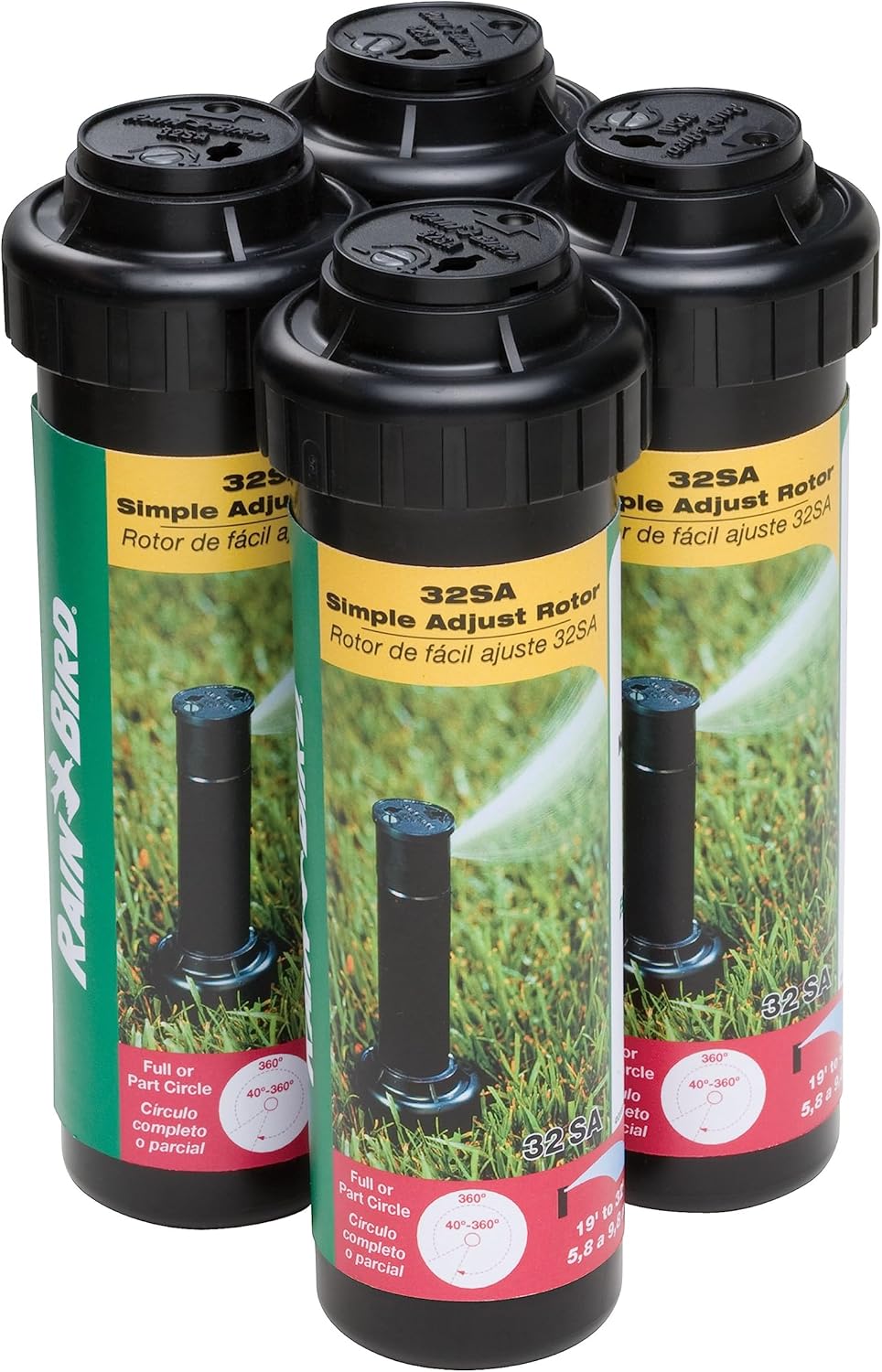
The Rain Bird 32SA 4-pack supplies reliable, contractor-style rotor coverage for residential in-ground systems. Each closed-case, gear-driven rotor pops up 4 inches and delivers a 19 to 32 foot throw using a preinstalled 3.0 gpm nozzle, with top-side adjustments for arc (40°–360°) and distance using a flat screwdriver. Rain Bird’s Rain Curtain nozzle produces larger, wind-resistant droplets and micro ramps that help avoid dry rings near the head, which improves uniformity and can reduce runtime. The unit includes a removable filter screen and nozzle for straightforward maintenance, plus O-rings and a dual-action wiper seal to protect internals in gritty water. Practical limitations are that the standard nozzle and pressure requirements target typical residential pressures, so very low-pressure systems or specialized long-range designs may need different nozzles or a different model. Also the ABS plastic housing is durable for most yards but not as long-lived as metal-shaft pro rotors in extremely abrasive conditions. For homeowners who value dependable coverage and easy adjustments, these heads are a solid choice for standard lawns.
Best for: Homeowners upgrading or repairing an in-ground sprinkler system who want consistent, easy-to-adjust rotor coverage and prefer proven products with broad user acceptance.
Less Ideal for: Commercial installers or users with very high-abrasion sites and large turf areas who need premium stainless components or extremely long-throw rotors.
- Adjustable 40°–360° arc with top-side screwdriver controls for quick on-site tuning
- Rain Curtain nozzle produces larger, wind-resistant droplets for more uniform coverage
- Closed-case design and wiper seal protect internals from debris and gritty water
- Includes removable filter screen and removable nozzle for simple maintenance
- Plastic shaft and ABS construction are less heavy-duty than premium metal-shaft rotors
- Preinstalled nozzle and pressure targeting may require swapping nozzles for atypical pressure or distance needs
Verdict: A dependable, easy-to-adjust rotor head pack that delivers uniform 19–32 ft coverage with contractor-style features for most residential lawns.
Hunter PGP-ADJ 3/4" Gear-Drive Rotor Sprinkler Head (4" Pop-Up)

| Maximum Pressure | 100 psi |
|---|---|
| Maximum Flow Rate | 14.1 gpm |
| Inlet Connection Size | 0.75 inches |
| Operating Pressure Range | 20 to 100 PSI |
| Preinstalled Nozzle Flow | 3.0 GPM |
The Hunter PGP-ADJ is a workhorse rotor sprinkler designed for reliable, long-range coverage on larger lawns. It installs on a standard 3/4" inlet and pops up 4" above the turf to deliver an adjustable 40° to 360° arc using a preinstalled 3.0 GPM nozzle, with a spray radius of about 22 to 52 feet depending on pressure and nozzle choice. The gear-driven, water-lubricated mechanism runs quietly and resists clogging, producing even rotation and consistent coverage that lets you space heads farther apart and reduce the number of zones. It handles a wide operating pressure range (20–100 PSI, recommended 25–70 PSI) and offers nozzle trajectory options for windy or sloped sites. Practical benefits include heavy-duty reliability favored by professionals and straightforward arc adjustment for mixed full- and part-circle zones. The main limitations are that it is a single head without integrated pressure regulation or water-saving MP rotator technology, so optimizing efficiency on very large or irregular lawns may require complementary nozzles or additional heads for the best uniformity and water use.
Best for: Homeowners setting up or upgrading irrigation on medium to large lawns who want durable, long-throw coverage and professional-grade reliability.
Less Ideal for: Those prioritizing maximum water savings or very small gardens where compact spray heads or MP Rotator nozzles would be a better match.
- Adjustable 40°–360° arc for full- and part-circle coverage
- Long spray radius (22–52 ft) reduces number of heads per zone
- Gear-driven, water-lubricated mechanism for quiet, durable operation
- Standard 3/4" inlet and 4" pop-up height for easy compatibility and installation
- No built-in pressure regulation or dedicated water-saving rotor nozzle included
Verdict: Choose the Hunter PGP-ADJ when you need a rugged, long-range rotor that delivers dependable, professional-grade coverage for large lawns.
Rain Bird 1804APPR25 1800 Series PRS Pressure-Regulating 4" Pop-Up Sprinkler

| Maximum Pressure | 30 psi |
|---|---|
| Maximum Flow Rate | 15 liters per minute |
| Material Type | Plastic, Stainless Steel |
| Spray Distance | 8' – 15' |
| Pop-Up Height | 4" |
The Rain Bird 1804APPR25 is a professional 4 inch pop-up spray head that keeps nozzle pressure steady at 30 psi to improve uniformity and cut misting and overspray. It is used in standard in-ground irrigation zones where mid-range spray distance (8 to 15 feet) is needed, and the adjustable collar lets you set the arc from 0° to 360° for corners or full-circle coverage. The integrated PRS regulator and matched precipitation nozzle reduce pressure-related variability across a zone so heads perform more evenly even when system pressure fluctuates. Durable construction — plastic body with stainless-steel spring and a co-molded wiper seal — makes retraction and sealing reliable and simplifies maintenance since components can be removed from the top. Practical benefits include measurable water savings, easier nozzle alignment with the ratchet mechanism, and fewer issues from wind or misting. Important limitations are that it is a fixed spray-style head so it is best for lawns and beds rather than long-distance rotary coverage, and you must choose the correct nozzle type and pop-up height for the exact layout of your system.
Best for: Homeowners or landscapers who want reliable, water-efficient fixed-spray coverage for lawns, beds, and irregular edges and value consistent performance when system pressure varies.
Less Ideal for: Large properties that need long-range rotary rotors or users who prefer variable-flow rotor heads for very wide turf areas.
- Built-in pressure regulator maintains 30 psi at the nozzle for consistent spray performance and reduced misting
- Adjustable 0°–360° arc and top-access distance adjustment provide precise placement without digging
- Durable materials with stainless-steel spring and co-molded wiper seal for reliable retraction and long life
- Matched precipitation nozzle options and ratchet alignment allow uniform coverage across mixed heads
- Spray head design is limited to short-to-mid range fixed spray patterns, not suitable for long-distance rotary needs
- Requires selecting the right nozzle/pop-up height for specific zones which adds planning during installation
Verdict: Choose this Rain Bird PRS pop-up if you need dependable, water-smart fixed-spray coverage with consistent pressure and reduced misting across a lawn zone.
Hunter Pro 4" Pop-Up Lawn Sprinkler Head (8–15 ft adjustable, 0°–360°)

| Maximum Pressure | 80 psi |
|---|---|
| Inlet Connection Size | 0.5 inches |
| Material Type | Plastic |
The Hunter Pro 4" Pop-Up is a professional-grade spray head designed for standard in-ground irrigation zones. It installs on a 1/2" NPT inlet and is typically used for lawn, garden, and flower-bed zones where a fixed or adjustable spray pattern is required. Key features include a fully adjustable arc from 0° to 360°, a user-adjustable radius from about 8 to 15 feet, a pull-ring flush cap to help clear debris, and a heavy-duty ribbed body and spring for reliable pop-up and retraction. In real use this translates to straightforward hand adjustments without tools, easy servicing of clogged nozzles, and a stable fit in softer soils. The head is compatible with most Hunter nozzles so you can swap in MP Rotators or specialty patterns to improve water distribution or efficiency. Limitations are that it is not pressure-regulated and maximum pressure is 80 psi, so you may need pressure regulation elsewhere for optimal performance, and plastic construction means extreme-impact resistance is lower than for metal-bodied rotors.
Best for: Homeowners and DIYers looking for a reliable, low-cost replacement or upgrade for standard in-ground spray zones who value easy installation and straightforward manual adjustment.
Less Ideal for: Those who need built-in pressure regulation or heavy-duty metal bodies for commercial applications should consider pressure-regulated or rotor-style alternatives.
- Adjustable arc and radius let you target irregular areas and reduce overspray
- Flush-cap pull ring simplifies clearing debris and routine maintenance
- Ribbed body and strong spring give stable installation and reliable pop-up/retraction
- Compatible with all Hunter nozzles for easy performance tuning and upgrades
- Not pressure-regulated so may need a separate pressure regulator for high-pressure systems
Verdict: A dependable, easy-to-adjust pop-up spray head that delivers professional performance for typical lawn and garden zones at a budget-friendly level.
K-Rain ProPlus RCW Gear Drive Rotor Sprinkler 4.5" Pop-Up (Pack of 4)

| Unit Count | 4 Count |
|---|---|
| Material Type | Stainless Steel |
| Inlet Connection Size | 0.75 inches |
| Maximum Flow Rate | 1.5 liters per minute |
The K-Rain ProPlus RCW rotor is a professional-style gear-drive pop-up sprinkler sold in a four-pack that’s built for dependable turf coverage and easy retrofits. It installs into standard 1800-series cans, uses a 3/4-inch inlet and includes an install kit plus a check valve with each head. The rotor accepts numerically coded interchangeable nozzles to match throw distance from 22 to 50 feet and the top-mounted arc adjuster sets any pattern from a 40 degree strip to a full 360 degree circle quickly. An internal arc-memory clutch protects the drive when the turret is clipped by a mower or foot traffic and returns to the programmed arc instead of stripping gears. Stainless steel construction and a design compatible with reclaimed water zones make these rotors suited to heavy-use, commercial-grade zones. Limitations to note are the relatively low listed flow figure that may not reflect typical irrigation units and the need to confirm compatibility with your valve and existing can if you do not already use 1800-series housings.
Best for: Buyers who prioritize long-term reliability and low-maintenance performance for turf or reclaimed-water irrigation zones and need rotors that tolerate mower impacts and heavy daily use.
Less Ideal for: If you need a compact or low-flow emitter for flower beds, drip lines, or very small lawns this rotor pack is overbuilt and not the best match.
- Arc adjustable from 40 to 360 degrees with a top-mounted indicator for fast, precise setup
- Interchangeable, numerically coded nozzles to match radius from 22 to 50 ft without stocking multiple models
- Internal arc-memory clutch protects internal gears from impact and restores the set arc
- Includes install kit and individual check valves to simplify multi-head installs
- Published maximum flow rate value appears low and may be misleading for system planning
- Designed to drop into Rain Bird 1800-series cans so older or nonstandard housings may require adapters
Verdict: Choose these K-Rain ProPlus rotors when you want robust, impact-tolerant pop-up heads that hold their arc and simplify retrofits for reliable turf irrigation.
Rain Bird 1804VAN 1800 Series 4-inch Pop-Up Sprinkler Head (4 pack)

| Material Type | Stainless Steel |
|---|---|
| Item Highlight | Adjustable 0-360 Degree Arc Nozzle; Up to 15 Ft Spray Distance; 1/2in NPT Threaded Inlet |
| Maximum Flow Rate | 176.71 cfm |
| Inlet Connection Size | 4 inches |
The Rain Bird 1804VAN is a compact 4-inch pop-up sprinkler head intended for lawns, garden beds, and landscaped zones where precise, matched precipitation is needed. Install it on a 1/2-inch female inlet and use the textured adjustment collar to set any arc from 0 to 360 degrees without tools, which simplifies corner and strip watering and reduces overspray. The head is built with UV- and weather-resistant components, a stainless-steel spring for reliable retraction, and a pressure-activated wiper seal to minimize leakage and prolong life. It delivers spray distances up to about 15 feet, making it suitable for small to medium turf areas and perimeter runs. Limitations are that it is a fixed spray pop-up rather than a pressure-regulated or multi-stream rotor, so it best serves zones designed for fixed-pattern spray heads and may require careful pressure and spacing planning to avoid misting or runoff. For gardeners focused on dependable, widely used components, these Rain Bird heads offer straightforward performance and long-term durability.
Best for: Buyers who prioritize proven, widely used irrigation parts and want reliable, easy-to-adjust spray heads for conventional lawn or landscape zones.
Less Ideal for: Those planning high-efficiency pressure-regulated or rotor-based zones for large turf areas should consider heads designed for pressure regulation or multi-stream rotors instead.
- Adjustable 0–360 degree nozzle for precise arc control without tools
- Durable construction with stainless-steel spring and UV-resistant materials for long service life
- Pressure-activated wiper seal to reduce leakage and conserve water
- Compatible 1/2-inch female inlet common to residential irrigation systems
- Not pressure-regulated so performance depends on system pressure and proper spacing
Verdict: A dependable, easy-to-adjust pop-up spray head that delivers proven durability and precise arc control for typical lawn and landscape irrigation needs.
Rain Bird 1806VAN 1800 Series 6 in. Pop-Up Sprinkler Head (5-pack)

| Unit Count | 5 Count |
|---|---|
| Maximum Flow Rate | 17.4 liters per minute |
| Inlet Connection Size | 0.5 inches |
| Material Type | Stainless Steel |
The Rain Bird 1806VAN is a straightforward, dependable pop-up sprinkler head sold in a five-pack for small to medium lawn systems. Each head installs on a standard 1/2-inch female NPT riser and offers an adjustable 0 to 360 degree arc so you can set quarter, half, or full-circle patterns without tools. The unit sprays reliably out to about 15 feet with a matched-precipitation nozzle and uses a stainless-steel spring and a pressure-activated wiper seal to reduce leakage and ensure the head retracts flush. In practice the build quality and UV-resistant materials mean these hold up well in typical residential conditions, and the textured adjustment collar makes fine-tuning quick during layout or repairs. Limitations: these are fixed-pattern spray heads rather than multi-stream rotors, so they work best on smaller zones and turf areas rather than large-reach landscapes where rotors are more efficient. Also they do not include a built-in pressure regulator model in this SKU, so very high-pressure zones may need external regulation for best uniformity.
Best for: Homeowners who want a reliable, no-nonsense replacement or new-install spray head for small to medium lawn zones and who prioritize ease of setup and long-term reliability.
Less Ideal for: Large properties or irrigation zones that require long throw and high efficiency where rotor heads would provide better coverage and lower run times.
- Adjustable 0–360° arc for precise coverage of corners and strips
- Matches precipitation over its spray radius for even watering
- Durable construction with stainless-steel spring and UV-resistant materials
- Standard 1/2-inch female inlet for easy retrofit into existing systems
- Fixed spray type is less water-efficient than rotor heads on large lawns
- No built-in pressure regulation in this model
Verdict: A dependable, easy-to-install spray head pack that gives precise, leak-resistant coverage for small to medium residential lawn zones.
Choosing the Right Sprinkler Head for Sprinkler System: Key Factors to Consider
Spray Pattern and Arc Adjustability
How a sprinkler head distributes water determines whether you get uniform wetting or patchy turf. Look for heads with adjustable arcs and multiple nozzle options so you can match the spray to lawn shape and avoid hard surfaces. Arc adjustability matters when heads are close together or when you need to avoid sidewalks and walls. A head that allows easy field adjustment reduces the need to swap parts or reposition risers.
Clog Resistance and Filtration Compatibility
Irrigation water often carries sand, rust, and organic debris that will clog small orifices. Heads with larger internal passages, built-in screens, or easily removable filters are easier to maintain and less likely to develop uneven patterns. Consider how the head interfaces with upstream filtration and whether it is easy to disassemble for cleaning without special tools. In systems using well water or older pipes, clog resistance becomes a primary buying factor.
Material Quality and UV Resistance
Plastic and metal components are both common, but UV-stabilized plastics and corrosion-resistant metals last longer outdoors. Exposed parts like pop-up stems and nozzles must stand up to sun, lawn equipment knocks, and regular foot traffic during maintenance. Check for replaceable seals and internal components so you can service the head after years of use rather than replacing the whole assembly. Material quality affects both lifespan and performance stability.
Pressure Range and Flow Compatibility
A sprinkler head performs best within a certain pressure and flow range. Mismatching heads to system pressure causes misting, poor throw, or short cycle times. Verify that the head operates well at your system pressure and with the flow supplied by the zone. Some heads have pressure-regulating features that stabilize performance across a wider range, which helps when zones share mixed nozzle sizes or when pump pressure varies.
Serviceability and Parts Availability
Irrigation heads are exposed to wear and occasional mechanical damage. Heads designed for easy in-field service let you replace seals, springs, and nozzles without digging out the entire assembly. Consider how common replacement parts are and whether the manufacturer supplies simple repair kits. Serviceable heads save time and reduce long-term cost because you can repair rather than replace the whole head when something fails.
Seal Integrity and Leak Prevention
Leaks at the head or riser connection waste water and reduce zone pressure for neighboring heads. Good sealing design and reliable gaskets reduce the chance of leaks after seasonal cycles. Evaluate how the head seals to the riser, whether it uses o-rings or threaded connections, and how it tolerates minor shifts caused by soil settling. Leak prevention also affects winterization and the chance of freeze damage in colder climates.
Matching Heads to Lawn Shapes
Different yard geometries demand different spray patterns. Large open areas do well with rotary or gear-driven patterns that throw water farther with less misting. Narrow strips and irregular beds benefit from fixed-pattern or adjustable spray nozzles that let you control arc and radius precisely.
When laying out zones, plan head spacing to achieve head-to-head coverage and avoid overlapping onto hardscapes. Swap to a nozzle with a tighter arc where you need a wedge of coverage instead of a full circle.
- Rotary heads for wide, open turf
- Adjustable spray nozzles for borders and beds
- Precision nozzles to avoid sidewalks and driveways
Installing and Adjusting Heads in the Field
Field adjustments should be quick and predictable. Use a screwdriver or manufacturer-specified tool to set arc and radius while the zone is running to see the real coverage. Mark adjusted heads so you can return to them during later maintenance.
When replacing a head, check riser height and alignment to avoid tilt that distorts spray. Keep spare nozzles and seal kits on hand for common adjustments to minimize downtime.
- Adjust arcs with the zone running for real-world results
- Inspect riser alignment after any head swap
- Keep spare nozzles and o-rings accessible
Maintaining Heads Seasonally
Regular seasonal checks reduce surprises. Clean screens and nozzles in spring before heavy use and inspect for crushed stems after winter. Replace worn seals during the spring start-up to prevent leaks later in the season.
Flush zones after repairs to clear debris that may have entered the line. For regions with freeze risk, perform proper blowout or drainage procedures to protect internal components.
- Clean nozzle screens at start of season
- Inspect and replace seals in spring
- Flush lines after repairs
Common Installation Pitfalls to Avoid
Avoid installing heads too high or low relative to grass height because mowing and foot traffic can interfere with pop-up action or damage unprotected units. Incorrect riser length also causes overspray or insufficient coverage.
Do not mix nozzle types arbitrarily in the same zone without recalculating flow and pressure. Doing so can lead to uneven distribution and shorter run times for the zone.
- Match riser height to finished turf height
- Balance nozzle types and flows within each zone
- Check alignment and secure fittings to prevent leaks
Adapting to Poor Water Quality
If your water contains sediment or mineral scale, choose heads with removable filters or larger internal passages to reduce clogging frequency. Integrate coarse filtration upstream to protect multiple heads and ease maintenance.
Regularly inspect nozzles for pattern distortion caused by scale build-up and replace or clean parts before they permanently alter spray geometry.
- Use upstream filters for high-sediment supplies
- Prefer heads with removable screens in dirty-water systems
- Schedule routine nozzle inspections
How We Chose the Best Sprinkler Head for Sprinkler System
We prioritized performance and longevity features that affect day-to-day irrigation rather than marketing claims. Our selection filtered for heads that offer multiple spray patterns or adjustable arcs, reliable anti-clogging features for common irrigation water, and robust materials for long service life in outdoor conditions. We also favored heads that are simple to adjust in the field and compatible with common riser sizes and system pressures. Durability criteria emphasized replaceable internal parts and resistance to sun and freeze-thaw where applicable. We excluded specialty heads that require proprietary controllers or uncommon plumbing fittings, and we did not consider products intended solely for decorative or fountain use. Final picks had to demonstrate consistent coverage control, manageable maintenance needs, and adaptability to typical residential and small-commercial sprinkler system layouts.
FAQ
How do I know which spray pattern I need for a zone?
It depends on the shape and obstacles in the zone. Use full-circle rotors for large, unobstructed turf and adjustable spray nozzles for irregular beds or areas next to paths. Run the zone while adjusting to see coverage in real time.
Can I use different nozzle types in the same zone?
You can, but it often creates flow and pressure imbalances. If you mix nozzle types, recalculate zone flow and make sure pressure is within recommended ranges so pattern and run time stay consistent across heads.
How often should I clean or service sprinkler heads?
Inspect heads at least twice a year and clean screens or nozzles during spring start-up and midseason if you notice pattern changes. Systems with poor water quality may need more frequent attention.
What causes a sprinkler head to leak at the base?
Leaks usually stem from failed seals, damaged threads, or a misaligned riser. Check o-rings and gaskets first, then confirm the riser is straight and the connection is tight. Replace worn components rather than forcing a compromised seal.
Are pressure-regulating heads necessary?
They are useful when your system pressure is high or variable. Pressure regulation reduces mist and maintains more consistent throw. If your zones run within a stable recommended pressure, regulation may be less critical.
Final Verdict
Prioritize the features that directly affect water distribution and long-term serviceability when choosing sprinkler heads for a sprinkler system. Spray pattern control, clog resistance, and material quality determine whether a head will deliver consistent coverage and require minimal maintenance. Balance pressure compatibility and ease of adjustment with the availability of replacement parts to reduce downtime and repair effort. With those tradeoffs in mind, select heads that fit your zone geometry and water conditions so you get reliable, efficient irrigation for years.
