

Note: This article contains affiliate links. If you click on these links and make a purchase, I may earn a small commission at no extra cost to you. This helps support my research and content. Read my full affiliate disclosure here.
If your yard has weak municipal supply, long hose runs, or a low-pressure well, the wrong sprinkler head can leave patchy, thirsty grass. Choosing a rotary sprinkler head designed for low water pressure ensures the water is delivered evenly across the lawn without short-cycling or misting away. This guide covers seven shortlisted rotary sprinkler heads built for low-pressure situations. We focus on real-world performance in typical home gardens: how well they spray at reduced pressure, how easy they are to tune, and how durable their moving parts are. Read on to understand the evaluation criteria and what to watch for when picking the right head for your system.
Top Picks at a Glance
| Best Overall The best all-around choice for most situations | Rain Bird R-VAN 17–24 ft Adjustable Rotary Nozzle, 5-Pack |  |
| Best Quality Built to a higher standard if you want something more solid | Rain Bird 8SAPROPR PRS High‑Efficiency Pro Rotary Sprinkler (Adjustable 45°–270°, 8–14 ft, 4" pop‑up) |  |
| Best Value The sweet spot between price and what you get | Hunter MP800SR 90–210° Short Radius Rotator Nozzle, 6–12 ft, 5-Pack |  |
| Best Budget The cheapest option that still gets the job done reliably | Rain Bird 18RNQ Mini Rotary Spray Nozzle, 90° Quarter Circle, Adjustable 13'–18' |  |
| Highest Rated A top-rated pick with lots of positive feedback | Hunter MP Rotator Sprinkler Nozzle MP2000-90 (13–21 ft, 90°–210°) |  |
| Most Popular A crowd favorite that many people choose with confidence | Rain Bird 12SAPROPR Pressure-Regulating Pro Rotary Pop-Up Sprinkler (4" pop-up) |  |
| Best Seller A high-volume bestseller chosen again and again | Rain Bird 24RNQ Mini Rotary Spray Nozzle, 90° Quarter Circle, Adjustable 18'–24' |  |
Rain Bird R-VAN 17–24 ft Adjustable Rotary Nozzle, 5-Pack

| Pressure range | 30 to 55 psi |
|---|---|
| Recommended operating pressure | 45 psi |
| Radius | 17-24 ft |
The Rain Bird R-VAN 17–24 is a compact rotary nozzle sold in a five-pack that delivers adjustable arcs and radii for medium-range lawn irrigation. It installs into standard spray bodies and risers and is color coded for quick identification. Users can change arc and radius without tools, which makes on-site tuning straightforward when matching head spacing. The nozzles operate across a 30 to 55 psi range with a recommended 45 psi, and their low precipitation rate helps reduce runoff on slopes or tighter soils. Because these are matched-precipitation nozzles, they can be paired with Rain Bird 5000 Series rotor MPR nozzles in mixed systems for more uniform coverage. Limitations include the specific 17–24 foot radius range, which means you may need different sizes for larger or very small zones, and they rely on adequate pressure to reach the upper end of the radius. For homeowners looking for easy adjustments and steady low-rate coverage in typical residential zones, these nozzles are a practical choice.
Best for: Homeowners who want reliable, easy-to-adjust rotary nozzles for medium-sized lawn zones and who value straightforward installation and low-runoff irrigation.
Less Ideal for: Large properties that require long-radius coverage or gardens with consistently low municipal pressure well below the nozzle operating range.
- Tool-free arc and radius adjustment for quick on-site tuning
- Color coded for easy model identification during installation
- Low precipitation rate reduces runoff and erosion
- Compatible with Rain Bird spray bodies and common risers for easy replacement
- Designed for a 17–24 ft radius only, so multiple nozzle sizes may be needed for mixed zones
- Performance depends on maintaining recommended pressure near 45 psi to reach full radius
Verdict: Choose these adjustable R-VAN nozzles when you need easy-to-tune medium-range rotary coverage with a low precipitation rate to minimize runoff.
Rain Bird 8SAPROPR PRS High‑Efficiency Pro Rotary Sprinkler (Adjustable 45°–270°, 8–14 ft, 4" pop‑up)
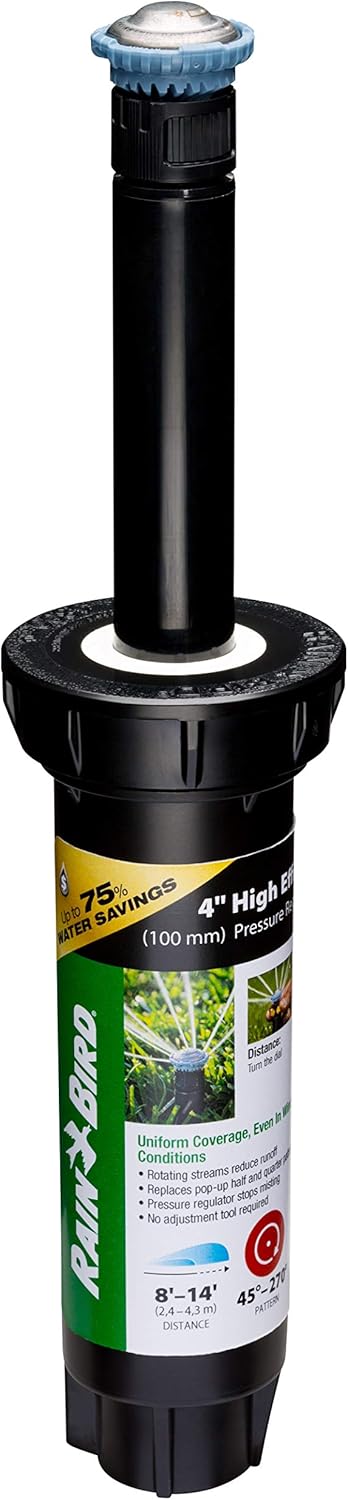
| Maximum Pressure | 30 psi |
|---|---|
| Maximum Flow Rate | 0.62 gpm |
| Inlet Connection Size | 4 inches |
| Style Name | Adjustable 45° – 270° |
The Rain Bird 8SAPROPR is a 4" pop‑up rotary sprinkler built for efficient, consistent performance in in-ground irrigation zones. It combines the 1800 Series pop‑up body with a built‑in PRS pressure regulator that holds outlet pressure at about 30 psi to prevent misting and maintain even distribution across the pattern. The R‑VAN rotary nozzle produces multiple rotating streams of large droplets, which improves wind resistance and allows the head to cover an 8 to 14 foot radius with an adjustable 45°–270° arc. You can hand‑adjust pattern and distance at the nozzle without tools and clear clogs by pulling the nozzle up while running water. The heavy‑duty plastic body, stainless spring, and sealed design are aimed at long life and reliable retraction in harsh soil conditions. Limitations to note are the relatively low maximum flow and pressure rating listed, so performance depends on matching the head to your zone hydraulics, and this is a replacement‑style pop‑up rather than a standalone above‑ground sprinkler for temporary use.
Best for: Buyers who prioritize reliable, water‑efficient performance and want a durable pop‑up rotor to upgrade or replace in‑ground sprinkler heads for better uniformity and wind resistance.
Less Ideal for: People needing a portable or temporary above‑ground sprinkler or those who cannot provide matching zone flow and pressure for rotor heads.
- Built‑in PRS regulator maintains ~30 psi for uniform coverage and reduced misting
- R‑VAN rotary nozzle delivers wind‑resistant, uniform streams for 8–14 ft coverage
- Hand‑adjustable pattern and distance with tool‑free clog flushing for quick on‑site adjustments
- Commercial‑grade 1800 Series body, stainless spring, and sealed design for durability in tough soils
- Maximum flow and pressure are modest so heads must be matched to zone hydraulics for best results
- Not intended as a temporary above‑ground sprinkler — designed for in‑ground pop‑up replacement use
Verdict: Choose this head when you want a durable, pressure‑regulating rotary pop‑up that improves distribution and cuts water waste in performance‑focused irrigation zones.
Hunter MP800SR 90–210° Short Radius Rotator Nozzle, 6–12 ft, 5-Pack

| Number of Packs | 5 |
|---|---|
| Material Type | Plastic |
| Maximum Pressure | 80 psi |
| Maximum Flow Rate | 12 liters per minute |
The Hunter MP800SR rotator nozzle is a short-radius rotary sprinkler head intended for 6 to 12 foot coverage and sold here as a five-pack. It installs in female-threaded spray heads from Hunter and other common brands and uses a slow, rotating stream to apply water at about 0.8 in/hr, which helps reduce runoff and improve soak-in on compacted or low-permeability soils. The nozzle includes a removable filter screen and a double-pop design to keep debris out, so it is lower maintenance than fixed spray tips in dirty water. Because it operates at low application rates and supports up to 80 psi and 12 L/min flow, it adapts well to systems with modest pressure while still delivering even rotary coverage across the 90 to 210 degree arc. The main limitations are that it is a small-radius head, so larger lawns will need different sizes, and it is plastic rather than metal, which is common for nozzles but may wear faster under heavy use.
Best for: Buyers who want to maximize water efficiency on small to medium lawn zones with limited pressure and prefer low-maintenance rotator performance across multiple spray heads.
Less Ideal for: Homeowners who need long-range coverage for large lawns or who prefer heavy-duty metal sprinkler components should look at other nozzle types or sizes.
- Low application rate (0.8 in/hr) reduces runoff and improves percolation
- Compatible with standard female-threaded spray heads from multiple brands
- Removable filter screen and double-pop design help resist clogging
- Five-pack gives spare nozzles for quick replacement or multiple zones
- Plastic construction may be less durable than metal alternatives
- Designed only for short 6–12 foot radius so not suitable for larger turf areas
Verdict: A water-efficient short-radius rotator sold in a 5-pack that is ideal for improving soak-in and reducing runoff on low-pressure small lawn zones.
Rain Bird 18RNQ Mini Rotary Spray Nozzle, 90° Quarter Circle, Adjustable 13'–18'

| Material Type | Stainless Steel |
|---|---|
| Maximum Pressure | 55 psi |
| Style Name | Rotary |
| Unit Count | 1 Count |
The Rain Bird 18RNQ is a mini rotary nozzle designed to replace standard pop-up spray nozzles and deliver water efficiently at low pressure. It produces multiple gentle rotating streams in a 90° quarter-circle pattern, adjustable from about 13 to 18 feet, and maintains a matched precipitation rate so you can use more heads per zone without over-watering. The stainless steel adjustment screw concealed under the cap lets you fine-tune radius, and a removable 200-mesh filter helps resist clogging. Engineered to operate across a wide 20 to 55 psi range, the nozzle reduces flow by roughly 60 percent compared with conventional sprays, which helps on slopes and in low-pressure systems by minimizing runoff and erosion. Practical limits are that it is a small quarter-circle unit so you will need the matching half and full models for other arcs, and nozzle performance still depends on correct system design and spacing. For homeowners wanting water-efficient coverage on lawns or beds with limited pressure, it is a straightforward way to upgrade existing pop-up heads to rotary performance.
Best for: Homeowners managing traditional pop-up zones who need reliable, water-efficient coverage on slopes or lawns with limited pressure and who prefer a simple retrofit to existing systems.
Less Ideal for: Large properties requiring full-circle coverage from a single head or irrigation setups that rely on very coarse debris-laden water where larger filtration is required.
- Efficient low-flow rotary streams deliver similar coverage at about 60% less flow than conventional spray nozzles
- Works across a wide 20–55 psi range so it performs well on low-pressure systems
- Adjustable stainless steel screw under the cap lets you set spray distance from 13' to 18'
- Removable 200-mesh screen reduces clogging and protects the nozzle
- Only provides a quarter-circle arc so multiple arc options require buying other nozzle variants
- Small physical size means less tolerance for heavy debris compared with larger heads
Verdict: If you need a compact, water-saving nozzle that keeps working in low-pressure zones, the Rain Bird 18RNQ converts standard pop-up heads into efficient rotary coverage with adjustable range.
Hunter MP Rotator Sprinkler Nozzle MP2000-90 (13–21 ft, 90°–210°)
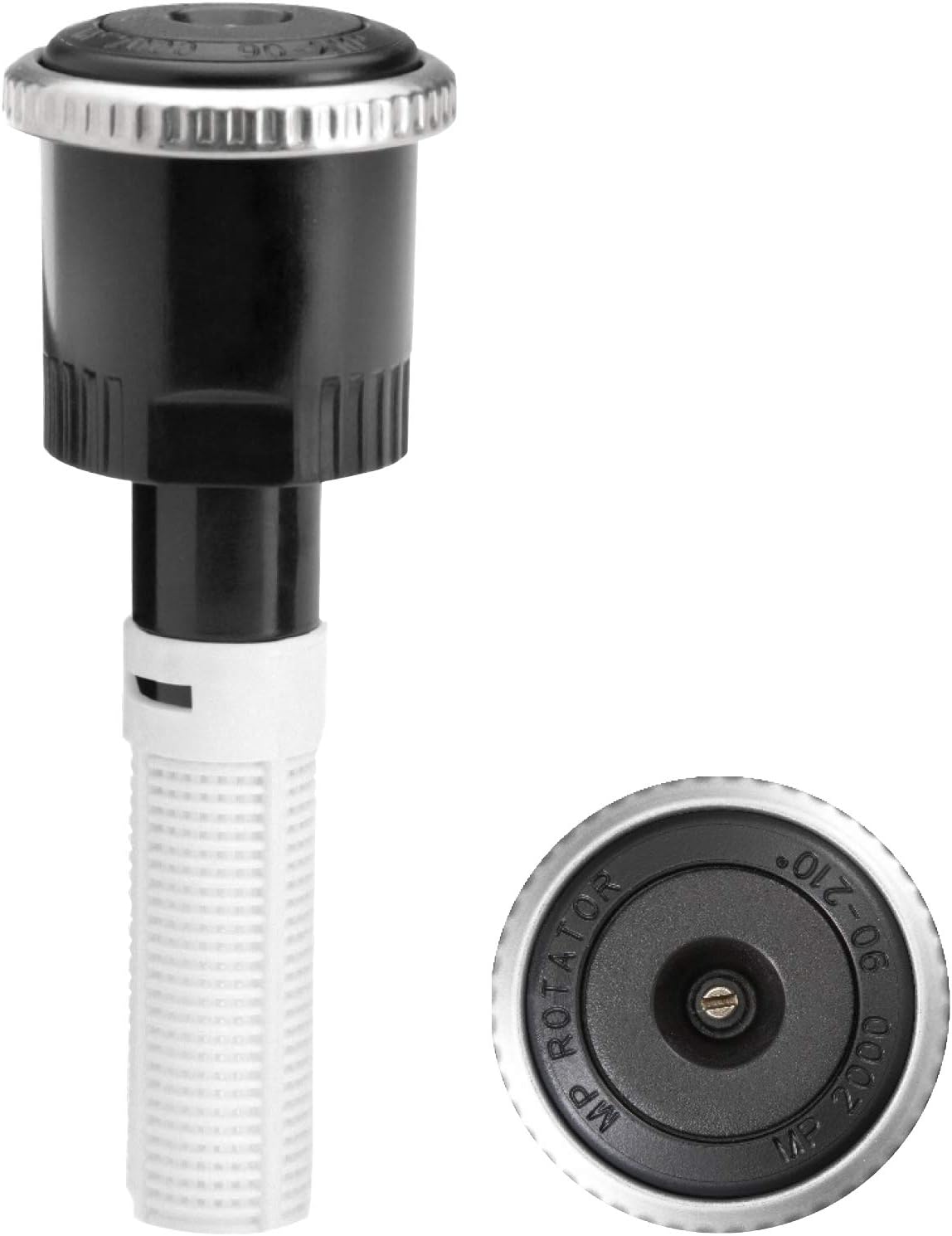
| Arc | 90°–210° |
|---|---|
| Radius | 13–21 ft |
| Thread | Female threaded |
| Material Type | Plastic |
The Hunter MP2000-90 MP Rotator is a retrofit sprinkler nozzle that turns standard pop-up spray heads into a slow, multi-stream rotating sprinkler to deliver uniform coverage with less runoff. Install it by swapping into most spray bodies or shrub adapters without tools, then fine-tune the arc (90°–210°) and radius (13–21 ft) for tight corners or irregular beds. Its multi-trajectory streams apply water slowly so soil soaks it in rather than running off, which is especially helpful in low-pressure systems and on slopes. The nozzle includes a built-in filter screen and a double-pop flushing action that helps resist clogging during startup and shutdown, supporting season-long reliability. For homeowners upgrading aging systems or tackling low PSI, it provides consistent coverage and up to 30% water savings versus conventional sprays. Be aware this is a single plastic nozzle intended for individual heads, so covering larger zones still requires planning nozzle placement and matching flow rates across the system.
Best for: Homeowners or landscapers who need a dependable, water-efficient nozzle that improves coverage in low-pressure or challenging zones and prefer practical upgrades over replacing spray bodies.
Less Ideal for: People who want an all-in-one rotor head replacement for large commercial zones or who need metal-heavy components for heavy-traffic sites should consider different products.
- Designed for low pressure and wind with multi-trajectory rotating streams for even coverage
- Adjustable arc (90°–210°) and radius (13–21 ft) for precise fit in irregular or tight zones
- Built-in filter screen plus double-pop flushing action reduces clogging and debris problems
- Retrofits into most standard spray bodies and shrub adapters without replacing the body
- Sold as a single nozzle so multiple heads are needed to upgrade whole systems
- Plastic construction may be less durable than metal components in high-wear installations
Verdict: Choose this MP Rotator if you want a reliable, clog-resistant nozzle that significantly improves coverage and saves water in low-pressure residential irrigation zones.
Rain Bird 12SAPROPR Pressure-Regulating Pro Rotary Pop-Up Sprinkler (4" pop-up)

| Maximum Pressure | 30 psi |
|---|---|
| Maximum Flow Rate | 0.01 cfm |
| Inlet Connection Size | 4 inches |
| Material Type | Plastic |
The Rain Bird 12SAPROPR is a compact 4" pop-up rotary sprinkler engineered for low or fluctuating water pressure zones. It combines the 1800 Series commercial-grade body with a built-in PRS regulator that holds outlet pressure at 30 psi so the R-VAN rotary nozzle runs efficiently without misting or drift. Install it in place of standard spray heads or within the same zone to gain more consistent coverage and reduce water waste. The hand-adjustable 45°–270° pattern and user-adjustable distance (about 13'–18') let you tailor coverage to beds, slopes, or tighter lawn areas without tools. The design includes a wiper seal, stainless steel spring, and a flushing action that helps clear debris by pulling the nozzle up while running. Because it is a plastic-bodied sprinkler designed for irrigation zones, expect the usual limitations of small pop-ups: it is best for lawn and turf areas rather than broad commercial turf, and replacement nozzles or different radii require compatible Rain Bird parts. Overall this head is a practical, water-efficient upgrade for systems struggling with high or uneven pressure.
Best for: Homeowners or installers who need a straightforward, water-efficient replacement head for zones with low or fluctuating pressure and want reliable, adjustable coverage without complex setup.
Less Ideal for: Large commercial turf areas or irrigation projects needing long throw rotors or metal-impact sprinklers; those requiring wider radius heads should choose larger rotor models.
- Built-in PRS regulator maintains 30 psi to prevent misting and improve uniformity
- High-efficiency R-VAN rotary nozzle delivers wind-resistant, uniform streams
- Hand-adjustable 45°–270° pattern and adjustable distance for precise coverage
- Flushing action and sealed stem reduce clogging and improve reliability
- Commercial-grade 1800 Series body features durable components for long life
- Plastic body may not be as impact-resistant as metal for heavy-duty commercial abuse
- Inlet connection listed generically which may require verifying fit with existing fittings
- Fixed spray distance range may not suit very large turf areas without different nozzle types
Verdict: Choose this Rain Bird pop-up when you need a durable, pressure-regulating sprinkler that delivers uniform, water-saving coverage in low or unstable pressure zones.
Rain Bird 24RNQ Mini Rotary Spray Nozzle, 90° Quarter Circle, Adjustable 18'–24'

| Maximum Pressure | 55 psi |
|---|---|
| Material Type | Plastic |
| Matched Precipitation Rate | 0.60 in/hr |
| Pattern | 90° quarter circle |
The Rain Bird 24RNQ is a small rotary spray nozzle designed to replace standard pop-up spray nozzles for quarter‑circle coverage and to work well on low pressure systems. It produces multiple rotating streams that match precipitation rates across its 18 to 24 foot adjustable radius, which helps spread water evenly while using roughly 60% less flow than conventional fixed spray nozzles. That makes it useful on slopes and in zones where you want to reduce runoff and erosion. The nozzle includes a removable 200 mesh screen to reduce clogging and a concealed stainless adjustment screw for fine tuning distance. It maintains consistent performance between 20 and 55 psi with minimal misting at higher pressures. The top cap is color coded for quick identification and the plastic construction is UV and chemical resistant for outdoor durability. Expect straightforward retrofit of existing Rain Bird pop-up heads, but understand this is a single quarter‑circle nozzle so full or half patterns require separate SKUs or additional heads to cover larger areas.
Best for: Homeowners who need a reliable, water‑efficient nozzle for existing pop‑up sprinkler systems and want predictable performance on low to moderate water pressure.
Less Ideal for: Large lawns that require full‑circle coverage from a single head or users who need metal-bodied commercial-grade nozzles for heavy‑duty applications.
- Works effectively at low pressures (20–55 psi) and reduces flow compared with conventional spray nozzles
- Adjustable 18'–24' radius with concealed stainless screw for precise distance control
- Removable 200 mesh screen helps prevent clogging from debris
- Matched precipitation rate simplifies system design and allows more heads per zone
- Quarter circle pattern only, so multiple heads or different models are needed for full coverage
Verdict: Choose the 24RNQ when you want a compact, low‑flow rotary nozzle that gives even quarter‑circle coverage and reliable performance on low pressure systems.
Choosing the Right Rotary Sprinkler Head for Low Water Pressure: Key Factors to Consider
Operating Pressure Range
Know the actual static and dynamic pressure available at the sprinkler location. A rotary head rated to work at lower PSI will produce coherent streams rather than misting, which preserves reach and reduces wind drift.
Operating range affects how many heads you can run on a single zone and whether you need pressure-regulating devices. If your supply pressure sits near the bottom of a head's range, plan for slightly reduced radius and check nozzle options tuned for low-pressure output.
Nozzle and Arc Adjustability
Adjustable nozzles let you tune radius and arc without changing the head. For low-pressure systems, look for nozzles that are explicitly labeled for reduced PSI or that allow exchange to lower-flow options. This adaptability helps you balance overlap across irregular lawn shapes.
Arc adjustment that is easy to set in the field reduces installation time and avoids frequent rework. Fine control over spray angle and sector length is important when you cannot rely on pressure to compensate for misalignment.
Stream Quality and Droplet Size
At low pressure, droplet size tends to increase and streams can break into mist. Prefer heads that form defined, heavier streams at lower PSI because larger droplets are less prone to wind drift and evaporation, and they reach intended plants more effectively.
Stream quality also affects soil infiltration. Coherent streams deliver water deeper into soil rather than just wetting the surface, which is better for root development and reduces runoff on sloped yards.
Durability of Drive Mechanism
Rotary heads rely on a mechanical drive to rotate the nozzle pattern. In low-pressure conditions, the drive must be designed to move with less force available. Look for robust gears, sealed bearings, or proven low-torque designs that resist clogging and wear.
A durable drive reduces maintenance visits and keeps spray patterns consistent over seasons. Consider how easy it is to access and service internal components if grit or mineral buildup is likely in your water supply.
Installation and Fitting Compatibility
Confirm that the head fits common pop-up assemblies and standard pipe thread sizes used in residential systems. Compatibility reduces the need for adapters that can leak or create pressure losses.
Ease of installation matters if you plan to retrofit heads into an existing system. Simple snap-in nozzles or standard male/female threads save time and lower the chance of mismatched flow characteristics.
Maintenance and Parts Availability
Routine maintenance keeps low-pressure heads operating as intended. Choose models with replaceable nozzles, accessible filter screens, and drive components that can be serviced without excavating lines.
Parts availability is important over the long term. Models that use standard nozzle sizes or have replacement kits make it easier to maintain uniform coverage without swapping entire assemblies.
Matching Heads To Typical Low-Pressure Scenarios
Low-pressure conditions arise from several causes: long lateral runs, small-diameter piping, well pump limitations, or municipal supply that drops during peak use. Identify which scenario applies to your property because it influences how many heads a single zone can support and which nozzle types will perform best.
For long runs and smaller pipes, prioritize heads and nozzles that operate well with reduced flow. In systems where pressure fluctuates, pick heads that maintain consistent stream pattern across the expected pressure band so coverage does not shift between morning and evening.
- Long lateral runs: use lower-flow nozzles to preserve pressure down the line
- Small-diameter piping: reduce head count per zone to maintain adequate pressure
- Well systems: verify pump cut-in pressure and match heads to that range
- Municipal drops: stagger irrigation times to avoid peak demand declines
Retrofit Tips for Existing Irrigation Systems
When replacing older spray heads with rotary low-pressure models, inspect the valve and piping for blockages and confirm the irrigation controller cycle lengths. Rotaries often apply water more slowly than high-pressure sprays, so you may need longer run times or changes to zone grouping.
Check connection fittings and pop-up heights so new heads clear surrounding turf and landscape. If pressure is marginal, installing a pressure-regulating device at the zone or swapping to low-flow nozzles can prevent misting and improve uniformity.
- Measure both static and dynamic pressure before swapping heads
- Adjust run time to account for lower precipitation rates
- Ensure pop-up riser height is correct for unobstructed rotation
Water-Saving Practices with Low-Pressure Rotaries
Rotary heads designed for low pressure can be more water-efficient than misting sprays because they produce larger droplets that reach turf and plants better. Combine these heads with zoning and smart controller scheduling to avoid overwatering.
Consider cycle-and-soak programming for soils with low infiltration rates. Shorter cycles repeated with soak periods reduce runoff while ensuring deeper soil wetting.
- Use matched precipitation rates when grouping heads in a zone
- Prefer early morning irrigation to reduce evaporation losses
- Use cycle-and-soak for compacted or sloped areas
Dealing with Hard Water and Debris
Mineral buildup and particulate debris can quickly degrade nozzle orifices and drive gears, especially in low-pressure systems where small losses have large effects on spray behavior. Install simple inline screens or clean nozzle filters regularly to maintain consistent streams.
If your water has heavy mineral content, choose heads with easily replaceable nozzles and components to simplify maintenance. Regular flushing of lateral lines can also prevent sediment from lodging in moving parts.
- Install filters at the zone valve if sediment is present
- Keep spare nozzle kits on hand for seasonal maintenance
- Periodically lift and inspect pop-up internals for grit
Optimizing Overlap and Coverage Patterns
Rotary heads require correct spacing and overlap to avoid dry spots. In low-pressure systems the effective radius may shrink, so plan for slightly tighter spacing or adjust nozzles to increase overlap where needed.
Use field adjustments to match arc settings to lawn shape, and walk test each zone after installation to confirm that streams meet in the desired locations without excessive pooling.
- Perform a catch-can test to verify precipitation uniformity
- Adjust arc and radius on-site rather than relying solely on specs
- Re-space or re-zone heads if low pressure prevents intended reach
How We Chose the Best Rotary Sprinkler Head for Low Water Pressure
We selected products that perform reliably under reduced inlet pressure and in common residential irrigation setups. Primary evaluation criteria included spray efficiency at low PSI, nozzle adaptability for different radii and droplet sizes, mechanical reliability of the rotary mechanism, ease of adjustment and maintenance, and compatibility with standard piping and pop-up assemblies. We prioritized heads that maintain defined streams rather than producing fine misting at low pressure, because misting wastes water and reduces effective coverage. We excluded heads designed only for high-pressure systems or stationary spray patterns that require normal municipal pressure to function correctly. We also filtered out models with recurrent user reports of rapid wear in the drive mechanism or nonstandard fittings that complicate replacement. The resulting shortlist emphasizes dependable low-pressure distribution, simple on-site adjustments, and parts that are widely serviceable within home irrigation systems.
FAQ
What minimum pressure should I expect for a rotary sprinkler head to operate well?
It depends on the head, but many low-pressure rotary designs start functioning effectively at pressures well below typical spray-head requirements. Check the head's operating range and compare it to measured static and dynamic pressure at the zone before choosing.
Can I improve performance without changing the pump or main supply?
Often yes. Swapping to nozzles designed for lower PSI, reducing the number of heads per zone, or adding a pressure-regulating device that stabilizes zone pressure can yield big improvements without major plumbing changes.
Do rotary heads save water compared with traditional fixed spray heads at low pressure?
They can. At low pressure, rotary heads that form heavier streams deliver water more efficiently to target areas and reduce drift. However, proper matching of nozzle flow rates and correct zoning are essential to realize water savings.
How often should I perform maintenance on rotary sprinkler heads?
Inspect heads seasonally and after any prolonged shutdown. In areas with sediment or hard water, check and clean nozzles and filters more frequently to prevent flow restriction and wear to the drive mechanism.
Will a low-pressure rotor still work in windy conditions?
Larger droplets from low-pressure rotaries are less affected by wind than fine mist, but strong winds will still distort streams. Schedule watering during calmer windows, typically early morning, to maximize uniform coverage.
Are replacement nozzles and parts widely available for these heads?
Many rotary heads use standard nozzle sizes and common fittings, making parts readily available. Confirm that replacement nozzles, seals, and drive components are offered before installing heads in remote or hard-to-access zones.
Final Verdict
Choose a rotary sprinkler head that matches your measured pressure band and the layout of your lawn. Prioritize models that maintain coherent streams at lower PSI, offer easy nozzle options for radius control, and have a robust drive that resists clogging. Accept the tradeoff that low-pressure rotaries often need longer run times than high-pressure sprays. Focus on proper zoning, overlap, and routine maintenance to get consistent, water-efficient coverage in a low-pressure system.
