

Note: This article contains affiliate links. If you click on these links and make a purchase, I may earn a small commission at no extra cost to you. This helps support my research and content. Read my full affiliate disclosure here.
Wind changes how water lands and how well your landscape gets irrigated. Choosing the right sprinkler head for windy areas matters because a mismatched nozzle or spray pattern can waste water, leave dry patches, and stress plants. This guide covers seven top-performing sprinkler heads shortlisted for breezy conditions and explains the practical tradeoffs gardeners face when controlling drift and maintaining uniform coverage. We evaluate stability in crosswinds, spray pattern control, and compatibility with common home irrigation setups so you can pick an option that suits your lawn, garden beds, or mixed planting areas. Read on to see the decision factors used to create the shortlist and what to prioritize for your yard.
Top Picks at a Glance
| Best Overall The best all-around choice for most situations | Rain Bird 52SA Stainless Steel Gear-Drive Rotor Sprinkler (25–50 ft) |  |
| Best Quality Built to a higher standard if you want something more solid | Biswing 2-Pack Impact Sprinkler Heads (1/2" NPT, Zinc Alloy) |  |
| Best Value The sweet spot between price and what you get | Orbit Tripod Zinc Impact Sprinkler (56667) |  |
| Best Budget The cheapest option that still gets the job done reliably | Rain Bird HE-VAN High Efficiency Variable Arc Nozzle (8–10 ft) |  |
| Highest Rated A top-rated pick with lots of positive feedback | Hunter 8A Adjustable Spray Nozzle, 8 ft Radius, 0°–360° Arc |  |
| Most Popular A crowd favorite that many people choose with confidence | Rain Bird 1804VAN 1800 Series 4-inch Pop-Up Sprinkler Head (4 pack) |  |
| Best Seller A high-volume bestseller chosen again and again | Rain Bird 1806VAN 1800 Series 6 in. Pop-Up Sprinkler Head (5-pack) |  |
Rain Bird 52SA Stainless Steel Gear-Drive Rotor Sprinkler (25–50 ft)

| Maximum Pressure | 70 psi |
|---|---|
| Maximum Flow Rate | 3 gpm |
| Inlet Connection Size | 0.75 inches |
| Material Type | Stainless Steel |
The Rain Bird 52SA is a contractor-grade gear-drive rotor built for dependable, long-range lawn irrigation. It delivers a 25 to 50 foot throw with a preinstalled 3.0 gpm nozzle and uses Rain Curtain nozzle technology to create large, wind-resistant droplets for more even coverage and less overspray. Top-of-head adjustments let you set arc (40° to 360°) and distance with a flat screwdriver while the quick check arc/fast-forward feature makes setup and troubleshooting simple while the head is running. The closed-case design, stainless-steel shaft, water-lubricated gears, and dual-action wiper seal protect internal parts from grit and creeping grasses, which helps the rotor run reliably in sandy or harsh soils. It pops up 4 inches to clear taller turf and has a 3/4" NPT female bottom inlet for contractor plumbing. Limitations are that it requires matching pressure and flow to reach the longest distances and replacement nozzles are sold separately if you need different flow rates or finer tuning for irregular lawns.
Best for: Buyers who prioritize a low-maintenance, long-lasting rotor for large lawns and want reliable, contractor-grade coverage without frequent servicing.
Less Ideal for: Homeowners with very low water pressure systems or those needing a compact spray head for small, densely planted beds should consider alternatives.
- Robust stainless-steel shaft and water-lubricated gear drive for long service life
- Rain Curtain nozzle produces large, wind-resistant droplets for uniform coverage
- Top-access arc and distance adjustments plus quick check feature speed installation and tuning
- Closed-case design and wiper seal protect internal components from debris and gritty water
- Requires sufficient system pressure and flow to achieve the full 25–50 ft throw and optimal uniformity
Verdict: Choose the 52SA when you need a dependable, long-range rotor built to withstand gritty soils and deliver consistent 25–50 foot coverage.
Biswing 2-Pack Impact Sprinkler Heads (1/2" NPT, Zinc Alloy)

| Maximum Pressure | 60 psi |
|---|---|
| Inlet Connection Size | 0.5 inches |
| Unit Count | 2 Count |
These Biswing impact sprinkler heads are built for heavy outdoor use and cover wide areas. Each head threads onto a standard 1/2 inch fitting and lets you set the arc from 20 to 360 degrees, while a top dial adjusts throw distance from a concentrated short pattern to a maximum spray that can reach large lawns. The body combines zinc alloy with brass and stainless steel internals, which helps resist corrosion and gives the heads a solid, weighty feel compared with plastic alternatives. A diffuser screw lets you fine tune spray intensity from a gentle mist to a strong jet, and the clearly marked guides make repeatable adjustments straightforward. They perform best with moderate to high water pressure as recommended, so expect full range only when supply pressure is sufficient. The package is two heads, which is convenient for pairing multiple zones or keeping a spare. If you need a low-pressure or pop-up automatic solution these stationary impact heads are less appropriate, but for reliable, serviceable sprinkler heads that handle heavy-duty seasonal use they are a practical choice.
Best for: Gardeners and property owners who prioritize long-lasting, serviceable irrigation hardware and need reliable, adjustable coverage for lawns, large flower beds, or agricultural plots.
Less Ideal for: People who need low-pressure, pop-up, or smart automatic sprinkler heads integrated into underground irrigation systems.
- Durable metal construction (zinc alloy, brass, stainless steel) resists rust and wear
- Adjustable arc from 20 to 360 degrees for full or partial coverage
- Top dial for precise distance control to tailor coverage up to the product's maximum range
- Diffuser screw allows changing spray intensity from mist to strong jet
- Sold as a two-pack so you can equip multiple zones or keep a backup
- Requires moderate to high water pressure to achieve maximum throw
- Stationary design is not intended for pop-up or fully automated in-ground systems
Verdict: A rugged two-pack impact sprinkler built from metal components that gives reliable, adjustable coverage for large lawns when paired with adequate water pressure.
Orbit Tripod Zinc Impact Sprinkler (56667)

| Material Type | Zinc |
|---|---|
| Maximum Pressure | 80 psi |
| Maximum Flow Rate | 1.8 gpm |
The Orbit Tripod Zinc Impact Sprinkler is a robust, elevated sprinkler built to cover wide lawns with a rotating impact head and adjustable tripod. You connect a standard garden hose, set the tripod height and spray arc, and the zinc impact head delivers a steady rotating spray that can reach long distances for up to a 90-foot diameter. Notable features include a clog-resistant impact mechanism that tolerates dirty or reclaimed water, a high-pressure nozzle for extended range, and an anti-backsplash arm and deflector for tuning spray pattern from partial to full circle. The all-metal zinc construction and adjustable 22 to 48 inch tripod make it stable and durable for repeated seasonal use. Limitations to consider are its single-stream flow rate, which is geared to long reach rather than fine misting or water conservation on small plots, and the tripod adds weight and footprint compared with compact ground sprinklers, so it is less convenient for frequent repositioning.
Best for: Homeowners with medium to large lawns who prioritize reliable, long-range coverage and durable construction for seasonal irrigation and minimal maintenance.
Less Ideal for: People with small yards, container gardens, or who need a low-flow or fine-misting sprinkler for delicate plants should choose a more compact, water-efficient option.
- Durable all-metal zinc impact head and tripod for long-term outdoor use
- Adjustable tripod height and spray arc for elevated, customizable coverage
- Clog-resistant impact design suitable for dirty or reclaimed water
- High-pressure nozzle capable of covering up to a 90-foot diameter
- Single high-flow nozzle favors long-range coverage over water-efficient fine spray
- Heavier and bulkier than low-profile ground or plastic sprinklers, making frequent moves more effort
Verdict: Choose this tripod impact sprinkler when you need durable, adjustable elevated coverage to water large lawns reliably and with long reach.
Rain Bird HE-VAN High Efficiency Variable Arc Nozzle (8–10 ft)

| Maximum Pressure | 30 psi |
|---|---|
| Maximum Flow Rate | 0.5 gpm |
| Spray Radius | 8 to 10 ft |
The Rain Bird HE-VAN variable arc nozzle is a compact replacement spray nozzle that delivers an 8 to 10 foot radius with adjustable arc from 0 to 360 degrees. It is designed for residential irrigation and uses low flow to create larger, wind-resistant droplets that cut misting and evaporation, which is especially helpful in breezy conditions. Installation is straightforward as a drop-in nozzle on standard pop-up heads and homeowners will notice shorter run times thanks to the high-efficiency design. Notable features include a maximum pressure rating of 30 psi and a maximum flow of 0.5 gpm, plus fine-tunable arc and radius adjustments for close-in, even coverage. The nozzle’s plastic construction keeps cost and weight down but means it is not the most heavy-duty option if you need extreme durability. Overall it is a practical, water-saving choice for replacing worn spray nozzles in windy yards when you want consistent coverage without the fine mist that blows away.
Best for: Homeowners who want an inexpensive, water-saving replacement nozzle that performs well in breezy conditions and fits standard spray heads for small to medium lawn zones.
Less Ideal for: Those needing heavy-duty commercial-grade nozzles or anyone covering large turf areas where longer radius spray heads are required.
- Designed to create larger, wind-resistant droplets that reduce misting and evaporation
- Adjustable arc and 8–10 ft radius allow targeted coverage and close-in watering
- High-efficiency design can shorten sprinkler run times by up to 35 percent
- Low flow rate (0.5 gpm max) helps conserve water and lower irrigation run time
- Plastic construction is less rugged than metal alternatives for high-wear settings
- Limited to an 8–10 ft radius so not suitable for larger coverage zones
Verdict: A budget-friendly, water-saving nozzle that reduces misting and delivers reliable short-radius coverage in windy yards.
Hunter 8A Adjustable Spray Nozzle, 8 ft Radius, 0°–360° Arc

| Material Type | Plastic |
|---|---|
| Inlet Connection Size | 0.75 inches |
| Item Highlight | 8 ft adjustable spray nozzle with 0°-360° arc and filter screen |
| Brand Name | Hunter |
The Hunter 8A Adjustable Spray Nozzle is a compact, tool-free replacement nozzle for pop-up sprinkler bodies designed for precise, repeatable watering of small zones. It lets you set the arc anywhere from 0° to 360° by hand, so you can accurately water narrow edges, garden beds, or small lawn circles without overspray. The 8 foot radius model delivers a balanced spray pattern and larger droplet sizes that resist wind and reduce misting, which keeps water on target in breezy conditions. Installation is simple: the nozzle snaps into most standard spray bodies and includes a mesh filter to cut down on clogs from debris. Made from durable plastic and engineered for field adjustment, it suits both routine residential maintenance and professional irrigation work. Limitations are minimal for its class but include a fixed maximum radius of about 8 feet so it is not intended for larger turf areas and being plastic it can be damaged by rough handling or freezing if left exposed.
Best for: Installers and homeowners who need a dependable, easy-to-adjust nozzle for small, high-precision zones and want consistent performance in breezy sites.
Less Ideal for: Large lawns or open areas that require greater spray distance should use rotors or longer-radius nozzles instead.
- Adjustable arc from 0° to 360° for precise targeting
- 8 foot radius with even distribution suited to small zones
- Larger droplet design reduces misting and performs well in wind
- Tool-free hand adjustment and easy snap-in installation
- Built-in mesh filter helps prevent clogs
- Designed for short-range coverage only and not suitable for larger lawns
- Plastic construction can be vulnerable to impact or freeze damage
Verdict: A reliable, wind-resistant adjustable nozzle that gives precise control for small zones and consistent watering where accuracy matters most.
Rain Bird 1804VAN 1800 Series 4-inch Pop-Up Sprinkler Head (4 pack)

| Material Type | Stainless Steel |
|---|---|
| Item Highlight | Adjustable 0-360 Degree Arc Nozzle; Up to 15 Ft Spray Distance; 1/2in NPT Threaded Inlet |
| Maximum Flow Rate | 176.71 cfm |
| Inlet Connection Size | 4 inches |
The Rain Bird 1804VAN is a compact 4-inch pop-up sprinkler head intended for lawns, garden beds, and landscaped zones where precise, matched precipitation is needed. Install it on a 1/2-inch female inlet and use the textured adjustment collar to set any arc from 0 to 360 degrees without tools, which simplifies corner and strip watering and reduces overspray. The head is built with UV- and weather-resistant components, a stainless-steel spring for reliable retraction, and a pressure-activated wiper seal to minimize leakage and prolong life. It delivers spray distances up to about 15 feet, making it suitable for small to medium turf areas and perimeter runs. Limitations are that it is a fixed spray pop-up rather than a pressure-regulated or multi-stream rotor, so it best serves zones designed for fixed-pattern spray heads and may require careful pressure and spacing planning to avoid misting or runoff. For gardeners focused on dependable, widely used components, these Rain Bird heads offer straightforward performance and long-term durability.
Best for: Buyers who prioritize proven, widely used irrigation parts and want reliable, easy-to-adjust spray heads for conventional lawn or landscape zones.
Less Ideal for: Those planning high-efficiency pressure-regulated or rotor-based zones for large turf areas should consider heads designed for pressure regulation or multi-stream rotors instead.
- Adjustable 0–360 degree nozzle for precise arc control without tools
- Durable construction with stainless-steel spring and UV-resistant materials for long service life
- Pressure-activated wiper seal to reduce leakage and conserve water
- Compatible 1/2-inch female inlet common to residential irrigation systems
- Not pressure-regulated so performance depends on system pressure and proper spacing
Verdict: A dependable, easy-to-adjust pop-up spray head that delivers proven durability and precise arc control for typical lawn and landscape irrigation needs.
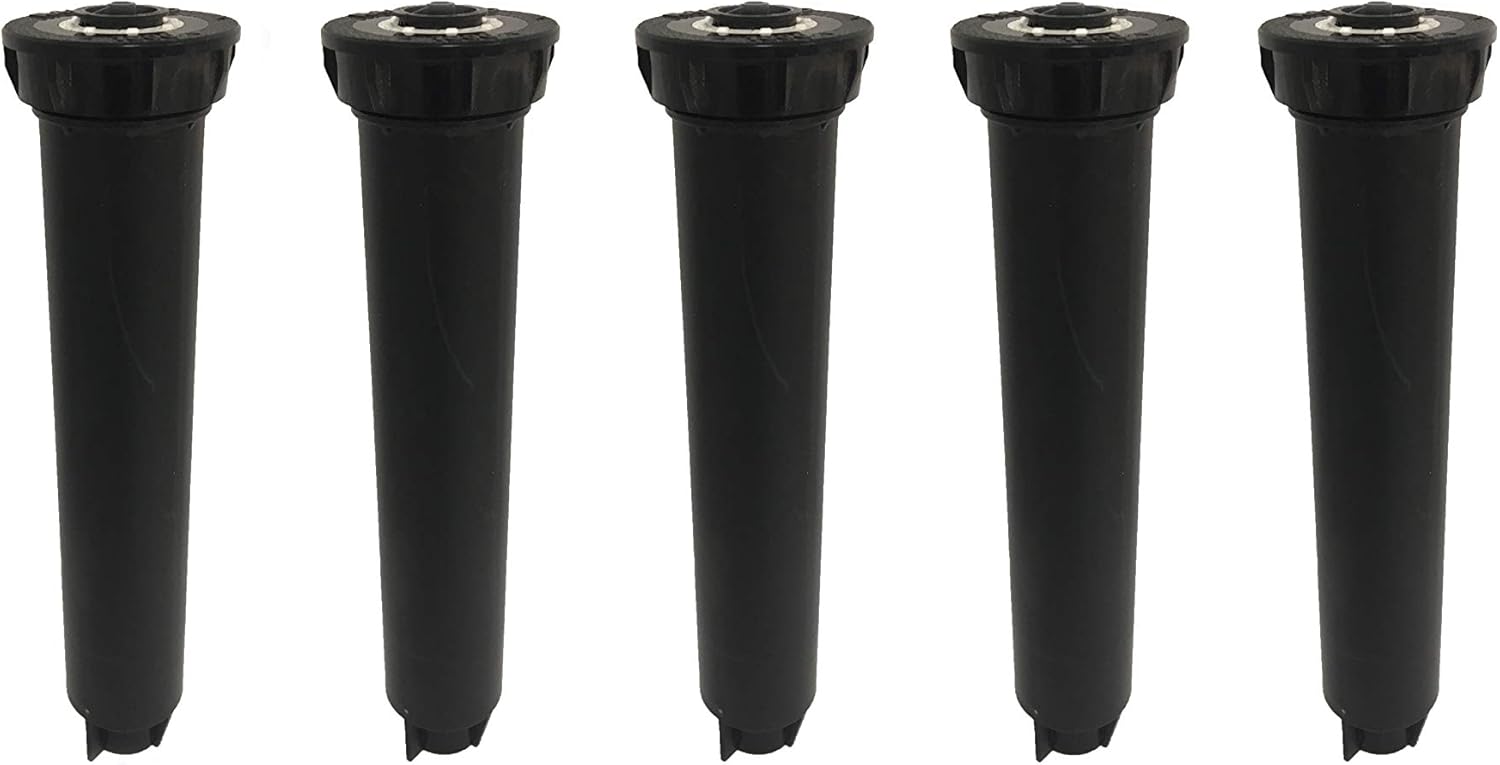
Rain Bird 1806VAN 1800 Series 6 in. Pop-Up Sprinkler Head (5-pack)
| Unit Count | 5 Count |
|---|---|
| Maximum Flow Rate | 17.4 liters per minute |
| Inlet Connection Size | 0.5 inches |
| Material Type | Stainless Steel |
The Rain Bird 1806VAN is a straightforward, dependable pop-up sprinkler head sold in a five-pack for small to medium lawn systems. Each head installs on a standard 1/2-inch female NPT riser and offers an adjustable 0 to 360 degree arc so you can set quarter, half, or full-circle patterns without tools. The unit sprays reliably out to about 15 feet with a matched-precipitation nozzle and uses a stainless-steel spring and a pressure-activated wiper seal to reduce leakage and ensure the head retracts flush. In practice the build quality and UV-resistant materials mean these hold up well in typical residential conditions, and the textured adjustment collar makes fine-tuning quick during layout or repairs. Limitations: these are fixed-pattern spray heads rather than multi-stream rotors, so they work best on smaller zones and turf areas rather than large-reach landscapes where rotors are more efficient. Also they do not include a built-in pressure regulator model in this SKU, so very high-pressure zones may need external regulation for best uniformity.
Best for: Homeowners who want a reliable, no-nonsense replacement or new-install spray head for small to medium lawn zones and who prioritize ease of setup and long-term reliability.
Less Ideal for: Large properties or irrigation zones that require long throw and high efficiency where rotor heads would provide better coverage and lower run times.
- Adjustable 0–360° arc for precise coverage of corners and strips
- Matches precipitation over its spray radius for even watering
- Durable construction with stainless-steel spring and UV-resistant materials
- Standard 1/2-inch female inlet for easy retrofit into existing systems
- Fixed spray type is less water-efficient than rotor heads on large lawns
- No built-in pressure regulation in this model
Verdict: A dependable, easy-to-install spray head pack that gives precise, leak-resistant coverage for small to medium residential lawn zones.
Choosing the Right Sprinkler Head for Windy Areas: Key Factors to Consider
Spray Pattern and Coverage Shape
The spray pattern determines how water is distributed and how vulnerable the output is to crosswinds. Rotors and stream-type nozzles deliver larger droplets that travel farther and are less likely to drift, while fine spray and mist-style heads break water into smaller droplets that can blow off target in breezy conditions.
Think about the shape of the area to be irrigated. Narrow strips next to fences or mixed planting beds benefit from targeted streams or adjustable sector heads that allow you to reduce arc and throw. Broad lawns may call for overlapping patterns but in windy spots you should aim for shorter throw and more frequent spacing to maintain uniform moisture without waste.
Droplet Size and Wind Drift
Droplet size is a practical determinant of drift. Larger droplets have more mass and momentum, so they resist being carried away by crosswinds. If you garden in a consistently breezy location, prioritize heads or nozzles that produce coarser droplets or let you switch to stream-style outputs.
Adjustable nozzles that offer a range of droplet sizes give you flexibility for seasonal changes. In still conditions you can use finer sprays for softer coverage, and when winds pick up you can switch to coarser patterns to preserve applied water where it is needed.
Pressure Compatibility and Flow Control
Homes and irrigation zones vary in operating pressure, and a head that relies on very high pressure to form a tight stream may become inefficient when pressure drops or fluctuates. Choose heads that perform well across a realistic residential pressure range and that include flow or pressure compensation features if your system is prone to variance.
Flow control allows you to reduce throw without changing the nozzle, which helps when wind makes your normal settings inefficient. A head that performs consistently at lower flow also reduces the risk of over-spraying during gusts and helps keep watering schedules predictable.
Adjustability and Ease of On-Site Tuning
Being able to dial in arc, range, and nozzle aperture in the field is essential for windy areas. Gardeners should favor heads with simple, tool-free adjustments or clearly marked settings so you can quickly decrease throw or change the spray pattern when conditions change.
Fine-tuning also speeds troubleshooting. If some zones show dry patches after a windy day, physical adjustability makes it faster to reorient heads or reduce sector sizes without dismantling the system.
Durability and Clog Resistance
Outdoor components in dusty, sandy, or mineral-rich water environments can clog, which changes droplet size and pattern – and that makes wind-related problems worse. Look for heads with screens, easy-to-remove nozzles, or self-flushing designs that minimize clog-related drift.
Materials and seal quality affect long-term stability. A durable head that resists warping or leaks will maintain its alignment and calibration through weather cycles and lawn maintenance, reducing the need for repeat adjustments in windy sites.
Installation Flexibility and Zone Design
Where you place heads and how zones are laid out has a direct effect on wind performance. Flexible installation options let you adjust head heights or swap in different nozzle types for exposed zones without redesigning the whole system.
Design zones to minimize long travel distances across open, wind-swept lawns. Shorter throw with more heads can outperform longer throw with fewer heads when gusts are common. Consider using a mix of stream-style heads on exposed edges and finer spray heads in sheltered planting beds.
How Wind Affects Different Head Types
Not all sprinkler heads respond the same way to wind. Pop-up sprays and fixed-pattern nozzles often produce finer droplets that scatter more readily, while rotating stream heads create concentrated jets that resist drifting. Understanding these mechanical differences helps you choose a style that matches the exposure of a given zone.
In many yards a hybrid approach works best: use stream-style or rotor heads along exposed borders and open lawns, and reserve finer sprays for sheltered beds where coverage softness is beneficial.
- Rotors and stream nozzles: larger droplets, better wind resistance
- Fixed spray nozzles: good for short-range, but more drift-prone
- Adjustable nozzles: let you tune throw and arc for changing conditions
Practical Adjustment Tips for Breezy Days
Make small adjustments to range and arc rather than increasing run time to compensate for drift. Reducing throw keeps water closer to plants and cuts crosswind loss. If your heads have flow control, reduce output first and only lengthen run times if the zone still needs more water.
When gusts are forecasted, lower the head height when possible or switch to coarser nozzles. Schedule irrigation for calmer parts of the day, typically early morning before thermal winds build, to reduce drift without changing equipment.
- Reduce throw and increase overlap to maintain even coverage
- Operate systems during calm windows, usually early morning
- Use flow control to adjust output without changing nozzles
Retrofitting Existing Systems for Windy Spots
If you have an established layout, you do not always need a full redesign to improve wind performance. Swapping in specific nozzle types or adding adjustable heads to exposed zones can yield big improvements. Focus on perimeter heads and long-run zones where drift tends to create dry edges.
Where retrofit limits are strict, consider adding deflectors or shields around heads to break prevailing gusts, or lowering head risers to reduce droplet travel distance. These simple changes can be a cost-effective alternative to rerouting piping.
- Target perimeter and long-run heads for nozzle swaps
- Lower riser heights to reduce droplet travel where practical
- Add physical shielding for particularly exposed locations
Seasonal Strategies and Maintenance
Wind conditions change with seasons, so a strategy that works in spring may need tweaking in late summer. Check and reorient heads after seasonal storms and perform routine nozzle cleaning to keep patterns consistent. Regular maintenance prevents gradual pattern drift caused by clogs or misalignment.
Adjust watering schedules seasonally to take advantage of calmer days and to reduce run times during windy stretches. Keep an eye on plant response and soil moisture rather than only on elapsed irrigation minutes.
- Inspect and clean nozzles before peak watering seasons
- Re-check head alignment after storms or lawn work
- Adjust run times seasonally to match calmer windows
Pressure Management Across Zones
Different zones often operate under different pressures because of pipe length and elevation. Use pressure regulating nozzles or pressure-compensating heads in long-run or uphill zones to maintain consistent droplet size and reduce wind sensitivity caused by pressure variance.
If pressure spikes make heads over-throw, install local regulators to keep output steady. Conversely, if pressure is too low for a given head to form a stable stream, choose heads designed to perform well at lower pressure to avoid uneven coverage.
- Install pressure regulators where pressure is inconsistent
- Select nozzles rated for your measured zone pressure
- Balance zones so exposed areas have reliable droplet formation
How We Chose the Best Sprinkler Head for Windy Areas
We focused on characteristics that directly affect performance in windy conditions and practical backyard irrigation needs. Our evaluation emphasized spray stability and pattern control because wind-driven drift and uneven distribution are the core problems this category must solve. We also considered nozzle adjustability and fine-tuning so gardeners can dial back throw or change droplet size to suit varying wind speeds. Coverage uniformity under realistic pressure ranges was another key filter. Sprinkler heads that maintained consistent distribution across common residential pressures scored better because inconsistent patterns amplify wind-related problems. Durability and clog resistance mattered as well because persistent maintenance issues or failures magnify irrigation gaps when wind is already a challenge. Finally, we checked compatibility with typical irrigation layouts and ease of on-site adjustment so installations do not require elaborate retrofitting. We excluded specialty commercial-only equipment and heads designed exclusively for high-pressure agricultural systems because they do not reflect typical home or small-plot use. The final picks balance wind performance, real-world adjustability, and installation practicality.
FAQ
What spray pattern is best when there is a steady crosswind?
Stream-style or rotor patterns that produce larger droplets are usually best in steady crosswinds because the droplets resist being blown off target. Reducing throw and increasing overlap also helps maintain even coverage.
Can I fix wind-related drift by simply running irrigation longer?
Running longer often wastes water because drift redistributes applied water away from plants. It is usually better to reduce throw, switch to coarser droplet settings, or adjust timing to calmer parts of the day than to extend run times.
How often should I check sprinkler heads in windy locations?
Inspect heads at least seasonally and after significant storms or high-wind events. Regular checks for alignment, clogging, and wear prevent gradual coverage changes that wind can exacerbate.
Are there nozzle types that work well across different wind conditions?
Adjustable nozzles that let you change arc and droplet size are versatile because they allow seasonal tuning. Pressure-compensating nozzles also help maintain consistent droplet formation across variable system pressures.
Should I change head height to reduce wind drift?
Lowering head height can reduce travel distance and help limit drift, but it may also reduce overlap and increase shadowed zones. Make small adjustments and check coverage to ensure plants still receive water evenly.
Is irrigation timing important for windy areas?
Yes. Run irrigation during the calmest parts of the day, typically early morning, to minimize drift. Avoid windy afternoons and schedule shorter cycles with multiple passes if needed to let water settle between applications.
Final Verdict
For windy sites prioritize sprinkler heads that produce larger droplets, offer on-site adjustability, and tolerate the pressure range of your system. Design zones to shorten throw on exposed edges and increase overlap where gusts are common. Regular maintenance and seasonal tuning keep patterns stable and reduce water waste. The best choice balances spray stability, ease of adjustment, and compatibility with your existing irrigation. Focus on the tradeoffs described here and pick a head style that lets you quickly adapt to changing wind and pressure conditions so your landscape stays evenly watered.
