

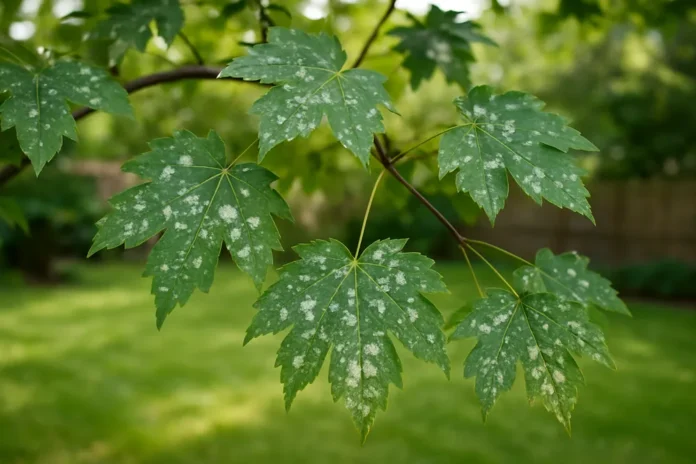
White spots on maple leaves are most often caused by powdery mildew, a common fungal disease that leaves a pale, dusty coating on the leaf surface. They can also come from insect feeding, mineral residue, or sun and weather damage that scars the leaf tissue.
Seeing white spotting on a maple can be unsettling, especially when the tree looked healthy just a week or two earlier. In my experience, this symptom usually turns out to be less mysterious than it first appears. The key is figuring out whether the white marks sit on the leaf like a coating, or whether the leaf itself has turned pale in spots.
Most home gardeners dealing with maple tree leaves with white spots are looking at powdery mildew, but that is not the only possibility. Sap-sucking insects, dried residue from irrigation or sprays, and even weather stress can all leave light-colored marks behind.
If you slow down and compare several leaves from different parts of the canopy, the pattern usually tells the story. Once you know the cause, you can decide whether the tree needs treatment or just a little time and better growing conditions.
What White Spots on Maple Leaves Usually Mean
White spots are a symptom, not a diagnosis. On maples, they can show up as dusty patches, tiny stippled dots, irregular bleached areas, or crusty residue. Each pattern points to a different issue, so it helps to look closely before reaching for a fungicide or insect spray.
- A soft, flour-like coating usually points to powdery mildew.
- Fine pale speckling or stippling often suggests mite or leafhopper feeding.
- Chalky spots that wipe off may be hard water or spray residue.
- Papery, bleached patches can be caused by sunscald, wind, or weather injury.
- White fuzzy clusters along veins or stems may indicate cottony insects such as scale or woolly aphids.
When I diagnose maples, I always check both the top and underside of the same leaf. If the top is white but the underside looks clean, I think mildew or residue first. If the underside is busy with insects, webbing, or cast skins, I start leaning toward pest damage.
Powdery Mildew Is the Most Common Cause
Powdery mildew is one of the most common reasons maple leaves develop white spots or patches. It is a fungal disease that looks like someone dusted the leaves with flour or baby powder. On maples, it often begins as small white spots that spread into larger patches over time.
This disease is especially common in late summer and early fall, when days are warm, nights are cool, and humidity is high. Shady areas with poor airflow tend to see it first. Young leaves and dense interior growth are often the most affected.
How to Recognize Powdery Mildew
- White or grayish powder on the leaf surface
- Spots that start small and expand into blotches
- Leaves may curl, twist, or look slightly distorted
- The coating often appears on upper leaf surfaces first
- Affected leaves may yellow or drop early if the infection is heavy
The good news is that powdery mildew on an established maple is often more cosmetic than dangerous. A mature tree usually tolerates it without long-term harm. Repeated infections can weaken a young or stressed tree, though, so it is still worth improving conditions around the plant.
What to Do if Mildew Is the Problem
- Rake and remove heavily infected fallen leaves at the end of the season
- Prune lightly to improve air circulation if the canopy is very dense
- Avoid overhead watering late in the day
- Keep the tree watered during dry spells so stress does not make the problem worse
- Use a labeled fungicide only if the tree is young, repeatedly affected, or highly valued for appearance
If you decide to treat powdery mildew, timing matters more than spray strength. Fungicides protect clean leaves better than they cure badly coated ones, so early treatment on new growth is much more effective than late-season rescue spraying.
Insects Can Leave White Spotting, Fuzz, or Stippling
Several pests can make maple leaves look spotted or dusty white even when no fungal disease is present. The difference is that insect damage usually changes the leaf tissue itself or leaves behind waxy or cottony material near veins and stems.
Spider Mites and Leafhoppers
Spider mites and leafhoppers feed by piercing leaf tissue and sucking out contents. This creates fine pale dots called stippling. From a distance, heavy stippling can make a leaf look washed out or silvery white. In dry weather, spider mites are especially common on stressed landscape trees.
- Tiny pale dots scattered across the leaf
- A dull, faded, or bronzed appearance over time
- Fine webbing on undersides if spider mites are present
- More damage during hot, dry periods
Scale Insects, Woolly Aphids, and Other Cottony Pests
Some insects protect themselves with white wax or cottony filaments. These can look like white spots from a distance, especially along stems, leaf petioles, or major veins. If the material looks fuzzy rather than powdery, take a close look for insects underneath.
- White cottony clumps instead of flat spots
- Clusters near leaf stems or on twigs
- Sticky honeydew on leaves or objects below the tree
- Sooty mold sometimes growing where honeydew collects
A small amount of pest activity is often manageable without aggressive treatment, especially on mature maples. A strong spray of water can help with aphids and mites on reachable branches, while dormant oil or horticultural oil may help with certain scale problems when used at the proper time.
Residue and Environmental Damage Can Mimic Disease
Not every white mark is caused by a living pest or disease organism. Sometimes the leaf surface is simply holding onto residue, or the tissue has been physically damaged and turned pale.
Hard Water and Spray Residue
If your maple is near a sprinkler or was recently treated with foliar products, mineral deposits or dried spray droplets can leave chalky white specks. These often look random and may be concentrated on the side of the tree that faces irrigation.
- Spots sit on the leaf surface and may rub or wash off
- The pattern may match sprinkler reach or spray coverage
- New leaves appear clean if the source is gone
- There is no spreading patch like you would see with mildew
Sunscald, Wind, and Weather Injury
Leaves can also develop pale or whitish patches after sudden heat, drying wind, hail, or abrupt shifts in weather. This kind of damage usually looks bleached or papery rather than powdery. It may be limited to exposed outer leaves while protected inner leaves stay normal.
Weather injury often shows up after a stressful week rather than gradually spreading through the canopy. The leaf tissue is damaged in place, so those spots do not wipe away.
How to Tell the Difference Between the Main Causes
A simple side-by-side inspection can usually narrow down the issue in a few minutes. Choose leaves from sunny and shady parts of the tree, then compare the top, underside, veins, and nearby stems.
- Rub the spot gently with your finger. If it smears or wipes off like dust, think powdery mildew or residue.
- Look at the underside with good light. If you see mites, cast skins, webbing, or moving insects, pest damage is more likely.
- Check whether the white area is fuzzy, flat, chalky, or bleached into the tissue.
- Notice where the problem is worst. Shade and crowding point toward mildew, while exposed outer leaves suggest weather stress.
- Look for sticky leaves, black sooty coating, or ant activity, which often accompany sap-sucking insects.
The pattern across the tree matters as much as the spot itself. When only lower, crowded branches show white coating, I almost always suspect a moisture and airflow issue. When damage is strongest on the hot, dry side of the canopy, insects or weather stress move much higher on my list.
When White Spots Are Mostly Cosmetic and when to Worry
Many maple leaf spot issues look dramatic but do not seriously threaten the tree. Mature, otherwise healthy maples can usually handle mild powdery mildew, occasional mite feeding, or scattered weather injury without lasting damage.
The situation is more concerning when white spotting comes with broader decline. That might include significant early leaf drop, branch dieback, repeated severe defoliation, poor new growth, or multiple stress factors at the same time such as drought, root damage, and pest pressure.
- Do not panic over a few affected leaves late in the season
- Pay closer attention if a young tree is heavily coated or repeatedly stressed
- Watch for yellowing, curling, and premature drop across large sections of the canopy
- Seek professional help if the tree shows branch death, trunk injury, or sudden large-scale decline
How to Help Your Maple Recover and Prevent Future Problems
Whether the cause is mildew, insects, or stress, the best long-term fix is to support overall tree health. A strong maple handles minor leaf problems much better than a stressed one.
Improve Growing Conditions
- Water deeply during extended dry periods, especially for newly planted trees
- Mulch the root zone with 2 to 3 inches of organic mulch, keeping it away from the trunk
- Avoid overfertilizing, which can push weak, disease-prone growth
- Prune only as needed to improve airflow and remove dead or rubbing branches
- Protect roots from compaction, trenching, and repeated mower damage
Use Treatments Carefully
Treatments work best when they match the actual cause. Fungicides will not fix sprinkler residue, and insecticidal soap will not cure mildew. If you are unsure, save a few affected leaves and compare them closely before applying anything.
I usually recommend cultural fixes first for established landscape maples. Chemical treatment is more worthwhile when the tree is young, repeatedly disfigured, or under enough stress that the problem is starting to affect vigor.
When to Call an Arborist
A certified arborist can help when the symptoms are confusing or when the tree is large enough that the canopy cannot be inspected from the ground. Professional diagnosis is especially useful if you suspect multiple problems at once.
- The white spotting returns year after year and gets worse
- Leaves are dropping heavily by midseason
- Large limbs show dieback or weak growth
- The tree recently experienced construction, root disturbance, or herbicide exposure
- You need treatment in a tall canopy where home spraying is not practical or safe
FAQ
Can Powdery Mildew Kill a Maple Tree?
It rarely kills an established maple by itself. On mature trees it is usually a cosmetic problem, though repeated severe infections can add stress to young, newly planted, or already weakened trees.
Should I Remove Leaves with White Spots From My Maple?
You do not need to pluck individual leaves off the tree unless the infection is very localized on a small plant. It is more useful to rake and dispose of heavily affected fallen leaves at the end of the season.
Do White Spots on Maple Leaves Always Mean Fungus?
No. White spots can also be caused by insects, hard water deposits, dried spray residue, and weather-related leaf injury. The look and location of the spots help separate these causes.
Can I Spray Neem Oil on Maple Leaves with White Spots?
Neem products may help with some fungal and insect issues when labeled for the plant and problem, but they are not a cure-all. Make sure you know whether you are dealing with mildew, pests, or simple residue before spraying.
Why Are Only the Lower Maple Leaves Getting White Spots?
Lower and interior leaves often stay more humid and get less airflow, which makes powdery mildew more likely there. If the tree is crowded by nearby shrubs or structures, that pattern becomes even more common.
Will Rain Wash White Spots Off Maple Leaves?
Rain may reduce loose residue or some surface dust, but it usually will not remove established powdery mildew or reverse leaf tissue damage. Spots caused by bleaching or insect feeding will remain on the affected leaves.
Is It Safe to Leave a Maple Untreated if the White Spots Are Minor?
Yes, in many cases. If the tree is otherwise healthy and the spotting is light, monitoring and improving care may be enough, especially late in the season.
Need a treatment that actually matches the problem? See our guide to the best fungicides, horticultural oils, and tree care products for maples so you can choose the right fix faster.
