

Note: This article contains affiliate links. If you click on these links and make a purchase, I may earn a small commission at no extra cost to you. This helps support my research and content. Read my full affiliate disclosure here.
If your irrigation source carries sediment, algae, or other particulates, a standard sprinkler head can clog quickly and leave lawns or beds dry. Choosing a sprinkler head designed for dirty water reduces maintenance, keeps spray patterns consistent, and prevents frequent flushing or replacements. This guide looks at six top-rated sprinkler heads for dirty water and explains the practical differences you will notice in a yard, garden, or commercial landscape. We shortlisted options that emphasize clog resistance, serviceability, and stable spray performance. Below you will find evaluation criteria and practical notes to help you pick a head that matches your water quality and maintenance tolerance.
Top Picks at a Glance
| Best Overall The best all-around choice for most situations | Orbit 4-inch Professional Pressure-Regulating Pop-Up Spray Head with 15-Foot Brass Nozzle (Half Spray) |  |
| Best Quality Built to a higher standard if you want something more solid | Rain Bird CP5000NP Non-Potable Gear Drive Rotor (26–38 ft, 40°–360°) |  |
| Best Value The sweet spot between price and what you get | Orbit Saturn III Gear-Drive Rotor Sprinkler — 2-Pack |  |
| Best Budget The cheapest option that still gets the job done reliably | Orbit 1/2-Inch Plastic Impact Sprinkler Head (Model 55018) |  |
| Highest Rated A top-rated pick with lots of positive feedback | K-Rain K2 RCW 3/4" Female Inlet Pop-Up Rotary Sprinkler (Reclaimed Water) |  |
| Most Popular A crowd favorite that many people choose with confidence | Orbit 55032 1/2" Brass Impact Sprinkler Head |  |
Orbit 4-inch Professional Pressure-Regulating Pop-Up Spray Head with 15-Foot Brass Nozzle (Half Spray)

| Maximum Pressure | 40 psi |
|---|---|
| Maximum Flow Rate | 1.8 gpm |
| Inlet Connection Size | 0.5 inches |
| Material Type | Brass, Plastic |
The Orbit professional pop-up spray head is a robust sprinkler head intended for in-ground irrigation zones with up to about 15 feet between heads. It installs on standard 1/2-in. female pipe threads and is offered in multiple riser heights; the pre-machined brass nozzle delivers a consistent half-pattern spray and includes a filter plus a radius adjustment screw for on-site tuning. A factory-set pressure regulator (adjustable from 30 to 40 psi) helps maintain steady spray performance when line pressure fluctuates, and the over-molded wiper seal with stainless-steel riser spring promotes smooth retraction and long service life. Practical features for challenging conditions include a gravity-activated silt trap in the can and a built-in nozzle filter to reduce clogging from dirty water. The riser ratchet lets you fine-tune spray direction after installation. Limitations are typical for spray heads: it is for cold water only and has a modest maximum flow and pressure rating, so it suits established residential systems rather than high-pressure commercial mains.
Best for: Gardeners and homeowners who want a dependable, serviceable pop-up head that resists sediment and keeps a uniform spray across typical residential lawns and beds.
Less Ideal for: Large commercial sites or systems that require very high flow or nonstandard fluids should consider industrial-grade or specialty heads instead.
- Adjustable pressure regulator (30–40 psi) keeps spray uniform under varying line pressure
- Brass, precision-machined nozzle with built-in filter and radius adjustment for durable, tunable performance
- Gravity-activated silt trap and nozzle filter help reduce clogging when using dirty water
- Over-molded wiper seal and stainless-steel riser spring improve long-term reliability and smooth retraction
- Rated for cold water only, not suitable for hot-water or specialty fluid applications
- Maximum flow and pressure limits may not match high-demand commercial irrigation systems
Verdict: Choose this Orbit pop-up head when you need a durable, pressure-regulated sprinkler with built-in filters and a silt trap to perform reliably with dirty water in residential irrigation systems.
Rain Bird CP5000NP Non-Potable Gear Drive Rotor (26–38 ft, 40°–360°)

| Maximum Pressure | 70 psi |
|---|---|
| Maximum Flow Rate | 3 gpm |
| Inlet Connection Size | 0.75 inches |
| Pattern | 40° – 360° |
The Rain Bird CP5000NP is a durable gear-driven rotor head built for non-potable irrigation where water quality may be gritty or contaminated. It installs with a 3/4" female bottom inlet and comes with a preinstalled 3.0 gpm nozzle that throws 26 to 38 feet at typical residential pressures. The closed-case, water-lubricated gears and dual-action wiper seal protect internal components from debris, while the heavy rubber-encased cap resists damage from edgers and impacts. Rain Bird's Rain Curtain nozzle produces large, wind-resistant droplets and micro ramps that deliver water close to the head to avoid dry rings and reduce overspray. Top-of-head screwdriver adjustments let you set arc from 40° to 360° and fine-tune distance while the rotor is running. The main limitations are that it uses a 3/4" inlet and standard 3.0 gpm nozzle by default so you may need to change nozzles or check system flow if your layout requires different radius or lower flow per head. For dirty or abrasive water, its sealed design and seals for gritty water make it a strong, long-lasting choice.
Best for: Gardeners and contractors who prioritize reliable, long-lasting performance on non-potable or dirty-water irrigation systems and need uniform coverage across medium to large turf areas.
Less Ideal for: People installing very low-flow drip or micro-spray systems or homeowners who need 1/2" inlet heads and smaller throw distances for tiny lawns.
- Closed-case, water-lubricated gear design resists grit and extends service life in dirty-water systems
- Rain Curtain nozzle creates large, wind-resistant droplets and reduces overspray for more uniform coverage
- Top-access screwdriver adjustments let you set arc and distance while the rotor is running
- Durable rubber-encased cap and positive-stop wiper seal protect against physical damage and debris
- Ships with a 3.0 gpm nozzle and 3/4" inlet which may require nozzle swaps or system adjustments for low-flow setups
Verdict: Choose the CP5000NP when you need a rugged, sealed rotor that reliably handles dirty or gritty irrigation water while delivering even, adjustable coverage.
Orbit Saturn III Gear-Drive Rotor Sprinkler — 2-Pack

| Number of Items | 2 |
|---|---|
| Maximum Pressure | 40 psi |
| Maximum Flow Rate | 2 gpm |
| Material Type | Plastic |
The Orbit Saturn III Gear-Drive Rotor Sprinkler (2-pack) is a compact pop-up rotor designed to deliver adjustable, water-efficient coverage for residential lawns. Each head offers a configurable arc from 40 to 360 degrees and a throw distance up to about 25 feet, so you can dial in coverage for narrow strips, beds, or open turf without overspray. The gear-drive mechanism produces a steady rotary pattern and the supplied 2 gpm nozzle and low precipitation rate help reduce runoff and puddling on slopes or heavier soils. Practical touches include a bottom inlet filter to reduce clogs and durable ABS and stainless steel components for season-to-season reliability. Installation is straightforward and the heads are compatible with common irrigation fittings, making them easy to swap into existing systems. Limitations to note are the 2 gpm flow rating and 40 psi maximum pressure, which mean this model is best for typical residential water supplies rather than high-flow commercial zones, and the plastic construction is less heavy-duty than all-metal pro series heads.
Best for: Homeowners and DIYers who want an efficient, easy-to-install rotor head to optimize water use across varied lawn zones and replace or upgrade existing residential sprinkler heads.
Less Ideal for: Large commercial landscapes or irrigation zones that require very high flow rates or heavy-duty metal heads should consider professional-grade rotors instead.
- Adjustable arc (40–360°) and radius for targeted coverage
- Low precipitation 2 gpm nozzle reduces runoff and puddling
- Bottom inlet filter helps prevent clogging from debris
- Durable ABS body with stainless steel components for seasonal durability
- Maximum pressure limited to 40 psi which may not suit high-pressure systems
- Plastic construction is less robust than professional metal heads
Verdict: A practical, water-efficient rotor head that gives homeowners adjustable, low-runoff coverage for typical residential lawns.
Orbit 1/2-Inch Plastic Impact Sprinkler Head (Model 55018)

| Material Type | Plastic |
|---|---|
| Inlet Connection Size | 0.5 inches |
| Item Type Name | Plastic Impact Head |
| Unit Count | 1 Count |
The Orbit 55018 is a straightforward replacement impact head designed for in-ground or retrofit irrigation systems that accept a 1/2-inch male thread. It delivers wide coverage—advertised up to a 90-foot diameter—and lets you set partial arcs or full 360-degree watering with a simple adjustment. The deflector shield and diffuser screw let you fine-tune distance and droplet size while the anti-backsplash arm helps keep the spray pattern consistent. Its flow-through design is resistant to clogging, so it tolerates dirty or reclaimed water better than some pop-up nozzles. Construction is lightweight plastic, which keeps cost and corrosion concerns low but means it is less rugged than metal heads under heavy mechanical stress. Installation and adjustments are intuitive for a homeowner or landscape installer and the unit works as a direct replacement for standard 1/2-inch impact heads. If you want a low-cost, no-frills option for watering large lawns or fields, this performs well, but professionals who need heavier-duty materials or premium precision controls may prefer brass models.
Best for: Homeowners or landscapers who need an inexpensive, easy-to-install impact head for watering large lawns or fields and who prioritize cost and clog resistance over premium materials.
Less Ideal for: Users who require heavy-duty, long-lasting metal construction or the highest precision in spray control for professional irrigation projects should consider commercial brass impact heads instead.
- Covers large areas up to a 90 ft. diameter when set to full circle
- Adjustable arc and distance with deflector shield and diffuser screw
- Flow-through design resists clogs and works with reclaimed or dirty water
- Lightweight plastic construction resists rust and corrosion
- Plastic body is less durable than brass under heavy use or impact
- Distance adjustment range (20 to 42 ft.) may require pressure tuning for consistent reach
Verdict: A budget-friendly, clog-resistant impact head that gives homeowners wide, adjustable coverage for large-area watering needs.
K-Rain K2 RCW 3/4" Female Inlet Pop-Up Rotary Sprinkler (Reclaimed Water)

| Maximum Pressure | 50 psi |
|---|---|
| Maximum Flow Rate | 2.5 gpm |
| Inlet Connection Size | 0.75 inches |
| Material Type | Plastic |
The K-Rain K2 RCW is a field-ready rotary pop-up sprinkler head intended for reclaimed or nonpotable water systems. It installs with a 3/4 inch female inlet and runs up to 2.5 gallons per minute at pressures up to 50 psi, making it suitable for typical residential irrigation zones. The unit offers an adjustable 40° to 360° arc and a single-stream nozzle for focused coverage, and the purple collar clearly identifies it for dirty or reclaimed water use to avoid cross-connection mistakes. Constructed from plastic with a simple reversing drive mechanism, the head is designed for low maintenance and long service life when used in irrigation with particulates. Practical benefits include easy compatibility with standard irrigation fittings, straightforward arc adjustment in the field, and water-conserving slow delivery to reduce runoff. Limitations to consider are standard plastic construction rather than metal components and a single-flow nozzle that may not suit very large-radius zones without matching pressure and spacing. Users handling heavily sediment-laden water should still use appropriate filtration upstream.
Best for: Homeowners or maintenance pros who prioritize a reliable, low-maintenance rotor for reclaimed or nonpotable irrigation and want clear identification to prevent potable water mix-ups.
Less Ideal for: Those installing high-end commercial systems that demand metal-bodied rotors or sites with extremely sandy or unfiltered water where heavier-duty materials and frequent servicing are required.
- Designed for reclaimed or nonpotable water with a purple collar to prevent cross-connection
- Adjustable arc range from 40° to 360° for precise coverage control
- Works at up to 50 psi and 2.5 gpm, suitable for most residential irrigation zones
- Simple rotary mechanism built for low maintenance and long-term performance
- Plastic construction may be less durable than metal-headed rotors in high-wear environments
- Single-stream 2.5 gpm nozzle may require careful placement or different nozzle choices for larger radii
Verdict: A dependable, low-maintenance rotary sprinkler specifically marked and built for reclaimed or nonpotable water systems.
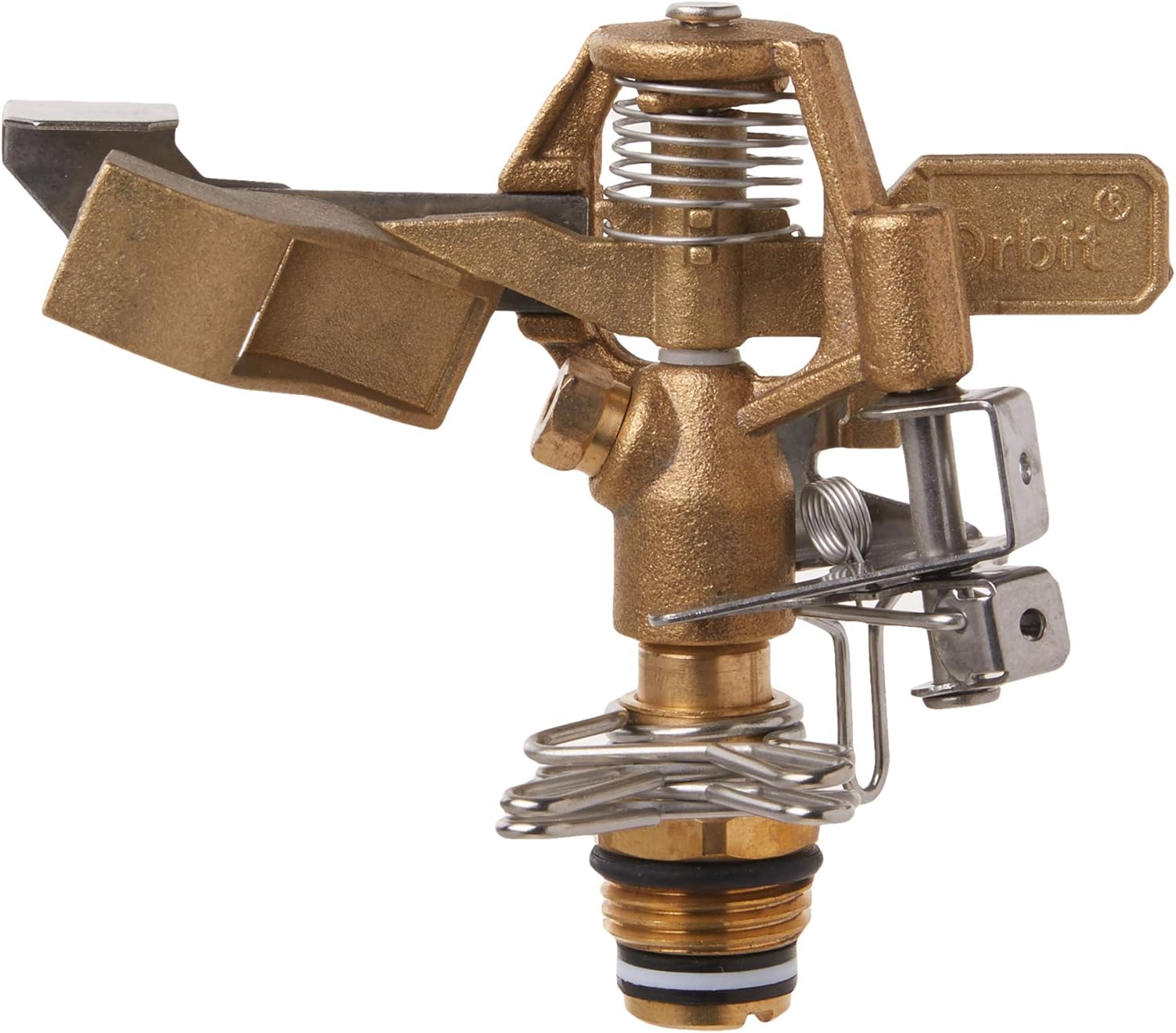
Orbit 55032 1/2" Brass Impact Sprinkler Head
| Material Type | Brass |
|---|---|
| Maximum Flow Rate | 3.5 gpm |
| Inlet Connection Size | 0.5 inches |
The Orbit 55032 is a 1/2‑inch male‑threaded impact sprinkler head designed to replace or upgrade standard impact heads in yard irrigation. Made from solid brass, it withstands weather and higher water pressures and sprays up to a 90‑ft. diameter for true large‑area coverage. You adjust arc and distance with the deflector shield and diffuser screw to tune coverage from a partial sector to a full 360° circle, and the anti‑backsplash arm helps maintain a stable spray pattern. Its flow‑through design resists clogging, which makes it suitable for use with dirty or reclaimed water. Typical use is on risers or pop‑up bodies where durable, long‑running rotary coverage is needed for lawns, fields, or large beds. The head is straightforward to install on standard 1/2‑inch fittings and requires minimal maintenance, though it lacks the fine droplet control of gear‑driven or rotary nozzles and can be noisy when operating. For those wanting automated, low‑profile pop‑up heads or very precise matched precipitation rates, an alternate style may be preferable.
Best for: Buyers who prioritize long‑lasting, low‑maintenance irrigation for large lawns or acreage and need a replacement head that handles varied water quality and strong pressure.
Less Ideal for: Gardeners who need quiet, low‑profile pop‑up heads or highly uniform, low‑drift micro‑spray for delicate plantings should consider other nozzle types.
- Durable all‑brass construction resists corrosion and handles higher water pressure.
- Wide coverage up to 90 ft. diameter suitable for large lawns and fields.
- Adjustable arc and distance let you fine‑tune coverage from partial sectors to full circle.
- Flow‑through, clog‑resistant design works with dirty or reclaimed water.
- Anti‑backsplash arm and diffuser screw improve spray consistency and distance control.
- Impact heads are louder and produce coarser droplets compared with gear‑driven rotary nozzles.
- Requires a 1/2‑inch male thread connection so may need adaptors for some systems.
Verdict: Choose this brass impact head when you need a rugged, clog‑resistant sprinkler that delivers adjustable long‑reach coverage for large areas.
Choosing the Right Sprinkler Head for Dirty Water: Key Factors to Consider
Clog Tolerance and Passage Size
Clog tolerance determines how large a particle the sprinkler head can pass without losing coverage. Heads with larger internal passages and coarse inlet screens allow sand, grit, and plant debris to pass through more easily, reducing the need for frequent cleaning.
Consider how much visible sediment your supply carries and choose a head spec whose minimum passage size exceeds the typical particle diameter. A head that tolerates larger particles will usually maintain spray uniformity longer between maintenance cycles, which is important when irrigation schedules are strict.
Serviceability in the Field
How easy it is to access and clear a clogged internal pathway matters when you want to minimize downtime. Removable nozzles, captive screen elements, and heads that pull up without tools make on-site cleaning much faster. Some designs include quick-release caps or pop-up bodies that allow flushing from the surface.
Think about whether you can reach heads regularly and whether you prefer to clear debris yourself. Designs that allow backflushing or simple disassembly reduce the frequency of digging and total labor involved with maintenance.
Nozzle Type and Spray Pattern Stability
Nozzle geometry affects both how the water exits the head and how resistant the spray is to partial blockage. Rotary and multi-stream nozzles often perform better with small obstructions because flow is divided across multiple ports, while single-orifice fixed-spray nozzles are more likely to lose their pattern when partially blocked.
Evaluate the typical pattern you need for turf, beds, or borders. Some clog-resistant nozzles trade off ultra-fine misting for larger droplet sizes, which can change watering efficiency but help avoid drift and loss of coverage when water quality is poor.
Built Materials and UV/Corrosion Resistance
Materials matter because dirty water can accelerate wear from mineral abrasion or biological activity. Heads built with corrosion-resistant plastics, stainless fasteners, and UV-stable components will hold tolerances better and resist cracking or brittleness.
Durable materials help maintain seals and threads, which reduces leaks and the likelihood that contaminants will bypass filters or screens. For installations near saltwater or in high-UV climates, prioritize materials rated for those exposures.
Compatibility With Inline Filtration
Even the most clog-tolerant sprinkler head can benefit from upstream filtration. Consider the head's ability to integrate with existing filtration strategies, such as coarse pre-filters, spin counters, or micro-strainers.
If you plan to use a pre-filter, choose heads whose inlet threading and flow capacity match the filtered supply. In some systems a simple screen is sufficient, while others need staged filtration for long-term reliability. Compatibility determines whether you can combine head-level and system-level defenses against debris.
Flow Rate and Pressure Sensitivity
Sprinkler heads designed for dirty water often need to perform across a range of reduced flows caused by partial blockages or upstream restrictions. A head that maintains a consistent radius and droplet size at varying pressures will provide more predictable irrigation.
Check the operational pressure range and flow curves. Heads that require precise pressure to maintain pattern may not be ideal if your water source fluctuates or if multiple heads share a zone with limited supply.
Common Sources of Dirty Water and How They Affect Heads
Dirty water in irrigation comes from wells, ponds, reclaimed sources, or mains with compromised filtration. Each source brings different particle types: sand and silt from wells, organic matter and algae from ponds, or rust and debris from old pipes. Particle hardness and shape determine how abrasive they are to internal passages.
Heads exposed to organic-rich water may experience biofilm buildup that narrows orifices over time, while mineral-heavy supplies cause crusting and scaling. Identifying the dominant contaminant helps you choose a head with the right passage sizes and materials.
- Sand and grit favor larger passage sizes and removable screens.
- Organic particles demand designs that avoid internal crevices and allow easy flushing.
- Hard minerals need corrosion-resistant materials and occasional chemical cleaning.
Maintenance Workflow for Dirty-Water Irrigation
Set up a regular inspection and quick-clean routine rather than waiting for visible performance loss. A short visual check and occasional lift of pop-up heads will reveal sediments trapped in the riser or on the screen. For systems using pond or reclaimed water, weekly checks during high-use months reduce the chance of large-scale clogs.
When clearing clogs, start with surface flushing and removing the nozzle or cap to access the inlet screen. Keep basic tools and replacement screens in a maintenance kit so you can clear heads without specialized service calls.
- Establish a seasonal inspection cadence based on sediment load.
- Carry spare screens, O-rings, and a soft brush for field maintenance.
- Document which zones clog most often to target upstream filtration improvements.
Integrating Pre-Filtration and Head-Level Strategies
Pre-filtration reduces the burden on sprinkler heads and extends service intervals. Coarse filters or sediment traps at the pump or entry point capture larger particles before they reach the zone. Complement this with head-level screens when particle sizes vary or when you have long runs of pipe that can shed debris.
Design filtration to match the expected contaminant. For heavy grit, use sediment separators and easily serviceable basket filters. For biological fouling, consider systems that allow periodic chemical or physical cleaning upstream while keeping heads simple and replaceable.
- Balance filtration with flow needs so heads still get adequate pressure.
- Use staged filtration for very dirty supplies: coarse first, fine second.
- Plan filter maintenance intervals that align with head inspection schedules.
Installation Tips to Reduce Clogging Risk
Install heads with accessible risers and orient nozzles away from areas that shed debris. Avoid low points in lateral lines where sediments settle. If possible, slope runs slightly and locate flush points to purge settled material during maintenance.
When installing pop-up heads, leave enough riser length to lift the nozzle above ground debris buildup and avoid burying the body, which makes access difficult. Secure threaded joints and use appropriate Teflon tape or thread sealant to prevent leaks that invite soil intrusion.
- Place manual flush valves at low points to remove settled sediment.
- Use risers that allow quick removal of nozzle assemblies.
- Avoid installing heads directly under heavy leaf fall or mulch without a debris barrier.
When to Upgrade or Replace Heads
Replace heads that require increasingly frequent cleaning or show wear that cannot be fixed by replacing screens or O-rings. Visible erosion of nozzle ports, persistent spray-pattern distortion, or cracked bodies signal the need for replacement. For systems with escalating sediment issues, consider swapping to heads designed specifically for high-turbidity supplies.
Upgrading can also mean changing nozzle style for better tolerance or adding upstream filtration as a remedial step. Balance replacement costs against labor and lost irrigation performance when deciding whether to retrofit or replace.
- Track maintenance frequency as the key indicator for replacement.
- Inspect for erosion at nozzle exits and uneven spray coverage.
- Consider system-level fixes before wholesale head replacement in large installations.
How We Chose the Best Sprinkler Head for Dirty Water
We prioritized attributes that directly affect long-term performance with sediment-laden or biologically active water. Core evaluation criteria included nozzle and filter design, how easily the head can be serviced in the field, resistance to mineral and organic buildup, and the ability to maintain a consistent spray pattern under reduced flow or partially clogged conditions. Durability of key components under outdoor exposure and compatibility with common irrigation fittings were also essential. Our process excluded heads intended only for clean, potable mains where filtration is guaranteed. We also excluded specialty foggers and micro-drip emitters that do not behave like true sprinkler heads. Products were assessed on documented clog-management features such as self-flushing nozzles, removable screens, large flow passages, and easy-access internals. We favored designs that let gardeners clear debris without digging or complex tools and that tolerate a range of particle sizes often found in pond, reclaimed, or well water.
FAQ
Will a mesh screen on the head stop all particles?
A mesh screen captures larger debris but will not stop fine silt or dissolved minerals. Screens extend head life by trapping big particles, but very fine material passes through and may still require upstream filtration or periodic internal cleaning.
Can I use pond water directly without filters?
You can use pond water, but direct use increases the chance of clogging and biofilm buildup. At minimum, use coarse pre-filters and establish more frequent inspection cycles. For heavy organic loads, staged filtration or settling tanks will reduce maintenance.
How often should I inspect heads supplied with dirty water?
Inspection frequency depends on sediment load, but a weekly to biweekly visual check during peak irrigation season is common for problematic supplies. Less frequent checks are possible with effective pre-filtration and clog-tolerant head designs.
Does nozzle type affect how easily a head clogs?
Yes. Multi-stream and rotary nozzles tend to maintain pattern better with partial blockages because flow is divided across several ports. Single-orifice nozzles are more prone to pattern loss when partially obstructed.
Are there cleaning methods that damage heads?
Aggressive scraping, harsh chemicals, or high-pressure jetting can erode port geometry and seals. Use gentle brushes, soaking in mild cleaning solutions when needed, and follow manufacturer guidance for safe cleaning methods.
Final Verdict
When irrigation water carries sediment or organic matter, prioritize sprinkler heads with large internal passages, easy field serviceability, and durable materials. Combine head-level features with appropriate upstream filtration to reduce maintenance frequency and preserve uniform coverage. Balance the tradeoff between ultra-fine spray and clog resistance based on the planting you irrigate, and use inspection data to decide whether retrofitting with more tolerant heads or improving filtration is the better long-term solution. Choose heads that match your maintenance capacity and water quality. That approach will keep systems running reliably and minimize surprise dry spots or costly emergency repairs.
